Mom and Dad, Thanks for Letting Us Go without Letting Go of Us

Following is an open letter my wife and I wrote to all parents who give so much to their children who are missionaries. We wrote it several years ago, while we were serving in Taiwan.

Dear Mom and Dad:

Thank you for raising us to know about God and his love for the world.

Thank you for letting us go without letting go of us.

Thank you for forgiving late birthday cards.

Thank you for praying for us.

Thank you for giving up time with your grandchildren.

Thank you for your e-mails and letters and calls.

Thank  you for sending Barbie Dolls, Tic Tacs, Koolaid, socks, Reader’s Digests, and Lucky Charms cereal.

Thank you for your questions about our new home and work.

Thank you for being patient and understanding when we tell you how exciting it is to live in another part of the world.

Thank you for being patient and understanding when, two days later, we complain about living in that same place.

Thank you for not making us feel selfish for wanting to go.  Sometimes we feel that way on our own.

Thank you for listening to our stories about people you’ll never meet with names you can’t pronounce.

Thank you for being our ambassadors.

Thank you for sending clippings from our hometown newspaper.

Thank you for telling us about our neighbors, classmates, and cousins—all the stories that don’t make the news.

Thank you for letting our brothers and sisters stand in for us when we’re too far away to do our part in the family.  (They really should get their own letter.)

Thank you for loving us.

Thank you for trusting Jesus to take care of us when you can’t.

Thank you for being proud of us.  We are proud of you.

We chose to be a missionary family, not you, and we understand that our move has meant many sacrifices for you.  You are not only a part of our family but an invaluable part of our team.

With all our love,

Your children

[photo: “leaving us,” by Petras Gagilas, used under a Creative Commons license]

200 Years of American Missions: Names and Numbers

On February 6, 1812, Gordon Hall, Adoniram Judson, Samuel Newell, Samuel Nott, and Luther Rice became the first North Americans commissioned as missionaries, set apart by the American Board of Commissioners for Foreign Missions at the Tabernacle Church in Salem, Massachusetts. A few days later,  Judson—along with his wife, Nancy—and Newell—with his wife, Harriett—set sail for India, arriving there in June. Samuel and Roxanna Nott, Hall, and Rice joined them there two months later.

On the occasion of this 200-year anniversary Todd Johnson, director of the Center for the Study of Global Christianity at Gordon-Conwell Theological Seminary in Massachusetts, announced that since that time, by 2010, the number of Christian missionaries sent from the US had grown to 127,000, or 32% of the 400,000 missionaries worldwide. The US is top on the list, while in 2010 Brazil sent the second-most number of missionaries at 34,000.

So if the US sends the most missionaries, who receives the most? Well, that would the US as well, with 32,400 missionaries arriving from other countries (again, using 2010 numbers). Turns out that many of the Brazilian missionaries are sent to work among Brazilian communities in states in the Northeast.

There’s also another person who is sometimes mentioned along with Adoniram Judson and his group when the first missionaries are listed, not because he went out with them, but because he went out before them. He was George Liele, an African-American former slave in Savannah, Georgia. He gained his freedom before the Civil War, and then he and his family escaped re-enslavement by sailing to Jamaica with a British colonel (sometime around 1782 to 1784). In Jamaica, Liele planted a Baptist church, reporting in 1791, “I have baptized 400 in Jamaica. . . . We have nigh three hundred and fifty members; a few white people among them.”

So who was the first American missionary? That depends on our definitions. The first American “citizens” “commissioned” and “sent,” those would be the ones from Salem. The first ones born in America to travel to another country and make disciples, that would be Liele and his family. My guess is that there would not have been a lot of jealous arguing about “firsts” coming from either group. And who knows? Maybe someone had already gone out earlier, someone now unnamed, someone unremembered, someone who simply went, without fanfare, spreading the hope of the gospel.

(Daniel Lovering, “In 200-Year Tradition, Most Christian Missionaries Are American,” Reuters, February 20, 2012; “People and Events: George Liele,” PBS; Billy Hall, “George Liele: Should Be a National Hero,” Jamaica Gleaner, April 8, 2003)

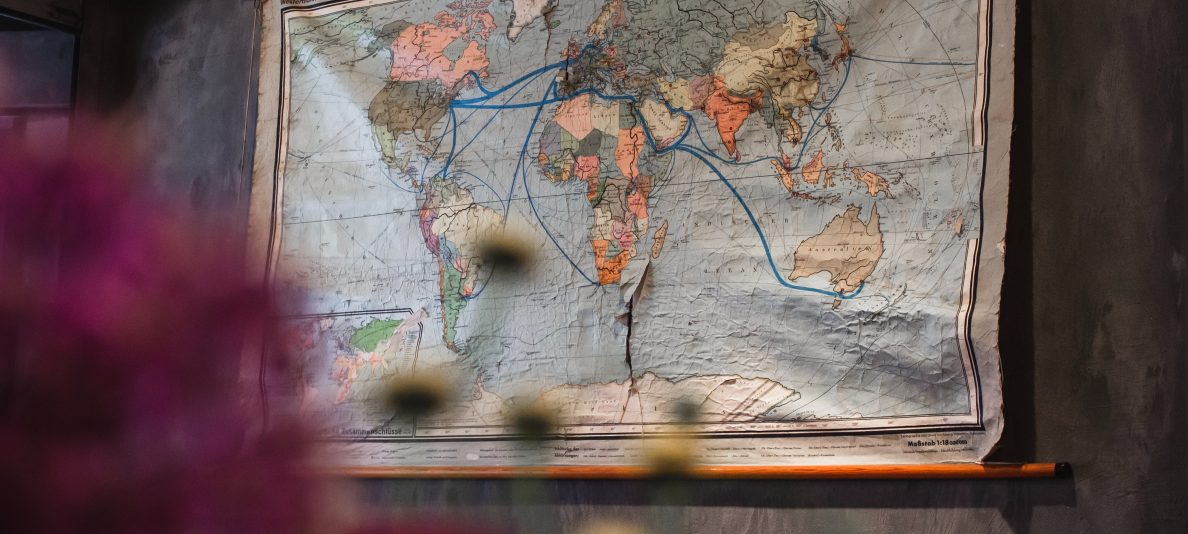
[photo: “Vintage Globes,” by The Shopping Sherpa, used under a Creative Commons license]

Octopi, Jellyfish, Cross-Cultural Partnerships, and Making Plans

An article in Wired discusses lessons we can learn from the octopus. One of them touches on cross-cultural partnerships, formed when sometimes antagonistic groups come together to combat immediate problems:

Some life-forms engage in symbiotic partnerships with other organisms. An octopus may provide shelter for toxic bacteria, which then give the octopus yet another tool in its arsenal—the ability, found in certain species, to inflict a deadly bite.

This skill, too, can translate to the man-made world. Symbiosis is at the heart of a remarkable partnership between Israeli, Palestinian, and Jordanian health practitioners who are sharing technology, databases, medicines, and knowledge to identify and reduce the threat of infectious diseases regardless of where they appear. These symbioses work not because they are perfect, all-encompassing solutions but because they solve immediate problems. The doctors in this coalition didn’t set out to create peace in the Middle East, but if peace does break out there, it will undoubtedly owe some credit to symbiotic relationships like this one.

And this isn’t the only place where these partnerships have born fruit:

[T]he facilitators of this Middle Eastern infectious-disease consortium have replicated their success in the mutually hostile southeast Asian countries bordering the Mekong River and are now bringing the model to southern Africa.

This reminds me of a book I’ve read that has found a place on my “favorites” bookshelf—Me, Myself, and Bob: A True Story about God, Dreams, and Talking Vegetables. In it, Phil Vischer tells how he founded Big Idea Productions, home of Veggie Tales, and built it into a major producer of Christian entertainment, only to see his dreams and his ministry end in bankruptcy. After having his grand plan, his “big idea,” fail, Vischer decided to imitate another sea creature . . . the jellyfish. He explained this approach in an interview with In Touch Magazine:

[M]y new company is called Jellyfish Labs—very intentionally, because jellyfish can’t choose their own course. They can’t locomote. They are carried by the current. And they have to trust the current will take them where they need to be and keep them alive.

I went off the track with Big Idea when I started making 20-year plans. I was like, “Okay, God, this is what I’m going to do for You in the next 20 years. Now, all You need to do is just bless it.” When we do this, we don’t have to listen anymore, because we’ve already figured out what we’re going to do. God is in some sort of subservient role where He gets to sit in the back seat and hand out the credit card when we need resources.

But for a jellyfish to make a 20-year plan—it’s humorous. It’s lunatic. I had viewed myself as a big macho barracuda in the ocean of life. In reality, I was a jellyfish—basically a spineless bag of goo that has no form.

. . . . 

In reality, if I’ve given Christ lordship of my life, and if I understand the concept of lordship, where I am in 20 years is really none of my business. It’s my business to say, “Okay, God, what have You called me to do today?”

Expats, repats, TCKs, ATCKs, missionaries, ex-missionaries, and others who face life-changing transitions can find it hard to make, and keep, long-term plans. What does the future hold? Will my transitions define my life? Where am I headed? Who have I become? There is a time for making big plans and for having big ideas, but thanks to Phil Vischer for reminding us that even though the jellyfish doesn’t control the currents, it still gets where it needs to go.

(Rafe Sagarin, “When Catastrophe Strikes, Emulate the Octopus,” Wired, March 21, 2012; Tonya Stoneman, “Mighty like a Jellyfish,” InTouch Ministries)

[top photo: “Octopus at Mothra,” by Neptune Canada, used under a Creative Commons license; bottom photo: “Jellyfish” by CodyHanson, used under a Creative Commons license]

Merry Christmas, Colonel Sanders-san

In the early 1970s, a Christian missionary school in Tokyo was looking for turkey for Christmas dinner. Finding none, a representative contacted the local Kentucky Fried Chicken and ordered chicken instead. A KFC employee suggested the company turn the request into an ad campaign, and Japan has never been the same since. Today, KFC’s Christmas Party Barrels are so popular that sales for December 23, 24, and 25 usually equal half of what is sold during a normal month, and Christmastime customers wait in long lines to pick up their orders, placed as early as October. Very few in Japan celebrate Christmas for its religious meaning, as less than 2% of Japanese even call themselves Christian. Instead, consumerism is emphasized, and the focus is on gifts, decorations . . . and chicken from the Colonel.

(Lindsay Whipp, “All Japan Wants for Christmas Is Kentucky Fried Chicken,” Financial Times, Dec. 19, 2010)

[photo: “KFC Colonel Santa” by Kleemo, used under a Creative Commons license]