Thanks, Wal-Mart, for Helping Vets in Need

Two weeks ago, my local newspaper had the following headlines on facing pages:

“Wal-Mart Announces Plan to Hire Veterans” and
“Military Suicides Hit Record High in 2012”

At first glance, the stories are unrelated, but deeper in, there is a connection.

(The information below comes from longer online versions of the AP stories printed in The Joplin Globe).

8061662328_e7cf08da2c_nWal-Mart Offers a Helping Hand

In a nutshell, Wal-Mart’s plan is to hire, over the next five years, every honorably discharged veteran who wants to work for it within the veteran’s first 12 months after leaving active duty. The program will start on Memorial Day, and the company projects that it will amount to more than 100,000 new hires.

This should be good news to veterans who have returned from serving in Afghanistan and Iraq. In December, that group had an unemployment rate of 10.8 percent, three percentage points higher than the overall rate in the US of 7.8.

Rising Suicide Rate a Troubling Issue for Returning Troops

Another statistic affecting military personnel is that last year, 349 active-duty troops committed suicide, the highest number since the Pentagon began keeping a more accurate record of suicides in 2001. The military’s suicide rate of 17.5 per 100,000 is still below the rate for civilian males aged 17-60, which, in 2010, was 25 per 100,000. But it’s the increase that is most troubling: up 16 percent over last year’s rate and more than doubling the rate of 2005.

“Now that we’re decreasing our troops and they’re coming back home,” says Kim Ruocco, whose husband killed himself in 2005, between Iraq deployments, “that’s when they’re really in the danger zone, when they’re transitioning back to their families, back to their communities and really finding a sense of purpose for themselves.” Ruocco now works with Tragedy Assistance Program for Survivors (TAPS).

Though the prospect of joblessness is not the most prominent factor in military suicides, it is a factor, being one of the many difficulties that returning veterans face. According to Joe Davis, spokesman for the Washington office of the Veterans of Foreign Wars, some veterans struggle with moving from the intensity of war to adjusting to their home bases, while some have trouble transitioning from their military job to looking for work in a slow economy.

Coming Back and Joining the Un- and Under-Employed

First Lady Michelle Obama supports the hiring plan of the largest private employer in the US, saying, “We all believe that no one who serves our country should have to fight for a job once they return home. Wal-Mart is setting a groundbreaking example for the private sector to follow.”

I agree. Maybe the jobs Wal-Mart is offering aren’t the absolute best (look here for a Stars and Stripes blog post on the plan’s detractors), but Wal-Mart is at least clearing one path for a group that faces so many obstacles.

While I was overseas—as a missionary, not a soldier—I and my coworkers would sometimes say, after a particularly frustrating day, “I just feel like leaving all this and moving back to the States and getting a job at Wal-Mart.”

What I’ve learned since then is that getting that easy full-time job at Wal-Mart isn’t the slam dunk that we thought it would be. Number one, working at Wal-Mart shouldn’t have been our go-to example of the simple, stress-free job we were willing to settle for. And number two, what made us think that ex-missionary’s applications are going to be at the top of Wal-Mart’s stack anyway?

I’ve been back in the US for over a year and a half now, and I’m still looking for long-term full-time employment. I’ve seen that while some employers might value the experiences gained overseas—whether by veterans, missionaries, or other cross-cultural workers—it is more than offset by the fact that those seeking new employment after working outside the US have been out of the loop when it comes to relationships. And, as Nelson Schwartz notes in a New York Times article published this week, being in the loop has become crucial in today’s job market. “Big companies . . . are increasingly using their own workers to find new hires,” he writes, “saving time and money but lengthening the odds for job seekers without connections, especially among the long-term unemployed.”

Schwartz quotes Mara Swan, executive vice president for global strategy and talent at Manpower Group, who says, “The long-term unemployed and other disadvantaged people don’t have access to the network. The more you’ve been out of the work force, the weaker your connections are.”

Being out of the country weakens your connections, as well.

(Anne D’Innocenzio, “Wal-Mart to Hire Vets, Buy More American Products,” NBC News, January 15, 2013; Robert Burns, “2012 Military Suicides Hit a Record High of 349,” The Big Story, January 14, 2013; Nelson D. Schwartz, “In Hiring, a Friend in Need Is a Prospect, Indeed,” The New York Times, January 27, 2013)

[photo: “121006-F-LX370-103,” by Justin Connaher, used under a Creative Commons license]

Speaking of “Coming Home”

2057958540_c80ea35181_m-1Last year I posted Carla Williams’ “Silences,” about how missionaries express themselves without using words, “about what faith looks like in the failures. Not in the everyday, stumble-and-move-on failures, but in the ones that knock you to your knees and change the course of the rest of your life.”

Recently, Carla wrote an article for Team Expansion‘s Tell magazine, titled “Coming ‘Home’: When Missionaries Come off the Field.” This time she used the words of former missionaries to share their thoughts on returning to the States. Here is some of what they came up with:

“We tried to change the factors and could not. I had arrived at the point that I cared more about being a missionary than I cared about my family. Ministering at the expense of your family isn’t really what God had in mind.”

“You know yourself, but you don’t know yourself here.”

“It was difficult to hear some people suggest ideas right away. We were numb and not in a good state to make big decisions.”

“I have to figure out I can explain this to someone who’s never done this and they’re just not going to understand the depths of emotion and the heights and lows that come with coming back.”

“In the moment of everything happening, it feels like such a heavy burden. We felt guilty that we weren’t following through with what we told people we would do. We felt like failures. But in the end, we can appreciate everything that we learned and did and can see how much more effective it has made us in the ways we are able to serve now. Coming back to the US wasn’t the end. In a lot of ways, it was just the beginning.”

Read the entire article in the latest Tell for more, including a discussion of why missionaries leave the field and what can be done to help them once they return.

I’m grateful to Carla for inviting Team Expansion repats—including my wife and me—to give their input for the article. And she even included my poem “Back in the States after Being Gone for a Long Time” as part of the issue.

Sometimes I need someone to listen to my silence. Sometimes I need someone to listen to my words.

(Carla Williams, “Coming ‘Home’: When Missionaries Come off the Field,” Tell, Fall 2012, pp 24-27)

[photo: “Make up chyer mind, please,” by Nikki, used under a Creative Commons license]
Regrets and Remembrances: A Prayer for Those Who Leave Home

With one plane ride the whole world as TCKs have known it can die. Every important place they’ve been, every tree climbed, pet owned, and virtually every close friend they’ve made are gone with the closing of the airplane door.
—David Pollock and Ruth Van Reken, Third Culture Kids

5420666395_e086b79cf9_mThis closing door doesn’t just happen to Third Culture Kids. It’s also the experience of immigrants who leave behind many what-could-have-beens in their old country. Cross-cultural workers feel the door close when they leave their work and return “home.” (What other job requires you to leave the country once you’re no longer on the payroll?) International students close the door with the hopes that new opportunities will open many more. And refugees often see the door slammed and locked by soldiers carrying guns.

5420666545_cd2c078381_mBut while the door is closed, the mind is still open to thoughts about what was left behind. Some thoughts are joyous and life giving. Some are hurtful and life stealing. And often they come intricately, painfully intertwined, called up by a scent, a word, a sound, a flavor, a feeling or a dream. Bittersweet.

For those who find themselves on the other side of a closed door, I offer this prayer, inspired by Reinhold Niebuhr’s “Serenity Prayer.”

God, grant me the confidence to let go of the regrets that I should not hold on to,
The ability to hold on to the memories I should not let go of,
And the wisdom to separate the one from the other. Amen.

(David C. Pollock and Ruth E. Van Reken, Third Culture Kids: Growing Up among Worlds, Boston: Nicholas Brealey, 2009)

[illustrations: (upper) “Joined” and (lower) “Cupped“) by Pete Hobden, used under a Creative Commons license]

Soaring Heights and Tragic Depths in the Life of Anne Morrow Lindbergh

5734550792_0e8ec76034

In 1929, Anne Morrow Lindbergh was on board the first ever passenger-paying flight, part of Transcontinental Air Transport’s (TAT’s) combination plane-and-train trip linking New York and California. Her husband, Charles, was the pilot, while Anne, the only female passenger, recorded her experience, later published as part of Hour of Gold, Hour of Lead: Diaries and Letters of Anne Morrow Lindbergh, 1929-1932. How things have changed:

The ship is beautifully decorated inside, painted a cool gray-green, with the most comfortable green leather-covered chairs, that are adjustable. Little green curtains and blue-shaded lights. There is a white uniformed attendant shouting in my ear that he will get anything I want—reading or writing material. . . .

We have each been given an envelope full of data on the TAT organization. . . . Also I have been handed a large folding map (decorated à la old picture-map style) of our route. Postcards of places along the route. The “courier” has just offered me a little aluminum table to write on; there is plenty of room for knees and a table.

. . . .

At Kingman [AZ] we took on two square tin cupboards and one large thermos. The little table was set up by me, covered with a lavender linen tablecloth (tied on), and on metal plates I had passed me a delicious meal: cold chicken or tongue, etc. . . .

After researching Lindbergh’s life for my post on Gift from the Sea. That led me to Hour of Gold, Hour of Lead, which I’ve just finished reading. It covers her wedding to Charles—the first global celebrity—their flights together, the birth of their son, and his kidnapping and murder 20 months later. The first three of the years covered in the book are the golden years, the last one, leaden. Hour of Gold, Hour of Lead is certainly an absorbing read, with Lindbergh’s account of the happiness and the tragedy written down in “real time,” not in the typical reflective style of a memoir.

Another event recorded by Lindbergh is her flight with Charles to Asia, with stops in Canada, Alaska, Russia, Japan, and China.  In a letter to her mother, she wrote about visiting a missionary station among the Inuit at Point Barrow, the northernmost point of Alaska. Again, how things have changed:

The afternoon after we arrived we heard all the little Eskimo children screaming and all the dogs howling, and coming out of the bungalow we were told excitedly, “The boat’s coming, the boat! See—the smoke!” . . . By the time it got in sight every man, woman, child, and dog was down on the mudbank to see it. It was tragedy not to be there. “Oh, poor Kay, she’s on duty at the hospital and won’t see it!” someone said.

An old white boat (like the Hudson excursion boats), the water wheel churning foam, was towing a big barge. Everyone speculated:

“Perhaps my shoes will be on it!”

“Doesn’t look like much gasoline—hope there’s more inside.”

. . . .

“Perhaps Mother sent me some fresh tomatoes.”

. . . .

Everyone trooped on board very excited and looked over lists of packages.

We’ve got a bathtub! You won’t be able to lord it over us any more—a regular bathtub.”

“That’s the new tank for my motorboat. They’ve sent the wrong kind! Look, Lenny, they’ve sent the wrong kind—and I sent them all the specifications. Can’t use it—have to wait till next year.”

In another letter, Lindbergh wrote about the difficulties faced by the missionaries:

I felt as though my life didn’t count for anything against the terrific sternness of that life. And terribly sad. They had been there so long and were old and tired and they dreaded sending David [their 15-year-old son] out. When they first went up there there was no radio, only the one boat, and they heard about the death of one of their sons four months after he died.

About a church service, led by the Presbyterian missionary Henry Griest, she wrote,

It was so strange, terribly strange, to hear Dr. Greist explain the Bible to them.

“‘We have gone astray like sheep.’ Like the reindeer who have scattered on the tundras.”

“‘The power of God.’ Force—like dynamite that blows up the ice sometimes and lets us get a ship out—the dynamite of God.”

During their time in China, the Lindberghs’ trip was cut short when they got news that Anne’s father had died. A few months later, after they were settled back into their rural New Jersey home, Charles, Jr. was taken from his bedroom and killed.

Forty years after the events of 1932, Lindbergh published Hour of Gold, Hour of Lead. In the introduction to the “Hour of Lead” section, she discusses suffering, grief, and courage, and the—sometimes painful—necessity of vulnerability.

What I am saying is not simply the old Puritan truism that “suffering teaches.” I do not believe that sheer suffering teaches. If suffering alone taught, all the world would be wise, since everyone suffers. To suffering must be added mourning, understanding, patience, love, openness, and the willingness to remain vulnerable. All these and other factors combined, if the circumstances are right, can teach and can lead to rebirth.

. . . .

One must grieve, and one must go through periods of numbness that are harder to bear than grief. One must refuse the easy escapes offered by habit and human tradition. The first and most common offerings of famiy and friends are always distractions (“Take her out”—”Get her away”—”Change the scene”—”Bring in people to cheer her up”—”Don’t let her sit and mourn” [when it is mourning one needs]). On the other hand, there is the temptation to self-pity or glorification of grief. . . .

Courage is a first step, but simply to bear the blow bravely is not enough. Stoicism is courageous, but it is only a halfway house on the long road. It is a sheild, permissible for a short time only. In the end one has to discard shields and remain open and vulnerable. Otherwise, scar tissue will seal off the wound and no growth will follow. To grow, to be reborn, one must remain vulnerable—open to love but also hideously open to the possibility of more suffering.

Lindbergh wrote a full account of her Asia voyage in her first book, North to the Orient. Newsreel footage from the trip can be seen at this link, courtesy of PBS’s Chasing the Sun.

(Anne Morrow Lindbergh, Hour of Gold, Hour of Lead: Diaries and Letters of Anne Morrow Lindbergh, 1929-1932, Orlando: Mariner, 1993)

[photo: “Col. Lindbergh and Wife Get Ready to Fly the Pacific,” courtesy of the Boston Public Library, Leslie Jones Collection, used under a Creative Commons license]

Eight Years Ago, “The Impossible” Happened

2947856952_e93daa6e15_mToday marks the eighth anniversary of the 2004 Indian Ocean tsunami that killed over 220,000 in 14 countries.

The disaster is the focal point of The Impossible, a movie starring Naomi Watts and Ewan McGregor. They play a British couple who, with their three young sons, are vacationing on the beach in Thailand when the tsunami hits. The film is based on the true story of Maria and Henry Belon, from Spain, and reviews from many who have seen The Impossible say that it portrays the tragedy in a realistic way. Though they were separated and injured, the Belons survived, due in large part to the compassion and kindness of the locals who helped them.

My first thought when I saw the movie trailer was, why must we tell non-western stories through the eyes of westerners? Surely there were stories about Indonesians, Sri Lankans, Indians, Thais, and others in Southeast Asia worth telling.

I was glad to hear Maria Belon address this during an appearance on The View. According to her, the movie is about the people of Southeast Asia. She said that her family’s story is not more important than theirs, but it serves as a way to show what was happening to the tens of thousands of people around them:

It needed to be told just as an excuse to tell everybody else’s stories. That’s the only reason why we wanted our story to be told is because nothing happened to us. . . . I will tell that thousands of times. Nothing happened to us, but from so many people were so painful, so difficult, that that was the only reason why we wanted to tell this story, just an excuse to tell everybody else’s stories. . . . Only for them. Only for them.

When she was asked about “survivor’s guilt,” she gave this interesting response:

I hate this concept, I hate this word. . . . Really, I will struggle to change this concept. It’s not guilt what you feel. Somebody else tells you you’re feeling guilty, and some people will say . . . OK, thank you, I’m feeling that. No, it’s not that what you’re feeling. You’re feeling pain. Pain. It’s a very strong pain that will remain for you forever, forever. I mean you can’t do anything about that.

So with PTSD and all the pain, how did Maria “move on”? She answered,

Moving on. I mean, moving on. I mean . . . no choice. . . . You have pain, OK, go on, Maria, with your pain. Tell the story. Help Naomi. Help the director. I mean, how do you cope when your knee’s in pain? You go on with pain, that’s all.

(The View, ABC, December 21, 2012)

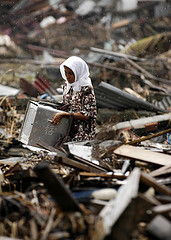
[photo: “Woman searches through debris . . . Banda Aceh, Sumatra, Indonesia,” by Chuck Simmins, used under a Creative Commons license]
Eleven Tips for Helping Someone with Cross-Cultural Transitional Loss

7016973613_ded8a0eac1_mIf you want to help people in transition—cultural, geographic, and vocational transition—then you’ll need to deal with the grief that comes with their losses. Here’s a great resource for that, A LifeCare Guide to Helping Others Cope with Grief. (LifeCare is a leading provider of “work-life services.”) While this publication is aimed at comforting people who have lost a loved one, the advice it gives can be applied to those with cross-cultural transitional loss as well.

It opens with the second half of this quotation from Henri Nouwen, from Out of Solitude: Three Meditations on the Christian Life:

[W]hen we honestly ask ourselves which persons in our lives mean the most to us, we often find that it is those who, instead of giving much advice, solutions, or cures, have chosen rather to share our pain and touch our wounds with a gentle and tender hand. The friend who can be silent with us in a moment of despair or confusion, who can stay with us in an hour of grief or bereavement, who can tolerate not knowing, not curing, not healing and face with us the reality of our powerlessness, that is a friend who cares.

Here are eleven tips from Helping Others Cope with Grief to guide us in being that “friend who cares.” Each one is followed by a short excerpt to help explain the idea. I have, when necessary, replaced some words (in brackets) in order to to apply the advice to people experiencing loss due to cross-cultural transition—a group including all cross-cultural workers, their parents and family left back “home,” Third Culture Kids, expats, and repats:

  1. Mention the [lost relationships, places, and things], and acknowledge your awareness of the loss.
    . . . . Many people avoid mentioning the [loss], fearing it will remind the grieving person of his or her pain. . . . [B]ut behaving as if you don’t remember or are unaware of your [friend’s] pain often leaves him or her feeling very alone.
  2. Listen to your [friend].
    . . . . The most important thing you can offer someone who is grieving is your ability to listen without judgment. A good rule to follow is to listen 80 percent of the time and talk 20 percent. . . .
  3. Insist that your [friend] see a doctor if he or she exhibits signs of depression.
    Intense grief can lead to depression. If your friend seems unusually depressed or withdrawn, suggest that he or she seek professional help. . . .
  4. Encourage your [friend] to make wise choices.
    Urge the person who is grieving to pay attention to his or her own needs, and make choices accordingly. . . .
  5. Offer practical help; don’t wait to be asked.
    . . . . Make specific offers several times, and encourage your friend to take you up on your offers. Avoid phrases such as, “Let me know if I can help.” Usually, he or she won’t let you know for fear of imposing on you. . . .
  6. Remember that grieving is a long process.
    The person you care about may be grieving for a long time. Several months or more after the transition, he or she may actually be feeling the loss more acutely, and much of his or her support system will have backed off. . . .
  7. Offer your companionship.
    Your presence can be comforting to a grieving [friend]; you don’t have to do anything special. Often, grieving people just do not want to be alone.
  8. Don’t minimize the loss.
    Be careful not to say, “I know exactly how you feel.” . . . Instead, use statements such as, “I know this is difficult,” . . .  or some other statement that is heartfelt and accurate, but leaves room for the uniqueness of your [friend’s] experience.
  9. Encourage your [friend] to share his or her feelings.
    Avoid saying things like, “Be strong for…” or “Don’t cry.” This sends the message that you are uncomfortable with your [friend’s] intense feelings and, therefore, you will leave him or her emotionally alone. . . . Instead, encourage your [friend] by saying, “It’s okay to cry,” or “You don’t have to be so strong.”
  10. Help your [friend] create new traditions/rituals/activities.
    . . . . Holidays and other events filled with tradition can . . . be especially hard to deal with; try to help your [friend] discover new ways to experience these events. At the same time, he or she should be encouraged to cherish the memories and/or traditions associated with the [people and places no longer close by].
  11. Give advice cautiously.
    Avoid offering advice with phrases such as, “You should…” or “You need to….” . . . . Instead, give advice that encourages the grieving person to trust him or herself and make choices based on his or her needs, rather than on what others think he or she should be doing or feeling.

(A LifeCare Guide to Helping Others Cope with Grief, LifeCare, 2001)
[photo: “B,” by Eugene’s Likeness, used under a Creative Commons license]

Better the Disappointment You Know?

Just last week, my wife and I watched Last Chance Harvey (2008) for the umpteenth time—well, maybe not the umpteenth time, but at least the umpth time. It evokes some particular emotions for us, as we first watched it on a plane ride back to the States during our time in Asia. We were coming back with some disappointments, and the movie—especially a conversation near the end—resonated with each of us. If you’re not familiar with the story, here’s a short synopsis, leading up to that exchange:

Harvey Shine (Dustin Hoffman) is a down-on-his-luck jingle writer from New York, flying to London for his daughter’s wedding. Kate Walker (Emma Thompson) is a Heathrow employee with the tedious job of interviewing travelers. Their first meeting begins with Kate’s attempts to ask Harvey the questions on her clipboard. It ends with Harvey rudely brushing her off.

Not only are things going poorly for Harvey on the job front, but he later finds out that his daughter has chosen her stepfather to walk her down the aisle—and there are obviously some family skeletons that reside in Harvey’s closet.

Things begin to look up, though, when Harvey meets up with Kate the next day at a Heathrow bar. Harvey has just missed his flight back to the States, and Kate is using a novel as an escape from failed blind dates and phone calls from her mother, with whom she lives.

Over the next several hours, Harvey and Kate begin to enjoy each other’s company, and they even see glimpses of a happy future together. The two attend Harvey’s daughter’s wedding reception and then wander around London, ending up at the fountains at Somerset House. They agree to meet there again at noon the next day. A spirited climb up his hotel steps puts Harvey in the hospital, just long enough to keep him from making the appointment. Not knowing the cause, Kate is crushed at having her emotions stood up . . . again.

Harvey tracks Kate down, even though she no longer wants to see him. She is wounded and fears being wounded even more. As Harvey tries to convince her that she should give their relationship a chance, they have their pivotal conversation, in which Kate says,

I’m not going to do it. I’m not going to do it, because it’ll hurt. . . . and I won’t do it. . . .

You see, what I think it is, is . . . is that I think I’m more comfortable with being disappointed. I think I’m angry with you for trying to take that away.

Since we were escorting our five children across the Pacific, my wife and I were separated during our flight, catching pieces of movies on our individual screens in between naps and meals. Sometime later during the trip, our youngest was asleep and we got to sit together for a while. We’d both watched Last Chance Harvey, and we both remembered what Kate had said. At the time we understood that even though disappointment is painful, it can become more comfortable than hoping for miracles and risking deeper loss. Maybe that’s why we continue to watch the film from time to time. . . because we still understand that. And when fear accompanies hope, as it often does, we do our best to press on, more guarded, but pressing on.

Last Chance Harvey doesn’t end with “happily ever after,” but it does end with a hopeful beginning. Harvey decides to stay longer in London, and Kate agrees to open her heart to the possibilities with him. As the two start down this new road together, Harvey remembers their first encounter and asks Kate to continue the interview that she’d started with him at the airport. She does:

“Name?” she asks.

He replies, “Harvey Shine.”

“Place of residence?”

“I’m in transition.”

Here’s the trailer:

And here’s a “Back Stage interview with Thompson and Hoffman, in which they talk about the mood and personality of the movie. When discussing the on-screen relationship between the two characters and how that was reflected in the film-making process, Hoffman says,

I always said that you always know who your friends are [. . . .] Your really good friends are the people that you can sit at a table with and not talk [. . . .] And we said, whatever the specialness about that relationship was, could we do this movie like that?

[photo: “Yellow Point: Somerset House Fountains,” by Tania Caruso, used under a Creative Commons license]

Henri Nouwen’s “Inner Voice of Love”: Finding the Path Home

I’m a fan of the writings of Henri Nouwen. Before his death in 1996, the Holland-born author and theologian served as a Catholic priest; taught at the Menninger Foundation in Topeka, Kansas, and at Notre Dame, Yale, and Harvard; worked with Trappist monks in New York’s Abbey of the Genesee; lived with the poor in Peru; and became pastor at a L’Arche community for the mentally disabled in Canada. Along the way, he wrote over 40 books.

One of the hallmarks of Nouwen’s works is his honest sharing of his personal struggles. This is probably nowhere more apparent than in his Inner Voice of Love, originally a series of “secret journal” entries written during a period of deep depression. In the introduction to the book, Nouwen writes that it was only at the urging of friends that he decided to have The Inner Voice of Love published.

In the book’s pages, Nouwen touches on themes that strike chords with many cross-cultural children and adults, global nomads, and others who are physical or spiritual “strangers in a strange land”—with those who are looking for a community and home to call their own. In fact, it was shortly after he joined the community of L’Arche, what he called his “true home,” that Nouwen was faced with his depression. “Just when I had found a home,” he writes, “I felt absolutely homeless. . . . It was if the house I had finally found had no floors.”

Over the course of the next six months, Nouwen moved from agony “to a new inner freedom, a new hope, and a new creativity.” Following are some of the “spiritual imperatives” that Nouwen wrote to himself during this journey, as he sought the path home:

Coming Home and Trusting Your Heart

Sometimes people who do not know your heart will altogether miss the importance of something that is part of your deepest self, precious in your eyes as well as God’s. They might not know you well enough to be able to respond to your genuine needs. It is then that you have to speak your heart and follow your own deepest calling.

There is a part of you that too easily gives in to others’ influence. As soon as someone questions your motives, you start doubting yourself. You end up agreeing with the other before you have consulted your own heart. Thus you grow passive and simply assume that the other knows better.

Here you have to be very attentive to your inner self. “Coming home” and “being given back to yourself” are expressions that indicate that you have a solid inner base from which you can speak and act—without apologies—humbly but convincingly.

Sharing Your Pain as a Fellow Traveler

You wonder whether it is good to share your struggles with others, especially with those to whom you are called to minister. you find it hard not to mention your own pains and sorrows to those you are trying to help. You feel that what belongs to the core of your humanity should not be hidden. You want to be a fellow traveler, not a distant guide.

The main question is “Do you own your pain?” As long as you do not own your pain—that is, integrate your pain into your way of being in the world—the danger exists that you will use the other to seek healing for yourself. . . .

But when you fully own your pain and do not expect those to whom you minister to alleviate it, you can speak about true freedom. Then sharing your struggle can become a service; then your openness about yourself can offer courage and hope to others.

For you to be able to share your struggle as a service, it is also essential to have people to whom you can go with your own needs. You will always need safe people to whom you can pour out your heart.

You Are Welcome Here

Not being welcome is your greatest fear. . . . It is the deepseated fear that it would have been better if you had not lived.

Everything Jesus is saying to you can be summarized in the words “Know that you are welcome.” Jesus offers you his own most intimate life with the Father. He wants you to know all he knows and to do all he does. He wants his home to be yours. Yes, he wants to prepare a place for you in his Father’s house.

Keep reminding yourself that your feelings of being unwelcome do not come from God and do not tell the truth. The Prince of Darkness wants you to believe that your life is a mistake and that there is no home for you. But every time you allow these thoughts to affect you, you set out on the road to self-destruction. So you have to keep unmasking the lie and think, speak, and act according to the truth that you are very, very welcome.

(Henri Nouwen, The Inner Voice of Love: A Journey through Anguish to Freedom, New York: Doubleday, 1996)

[photo: “To die by your side,” by Hugo Marcelo Mendez Campos, used under a Creative Commons license]