The Bible has been called the most quoted, most translated, most published, most sold, and most shoplifted book of all time. It is difficult to overestimate the impact of its ideas on Western culture. And, particularly in the translation completed under the direction of King James I of England in 1611, it has had a leading role in shaping the English language and English literature. Alister McGrath, in his book In the Beginning: The Story of the King James Bible and How It Changed a Nation, a Language, and a Culture, writes,
No other book has so permeated and penetrated the hearts and speech of the English race as has the Bible. . . . The King James Bible, along with the words of William Shakespeare, is regularly singled out as one of the most foundational influences on the development of the modern English language.
I wrote Putting Words in Our Mouths: A Look at Biblical Expressions in American English with English learners in mind, to teach them the meanings of commonly used phrases and to familiarize them with the stories and concepts of the Bible. Familiarity with the Bible leads to a better understanding of the art, history, music, politics, and customs of English-speaking peoples. The authors of The Bible Literacy Report II state, “Almost without exception, English professors we surveyed at major American colleges and universities see knowledge of the Bible as a deeply important part of a good education.” The report quotes a professor from Northwestern University who calls the Bible the “most influential text in all of Western culture.”
But this doesn’t mean that all English speakers are aware of or understand the Bible’s influence. In fact, serious English-language students who gain a basic knowledge of the Bible may find themselves ahead of many native speakers.
Today, biblical words and phrases—including idioms—appear in informal conversation, news articles, blogs, television shows, movies, popular songs, and literature. Even the word bible itself has a place in modern English as any “authoritative book on a particular subject.” Bible comes from a Greek word meaning “books.” This is because the Bible is a collection of 66 books, written by at least 40 men over about 1500 years. And on the pages of these books are written many well-known stories, some of which take place on a grand scale or involve huge groups of people—such as Noah and the flood, the 10 plagues of Egypt, and the journey of the Israelites to the Promised Land. Therefore, something that is “enourmous or extremely extensive” can be said to be of biblical proportions or on a biblical scale.
I invite you to join me on a journey through the Bible, using common English expressions as our stepping stones. We’ll start at the best place possible . . . in the beginning.
The format of Putting Words in Our Mouths is simple. Each word or phrase is introduced with its definition and a sample sentence showing how it can be used in conversation. Then an explanation of the word/phrase’s origin follows, along with the biblical passage from which it comes. Where it differs from the more modern translation, I’ve included in brackets the expression in its King James version.
I will be adding expressions as time permits, moving from Genesis to Revelation. You can view all the posts in order by clicking on Browse All Entries in the right-hand column. You can also look for specific topics by using the search field.
When we first moved to Taipei, we lived across the street from a park. One day, in that park, I was approached by three college-age students who asked me in English, “Do you know Jesus?”
“Yes,” I said.
“OK,” they replied. “But do you really know him?” This was a logical question, because while English has the one word for knowing someone, Chinese has two. The first would be the one in “I know who he is,” while the second means “I know him personally.”
I had the perfect response. Not only was I a Christian, but I was a missionary . . . and I’d been studying Chinese, too. So, I told them, somewhat smugly, in their language, “Yes, I know him. I’m a . . . bicycle.”
I wish I could say that the Chinese words for missionary and bicycle sound just alike, but they don’t. The first is chuan jiao shi, and the second is jiao ta che. I think I must have learned them on the same day, because they are forever confused in my mind. The young people in the park laughed with me and let me correct myself. “Chinese is hard,” they said. I didn’t argue.
Over the years, that encounter became a symbol to me for the good and bad times in Taiwan: Some days I was a missionary. Some days I was just a bicycle.
[T]he reason why I have Yeshua, my de-familiarized Christ, saying, “Far more can be mended than you know,” which I think is actually true to the New Testament, is that I want mending. Not flying free, not transformation, but humble, ordinary, everyday, get-you-back-on-your-feet mending, to be at the center of the Christian story.
When the book was being translated into Dutch, the translator sent me an email: “This word mend, I’ve looked it up in the dictionary, and it seems to be the same word you use for repairing bicycles. You must mean something else.”
I wrote back, “No. No. No. I want the bicycle-repair word.” What I absolutely want is to suggest that before it’s anything else, redemption is God mending the bicycle of our souls; God bringing out the puncture repair kit, re-inflating the tires, taking off the rust, making us roadworthy once more. Not so that we can take flight into ecstasy, but so that we can do the next needful mile of our lives.
We all need that kind of mending from God. I guess being a bicycle isn’t so far from being a Christian—and a missionary—after all.
In modern America, the authors point out, we tend to associate missing teeth with lack of intelligence. But what would your smile look like without the luxury of modern and available dentistry? Would you have a full mouth of straight pearly whites? Did Jesus have all his teeth intact? The authors write, “It seems like heresy to suggest otherwise.” But for much of the world, a lack of teeth would be irrelevant—if not expected—in a carpenter who lived 2,000 years ago.
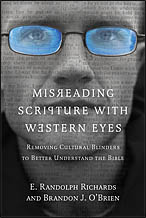
Richards (a former missionary to Indonesia) and O’Brien’s goal in Misreading Scripture is to get us to rethink our assumptions about what we read in the Bible. They’re not saying that non-Westerners can understand the Bible better, just that we all come to the text with our own cultural baggage that we need to lay down. (They offer that someone else could easily write Misreading Scripture with EasternEyes.)
The authors admit that they’ve had to oversimplify the topic, as there is way too much to cover in one book. But, they write, their purpose is to “unsettle you just enough that you remember biblical interpretation is a crosscultural experience and to help you be more aware of what you take for granted when you read.”
For instance, they open the book with the example of the hot, cold, and lukewarm waters of the church in Laodicea:
I know your deeds, that you are neither cold nor hot. I wish you were either one or the other!So, because you are lukewarm—neither hot nor cold—I am about to spit you out of my mouth. (Revelation 3:15,16 NIV)
Our assumptions lead us to think that hot means “on fire” with faith, while cold means that faith is absent. This reading says that God would rather us be non believing than to have a weak faith. But when O’Brien traveled to the site of Laodicea, he learned that nearby were the hot springs of Hierapolis and the cold springs of Colossae. Laodicea didn’t have any springs, so aqueducts brought water in. Both kinds of water, hot and cold, would have been welcome and refreshing to the people of Laodicea, but by the time the water arrived, it was only lukewarm. New insights bring new perspectives.
The story of David and Bathsheba gives another opportunity for us to see an “Eastern” viewpoint. The authors’ thought-provoking analysis suggests that David’s actions were motivated more by honor and shame than by feelings of guilt. In fact, they show how not only the king’s decisions, but also those of Bathsheba and Uriah, exemplify a culture where individual convictions of right and wrong are trumped by the weight of societal expectations.
Other topics covered in Misreading Scripture are the cultural differences of Individualism and Collectivism, Time, Rules and Relationships, Virtue and Vice, and Finding the Center of God’s Will. In the chapter covering this last subject, Richards and O’Brien discuss the common Western practice of a reader applying scriptures to himself, while non-Western readers—as with the Jews of the Old Testament—are more likely to apply it to the entire group. This is compounded, as the authors point out earlier in their book, by the lack of a plural you in the English language.
While I taught the Bible in Asia, it was a constant challenge to set aside my American presuppositions and allow my non-American friends to understand the Bible on their own terms. Instead, I was tempted to share my personal and cultural footnotes before they could be convicted of a “misguided” interpretation. This was especially dangerous when I found myself, as the authors call it, “arguing [them] to a lower standard.”
As I read through Misreading Scriptures, I wasn’t always convinced of the authors’ conclusions, but I was consistently “unsettled” enough to rethink my assumptions. And when I question those things that I take for granted, it makes me a better teacher and student. When I acknowledge my cultural biases, I am then better able to understand what the Bible says and less hindered by what I’m sure it should be saying.
(E. Randolph Richards and Brandon J. O’Brien, Misreading Scripture with Western Eyes: Removing Cultural Blinders to Better Understand the Bible, IVP, 2012)
[My family is moving across town this week, so I haven’t been able to work on the blog much lately. So here’s a repost from about a year and a half ago. This transition thing can feel like Frost’s “miles to go before I sleep.” But until that rest comes, I’ll look for a park bench along the way.]
Finding good listeners is very important to missionaries. In fact, when member-care trainer Brenda Bosch surveyed missionaries about what they wanted from their mission agency, the top answer was “someone to listen to me.”
German theologian Dietrich Bonhoeffer writes that listening is necessary in Christian community. He calls it the “first service” that Christians owe each other:
Just as our love for God begins with listening to God’s Word, the beginning of love for other Christians is learning to listen to them. God’s love for us is shown by the fact that God not only gives us God’s Word, but also lends us God’s ear. We do God’s work for our brothers and sisters when we learn to listen to them. So often Christians, especially preachers, think that their only service is always to have to “offer” something when they are together with other people. They forget that listening can be a greater service than speaking. Many people seek a sympathetic ear and do not find it among Christians, because these Christians are talking even when they should be listening. But Christians who can no longer listen to one another will soon no longer be listening to God either; they will always be talking even in the presence of God. The death of the spiritual life starts here, and in the end there is nothing left but empty spiritual chatter and clerical condescension which chokes on pious words. Those who cannot listen long and patiently will always be talking past others, and finally no longer will even notice it. Those who think their time is too precious to spend listening will never really have time for God and others, but only for themselves and for their own words and plans.
For Christians, pastoral care differs essentially from preaching in that here the task of listening is joined to the task of speaking the Word. There is also a kind of listening with half an ear that presumes already to know what the other person has to say. This impatient, inattentive listening really despises the other Christian and finally is only waiting to get a chance to speak and thus to get rid of the other. This sort of listening is no fulfillment of our task. And it is certain that here, too, in our attitude toward other Christians we simply see reflected our own relationship to God.
In the latter paragraph, Bonhoeffer describes a false, inadequate kind of listening. In reading what is lacking there, we can see the qualities required of a good listener. Are you someone who listens in that way?
Do you listen with a “whole” ear?
Do you presume that you will hear something unique and valuable?
Are you patient?
Are you attentive?
Do you love the speaker?
Do you waive your right to speak?
Do you hope to keep the other person in your presence, sharing with you?
Are you fulfilling your task, to your neighbors and to God?
The New Testament records Jesus saying several times, “He who has ears to hear, let him hear.” In The Message, this is translated, “Are you listening to this? Really listening?”
Repatriation—to borrow a phrase from John Denver—is coming home to a place you’ve never been before.
Here’s a repost from my first year blogging, with 92 things that remind repats that they’ve been out of the country for a while. As time goes by, more and more of them are happening less and less for me. But some will never go away.
_______________________________
In the hallowed tradition of “You Know You’re an Expat / Third Culture Kid / Missionary when . . .” lists, I offer my own version for repats. This is for the times when you’re reminded that your plug doesn’t always fit the outlet.
Since I’m a former missionary to Asia who’s repatriated back to the US, a lot of my list leans in that direction, but I hope there’s something here for repats of every stripe (or voltage, as it were).
You remember you’re a repat when . . .
1. Your passport is your preferred form of ID.
2. You comment on how cheap gas is in the US.
3. You ask your friends who they’re picking to win the World Cup.
4. Your CNN web page is set on “International.”
5. You accidentally try to pay for something with the strange coins from the top of your dresser.
6. You don’t trust your friends when they say they’ve found a “good” Italian restaurant.
7. You ask the clerk at the convenience store if you can pay your electric bill there.
8. You don’t know how to fill out taxes without Form 2555.
9. You think Americans are loud. 10. You talk about Americans overseas and call them “foreigners.”
11. You find out that living overseas is not the top qualification employers are looking for.
12. You learn to stop talking about the nanny and groundskeeper you used to employ.
13. You have to ask how to write a check.
14. You forgot how many numbers to dial for a local phone call.
15. You tell your toddler, “No seaweed until you finish all your hamburger.”
16. You try to order fried chicken at Burger King.
17. You check prices by converting from what a similar item cost overseas.
18. You think American paper money is boring because it lacks color and the bills are all the same size.
19. You don’t know how to respond when people say, “I bet you’re glad to be back home.”
20. You prefer to hear news reports from someone with a British accent.
21. You wonder why all the commentators on TV are yelling.
22. You wish you’d brought back ten of your favorite kitchen utensil because you didn’t know it’s not sold in the States.
23. You realize international students are you’re kind of people.
24. You ask where you can get a late-model, low-mileage Toyota for around $2000.
25. You turn on the subtitles on an English movie because you don’t want to miss anything.
26. You ask the clerk at the video store if they have VCDs.
27. You wonder if organization should be spelled with an s.
28. You load up your suitcase and you try not to “pack like an American.”
29. You stop bringing your bi-lingual Bible to church.
30. You smirk inside because someone calls a 4.3 earthquake “a big one.”
Here’s a repost of something I wrote back in March of 2012—it was only my fifth entry—back when I had no followers and very few readers. It’s an interesting and timely story, and helps give me a break during the busyness of the holidays. May you enjoy the blessings of Christmas, wherever you are in the world.
In the early 1970s, a Christian missionary school in Tokyo was looking for turkey for Christmas dinner. Finding none, a representative contacted the local Kentucky Fried Chicken and ordered chicken instead. A KFC employee suggested the company turn the request into an ad campaign, and Japan has never been the same since. Today, KFC’s Christmas Party Barrels are so popular that sales for December 23rd, 24th, and 25th usually equal half of what is sold during a normal month, and Christmastime customers wait in long lines to pick up their orders, placed as early as October. Very few in Japan celebrate Christmas for its religious meaning, as less than 2% of Japanese even call themselves Christian. Instead, consumerism is emphasized, and the focus is on gifts, decorations . . . and chicken from the Colonel.
The statures of thirteen saints adorn the roof of Montreal’s Cathédrale Marie-Reine-du-Monde.
According to the 1917 Catholic Encyclopedia, Simeon Stylites was the first “pillar hermit,” spending much of his life perched atop a column (stylos is Greek for pillar). Simeon began this practice to escape the constant crowds of pilgrims who sought his prayers, disrupting his personal devotions. His original pedestal held him around nine feet off the ground, but over time it was replaced by ever-taller versions, until it was some 50 feet high. Simeon remained on his pillar for 36 years, until his death.
While Simeon seems to have thrived living above the masses, most church leaders today find life atop a pedestal difficult at best. But that doesn’t stop many Christians from elevating them to greater and greater heights, and sometimes those leaders get quite comfortable with the view from above.
This is one of the topics addressed in this month’s issue of Christianity Today. The headline on the front cover is “New Life after the Fall,” referring to the seven-year recovery of Colorado Springs’ New Life Church following the scandals and resignation of its founder and pastor, Ted Haggard.
In a companion article, “Letting Pastors Be Real,” Mark Galli interviews Dale Pyne, president of Peacemakers Ministries, on how churches can help keep their leaders from falling. While Pyne’s advice is focused on pastors, I believe that it applies to missionaries, as well—not only concerning their pastoral role overseas, but also in their relationships with sending churches and supporters. Here is some of what he has to say:
Putting pastors up on pedestals, says Pyne, creates “minigods in our minds and hearts.”
We don’t hold pastors or missionaries accountable when we think we don’t know enough to address their adherence to “fundamental issues.” Pyne says he’s lost track of how many times he’s heard elders say, ‘I wanted to say something, but I thought, Who am I?'” If a pastor wants to “address or confess [a sin], his place on the pedestal sometimes facilitates pride and fear of man. So they die in silence and pain.”
When it comes to attendance, there is pressure on church leaders to “inflate or puff the numbers.” But Pyne says that “if we start managing shepherding by the numbers, we’re going to lose shepherding, and we’re going to focus on the numbers.”
“Jesus was perfect,” says Pyne, “pastors are not.” This is, of course, true for missionaries, as well. If either aren’t humble and honest, they “create distance and discourage connection.”
Pastors—and missionaries—need “a high-integrity accountability relationship with one or several spiritually mature individuals” to address personal issues. “And they must trust that the relationship is a confidential one.”
Pyne ends with a call for transparency. Here again, as in most of his responses in the article, pastor can be replaced with missionary. It’s a lesson that needs to be learned by everyone in Christian leadership and service:
If we’re too busy denying and protecting and putting on a church face, then the congregation perceives that the pastor has it all together. We say to ourselves, Wow, I am so far from that pastor. I am unworthy. Why isn’t God working in me the way God’s working in him? The people start to elevate them. It’s not all about the pastor, but that transparency releases the congregation. It helps the pastor be real. And releases the congregant to accept who they are and pursue hope in Christ.
In doing research on Scott Wallace’s work with isolated tribes of the Amazon, I came across his March report about two Waorani Indians who had been killed by members of an “uncontacted” tribe. According to witnesses, “the assailants belonged to a clan of Taromenane, a branch of the Waorani who spurned contact with evangelical missionaries in the 1950s and continue to roam the forests of Yasuní as nomads.”
I knew about the Waorani (Woadani, Huaorani, Auca) story, that their original contact with Western Christians had resulted in the spearing death of five missionaries in 1956, but I hadn’t updated myself on what was currently going on with the tribe. I also knew that the son of one of those missionaries, Steve Saint, had continued the work with the Waorani and that last year an accident had left him partially paralyzed. Again, I hadn’t kept up with his situation and assumed that his recovery was complete.
Following through a number of links, here is what I found: Steve Saint and Elisabeth Elliot (wife of one of the slain missionaries) living out their lives after tragedy, grabbing hold of their all-too-often idealized stories, stripping away the neatly tied bows, and letting the loose ends speak.
Our stories are part of God’s story, and by adding their epilogues, Saint and Elliot show that all our stories are best told completely, fairly, and honestly.
Steve Saint: All Is Not Good, but Let God Write Your Story
One year ago this past June, an accident left Steve Saint partially paralyzed from the neck down. Saint, the founder of the Indigenous Peoples Technology and Education Center (I-TEC), was testing an aluminum wing when it became unmounted from its stand, striking him in the head.
Steve Saint was five years old when his father, Nate Saint, was killed by the Waorani Indians in Ecuador. The story of their deaths is told in Elisabeth Elliot’s book Through Gates of Splendor and in the film End of the Spear.
Due to the continued efforts of Saint’s Aunt Rachel and Elliot—wife of Jim Elliot, another of the five killed—many of the Waorani became Christians. And as teenagers, Steve and his sister, Kathy, were baptized by two of the men who had killed their father—in the Curaray River next to the beach where the killings had taken place.
After Rachel Saint’s death, Steve Saint was invited by the Waorani to come live with them, which he, his wife, and children did, for a year and a half. Later, he started I-TEC to “enabl[e] indigenous churches to overcome the technological and educational hurdles that stand in the way of their independence.” I-TEC’s most famous invention is the Maverick, a “flying car” developed to help Christian workers reach “frontier” areas.
Since his accident, Saint has produced a series of six videos, called “The Next Chapter,” telling about his injury and recovery. The first was filmed a week after the accident, with Steve speaking from his hospital bed. The last came a year later. In it, Saint begins, over footage of him struggling to get up in the morning,
I think, maybe in some of the recordings we made earlier on, what I wanted to show was, you know, how wonderful things were, and I think we gave the impression that, you know, all is good now. And there is good now, but not all is good. . . . You know, stand up, and that’s the worst, standing up is just agony in the morning, you know, trying to get these stilts, ’cause I can’t feel from my waist on down . . . and I can’t feel most of my arms, and I certainly can’t feel my hands. . . .
I was privileged to meet Saint and his good friend Mincaye several years ago when they gave an interview at a ministry I worked for. Mincaye, now a Christian, was part of the group that speared Saint’s father. I am encouraged by Saint’s faith and dedication. Despite his current condition, he has kept his trust in God. Three months after his injury, he told the Ocala StarBanner, using much of the same language that is part of the video above:
My motto has been, “Let God write your story,” and that’s what I have always done. Opportunity comes in strange formats. You have a lot of people, nowadays, who want to write their own story and have God be their editor, when something goes wrong. I decided long ago to let God write my story.
Elisabeth Elliot: We Are Buffoons, but the Work is God’s
It’s been a long time since I read Elisabeth Elliot’s Shadow of the Almighty: The Life and Testament of Jim Elliot. I remember being inspired by Jim and Elisabeth’s lives, but also discouraged. It seemed that their level of faith was unattainable for someone like me. If they were the definition of missionary, then I probably shouldn’t even try.
I’ve had trouble in the past putting missionaries on pedestals. But experience has taught me that missionaries are imperfect people, too, especially my experience living out my own far-from-perfect missionary life.
In 1961, Elliot wrote The Savage My Kinsman, chronicling her two years working with the Waorani. Twenty years later, she penned an epilogue that includes a brief explanation of why she left them: because she wanted to provide a better education for her daughter and because the “differences” between her and her fellow missionary, Rachel Saint, meant that they were “not in any strictly truthful sense really working together.”
“One of us, it appeared, must go,” she writes. “My decision was a painful one.”
But while Elliot doesn’t want to gloss over the difficulties of her story, neither does she want to “magnify the trivial.” According to Elliot, there are two “dangerous” extremes in the way Christians interpret life, and the stories we tell:
One is the sheer triumphalism which is the coin of much religious telecasting. Make it appealing. Make it cheap. Make it easy. Be a Christian and watch your difficulties dissolve. Obey God and everything you touch will turn to gold. The other is the exposé. Out of a very muddy notion of something called equality, and perhaps also out of an exaggerated fear of hero-worship or cultism, springs an urge to spy out all weaknesses and inconsistencies and thereby discredit practically all human effort, especially when its intention is an unselfish one.
To be sure, the life of a missionary—the life of a Christian—is a natural mix of victories and defeats. Elliot saw this in her team’s contact with the Waorani: the highs (“the Auca Indians were finally reached”) and lows (“nine children were left fatherless”), the joys (“the Aucas heard the gospel”) and sorrows (“they also got polio”). And her list goes on.
How we long to point to something—anything—and say, “This works! This is sure!” But if it is something other than God Himself we are destined for disappointment. There is only one ultimate guarantee. It is the love of Christ. The love of Christ. . . .
God keep us from sitting in the seat of the scornful, concentrating solely on the mistakes, the paltriness of our efforts, the width of the gap between what we hoped for and what we got. How shall we call this “Christian” work? What are we to make of it?
Elliot continues with these thoughts in another epilogue, this one added to Through Gates of Splendor in 1996, marking the 40th anniversary of the missionaries’ deaths:
[W]e are tempted to assume a simple equation here. Five men died. This will mean x-number of Waorani Christians.
Perhaps so. Perhaps not. Cause and effect are in God’s hands. Is it not the part of faith simply to let them rest there? God is God. I dethrone Him in my heart if I demand that He act in ways that satisfy my idea of justice. . . .
The massacre . . . was interpreted according to the measure of one’s faith or faithlessness—full of meaning or empty. . . . The beginning of a great work, a demonstration of the power of God, a sorrowful first act that would lead to a beautifully predictable third act in which all puzzles would be solved, God would vindicate Himself, Waoranis would be converted, and we could all “feel good” about our faith. Bulletins about progress were hailed with joy and a certain amount of “Ah! You see!” But the danger lies in seizing upon the immediate and hoped-for, as though God’s justice is thereby verified, and glossing over as neatly as possible certain other consequences, some of them inevitable, others simply the result of a botched job. In short, in the Waorani story as in other stories, we are consoled as long as we do not examine too closely the unpalatable data. By this evasion we are willing still to call the work “ours,” to arrogate to ourselves whatever there is of success, and to deny all failure. . . .
I think back to the five men themselves, remembering Pete’s agony of indecision as to whether he should join the others in the venture; Ed’s eagerness to go even though Marilou was eight months pregnant, his strong assurance that all would be well; Roj’s depression and deep sense of failure as a missionary; Nate’s extreme caution and determination; Jim’s nearly reckless exuberance. . . .
[W]e are sinners. And we are buffoons. . . .
It is not the level of our spirituality that we can depend on. It is God and nothing less than God, for the work is God’s and the call is God’s and everything is summoned by Him and to His purposes, the whole scene, the whole mess, the whole package—our bravery and our cowardice, our love and our selfishness, our strengths and our weaknesses.

 The Bible has been called the most quoted, most translated, most published, most sold, and most shoplifted book of all time. It is difficult to overestimate the impact of its ideas on Western culture. And, particularly in the translation completed under the direction of King James I of England in 1611, it has had a leading role in shaping the English language and English literature. Alister McGrath, in his book In the Beginning: The Story of the King James Bible and How It Changed a Nation, a Language, and a Culture, writes,



 In the early 1970s, a Christian missionary school in Tokyo was looking for turkey for Christmas dinner. Finding none, a representative contacted the local Kentucky Fried Chicken and ordered chicken instead. A KFC employee suggested the company turn the request into an ad campaign, and Japan has never been the same since. Today, KFC’s Christmas Party Barrels are so popular that sales for December 23rd, 24th, and 25th usually equal half of what is sold during a normal month, and Christmastime customers wait in long lines to pick up their orders, placed as early as October. Very few in Japan celebrate Christmas for its religious meaning, as less than 2% of Japanese even call themselves Christian. Instead, consumerism is emphasized, and the focus is on gifts, decorations . . . and chicken from the Colonel.

 Clearing Customs