In his TED Talk—on home, travel, and stillness—author Pico Iyer refers to the words of the French author Marcel Proust:
The real voyage of discovery consists not in seeing new sights, but in looking with new eyes.
When I Googled that phrase, I came up with several similar, though slightly different, versions. The most popular one comes up on over 800,000 sites, often used, as Iyer did, in the context of travel:
The real voyage of discovery consists not in seeking new landscapes, but in having new eyes.
 But I wasn’t done yet. I don’t trust “famous quote” sites, nor do I trust the democracy of the Internet. A little more searching led me to the actual quotation, and the original source. It’s Proust’s seven-volume work, Remembrance of Things Past (or In Search of Lost Time). The quotation above is a paraphrase of text in volume 5—The Prisoner—originally published in French, in 1923, and first translated into English by C. K. Moncrief.
In chapter 2 of The Prisoner, the narrator is commenting at length on art, rather than travel. Listening for the first time to a work by the composer Vinteuil, he finds himself transported not to a physical location, but to a wonderful “strange land” of the composer’s own making. “Each artist,” he decides, “seems thus to be the native of an unknown country, which he himself has forgotten. . . .” These artists include composers, such as Vinteuil, and painters, such as the narrator’s friend, Elstir. He continues:
This lost country composers do not actually remember, but each of them remains all his life somehow attuned to it; he is wild with joy when he is singing the airs of his native land, betrays it at times in his thirst for fame, but then, in seeking fame, turns his back upon it, and it is only when he despises it that he finds it when he utters, whatever the subject with which he is dealing, that peculiar strain the monotony of which—for whatever its subject it remains identical in itself—proves the permanence of the elements that compose his soul. But is it not the fact then that from those elements, all the real residuum which we are obliged to keep to ourselves, which cannot be transmitted in talk, even by friend to friend, by master to disciple, by lover to mistress, that ineffable something which makes a difference in quality between what each of us has felt and what he is obliged to leave behind at the threshold of the phrases in which he can communicate with his fellows only by limiting himself to external points common to us all and of no interest, art, the art of a Vinteuil like that of an Elstir, makes the man himself apparent, rendering externally visible in the colours of the spectrum that intimate composition of those worlds which we call individual persons and which, without the aid of art, we should never know? A pair of wings, a different mode of breathing, which would enable us to traverse infinite space, would in no way help us, for, if we visited Mars or Venus keeping the same senses, they would clothe in the same aspect as the things of the earth everything that we should be capable of seeing. The only true voyage of discovery, the only fountain of Eternal Youth, would be not to visit strange lands but to possess other eyes, to behold the universe through the eyes of another, of a hundred others, to behold the hundred universes that each of them beholds, that each of them is; and this we can contrive with an Elstir, with a Vinteuil; with men like these we do really fly from star to star.
So there you have it. Maybe this adds to the meaning of the more-familiar “quotation.” Or maybe it lessens it, in your mind.
Maybe, for you, this is no longer a phrase about travel. Or maybe it is now much, much more so.
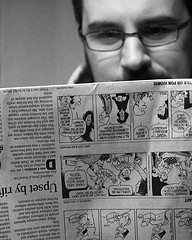
[photo: “New Eyes,” by Brian Talbot, used under a Creative Commons license—the photo’s caption at Flickr.com is the “most popular” version of Proust’s words, above]
 Clearing Customs