Reconciling the Planetal and the Personal: Anne Morrow Lindbergh’s Lessons from the Beach

Planetal awareness.

That’s what Anne Morrow Lindbergh, in  Gift from the Seacalls an attentiveness to what is going on around the globe. In her bestselling book, she wonders how we can balance a “planetal point of view [which] has burst upon mankind” with a “search for outward simplicity, for inner integrity, for fuller relationship.”
Throughout Gift from the Sea, she examines shells that she finds during a respite by herself at the beach, finding lessons from them on how to escape the constant distractions and overwhelming demands of life. It is in the final chapter, entitled “The Beach at My Back,” that she discusses the need to return from the seashore while remembering what was learned there.

Lindbergh’s book was published in 1955, and it uses the language of her day (planetal has since given way to global, and the Internet has replaced “public print” as the dominant media), but it is striking how much her thoughts apply to our present world, with the flood of global information and news threatening to overwhelm our senses and our empathy. She writes,

The world is rumbling and erupting in ever-widening circles around us. The tensions, conflicts and sufferings even in the outermost circle touch us all, reverberate in all of us. We cannot avoid these vibrations.

But just how far can we implement this planetal awareness? We are asked today to feel compassionately for everyone in the world, to digest intellectually all the information spread out in public print, and to implement in action every ethical impulse aroused by our hearts and minds. The interrelatedness of the world links us constantly with more people than our hearts can hold. Or rather—for I believe the heart is infinite—modern communication loads us with more problems than the human frame can carry. It is good, I think, for our hearts, our minds, our imaginations to be stretched, but body, nerve, endurance and life-span are not as elastic. My life cannot implement in action the demands of all the people to whom my heart responds. I cannot marry all of them, or bear them all as children, or care for them all as I would my parents in illness or old age. Our grandmothers, and even—with some scrambling—our mothers, lived in a circle small enough to let them implement in action most of the impulses of their hearts and minds. We were brought up in a tradition that has now become impossible, for we have extended our circle throughout space and time.

Faced with this dilemma what can we do? How can we adjust our planetal awareness to our Puritan conscience? We are forced to make some compromise. Because we cannot deal with the many as individuals, we sometimes try to simplify the many into an abstraction called the mass. Because we cannot deal with the complexity of the present, we often over-ride it and live in a simplified dream of the future. Because we cannot solve our own problems right here at home, we talk about problems out there in the world. An escape process goes on from the intolerable burden we have placed upon ourselves. But can one really feel deeply for an abstraction called the mass? Can one make the future a substitute for the present? And what guarantee have we that the future will be any better if we neglect the present? Can one solve world problems when one is unable to solve one’s own? Where have we arrived in this process? Have we been successful, working at the periphery of the circle and not at the center?

The answer, writes Lindbergh, is to affect the wider circles of the there, the future, and the mass by concentrating on—by enjoying—the centers of “the here, the now, [and] the individual and his relationships.” We must leave the beach, but we leave with our pockets full of shells, reminding us how to “find again some of the joy in the now, some of the peace in the here, some of the love in me and thee which go to make up the kingdom of heaven on earth.”

“It may be our special function to emphasize again these neglected realities,” writes Lindbergh, “not as a retreat from greater responsibilities but as a first real step toward a deeper understanding and solution of them.”

____________________________________

In 1929, Anne Morrow Lindbergh married Charles Lindbergh, already a worldwide celebrity, being the first person to fly from New York to Paris. They met when Charles visited Anne’s family in Mexico, where her father was serving as ambassador from the US.  After their marriage, Anne learned to fly and became Charles’s copilot and navigator as the two flew the globe exploring and mapping out routes.

Though America’s “first couple of the air” seemed destined to live out a fairy tale, their life together was beset by turmoil. Tragedy struck their family in 1932 when the Lindbergh’s 20-month-old son was kidnapped and killed. A highly sensationalized trial resulted in the conviction of Bruno Richard Hauptmann, who was later executed for the murder. To escape the media and public attention, the Lindberghs moved secretly to Europe, living in England and France for over three years.

A theme through much of Anne’s writing is the struggle to find the right path in the face of outward pressures and distractions. In living out this struggle in her own life, she sometimes made regrettable decisions. As Hitler began his offensive in Europe, Anne wrote The Wave of the Future, declaring the inevitability of fascism and calling for America not to oppose the Nazis. Also, in a letter, she called Hitler “a very great man, like an inspired religious leader—and as such rather fanatical—but not scheming, not selfish, not greedy for power.” In her personal life, too, Anne had her failings, having an affair with her doctor shortly after writing Gift from the Sea. (Unknown to Anne, Charles was later unfaithful to her, fathering seven children by three women in Europe.)

Anne wrote more than a dozen books, with Gift from the Sea being her most popular. She died in Vermont in 2001, at the age of 94.

(Anne Morrow Lindbergh, Gift from the Sea, New York: Pantheon, 1955)

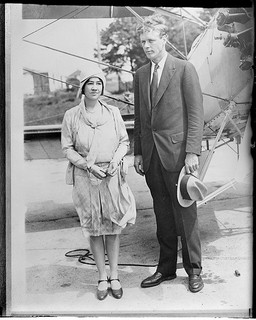
[photo: “Mr. and Mrs. Lindbergh,” Courtesy of the Boston Public Library, Leslie Jones Collection, used under a Creative Commons license]

Waiter, What’s This Maggot Doing in My Soup?

As a boy growing up in rural Missouri, I was very interested in insects and ended up with a rather sizable collection of mounted specimens that I took to the local 4-H fair. Later, when I became a 4-H leader to a younger friend nearby, I passed on what I’d learned. I remember once, after running out of ideas, spicing things up with a snack of deep-fried insects. As I recall, we ate grasshoppers, bees, and possibly cicadas. Little did I know that I could have been on the brink of a future career.

If you travel much outside the US and Europe, you run a good chance of running across insects served up as snacks or side dishes. But if people like China’s Li Jinsui have their way, edible insects will become a global main course.

As reported in Le Monde, Li runs an “insect factory,” which has as its focus the housefly—in particular, the immature housefly, or maggot. You can read the entire article here, but if you need some coaxing, let me whet your appetite with some quotations. Where else can you read such phrases as this?

China’s Maggot Factories Hoping to Feed the World (the headline)
Li says he can deliver about 150kg of maggots a day . . .
As he walks into a room filled with two million flies . . . , and
With the price of wasp larvae on the rise . . .

For Li, raising insects for human consumption isn’t just a novelty. He’s hoping to educate his countrymen, develop his business, and become “the industry’s world leader.” One obstacle that he has to overcome on the maggot front, though, is to figure out how to raise his flies on a diet of rice. That’s because housefly maggots typically feed on animal feces, which makes them unsuitable for human consumption.

Sounds like Li has a lot of educating and persuading to do.

But he’s not alone. There’s a whole movement devoted to “entomophagy,” or the eating of insects. It touts the health and environmental benefits of insect eating and presents it as an effective solution to the problem of feeding a rapidly growing world. For more information, check out these interesting sites:

Also, at NOVA’s “Bugs You Can Eat,” you can follow a couple American journalists, Peter Menzel and Faith D’Aluisio, as they trek around the world trying a variety of insect and spider dishes. With a twist on the “tastes like chicken” meme, Menzel describes deep-fried tarantulas in Cambodia, saying,

If day-old deep-fried chickens had no bones, had hair instead of feathers, and were the size of a newborn sparrow, they might taste like tarantulas.

And finally, if you’re in the States and want to get your taste buds ready for the insect-eating future, go to HOTLIX to order some “larvets,” hand-dipped chocolate crickets, or other varieties of insect candy. Or go to Hollywood location scout Scott Trimble’s Entomophagy, inspired by “the seeming lack of a concise smartphone-friendly list of American restaurants that serve insect options on their menus.”

Who knows, maybe someday you’ll ask, “Waiter, what’s this fly doing in my soup?” and his answer will be “Why, adding flavor, protein, and pizazz, of course!”

(Harold Thibault, “China’s Maggot Factories Hoping to Feed the World,”  Worldcrunch, October 1, 2012, translated from “Des Usines d’Insectes pour Nourrir les Chinois,” Le Monde, September 28, 2012;

[photo: “Fly larva,” by Susannah Anderson, used under a Creative Commons license]

Click.Click.Click: Do.Something.Good

With only a click—here—you can test your vocabulary at Word Dynamo. Not a bad return on your investment.

With the same click—here—you can not only test your vocabulary but also facilitate a donation of 10 grains of rice to the UN World Food Programme, and it continues for every definition you choose correctly.

That’s because the second click takes you to Free Rice, one of the many Web sites that make a donation to a charity in exchange for you clicking a link. That link sends you to a page with advertisements, and the advertisers are the ones that make the donation, not you.

While Free Rice’s word game might keep you clicking, you might prefer something less challenging, like, say, just pressing your finger without having to read any words other than click here. If that’s more your speed, bookmark some of the sites below, several of which support causes that reach beyond the borders of the US.

The Greater Good Network:

Another place with opportunities to click for several issues is Click to Give, with these categories:

And finally, there are these options at Care2:

Looking for even more choices? Go to these lists:

Of course, if all this benevolence gives you “mouse finger,” take a look at eHow.com for treatment and prevention.

[photo: “air:alone in Kyoto,” by Lali Masriera, used under a Creative Commons license]

Chris Jodan’s Art Helps Us “Feel” Some “Enormous Statistics”

Chris Jordan produces some really big artwork to represent some really big numbers. For example, this first piece below “depicts 92,500 agricultural plant seeds, equal to one hundredth of one percent of the number of people in the world today who suffer from malnutrition.”

This next one “depicts 240,000 plastic bags, equal to the estimated number of plastic bags consumed around the world every ten seconds.”

And this one “depicts 270,000 fossilized shark teeth, equal to the estimated number of sharks of all species killed around the world every day for their fins.”

All are part of the collection “Running the Numbers II: Portraits of Global Mass Culture.” Click on the thumbnails above and you’ll go to Jordan’s site, where you can see what makes these images so interesting. By clicking on the selected photos there, you’ll zoom all the way in to see the tiny parts—the seeds, the plastic bags, the shark teeth—that make up the larger whole.

In the TED Talk below, Jordan discusses the motivation behind his work, as he talks specifically about his earlier “Running the Numbers: An American Self-Portrait,” which looks at excesses and issues in US culture, such as personal bankruptcy, deaths caused by smoking, and the country’s high rate of incarceration.

“Now I want to emphasize that these are just examples,” Jordan tells the TED audience. “I’m not holding these out as being the biggest issues. They’re just examples. And the reason that I do this . . . it’s because I have this fear that we aren’t feeling enough as a culture right now. There’s this kind of anesthesia in America at the moment.”

Using his creative talents, Jordan’s goal is, as he says, to take “gigantic numbers” and “enormous statistics” and “translate them into a more universal visual language that can be felt.”

It makes me think about what numbers I’d like to see shown in this way, such as those representing worldwide refugees and displaced people, abortions, human trafficking, and child soldiers, to name a few. I’m sure that we each have our own list of statistics that we believe need to be heard, seen . . . and felt.

And finally, we can see Jordan’s ability to challenge and educate using more traditional images in Ushirikiano: Building a Sustainable Future in Kenya’s Northern Rangelands. This book chronicles, in words and photographs, “the Nakuprat-Gotu Conservancy in Northern Kenya, an initiative led by tribal Elders, which aims to bring peace and prosperity to a region ravaged by violence and climate change.” Go here to see over 70 stunning photos from the collection, including many beautiful portraits of Kenya’s Turkana, Samburu, Borana, and Meru people.

[all images are by Chris Jordan, used under a Creative Commons license]

President Obama to Joplin Seniors: “Pay It Forward”

Last night I and my family were honored to hear President Obama speak to the graduating seniors, including my son, at the Joplin High School commencement. The president came to commemorate the one-year anniversary of the tornado that ripped through the town shortly after last year’s commencement, destroying thousands of buildings and killing 161.

In March I blogged about Toshiya Muto, the man from Japan who came to Joplin to help in the cleanup efforts, and about the $500,000 gift to Joplin Schools from the United Arab Emirates. Last night, President Obama mentioned both, telling the students, “You’ll always remember that in a town of 50,000 people, nearly 50,000 more came to help in the weeks after the tornado—perfect strangers who’ve never met you, and would never ask for anything in return.” This included Muto, who  “traveled all the way from Japan, because he remembered that Americans were there for his country after last year’s tsunami, and he wanted the chance to pay it forward.” And later he added, “You’ll remember the school supplies donated by your neighboring towns, but also the brand new laptops that were sent from the United Arab Emirates—a small country on the other side of the world.”

Though he didn’t make it part of his speech, President Obama could have also mentioned another gift from the UAE, a newly announced $5 million donation to Mercy Health Systems. The money will pay for a wing in the new hospital that will replace St. John’s Regional Medical Center, which was destroyed in the storm.

The president gave several more examples of generosity shown to the people of Joplin over the past year, and then he came back again to the story of the man who came from thousands of miles away: “There are so many good people in the world. There is such a decency, a bigness of spirit, in this country of ours. Remember that. Remember what people did here. And like the man from Japan who came to Joplin, make sure to pay it forward in your own life.”

(Photo: President Obama looks over the commencement program before speaking to Joplin High seniors)

Soap and Water for the World

When Ugandan Derreck Kayongo first stayed in an American hotel in the 1990s, he was surprised to see that his partially used bar of soap was replaced with a new one each morning. He told CNN (Ebonne Ruffins, “Recycling Hotel Soap to Save Lives,” June 16, 2011) that he thought he was being charged for it, so he tried to return the new soap to the concierge. After learning that it was complementary—and the old soap had been thrown away—Kayongo, the son of a former soap maker in Uganda, decided to become a middleman to get the used soap to those who need it. In 2009, Kayongo and his wife, Sarah, founded the Global Soap Project. The organization receives used soap from over 600 hotels across the US, then cleans, processes, and remolds it into new bars. As of February of this year, they had distributed over 250,000 bars of soap to 21 countries, including Haiti, Kenya, South Sudan, Guatemala, and Afghanistan.

As a child, Kayongo and his family fled Uganda to live in Kenya, escaping the dictatorship of Idi Amin. There he saw the conditions of the refugee camps, where basics like soap were scarce. According to the Global Soap Project, many places in the world today have the same problem. Their “Soap Facts” page gives the following information:

  • 1.4 million deaths can be prevented each year by handwashing with soap
  • Children under 5 who wash with soap can reduce their risk of pneumonia by 50%
  • 1/3 of the world’s soap is used by the U.S
  • 7 million children have died due to disease that could have been prevented with proper hygiene since 2009
  • 2.6 million bars of soap are discarded daily by the hotel industry in the U.S. alone

Between the two of them, the Kayongos have spent many years in humanitarian relief, working for such NGOs as World Vision, CARE International, Amnesty International, and the American Friends Service Committee. But it is his work with the Global Soap Project that has garnered Mr. Kayongo the most attention, making him one of CNN’s “Top 10 Heroes” last year. He told CNN,

As a new immigrant and a new citizen to this country, I feel very blessed to be here. But it’s important, as Africans living in the Diaspora, that we don’t forget what we can do to help people back at home. It’s not good enough for us to complain about what other people aren’t doing for us. It’s important that we all band together, think of an idea and pursue it.

In February, Christianity Today ran the story “Cost Effective Compassion: The 10 Most Popular Strategies for Helping the Poor” (February 17, 2012), in which the author, Bruce Wydick, had asked “top development economists” to rank development programs for their cost effectiveness. “Soap” wasn’t on the list, but it is similar to the kinds of projects at the top: those that provide direct aid to individuals to meet immediate health needs. Here is the list, starting with the most effective—

  1. Clean water for rural villages
  2. De-worming treatments for children
  3. Mosquito nets
  4. Child sponsorship
  5. Wood-burning stoves
  6. Microfinance loans
  7. Reparative surgeries
  8. Farm animals
  9. Fair-trade coffee
  10. Laptop computers

In the CT blog Her.meneutics, Elrena Evans (“Amid Bribery Scandal, Wal-Mart Contest Attracts Christians” April 25, 2012) wrote that the bottled-water company, HumanKind Water (HKW), had reached the top ten in Wal-Mart’s “Get on the Shelf” contest. The competition had product developers vying for online votes, with the overall winner receiving a contract to sell its item in Wal-Mart’s Web and brick-and-mortar stores. Evans highlighted HumanKind because the companies founder, T. J. Foltz, is a former Christian youth minister and because 100% of HumanKind’s profits go to providing clean water to needy communities around the globe. She also pointed out that the group’s strategy was consistent with the findings of the CTarticle above. HKW started bottling water in October of last year, and Foltz found out about Wal-Mart’s contest only three months later. “Our entire marketing plan got put on hold, and we went all in on plans to try and win this competition,” said Foltz. “Literally a half an hour after I got that e-mail, we were strategizing on how we could try and win this thing.”

And win it they did, as the Wal-Mart corporation announced HKW as the top vote getter on May 3.

So  the next time you’re at a hotel, ask them if they’ve heard about the Global Soap Project, and the next time you’re at Wal-Mart, look for HumanKind Water (it should be there soon).

[photos: “Scavenger Hunt – Bar of Soap,” by Lucille Pine, used under a Creative Commons license; “Soap,” by Sam Sabbagh, used under a Creative Commons license]

Powerful Images from Pictures of the Year International

I never remember when the selections are made, but sometime each year I track down the POYi (Pictures of the Year International) website, set aside some time, and click my way through hundreds of outstanding photos from around the world. This year, I wasn’t too far off, as the awards for 2011 were handed out in February. The Winners’ Gallery is a front door to links for all the winning photos and collections. Or if you’d like a few side doors, below are just some of the collections that focus on global and cross-cultural topics.

And for those of you who figure that the Pulitzer Prize winners are the best of the best, they’re in the POYi collection, too. Just announced yesterday, the Pulitzer for Breaking News Photography went to Massoud Hossaini, for his heartbreaking photo “Kabul Bombing,” and the award for Feature Photography went to Craig F. Walker, for “Welcome Home: The Story of Scott Ostrom,” which tells the story of an Iraq war veteran with PTSD who has returned to the States.

There’s so much at POYi to see. Not only does it take a while to wander around the links and look at the photos, there’s plenty of descriptive text, and then sometimes you just have to take some time to let the images sink in. Powerful images. Poignant images. And sometimes shocking images (so viewer discretion is advised).

Here are those side doors:

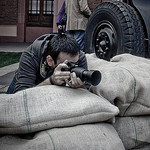
[photo: “Behind the Enemy Lines,” by Mauricio Ulloa, used under a Creative Commons license]
Octopi, Jellyfish, Cross-Cultural Partnerships, and Making Plans

An article in Wired discusses lessons we can learn from the octopus. One of them touches on cross-cultural partnerships, formed when sometimes antagonistic groups come together to combat immediate problems:

Some life-forms engage in symbiotic partnerships with other organisms. An octopus may provide shelter for toxic bacteria, which then give the octopus yet another tool in its arsenal—the ability, found in certain species, to inflict a deadly bite.

This skill, too, can translate to the man-made world. Symbiosis is at the heart of a remarkable partnership between Israeli, Palestinian, and Jordanian health practitioners who are sharing technology, databases, medicines, and knowledge to identify and reduce the threat of infectious diseases regardless of where they appear. These symbioses work not because they are perfect, all-encompassing solutions but because they solve immediate problems. The doctors in this coalition didn’t set out to create peace in the Middle East, but if peace does break out there, it will undoubtedly owe some credit to symbiotic relationships like this one.

And this isn’t the only place where these partnerships have born fruit:

[T]he facilitators of this Middle Eastern infectious-disease consortium have replicated their success in the mutually hostile southeast Asian countries bordering the Mekong River and are now bringing the model to southern Africa.

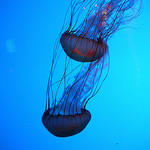
This reminds me of a book I’ve read that has found a place on my “favorites” bookshelf—Me, Myself, and Bob: A True Story about God, Dreams, and Talking Vegetables. In it, Phil Vischer tells how he founded Big Idea Productions, home of Veggie Tales, and built it into a major producer of Christian entertainment, only to see his dreams and his ministry end in bankruptcy. After having his grand plan, his “big idea,” fail, Vischer decided to imitate another sea creature . . . the jellyfish. He explained this approach in an interview with In Touch Magazine:

[M]y new company is called Jellyfish Labs—very intentionally, because jellyfish can’t choose their own course. They can’t locomote. They are carried by the current. And they have to trust the current will take them where they need to be and keep them alive.

I went off the track with Big Idea when I started making 20-year plans. I was like, “Okay, God, this is what I’m going to do for You in the next 20 years. Now, all You need to do is just bless it.” When we do this, we don’t have to listen anymore, because we’ve already figured out what we’re going to do. God is in some sort of subservient role where He gets to sit in the back seat and hand out the credit card when we need resources.

But for a jellyfish to make a 20-year plan—it’s humorous. It’s lunatic. I had viewed myself as a big macho barracuda in the ocean of life. In reality, I was a jellyfish—basically a spineless bag of goo that has no form.

. . . . 

In reality, if I’ve given Christ lordship of my life, and if I understand the concept of lordship, where I am in 20 years is really none of my business. It’s my business to say, “Okay, God, what have You called me to do today?”

Expats, repats, TCKs, ATCKs, missionaries, ex-missionaries, and others who face life-changing transitions can find it hard to make, and keep, long-term plans. What does the future hold? Will my transitions define my life? Where am I headed? Who have I become? There is a time for making big plans and for having big ideas, but thanks to Phil Vischer for reminding us that even though the jellyfish doesn’t control the currents, it still gets where it needs to go.

(Rafe Sagarin, “When Catastrophe Strikes, Emulate the Octopus,” Wired, March 21, 2012; Tonya Stoneman, “Mighty like a Jellyfish,” InTouch Ministries)

[top photo: “Octopus at Mothra,” by Neptune Canada, used under a Creative Commons license; bottom photo: “Jellyfish” by CodyHanson, used under a Creative Commons license]