You Remember You’re a Repat when . . . (Part 2)

(Part 1)

You remember you’re a repat when . . .

31. You stock up on Mountain Dew because you never know when it won’t be available again, and you check the expiration dates.
32. You think the public schools are great because the teachers are all proficient in English.
33. You read all your junk mail because it looks important.
34. You don’t hang pictures on the wall in case you’ll be moving again soon.
35. You still have unopened boxes shipped from overseas, and you don’t have a clue what’s inside them.

36. For Christmas, you open up one of those boxes.
37. Even though you own a house, you still catch yourself turning the music down so you won’t “bother the neighbors downstairs.”
38. You’re invited to a bar-b-que and your first thought is “I hope they don’t give me the fatty part of the goat’s tail.”
39. You hand the cashier at Wal-Mart your credit card instead of swiping it yourself.
40. You put your hand lotion in 3 oz. containers just to drive to visit grandma.
41. You’re frustrated that you have to ask for chopsticks in a Chinese restaurant.
42. You have to ask what’s the right amount to spend on a wedding gift.
43. You give up trying to decide which shampoo to buy.
44. You ask your friends to take off their shoes when they enter your home.
45. People ask where you’re from and you just answer with the name of the city where you live now.
46. You skip reading the Facebook posts of your former coworkers overseas because it’s just too hard.
47. When you buy clothes, you check to see that the brand name is spelled correctly.
48. You stop telling stories about your old host country because people stop asking for them.
49. Now that you’ve returned, your family members can tell you they didn’t know why you went over there in the first place.
50. People who knew you before you left ask if you’ve “gotten that out of your system.”
51. You go to the hospital for surgery and you take your own towels and gauze.
52. Your high schooler is pulled over for a routine traffic stop and gets out of the car before the policeman approaches.
53. You question the waitress’s math skills until you remember she simply added tax.
54. You realize that Taco Bell isn’t quite as good as you remembered it.
55. Your daughter calls herself an “African American” because she was born in Africa.
56. You look forward to mowing the lawn, because you have a lawn.
57. You say “here” and you mean the US, not the town you’re in.
58. You take an umbrella outside when the sun is shining.
59. “Made in Taiwan” labels fill you with nostalgia.
60. People correct you when you pronounce foreign names the way they’re supposed to sound.

(Part 3)

[top photo: “Electrical Outlet,” by grendelkhan, used under a Creative Commons license; bottom photo: “Having It Both Ways,” by Keith Williamson, used under a Creative Commons license]

You Remember You’re a Repat when . . . (Part 3)

(Part 1, Part 2)

You remember you’re a repat when . . .

61. You describe a city as “small” because it has only a million residents.
62. You hear yourself saying at the dinner table, “Where’s the garlic?”
63. You pull out the winter coats when the temperature gets below 70 degrees; or you pull out the shorts when it gets above 40.
64. You get a bill from the doctor and you call to see whose clerical error made the amount so high.
65. Glade’s “Ocean Breeze” scent isn’t any substitute for the real thing.
66. You assume everyplace in the US has WiFi, just like in the city you used to live in.
67. Wearing your traditional ethnic shirt isn’t as much fun now that you’re not going back again.
68. You ask at the grocery store if they have KLIM powdered milk. When they say “No,” you ask when they expect it to be in.
69. You buy three cartons of Hagen Dazs ice cream because it’s one third of the price of Hagen Dazs in your old host country. When you get home, your spouse reminds you it’s still too expensive.
70. You reset your new computer’s clock to military time.
71. You need to convert to the metric system to make sure of distances and temperatures.
72. You get fully dressed to sit in your living room because someone may be peeking in the window.
73. Airports feel like home.
74. The thought of moving again sends you into a panic attack. But your spouse feels the same way about staying put.
75. Your college-age children resent that you took away their opportunity to go “home” for the summer.
76. You can’t remember why anyone would like pineapple from a can, the same for orange juice from concentrate.
77. You understand why the restrooms in LAX have signs saying, “Do not stand on the toilets.”
78. People say, “football,” and you ask, “Which kind?”
79. A friend sends funds to a scammer who sent out an e-mail saying he’s you, stranded abroad, and your friend believes it because, hey, you travel all the time and you’re always needing money.
80. You don’t know what to buy your parents for Christmas now that you can’t give them souvenirs.
81. You shed a tear after finally eating the last package of dried fruit that you brought back with you.
82. You do your happy dance when you find another package of dried fruit in the outside pocket of your carry-on bag a year later.
83. You cringe because you hear someone say she’s “starving to death.”
84. You realize that all the documents on your computer are formatted for A4 paper.
85. You tell your waiter, “I’d like my water with ice . . . if you have any.”
86. You get nervous about buying tickets at the movie theater, because you forgot what the “rules” are.
87. You still can’t drink water straight from the faucet.
88. Your children are happy to see that the US has Costcos, too.
89. You miss the familiar sound of the daily call to prayer . . . or a rooster crowing . . . or late-night traffic . . . or the song the trash truck plays.
90. You show up at a party 2 hours late because you don’t want to be the first one there.
91. You put your favorite DVD in the player and it says, “Region Unsupported.”
92. You understand that some things just take a lot of time.

[top photo: “Electrical Outlet,” by grendelkhan, used under a Creative Commons license; bottom photo: “Having It Both Ways,” by Keith Williamson, used under a Creative Commons license]

Can There Be Too Much Choice? It’s a Cultural Thing

I recently wrote about the trials of choosing cereal at Wal-Mart, and friend and fellow blogger MaDonna followed up with her own post calling the cereal aisle “one of the top 5 places expats hate to visit in the US.”

Sheena Iyengar, a professor at Columbia University and leading expert on choice, understands our pain. She writes in her book The Art of Choosing,

In 1994, the year I had my first inkling that there might be such a thing as too much choice, over 500,000 different consumer goods were already available in the United States. By 2003, the number had increased to nearly 700,000, an upward trend that shows no signs of letting up. Technological advances frequently introduce new categories of products into our lives. Some of them—cell phones, computers, digital cameras—become indispensable, and soon enough the options proliferate. Just as importantly, not only are there more goods on the market, there are more ways to get at them. The typical supermarket, which carried 3,750 different items in 1949, now boasts some 45,000 items. Walmart and other “big-box” retailers offer smorgasbords of over 100,000 products to Americans in just about every part of the country. And if you don’t find what you’re looking for within a few blocks, you’ll certainly find it with a few clicks. The Internet extends your reach well beyond local venues, providing access to the 100,000 DVDs on Netflix.com, 24 million books (and millions of other products) on Amazon.com, and 15 million singles on Match.com.

Following is a fascinating TedGlobal talk by Iyangar in which she discusses cultural differences in the valuing of choice. In her introduction to the video on her website, she says,

In America, choice is sacred. We believe in its limitless power and we worship it for the possibilities it offers. For Americans, choice is liberty, which is subordinate only to life itself in the Declaration of Independence. So it can be almost impossible to accept that not only are there countries and cultures that do not subscribe to the American ideal of choice, but that they wouldn’t necessarily be better off if more choice suddenly became available to them. I explore the great variation across the globe in beliefs about who should choose and when, how much choice should be available, and when choice is a burden rather than a pleasure.

Iyangar starts her presentation with an experience she had in a Japanese restaurant and ends in the US with a story of how her blindness affected how she chose the right fingernail polish. In between she shares research and anecdotes from around the world. Enjoy.

[photo: “Fi,” by Michael Hopkinsii, used under a Creative Commons license]

Disenfranchised Grief and the Returning Cross-Cultural Worker

Disenfranchised grief, also called “hidden sorrow,” is caused by “a loss that is not or cannot be openly acknowledged, publicly mourned or socially supported.”  This definition comes from an article I recently came across from Australian Family Physician, discussing the response of general practitioners (family physicians) to repatriated cross-cultural workers affected by grief.

What makes their grief disenfranchised is that their losses are not typical to the population at large, so others often discount those losses or don’t understand them. It is difficult to have compassion for a person when you don’t recognize why he is grieving. Others with disenfranchised grief include “ex-spouses, caregivers, nursing home staff, pet owners, children, adoptees, individuals with developmental disabilities, . . . those who may be grieving suicide or AIDs victims or other forms of stigmatised death, . . . victims of sexual abuse, indigenous people and prisoners re-entering their original subcultures.” While this seems to be a list made up of disparate groups, their commonality is that the losses they suffer are often easy to ignore or downplay.

The part of the article that most helped me understand the concept was the authors’ explanation of six types of disenfranchised grief. I am presenting the list here, but I’ve taken the liberty of providing my own examples of how they might apply to repatriated cross-cultural workers:

  • The griever’s relationships are unacknowledged
    [“You can enjoy yourself now that you’re back with your own people.”]
  • Lack of acknowledgment of the griever’s loss
    [“People move all the time. It’s not like somebody died.”]
  • Exclusion of the griever as not being capable of grieving
    [“She’s just a child. She’ll make new friends.”]
  • Exclusion of the griever due to the circumstances of the loss
    [“You knew what you were getting into when you decided to go overseas.”]
  • Exclusion of the griever due to their way of grieving which is not deemed appropriate by the community
    [“The Bible says ‘Consider it pure joy, my brothers, whenever you face trials of many kinds.'”]
  • Self initiated disenfranchised grief where shame plays a significant role
    [“Why don’t I trust God more?”]

The authors go on to stress how important it is that general practitioners understand disenfranchised grief and take steps to deal with it. Not only may family doctors be asked to treat physical symptoms that are a result of grief, but they may also be the only affordable and “safe” help that is available to the re-entering worker.

I wish that we could all understand and acknowledge others’ grief, whatever the source, so that we could “mourn with those who mourn,” giving them the community they need so they don’t have to grieve alone.

(Susan Selby, et al, “Disenfranchised Grievers: The GP’s Role in Management,” Australian Family Physician, Vol. 36, No. 9, September 2007)

[photo: “grief,” by Tomek.pl, used under a Creative Commons license]

Back in the States after Being Gone for a Long Time (poem)

Back in the States after being gone for a long time,
I’m standing
in the cereal aisle at Wal-Mart.
My list says “bran cereal” with no instructions
on how to pick out the right kind.
I tell the kids to quiet down
and remind them
that “everybody here knows English
so they can understand everything you say
now.”

A friend turns the corner and sees us: “Hey!
Long time no see.
Didn’t know you were back.
Look at you.
A little grey around the edges,
but not too bad.
Bet you’re glad to be
home.”

He’s describing me like you’d describe a used book:
Acceptable.
Slight shelf wear.
Dust jacket missing.
Discoloration on edge of spine.
A few underlined passages and extensive notes in margins.
Some dogeared
pages.

We chat about
how big the kids look and about
the new high school being built,
and then he says again,
“Bet you’re glad to be home.”
This time I respond with “Well,
both places have their advantages.”
My daughter shows me a box of
off-brand Fruit Loops,
raising her eyebrows like two question marks.
I shrug my shoulders and she puts it in the
cart.

That is the way I feel,
like a used
book.

But deep inside, I’d rather
be a manuscript.
Like one of those manuscripts
that’s been sent to
44 publishers and rejected
44 times.
Then the author’s wife sees it
in the trash folder
on the computer and sends it
in for one last try.
It’s picked up
and becomes a bestseller,
and it’s made into a movie
that wins two or
three Academy Awards.
That’s what I’d like to be, now
that I’m starting over
with this new life
in a new place that everybody says is
home.

African-American Expats

Here’s a book that I’d like to read . . . as soon as it’s written.

The Center for Intercultural Dialogue is calling for chapters and chapter proposals for a proposed book with the working title The Hidden Lives of African Americans Living Abroad Series, Book 1: Articulating the Opportunities and Challenges of Living Internationally. The overview of the book includes the following:

While anecdotal data indicate that the experiences of African Americans living abroad qualitatively differs from those of European Americans, there is a substantial lack of scholarship that investigates the ways in which national and ethnic identities are expressed (and experienced) cross culturally by Black Americans living overseas. In many ways, the everyday lived experiences of African American expatriates living abroad remain unknown—and largely neglected by mainstream media and academic research. This series seeks to examine and highlight what life is like for African Americans living abroad.

And here are some of the suggested chapter topics that look particularly interesting to me:

  • What it’s like to be the only African American in the country
  • “But you don’t have blonde hair or blue eyes”: Encountering and overcoming stereotypes of the “All American” image abroad
  •  “How do they treat Black people there?” Addressing the pre-departure fears of friends
  • Perceptions of African Americans abroad
  • African American Image in Overseas Advertising
  • Returning to the U.S. and Readjusting to Home

As a White American, I’ve often wondered what it is like for Black Americans living overseas, with the extra challenges of facing stereotypes and prejudices . . . layered on top of and intertwined with the other difficulties of cross-cultural living. Hopefully this book—and the whole series—will draw together some good stories and research and create a meaningful discussion.

Go to “CFP African Americans Living Abroad” for more information and submission guidelines.

[illustration: “Blank Open Book,” by DonkeyHotey, used under a Creative Commons license]

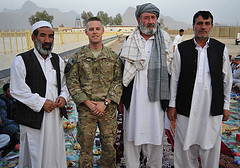
Returning Soldiers, “Fitting Back into That World”

NPR is running a series on the members of the 182nd Infantry Regiment, which has recently returned to the States after spending a year in Afghanistan. Reporters will be following the group as they adjust to life in the US over the coming year. I’ve never served in the military, but I have come “home” after living overseas. I can only imagine the loss and trauma and stress that these soldiers have experienced, along with the challenges they are now facing. But I’ve also learned that it doesn’t help to compare experiences: every situation is unique, and different levels of loss and trauma and stress are all still loss and trauma and stress. When I read/hear stories such as these, I’m reminded how much we all have in common when we come back to the US after adjusting to another culture. And while serving in a war overseas certainly adds to the challenges of readjustment (war has a “culture” all its own), I know other repats, former missionaries and NGO workers who served in harsh circumstances, who carry some of the extreme baggage that soldiers bring back with them.

Following are some pullouts from the report. If you are readjusting to life back in the States, regardless of where you were or what you did while you were away, change a few words here and there and see how many of these ring true to you. As I said, I’ve never fought in a war, but I’ve tasted some of the challenges of reentry. I will pray for the 182nd Infantry Regiment today. . . .

Once they settle back home, they’ll begin the transition from soldier to civilian. Some could face unemployment and financial problems; others may struggle with depression or post-traumatic stress disorder. Their families face challenges as well, trying to integrate these men back into their lives.

“But listen, something is no kidding going to slap you right across the face when you get home within the first 72 hours, and it’s going to let you know that life has continued on in your absence,” [says. Col. Tim Newsome].

Newsome says these war wounds [like PTSD or depression] should be treated like any other. . . . “Somebody has got something wrong with their foot, they go see the podiatrist,” he says, “no harm, no foul. Nobody says anything. It’s when they got something wrong up here, that’s when we want to put a stigma on somebody.”

But going home comes with its own kind of stress. Like many guardsmen, [Spc. John] Nestico had a civilian job before he deployed. He worked at Radio Shack selling cell phones, but a lot of his friends there have moved on, and he’s worried about fitting back into that world.

“For a while, admittedly I was in a bit of a free fall,” he says. “It just took a change of environment and the ability to talk to someone who wasn’t in uniform to allow myself to open up a little bit [and] to feel like what I say here isn’t going to be held in contempt or against me, but in the best interest of what’s good for me.”

They’ll return to their civilian lives. . . . For some, that will mean packing up their uniform and picking up where they left off; for others, it will mean picking up the pieces and starting over.

(Rachel Martin and Tom Dreisbach, “A Rest Stop on the Road from Soldier to Civilian,” NPR, April 1, 2012)

[photo: “110828-F-JP934-057,” by ISAF Public Affairs, used under a Creative Commons license]