
“Letters Never Sent” but, Thankfully, Published Instead

It’s been 25 years since Ruth E. Van Reken125933835_e355fbcad2_m first published Letters Never Sent, but I hope it doesn’t ever become a book rarely read.

Following her experiences as a Third Culture Kid, born to missionary parents in Nigeria, and later as a missionary to Africa herself, Van Reken wrote a series of “letters,” to her mother and father, and to God, expressing feelings that earlier she wasn’t able to fully share.

While it would be easy to assume that the details of Van Reken’s story are dated—the book begins with her trip to boarding school in 1951—her expressions of honest emotions cut through the years and show the wonderings and pleadings of a heart that beats in many missionaries and their children today. But it is a heart that is all too often hidden and quieted.

One of the feelings voiced by the young Ruth Ellen is guilt . . . guilt that her inner thoughts are a betrayal of her parents’ calling. During her high-school years, she and her sister stayed in the States, while their parents returned to their work in Nigeria. As her mother and father’s departure nears, Ruth Ellen fights with her emotions, writing in a “never sent” letter:

If I throw myself into your arms and sob my heart out, it might keep you from going. And even though that’s what I want, how could I ever bear the guilt of being the one who kept you from doing God’s work? I’ve always vowed I wouldn’t be one of “those kids,” the kind that other missionaries talk about in whispers, with a sad shake of their heads. “So-and-so couldn’t come back to the field because of their children.” They must be pretty bad kids, I’ve always figured. I don’t want anyone to say that about me or our family.

And I can’t very well come to God with this because, in a way I feel like it’s all His fault.

Years later, as Ruth Ellen ponders her approaching wedding to David Van Reken, she expresses a distrust of God, developed from many years of having, as a TCK, to let go of what is dear to her:

I can’t believe God will let me keep David. It’s like He’s dangling Dave on a rope, letting him come closer and closer. I’m afraid that at the last moment, when I put out my hand to take him, the string will be jerked back and God will laugh.

“Ha ha. Thought you finally had someone you could keep. Don’t count on it. Whatever you depend on, I will surely take that, so that you’ll depend solely on Me.”

Ruth does get to keep David, and the two are soon joined by a baby daughter. But depression comes to Ruth, seeming to be at odds with the spirituality that she longs to possess. “How many hundreds of testimonies have I heard about the joy that Jesus gives?” she writes. “He surely isn’t giving it to me right now—or maybe I just don’t know how to receive it.”

Her depression becomes deep enough that she thinks about suicide:

I’ve actually wondered what it would be like to take pills and never wake up. But in my heart I know that wouldn’t solve anything. I have a child I’m responsible for, and I want to see her grow up. And I want to live, if I can be the person that I’ve always thought I had the potential to be. But right now that seems like a hopeless dream.

Then, using words that are reminiscent of those penned by the Psalmist in Psalm 13, she writes,

The thread I’m hanging on to is an intellectual belief that God still has a purpose for my life. I can’t imagine how He can ever put all the pieces back together and make me whole, but it’s my only hope. I told Him today that He could forget helping me to do better—there’s nothing left of me to help. If He doesn’t do something new, I’m finished.

But there is hope. There is help for her to do better. And it comes in the form of a new friend, Linda, who opens a path for Ruth by sharing her own personal struggles in a Sunday school class. This is something that Ruth hasn’t experienced before, and it gives her courage. This leads to many conversations with Linda, in which Ruth shares her pain, and Linda listens without judgment.

Within a few years, the Van Rekens are preparing for their own missionary work in Africa, and Ruth continues to learn how to function without hiding behind masks. Sometimes the masks come off gently, as with Linda, but at other times, they are pulled off forcefully, as when a pastor shares from the pulpit about some of her struggles. But to her amazement, she writes, when “[t]he awful, naked ugliness of my soul was exposed, . . . I was still accepted!”

Healing also comes through forgiveness: forgiving her parents for her many separations from them and forgiving “all those who locked me up with pat answers or quick words of encouragement, when what I needed was understanding and a hug.” Following the death of her uncle, Ruth gets a different kind of response from Jesus: “He held me and understood. He acknowledge my pain. He didn’t try to talk me out of my hurt. . . . I’m learning about God as the Comforter and binder of broken hearts.”

But in letters dated less than two years later, as she and David are serving in Liberia, Ruth writes that the depression has returned. She tells God, barring a change in the next month, to let her die. In her conversations with God that follow, she learns that she has not addressed all of the anger that is leading to her depressed feelings. She still needs to “forgive” God.

“Why don’t you leave me alone?” she hears herself say. “Ever since I came to Liberia to serve you, You’ve done nothing but bad things to me. I’m sick and tired of it.” And she hears God say to her that he isn’t at all shocked by her anger. He can handle it. “You can love someone and still be angry at him,” God tells her. Acknowledging this anger is an important step for Ruth, a step that leads to more healing.

One of the final letters penned by Ruth is dated 1984. That’s 24 years after Ruth Ellen had voiced her struggle with guilt because she wasn’t the perfect missionary child. In it, she says, after reading through all of her previous letters, that there still was one more person to forgive:

I can forgive the little girl I was, for not being all she thought she was supposed to be. The greatest joy has been to understand for the first time in my life that God is the “God of all Comfort.” I could not understand that until I recognized how much I needed His comfort.

Ruth’s story is one of faith and anger and hope and fear and sadness and peace, all flowing one into another. It is a story beautifully and sincerely told. It is a story that can speak to generations of TCKs and cross-cultural workers and to those who want to understand them. And it’s a story that continues. Last year, Van Reken published a newly revised edition of Letters Never Sent, containing 30 additional pages, with photos and an epilogue addressing her later life, including a bout with cancer.

It’s been 25 years since Ruth E. Van Reken first published Letters Never Sent, but I hope it doesn’t ever become a book rarely read.

The above quotations are taken from the 1988 edition of Letters Never Sent. The book was first printed in the US in 1987 under the title Letters I Never Wrote.

[photo: “unreachable,” by Daniel Zimmel, used under a Creative Commons license]
Regrets and Remembrances: A Prayer for Those Who Leave Home

With one plane ride the whole world as TCKs have known it can die. Every important place they’ve been, every tree climbed, pet owned, and virtually every close friend they’ve made are gone with the closing of the airplane door.
—David Pollock and Ruth Van Reken, Third Culture Kids

5420666395_e086b79cf9_mThis closing door doesn’t just happen to Third Culture Kids. It’s also the experience of immigrants who leave behind many what-could-have-beens in their old country. Cross-cultural workers feel the door close when they leave their work and return “home.” (What other job requires you to leave the country once you’re no longer on the payroll?) International students close the door with the hopes that new opportunities will open many more. And refugees often see the door slammed and locked by soldiers carrying guns.

5420666545_cd2c078381_mBut while the door is closed, the mind is still open to thoughts about what was left behind. Some thoughts are joyous and life giving. Some are hurtful and life stealing. And often they come intricately, painfully intertwined, called up by a scent, a word, a sound, a flavor, a feeling or a dream. Bittersweet.

For those who find themselves on the other side of a closed door, I offer this prayer, inspired by Reinhold Niebuhr’s “Serenity Prayer.”

God, grant me the confidence to let go of the regrets that I should not hold on to,
The ability to hold on to the memories I should not let go of,
And the wisdom to separate the one from the other. Amen.

(David C. Pollock and Ruth E. Van Reken, Third Culture Kids: Growing Up among Worlds, Boston: Nicholas Brealey, 2009)

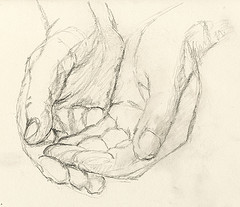
[illustrations: (upper) “Joined” and (lower) “Cupped“) by Pete Hobden, used under a Creative Commons license]

Back Home to Papua, 50 Years after Peace Child

Home is an elusive concept for many Third Culture Kids. Paul Richardson, who was born in Papua, Indonesia, is no exception.

“Because I lived so many places in different parts of the world, traveled so much,” he says, “I’d never been able to really say where’s home.”

5712238389_d4bb32ba5f_nBut this summer, he, along with his father and two brothers, returned to the place where he was “born and raised.” That return is the subject of the 15-minute film Never the Same: Celebrating 50 Years since Peace Child.

Paul is part of a famous family, at least among evangelical Christians and the missionary community. Don and Carol, his parents, moved to Papua in 1962 to take the gospel to the Sawi, a tribe of cannibals and headhunters. Their story is the subject of the book Peace Child: An Unforgettable Story of Primitive Jungle Treachery in the 20th Century, later made into a movie, also called Peace Child.

When missionary historian Ruth Tucker wrote From Jerusalem to Irian Jaya: A Biographical History of Christian Missions, it was the work of the Richardsons in Papua (formerly Irian Jaya) that made up the final chapter.

Ministering to a warring tribe was not easy, and at one point, Don told the Sawis that if they didn’t stop fighting, he and his family would have to leave. In order to keep the missionaries there, each Sawi village gave an infant boy to its enemies as a sign of peace. This idea of the “peace child” became a door for the message that the Richardsons were trying to tell them, that God, likewise, had given the world a peace gift, his only son.

This experience among the Sawi formed the basis for Don’s belief that every culture has a “redemptive analogy,” a story, practice, or tradition that can be used to help the people understand the gospel of Christ.  He expounds on this concept in his book Eternity in Their Hearts: Startling Evidence of Belief in the One True God in Hundreds of Cultures throughout the World.

Fifty years after first arriving in Papua, Don revisited the Sawi tribe, which had not only embraced Christianity but had become a base for reaching out to the tribes around them with the message of Christ. Making the trip with him were his sons: Steve, who was seven months old when his family moved to be with the Sawi, and Paul and Shannon, who were born in Papua.

Steve is now the president of the mission agency Pioneers-USA, and he serves as the narrator for Never the Same, which you can view below. It begins with a short overview of the Richardson’s work with the Sawi people and then shows their reunion with their old friends. This is where Paul talks about returning to the place where he lived as a child:

There’s no electricity except for a little generator, and . . . there’s no emails, there’s no text messages . . . just, you know . . . it’s just quiet here. And it’s beautiful, and . . . and there’s a connection with the people here. And, uh, just waking up in the morning, hearing the sounds of the jungle, and, I don’t know, I slept better last night than I have in years, even though I’m just sleeping on the floor in this village.

So there is something to going back. I . . . Because I lived so many places in different parts of the world, traveled so much, I’d never been able to really say where’s home. But I think this would probably be more than anywhere else . . . is where I was born and raised. So this will always be special for me.

I heard about this video from Brian Stankich at Fulfill. In response to my post on eating insects, he pointed to a scene where Steve is eating some grubs on a stick, given to him by his Sawi hosts. Showing his snack to the camera, he says,

Oh this is um . . . these are grubs. And inside they’re just full of grease, and the heads are really . . . very strange, actually, the more I think about it. But [chewing and clearing his throat] they grow on you.

[photo: “Papua-Indonesia, 2008,” by CIFOR, used under a Creative Commons license]

Eleven Tips for Helping Someone with Cross-Cultural Transitional Loss

7016973613_ded8a0eac1_mIf you want to help people in transition—cultural, geographic, and vocational transition—then you’ll need to deal with the grief that comes with their losses. Here’s a great resource for that, A LifeCare Guide to Helping Others Cope with Grief. (LifeCare is a leading provider of “work-life services.”) While this publication is aimed at comforting people who have lost a loved one, the advice it gives can be applied to those with cross-cultural transitional loss as well.

It opens with the second half of this quotation from Henri Nouwen, from Out of Solitude: Three Meditations on the Christian Life:

[W]hen we honestly ask ourselves which persons in our lives mean the most to us, we often find that it is those who, instead of giving much advice, solutions, or cures, have chosen rather to share our pain and touch our wounds with a gentle and tender hand. The friend who can be silent with us in a moment of despair or confusion, who can stay with us in an hour of grief or bereavement, who can tolerate not knowing, not curing, not healing and face with us the reality of our powerlessness, that is a friend who cares.

Here are eleven tips from Helping Others Cope with Grief to guide us in being that “friend who cares.” Each one is followed by a short excerpt to help explain the idea. I have, when necessary, replaced some words (in brackets) in order to to apply the advice to people experiencing loss due to cross-cultural transition—a group including all cross-cultural workers, their parents and family left back “home,” Third Culture Kids, expats, and repats:

  1. Mention the [lost relationships, places, and things], and acknowledge your awareness of the loss.
    . . . . Many people avoid mentioning the [loss], fearing it will remind the grieving person of his or her pain. . . . [B]ut behaving as if you don’t remember or are unaware of your [friend’s] pain often leaves him or her feeling very alone.
  2. Listen to your [friend].
    . . . . The most important thing you can offer someone who is grieving is your ability to listen without judgment. A good rule to follow is to listen 80 percent of the time and talk 20 percent. . . .
  3. Insist that your [friend] see a doctor if he or she exhibits signs of depression.
    Intense grief can lead to depression. If your friend seems unusually depressed or withdrawn, suggest that he or she seek professional help. . . .
  4. Encourage your [friend] to make wise choices.
    Urge the person who is grieving to pay attention to his or her own needs, and make choices accordingly. . . .
  5. Offer practical help; don’t wait to be asked.
    . . . . Make specific offers several times, and encourage your friend to take you up on your offers. Avoid phrases such as, “Let me know if I can help.” Usually, he or she won’t let you know for fear of imposing on you. . . .
  6. Remember that grieving is a long process.
    The person you care about may be grieving for a long time. Several months or more after the transition, he or she may actually be feeling the loss more acutely, and much of his or her support system will have backed off. . . .
  7. Offer your companionship.
    Your presence can be comforting to a grieving [friend]; you don’t have to do anything special. Often, grieving people just do not want to be alone.
  8. Don’t minimize the loss.
    Be careful not to say, “I know exactly how you feel.” . . . Instead, use statements such as, “I know this is difficult,” . . .  or some other statement that is heartfelt and accurate, but leaves room for the uniqueness of your [friend’s] experience.
  9. Encourage your [friend] to share his or her feelings.
    Avoid saying things like, “Be strong for…” or “Don’t cry.” This sends the message that you are uncomfortable with your [friend’s] intense feelings and, therefore, you will leave him or her emotionally alone. . . . Instead, encourage your [friend] by saying, “It’s okay to cry,” or “You don’t have to be so strong.”
  10. Help your [friend] create new traditions/rituals/activities.
    . . . . Holidays and other events filled with tradition can . . . be especially hard to deal with; try to help your [friend] discover new ways to experience these events. At the same time, he or she should be encouraged to cherish the memories and/or traditions associated with the [people and places no longer close by].
  11. Give advice cautiously.
    Avoid offering advice with phrases such as, “You should…” or “You need to….” . . . . Instead, give advice that encourages the grieving person to trust him or herself and make choices based on his or her needs, rather than on what others think he or she should be doing or feeling.

(A LifeCare Guide to Helping Others Cope with Grief, LifeCare, 2001)
[photo: “B,” by Eugene’s Likeness, used under a Creative Commons license]

Can’t We Just Be Friends? Bridging the Cultural Divide on Campus

 In my last post, on friendships between international and American students, I pulled some statistics from Voice of America’s “Student Union” blog. Actually, rather than a lot of numbers, much of what you’ll find at “Student Union” are first-hand accounts of what it’s like to study in American colleges and universities, while facing the challenges of a new culture.

There’s a lot of insight and candor there, on a great variety of topics. Take, for example, these posts:

But back to the topic of friendships. In my post I cited a recent study that says over half of students from China and other East Asian countries have no close American friends. Under the title “Whose Fault Is It when American and International Students Don’t Mix?” Jessica Stahl discusses a video from the Office for International Students and Scholars at Michigan State University, in which students from China and the US talk about the ins and outs of cross-cultural friendships. Part of what makes the video especially interesting is that the group of four female Chinese students and the group of three male Americans are not interviewed at the same time. While this means they don’t respond directly to what their counterparts are saying, it does give them a greater opportunity for honesty and frankness.

After the introduction, the video opens with a segment called “Forming Friendships: Finding Common Ground.” One of the Chinese students begins by saying, “Finding something in common is really hard, because you don’t make friends with someone without having something in common with them.” I think she makes a good point.

When we meet people, we usually start with questions that will reveal what we have in common. And when we find that we share something—place of origin, interests, likes, beliefs, friends, experiences—we pursue it in conversation to see how good a fit we are. It takes time and patience to get past the superficials to track down deeper commonalities, and people from different cultures often don’t get past the opening conversation . . . or they don’t even begin the conversation in the first place.

On the other hand, just looking like you’re from “someplace else” is enough to draw attention from others with significant cross-cultural experience. So Third Culture Kids often seek out international students, and international students find community among each other, regardless of how far apart their home countries are. But while this can lead to some wonderful opportunities for friendship, it is often a small pool to draw from, and it can further limit one’s feeling of fitting in to the general population.

To pique your curiosity, I’ve transcribed below more of the students’ comments on this topic of making friends. But really, if you’re interested in any aspect of cross-cultural interactions, watch the whole video. It’s 17 minutes long but well worth your time.

FYI: The video description at YouTube states that the panelists are all undergraduate students at Michigan State, and the American students “have all spent time in China and have meaningful Chinese friendships.”

Here are some of the comments made by the Chinese students.

Students’ get-togethers start off by talking about high school life. When they came from the same area, well they have some kind of similar backgrounds and experiences that we don’t really have.

Some Chinese students, when they talk with an American, when they cannot find anything in common, they’ll just keep quiet. So they just ignore you. . . .

They care about their baseball game, football game, everything else, instead of this bunch of Chinese people just arrived.

If you make friends . . . you want to get involved in the American community, they will treat you as either a joke or just ignore you.

I’d rather just be with my Chinese friends.

I’ve met a lot of great American friends who are willing to sit down and listen to you and also share their story.

And by the American students:

For someone who hasn’t been to China before or who doesn’t know the culture, I think it’s going to be difficult for them to kickstart a conversation.

The closest relationships that I’ve had with Chinese students are the ones where the Chinese students make it an effort to also start a relationship as well.

My feeling, from my experience of why Chinese students don’t necessarily form close relationships with Americans and why Americans don’t form necessarily close relationships with  Chinese is more so the flaw of the Chinese students.

Man, all the Asians are always together. You’ll never see one by themselves. They’re always in a group.

Besides those certain things that do make an impact, we’re all very similar, and you don’t need to stress the differences too much, because those are easily overlooked. . . . Differences aren’t a problem. Differences are what make life.

[photo: “When Chopstick Meet Fork & Spoon,” by Lohb, used under a Creative Commons license]

Conversation: noun, “a turning with”

Steve Smith, author of The Jesus Life and co-founder of Potter’s Inn, recently wrote in his blog,

[I]n the course of life’s seasons, we need to have spiritual conversations with people who are good listeners. Let me be clear here, most people are not good listeners. They listen for facts not feelings. They listen for what they hope to hear. They listen when it may not cost them something.

A spiritual conversation is a reciprocal dialogue between two people where thoughts, opinions and feelings are shared and received. It’s two-way. Not one way.

People who have gone through major transitions—and others who have encountered loss—need good listeners. But what is necessary to be someone who listens well, to be someone who nurtures spiritual conversations? How about compassion and empathy and comfort?

Following is a list of words that I associate with good listeners. We all know what the words mean, but we’ve become fairly complacent in using them. Therefore, as a way to jumpstart our thinking and to help us do a better job of living them out, I’m pairing them with the literal meanings from their origins (with the help of the  Online Etymology Dictionary and other resources). My intent is not to “correct” their modern definitions but simply to give depth to what we already know.

For instance, today a companion is a friend or partner. But the word companion is formed from two parts that originally meant “with” and “bread.” So a companion was someone who shared a meal with another. Even now we understand the link between sharing food and sharing our hearts. Here’s what Smith says about companionship:

I wrote in The Jesus Life that spiritual conversations take place at the table where we eat our meals. . . . It’s never an intent when you ask someone for lunch–to share protein, carbs and water with someone. No, when you ask someone for lunch, you’re really meaning, “Hey, let’s get together so we can share what’s been going on in our lives. It’s been too long. How about next Tuesday at noon at the deli?”  That’s the stuff of conversations where hearts connect and souls meet and people who are lonely become spiritual companions.

Now, here’s the rest of my list:

acknowledge: “to admit understanding or knowing”
from a blending of Old English on, “into,” and cnawan, “recognize,” with Middle English knowlechen “admit”

affirm: “to strengthen”
from Latin ad, “to,” plus firmare, “make firm”

advocate: “someone called to help or plead”
Latin ad plus vocare, for “to” and “to call”

comfort: “to strengthen much”
Late Latin com, “very,” and fortis, “strong”

commiserate: “to lament with”
from Latin com, “with,” and miserari, “to feel pity”

communicate: “to make common”
from Latin commun, “common,” plus the verb suffix icare

companion: “eating partner”
Latin com, “with,” and panis, “bread, food”

compassion: “a suffering with”
Latin com and pati, meaning “with” and “to suffer”

concern: “a sifting” or “comprehension”
from Latin com, “with,” and cernere, “to sift”

confide: “to trust strongly”
Latin com plus fidere, meaning “very” and “to trust”

console: “to give much comfort or solace”
from Latin com, “very,” and solari, “to comfort”

contact: “to touch with”
from Latin com, “together,” and tangere, “to touch”

conversation: “a turning with”
Latin com, meaning “with,” and vertare, meaning “turn about”

empathy: “a feeling in”
Greek en and pathos, meaning “in” and “feeling”

encourage: “to add heart or bravery”
Old French en, “make, put in,” and corage, “heart, innermost feelings”

sympathy: “a feeling together”
Greek syn, “together,” plus pathos, “feeling”

understand: “to stand in the midst of”
Old English under, “between, among,” plus stand

May we better understand these ideas and, in so doing, better understand each other. May we put them into practice. May we all become better companions . . . and better listeners.

(Steve Smith, “The Power of a Spiritual Conversation,” Steve and Gwen Smith, September 26, 2012)

[photo: “61098,” by Drew Herron, used under a Creative Commons license]

Live and Learn Abroad to Boost Creativity

You’ve been overseas and you’re back in the US looking for work. Not many job descriptions say that the “ideal candidate will have lived outside the US.” So what transferable qualities or skills have your experiences developed in you? How about adaptability, flexibility, resilience, and empathy?

Here’s something else you can add to your qualifications, and there’s research to back up the claim: creativity.

Finding the Relationship between Creativity and Living Cross-Culturally

A few years ago, William Maddux and Adam Galinsky conducted a series of experiments that demonstrate the link between living abroad and creativity.

  1. In the first, the pair showed that the more time a subject had spent living (though not traveling) abroad, the more likely it was for him to solve a particular puzzle. But the cause-effect relationship wasn’t clear. What if it’s simply because creative people choose more often to live abroad?
  2. The second experiment verified the results, this time using built-in controls for personality factors that are linked to creativity in order to isolate the effects of living abroad.
  3. The third study had subjects who had previously lived abroad think and write about their experiences. They were then tested, showing a temporary increase in creativity.
  4. Study number four looked at adaption to a new culture as the main driver of increased creativity. It showed that the more a person adapted, immersing herself in a culture, the higher the creativity.
  5. And, finally, the fifth study followed up by showing that subjects with past living-abroad experience who then imagined and wrote about adapting to a foreign culture exhibited higher levels of creativity in a subsequent exercise.

(William Maddux and Adam Galinsky, “Cultural Borders and Mental Barriers: The Relationship between Living Abroad and Creativity,” Journal of Personality and Social Psychology, May 2009)

Wanting to Live Abroad Isn’t the Same

As described in a recent article in Pacific Standard, researchers at the University of Florida, Gainesville, further validated the idea that studying abroad increases creativity, rather than vice versa. The study, by Christine Lee, David Therriault, and Tracy Linderholm, looked at three groups of students: those who had studied abroad, those who were planning to study abroad, and those who had not nor were planning to study abroad. The first group scored higher than the other two in levels of creative thinking, suggesting that it’s the actual experience of living overseas, rather than a personality type that is inclined to do so.

(Tom Jacobs, “To Boost Creativity, Study Abroad,” Pacific Standard, August 6, 2012; Christine Lee, David Therriault, and Tracy Linderholm, abstract of “On the Cognitive Benefits of Cultural Experience: Exploring the Relationship between Studying Abroad and Creative Thinking,” Applied Cognitive Psychology, July 2012)

Diversification and Flexibility

In the abstract to their research published in the Journal of Experimental Social Psychology, researchers from the Netherlands and California note that “past research has linked creativity to unusual and unexpected experiences, such as early parental loss or living abroad.” Their experiments suggest that it is the “diversifying” aspect of these experiences that brings about great “cognitive flexibility.”

(Simone Ritter, et al., abstract of “Diversifying Experiences Enhance Cognitive Flexibility,” Journal of Experimental Social Psychology, July 2012)

Learning the Whys of Culture Helps Even More

Back to Maddux and Galinsky, this time joined by Hajo Adam. Working on the idea that adapting to a new culture brings about novel ways of thinking, the researchers asked, “What is it about adaptation to foreign environments that is critical for facilitating the creative process?” They hypothesized that it is learning about a foreign culture in a multicultural setting that boosts creativity, To test this, the researchers assembled a group of university students in Paris who had previously lived abroad. They then “primed” part of the group by having them think and write about a time when they had learned about another culture. Others in the group did the same about a time of learning about their own culture. As predicted, the first group scored higher in a followup test of creativity.

The three then focused on “functional learning,” or “learning about the underlying reasons for observed foreign rituals, rules, and behaviors.” Subsequent experiments showed that creativity increased even more when the priming focused on not only on learning something new about another culture but learning when the subjects were actually able to find out the reason behind the cultural differences.

(William Maddux, Hajo Adam, and Adam Galinsky, “When in Rome . . . Learn Why the Romans Do What They Do: How Multicultural Learning Experiences Facilitate Creativity,” Personality and Social Psychology Bulletin, June 2010)

Boosting Your Resume in a Globalized World

So, in review, if you want to develop your creativity, here’s the plan:

  1. live overseas
  2. adapt to another culture
  3. learn about that culture
  4. and learn why a culture is the way it is

In an article posted by the Kellogg School of Management, Maddux tells the American Psychological Association that their research

may have something to say about the increasing impact of globalization on the world, a fact that has been hammered home by the recent financial crisis. Knowing that experiences abroad are critical for creative output makes study abroad programs and job assignments in other countries that much more important, especially for people and companies that put a premium on creativity and innovation to stay competitive.

(Audrey Hamilton, “Living Outside the Box: New Research by Kellogg Professor Adam Galinsky Suggests That Living Abroad Boosts Creativity,” Kellogg School of Management, April 23, 2009)

[photo: “Globeism,” by Joel Ormsby, used under a Creative Commons license]

Comfort vs Encouragement: Jesus’ Responses to Mary and Martha

The past few weeks have been kind of tough for my wife and me. Not long ago, we marked the one year anniversary of our return to the States after living in Taiwan for 10 years. We assumed that by this time we’d have this next stage of our life on track, but instead, we’ve got a lot of loose ends, still looking for full-time work and long-term housing. As Ruth Van Reken says (talking about Third Culture Kids, but it has broad applications), “Every time there’s transition, there is loss,” and then she adds that “where there’s loss, there’s grief.”

One of the ways I’ve dealt with our losses is by attending a “grief group.” While most of the other people in the meetings have lost loved ones, I have found it very helpful to hear their stories and learn general principles for dealing with grief.

The more I hear the experiences of those who are going through difficult times, the more I’m convinced that good listeners are hard to find—and I’m sure I don’t always fall into that category, myself. Too many people would rather offer quick-fix cliches than to share in another person’s grief. In fact, we even have a hard time accepting our own grief. Grief counselor Dr. Alan Wolfelt, in The Journey through Grief: Reflections on Healingwrites about the grieving process,

I must keep opening and changing through it all until I become the unique person who has transcended the pain and discovered self-compassion—a vulnerable yet grounded me who chooses to live again.

“Self-compassion” is an interesting concept, as compassion comes from the Latin com and pati, meaning “with” and “suffer,” respectively. So according to Wolfelt, we must discover how to “suffer with” ourselves.

In a previous post, I quoted Van Reken as saying,

There is a proper place for encouragement (“you’ll do fine,” “just think about others who have so much less,” etc.) but when it happens too soon, it can also abort the grieving process. Comfort is simply acknowledging the loss, validating its reality, and giving the person space to grieve properly before pushing him or her to move on or past it.

She elaborated on this idea in a presentation I heard her give several years ago, citing a wonderful example from the New Testament: When Jesus traveled to Bethany after the death of his friend Lazarus, Lazarus’s sister Martha came out to meet him:

“Lord,” Martha said to Jesus, “if you had been here, my brother would not have died. But I know that even now God will give you whatever you ask.”

Jesus said to her, “Your brother will rise again.”

Martha answered, “I know he will rise again in the resurrection at the last day.”

Jesus said to her, “I am the resurrection and the life. He who believes in me will live, even though he dies; and whoever lives and believes in me will never die. Do you believe this?”

“Yes, Lord,” she told him, “I believe that you are the Christ, the Son of God, who was to come into the world.”

(John 11:221-27 NIV 1984)

This, says Van Reken, is an example of encouragement, given by Jesus because he knew the needs of Martha. But Van Reken sees herself more as a Mary, Lazarus’s other sister. According to Van Reken, Mary didn’t need encouragement, she needed comfort:

When Mary reached the place where Jesus was and saw him, she fell at his feet and said, “Lord, if you had been here, my brother would not have died.”

When Jesus saw her weeping, and the Jews who had come along with her also weeping, he was deeply moved in spirit and troubled. “Where have you laid him?” he asked.

“Come and see, Lord,” they replied.

Jesus wept.

(John 11:32-35 NIV 1984)

While both sisters said the same thing to Jesus, he responded to them in different ways. Van Reken, in an e-mail discussion by the SIM AMK Task Force, says that while Jesus “appealed to [Martha’s] reason and gave her truth as information,” with Mary

Jesus entered into her experience with the truth of his compassion and comfort. Words to her would have bounced like icicles on her heart. Didn’t anyone CARE? And He showed, He cared. I love it that Jesus knows us well enough to meet us as the people He made us to be. I love it when He meets others in their way—but sometimes when they try to meet ME in their way, or I try to meet them in MY way, we can clash. I think they don’t care because they aren’t on the floor crying with me, and they think I’m a basket case who needs to look at the facts a little more clearly and I’ll be “just fine.”

I think that many of us are Marys. We need tears of compassion rather than words of reason. And I would suggest that, lacking the insight of the Son of God, we would do well to start with the kind of comfort that comes alongside those who are grieving, instead of trying to pull them out of their grief with our words or actions. There will be time for encouragement, when the griever is ready. For many of us, it’s not that we don’t understand the encouraging truths, it’s just that other truths, of loss and pain and sadness, are demanding our attention, and we push them away too soon at our own peril.

“My process has been hard at times because so much of our system of faith precludes the simplicity of the ‘Jesus wept’ verse,” says Van Reken. “And for whoever I am, those kinds of tears will change more for me than anything else. The problem with a quick spiritual answer is I actually KNOW the answer; I’m just not there yet.”

(Peter Katona, “More and More Americans Consider Themselves ‘Hidden Immigrants,’” Columbia News Service, February 27, 2007; Alan Wolfelt, The Journey through Grief: Reflections on Healing, Fort Collins: Companion Press, 1997, p 42; Ruth Van Reken, “Mary and Martha,” Simroots Open Dialogue)

[photo: “The Eye of Eliza,” by Augusto Serna, used under a Creative Commons license]