You Remember You’re a Repat when . . . (Part 1)

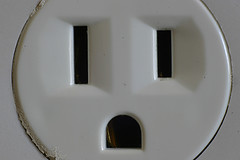
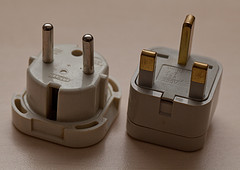
In the hallowed tradition of “You Know You’re an Expat / Third Culture Kid / Missionary when . . .” lists, I offer my own version for repats. This is for the times when you’re reminded that your plug doesn’t always fit the outlet.

Since I’m a former missionary to Asia who’s repatriated back to the US, a lot of my list leans in that direction, but I hope there’s something here for repats of every stripe (or voltage, as it were).

You remember you’re a repat when . . .

1. Your passport is your preferred form of ID.
2. You comment on how cheap gas is in the US.
3. You ask your friends who they’re picking to win the World Cup.
4. Your CNN web page is set on “International.”
5. You accidentally try to pay for something with the strange coins from the top of your dresser.
6. You don’t trust your friends when they say they’ve found a “good” Italian restaurant.
7. You ask the clerk at the convenience store if you can pay your electric bill there.
8. You don’t know how to fill out taxes without Form 2555.
9. You think Americans are loud.
10. You talk about Americans overseas and call them “foreigners.”
11. You find out that living overseas is not the top qualification employers are looking for.
12. You learn to stop talking about the nanny and groundskeeper you used to employ.
13. You have to ask how to write a check.
14. You forgot how many numbers to dial for a local phone call.
15. You tell your toddler, “No seaweed until you finish all your hamburger.”
16. You try to order fried chicken at Burger King.
17. You check prices by converting from what a similar item cost overseas.
18. People say, “football,” and you ask, “Which kind?”
19. You don’t know how to respond when people say, “I bet you’re glad to be back home.”
20. You prefer to hear news reports from someone with a British accent.
21. You wonder why all the commentators on TV are yelling.
22. You wish you’d brought back ten of your favorite kitchen utensil because you didn’t know it’s not sold in the States.
23. You realize international students are you’re kind of people.
24. You ask where you can get a late-model, low-mileage Toyota for around $2000.
25. You turn on the subtitles on an English movie because you don’t want to miss anything.
26. You ask the clerk at the video store if they have VCDs.
27. You wonder if organization should be spelled with an s.
28. You load up your suitcase and you try not to “pack like an American.”
29. You stop bringing your bi-lingual Bible to church.
30. You just smile at people who say, “So I guess you’re all settled in now.”

(Part 2Part 3)

[top photo: “Electrical Outlet,” by grendelkhan, used under a Creative Commons license; bottom photo: “Having It Both Ways,” by Keith Williamson, used under a Creative Commons license]

You Remember You’re a Repat when . . . (Part 2)

(Part 1)

You remember you’re a repat when . . .

31. You stock up on Mountain Dew because you never know when it won’t be available again, and you check the expiration dates.
32. You think the public schools are great because the teachers are all proficient in English.
33. You read all your junk mail because it looks important.
34. You don’t hang pictures on the wall in case you’ll be moving again soon.
35. You still have unopened boxes shipped from overseas, and you don’t have a clue what’s inside them.
36. For Christmas, you open up one of those boxes.
37. Even though you own a house, you still catch yourself turning the music down so you won’t “bother the neighbors downstairs.”
38. You’re invited to a bar-b-que and your first thought is “I hope they don’t give me the fatty part of the goat’s tail.”
39. You hand the cashier at Wal-Mart your credit card instead of swiping it yourself.
40. You put your hand lotion in 3 oz. containers just to drive to visit grandma.
41. You’re frustrated that you have to ask for chopsticks in a Chinese restaurant.
42. You have to ask what’s the right amount to spend on a wedding gift.
43. You give up trying to decide which shampoo to buy.
44. You ask your friends to take off their shoes when they enter your home.
45. People ask where you’re from and you just answer with the name of the city where you live now.
46. You skip reading the Facebook posts of your former coworkers overseas because it’s just too hard.
47. When you buy clothes, you check to see that the brand name is spelled correctly.
48. You stop telling stories about your old host country because people stop asking for them.
49. Now that you’ve returned, your family members can tell you they didn’t know why you went over there in the first place.
50. People who knew you before you left ask if you’ve “gotten that out of your system.”
51. You go to the hospital for surgery and you take your own towels and gauze.
52. Your high schooler is pulled over for a routine traffic stop and gets out of the car before the policeman approaches.
53. You question the waitress’s math skills until you remember she simply added tax.
54. You realize that Taco Bell isn’t quite as good as you remembered it.
55. Your daughter calls herself an “African American” because she was born in Africa.
56. You look forward to mowing the lawn, because you have a lawn.
57. You say “here” and you mean the US, not the town you’re in.
58. You take an umbrella outside when the sun is shining.
59. “Made in Taiwan” labels fill you with nostalgia.
60. People correct you when you pronounce foreign names the way they’re supposed to sound.

(Part 3)

[top photo: “Electrical Outlet,” by grendelkhan, used under a Creative Commons license; bottom photo: “Having It Both Ways,” by Keith Williamson, used under a Creative Commons license]

You Remember You’re a Repat when . . . (Part 3)

(Part 1, Part 2)

You remember you’re a repat when . . .

61. You describe a city as “small” because it has only a million residents.
62. You hear yourself saying at the dinner table, “Where’s the garlic?”
63. You pull out the winter coats when the temperature gets below 70 degrees; or you pull out the shorts when it gets above 40.
64. You get a bill from the doctor and you call to see whose clerical error made the amount so high.
65. Glade’s “Ocean Breeze” scent isn’t any substitute for the real thing.
66. You assume everyplace in the US has WiFi, just like in the city you used to live in.
67. Wearing your traditional ethnic shirt isn’t as much fun now that you’re not going back again.
68. You ask at the grocery store if they have KLIM powdered milk. When they say “No,” you ask when they expect it to be in.
69. You buy three cartons of Hagen Dazs ice cream because it’s one third of the price of Hagen Dazs in your old host country. When you get home, your spouse reminds you it’s still too expensive.
70. You reset your new computer’s clock to military time.
71. You need to convert to the metric system to make sure of distances and temperatures.
72. You get fully dressed to sit in your living room because someone may be peeking in the window.
73. Airports feel like home.
74. The thought of moving again sends you into a panic attack. But your spouse feels the same way about staying put.
75. Your college-age children resent that you took away their opportunity to go “home” for the summer.
76. You can’t remember why anyone would like pineapple from a can, the same for orange juice from concentrate.
77. You understand why the restrooms in LAX have signs saying, “Do not stand on the toilets.”
78. People say, “football,” and you ask, “Which kind?”
79. A friend sends funds to a scammer who sent out an e-mail saying he’s you, stranded abroad, and your friend believes it because, hey, you travel all the time and you’re always needing money.
80. You don’t know what to buy your parents for Christmas now that you can’t give them souvenirs.
81. You shed a tear after finally eating the last package of dried fruit that you brought back with you.
82. You do your happy dance when you find another package of dried fruit in the outside pocket of your carry-on bag a year later.
83. You cringe because you hear someone say she’s “starving to death.”
84. You realize that all the documents on your computer are formatted for A4 paper.
85. You tell your waiter, “I’d like my water with ice . . . if you have any.”
86. You get nervous about buying tickets at the movie theater, because you forgot what the “rules” are.
87. You still can’t drink water straight from the faucet.
88. Your children are happy to see that the US has Costcos, too.
89. You miss the familiar sound of the daily call to prayer . . . or a rooster crowing . . . or late-night traffic . . . or the song the trash truck plays.
90. You show up at a party 2 hours late because you don’t want to be the first one there.
91. You put your favorite DVD in the player and it says, “Region Unsupported.”
92. You understand that some things just take a lot of time.

[top photo: “Electrical Outlet,” by grendelkhan, used under a Creative Commons license; bottom photo: “Having It Both Ways,” by Keith Williamson, used under a Creative Commons license]

An Adult Cross-Cultural Kid Creates “Home” in the “World’s Smallest House,” and You Can Too

When he was a child, Van Bo Le-Mentzel’s family relocated as refugees from Laos to Germany. Now an architect, he is redefining home.

“All my life,” Le-Mentzel tells CNN, “I was confronted with the question, What is home? Where do I belong to? Where is my home base? And where do I want to settle?”

One of his answers is his creation, the “one square meter house.” With it, he says, “I can settle wherever I want, because this is the one square meter that nobody is allowed to touch. It’s mine.”

Not only does he want do-it-yourselfers to build their own One SQM Houses, he also envisions them placed in public places in urban areas, each available as “one square meter of freedom,” a place to calm down, concentrate, pray, cry, or “whatever.”

Le-Mentzel is giving away plans for constructing his “world’s smallest house” (which, when completed costs about $300) at Hartz IV Möbel. The site also offers instructions on several other DIY projects, including the Berliner Hocker (Berlin Stool), shown in the video below. It’s a stackable modular bookshelf (a frugal man’s BrickBox?) that, with it’s asymmetrical design, can also serve as a desk, end table, and chair—I think he’s sitting on one inside his house in the video above.

Here’s to creativity spurred on by a cross-cultural life.

(Doug Gross, “Architect Designs ‘World’s Smallest House,'” CNN, July 25)

The UK’s Sindy Could Become the First Third-Culture-Kid Doll

Her 50th birthday is around the corner and she can no longer keep up with fashion. Can anyone save Sindy, the doll created to be a British rival to Barbie?

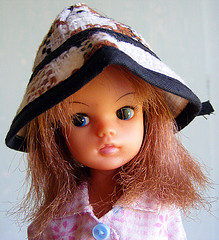
So begins David Sillito in his article for BBC News, “How Barbie Crushed Sindy” (July 2, 2012).” The “she” he is referring to is Sindy, a doll created by England’s Pedigree Toys in 1963. Like Iran’s Sara and Dara, Sindy was presented as an alternative to the American-made Barbie.

Sindy was the “British girl-next-door.” Compared to Barbie, she had a rounder face, a younger look, shorter legs, and a flatter chest. Sindy had great success through the 80s, peaking in 1985 with 80% of the UK doll market. But as the 90s began, Sindy was losing out to the ever glamorous and trendy Barbie, so Pedigree remade her, more in the image of her American rival. Mattel, Barbie’s manufacturer, noticed and filed a lawsuit against Pedigree. The British company responded with another makeover.

Helen Carter, “an avid Sindy collector and fashion lecturer” misses the old look, telling BBC “[The original Sindy] has got such a warm, friendly expression on her face, she’s got side-glancing eyes. She’s not challenging in any way, she’s pretty, she’s the English Rose.”

Up until 2009, the newest generation Sindy was being sold by Woolworth’s, but when that chain closed, Sindy said goodbye, as well. Now, Pedigree is looking for someone else to take over the Sindy name. “We don’t really have the skills to keep up with all the fashions,” says Pedigree’s Jerry Reynolds. “If it’s a retailer or a manufacturer, they have to change her clothes every year to keep up with trends.”

I think I have a solution. Sindy should go back to her origins, and she should be marketed as the “Third Culture Kid” doll. Here are 6 reasons why it makes sense:

  1. In 1984, Michigan State University sociologist Ted Ward called TCKs “the prototype citizens of the future.” The future has arrived and Sindy can help lead the way.*
  2. Many of the earlier Sindys are proud of their TCK heritage, as they have “Made in Hong Kong” printed on their waists.
  3. TCKs don’t always “keep up with the trends.” Sometimes it’s because they aren’t aware of the trends, sometimes because they disdain the trends. Either way, Sindy can create her own fashion statements. (And, as the BBC article mentions, Sindy could re-adopt her original wardrobe, going “retro to cash in on the popularity of vintage looks.”)
  4. Barbie has a closetful of international costumes, but they’re just that, costumes. Sindy could show the world what the real global citizen wears, as she transitions in and out of countries. Think of the culturally-relevant clothing possibilities. Collect them all!
  5. If Sindy could talk, what global stories she could tell, and all with a cosmopolitan British accent.
  6. Sindy should get back her “side-glancing eyes” (they turned forward in the makeover). This would represent the inquisitiveness of the TCK mind, mixed with a little bit of suspicion.
  7. Sindy looks like a TCK name, doesn’t it?

So who will save Sindy? Raise your hand and give Mr. Reynolds a call.

* When I wrote this post, I hadn’t looked up the source of this oft-quoted quotation. Actually, it’s from 1987, and it’s a paraphrase of “[T]he missionary kid of the nineties will be the prototype of the Christian of the twenty-first century.” I wrote more about Ted Ward and the context of this quotation at “TCKs as Prototypical Citizens and Culture Shock as Exaggerated Poop: Ted Ward and His Views on Growing Up Abroad.” (updated 03/2015)

[photo: “Sindyhat,” by Holly at The Thinking Doll, used under a Creative Commons license]

Disenfranchised Grief and the Returning Cross-Cultural Worker

Disenfranchised grief, also called “hidden sorrow,” is caused by “a loss that is not or cannot be openly acknowledged, publicly mourned or socially supported.”  This definition comes from an article I recently came across from Australian Family Physician, discussing the response of general practitioners (family physicians) to repatriated cross-cultural workers affected by grief.

What makes their grief disenfranchised is that their losses are not typical to the population at large, so others often discount those losses or don’t understand them. It is difficult to have compassion for a person when you don’t recognize why he is grieving. Others with disenfranchised grief include “ex-spouses, caregivers, nursing home staff, pet owners, children, adoptees, individuals with developmental disabilities, . . . those who may be grieving suicide or AIDs victims or other forms of stigmatised death, . . . victims of sexual abuse, indigenous people and prisoners re-entering their original subcultures.” While this seems to be a list made up of disparate groups, their commonality is that the losses they suffer are often easy to ignore or downplay.

The part of the article that most helped me understand the concept was the authors’ explanation of six types of disenfranchised grief. I am presenting the list here, but I’ve taken the liberty of providing my own examples of how they might apply to repatriated cross-cultural workers:

  • The griever’s relationships are unacknowledged
    [“You can enjoy yourself now that you’re back with your own people.”]
  • Lack of acknowledgment of the griever’s loss
    [“People move all the time. It’s not like somebody died.”]
  • Exclusion of the griever as not being capable of grieving
    [“She’s just a child. She’ll make new friends.”]
  • Exclusion of the griever due to the circumstances of the loss
    [“You knew what you were getting into when you decided to go overseas.”]
  • Exclusion of the griever due to their way of grieving which is not deemed appropriate by the community
    [“The Bible says ‘Consider it pure joy, my brothers, whenever you face trials of many kinds.'”]
  • Self initiated disenfranchised grief where shame plays a significant role
    [“Why don’t I trust God more?”]

The authors go on to stress how important it is that general practitioners understand disenfranchised grief and take steps to deal with it. Not only may family doctors be asked to treat physical symptoms that are a result of grief, but they may also be the only affordable and “safe” help that is available to the re-entering worker.

I wish that we could all understand and acknowledge others’ grief, whatever the source, so that we could “mourn with those who mourn,” giving them the community they need so they don’t have to grieve alone.

(Susan Selby, et al, “Disenfranchised Grievers: The GP’s Role in Management,” Australian Family Physician, Vol. 36, No. 9, September 2007)

[photo: “grief,” by Tomek.pl, used under a Creative Commons license]

Barack Obama, TCK President

A new biography is out on the president, David Maraniss’s Barack Obama: The Story, and it’s getting some media attention, mostly because of the input from former girlfriends and because parts seem to contradict Obama’s own earlier writings. But what interests me more are the insights on how the president’s international upbringing has been a factor in shaping his personality.

As Obama grew up, he was exposed to a variety of different cultures. He was born in Hawaii to a Kenyan father and a white American mother from Kansas, and after his parents divorced, his mother married an Indonesian man. The family later moved to Jakarta, where Obama lived from 6 to 10 years old, before returning to Hawaii, finishing out his elementary and secondary schooling there.

In adaptations from the book, published in Vanity Fair this month, Maraniss writes,

At age 20, Obama was a man of the world. He had never been to south-central Kansas or western Kenya, the homelands of his ancestors, yet his divided heritage from Africa and the American heartland had defined him from the beginning. He could not be of one place, rooted and provincial. From his years living in Indonesia, where he was fully immersed in Javanese schools and culture; from his adolescence in Hawaii, where he was in the polyglot sea of hapa and haole, Asians and islanders; from his mother’s long-term commitment to development work overseas; from his friendship with Pakistani students at Occidental and his extended visit to their country—from all of these he had experienced far more global diversity than the average college junior. He knew the ways of different cultures better than he knew himself.

In 1979, Obama began his post-secondary education at Occidental College, in Los Angeles. Then, after transferring to Columbia University two years later, he reconnected with Alex McNear, a friend from Occidental, who was spending the summer in New York. Obama wrote her that he envied his friends who were heading into business and other mainstream pursuits, but that didn’t feel right for him:

Caught without a class, a structure or tradition to support me, in a sense the choice to take a different path is made for me. The only way to assuage my feelings of isolation are to absorb all the traditions [and] classes; make them mine, me theirs.

Obama first met a later girlfriend, Genevieve Cook, in 1983 at a Christmas party. In one of those TCK “me too!” moments, they discovered that both had spent time in Jakarta as children. Maraniss writes,

He noticed her accent. Australian, she said. He knew many Aussies, friends of his mother’s, because he had lived in Indonesia when he was a boy. So had she, before her parents divorced, and again briefly in high school. As it turned out, their stays in Jakarta had overlapped for a few years, starting in 1967. They talked nonstop, moving from one subject to another, sharing an intense and immediate affinity, enthralled by the randomness of their meeting and how much they had in common. They had lived many places but never felt at home.

John Richardson, himself a TCK who grew up in Asia, believes that Obama’s time overseas has had a big impact on shaping his personality and how he goes about solving problems. What some—from both the right and left—see as Obama’s frustrating bipartisanship, writes Richardson, isn’t “exactly bipartisanship. It’s something else—something strange and essential. It is, though we don’t quite realize it yet, the real reason we elected him.”

Some, fellow TCKs and non TCKs alike, would argue that this form of bipartisanship is what kept them from voting for him. It’s not my purpose here to argue politics or the rightness or wrongness of Obama’s views or “the real reason we elected him.” Rather, I want to look at how his TCKness affects him. When TCKs meet each other, they soon find out that while their common experiences have often produced shared attitudes, that does not mean that they share the same beliefs and convictions. Some TCKs passionately defend Obama’s policies while others passionately attack them. Being a Third Culture Kid certainly doesn’t produce cookie-cutter people, political or otherwise.

Richardson goes on to quote from what he calls “the TCK bible,” David C. Pollock and Ruth E. Van Reken’s Third Culture Kids: The Experience of Growing Up among Worlds:

While growing up in a multiplicity of countries and cultures, TCKs not only observe firsthand the many geographical differences around the world but they also learn how people view life from different philosophical and political perspectives. . . . [TCKs] have lived in other places long enough to appreciate the reasons and understanding behind some of the behavioral differences rather than simply being frustrated by them as visitors tend to be.

But, writes Richardson, when TCKs arrive in the US, their disconnect with American culture makes those around them wonder if there is a disconnect in values, too. He goes back to Third Culture Kids:

It seems the very awareness which helps TCKs view a situation from multiple perspectives can also make TCKs seem impatient or arrogant with others who only see things from their own perspective—particularly people from their home culture . . . others may notice how the TCK’s behavior changes in various circumstances and begin to wonder if they can trust anything the TCK does or says. It looks to them as if he or she has no real convictions about much of anything.

According to Van Reken, TCKs often call themselves “chameleons” because “after spending a little time observing what is going on, they can easily switch language, style of relating, appearance, and cultural practices to take on the characteristics needed to blend better into the current scene.” She quotes an article in the Financial Times that states President Obama “benefited from his chameleon power to make a lot of different people feel he represents them. . . .”

Shortly after Obama’s election, Van Reken wrote for The Daily Beast that the new president and the other adult TCKs that he appointed to his cabinet “share certain emotional and psychological traits that may exert great influence in the new administration.” To Van Reken, Obama’s Dreams of My Father “could serve as a textbook in the TCK syllabus, a classic search for self-definition, described in living color,” and she calls Obama’s “exceptional skill at mediating among competing arguments,” his seeming aloofness, and his “cool manner” as common traits of Third Culture Kids.

Aloofness is one of the descriptors that President Obama’s critics use to tag him. It is similar to some of the ways his girlfriend, Cook, also describes him in her diary: “something also there of smoothed veneer, of guardedness . . . but I’m still left with this feeling of . . . a bit of a wall—the veil,” “Distance, distance, distance, and wariness,” “that coolness,” and “his withheld-ness.”

During his relationship with Cook, when the two went to social functions, it was usually with Pakistani friends. But there came a time when Obama began to draw away from them, which Beenu Mahmood, one of those friends, noticed. Maraniss writes that Mahmood

could see Obama slowly but carefully distancing himself as a necessary step in establishing his political identity as an American. For years when Barack was around [the Pakistanis], he seemed to share their attitudes as sophisticated outsiders who looked at politics from an international perspective. He was one of them, in that sense. But to get to where he wanted to go he had to change.

Where am I from? Where am I going? These are questions that are sometimes difficult for Third Culture Kids to answer. But for at least one TCK, the answer to the second question ended up being the White House.

(David Maraniss, “Young Barack Obama in Love: A Girlfriend’s Secret Diary,” Vanity Fair, June 2012; John H. Richardson, “How Obama Really  Thinks: A Primer for the Left and Right,” Esquire, June 21, 2010; David C. Pollock and Ruth E. Van Reken, Third Culture Kids: The Experience of Growing Up among Worlds, Boston: Nicholas Brealey, 2009; Ruth E. Van Reken, “Obama’s ‘Third Culture’ Team,” The Daily Beast, Nov. 26, 2008)

[photo: “Obama plaque,” by Stefan Geens, used under a Creative Commons license. The plaque is located at State Elementary School Menteng 01, Menteng, Jakarta, Indonesia. The inscription reads, “Barack Hussein Obama II, the 44th President of the United States of America, attended this school from 1969-1971.”]
Back in the States after Being Gone for a Long Time (poem)

Back in the States after being gone for a long time,
I’m standing
in the cereal aisle at Wal-Mart.
My list says “bran cereal” with no instructions
on how to pick out the right kind.
I tell the kids to quiet down
and remind them
that “everybody here knows English
so they can understand everything you say
now.”

A friend turns the corner and sees us: “Hey!
Long time no see.
Didn’t know you were back.
Look at you.
A little grey around the edges,
but not too bad.
Bet you’re glad to be
home.”

He’s describing me like you’d describe a used book:
Acceptable.
Slight shelf wear.
Dust jacket missing.
Discoloration on edge of spine.
A few underlined passages and extensive notes in margins.
Some dogeared
pages.

We chat about
how big the kids look and about
the new high school being built,
and then he says again,
“Bet you’re glad to be home.”
This time I respond with “Well,
both places have their advantages.”
My daughter shows me a box of
off-brand Fruit Loops,
raising her eyebrows like two question marks.
I shrug my shoulders and she puts it in the
cart.

That is the way I feel,
like a used
book.

But deep inside, I’d rather
be a manuscript.
Like one of those manuscripts
that’s been sent to
44 publishers and rejected
44 times.
Then the author’s wife sees it
in the trash folder
on the computer and sends it
in for one last try.
It’s picked up
and becomes a bestseller,
and it’s made into a movie
that wins two or
three Academy Awards.
That’s what I’d like to be, now
that I’m starting over
with this new life
in a new place that everybody says is
home.