Sweet-Dreams Liner . . . Maybe Someday

5287865564_65b5330065_nIt’s been big news lately that the new Boeing 787 is having problems, resulting in its grounding until a solution can be found to its lithium-ion batteries catching fire. Certainly, that’s not the track record that was expected when it was christened the “Dreamliner” in an online naming contest (beating out “Global Cruiser” by 2500 votes).

There’s another kind of jet that I’m waiting for with more anticipation. It’s only in the concept stage, but it’s a well-thought-out concept—aimed directly at families with children. It’s called cAir, and it’s the brainchild of RKS Design. I heard about it from Karolyn Wojtowicz at the blog William Penn University Study Abroad (lots of good stuff there for “opening the eyes of students, of all ages, everywhere to opportunities available anywhere”). Read her take at “cAir: The New Child-Friendly Airline.”

cAir innovations include

  • Toy rental
  • Sound curtains that pull down from the ceiling (reminds me of Get Smart‘s “Cone of Silence”)
  • Child-friendly, family-size lavatories
  • Places for storing and reheating food
  • Built-in child seats
  • Spinnable seat pairs that allow family members to face each other (my favorite—just like the trains in Taiwan)
  • Lower-level overhead compartments for child access to smaller items
  • And half-price discounts for parents flying with children (OK, I made this last one up, but we’re dreaming, aren’t we?)

“Flying with children can be a real nightmare. . . . So why not do something to fix it?” —RKS Design

(David M. Ewalt, “Dreamliner’s News May Be Getting Worse, and Not Just for Boeing,” Forbes, January 22, 2013; “Puget Sound Employee Wins ‘Name Your Plane’ Sweepstakes,” Boeing Frontiers Online, July 2003)

[illustration: “Flying Duck Patrol,” by Colorful Bleeding, used under a Creative Commons license]

Soaring Heights and Tragic Depths in the Life of Anne Morrow Lindbergh

5734550792_0e8ec76034

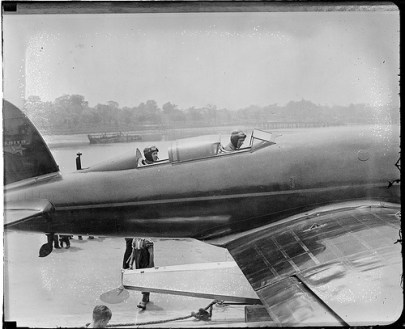
In 1929, Anne Morrow Lindbergh was on board the first ever passenger-paying flight, part of Transcontinental Air Transport’s (TAT’s) combination plane-and-train trip linking New York and California. Her husband, Charles, was the pilot, while Anne, the only female passenger, recorded her experience, later published as part of Hour of Gold, Hour of Lead: Diaries and Letters of Anne Morrow Lindbergh, 1929-1932. How things have changed:

The ship is beautifully decorated inside, painted a cool gray-green, with the most comfortable green leather-covered chairs, that are adjustable. Little green curtains and blue-shaded lights. There is a white uniformed attendant shouting in my ear that he will get anything I want—reading or writing material. . . .

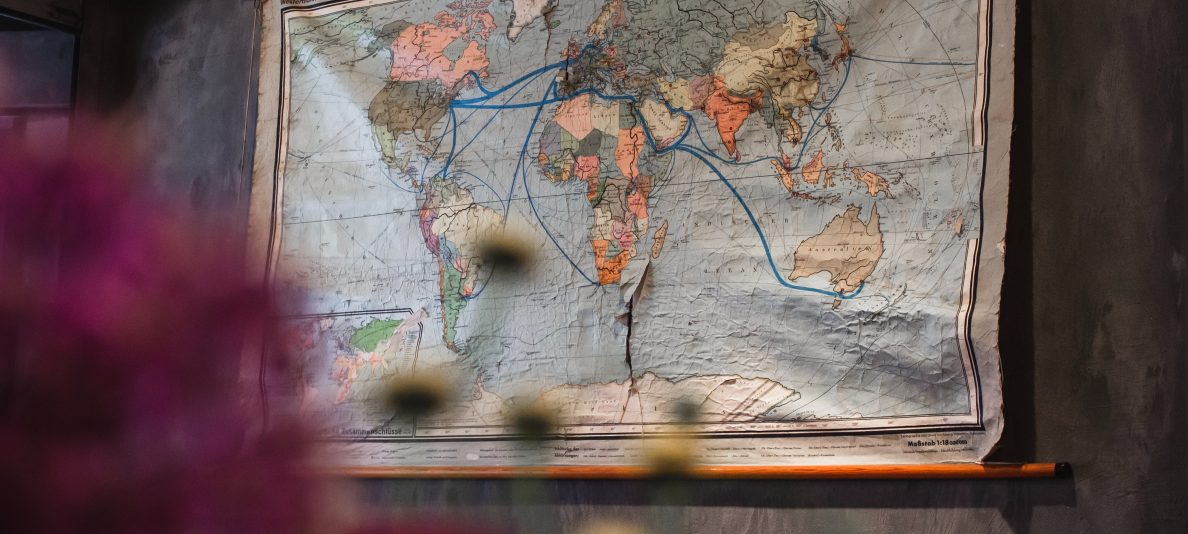
We have each been given an envelope full of data on the TAT organization. . . . Also I have been handed a large folding map (decorated à la old picture-map style) of our route. Postcards of places along the route. The “courier” has just offered me a little aluminum table to write on; there is plenty of room for knees and a table.

. . . .

At Kingman [AZ] we took on two square tin cupboards and one large thermos. The little table was set up by me, covered with a lavender linen tablecloth (tied on), and on metal plates I had passed me a delicious meal: cold chicken or tongue, etc. . . .

After researching Lindbergh’s life for my post on Gift from the Sea. That led me to Hour of Gold, Hour of Lead, which I’ve just finished reading. It covers her wedding to Charles—the first global celebrity—their flights together, the birth of their son, and his kidnapping and murder 20 months later. The first three of the years covered in the book are the golden years, the last one, leaden. Hour of Gold, Hour of Lead is certainly an absorbing read, with Lindbergh’s account of the happiness and the tragedy written down in “real time,” not in the typical reflective style of a memoir.

Another event recorded by Lindbergh is her flight with Charles to Asia, with stops in Canada, Alaska, Russia, Japan, and China.  In a letter to her mother, she wrote about visiting a missionary station among the Inuit at Point Barrow, the northernmost point of Alaska. Again, how things have changed:

The afternoon after we arrived we heard all the little Eskimo children screaming and all the dogs howling, and coming out of the bungalow we were told excitedly, “The boat’s coming, the boat! See—the smoke!” . . . By the time it got in sight every man, woman, child, and dog was down on the mudbank to see it. It was tragedy not to be there. “Oh, poor Kay, she’s on duty at the hospital and won’t see it!” someone said.

An old white boat (like the Hudson excursion boats), the water wheel churning foam, was towing a big barge. Everyone speculated:

“Perhaps my shoes will be on it!”

“Doesn’t look like much gasoline—hope there’s more inside.”

. . . .

“Perhaps Mother sent me some fresh tomatoes.”

. . . .

Everyone trooped on board very excited and looked over lists of packages.

We’ve got a bathtub! You won’t be able to lord it over us any more—a regular bathtub.”

“That’s the new tank for my motorboat. They’ve sent the wrong kind! Look, Lenny, they’ve sent the wrong kind—and I sent them all the specifications. Can’t use it—have to wait till next year.”

In another letter, Lindbergh wrote about the difficulties faced by the missionaries:

I felt as though my life didn’t count for anything against the terrific sternness of that life. And terribly sad. They had been there so long and were old and tired and they dreaded sending David [their 15-year-old son] out. When they first went up there there was no radio, only the one boat, and they heard about the death of one of their sons four months after he died.

About a church service, led by the Presbyterian missionary Henry Griest, she wrote,

It was so strange, terribly strange, to hear Dr. Greist explain the Bible to them.

“‘We have gone astray like sheep.’ Like the reindeer who have scattered on the tundras.”

“‘The power of God.’ Force—like dynamite that blows up the ice sometimes and lets us get a ship out—the dynamite of God.”

During their time in China, the Lindberghs’ trip was cut short when they got news that Anne’s father had died. A few months later, after they were settled back into their rural New Jersey home, Charles, Jr. was taken from his bedroom and killed.

Forty years after the events of 1932, Lindbergh published Hour of Gold, Hour of Lead. In the introduction to the “Hour of Lead” section, she discusses suffering, grief, and courage, and the—sometimes painful—necessity of vulnerability.

What I am saying is not simply the old Puritan truism that “suffering teaches.” I do not believe that sheer suffering teaches. If suffering alone taught, all the world would be wise, since everyone suffers. To suffering must be added mourning, understanding, patience, love, openness, and the willingness to remain vulnerable. All these and other factors combined, if the circumstances are right, can teach and can lead to rebirth.

. . . .

One must grieve, and one must go through periods of numbness that are harder to bear than grief. One must refuse the easy escapes offered by habit and human tradition. The first and most common offerings of famiy and friends are always distractions (“Take her out”—”Get her away”—”Change the scene”—”Bring in people to cheer her up”—”Don’t let her sit and mourn” [when it is mourning one needs]). On the other hand, there is the temptation to self-pity or glorification of grief. . . .

Courage is a first step, but simply to bear the blow bravely is not enough. Stoicism is courageous, but it is only a halfway house on the long road. It is a sheild, permissible for a short time only. In the end one has to discard shields and remain open and vulnerable. Otherwise, scar tissue will seal off the wound and no growth will follow. To grow, to be reborn, one must remain vulnerable—open to love but also hideously open to the possibility of more suffering.

Lindbergh wrote a full account of her Asia voyage in her first book, North to the Orient. Newsreel footage from the trip can be seen at this link, courtesy of PBS’s Chasing the Sun.

(Anne Morrow Lindbergh, Hour of Gold, Hour of Lead: Diaries and Letters of Anne Morrow Lindbergh, 1929-1932, Orlando: Mariner, 1993)

[photo: “Col. Lindbergh and Wife Get Ready to Fly the Pacific,” courtesy of the Boston Public Library, Leslie Jones Collection, used under a Creative Commons license]
Chinese Towns with Châteaus and Pubs

421040590_416a162457If imitation truly is the greatest form of flattery, then many in China believe that flattery will get them everywhere.

Over the past decade, China has experienced a boom in the building of look-alike cities and structures, fashioned after architecture from non-Chinese locales. Leading the trend is Shanghai’s “One City, Nine Towns” project, building foreign-inspired housing developments to draw residents out of the city’s crowded center—though it seems that the people have been a little reluctant to make the move.

There’s been a bunch written about the carbon-copy construction—lots of photos, too. Here are links to some of the articles around the Web:

Welcome To the Bizarre Chinese Ghost Town That Looks Like It Was Plucked from the British Countryside
(Julie Zeveloff, Business Insider, June 14, 2011)
“Thames Town is not nestled in the British countryside; it’s located in the northeast corner of China in Songjiang, near Shanghai. And it didn’t grow gradually over hundreds of years.”

Anting New Town: Car Museum, Cafes and Homes, but No People
(CNN Travel, September 24, 2010)
“The Anting New Town development was designed by Albert Speer, the son of Hitler’s favorite architect, to accommodate 50,000 inhabitants in apartment buildings and stand-alone houses.”

Going Dutch: Shanghai’s “Holland Town” Brings Europe to the City
(Mathias Guillin, CNN Travel, July 8, 2010)
“Life in Shanghai can be a bit monotonous: work, party, brunch and then do it all over again the next weekend. If you need to break things up and don’t want to hop on plane, head over the river and check out Pudong’s Nederland, aka ‘Holland Town.'”

Luodian—a Slice of Sweden in China
(Ulrika K Engström, Sweden.se, February 10, 2006)
“Luodian is a fully fledged copy of a Scandinavian town. Even the weather seems to have been specially imported to this newly built development in Baoshan, one of 16 districts in Shanghai.”

China: Shanghai: Citta di Pujiang
(Bret Wallach, The Great Mirror)
“An Italian city in Shanghai? But of course: this is another of Shanghai’s new towns, like Thames Town, but in this case Venice. Well, that’s what you’ll read in the press, but this new town doesn’t ape Europe: it has lots of water, in other words, but an intensely modern architectural style.”

China Builds Its Own Eiffel Tower
(Metro News, September 21, 2007)
“Chinese architects copied the Eiffel Tower, the Arc de Triomphe and the famous fountain in the gardens of the Palace of Versaille to make their own version of the French capital. Famous buildings and Parisienne style gardens are surrounded by rows of European-style villas where up to 100,000 Chinese people will live in a special gated community called Tianducheng just outside Shanghai.”

Made in China: An Austrian Village
(Reuters, June 5, 2012)
“A $940 million Chinese clone of one of Austria’s most picturesque villages, the UNESCO World Heritage-listed Hallstatt, recently opened its doors to visitors in the southern Chinese province of Guangdong amidst some controversy.”

Photos: Jiangsu City Has Four Fake US Capitols
(Michael Evans, Shanghaiist, December 3, 2012)
“The Jiangsu city of Wuxi is home to not one, not two, but four buildings with a less-than-coincidental resemblance to the US Capitol.”

Village Uses Famous Site Replicas to Draw Tourists
(Wang Hongyi, China Daily, October 12, 2011)
“[T]ourists can also see replicas of the US Capitol building, the Arch of Triumph in France and the Sydney Opera House by going to Huaxi village, which is deemed the richest village in China.”

Dorset Town is Re-built in China
(BBC News, July 26, 2007)
“A town in China has been modelled on Dorchester after planners saw the town’s picture on a Christmas card. The development in Chengdun, Sichuan province, named British Town, is complete with mock Victorian and Georgian architecture.”

Mr. Zhang Builds His Dream Town
(James Fallows, The Atlantic, March 2007)
“After lunch, Zhang thanked the guests for coming and invited them to spend time seeing some of the other highlights of Broad Town: the 130-foot-high gold-colored replica of an Egyptian pyramid, for instance.”

China’s Elite Learn to Flaunt It while the New Landless Weep
(Joseph Kahn, The New York Times, December 24, 2004)
“Chateau Zhang Laffitte is no ordinary imitation. It is the oriental twin of Château Maisons-Laffitte, the French architect François Mansart’s 1650 landmark on the Seine. Its symmetrical facade and soaring slate roof were crafted using the historic blueprints, 10,000 photographs and the same white Chantilly stone. . . . ‘It cost me $50 million,’ Mr. Zhang said. ‘But that’s because we made so many improvements compared with the original.'”

Château China: $30 Million “Hobby”
(Sheila Melvin, The New York Times, January 10, 2006)
“The town of Changli, in Hebei Province, resembles any other nondescript county seat in northern China. . . . But just outside the town center is a 200-hectare, or 500-acre, vineyard replete with a state-of-the-art wine production facility; a villa with tasting rooms and restaurants; a three-story wine school; a luxury hotel, and an immense private château. The Tuscan-style complex is so opulent and incongruous in the Hebei countryside that it at first seems like a mirage.”

Related Post:
Shanghai Calling: “Come Home”

[photo: “07/02/23 15:10:06 Shanghai,” by 2 Dogs, used under a Creative Commons license]

Eight Years Ago, “The Impossible” Happened

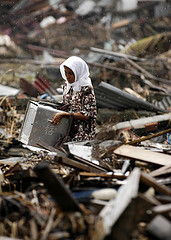
2947856952_e93daa6e15_mToday marks the eighth anniversary of the 2004 Indian Ocean tsunami that killed over 220,000 in 14 countries.

The disaster is the focal point of The Impossible, a movie starring Naomi Watts and Ewan McGregor. They play a British couple who, with their three young sons, are vacationing on the beach in Thailand when the tsunami hits. The film is based on the true story of Maria and Henry Belon, from Spain, and reviews from many who have seen The Impossible say that it portrays the tragedy in a realistic way. Though they were separated and injured, the Belons survived, due in large part to the compassion and kindness of the locals who helped them.

My first thought when I saw the movie trailer was, why must we tell non-western stories through the eyes of westerners? Surely there were stories about Indonesians, Sri Lankans, Indians, Thais, and others in Southeast Asia worth telling.

I was glad to hear Maria Belon address this during an appearance on The View. According to her, the movie is about the people of Southeast Asia. She said that her family’s story is not more important than theirs, but it serves as a way to show what was happening to the tens of thousands of people around them:

It needed to be told just as an excuse to tell everybody else’s stories. That’s the only reason why we wanted our story to be told is because nothing happened to us. . . . I will tell that thousands of times. Nothing happened to us, but from so many people were so painful, so difficult, that that was the only reason why we wanted to tell this story, just an excuse to tell everybody else’s stories. . . . Only for them. Only for them.

When she was asked about “survivor’s guilt,” she gave this interesting response:

I hate this concept, I hate this word. . . . Really, I will struggle to change this concept. It’s not guilt what you feel. Somebody else tells you you’re feeling guilty, and some people will say . . . OK, thank you, I’m feeling that. No, it’s not that what you’re feeling. You’re feeling pain. Pain. It’s a very strong pain that will remain for you forever, forever. I mean you can’t do anything about that.

So with PTSD and all the pain, how did Maria “move on”? She answered,

Moving on. I mean, moving on. I mean . . . no choice. . . . You have pain, OK, go on, Maria, with your pain. Tell the story. Help Naomi. Help the director. I mean, how do you cope when your knee’s in pain? You go on with pain, that’s all.

(The View, ABC, December 21, 2012)

[photo: “Woman searches through debris . . . Banda Aceh, Sumatra, Indonesia,” by Chuck Simmins, used under a Creative Commons license]

Playing Games with World Proverbs

2706821422_b976cbc1db_mLooking for a game to play with family and friends? Here’s one you might like.
I’ll call it simply The World Proverbs Game. I came up with the idea several years ago after playing a version of Balderdash, just using a dictionary. (As you probably know, Balderdash is a board game in which players try to come up with believable sounding definitions for obscure words.) Similar to Balderdash, there’s a game called Wise and Otherwise that requires players to complete proverbs that come from around the world. I found out about it after I’d already bought a book of world proverbs and made up my own rules. Honest.

Judging by the reviews at Amazon.com, Wise and Otherwise is a great game. For about $43.00, you get a game board, a die, paper and pencils, playing pieces, and 500 cards containing 2,500 proverbs. But if you can do without most of that and would like to save some money, here’s how to play The World Proverbs Game:

First, you need an encyclopedia of proverbs. There are several out there, but the one I got is Wolfgang Mieder’s Prentice-Hall Encyclopedia of World Proverbs. It says it’s “the largest compilation of its kind,” and I won’t argue with that claim, since it includes 18,520 sayings from all over the globe (that’s a big increase over Wise and Otherwise). The proverbs are arranged by topic, and each one is followed by the place from which it comes. As I write this, I see there are a couple used copies at Amazon for under $3.00.

Next, cut up some scratch paper and gather up some pencils. That’s it. You’re ready.

The rules are simple: One person in the group (you need three or more players) looks through the encyclopedia and chooses a proverb. He then reads it to the other players, leaving out one or several words. For example, he might read, “Nine out of ten matchmakers are BLANK.” Then everyone writes down the full phrase, filling in the blank with a word or phrase of his choosing.

After everyone is done, the players hand in their papers to the reader, who has written down the real proverb on his own piece of paper. He then reads them all out loud. The rest of the players then vote on which one they think is the real proverb. You can work out your own scoring system, but here’s one to start with:

  • 10 points go to a player for every person who mistakenly chooses his made-up proverb
  • 10 points go to a player if he completed the proverb correctly—regardless of whether anyone chooses it
  • 20 points go to the reader if no one chooses the actual proverb as being correct (he gets no points if anyone correctly picks his phrase as the real saying)

Each player takes a turn being the reader. To save time, the person next in line should vote first and then make her own selection from the encyclopedia while the others are voting.

Play continues until someone reaches 100 points (or that can be higher or lower, depending on how long you want the game to last).

It’s fun to see how people with different personalities play the game. Some people are very logical. Some people would rather go for laughs. Some are experts at bluffing. Some, not so much. And some people can’t keep a straight face when they read the false proverbs, no matter how hard they try.

What about you and your friends? If you want to find out, start playing. As the Russians say, “One gets to know people during games and on journeys.”

By the way, according to the Chinese, “Nine out of ten matchmakers are liars.”

[photo: “A Bird in the Hand,” by Dave S., used under a Creative Commons license]

Book a Trip to Raoul Silva’s Island Lair

While working on my post about Last Chance Harvey, I needed to find the location of a conversation between Harvey and Kate. My search not only led me to London’s Somerset House but to a slew of sites on the topic of “movie tourism,” as well, where I found that travelers can also visit the place where the wedding was filmed—Grosvenor House—and the setting for one of the couple’s walks—Belsize Park.

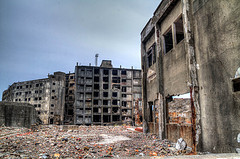
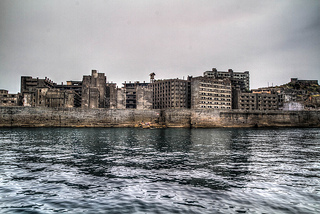
Now these places are impressive in their own way, but none of them is quite as fascinating as a locale in the latest James Bond film, Skyfall: the evil lair of Raoul Silva, 007’s latest nemesis. While the scenes inside Silva’s hideout were shot in a built-for-the-movie set at London’s Pinewood Studios, the long-distance shots are of a real-life place located nine miles off the coast of Japan—Hashima Island (pictured above). Not only does the island look sinister—a pile of abandoned and crumbling concrete apartment buildings jutting out of the ocean—but its backstory could supply an unsettling script for a film of its own. Clark Boyd, at PRI’s The World, writes that the island’s “true history is even creepier than you can imagine.”

Boyd goes on to give an overview of that history in this audio story (or you can read the article here).

Also, for a more in-depth treatment, including more details about life on the island, you can read Brian Burke-Gaffney’s article in the magazine Cabinet.

Hashima Island’s story in a nutshell is this:

In 1890 Mitsubishi bought the small outcropping of rock  for the coal that lay below the seabed underneath it. As coal production increased, so did the need for workers, and in 1916, the company built the first of many concrete structures to house them. In time, over 30 multi-story buildings were constructed, and in 1959 they were home to 5,259 people, including Japanese employees, their families, and forced laborers from China and Korea. Its 1,391 people per hectare (2.47 acres) in the residential area at that time is thought to be the highest population density ever recorded in the world.

Many of the people who lived on the island died there as well. Burke-Gaffney reports that by mid 1949, around 1,300 residents had lost their lives—from mining accidents, exhaustion, or malnutrition. “Still others had chosen a quicker, less gruesome death,” he writes, “by jumping over the sea-wall and trying in vain to swim to the mainland.”

In the late 1960s, petroleum replaced coal as Japan’s preferred energy source. Then, in 1974, Mitsubishi closed the mine, and all the inhabitants still there hastily left.

Following is a short documentary by Swedish filmmaker Thomas Nordanstad. In the film, Nordanstad follows Dotokou Sakamoto, a Japanese man who moved to Hashima Island with his family at the age of four, as he visits, among other places, the “hotel,” where new arrivals awaited permanent housing, his school, and the crumbling remains of his family home.

At the beginning of the documentary, Sakamoto says,

Some people say that your roots exist in the place where you were born, but that’s not the case for me. My roots are here, in this place.

And at the end, he adds,

In Japan, things are being thrown away so easily, just like that. But you can’t throw away your memories. The roots sit there, in your heart.

While the bulk of the island is closed to the public, in 2009 observation decks were opened at the island’s edge, with the boat ride from Nagasaki and a tour costing about $50.

To find the rest of the venues featured in Skyfall, go to The Worldwide Guide to Movie Locations, the self-described “ultimate travel guide to film locations around the world.” It’s a great resource that ties detailed info on places with plot points in the movie. And if you want to look up a film that’s not included there, you can try IMDb (International Movie Database). The location info there is less specific, but its movie list is much more comprehensive. (Search for “Filming Locations” on a movie’s page.)

(Clark Boyd, “The History of Hashima, the Island in Bond Film ‘Skyfall,'” PRI’s The World, November 23, 2012; Brian Burke-Gaffney, “Hashima: The Ghost Island,” Cabinet, Summer 2002)

[photos: “Nagasaki Hashima Island (端島) Gunkajima Tour” (top and bottom) by Ronald Woan, used under a Creative Commons license]

Get Steve McCurry’s “Afghan Girl” for $8,000 or More, or How about Much, Much Less?

Most online introductions of Steve McCurry say something like “He’s the guy who took the photo of the Afghan girl.” Yes, his portrait of Sharbat Gula, a girl in a refugee camp, was featured on the cover of National Geographic in 1985—and became one of the most recognized photographs of all time. But it should also go without saying that McCurry has produced many, many more remarkable photos over his career. He continues to travel the world, capturing the images as they develop before him. As reported in the blog CNN Photos, his philosophy is “travel to a place, work with the locals, and see what emerges.”

If you’d like to own some of McCurry’s photos, including Afghan Girl, there are numerous ways to acquire them, covering a wide range of budgets—from really, really expensive to free. Just in time for Christmas, here are your pricing options, arranged for your convenience from highest to lowest:

$8,000 to $12,000 (estimate)
For the first time, the National Geographic Society is auctioning off some of its vast collection of 11.5 million photographs and illustrations. The sale will take place December 6, at Christie’s, and will include a special print of McCurry’s Afghan Girl. The 240 pieces offered are expected to bring a total of about $3 million, so don’t expect too many bargain-basement prices. (For an update on the auction, see “Sorry You Weren’t the One to Buy ‘Afghan Girl.’“)

Something less than $8,000, I presume
McCurry offers signed fine-art prints of his work at his website. A pdf catalog is available, but prices aren’t included. If you want to find out how much a print costs, you’ll need to contact a lady named Bonnie.

$65
Also available at McCurry’s site. At this price you can get a 20 x 24 inch poster of one of ten McCurry photos. Proceeds go to Imagine Asia.

$37.46
McCurry has just published a new book, titled Steve McCurry: The Iconic Photographs. It covers his best of the best (165 images) from the last 30 years. Amazon sells the standard hardback at the above price, but if you absolutely have to spend more, there’s the deluxe edition for $248.85 and a signed edition at Phaidon for $79.99.

Free
If you’re like me, then browsing the photos on the Internet will have to do for now. But it’s not a bad alternative. It certainly gives you the best selection. Several of the links above can get you started, but for the most images, go to the galleries at stevemccurry.com. Wow, he definitely has had some amazing things “emerge” in front of his lens.

Hear McCurry tell how he captured the photo Beggar Girl, Bombay, India:

(Elizabeth I. Johnson, “Curiosity Inspires Iconic Photographer,” CNN Photos; Ula Ilnytzky, “National Geographic to Auction Famous Photos, Art,” San Francisco Chronicle, October 23, 2012)

[top photo: “Steve McCurry Exhibit,” by Steve Evans, used under a Creative Commons license; Bottom photo: “Occhi che scrutano” (Eyes that stare), by Giuseppe Nicoloro, used under a Creative Commons license]

Better the Disappointment You Know?

Just last week, my wife and I watched Last Chance Harvey (2008) for the umpteenth time—well, maybe not the umpteenth time, but at least the umpth time. It evokes some particular emotions for us, as we first watched it on a plane ride back to the States during our time in Asia. We were coming back with some disappointments, and the movie—especially a conversation near the end—resonated with each of us. If you’re not familiar with the story, here’s a short synopsis, leading up to that exchange:

Harvey Shine (Dustin Hoffman) is a down-on-his-luck jingle writer from New York, flying to London for his daughter’s wedding. Kate Walker (Emma Thompson) is a Heathrow employee with the tedious job of interviewing travelers. Their first meeting begins with Kate’s attempts to ask Harvey the questions on her clipboard. It ends with Harvey rudely brushing her off.

Not only are things going poorly for Harvey on the job front, but he later finds out that his daughter has chosen her stepfather to walk her down the aisle—and there are obviously some family skeletons that reside in Harvey’s closet.

Things begin to look up, though, when Harvey meets up with Kate the next day at a Heathrow bar. Harvey has just missed his flight back to the States, and Kate is using a novel as an escape from failed blind dates and phone calls from her mother, with whom she lives.

Over the next several hours, Harvey and Kate begin to enjoy each other’s company, and they even see glimpses of a happy future together. The two attend Harvey’s daughter’s wedding reception and then wander around London, ending up at the fountains at Somerset House. They agree to meet there again at noon the next day. A spirited climb up his hotel steps puts Harvey in the hospital, just long enough to keep him from making the appointment. Not knowing the cause, Kate is crushed at having her emotions stood up . . . again.

Harvey tracks Kate down, even though she no longer wants to see him. She is wounded and fears being wounded even more. As Harvey tries to convince her that she should give their relationship a chance, they have their pivotal conversation, in which Kate says,

I’m not going to do it. I’m not going to do it, because it’ll hurt. . . . and I won’t do it. . . .

You see, what I think it is, is . . . is that I think I’m more comfortable with being disappointed. I think I’m angry with you for trying to take that away.

Since we were escorting our five children across the Pacific, my wife and I were separated during our flight, catching pieces of movies on our individual screens in between naps and meals. Sometime later during the trip, our youngest was asleep and we got to sit together for a while. We’d both watched Last Chance Harvey, and we both remembered what Kate had said. At the time we understood that even though disappointment is painful, it can become more comfortable than hoping for miracles and risking deeper loss. Maybe that’s why we continue to watch the film from time to time. . . because we still understand that. And when fear accompanies hope, as it often does, we do our best to press on, more guarded, but pressing on.

Last Chance Harvey doesn’t end with “happily ever after,” but it does end with a hopeful beginning. Harvey decides to stay longer in London, and Kate agrees to open her heart to the possibilities with him. As the two start down this new road together, Harvey remembers their first encounter and asks Kate to continue the interview that she’d started with him at the airport. She does:

“Name?” she asks.

He replies, “Harvey Shine.”

“Place of residence?”

“I’m in transition.”

Here’s the trailer:

And here’s a “Back Stage interview with Thompson and Hoffman, in which they talk about the mood and personality of the movie. When discussing the on-screen relationship between the two characters and how that was reflected in the film-making process, Hoffman says,

I always said that you always know who your friends are [. . . .] Your really good friends are the people that you can sit at a table with and not talk [. . . .] And we said, whatever the specialness about that relationship was, could we do this movie like that?

[photo: “Yellow Point: Somerset House Fountains,” by Tania Caruso, used under a Creative Commons license]