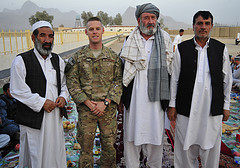
 NPR is running a series on the members of the 182nd Infantry Regiment, which has recently returned to the States after spending a year in Afghanistan. Reporters will be following the group as they adjust to life in the US over the coming year. I’ve never served in the military, but I have come “home” after living overseas. I can only imagine the loss and trauma and stress that these soldiers have experienced, along with the challenges they are now facing. But I’ve also learned that it doesn’t help to compare experiences: every situation is unique, and different levels of loss and trauma and stress are all still loss and trauma and stress. When I read/hear stories such as these, I’m reminded how much we all have in common when we come back to the US after adjusting to another culture. And while serving in a war overseas certainly adds to the challenges of readjustment (war has a “culture” all its own), I know other repats, former missionaries and NGO workers who served in harsh circumstances, who carry some of the extreme baggage that soldiers bring back with them.
Following are some pullouts from the report. If you are readjusting to life back in the States, regardless of where you were or what you did while you were away, change a few words here and there and see how many of these ring true to you. As I said, I’ve never fought in a war, but I’ve tasted some of the challenges of reentry. I will pray for the 182nd Infantry Regiment today. . . .
Once they settle back home, they’ll begin the transition from soldier to civilian. Some could face unemployment and financial problems; others may struggle with depression or post-traumatic stress disorder. Their families face challenges as well, trying to integrate these men back into their lives.
“But listen, something is no kidding going to slap you right across the face when you get home within the first 72 hours, and it’s going to let you know that life has continued on in your absence,” [says. Col. Tim Newsome].
Newsome says these war wounds [like PTSD or depression] should be treated like any other. . . . “Somebody has got something wrong with their foot, they go see the podiatrist,” he says, “no harm, no foul. Nobody says anything. It’s when they got something wrong up here, that’s when we want to put a stigma on somebody.”
But going home comes with its own kind of stress. Like many guardsmen, [Spc. John] Nestico had a civilian job before he deployed. He worked at Radio Shack selling cell phones, but a lot of his friends there have moved on, and he’s worried about fitting back into that world.
“For a while, admittedly I was in a bit of a free fall,” he says. “It just took a change of environment and the ability to talk to someone who wasn’t in uniform to allow myself to open up a little bit [and] to feel like what I say here isn’t going to be held in contempt or against me, but in the best interest of what’s good for me.”
They’ll return to their civilian lives. . . . For some, that will mean packing up their uniform and picking up where they left off; for others, it will mean picking up the pieces and starting over.
(Rachel Martin and Tom Dreisbach, “A Rest Stop on the Road from Soldier to Civilian,” NPR, April 1, 2012)
[photo: “110828-F-JP934-057,” by ISAF Public Affairs, used under a Creative Commons license]
 Clearing Customs