
Do You Have Compassion Fatigue?

5982590252_cab6303486_nAre you a cross-cultural worker in a “caring profession”? Are you a member-care giver or coach to someone who works cross-culturally? Do you sometimes feel overwhelmed by the needs of those you’re helping, pouring out more and more from a reservoir that is going dry? Has your compassion satisfaction turned into compassion fatigue?

A few weeks ago I attended a day-long workshop entitled “Resilience Strategies for Educators: Techniques for Self-Care and Peer Support.” It was offered to our community in Joplin, Missouri, because of the ongoing effects—felt by educators and students—of the May 22 tornado, two years ago.

I am very interested in how the vocabulary and strategies used by the facilitators, Arthur Cummins (Orange County Department of Education) and Stephen Hydon (University of Southern California), parallel what I’ve heard presented by those in member care for cross-cultural workers. One of their goals was to give us “tools” for our “toolbox,” and I’d like to share one of those tools with you: the “Professional Quality of Life Scale,” or ProQOL.

The ProQOL measures “compassion satisfaction” and “compassion fatigue,” with the latter category further broken down into “burnout” and “secondary trauma.”

I have included the ProQOL Measure below. As you can see, it uses the generic terms help and helper, but they can be substituted with words to better fit a given audience. A printable version, along with scoring instructions, is available here. The ProQOL Measure in 17 non-English languages (versions vary) can be downloaded here. And the 2010 edition of the “The Concise ProQOL Manual,” explaining the background and interpretation of scores is here.

For those interested in more information on compassion fatigue and trauma stress, try these sites:

If you use the scale, I hope that you find you’re doing well, but if the results show that you have compassion fatigue, I hope you can find the rest and help you need.

Professional Quality of Life Scale (ProQOL)

Compassion Satisfaction and Compassion Fatigue (ProQOL) Version 5 (2009)

When you [help] people you have direct contact with their lives. As you may have found, your compassion for those you [help] can affect you in positive and negative ways. Below are some questions about your experiences, both positive and negative, as a [helper]. Consider each of the following questions about you and your current work situation. Select the number that honestly reflects how frequently you experienced these things in the last 30 days.

1=Never    2=Rarely    3=Sometimes    4=Often    5=Very Often

___ 1. I am happy.
___ 2. I am preoccupied with more than one person I [help].
___ 3. I get satisfaction from being able to [help] people.
___ 4. I feel connected to others.
___ 5. I jump or am startled by unexpected sounds.
___ 6. I feel invigorated after working with those I [help].
___ 7. I find it difficult to separate my personal life from my life as a [helper].
___ 8. I am not as productive at work because I am losing sleep over traumatic experiences of a person I [help].
___ 9. I think that I might have been affected by the traumatic stress of those I [help].
___ 10. I feel trapped by my job as a [helper].
___ 11. Because of my [helping], I have felt “on edge” about various things.
___ 12. I like my work as a [helper].
___ 13. I feel depressed because of the traumatic experiences of the people I [help].
___ 
14. I feel as though I am experiencing the trauma of someone I have [helped].
___ 15. I have beliefs that sustain me.
___ 16. I am pleased with how I am able to keep up with [helping] techniques and protocols.
___ 17. I am the person I always wanted to be.
___ 18. My work makes me feel satisfied.
___ 19. I feel worn out because of my work as a [helper].
___ 
20. I have happy thoughts and feelings about those I [help] and how I could help them.
___ 21. I feel overwhelmed because my case [work] load seems endless.
___ 22. I believe I can make a difference through my work.
___ 23. I avoid certain activities or situations because they remind me of frightening experiences of the people I [help].
___ 24. I am proud of what I can do to [help].
___ 25. As a result of my [helping], I have intrusive, frightening thoughts.
___ 26. I feel “bogged down” by the system.
___ 27. I have thoughts that I am a “success” as a [helper].
___ 28. I can’t recall important parts of my work with trauma victims.
___ 29. I am a very caring person.
___ 30. I am happy that I chose to do this work.

(After completing the scale, go here for the self-scoring guide.)

© B. Hudnall Stamm, 2009. Professional Quality of Life: Compassion Satisfaction and Fatigue Version 5 (ProQOL). /www. isu. edu/~bhstamm or www. proqol. org. This test may be freely copied as long as (a) author is credited, (b) no changes are made, and (c) it is not sold.

[photo: “I Think I’ll Start a New Life,” by Noukka Signe, used under a Creative Commons license]

Barnga—When Cultures Play by Different Rules

When it comes to cross-cultural simulation games, Barnga is an oldie but a goodie.

Barnga was created by Sivasailam “Thiagi” Thiagarajan in 1980, while working for USAID in Gbarnga, Liberia. During a coup, his team’s vehicles were commandeered by the military, so Thiagarajan and his colleagues stayed in their compound, passing the time playing Euchre. Born in Chennai, India, Thiagarajan had moved to Bloomington, Indiana, where he’d learned how to play the card game, and as his Liberian coworkers hadn’t played it before, he gave them a copy of Hoyles Games to read up on the rules. The trouble was, after their crash course, they all came away with different interpretations of how to play. Rather than clear up the arguments, Thiagarajan let the players work it out, and after three hours, the group had settled on their own, unique version of Euchre.

“This interesting episode presented me with a blinding flash of the obvious,” writes Thiagarajan in Barnga: A Simulation Game on Cultural Clashes. “Serious conflicts arise not from major, obvious cultural differences, but from unrecognized, minor ones.”

From this, Thiagarajan developed Barnga, one of 120 simulations and games that he has created during his career.

The concept of Barnga is simple (Spoiler Alert!): players are given rules for a card game called “Five Tricks.” Unknown by the players, though, is that each set of rules is slightly different. When participants begin playing, the results are many and varied: confusion, accusations of cheating, frustration, assertions of authority, feelings of isolation, resignation, competitiveness, formation of alliances, etc.

The instructions for Barnga not only include how-tos for the simulation but also guidelines for directing the follow-up discussion—wherein lies the real meat of the experience. It’s when people discuss how they feel about the game, and about each other, that the shift is made to the realm of cultural interaction.

Barnga works best with about 20 to 40 players, though it is possible with fewer than eight. Instructions—in four languages—are available from several sources, including Thiagarajan’s website, The Thiagi Group, and Amazon, where several pages describing the game are available with the “Look Inside!” feature.

If you’ve played Barnga in the past, it may be worth another look, as the “25th Anniversary Edition” includes the following updates:

  • the option of partnership play, which opens up discussion on the effect of moral support
  • a subtle trick that reinforces the idea that everyone is using the same rules
  • multiple tournament formats, and
  • more debriefing prompts

And if Barnga whets your appetite for group activities, take a look at Thiagarajan’s list of over 300 free “training games and activities,” most of which also appeared in the Thiagi GameLetter.

(Sivasailam “Thiagi” Thiagarajan, with Raja Thiagarajan, Barnga: A Simulation Game on Cultural Clashes, Intercultural Press, 2006)

[photo: “Card Games,” by Twaize, used under a Creative Commons license]
 

An Ambassador from the Brazilian Rain Forest to New York’s Concrete Jungle

516818391_0849517be5_mIn September of last year, Nilson Tuwe Huni Kui traveled from a village of 600 in the Amazon rain forest to New York City. The 29-year-old Tuwe has a unique way of describing jet lag: “First you arrive physically and you are very tired,” he told BBC. “But only after a while, your soul gets here, too. Because the plane is very fast, but the soul takes longer to arrive.”

Tuwe is set to finish up his nine months in the US at the end of May, having come to New York to study English as a Second Language and to take filmmaking and film-editing classes. His trip is sponsored by Tribal Link’s Indigenous Fellowship Program and the Nataasha van Kampen Foundation. Tuwe is working on a documentary called Us and Them, showing the challenges faced by peoples living in voluntary isolation near the border of Peru and Brazil as they are confronted by illegal loggers, narco-traffickers, and oil prospectors. His goal is to learn English and sharpen his technical skills so that he can become a professional filmmaker, to get the message out to a wider audience.

This is not Tuwe’s first trip as an ambassador to the outside world. Tribal Link originally met him five years ago at the UN Convention on Biological Diversity‘s 9th Conference of the Parties in Bonn, German, and then, last summer, talked with him again in Rio de Janeiro at Rio+20.

Following are a BBC video highlighting Tuwe’s introduction to New York and an interview from Tribal Link in which Tuwe further explains his role as “a spokesperson and a messenger of [his] people.”

I can only wonder about the effects of reverse culture shock on Tuwe as he returns to his tribe. It may take even longer for his soul to catch up on the return trip.

(“Culture Shock for Amazon Chief’s Son Who Left Rainforest for New York,” BBC News, March 17, 2013; “Tribal Link Welcomes to New York Nilson Tuwe Huni Kuin, 2012 Indigenous Fellow,” Tribal Link, December 15, 2012)

[photo: “New York City,” by Kaysha, used under a Creative Commons license]

Member Care: Learning from Each Other

6197682597_741e205c42

Blogger Maria Foley, at I Was an Expat Wife, writes that her husband’s employer did a great job of easing her family’s transition to life overseas. In fact, she calls the help they got in their move to Singapore “wonderful.” But the return trip was a different story. When they came back to Canada, she says, “the silence was deafening.”

But it doesn’t have to be that way. In “What the Missionary Sector Can Teach Us about Handling Re-Entry” (May 6, 2013), Maria applauds the work of the Assemblies of God in meeting the needs of their cross-cultural workers. She tells about her friend, Heather, who is a youth coordinator in the International Society of Missionary Kids‘ reentry program, part of the AG’s efforts to help missionaries and MKs adjust to the comings and goings of their cross-cultural lives. Part of Heather’s motivation to help MKs comes from her own experiences as a child in a missionary family. “I wish I’d been able to go through a program like this. It would have been helpful to have those tools,” she says. “That’s why I think it means so much to me to work with these kids, because I had such a difficult re-entry.” (You can read more from Heather at her blog, Adventures in Transition.)

This is a common sentiment among those who work in member care: wanting to serve current cross-cultural workers and their families by providing the kind of help that wasn’t available when they faced similar difficulties in their own lives.

That’s what happened with Lauren and Jo Ann Helveston, who started The Mission Society‘s pastoral-care department in 2007. When the couple were missionaries in Ghana, they weren’t part of “an agency like The Mission Society,” says Jo Ann. “So debriefing, or even training, was not part of our experience.” Now they debrief missionaries who are back in the States.

Jo Ann’s comments come from The Mission Society’s spring 2013 issue of Unfinished—an edition devoted entirely to member care. The article “What Missionaries Don’t Tell You” describes the issue in this way:

The pages of Unfinished typically tell the stories of what God is doing through our missionaries. This issue, however, is more about what God is doing in them, particularly during those difficult seasons that aren’t typically chronicled in their newsletters or blogs. It’s about how missionaries themselves need to be cared for and ministered to.

Other articles include

  • When Hope Begins to Stir
    Missionary care can happen through listening (the source of Jo Ann Helveston’s comments above)
  • How Can We find Our Way?
    What happens to missionaries when disillusionment becomes their constant companion?
  • Top 10 Ways to Care for Your Missionaries
  • Top 10 Items to Include in a Care Package
  • A Different World
    Third culture kids speak about a life only a select population can relate to.

I stumbled upon Unfinished as I was collecting information for my post on African-American missionaries. What a find. Not only does it include great information and insights, it is an encouragement to see that when we participate in member care, we are joining a growing group that has common goals, lives out common experiences, and speaks a common language. It is a group that grows in understanding as we share with and learn from each other.

And the world is our classroom.

[photo: “Geography Lesson in a Grammar Class,” by Boston Public Library, used under a Creative Commons license]

Why So Few African-American Missionaries and Why Should That Change? Seven Voices

2587685795_1d8716c603_mIn the world of Christian missions, statistics play a large role. How many people groups are “unreached”? What percentage of a country’s citizens are believers? How many languages still don’t have a Bible?

Here’s another question: What portion of protestant missionaries sent from the US are African-American?

Answer: less than 0.5%—even though blacks make up 20% of Americans affiliated with protestant denominations.*

That number is reflected in the Southern Baptist Convention, the largest protestant group in the US, where 0.6% of its missionaries (27 out or 4,900) are African American.

Last month, Christianity Today devoted an article to this situation, quoting Fred Luter, the current president of the Southern Baptist Convention, and the first African-American to serve in that role, and David Goatley, the executive secretary treasurer of the Lott Carey Baptist Foreign Mission Convention, named after the first African-American missionary sent out and supported by a mission agency.

Following is some of what they have to say, on why there are so few African-American missionaries and what can be done to increase their number, along with several other voices on the topic.

Fred Luter:

A lot of our African American churches are in the “hood.” It’s a daily fight every day. [People ask me], “Why do I need to go to Africa, Asia or Europe? We need to get people saved in this community.”

It’s a both/and approach. We need to reach the people in our neighborhoods and get African Americans out on the foreign field.

Granted, some (young people) want to be nurses, doctors or attorneys. Some want to be football players or basketball players, but a lot . . . can be missionaries. I never heard that all my life in the church I grew up in . . . I don’t hear it being said in the church I pastor now.

As SBC president, I will let African American churches know that we desperately need more African Americans on the mission field. I want to challenge pastor[s] to start with your young people.

Keith Jefferson:
African-American Missional Church Strategist, International Mission Board (Southern Baptists)

Charity begins at home, but it doesn’t end there. The command begins in Jerusalem, but we don’t stop at the beginning.

Our ancestors didn’t say, “We’ve got to take care of Jerusalem before we go.” No, some of them had the call and they went.

The world is becoming smaller and smaller. African American professionals are traveling worldwide. Communication is becoming greater and greater. Younger people especially are communicating with people throughout the world, and they are more adventurous. They’re not “set.” They’re open to new things.

God is calling us, because like every other child of God, we have a responsibility. We don’t have any excuses.

(Tess Rivers, “SBC President: We Need African Americans on Int’l Mission Field,” Baptist Press, February 13, 2013; Erich Bridges, “Worldview: A New Generation of Black Missionaries,” Baptist Press, February 13, 2013)

Michael Emerson:
Sociologist and Co-Director of the Kinder Institute for Urban Research, Rice University

On the difficulty of raising funds for mission work:

Whites have 20 times the wealth of African Americans. So when you go to raise support, it’s really hard because there’s so much less money going around.

David Goatley:

[African American] income is about 75 percent compared to our [Anglo American] siblings’—even when we have comparable education and experience. Our unemployment rate is also nearly twice their rate.

The prospect of African Americans being part of Christian organizations with sending capacity is small.

On the value that African Americans’ cultural history brings to missions:

[T]he experiences of racism and white supremacy . . . would teach them to avoid better the paternalism that too many Anglo Americans show toward Africans and other majority-world people.

(Sarah Eekhoff Zylstra, “Black Churches’ Missing Missionaries,” Christianity Today, April 2, 2013)

Richard Coleman
Senior Director of Mobilization and Candidacy, The Mission Society

As a student at Oral Roberts University, Coleman went on a short-term trip to Uganda.

[W]hen I went to Africa, Africans would say “Where are the blacks? How come they don’t come?”

When you look at the civil rights movement, everyone had to focus inward and everybody was needed to deal with this big issue at home. They had to suspend other ventures.

And once we got the same rights and privileges as everybody else, human nature—and this is not a black thing or a white thing or any color thing—pursues security, comfort and equality. And so when the playing field became a lot more level, I think our pursuits changed toward building up the community and I don’t think we’ve really begun to look outward.

People around the world have heard that story and have seen the overcoming of struggles. Black churches have a message of encouragement for the world.

(Lillian Kwon , “Black Christians Largely Absent from U.S. Missionary Force,” The Christian Post, October 6, 2010)

Leroy Barber
President, Mission Year
Jim Sutherland

Director, Reconciliation Ministries Network

From Black in America, CNN, September 27, 2010

Leroy Barber: I’m the Jackie Robinson of missions, you know.

Soledad O’Brien, CNN special correspondent: Leroy Barber is a man with a calling, and he’s the president of Mission Year. It’s a year-long ministry and volunteer program for Christian young adults in the United States.

Barber: There is a goal for people coming to know Jesus. There is probably another strong goal of things are not right in the world, and I want to be part of making them right.

O’Brien: How many African-Americans are involved in Mission Year’s missionary work?

Barber: Generally about five percent a year or less sometimes.

O’Brien: So why does that matter?

Barber: I don’t think it’s good for a kid growing up in an urban neighborhood, to only see white faces coming to serve.

. . . . .

Jim Sutherland: In terms of the mission area percentage of African-Americans it’s less, far less than 1 percent.

O’Brien: Jim Sutherland studies missionary work and the black church.

Sutherland: Many black churches are—do a fairly good job of taking care of their own local communities but the vocation of missionary in the African-American church is essentially off the radar. It’s basically not there.

O’Brien: So why are there so few African-Americans who are involved in missionary work?

Barber: I think the way missions is traditionally done is you raise support to do it and—

O’Brien: Money.

Barber: Money. How you work out taking a year off which means not working, not earning an income.

(from a cached copy of a rush transcript)

* The African American Missions Manifesto, ratified in 2007 at Columbia International University, estimated the number of African-American missionaries to be around 500, though they admit the actual number is unknown and say that 500 “may be overestimated.” This would suggest that African Americans make up about 0.4% of the total number of missionaries. The percentage of protestants who are African American comes from numbers derived from the Pew Forum’s “Religious Portrait of African-Americans,” (January 30, 2009).

[photo: “Hand and Cross,” by Tim Green, used under a Creative Commons license]
Slavery Didn’t End with the Civil War

7946241182_2eddb17379_mThere are more slaves in the world today than at any other time in history. In fact, estimated at 20-30 million, the current number of people enslaved in forced labor is well more than the 13.5 million people taken from Africa during the 350 years of the transatlantic slave trade.

The ballooning numbers of human trafficking is the subject of J. J. Gould’s article, “Slavery’s Global Comeback,” published in The Atlantic this past December. Gould not only covers the statistics but looks at the definitions and perceptions concerning slavery as well as abolitionist movements throughout history.

While, on the one hand, the numbers are worse than they’ve ever been, Gould also sees a reason for muted optimism: Because of the increase in the world’s overall population, the percentage of people currently enslaved is at an all-time low, and the $30-45 million generated by slavery annually is the smallest-ever portion of the global economy. This, along with a growing global intolerance for human trafficking, makes Gould wonder if the current situation is nearing a tipping point for a new abolition movement.

The Faces of Slavery
Slavery takes many forms around the globe, and photographer Lisa Kristine has spent the past two years documenting them with her camera. Kristine first became aware of the scope of human trafficking when, at an exhibit, she met a representative of Free the Slaves. Since then, her subjects have included slaves in the brick kilns of Nepal and India who carry bricks on their heads for 16 to 17 hours every day; children hauling sheets of slate from quarries in the Himalayas; sex slaves in Kathmandu; families in Uttar Pradesh enslaved coloring silk in vats of toxic dye; an estimated 4,000 children forced into fishing on Lake Volta in Ghana; and people forced to pan for gold in water poisoned with mercury, as well as miners and those who crush the stones from the mines, looking for gold, also in Ghana.

You can see her photos and hear her stories in the following TEDtalk. She ends her presentation by showing photographs she took of slaves holding candles she had given them, symbolically “shining a light” on their tragic circumstances. She says,

They knew their image would be seen by you out in the world. I wanted them to know that we will be bearing witness to them. And that we will do whatever we can to help make a difference in their lives. I truly believe, if we can see one another as fellow human beings, then it becomes very difficult to tolerate atrocities like slavery.

Not Just “Over There”
For those of us in the West, we need to realize that forced labor is not a problem limited only to the rest of the world. As present-day abolitionists are quick to point out, while slavery is illegal all over the world, it is also present all over the world. The International Labour Organization estimates that there are 1.5 million people in forced labor in “Developed Economies” (including the United States) and the European Union.

The movie, I Am Slave, gives a glimpse of the kind of slavery that is hidden in plain sight in the West. Inspired by the real-life story of Mende Nazer, it tells of a girl, Malia, stolen from her home in Sudan and forced to work for a family in London. The deeply moving film is advertised as a thriller, but it is less thrilling than it is frightening—frightening for “Malia Al-Noor, daughter of Bah Al-Noor, champion wrestler” . . . in her tribe, a princess . . . in London, a slave—and frightening for us all, as well.

Produced by Altered Image Films, I Am Slave aired on Britain’s Channel 4 in 2010. It is available online in the UK at 4oD and can be rented for streaming at Netflix (viewer discretion, for “violence and some strong language”).

(J. J. Gould, “Slavery’s Global Comeback, The Atlantic, December 19, 2012; “ILO Global Estimate of Forced Labour,” International Labour Organization, June 1, 20102)

[photo: “Yr hudol eiliad olaf—Ynys-las,” by Rhisiart Hincks, used under a Creative Commons license]

At the Night Market, Some Flavors Are Better Left Untried

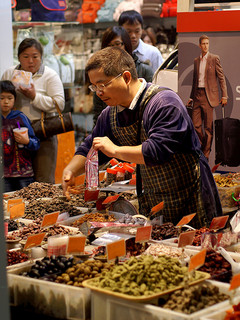
3387528058_9e0064f799_nWhile living in Taipei, we got many opportunities to try new and (to us) strange foods, especially at the night markets. I was game for tasting most things at least once. But sometimes it took me a little while to work up my nerve—like when I waited a few years before trying “stinky tofu.” (Ends up it’s not as bad as it sounds, or smells.)

For a long time, I’d seen mounds of small black spiral shells sold as a snack at night markets, and I wondered what they tasted like. Actually, I also wondered how you’d eat them. I figured a snail, or some sort of other creature, was cooked inside, so maybe you sucked the meat out, or maybe the shell was cooked to the point where it was soft and you were supposed to eat the whole thing. I didn’t know, but I saw the locals walking around with plastic bags full of them, so I assumed they tasted good.

One evening I finally gave in to my curiosity and confidently walked over to the lady selling the black shells. It’s the custom for vendors at the markets to provide a small bowl of samples for potential customers to try. This lady was no exception, as she had a paper bowl holding a few shells sitting on the front of the table. I grabbed one of the samples, put it in my mouth, and sucked on it as I walked away. While the shells looked spicy piled up on display—with a few peppers mixed in—I tasted nothing. Flavorless. And I was disappointed to find no meat inside.

The next night, I was at the same market, and I wanted to try one more time. So I grabbed another sample from the shell lady. Again, no matter how much I worked it around in my mouth, no meat, no flavor, just a shell. Come on. Why do people buy those things? I walked back to my family and told them how I’d wasted my time and was glad I hadn’t wasted my money.

That’s when my son looked back at the table . . . and said, “Dad, that’s not the bowl for samples. That’s where people put the shell after they’ve tried one and need to throw it away.”

[photo: “Taiwan 2009,” by bill_bly_ca, used under a Creative Commons license]

Listen to the Stories: Learning from Dick Gordon

6791137654_4a5b012e71_nI nominate Dick Gordon to be America’s first Listener Laureate.

Gordon is host of “The Story,” an hour-long show broadcast on many public radio stations five days a week.

Everybody has a story to tell. Everybody. But it takes time to hear it. The longer we listen, the more we learn about peoples and groups and cultures. And the longer we listen, the more we learn about individuals who are unlike anyone else around them.

Gordon’s soothing voice has rounded edges, and his style is unhurried. His questions invite his guests to speak at their own pace. He allows them to meander a little, since the place they end up is often better than where the question was pointing. “The Story” isn’t hard news. While we do learn facts from listening in, we learn more about the people who are living out those facts.

According to Gordon’s page at the show’s website, the idea for “The Story” came from a train ride through the former Soviet Union, while he was working for the Canadian Broadcasting Corporation:

On his way to interview a government official, Dick walked the train aisles and spoke to passengers. One by one, he heard their stories, and he realized that what they had to say was way more interesting and illuminating than any interview with any politician. It was a seed, and he tucked it away.

Born in Ontario, Gordon has had a reporting career that has taken him “from South Africa to India, and Moscow to Iraq,” and he often has guests who tell  first-hand stories from their own experiences around the globe. A couple weeks ago, Gordon talked with Iraqi-born Azzam Alwash, who became a civil engineer in the US and has returned to Iraq to restore the marshlands along the Tigris and Euphrates Rivers, drained by Saddam Hussein to drive out the people who lived there. Earlier, he also talked with Sokeel Park, of the NGO Liberty, about how people in North Korea are using illegal cell phones to communicate beyond their borders and outside the reach of their totalitarian government.

But the interviews from April 23rd are the ones that caught my attention. They’re with people here in the US. These people aren’t movers and shakers on the world stage, and that’s what makes their time wtih Gordon so poignant.

The first is a conversation with Nita Gerik, the 88-year-old widow of the former chief of the volunteer fire department in West, Texas, site of the terrible explosion that killed 14. Gerik was planning to attend every funeral. Gordon talks with her son, Jim, as well. (West, Texas, Is Home)

Then there’s Damion Roberts, a firefighter and bagpipe player who was taking part in a ceremony at Baylor University honoring the 11 first responders who died in West. (Amazing Grace)

And then Gordon interviewed Dotan Negrin, who travels the country—and to places as far away as Panama—with his upright piano, playing for whomever is willing to listen. (A Man and His Piano)

The kind moments that make these conversations special to me are these:

Gordon isn’t afraid of waiting in silence. The pauses at the end of sentences let his guests think and turn and move in new, natural directions.

He says things like “You must be . . . (as in “You must be very proud”) and “Sounds to me like . . . ,” entering into the moment and giving affirmation to the emotions involved.

He has questions that make his guests respond, “That’s actually really funny that you ask that. . . .” They know that he understands what they’re talking about, and they know that he deserves to hear more.

When Mrs. Gerik tells him, “They’re going to have one every day,” Gordon says he doesn’t understand and asks her what she means, because truly understanding is better than seeming to understand. And when Mrs. Gerik replies, “Funeral,” he apologizes. His apology is left as part of the interview, because heartfelt apologies lead to heartfelt responses that give even more depth to our stories.

I look forward to learning more from Gordon about how to listen well as I catch more of his work. “The Story” is produced by North Carolina Public Radio and distributed by American Public Media. Past episodes are archived under the heading “Stories: The language we all speak.”

If you’ve not seen it, or if you’d like to watch it again, here’s a video put out by Chick-fil-A, reminding us that “Every Life Has a Story.” Here’s to taking the time and the effort to listen to them.

[photo: “Vintage Microphone,” by Juliana Luz, used under a Creative Commons license]