
“Life Is What Happens . . .” Isn’t a John Lennon Original

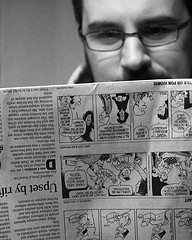
3051471866_f12b1460f5_mWho says you can’t learn anything from the comics? (Actually, I’ve never heard anyone say that, but it sounds like something somebody might say.)

Last week, in Jimmy Johnson’s Arlo and Janis comic strip, Arlo is looking at a calendar and ponders, “Life is what happens while you’re making other plans.” He comments that we’ve probably heard that that line came from John Lennon, but it actually originated with Allen Saunders, the writer of the dramatic comic strips Mary Worth and Kerry Drake. Arlo closes with, “Lucky so-and-so never had to be funny!” (See the February 1 strip here.)

While I was a missionary in Taipei, I helped some Taiwanese friends study the Bible with the hopes that they would continue meeting when I wasn’t with them. One group was made up of students at a technology university and another consisted of former university students who had degrees from the US. This second group had started meeting at a McDonald’s for a weekly Bible study even before I met them. During one of my family’s trips to the States, hosts for each group planned to keep the meetings going while we were gone. One group met for two weeks, but then the host had to travel outside the country. And in the other group, the hosts weren’t able to continue organizing the meetings because of an illness in the family. In our monthly newsletter, I wrote,

It reminds us of John Lennon’s famous phrase: “Life is what happens to you while you’re busy making other plans.”  But even though their schedules didn’t work out as well as they, and we, had hoped, we are greatly encouraged by their desire and willingness to try.

I stand corrected by a comic-strip character. Lennon used the “Life is what happens . . .” line in his song “Beautiful Boy” in 1980, but according to Garson O’Toole of the Quote Investigator, that was over 20 years after a nearly identical phrase appeared in the “Quotable Quotes” section of Reader’s Digest. In the January 1957 issue, Saunders was given as the source of “Life is what happens to us while we are making other plans.”

So there you have it. All those quotation sites on the web should replace John Lennon with Allen Saunders.

Life often does get in the way of our plans, doesn’t it? Reminds me of the Yiddish proverb, “Man plans, God laughs.” At least I’m pretty sure it’s a Yiddish proverb. And I guess I’ll stick with that until Dilbert says otherwise.

(Garson O’Toole, “Life Is What Happens to You while You’re Busy Making Other Plans,” Quote Investigator, May 6, 2012)

[photo: “Funny Pages,” by summerbl4ck, used under a Creative Commons license]
Go Global with Go Daddy . . . but Be Sure to Be First

I’m not a fan of very many Go Daddy commercials. Most aren’t in very good taste. But I was looking at the availability of some domain names at their site today, and I saw an ad that I like. It’s pretty funny, and it’s supposed to air during the Super Bowl.

The commercial is touting registration for .co domains. While .co is the internet country code for Colombia, it’s been open to unrestricted used since 2010.

The ad is aimed at an American audience, but it has a global cast. The internet really has broadened the playing field when it comes to the marketing of ideas, even ones that are “one in a gazillion.”

YourBigIdea.co:

Thanks, Wal-Mart, for Helping Vets in Need

Two weeks ago, my local newspaper had the following headlines on facing pages:

“Wal-Mart Announces Plan to Hire Veterans” and
“Military Suicides Hit Record High in 2012”

At first glance, the stories are unrelated, but deeper in, there is a connection.

(The information below comes from longer online versions of the AP stories printed in The Joplin Globe).

8061662328_e7cf08da2c_nWal-Mart Offers a Helping Hand

In a nutshell, Wal-Mart’s plan is to hire, over the next five years, every honorably discharged veteran who wants to work for it within the veteran’s first 12 months after leaving active duty. The program will start on Memorial Day, and the company projects that it will amount to more than 100,000 new hires.

This should be good news to veterans who have returned from serving in Afghanistan and Iraq. In December, that group had an unemployment rate of 10.8 percent, three percentage points higher than the overall rate in the US of 7.8.

Rising Suicide Rate a Troubling Issue for Returning Troops

Another statistic affecting military personnel is that last year, 349 active-duty troops committed suicide, the highest number since the Pentagon began keeping a more accurate record of suicides in 2001. The military’s suicide rate of 17.5 per 100,000 is still below the rate for civilian males aged 17-60, which, in 2010, was 25 per 100,000. But it’s the increase that is most troubling: up 16 percent over last year’s rate and more than doubling the rate of 2005.

“Now that we’re decreasing our troops and they’re coming back home,” says Kim Ruocco, whose husband killed himself in 2005, between Iraq deployments, “that’s when they’re really in the danger zone, when they’re transitioning back to their families, back to their communities and really finding a sense of purpose for themselves.” Ruocco now works with Tragedy Assistance Program for Survivors (TAPS).

Though the prospect of joblessness is not the most prominent factor in military suicides, it is a factor, being one of the many difficulties that returning veterans face. According to Joe Davis, spokesman for the Washington office of the Veterans of Foreign Wars, some veterans struggle with moving from the intensity of war to adjusting to their home bases, while some have trouble transitioning from their military job to looking for work in a slow economy.

Coming Back and Joining the Un- and Under-Employed

First Lady Michelle Obama supports the hiring plan of the largest private employer in the US, saying, “We all believe that no one who serves our country should have to fight for a job once they return home. Wal-Mart is setting a groundbreaking example for the private sector to follow.”

I agree. Maybe the jobs Wal-Mart is offering aren’t the absolute best (look here for a Stars and Stripes blog post on the plan’s detractors), but Wal-Mart is at least clearing one path for a group that faces so many obstacles.

While I was overseas—as a missionary, not a soldier—I and my coworkers would sometimes say, after a particularly frustrating day, “I just feel like leaving all this and moving back to the States and getting a job at Wal-Mart.”

What I’ve learned since then is that getting that easy full-time job at Wal-Mart isn’t the slam dunk that we thought it would be. Number one, working at Wal-Mart shouldn’t have been our go-to example of the simple, stress-free job we were willing to settle for. And number two, what made us think that ex-missionary’s applications are going to be at the top of Wal-Mart’s stack anyway?

I’ve been back in the US for over a year and a half now, and I’m still looking for long-term full-time employment. I’ve seen that while some employers might value the experiences gained overseas—whether by veterans, missionaries, or other cross-cultural workers—it is more than offset by the fact that those seeking new employment after working outside the US have been out of the loop when it comes to relationships. And, as Nelson Schwartz notes in a New York Times article published this week, being in the loop has become crucial in today’s job market. “Big companies . . . are increasingly using their own workers to find new hires,” he writes, “saving time and money but lengthening the odds for job seekers without connections, especially among the long-term unemployed.”

Schwartz quotes Mara Swan, executive vice president for global strategy and talent at Manpower Group, who says, “The long-term unemployed and other disadvantaged people don’t have access to the network. The more you’ve been out of the work force, the weaker your connections are.”

Being out of the country weakens your connections, as well.

(Anne D’Innocenzio, “Wal-Mart to Hire Vets, Buy More American Products,” NBC News, January 15, 2013; Robert Burns, “2012 Military Suicides Hit a Record High of 349,” The Big Story, January 14, 2013; Nelson D. Schwartz, “In Hiring, a Friend in Need Is a Prospect, Indeed,” The New York Times, January 27, 2013)

[photo: “121006-F-LX370-103,” by Justin Connaher, used under a Creative Commons license]

Is This the Africa You Know?

“What do you know about Africa?”

That’s the question that the producers of My Africa Is asked pedestrians on the streets of New York. Not surprisingly, the answers they received showed a lack of knowledge mixed with an abundance of stereotypes. But there was also a desire to learn more about the continent.

To help us all in our education, here are five videos that creatively take on the task of tearing down common misconceptions about Africa and replacing them with a more complete picture:

The first video is from the Kickstarter campaign of My Africa Is, a proposed documentary series. (The campaign ended in July of last year, without reaching its goal.)

My Africa Is Kickstarter Video

“We know what you’ve seen and heard about Africa—what they think is happening, what they think she needs, what they think she is. The four things that come to mind when people think of Africa are population, problems, poverty, and promise unfulfilled . . . but that’s not the whole story.”

The next two come from Mama Hope, part of its video campaign “Stop the Pity. Unlock the Potential.”

African Men. Hollywood Stereotypes

“If people believed only what they saw in movies, they would think we are all warlords who love violence.”

Call Me Hope

“It is only when people are no longer seen through the stereotypes of poverty that we can begin to see we are not so different from each other.”

The following video is from Radi-Aid, inspired by the Live Aid concerts of the mid 1980s.

Africa for Norway

“Imagine if every person in Africa saw the ‘Africa for Norway’-video, and this was the only information they ever got about Norway. What would they think about Norway?”

And finally, here’s a clip from the documentary This Is My Africa, in which interviewees imagine the Africa of the future.

This Is My Africa—Excerpt—Africa 2060

“Created to reveal a more personal vision of the continent  by weaving together the personal memories, tastes and experiences of 21 Africans and Africaphiles, This Is My Africa has been described as a 50-minute crash course in African culture.”

Related Post:
Coca-Cola: Selling Soda and Marketing Global Happiness
T-Shirts Redux

Speaking of “Coming Home”

2057958540_c80ea35181_m-1Last year I posted Carla Williams’ “Silences,” about how missionaries express themselves without using words, “about what faith looks like in the failures. Not in the everyday, stumble-and-move-on failures, but in the ones that knock you to your knees and change the course of the rest of your life.”

Recently, Carla wrote an article for Team Expansion‘s Tell magazine, titled “Coming ‘Home’: When Missionaries Come off the Field.” This time she used the words of former missionaries to share their thoughts on returning to the States. Here is some of what they came up with:

“We tried to change the factors and could not. I had arrived at the point that I cared more about being a missionary than I cared about my family. Ministering at the expense of your family isn’t really what God had in mind.”

“You know yourself, but you don’t know yourself here.”

“It was difficult to hear some people suggest ideas right away. We were numb and not in a good state to make big decisions.”

“I have to figure out I can explain this to someone who’s never done this and they’re just not going to understand the depths of emotion and the heights and lows that come with coming back.”

“In the moment of everything happening, it feels like such a heavy burden. We felt guilty that we weren’t following through with what we told people we would do. We felt like failures. But in the end, we can appreciate everything that we learned and did and can see how much more effective it has made us in the ways we are able to serve now. Coming back to the US wasn’t the end. In a lot of ways, it was just the beginning.”

Read the entire article in the latest Tell for more, including a discussion of why missionaries leave the field and what can be done to help them once they return.

I’m grateful to Carla for inviting Team Expansion repats—including my wife and me—to give their input for the article. And she even included my poem “Back in the States after Being Gone for a Long Time” as part of the issue.

Sometimes I need someone to listen to my silence. Sometimes I need someone to listen to my words.

(Carla Williams, “Coming ‘Home’: When Missionaries Come off the Field,” Tell, Fall 2012, pp 24-27)

[photo: “Make up chyer mind, please,” by Nikki, used under a Creative Commons license]

Sweet-Dreams Liner . . . Maybe Someday

5287865564_65b5330065_nIt’s been big news lately that the new Boeing 787 is having problems, resulting in its grounding until a solution can be found to its lithium-ion batteries catching fire. Certainly, that’s not the track record that was expected when it was christened the “Dreamliner” in an online naming contest (beating out “Global Cruiser” by 2500 votes).

There’s another kind of jet that I’m waiting for with more anticipation. It’s only in the concept stage, but it’s a well-thought-out concept—aimed directly at families with children. It’s called cAir, and it’s the brainchild of RKS Design. I heard about it from Karolyn Wojtowicz at the blog William Penn University Study Abroad (lots of good stuff there for “opening the eyes of students, of all ages, everywhere to opportunities available anywhere”). Read her take at “cAir: The New Child-Friendly Airline.”

cAir innovations include

  • Toy rental
  • Sound curtains that pull down from the ceiling (reminds me of Get Smart‘s “Cone of Silence”)
  • Child-friendly, family-size lavatories
  • Places for storing and reheating food
  • Built-in child seats
  • Spinnable seat pairs that allow family members to face each other (my favorite—just like the trains in Taiwan)
  • Lower-level overhead compartments for child access to smaller items
  • And half-price discounts for parents flying with children (OK, I made this last one up, but we’re dreaming, aren’t we?)

“Flying with children can be a real nightmare. . . . So why not do something to fix it?” —RKS Design

(David M. Ewalt, “Dreamliner’s News May Be Getting Worse, and Not Just for Boeing,” Forbes, January 22, 2013; “Puget Sound Employee Wins ‘Name Your Plane’ Sweepstakes,” Boeing Frontiers Online, July 2003)

[illustration: “Flying Duck Patrol,” by Colorful Bleeding, used under a Creative Commons license]

Regrets and Remembrances: A Prayer for Those Who Leave Home

With one plane ride the whole world as TCKs have known it can die. Every important place they’ve been, every tree climbed, pet owned, and virtually every close friend they’ve made are gone with the closing of the airplane door.
—David Pollock and Ruth Van Reken, Third Culture Kids

5420666395_e086b79cf9_mThis closing door doesn’t just happen to Third Culture Kids. It’s also the experience of immigrants who leave behind many what-could-have-beens in their old country. Cross-cultural workers feel the door close when they leave their work and return “home.” (What other job requires you to leave the country once you’re no longer on the payroll?) International students close the door with the hopes that new opportunities will open many more. And refugees often see the door slammed and locked by soldiers carrying guns.

5420666545_cd2c078381_mBut while the door is closed, the mind is still open to thoughts about what was left behind. Some thoughts are joyous and life giving. Some are hurtful and life stealing. And often they come intricately, painfully intertwined, called up by a scent, a word, a sound, a flavor, a feeling or a dream. Bittersweet.

For those who find themselves on the other side of a closed door, I offer this prayer, inspired by Reinhold Niebuhr’s “Serenity Prayer.”

God, grant me the confidence to let go of the regrets that I should not hold on to,
The ability to hold on to the memories I should not let go of,
And the wisdom to separate the one from the other. Amen.

(David C. Pollock and Ruth E. Van Reken, Third Culture Kids: Growing Up among Worlds, Boston: Nicholas Brealey, 2009)

[illustrations: (upper) “Joined” and (lower) “Cupped“) by Pete Hobden, used under a Creative Commons license]

Jesus Has Rhythm, How about You?

5952477370_6475320cc9_m“In the gospel accounts, we don’t see Jesus scurrying around driven by what we might call ‘hurry sickness,'” writes Stephen W. Smith. “We don’t sense Jesus navigating white water. We don’t see Him spinning plates or trying to live a balanced life. None of the four biographers of Jesus show Him in a hurry—ever.”

In his book, The Jesus Life: Eight Ways to Recover Authentic Christianity, Smith teaches that we not only need to listen to the words of Jesus but watch the lifestyle of Jesus, as well. And if we look closely, we’ll see that Jesus’ life is marked by a rhythm. This is especially clear, says Smith, in the Gospel of Luke:

Engage then disengage; work in the crowds but always make time to rejuvenate with time alone. Luke revealed that Jesus was not always on, He was not always available. This important lesson is key to sustaining a resilient and satisfying life.

Smith then goes on to tell the story of two “modern pilgrims,” Rich and Carla, who “graduated from a Christian college, got married, and moved to the mission field.”

They both had a dream of sharing Jesus with others who had never heard His teachings. But eighteen months after they arrived in their assigned country, they came back home. They left enthusiastic and invigorated. They returned broken and discouraged. Both shared that they had worked over seventy hours a week in a tireless effort with dozens of volunteer teams to build a children’s center from a crumbling building. They said, “We never had a day off. We never had one moment to ourselves. We hosted college students in our homes who stayed up late playing games, and we found ourselves playing the games with them until the early-morning hours. We went to bed exhausted, got up exhausted, did our work exhausted, and fought all the time—it seemed.”

Sound familiar? Feel familiar?

If so, and if you’d like help in imitating the rhythmic life of Jesus, pick up a copy of The Jesus Life.

(Stephen W. Smith, The Jesus Life: Eight Way to Recover Authentic Christianity, Colorado Springs: David C Cook, 2012)

[photo: “Plate Spinning,” by Vincent Cornelius, used under a Creative Commons license]