Grilled-Corn KitKats and Other Worldly Cuisine

Approved by more than 90% of shareholders who voted, Mondelez (pronounced “mon-dah-LEEZ”) has been officially chosen as the name of Kraft’s new global snack food business. Later this year, Kraft will split into two divisions, Mondelez International, Inc., which will include worldwide brands such as Oreo, Cadbury, and Nabisco, while the North American business will continue under the Kraft banner. The new name is a combination of the Latin word for world and delicious.

Kraft isn’t the only American food company ramping up its global business. An article from the Associated Press takes a look at how several brands are glocalizing their products to meet the tastes and preferences of people around the world. Have you had any of these?

  • in China: Kraft’s (soon to be Mondelez’s) Oreo wafer cookies and “regular” Oreos with green-tea, raspberry-and-blueberry, and mango-and-orange fillings. Oreos now claim a 13% share in the Chinese cookie market, making them number one.
  • in Saudi Arabia: lemon-pepper-flavored Tang
  • in Mexico: Tang in tamarind, mandarin, and hibiscus versions
  • in Spain: Kellog’s All-Bran cereal sold to be eaten in coffee instead of milk
  • in Russia: Lay’s Potato Chips in crab, caviar, and “pickled cucumber” flavors

And here are just a few of the many products listed by a blogger at Mental Floss:

  • Fanta: honeydew, lactic white grape, and toffee flavors in Taiwan; tamarind in Mexico; and melon cream in Japan
  • Lay’s Potato Chips: wasabi, poutine, and spicy curry flavors in Canada; blueberry in China; cucumber and goat cheese in Belgium; spicy chill squid in Thailand; Tzatziki in Greece and South America
  • Nestle KitKats: Japan wins the prize here with many, many flavors, including aloe vera, banana, beet, bubblegum, cheese, cucumber, ginger ale, miso, pepper, pumpkin, rose, soybean, wasabi, wine and yakimorokoshi (grilled corn)

I’m remembering a couple unique “American” snacks I’ve had: sea-weed flavored Pringles and Nestle’s red-bean and taro ice creams. How about you? What are your favorites—or not-so favorites? Or maybe it was something you saw but were afraid to try.

(“Kraft Shareholders Give ‘Mondelez’ Thumbs Up for New Snack Food Business,” The Washington Post, May 23, 2012; Candice Choi, “Crab’ Chips, Fruity Oreos? They’re Big Overseas,” Yahoo! News, May 6, 2012; Jill Harness, “8 American Snacks and Their Foreign Flavors,” Mental Floss, September 14, 2011)

[photo: “KitKat Candy from Japse,” by Dan Century, used under a Creative Commons license]

T-Shirts Redux

In an earlier post I talked about sports leagues giving  losing-team t-shirts to the poor in Africa and other places around the world through World Vision. Turns out there was a long online debate about whether these kinds of “gifts in kind” help or hurt the recipients. One article that seems to give a pretty straightforward overview of the situation is “What Happens to All Those Super Bowl T-Shirts?: A Guest Post by Dean Karlan” (Freakonomics, February 15, 2011). Karlan is co-author of More Than Good Intentions: How a New Economics Is Helping to Solve Global Poverty.

I say this article seems to give a pretty straightforward overview because the issue is complicated,  and while I think I understand the problem (the biggest negative is the possible impact on the local textile economy) , I don’t know nearly enough to take sides or figure out a solution. Actually, what led me to this discussion was the serendipity of the Internet: I was searching for repat to see if it’s a legitimate abbreviation for repatriate, like expat for expatriate. (Answer: Not sure, but it should be.) That led me to the ProjectRepat site. ProjectRepat raises money for nonprofits by buying back used American T-shirts in Africa and then reselling them in the US. They explain that most of the shirts donated to non-profits in the US are baled up and sold for “pennies on the pound” and shipped to places like Africa to be resold in local markets. (I remember that as a college student I volunteered at the local Salvation Army, helping bundle up similar bales of clothing.) ProjectRepat then buys some of them back, adds their own screen-printed label, and resells them to US customers for $25 apiece. It’s an ironic and hip way to raise funds and draw attention to the situation. They also sell bags, scarves, and other items made by Kenyans from upcycled T-shirts. It was when I clicked on some of the news articles about their work that I found one at UN Dispatch: “Fighting Bad Aid by Selling Second-Hand T-Shirts Back to Americans” (May 17, 2011), in which Penelope Chester writes about the World Vision controversy and then draws attention to ProjectRepat. It’s interesting to note that on ProjectRepat’s FAQ page, they address the question of whether used T-shirts in Africa are destroying local markets:

This is an interesting question, and one that we will continue to explore as we grow as a company. We’ve heard a lot of different arguments. On the one hand, an abundance of inexpensive secondhand clothing does prevent local entrepreneurs and textile companies from starting their own businesses. On the other, it has created millions of small businesses (from clothing vendors, to seamstresses, to those packaging the clothing), and provides inexpensive clothing for those who otherwise might not be able to afford it at full price.

[the photo was taken in San, Mali: “San Market” by Janet Goldner, used under a Creative Commons license]

No McAloo Tiki for You!

Back in October, MainStreet came out with a list of 10 glocalized items—from American-based fast-food chains—that aren’t available in the US. Among the food that the author writes “we wish we could have” are McDonald’s McVeggie (India), Burger King’s Meat Monster (Japan), Pizza Hut’s Chunky Loaded Pizza (Malaysia), Wendy’s Rugby Combo (New Zealand), and McDonald’s Bubur Ayam McD (Malaysia)—”juicy chicken strips in mouth-watering porridge, garnished with spring onions, sliced ginger, fried shallots and diced chilies . . . just like mum’s cooking!”

(Matt Brownell, “10 Fast Food Items You Can’t Have,” MainStreet, October 11, 2011)

By the way, did you know that since late 2010 Burger King has been owned by a Brazilian investment firm? At the time of the purchase, for $3.26 billion, 3G Capital planned to increase BK’s international presence, including opening 500 new restaurants in Latin America by 2015.

(“Brazilian-Owned 3G Capital Buys Burger King,” Business Pundit, October 11, 2011)

[the photo is of a lady enjoying McDonald’s fried chicken in Thailand: “IMG_7529 by weenie dog, used under a Creative Commons license]

Ken and Barbie, Not Welcome in Iran

Back in 1996, religious leaders in Iran declared Mattel’s Barbie un-Islamic because of “destructive cultural and social consequences,” but toy sellers largely ignored their edict. Starting in December of last year, though, Iran’s morality police initiated an official ban on the doll (and her companion, Ken). Who will fill the empty shelves? Enter Sara and Dara, created by the Iranian government’s Institute for the Intellectual Development of Children and Young Adults in 2002 “to promote traditional values, with their modest clothing and pro-family backgrounds.” The pair of dolls are modeled after eight-year-old children, and even though that is young enough for Sara not to have to wear a headscarf in public under Islamic law, one is provided with each of her outfits. Quoted in Islam for Today, Masoumeh Rahimi, a toy seller in Iran, welcomes Sara and Dara’s arrival. “I think every Barbie doll is more harmful than an American missile,” she said. Another shop owner, agreed, calling Sara and Dara “an answer to Barbie and Ken, which have dominated Iran’s toy market.” But a Reuter’s report quotes a toy seller in Tehran who has a different opinion of the changes: “We still sell Barbies but secretly and put [dolls covered with veils and wearing loose-fitting clothes] in the window to make the police think we are just selling these kinds of dolls.” And Famaz, a 38-year-old mother, said, “My daughter prefers Barbies. She says Sara and Dara are ugly and fat.” Made in China, a Sara doll sells in Iran for about US$15, compared to US$40 for a real Barbie, and US$3 for a copy.

(Mitra Amiri, “Iran: Morality Police Cracking Down on Barbie Dolls,” Huffpost World, January 16, 2012; “Dara and Sara—Iran’s Islamic Alternative to Ken and Barbie,” Islam for Today)

[the photo is of girls in Iran with a Barbie backpack: “Picture 980” by cordelia_persen, used under a Creative Commons license]
Made in Americus

One-third of the people in the world use them, then throw them away. Japan uses about 23 billion pairs each year. And China produces 63 billion pairs annually. They are disposable chopsticks . . . and recently, more and more of them are being made in the USA. Back in mid July, Georgia Chopsticks, of Americus, Georgia, was churning out about 2 million pairs of chopsticks per day, with plans to produce 10 million a day by the end of 2011. Why Georgia? “The Pacific Rim, especially areas of China and Japan, they’ve run out of wood,” says David Garriga, head of the local economic development council, “but we have an abundance of it.” This includes sweet gum and poplar, which are great for making chopsticks because their wood doesn’t have to be chemically lightened, like Asian wood, to achieve the desired color. Susan White, who works at the company says, “Everywhere in America you see ‘Made in China,’ and you wonder if, in China, they ever see ‘Made in America.’” With every chopstick made in Americus going oversees, she really doesn’t have to wonder any more.

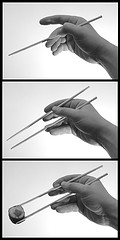
If the subtle art of chopsticks usage eludes you, and you’d like some instructions to go with the pictures above, go to eHow’s “How to Use Chopsticks.”

(Philip Graitcer, “Chopsticks Carry ‘Made in America’ Label,” Voice of America, July 18, 2011)

[photo by lintmachine, used under a Creative Commons license]