Happiness Is As Happiness Does

517517380_2c489713abWhat are the happiest countries in the world?

Well, that depends. It depends on how you define happiness and how you figure out if people fit your definition.

Do You Feel Good?
In 2011, the Gallup organization measured “positive emotions” by asking people in 148 countries about their previous day, asking whether they felt well-rested, were treated with respect, smiled or laughed a lot, learned or did something interesting, and experienced enjoyment. The countries with the highest percentage of respondents answering “yes” to all five questions are labeled the “most positive.” They are

  1. Panama
  2. Paraguay
  3. El Salvador
  4. Venezuela
  5. Trinidad and Tobago
  6. Thailand
  7. Guatemala
  8. Philippines
  9. Ecuador
  10. Costa Rica

(Jon Clifton, “Latin Americans Most Positive in the World,” Gallup World, December 29, 2012)

Do You Not Feel Bad?
Gallup also asked people if they had experienced physical pain, worry, sadness, stress, or anger. Those answers produce the following list of places with the least negative emotions:

  1. Somaliland region
  2. Uzbekistan
  3. Thailand
  4. Kyrgyzstan
  5. Kosovo
  6. Turkmenistan
  7. Mali
  8. Singapore
  9. Mongolia
  10. China

(Jon Clifton, “Middle East Leads World in Negative Emotions,” Gallup World, June 6, 2012)

Are You Prosperous?
The Legatum Institutes Prosperity Index measures wealth and wellbeing by looking at the eight categories of economy, entrepreneurship and opportunity, governance, education, health, safety and security, personal freedom, and social capital. This gives us the following list of top-ten countries in 2012:

  1. Norway
  2. Denmark
  3. Sweden
  4. Australia
  5. New Zealand
  6. Canada
  7. Finland
  8. Netherlands
  9. Switzerland
  10. Ireland

(The 2012 Legatum Prosperity Index, The Legatum Institute, 2012)

Are You Thriving?
To measure whether people are “thriving,” “struggling,” or “suffering,” Gallup uses the “Cantril Self-Anchoring Striving Scale.” Participants are asked to imagine a ladder, with rungs numbered 0 to 10 from bottom to top, with 0 being the worst and 10 being the best. The poll then asks two questions: “On which step of the ladder would you say you personally feel you stand at this time?” and “On which step do you think you will stand about five years from now?” Results in 2010 produce the following ranking, showing the ten countries with the highest levels of thriving people:

  1. Denmark
  2. Sweden
  3. Canada
  4. Australia
  5. Finland
  6. Venezuela
  7. Netherlands
  8. Ireland
  9. Panama
  10. United States

(Julie Ray, “Nearly One in Four Worldwide Thriving,Gallup World, April 10, 2012)

Deeper Analysis, Anyone?
Last year, Columbia University’s Earth Institute published the first World Happiness Report. It contains in-depth evaluations of the hows and whys of measuring happiness around the world, as well as lists based on its own examination of survey responses. One such ranking is the “Average Net Effect by Country,” which combines the averages of the positive and negative emotion results from Gallup (like those shown above). Those results give these top-10 countries:

  1. Iceland
  2. Laos
  3. Ireland
  4. Panama
  5. Somaliland region
  6. Thailand
  7. Taiwan
  8. Austria
  9. Sweden
  10. New Zealand

Another ranking shown in the World Happiness Report is called the “Happy Index.” It uses information from the combined World Values Survey/European Values Survey, asking the question, “All things considered, how satisfied are you with your life as a whole these days/nowadays?” putting these countries at the top.

  1. Iceland
  2. New Zealand
  3. Denmark
  4. Netherlands
  5. Northern Ireland
  6. Ireland
  7. Singapore
  8. Malaysia
  9. Norway
  10. Tanzania

(John Helliwell, Richard Layard, and Jeffrey Sachs, eds., World Happiness Report, The Earth Institute, 2012)

Or Would an Anecdotal Approach Make You Feel Better?
And finally, if all this data crunching is not your cup of tea—or if it leaves you somewhat confused—you can do what documentarian Werner Herzog did, and simply recognize happiness where you find it. Even if it’s in the most unlikely places, under the most unlikely circumstances. Even if it’s in the wilderness of Siberia.

Happy People: A Year in the Taiga (Werner Herzog and Dmitry Vasyukov, dirs., 2010)

[photo: “A Happy Man,” by Sukanto Debnath, used under a Creative Commons license]

Thanks, Wal-Mart, for Helping Vets in Need

Two weeks ago, my local newspaper had the following headlines on facing pages:

“Wal-Mart Announces Plan to Hire Veterans” and
“Military Suicides Hit Record High in 2012”

At first glance, the stories are unrelated, but deeper in, there is a connection.

(The information below comes from longer online versions of the AP stories printed in The Joplin Globe).

8061662328_e7cf08da2c_nWal-Mart Offers a Helping Hand

In a nutshell, Wal-Mart’s plan is to hire, over the next five years, every honorably discharged veteran who wants to work for it within the veteran’s first 12 months after leaving active duty. The program will start on Memorial Day, and the company projects that it will amount to more than 100,000 new hires.

This should be good news to veterans who have returned from serving in Afghanistan and Iraq. In December, that group had an unemployment rate of 10.8 percent, three percentage points higher than the overall rate in the US of 7.8.

Rising Suicide Rate a Troubling Issue for Returning Troops

Another statistic affecting military personnel is that last year, 349 active-duty troops committed suicide, the highest number since the Pentagon began keeping a more accurate record of suicides in 2001. The military’s suicide rate of 17.5 per 100,000 is still below the rate for civilian males aged 17-60, which, in 2010, was 25 per 100,000. But it’s the increase that is most troubling: up 16 percent over last year’s rate and more than doubling the rate of 2005.

“Now that we’re decreasing our troops and they’re coming back home,” says Kim Ruocco, whose husband killed himself in 2005, between Iraq deployments, “that’s when they’re really in the danger zone, when they’re transitioning back to their families, back to their communities and really finding a sense of purpose for themselves.” Ruocco now works with Tragedy Assistance Program for Survivors (TAPS).

Though the prospect of joblessness is not the most prominent factor in military suicides, it is a factor, being one of the many difficulties that returning veterans face. According to Joe Davis, spokesman for the Washington office of the Veterans of Foreign Wars, some veterans struggle with moving from the intensity of war to adjusting to their home bases, while some have trouble transitioning from their military job to looking for work in a slow economy.

Coming Back and Joining the Un- and Under-Employed

First Lady Michelle Obama supports the hiring plan of the largest private employer in the US, saying, “We all believe that no one who serves our country should have to fight for a job once they return home. Wal-Mart is setting a groundbreaking example for the private sector to follow.”

I agree. Maybe the jobs Wal-Mart is offering aren’t the absolute best (look here for a Stars and Stripes blog post on the plan’s detractors), but Wal-Mart is at least clearing one path for a group that faces so many obstacles.

While I was overseas—as a missionary, not a soldier—I and my coworkers would sometimes say, after a particularly frustrating day, “I just feel like leaving all this and moving back to the States and getting a job at Wal-Mart.”

What I’ve learned since then is that getting that easy full-time job at Wal-Mart isn’t the slam dunk that we thought it would be. Number one, working at Wal-Mart shouldn’t have been our go-to example of the simple, stress-free job we were willing to settle for. And number two, what made us think that ex-missionary’s applications are going to be at the top of Wal-Mart’s stack anyway?

I’ve been back in the US for over a year and a half now, and I’m still looking for long-term full-time employment. I’ve seen that while some employers might value the experiences gained overseas—whether by veterans, missionaries, or other cross-cultural workers—it is more than offset by the fact that those seeking new employment after working outside the US have been out of the loop when it comes to relationships. And, as Nelson Schwartz notes in a New York Times article published this week, being in the loop has become crucial in today’s job market. “Big companies . . . are increasingly using their own workers to find new hires,” he writes, “saving time and money but lengthening the odds for job seekers without connections, especially among the long-term unemployed.”

Schwartz quotes Mara Swan, executive vice president for global strategy and talent at Manpower Group, who says, “The long-term unemployed and other disadvantaged people don’t have access to the network. The more you’ve been out of the work force, the weaker your connections are.”

Being out of the country weakens your connections, as well.

(Anne D’Innocenzio, “Wal-Mart to Hire Vets, Buy More American Products,” NBC News, January 15, 2013; Robert Burns, “2012 Military Suicides Hit a Record High of 349,” The Big Story, January 14, 2013; Nelson D. Schwartz, “In Hiring, a Friend in Need Is a Prospect, Indeed,” The New York Times, January 27, 2013)

[photo: “121006-F-LX370-103,” by Justin Connaher, used under a Creative Commons license]

Samsara and Baraka, Our World in Film

Coming soon to a theater near you. We’ve all heard those words. (At least I think we have. Do movie advertisements say that any more?) But for a lot of the movies I’d like to see, it’s not true. That’s because my community doesn’t have a local venue for foreign films and documentaries. We do, though, have a library that does a pretty good job of keeping up with off-the-beaten-path movies. For these kinds of films, maybe the slogan should be “Coming later to a library near you.”

That brings me to a new production that premiers today in New York and Seattle. The title is Samsara, which the production’s website says is “a Sanskrit word that means ‘the ever turning wheel of life.'” It’s a series of video clips filmed in 25 countries over a period of nearly five years. With a musical score but no dialogue or commentary, it is director Ron Fricke’s followup to his earlier Baraka (1992). Both follow the same format, and both were shot on high-resolution 70 mm film. Baraka, a word present in several languages, means “blessing.”

Of Baraka, Chicago Sun-Times film critic Roger Ebert writes, “Of course there is a ‘message’ somewhere in ‘Baraka’—the same message we have heard before, about how man must love and respect the planet.” But Mark Magidson, who produced and co-edited Samsara and worked on Baraka as well, tells The New York Times that with Samsara, “We’re not trying to say anything.”

Maybe the editing of Samsara will end up showing an obvious message, but it looks to me right now that the film is a video Rorschach test, with the meaning varying from viewer to viewer. In fact, I envision getting a copy and showing it to some groups—for instance, college students or potential missionaries or veteran cross-cultural workers—and asking them, “What do you think the filmmakers are trying to say? What one-word title would you give to the movie? What does it mean to you?”

In 2008, Baraka was digitally restored and released on Blu-ray (it’s also available on DVD). In response to the restoration, Ebert writes, “If man sends another Voyager to the distant stars and it can carry only one film on board, that film might be “Baraka.” And as for the Blu-ray version:

[It] is the finest video disc I have every viewed or ever imagined. . . . It is comparable to what is perceptible to the human eye, the restorers say. “Baraka” by itself is sufficient reason to acquire a Blu-ray player.

While I’m waiting for Samsara to come to my library, I think I’ll check out—or buy—a copy of Baraka. And maybe both will be aboard Voyager 3, going soon to a galaxy far, far away.

(Nicolas Rapold, “Planetary Poetry, Woven into a Movie,” The New York Times, August 18, 2012; Roger Ebert, “Baraka,” November 12, 1993; Ebert, “Baraka [1992],” October 16, 2008)

[photo: “holi amusedness!” by Elijah Nouvelage, used under a Creative Commons license]

Chris Jodan’s Art Helps Us “Feel” Some “Enormous Statistics”

Chris Jordan produces some really big artwork to represent some really big numbers. For example, this first piece below “depicts 92,500 agricultural plant seeds, equal to one hundredth of one percent of the number of people in the world today who suffer from malnutrition.”

This next one “depicts 240,000 plastic bags, equal to the estimated number of plastic bags consumed around the world every ten seconds.”

And this one “depicts 270,000 fossilized shark teeth, equal to the estimated number of sharks of all species killed around the world every day for their fins.”

All are part of the collection “Running the Numbers II: Portraits of Global Mass Culture.” Click on the thumbnails above and you’ll go to Jordan’s site, where you can see what makes these images so interesting. By clicking on the selected photos there, you’ll zoom all the way in to see the tiny parts—the seeds, the plastic bags, the shark teeth—that make up the larger whole.

In the TED Talk below, Jordan discusses the motivation behind his work, as he talks specifically about his earlier “Running the Numbers: An American Self-Portrait,” which looks at excesses and issues in US culture, such as personal bankruptcy, deaths caused by smoking, and the country’s high rate of incarceration.

“Now I want to emphasize that these are just examples,” Jordan tells the TED audience. “I’m not holding these out as being the biggest issues. They’re just examples. And the reason that I do this . . . it’s because I have this fear that we aren’t feeling enough as a culture right now. There’s this kind of anesthesia in America at the moment.”

Using his creative talents, Jordan’s goal is, as he says, to take “gigantic numbers” and “enormous statistics” and “translate them into a more universal visual language that can be felt.”

It makes me think about what numbers I’d like to see shown in this way, such as those representing worldwide refugees and displaced people, abortions, human trafficking, and child soldiers, to name a few. I’m sure that we each have our own list of statistics that we believe need to be heard, seen . . . and felt.

And finally, we can see Jordan’s ability to challenge and educate using more traditional images in Ushirikiano: Building a Sustainable Future in Kenya’s Northern Rangelands. This book chronicles, in words and photographs, “the Nakuprat-Gotu Conservancy in Northern Kenya, an initiative led by tribal Elders, which aims to bring peace and prosperity to a region ravaged by violence and climate change.” Go here to see over 70 stunning photos from the collection, including many beautiful portraits of Kenya’s Turkana, Samburu, Borana, and Meru people.

[all images are by Chris Jordan, used under a Creative Commons license]

Can There Be Too Much Choice? It’s a Cultural Thing

I recently wrote about the trials of choosing cereal at Wal-Mart, and friend and fellow blogger MaDonna followed up with her own post calling the cereal aisle “one of the top 5 places expats hate to visit in the US.”

Sheena Iyengar, a professor at Columbia University and leading expert on choice, understands our pain. She writes in her book The Art of Choosing,

In 1994, the year I had my first inkling that there might be such a thing as too much choice, over 500,000 different consumer goods were already available in the United States. By 2003, the number had increased to nearly 700,000, an upward trend that shows no signs of letting up. Technological advances frequently introduce new categories of products into our lives. Some of them—cell phones, computers, digital cameras—become indispensable, and soon enough the options proliferate. Just as importantly, not only are there more goods on the market, there are more ways to get at them. The typical supermarket, which carried 3,750 different items in 1949, now boasts some 45,000 items. Walmart and other “big-box” retailers offer smorgasbords of over 100,000 products to Americans in just about every part of the country. And if you don’t find what you’re looking for within a few blocks, you’ll certainly find it with a few clicks. The Internet extends your reach well beyond local venues, providing access to the 100,000 DVDs on Netflix.com, 24 million books (and millions of other products) on Amazon.com, and 15 million singles on Match.com.

Following is a fascinating TedGlobal talk by Iyangar in which she discusses cultural differences in the valuing of choice. In her introduction to the video on her website, she says,

In America, choice is sacred. We believe in its limitless power and we worship it for the possibilities it offers. For Americans, choice is liberty, which is subordinate only to life itself in the Declaration of Independence. So it can be almost impossible to accept that not only are there countries and cultures that do not subscribe to the American ideal of choice, but that they wouldn’t necessarily be better off if more choice suddenly became available to them. I explore the great variation across the globe in beliefs about who should choose and when, how much choice should be available, and when choice is a burden rather than a pleasure.

Iyangar starts her presentation with an experience she had in a Japanese restaurant and ends in the US with a story of how her blindness affected how she chose the right fingernail polish. In between she shares research and anecdotes from around the world. Enjoy.

[photo: “Fi,” by Michael Hopkinsii, used under a Creative Commons license]

Two Books for Helping Us Picture the Kids of the World

When people miss home, they often say they wish they could be back in their own beds. Children, especially, find comfort underneath familiar covers. Of course, there is a great variety of beds, and bedrooms, around the world. That’s the theme of James Mollison’s Where Children Sleep (2010), “stories of diverse children around the world, told through portraits and pictures of their bedrooms.” It’s aimed a 9-13 year olds, but the photos of the bedrooms and portraits of the children are engaging for adults, as well. See for yourself at the author’s site, where you can view 27 of the photo/portrait pairs.

And another book that shows the diversity of children around the globe is Children of the World: How We Live, Learn, and Play in Poems, Drawings, and Photographs (2011). Authored by Anthony Asael and Stephanie Rabemiafara, founders of Art in All of Us, the book helps us “learn a little of the geography, traditions, and peoples of 192 countries around the globe—including our cultural similarities and differences—ultimately discovering that children everywhere draw, smile, play, and rejoice in their different backgrounds and in their universal friendship.” More information about Art in All of Us and a gallery of children’s artwork and photos is at the organization’s site.

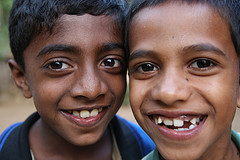
[photo: “Portrait two boys – Sri Lanka,” by World Bank Photo Collection, used under a Creative Commons license]

Three Ways to Find Out Where You Fit into the Global Work World—Hours, Pay, and Real Slave Labor

Back in 2003, the Taipei Times reported that the Taiwanese put in the most working hours of anyone in the world, averaging 2,282 per year, or 44 per week. According to a recent BBC article on workplace suicides in Taiwan, the current situation hasn’t improved much, if at all, stating that the average Taiwan employee works “about 2,200 hours annually.” Even this number would put Taiwan at the top of the Organisation for Economic Co-operation and Development’s  list of  hours worked per country, as reported by BBC. (My guess is that the OECD left Taiwan out because it does not recognize it as a country. They list Taiwan on their website as “Chinese Taipei.”)

So where does your work schedule fit in? Are you above or below the global average? To find out, enter your information on the BBC News site “Who Works the Longest Hours?

And while you’re at it, take a look at “Where Are You on the Global Pay Scale?

And finally, go to Slavery Footprint’s “How Many Slaves Work for You?” to find out how your lifestyle depends on slave labor around the world. It’s a pretty slick site that brings attention to a very important topic.

(“Taiwan Works Too Hard: Survey,” Taipei Times, August 31, 2003; Cindy Sui, “Deaths Spotlight Taiwan’s ‘Overwork’ Culture,” BBC News, March 19, 2012)

[photo: “kill me now,” by Katrine Thielke, used under a Creative Commons license]

The Globesity Epidemic

Several news outlets, including The Washington Post, have recently cited a study, published in the American Journal of Preventive Medicine, on obesity in the US. It predicts that the number of obese Americans will rise from the current 34% of the population to 42% by the year 2030. This is less than the 51% that was predicted in another study four years ago, but the new figures still show a worrying trend, one that is expected to add over half a trillion dollars to health-care costs.

Here’s where I’d planned on segueing to a discussion of the growth of obesity around the globe with something like “While the US is the global leader in the overweight category, the obesity epidemic is truly global.” I thought that America’s status as the fattest country was a given, but it’s actually not true. In fact, according to an article published in The Lancet (as reported in LiveScience), the US comes in at about #20. Behind places like Nauru (#1, where over 80% are obese), Samoa, and other island nations in Oceania, as well as Middle Eastern countries, such as Kuwait and Saudi Arabia. Turns out that when we heard that the US was the most obese, that was referring to industrialized countries. But now that the United Arab Emirates and Qatar have climbed up the list, America is no longer tops even in that category.

Anyway, back to “the obesity epidemic is truly global” . . . .

The Harvard School of Public Health reports that worldwide, about 500 million people are obese, with another one billion considered overweight. We now live in a world where there are more overweight than underweight people. And the number of obese in the world is expected to double by 2030.

Fed by globalization, the “globesity epidemic” has several causes affecting low- and middle-income countries:

  • Free trade brings cheaper food and greater access to processed foods.
  • Rising global wealth brings about habits that lead to obesity—including reduced levels of activity, eating outside the home, and buying more processed foods.
  • Urbanization and technological advances lead to a decrease in activity and more sedentary lifestyles.
  • The spread of advertising, on TV and in other media, is pushing the products and eating habits of the West.
  • And increased industrialization produces higher levels of stress and reduced sleep, two factors that are associated with obesity.

Even though the trends are set in place, the Harvard School of Public Health believes that there is room for hope. Education and smart policies can slow the momentum. Low- and middle-income countries need to “learn from the mistakes of higher income countries, which did not recognize the health consequences of modernization until they were already taking a greater toll.” But that would require the ability to distinguish excesses from successes, something that the West has not been very good at.

(David Brown, “Study Predicts 42 Percent of Americans Will Be Obese in 2030,” The Washington Post, May 7, 2012; Christopher Wanjek, “US Loses Its Fat Supremacy,LiveScience, February 8, 2011; “The Obesity Prevention Source: Globalization,” The Harvard School of Public Health)

[photo: “Obesity in the US,” by Global X, used under a Creative Commons license]