
Why Do Missionaries Leave the Field? It’s Hard to Say

7793620080_30d1cace90_z

Read very many reports of people who out of the blue quit their prestigious, well-paying jobs (for example, company CEO, NBA coach, speaker of the house), and you’ll quickly see that one of the main reasons they claim is “to spend more time with family.” Of course, we understand that in most cases, that’s a boilerplate answer used to sidestep what’s really going on. The truth is much more difficult to discern.

When it comes to missionary attrition, the situation is not much different.

After finishing our first term on the mission field in Taiwan, I and my family made our first trip back to the States. During that visit I heard a representative from our sending agency talk about the many reasons why missionaries leave the field. What she said went something like this:

There’s the reason you tell your supporters.
There’s the reason you tell your church.
There’s the reason you tell your agency.
There’s the reason you tell your teammates.
There’s the reason you tell your family.
There’s the reason you tell yourself.
And there’s the reason you tell God.

Detlef Bloecher, in Worth Keeping: Global Perspectives on Good Practices in Missionary Retention, has a similar list, citing

stated reasons (written in the missionary’s prayer letter)
personal reasons (told to close friends or family)
secret reasons (not shared but believed deep in the missionary’s heart)
leader’s reasons (identified by the team or field leader)
recorded reasons (added to the missionary’s file)
believed reasons (accepted by the director of the sending base)
socially accepted reasons (published in the mission journal)
further reasons identified by the missionary’s professional counsellor, and
true reasons (a combination of the above or something completely different)

Bloecher’s listing is part of his discussion of the challenges faced by the Mission Commission of the World Evangelical Fellowship (WEF) when, in 1994, they set out to examine why missionaries leave their work. Their study, surveying 551 mission organizations and sending churches from 14 countries, was called ReMAP (Reducing Missionary Attrition Project), and their findings were reported and discussed in Too Valuable to Lose: Exploring the Causes and Cures of Missionary Attrition.

Why do missionaries leave the field? It seems that it’s hard to say.

Attrition Happens

In Chapter 6 of Too Valuable to Lose, Peter Brierley writes that one of the key findings of ReMAP is that each year the on-field mission force loses 5.1% of its workers. Of these, 71% leave for what are called “preventable reasons.” These reasons are in contrast to non-preventable reasons, “such as normal retirement, a political crisis, death of a spouse, marriage outside the mission, or a change of job.”

To clarify, this number of “leaving” missionaries includes those who resign from one agency and then join another, thus returning to the field, but it does not include those who leave the field to take a home-based position with their agency.

When grouped in categories, the reasons that ReMAP found for missionary attrition are as follows, ranked by weight/importance:

  1. Unpreventable
  2. Personal
  3. Marriage/Family
  4. Society
  5. Work-Related
  6. Team
  7. Cultural
  8. Other

Broken down further, the complete list includes 26 reasons, arranged by perceived significance, from greatest to least:

  1. Normal retirement
  2. Child(ren)
  3. Change of job
  4. Health problems
  5. Lack of home support
  6. Problems with peers
  7. Personal concerns
  8. Disagreement with agency
  9. Inadequate commitment
  10. Lack of call
  11. Outside marriage
  12. Immature spiritual life
  13. Marriage/family conflict
  14. Poor cultural adaptation
  15. Problems with local leaders
  16. Elderly parents
  17. Inappropriate training
  18. Lack of job satisfaction
  19. Political crisis
  20. Inadequate supervision
  21. Death in service
  22. Dismissal by agency
  23. Immoral lifestyle
  24. Language problems
  25. Theological reasons
  26. Other

Where Should the Data Come From?

It is important to note, and fully acknowledged by ReMAP researchers, that the reasons above are not necessarily those given by the missionaries themselves. Rather, they are the ones perceived to be true by their sending agency or church. This is because, writes Jonathan Lewis in Too Valuable to Lose, interviewing all 4,400 missionaries who left the field during the study period, from 1992-1994, would have been nearly impossible. And by choosing to get data from organization “decision makers,” the researchers were involving the people who would have the power to later make the changes necessary to reduce attrition.

This method of gathering data on attrition is not uncommon in the missionary community. Mark Wingfield, writing in the Baptist Standard, reports that the Southern Baptist Convention’s International Mission Board (IMB) carries out a study each year on personnel attrition, with regional supervisors filling out the survey forms.

In 2000, several IMB trustees had questions about the reported numbers. They wondered if IMB’s recent movement of missionaries to new fields had caused an increase in missionary attrition.

David Garrison, then the associate vice president for strategy coordination and mobilization, assured them that that was not the case.

IMB’s figures showed that in 1999, only 9.56% of those who left their work left with “disagreement with IMB philosophy, policies, staff or structure as a contributing reason.” The largest proportion, 25%, left because of a “change in understanding of God’s call.”

Winfield writes that Garrison “admitted some who resigned could have failed to cite their true feelings about IMB philosophy changes but expressed confidence that was not likely to have been true in many cases.”

Drilling Deeper

When Worth Keeping was published in 2007, it was ten years after Too Valuable to Lose. The second book uses the results of the ReMAP II (Retaining Missionaries: Agency Practices) study to followup on ReMAP, this time focusing on what organizations can do to keep their missionaries. ReMAP II called on agency leaders to evaluate their practices, and then their responses were used to find correlations between methods and retention.

Two  months ago, the mission research organization Global Mapping International (GMI) published a post on their blog commenting on ReMAP II, calling it “one of the more famous mission research studies since the turn of the millennium.” But GMI reports that when Jim Van Meter, the leader of the US analysis, looked at the correlations, he found that the practices and retention rates didn’t match up as expected. So he asked GMI for its input. Were the questions flawed?

No, said GMI. “The problem isn’t the questions. It’s the person answering them!” They explain further:

Administrators can reliably answer factual questions about their agency’s practices, but they cannot reliably answer evaluative questions related to their support of field staff.

GMI cites the following example: In ReMAP II, administrators were asked to rate their agencies’ practices in relation to the statement “Missionaries are included in major decisions related to the field.” While the responses showed that this is something that agencies do well, the findings did not correlate with retention rates.

When GMI did their own survey of over 1,700 workers in the field, the phrase “My organization involves employees in decisions that affect them” was rated in the bottom 10 of 68 items. And unlike in ReMAP II, this finding did correlate with retention.

The solution, says GMI, is a third-party collector of data, and in what they call a “shameless plug,” they offer Engage, “a customized Field Missionary-Friendly employee survey,” implemented by GMI and Best Christian Workplaces. By using Engage, they say, “Everyone wins. Leadership teams get to celebrate successes and identify priorities. Boards receive meaningful measures and see how leaders are taking initiative.  Field staff gets a chance to be heard and offer ideas.”

Getting the Full Picture

To better know why missionaries leave the field, it makes sense to me to start with what the missionaries themselves have to say, reported by them, unfiltered through others. We all have our natural, inherent biases, along with fears that come with speaking and hearing the unvarnished truth, and the less we add these to the equation, the closer we will get to that truth.

This won’t be easy, and we should consider utilizing GMI and Best Christian Workplaces, and other groups like them, for their objectivity and for their experience in conducting and analyzing surveys. At best, surveys should be repeated consistently (as is done by the IMB), and they should be shared with, and owned by, everyone in the organization, not just those in leadership.

While I highly value the responses of missionaries, I also realize that their views alone aren’t guaranteed to represent the whole picture on the causes of attrition. Missionaries don’t always completely understand their own situations, and even when they do, they’re too often inclined to voice safe or respectable explanations. Getting to the truth will take patient listening and will need to seek anecdotal input that goes beyond numerical responses to a standardized list of questions.

Groups and individuals who offer member care and debriefing can help in this area. They often hear what others do not, because of their willingness to listen and because of the safe outlets they provide. But care needs to be taken to ensure that any reporting they do does not compromise the very trust they have fostered that encourages missionaries to share openly.

Writing in Too Valuable to Lose, Brierley suggests that future research on attrition goes beyond the statistics of quantitative research and move to the explanations of qualitative research. One example he gives of how this would be helpful would be to look more deeply at the differences between responses collected from different sources. How and why do the reasons given by missionaries and those written in the missionary’s personnel file and those believed to be true by mission leaders differ?

The Truth Is Out There

We need to recognize that though the truth on why missionaries leave the field may be elusive, it can be found. The differences in viewpoints can cause confusion, but they can also bring clarity. Recognizing how we see things differently can help us get closer to the truth and can also point out areas where more communication is necessary.

I think of how we prepare for the classic interview question, “What is your greatest weakness?” Knowing that the question is coming, we try to prepare an answer that at least seems honest but also doesn’t reveal an actual grievous problem. In one interview, I was asked to tell what my coworkers would say my greatest weakness was. Though I can’t remember what I said, I know it was more revealing. Just looking at myself through others’ eyes helps me see myself more clearly.

I hope that we will be able to trust each other more and become more open to listening to different perspectives. This goes both ways in the relationships between mission leaders and field workers—and should also include researchers, trainers, and member-care workers. We’re all on the same team, and while we sometimes don’t see eye to eye, we all are working toward the same goals.

So back to the question: Why do missionaries leave the field?

It is hard to say. But if we commit ourselves to opening our hearts and our ears, it’s far from impossible.

[Update: Global Mapping International closed in June of 2017, and the Engage survey is no longer available. For more on this and for a deeper look at the ReMAP results, see my post at A Life Overseas.]

(Detlef Bloecher, “ReMAP 1: What It Said, What It Did, and What It Achieved,” Worth Keeping: Global Perspectives on Good Practices in Missionary Retention, edited by Rob Hay, William Carey Library, 2006; Peter W. Brierley, “Missionary Attrition: The ReMAP Research Report,” Too Valuable to Lose: Exploring the Causes and Cures of Missionary Attrition, edited by William D. Taylor, William Carey Library, 1997; Jonathan Lewis, “Designing the ReMAP Research Project,” Too Valuable to Lose; Mark Winfield, “Disagreements Discounted as Source of Missionary Attrition,” Baptist Standard, April 24, 2000; “Listening Well . . . and Why It Matters,” Global Mapping International, September 22, 2014 [cached at Google])

[photo: “Walk Away,” by Nikos, used under a Creative Commons license]

Repost from Stephen W. Smith: The Greenhouse Effect

When Steve and Gwen Smith founded Potter’s Inn, they had their hearts set on helping, as Stephen calls them, “men and women who are caught in the whitewater of life.” Some of those men and women are church leaders, some are leaders in business, some are missionaries. The Smiths, who have served in churches in Kentucky, North Carolina, and The Netherlands, now lead others in soul care and spiritual formation, with much of their ministry taking place at their retreat center, Potter’s Inn at Aspen Ridge, in Colorado.

My wife and I met Steve and Gwen when they were facilitators at the week of Debriefing and Renewal we attended (DAR is a program of Mission Training International) after we came back to the States following 10 years in Taiwan. We so appreciate the wisdom, comfort, and encouragement they shared with us and with the others in our group.

Steve, the author of The Lazarus Life: Spiritual Transformation for Ordinary People and Soul Custody: Choosing to Care for the One and Only You, recently posted the following on his blog.

207373492_59c7656c94_z

The Greenhouse Effect
(reposted with permission from www.pottersinn.com)

People build green houses to help plants and vegetables to flourish. When the weather conditions are less than ideal, greenhouses are constructed to help plants thrive.  Too much cold; too much wind; too many predators and nothing will grow.

In many ways, the ministry of Potter’s Inn is creating a Greenhouse Effect for people. People come to our retreat; read one of our books, experience soul care and something deep within happens. They begin to flourish in many ways they could never do without coming to the retreat or reading a book. Sometimes, the harshness of life—the predators and conditions—make life more difficult, almost unbearable. We need a new, safe and spiritual environment to grow and thrive.

We all need the right conditions to grow, don’t we? Jesus used this metaphor in helping his followers understand the spiritual life. We need the right soil—the right environment and conditions—to truly thrive.

This past weekend I personally experienced the Greenhouse Effect.  We hosted a “Coming Home” retreat based on the teaching of the life-changing book, Return of the Prodigal by Henri Nouwen. It was a moving weekend to be sure. One business executive flew in from Atlanta to attend. When he arrived, he showed me his worn, tattered shoes that were literally falling apart. He asked where the closest store would be so he could go buy new shoes. I said, “Here, take my shoes and wear them for the weekend. You’ve come with your ‘soul’ falling apart. God must really want you here.”  He smiled and graciously took my shoes and wore them. On Sunday, I said, “Wear these shoes all the way ‘home’ cause God is doing a new thing in your life.” He cried and wept in my arms.

The weekend was so very powerful for all of us. Healing. Restorative and Transforming. For me, it was a moment of truly giving someone shoes who had come as the Prodigal—someone who had lost so much on their journey home.  We sat in silence for our final breakfast and ate breakfast together without one word. As I sat there with my fruit and yogurt, I wept. I was flooded with emotion and compassion. It was a moment of sheer highlight for me to truly feel God’s love for me and so many others who had come with their Prodigal hearts only to truly come home to God again.

Everyone needs a greenhouse to flourish. Churches help us flourish.  Friends help us flourish and as you know, Inns help us to flourish. Jesus told another story to help us understand this in the story of the Good Samaritan. After the man was beat up and left stranded, someone took this man to an “Inn” where he would experience the Greenhouse Effect.

That is who we are. This is what we do.

[photo: “Antique Greenhouse Interior,” by Jaydot, used under a Creative Commons license]

10 Things I’d Rather Not Hear When I’m Hurting

365 0127

“Every time there’s transition, there is loss. So when people are feeling strange about their situation I ask them, ‘What did you lose?’ Because where there’s loss, there’s grief.” —Ruth Van Reken, author of Third Culture Kids

The losses involved with cross-cultural transitions are many, and not all will be voiced as simple answers to the question “What do you miss the most?” They include relationships, dreams, purpose, status, identity, and some things that defy labels.

When someone is grieving a loss—whether of a loved one or of opportunities or of “home”—we tend to search for something to say rather than for a chance to listen. And when we speak, we too often don’t invite the person to express her sadness. Instead, we say what we hope will make the grief go away.

Why are we so uncomfortable with grief? Of course, we don’t like for our friends to be sad, but how often does our discomfort also come from not wanting to be around sad people?

At the risk of being hypocritical, I’ve made a list of things that I don’t like to hear when I’m sad and hurting. I’m afraid that I’ve said most of them myself and probably will continue to do so from time to time. But I’m trying to listen more and talk less. I’m trying to allow grief to run its course in others and not try to make it go away so that can get on with life.

I need to give credit to a small book, A Friend in Grief: Simple Ways to Help, for it’s inspiration and validation. At just over 100 pages, this guide by Ginny Callaway is full of practical advice for what to say and what not to say, for what to do and what not to do when helping a grieving friend. From her own experience—Callaway’s ten-year-old daughter died in a car accident—and from talking with others, Callaway knows what she’s writing about. Even though the subject of her book is grief caused by the death of a loved one, her advice is valuable for dealing with people grieving other losses as well.

You may not agree with my list. Some items may seem rather picky, and some may be the things that in fact cheer you up. But if I do nothing else, I’d like to initiate an inner conversation on how our words may sound, even if they come from the best of intentions.

10 Things I’d Rather Not Hear . . . and Shouldn’t Say:

1 – I know how you feel.
(This was first on Callaway’s list, too.)

We don’t know exactly how others feel, and even if we’ve gone through something similar, it’s only similar, not exactly the same. We don’t know everything from a person’s past that has culminated in the present emotions. “I know how you feel” doesn’t invite much further sharing. You might try saying something like, “I know a little of what you’re going through,” that is, if it’s true.

“I know how you feel” often leads to . . .

2 – Let me tell you what happened to me.

This is not a time to one-up someone. We shouldn’t invalidate others’ experiences or their emotions. Maybe my friend moved three times in a year. Telling her that I’ve moved six times says, “Compared to me, you don’t have the right to feel sad.” This phrase is a close cousin to “We all have our problems.”

3 – Do you mind if I take this call?

When we’re having deep, important conversations with others, a you’re-important-enough-to-me-that-I’ve-set-aside-this-time-for-you talk, we shouldn’t even have our phones out, ringing, beeping, or buzzing. Just being able to see a cell phone during a conversation distracts from building relationships. We shouldn’t acknowledge a ring unless it’s to silence the phone. And we shouldn’t answer our phones unless we’re on call for an emergency situation. It’s not always possible to escape distractions, but that means we need to do a better job of choosing our times and places.

4 – Everything happens for a reason. (It’s all part of God’s plan. It wasn’t meant to be.)

I actually don’t believe this to be true. Maybe you do. Either way, it’s not a cure-all that makes the pain go away, even though that’s often how it’s used. It’s become something that too many people say with little thought to the theology behind it. This often sounds like “Why are you sad? This is the way it’s supposed to be.” But if the things that have occurred happen not to feel like good things, then remember . . .

5 – When one door closes, another one opens.

A more spiritualized version of this is “When God closes a door, he opens a window.” I haven’t figured out which chapter of the Bible this verse comes from. It’s one of the many platitudes that people say to make everything OK. Feel-good sayings tell the listener just that: “Feel good.” They are often used to tie problems up in a bow and to do the same for many a conversation: Now that we’ve solved that problem, we can talk about something else.

6 – Let me know if you need anything.

Many people who are huting emotionally feel as if they’re burdening others and can be embarrassed by how needy they’ve become. Saying “Let me know if you need anything” puts the ball in their court to ask for help. And even though we’ve made the offer sincerely, when someone considers sharing a need, it’s very easy for him to feel as if he’s imposing. Instead, we should continue to ask what his needs are . . . and also help without an invitation.

7 – It could be worse. (You have so much to be thankful for.)

Of course it could be worse. But that’s not the point. It’s bad enough. Words saying that a person’s problems don’t deserve the grief being expressed can lead that person to hide his sorrow, convinced that his feelings aren’t justified. Hidden sorrow doesn’t go away, it just shows up later as unexplained despair, anger, physical ailments, and the like.

8 – You need to move on.

It’s no fun to be stuck in a difficult place, but that place may seem like the only option. When the routines of the past are gone, and the future is frighteningly unsettled, what does progress look like? It’s not simply putting on a smile so that others feel more comfortable.

9 – I want the old you back.

There’s a good chance the grieving person wants her old self back, too. It may seem as if the grief is the cause of the change, but often, one of the losses that the person is grieving is the loss of the person she used to be. That loss wasn’t chosen. It wasn’t planned, expected, or wanted. And coming “home” doesn’t mean the changes will automatically go away.

And last, but not least . . .

10 – This is just a season.

Doesn’t it seem that for Christians every period of time has become a “season”? When people tell me that my difficulties are only a season, I hear them say that they will end soon, and spring is around the corner. How do they know? What if my winter lasts for 8 years? Why don’t we call the good times “just a season”?


I Need to Listen with Grace, Too

Now that I’ve gotten all that off my chest, I’ll step down off my rickety soapbox and look at things from another angle. As a sometime recipient of the words above, I also understand that I need to receive with grace my friends’ efforts—even when I’m hurting. I need better to hear their concern even when the words don’t feel right.

Missionary Rachel Marie Stone and her fellow authors address this in their Christianity Today article, “Go Ahead, Say the Wrong Thing.” She writes that “listicles” of “things you should never say” are all the rage but often misguided.

I’ll stand by my list, but I’ll also take her point to heart:

Just before I returned from a very difficult time as a mission worker in sub-Saharan Africa, I talked to my therapist on Skype. She’d been a mission worker herself, and understood my anxiety:

“I just can’t stand the thought of all the stupid things people at church might say to me about this experience,” I told her.

“But people will say stupid things,” she said kindly. “The question is, how will you receive those stupid remarks?”

It seemed to me then that my own sense of the importance of right words did not necessitate my hair-trigger outrage at hearing “wrong” words. I could survive thoughtless remarks, choosing to hear, beneath them, the genuine concern and impulse to connect that underlies so much of our imperfect human communication.

When I’m helping, I’ll do my best not to say the wrong things. When I’m being helped, I’ll do my best to hear those best intentions.

(Peter Katona, “More and More Americans Consider Themselves ‘Hidden Immigrants,’” Columbia News Service, February 27, 2007; Ginny Callaway, A Friend in Grief: Simple Ways to Help, High Windy Press, 2011; Rachel Marie Stone, Megan Hill, and Gina Dalfonzo, “Go Ahead, Say the Wrong Thing,” Christianity Today, August 5, 2014)

[photo: “365 0127,” by Tim Caynes, used under a Creative Commons license]

Mercy Ships, a TCK, Ex-Missionaries, and Small Clubs

124656114_bb22ee2ff3_o

“We’re part of a small club.” That’s what a friend told me not long ago.

I was at a meeting where a young missionary couple had just finished presenting why they had left their ministry and had come back to the States. A former missionary myself, I made my way to the husband to thank him for sharing. Then my friend and his wife joined us. They had returned from the mission field, too. My friend said with a sigh, “We’re part of a small club.”

It is a small club. And when you’ve come back well before you thought you would, when you didn’t come back celebrating a finished work or returning to a greater ministry, when you’re still in the process of refinding your place back home, it’s a club that can feel smaller than it really is.

A few days later, I read an article in Christianity Today about a still smaller club. It’s a club  that currently has just one member. Her name is Carys Parker.

Carys is a TCK and an MK. And she’s the only person to have been raised on a Mercy Ship from birth through high school graduation. Spun off from Youth With a Mission (YWAM),  Mercy Ships is a Christian ministry providing free health care in port cities around the world—mostly in Africa—from the decks of its floating hospital.

Carys is the daughter of Gary Parker, an oral and maxillofacial surgeon, and Susan Parker, an executive assistant. The couple met while working with Mercy Ships in 1987. Carys lived on the ship Anastasis until she was 12 years old, then moved with her family, including a younger brother, Wesley, to the Africa Mercy.

At the graduation ceremony for Mercy Ships Academy last year, Carys and her two classmates, aboard their home docked at Conakry, Guinea, addressed the audience. Carys began her speech,

I grew up here.  And without a doubt, my 18 years on a hospital ship in Africa will define me—even when I no longer live here. For just as every person’s worldview develops out of their unique set of experiences, living in this place, with all of you, has profoundly formed and shaped me.  And I am deeply grateful for a lifetime in this community.

And she ended with these words:

There’s an ancient African proverb that says this: “If you want to travel fast travel alone; But if you want to travel far, travel together.” I’m glad that we’ve traveled this road together.  I’m so grateful for you—as well as many former crew, who have passed through my life and now have gone on to other things.  By God’s grace, may I always be faithful to keep the main thing the main thing. Thank you.

Carys is now beginning her second year at Whitworth, a private liberal arts university. About the decision for Carys to attend the Presbyterian-church-affiliated school, Susan told Whitworth University News, “We come from a small shipboard community, and we know that the quality of the community is directly related to the quality of the product—whether that be healthcare or education.”

According to Whitworth University, their community is a campus located in Spokane, Washington, with 3,000 students . . . one of whom grew up on a boat off the coast of Africa, with 400 crew members representing more than 35 countries.

The Whitworth article includes links to segments from a 60 Minutes show that aired last year. The first is a 12-minute spot on Africa Mercy and the inspiring work done by Mercy Ships in Togo, West Africa. The second is a closer look at the Parker family, part of 60 Minutes Overtime.

Reporter Scott Pelley spends considerable time with Gary Parker and his family, and we hear about the staff’s amazing medical ministry as well as what it’s like raising a family in a 630-square-foot ship’s cabin. “The only life the kids have known has made them strangers back home,” he says, and Susan Parker tells TCK stories about her children: In the States, Carys didn’t know what a mailbox looked like, and Wesley (a white child in a white family) came back from school one day to tell his mother that in the past Americans had made slaves out of “our people.” Producer Henry Schuster describes Carys’s life in a way that would be familiar to Third Culture Kids: “She’s got one foot in America. She’s got one foot in Africa. But she’s in this other place in between.”

Living on a ship, of course, has its tensions and difficulties. “It’s not all sweetness and light,” Pelley reports, noting that Susan has not always wanted to raise her children onboard long term. But now, she believes that a ship is the best place for her and Gary to bring up their children, and she no longer wants to return to the States. “There’s nothing wrong with living at home,” she says, “but I don’t think it’s what we’re supposed to do.”

Pelley calls the ship “a tribe unto itself.” That’s a term I’ve heard—tribe—used to describe those who are or have been missionaries. I count myself a member of that tribe. I’ve never been part of a hospital ship, but I know the camaraderie and  purposefulness of being part of a mission community.

The 60 Minutes segments tug at my heart. Sometimes it’s easy to figure out “what we’re supposed to do.” Sometimes it’s not easy at all. We think, we pray, we talk, we argue, we worry, we wonder, we decide . . . and then we stay or we go.

Hearing Carys and her family’s story helps me better appreciate my club, my tribe. But I understand that I’m now here, raising my kids here. And that means I’m no longer part of a more exclusive club, those who are still there.

(Kate Tracy, “Carys Parker, Raised Entirely aboard Mercy Ships, Drops Anchor,” Christianity Today, July 8, 2014; Carys Parker, “Keeping the Main Thing the Main Thing,” doingmercy, May 24, 2013; “Student Disembarks at Whitworth after Life at Sea,” October 16, 2013; “Africa Mercy: Hospital of Hope,” 60 Mintues, CBS, February 17, 2013; “Raising Kids at Sea: Meet the Parkers,” 60 Minutes Overtime, CBS, August 4, 2013)

[photo: “Africa Mercy,” by Denise Miller, used under a Creative Commons license]

Sorry—No Ifs, Sos, or Buts

139499559_0248586250_nIf you were following the news a couple weeks ago, you got to hear a great example of a straightforward, unequivocal apology from MSNBC host Melissa Harris-Perry. Earlier, on her show, she and her guests had made fun of a photograph showing Mitt and Ann Romney with their 21 grandchildren. The subject of their jokes was that everyone in the photo was white, except for the adopted African-American baby sitting on Mr. Romney’s knee.

In a tweet following the show, Harris-Perry wrote, “I am sorry. Without reservation or qualification. I apologize to the Romney family.”

That kind of an apology is hard to come by. It’s hard to get, and it’s hard to give. But it’s the kind of apology necessary for healthy repentance and healthy relationships—and for healthy good-byes.

R is for Reconciliation

In their book, Third Culture Kids: Growing Up among Worlds, Third Culture Kid experts David Pollock and Ruth Van Reken advise that those transitioning from one country to another should build a “RAFT.” The four parts of that raft are

  • Reconciliation
  • Affirmation
  • Farewells, and
  • Think Destination

“Reconciliation,” say the authors, “includes both the need to forgive and to be forgiven.” And this forgiveness is especially important preceding a move across time zones and oceans.

When transitions approach, those leaving—and those staying—have a small window of opportunity for a face-to-face healing of wounded relationships, a window that gets smaller as the departure gets closer. That’s why apologies become more and more necessary, even at a time when they may seem more and more difficult.

But simply deciding to say “I’m sorry” isn’t enough, because not all apologies are created equal. In fact, we live in the age of the “non-apology apology.” When you say, “I’m sorry,” do you add on any qualifiers? Do extra words reveal your true feelings?

Or do your words of remorse stand on their own, with no ifs, sos, or buts?

No Ifs

The “If” apology is probably the most popular way to get out of a full confession. It goes something like this: “I’m sorry if my choice of words offended you.” What that says is “If my words offended you, then you must be very thin skinned. You should not be offended by what I said, because it wasn’t really offensive. But because you are upset, I would like you to know that had I known I was dealing with someone as sensitive as you, I would not have said what I said . . in your presence.” When this kind of apology is given, is there any real doubt in the speaker’s mind that someone is offended, hurt, etc.?

No Sos

Sos aren’t usually spoken—unless we’re particularly brazen—but they appear when we require something in return for our apologies. If they were actually to emerge from the recesses of our hidden motives and be vocalized, we might say, “I’m sorry . . . so now I’ll listen while you tell me there’s nothing to apologize for,” or “I’m sorry . . . so you need to stop blaming me,” or “I’m sorry . . . so you’re sorry too, right? (I’m more than willing to meet you halfway. That is the way it works, isn’t it?)”

No Buts

By definition, but means that what comes second is going to contrast with what came first. Sometimes the I’m sorry is just a way to softly introduce the “truth”: “I’m sorry, but you had it coming to you.” The but can also announce excuses: “I’m sorry, but I was really tired.” It can spread around the blame: “I’m sorry, but I’m not the only guilty party here.” Or it can even pass the buck on to all of humanity: “I’m sorry, but anyone else in my situation would have done the same thing. (And any reasonable person would agree.)”

Sorry Does Seem to Be the Hardest Word

It’s difficult to apologize without tacking on a weasel word or two, to just let our “I’m sorry” resonate in silence. I should know, as I’m guilty of using every kind of disclaimer above myself, several times. I’ve also left apologies unsaid.

So why is it so hard?

Maybe it’s habit. It’s easy to fall into old patterns, in particular when we’re under stress. And few things are more stressful than voicing an apology that’s been a long time coming. If you don’t want it to come out wrong, you might need to practice beforehand.

Maybe it’s self preservation. A real apology leaves us truly vulnerable. We have to drop our guard and be willing to take our licks.

Or maybe it’s because of the word sorry itself, coming from the Old English sarig, meaning “full of sorrow.” Today, sorry can range from a deep, sorrowful regret over something said or done to a simple usage that means “excuse me,” such as when we’re walking through a crowded hallway. And we also use it to express our sympathy for someone else’s sorrow, as in “I’m sorry for your loss.” I think it’s this last usage, in the context of an apology, that often get’s us in trouble. As with several examples above, our words sound less like “I’m sorry that I wronged you” and more like “I’m sorry you feel that way.”

Regardless of why it’s hard, it’s worth the effort. We need to mend relationships, and we need to bring healing to our own hearts. And we need to do it as soon as possible, so we don’t have to try to work it in at the airport.

And one more thing. There’s no guarantee that the person on the other end of an apology will forgive us. In fact, the deepest apologies come when we don’t think we deserve to be forgiven. And the greatest relief comes when we receive forgiveness anyway.

A Final Disclaimer

Maybe I’ve stepped on some toes with this post. I apologize if you’re bothered by what I’ve written, but sometimes I have a hard time getting my real meaning across, so please don’t think that any of it was on purpose.

I guess what I’m trying to say is “I’m sorry.”

Well, no. Not really.

(Melissa Harris-Perry, “An Apology from Melissa Harris-Perry,” MSNBC, January 4, 2014; David C. Pollock and Ruth E. Van Reken, Third Culture Kids: Growing Up among Worlds, Boston: Nicholas Brealey, 2009)

[photo: “Sorry!” by Andrew Yee, used under a Creative Commons license]

Repost – You Remember You’re a Repat when . . . (Part 1)

Repatriation—to borrow a phrase from John Denver—is coming home to a place you’ve never been before.

Here’s a repost from my first year blogging, with 92 things that remind repats that they’ve been out of the country for a while. As time goes by, more and more of them are happening less and less for me. But some will never go away.

_______________________________

In the hallowed tradition of “You Know You’re an Expat / Third Culture Kid / Missionary when . . .” lists, I offer my own version for repats. This is for the times when you’re reminded that your plug doesn’t always fit the outlet.

Since I’m a former missionary to Asia who’s repatriated back to the US, a lot of my list leans in that direction, but I hope there’s something here for repats of every stripe (or voltage, as it were).

You remember you’re a repat when . . .

1. Your passport is your preferred form of ID.
2. You comment on how cheap gas is in the US.
3. You ask your friends who they’re picking to win the World Cup.
4. Your CNN web page is set on “International.”
5. You accidentally try to pay for something with the strange coins from the top of your dresser.
6. You don’t trust your friends when they say they’ve found a “good” Italian restaurant.
7. You ask the clerk at the convenience store if you can pay your electric bill there.
8. You don’t know how to fill out taxes without Form 2555.
9. You think Americans are loud.
10. You talk about Americans overseas and call them “foreigners.”
11. You find out that living overseas is not the top qualification employers are looking for.
12. You learn to stop talking about the nanny and groundskeeper you used to employ.
13. You have to ask how to write a check.
14. You forgot how many numbers to dial for a local phone call.
15. You tell your toddler, “No seaweed until you finish all your hamburger.”
16. You try to order fried chicken at Burger King.
17. You check prices by converting from what a similar item cost overseas.
18. You think American paper money is boring because it lacks color and the bills are all the same size.
19. You don’t know how to respond when people say, “I bet you’re glad to be back home.”
20. You prefer to hear news reports from someone with a British accent.
21. You wonder why all the commentators on TV are yelling.
22. You wish you’d brought back ten of your favorite kitchen utensil because you didn’t know it’s not sold in the States.
23. You realize international students are you’re kind of people.
24. You ask where you can get a late-model, low-mileage Toyota for around $2000.
25. You turn on the subtitles on an English movie because you don’t want to miss anything.
26. You ask the clerk at the video store if they have VCDs.
27. You wonder if organization should be spelled with an s.
28. You load up your suitcase and you try not to “pack like an American.”
29. You stop bringing your bi-lingual Bible to church.
30. You smirk inside because someone calls a 4.3 earthquake “a big one.”

(Part 2Part 3)

[top photo: “Electrical Outlet,” by grendelkhan, used under a Creative Commons license; bottom photo: “Having It Both Ways,” by Keith Williamson, used under a Creative Commons license]

11 Ways Moving Abroad Is like Skiing to the North Pole

34961051_5302f8458a
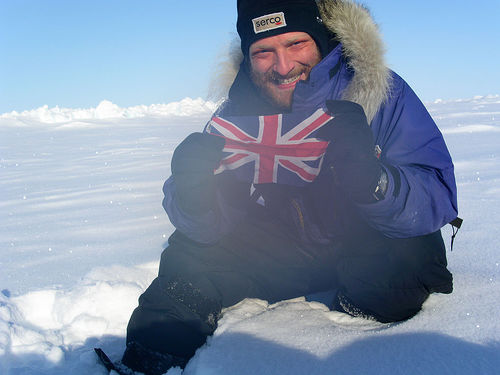
Ben Saunders sits on top of the world, the youngest person to reach the North Pole alone and by foot.

In 2004, 26-year-old Briton Ben Saunders became only the third person, and the youngest ever, to ski unaccompanied to the North Pole. As it turns out, there are a lot of ways that making a solo trek to the North Pole is a like moving to another country. Here are 11 things that the two adventures have in common, all taken from Saunder’s February 2005 TED Talk, “Why Did I Ski to the North Pole?”

  1. Luggage is a drag
    Saunders describes his specialty as “dragging heavy things around cold places.” He says, for his trip to the North Pole, “I was dragging all the food I needed, the supplies, the equipment, sleeping bag, one change of underwear—everything I needed for nearly three months.” That sounds like trying to put every necessary item in your carry-on bag, just in case your checked luggage gets lost. (If you think your bags are heavy, Saunder’s supply of food and fuel weighed 400 pounds.) Sometimes your destination has harsh conditions. And sometimes it doesn’t have chocolate chips. How many bags of those should you bring? Can’t be too prepared.
  2. It can be lonely out there
    One of the challenges of Saunder’s voyage was that he had to make it alone. Very alone. When he arrived at the northern-most point on the globe, he was the only “human being in an area one-and-a-half times the size of America, five-and-a-half thousand square miles.” Most of us don’t go to such remote places, but even if you’re in the biggest city, surrounded by millions of other souls, you can easily feel all by yourself.
  3. No, Virginia, there isn’t a Santa Claus
    When Saunders got to the top of the world, he didn’t find Santa. No Santa’s workshop. No elves. In fact, he says, “There isn’t even a pole at the Pole. There’s nothing there, purely because it’s sea ice.” When you go to another country, expect the unexpected. Don’t be surprised when what you find doesn’t match the photos in the magazine article. “I’d read lots of books,” says Saunders. “I studied maps and charts. But I realized on the morning of day one that I had no idea exactly what I’d let myself in for.” Photoshopped and cropped pics don’t do us any favors. If GPS and street signs say we’re in the right place, don’t waste time—or emotions—trying to find something that doesn’t exist.
  4. Sometimes it’s one step forward, two steps back
    According to NASA, during the year of Saunders journey, the ice conditions were the worst on record. Ninety percent of the time he was skiing into headwinds and the drifting ice pulled him backwards. “My record,” he says, “was minus 2.5 miles. I got up in the morning, took the tent down, skied north for seven-and-a-half hours, put the tent up, and I was two and a half miles further back than when I’d started. I literally couldn’t keep up with the drift of the ice.” When you’re in a new place, learning the language and culture, get used to those backward drifts. But always keep your compass set on your true north.
  5. The only constant is change
    Because the ice is constantly drifting over the North Pole, Saunders says that if he’d planted a flag there, it wouldn’t be long before it would be heading toward Canada or Greenland. Like Saunders, don’t be surprised when the emotional flags you plant aren’t permanent. The ground may not move under your feet (earthquakes not withstanding), but other kinds of landscapes certainly will. Find a special restaurant that serves your favorite dishes? Wake up the next day and it’s become a plumber’s shop. Make friends with some other expats? You may soon have to say goodbye. But, repeat after me, “Change can be good. Change can be good. Change can be good.” Maybe, just maybe, that plumber’s shop will end up being exactly what you need.
  6. Culture stress can be a bear
    Literally. On his first try at the North Pole, Saunders went with a partner, but they failed to reach their goal. Saunders says that from the outset “almost everything that could have gone wrong did go wrong. We were attacked by a polar bear on day two. I had frostbite in my left big toe. We started running very low on food. We were both pretty hungry, losing lots of weight.” Yup. Sounds like culture stress to me.
  7. Coming back can feel like the bear wins
    When his first attempt fell short, Saunders says he “was physically exhausted, mentally an absolute wreck, considered myself a failure, in a huge amount of debt personally to this expedition, and lying on my mum’s sofa, day in day out, watching daytime TV.” His brother texted him an encouraging quotation from Homer Simpson:
    “You tried your hardest and failed miserably. The lesson is: don’t even try.” Repatriation can feel that way. Maybe all the people who’d said you shouldn’t go were right. But Saunders didn’t let his failure define him. Instead, three years later he made history.
  8. People aren’t sitting around waiting to hear your stories
    When Saunders reached the North Pole, he got out his satellite phone. After warming up the battery in his armpit, he made three calls: “I dialed my mum. I dialed my girlfriend. I dialed the CEO of my sponsor. And I got three voicemails.” OK, that’s unfair to say they didn’t want to hear what he’d done. They were just busy at the time, that’s all. But . . .
  9. Some people really do want to listen
    “I finally got through to my mum,” says Saunders. “She was at the queue of the supermarket. She started crying. She asked me to call her back.” There are special people who will make time to listen—when they can focus on your story without distractions. Thanks, Mum.
  10. Don’t let others draw boundaries on your map
    When Saunders was 13, he got a school report that said, “Ben lacks sufficient impetus to achieve anything worthwhile.” Saunder’s response—”I think if I’ve learned anything, it’s this: that no one else is the authority on your potential. You’re the only person that decides how far you go and what you’re capable of.”
  11.  One of the three most important questions will always be “Where is the bathroom?”
    Saunders gave his TED Talk to answer three questions:
    (1 ) Why?
    (2) How do you go to the loo at minus 40?
    (3) What’s next?
    That second question is very important at the North Pole, because it seems that “at minus 40, exposed skin becomes frostbitten in less than a minute.” Your question number two will be more like “Where’s the bathroom?” or just “Bathroom? Bathroom?” Then, once you see the facilities, you may ask yourself, “How?”

As for the answers to those question, in short, Saunder’s responses go something like this:

(1) “For me,” says Saunders, “this is about exploring human limits, about exploring the limits of physiology, of psychology, and of technology. They’re the things that excite me. And it’s also about potential, on a personal level. This, for me, is a chance to explore the limits—really push the limits of my own potential, see how far they stretch.”
(2) That’s a trade secret, no answer here.
(3) Antarctica. Saunders and Tarka L’Herpiniere are currently on the first leg of their trek from the coast of Antarctica to the South Pole and back again—1,800 miles in all—unsupported and on foot. You can follow Saunder’s daily blog posts here. Why the South Pole? See answer number one above.

Somebody’s got a severe case of wanderlust.

[photo: “North Pole (3),” by Ben Saunders, used under a Creative Commons license]
The Psychological Health of Missionaries—Adding to the Research

6903821997_e0a95ce498_nHere’s a quick question:

What percentage of returned missionaries and aid workers report psychological disorders during their time overseas or shortly after their return? What do you think? About a quarter, a third, half, two thirds, three quarters?

According to a 1997 study conducted by Debbie Lovell-Hawker of Oxford University, the answer is “about half.” More precisely, Lovell-Hawker’s findings show that among the returned missionaries and aid workers she studied,

46% reported that they had experienced a clinically diagnosed psychological disorder either while working overseas or shortly after returning to the United Kingdom.

Before I went overseas, I would have guessed much lower than half, but after I first heard this statistic referenced in a debriefing I attended, in my mind, the number began to grow much higher than 46%. Statistics have a way of doing that.

Lovell-Hawker’s research included 145 aid and development workers and missionaries from 62 organizations. Though not definitive, the findings are significant as a wake-up call to cross-cultural workers, sending agencies, NGOs, churches, and member-care givers. And they also can assure those repats who are struggling that they are not alone.

Other  findings include

• 18% reported that their problems developed while they were overseas—82% said they began after returning to their home country
• Depression was the most frequently reported problem, occuring in 87% of the cases
• Those who reported having psychological problems had spent significantly longer time overseas than those who reported having none

(Debbie Lovell-Hawker, “Specialist Care: Psychological Input,” Global Connections Member Care Conference, February 18, 2002)

Moving forward from this study, there are some things I’d still like to know: Has anything changed in the 26 years since the findings were published? What would the numbers be for all missionaries and aid workers, not just those who’ve returned? What would the breakdown be among those working in relief and development vs other settings, such as teaching or church planting in developed areas? Are the numbers consistent for workers returning to countries other than the UK? And what about TCKs?

The good news is that there are researchers who are working on these and similar questions.

The Research Continues

One of those researchers is Lynette H. Bikos. Lynette served as a guest editor (along with M. Elizabeth Lewis Hall) of a special issue of Mental Health, Religion & Culture in 2009, titled “Missionaries.” Lynette is director of research and professor of clinical psychology in the School of Psychology, Family, and Community at Seattle Pacific University—and she also happens to be a friend who lived next to me, on an adjoining farm, as we grew up in northeast Missouri. We’ve kept in touch over the years, and she corresponded with my family and me as she worked on her research.

The special issue includes 10 articles dealing with several aspects of cross-cultural adjustment among those whom the editors call “religiously motivated sojourners.” I’d like to highlight four of those articles:

“Social Support, Organisational Support, and Religious Support in Relation to Burnout in Expatriate Humanitarian Aid Workers”
(Cynthia B. Eriksson et al., Mental Health, Religion, & Culture, November 2009)

This assessment found that 40% of expat middle managers in an international faith-based agency were at “high risk” of burnout in one of three areas—lack of personal accomplishment, emotional exhaustion, and disconnection or distance from those being cared for—but less than 4% reported high levels of burnout in all three.

According to the authors of the study, “This suggests that despite intense work and chaotic environments a majority of workers find ways to identify accomplishments, stay connected to others in their work, and rejuvenate. Team relationships, friendships, and positive organisational support may contribute to the resilience for these workers.”

The findings also indicate that younger workers are at a greater risk of burnout, as they register greater negatives in all three burnout areas. But while age was a factor, the number of years serving with the agency was not.

“Resilience in Re-Entering Missionaries: Why Do Some Do Well?”
(Susan P. Selby et al., Mental Health, Religion, & Culture, November 2009)

The authors posed the question ‘‘Why do some re-entering missionaries do well while others do not?’’ and interviewed 15 Australian cross-cultural missionary workers to help find the answer.

All the participants were over 25 years old and had spent at least 2 out of the previous 3 years in a non-Western country. Based on their responses, the researchers divided the missionaries into two categories: “resilient” and “fragile.”

In the interviews, the eight resilient missionaries described having

• flexibility
• higher expectancy and self-determination
• denial in the form of minimization to deal with their distress
• good mental health
• more social support
• a positive reintegration
• a personal spiritual connection to God

In contrast, the seven who were considered fragile described

• less flexibility
• lower expectancy and self-determination
• less use of denial with minimization
• poorer mental health
• less social support
• difficulty reintegrating
• a decreased or fluctuating personal spiritual connection to God

It is interesting that while the results of a questionnaire measuring depression, anxiety, and stress (DASS 21) showed higher levels for the fragile group, the scale showed that only one out of the entire group (including resilient and fragile) had an actual perception of being “personally stressed.”

“Psychological Well-Being and Sociocultural Adaptation in College-Aged, Repatriated, Missionary Kids”
(Michael J. Klemens and Lynette H. Bikos, Mental Health, Religion, & Culture, November 2009)

When the researchers compared a group of MKs to non-MKs at a Christian university, they found that while both groups scored in the healthy range of psychological well-being (PWB),  the missionary kids’ scores were significantly lower.

The missionary kids’ MK status accounted for only 4% of the variance in psychological well-being but was responsible for nearly a quarter (23%) of the difference in sociocultural adaptation (SCA). In this latter area, the MKs reported the most difficulty in “taking a US’ perspective on the culture; seeing things from an American’s point of view; understanding the US’ worldview; understanding the US’ value system; and making yourself understood.”

“Curiously,” report Klemens and Bikos, “neither the age of the participant, nor the number of years abroad, nor the number of years since repatriation was related to PWB or SCA for the MKs.”

“Reduction in Burnout May Be a Benefit for Short-Term Medical Mission Volunteers”
(Clark Campbell et al., Mental Health, Religion, & Culture, November 2009)

This assessment looked at how international short-term mission trips affect burnout among volunteers.

The participants in the study, most of whom were physicians and nurses, travelled to South America for two weeks to provide medical care in a non-disaster-relief setting. Prior to their departure, the group members’ responses to questionnaires showed that they were experiencing moderate burnout. Their burnout levels were again assessed one month and six months after the trip.

“The major finding of this study,” report the researches, “is counter-intuitive: that medical personnel who are emotionally exhausted, have an impersonal response towards their patients, and lack a sense of [personal accomplishments] (moderately burned out) benefit by working hard with numerous patients in an international context.”

They found that levels of emotional exhaustion and perceived personal accomplishments showed significant improvements following the short-term trip and continued in a positive direction in the 6-month followup.

___________________________________________________

All good research builds about what has been learned before and leads to questions for new studies in the future. I join with Lynette and her co-editor in hoping that the information in their special issue of Mental Health, Religion & Culture encourages others to join in the “exploration” of the psychological health of missionaries. There is so much more to be discovered.

(Lynette H. Bikos and M. Elizabeth Lewis Hall, “Psychological Functioning of International Missionaries: Introduction to the Special Issue,” Mental Health, Religion, & Culture, November 2009)

This special journal issue also includes several articles specific to the experiences of female missionaries. I hope to discuss these in a future post.

[photo: “Confused,” by Mary T Moore, used under a Creative Commons license]