Krispy Kreme: Going Global with a Strategy That’s Full of Holes . . . and Topped with Green-Tea Icing

6044675149_dc4e8ce3da_z

In September of 2015, CNN posted a story with the horrifying headline “Krispy Kreme Krashes”! (exklamation point mine), announcing that KKD stock had dropped 12% following poor sales and earnings reports. The problem? Lackluster profits on their packaged doughnuts sold outside their Krispy Kreme stores. The solution? Opening more Krispy Kreme stores overseas.

Fast forward to today, and the eatery has outlets in over 25 countries. That means fewer people making overseas Krispy Kreme runs and wondering if they can get their purchases through airport security and transport them as carry ons.

It also means plenty of new creations to appeal to global palates. Take, for instance, the new “premium” doughnuts at Krispy Kreme Japan, which, RocketNews24 reports, just became available this month. They include the Premium Matcha Azuki, filled with green-tea flavored whipped cream and red-bean paste and topped with matcha green-tea icing; and also the Premium Sakura, which has a multi-layered filling of cherry paste, strawberry-raspberry-cranberry puree, and whipped cream. (If either of those sound good to you, you’ll need to head over to the Krispy Kreme JR Nagoya Takashimaya store in Aichi Prefecture in the next few weeks—it’s a limited-time offer.)

Seeing that news got me wondering what else one can find at Krispy Kremes far and wide. And so that you don’t have to wonder, too, here’s a list of some of the tasty offerings from Krispy Kremes around the world.

My mouth is watering as I type. . . .

(Paul La Monica, “Krispy Kreme Krashes,” CNN Money, September 10, 2015; Oona McGee, “New Krispy Kreme Premium Range Includes Sakura and Matcha Green Tea Doughnut Cakes,” RocketNews24, March 8, 2017)

[photo: “Free for All,” by Bokeh-licious, used under a Creative Commons license]

Tea, 2, 3, 4

[an animation made from tea leaves]

“Tea Tuesdays: Kenyan Farmers See Green in the Color Purple”

Across the picturesque highlands of Kenya’s Great Rift Valley, fields of tea shimmer in shades of emerald, lime and moss under the equatorial sky.

Some of these fields, though, are now darkened with patches of purple. The purple comes from leaves with high levels of anthocyanins, natural pigments that also give cranberries, blueberries and grapes their color.

These purple leaves are Africa’s newest—and most intriguing—tea.

At the moment, they are being made into a handful of different styles. . . .

As pleasing as the unique flavors might be, [purple tea] was never developed for its taste.

Instead, [state-run Tea Research Institute] breeders were most interested in creating “a high-value medicinal tea product.” A number of scientific studies done inside and outside Kenya on purple tea suggest that its anthocyanins may help protect against neurodegenerative diseases and cancer.

“Anthocyanins have capacity to scavenge for free radicals and thus are good antioxidants,” says Stephen Karori Mbuthia, a biochemist at Egerton University, Kenya’s premier agricultural public university, and lead author of a recent study.

Jeff Koehler, Tea Tuesdays, NPR, March 3, 2015

Background Music and Getting Outside of Ourselves

3928075021_6e8382ae20_z

Jon Weece likes to introduce people to each other. Often it’s telling large crowds about someone he knows. And as “lead follower” at Southland Christian Church, a megachurch in Lexington, he has lots of opportunities to address large crowds. I’ve known Jon since he was a kid, and I was glad to be able to hear him speak last month at Ozark Christian College, his alma mater, as it celebrated its 75th anniversary.

Jon, a former missionary in Haiti, keeps his eye out for people who need a helping hand. One of those people is his friend Donnie, and Jon told us his story. In his book Jesus Prom, Jon writes,

When Donnie was six years old, he watched his dad beat up his mom. The trauma of that episode locked Donnie into a permanent state of childlikeness. Though he is fifty-two years of age today, Donnie thinks and acts and communicates like a six-year-old. Donnie loves me, and I love Donnie. He has taught me a lot about love.

Donnie washed dishes at a local restaurant for two decades. Each Friday he would cash his paycheck, and each Saturday he would ride his bike from one garage sale to the next buying albums and paper novels and costume jewelry. Donnie has a Christmas gift list and 385 people on it. Donnie loves people, and people love Donnie—so much so that he spends his entire year Christmas shopping for all the people he loves.

…..

Donnie doesn’t know a stranger. When he meets people for the first time, he hugs them. And he doesn’t let go! When Donnie hugs people, he holds on! And it doesn’t matter who you are; once Donnie learns your name, your name finds its way onto his Christmas list. From the mayor of our city to the homeless men in Phoenix Park, Donnie konws a lot of people by name.

Donnie looks a lot like love.

Love holds on.

Love gives.

Love knows.

Jon also introduces people to Donnie one on one. He said that when Tony Anderson, another OCC grad, contacted him to get together, Jon brought Donnie along. Tony lives in Lexington and is a successful film composer with a long list of commercial and documentary credits.

Before Tony had become established in his career, he took on his first project, a short documentary for Christ in Youth and Rapha House, a ministry working to eliminate child trafficking and sexual exploitation. The film Tony helped them with was Baht, about sex trafficking in Cambodia.

Tony later worked on another production for Rapha House, creating the score for Finding Home, a longer documentary following three young women who’d gotten out of the sex trade in Cambodia.

Tony’s career took off when Musicbed made his growing body of work available on their licensing site, and now his clients include Ford, TOMS Shoes, ESPN, and National Geographic. When Musicbed produced a video highlighting Tony, he put Donnie front and center (and, yes, that’s Tony’s music in the background). Tony says that Donnie is teaching him how to recapture the “childlike innocence and joy” that he’s let slip away. He’s also teaching him about opening doors, seeing the value of relationships over competition and deadlines, and “getting outside of” himself.

And finally, here’s one more example of Tony’s work. He composed the music behind this short film, Onward. It’s about a family in Western Mongolia and their tradition of hunting with eagles.

(Jon Weece, Jesus Prom: Life Gets Fun when You Love People like God Does, Thomas Nelson, 2014)

[photo: “Sitting by the Piano,” by Difei Li, used under a Creative Commons license]

An Open Letter to the Kind People in My Host Country [—at A Life Overseas]

518803063_75cf6d6dc1_b

Dear neighbors:

When my wife and I and our four children stepped off the plane in your country, with our 12 carry-on bags—and all our plans, enthusiasm, expectations . . . and naiveté—you welcomed us. In fact, the customs agent greeted us with a smile. And during the following years that we lived among you, we lost count of your kindnesses.

We weren’t refugees, we didn’t arrive on your shores having been forced out of our homes, we weren’t stranded. We had chosen to come. You didn’t find us naked and bloodied at the side of a road, but still you were often good Samaritans to us. When you saw us sitting on the curb, so to speak, facing roadblocks or not sure where we were headed, so many of you did not simply walk by on the other side.

For this we thank you.

To our language teachers who patiently, ever so patiently, led us through vocabulary lessons and guided us on the nuances of your culture, laughing with us but not at us, thank you.

To the food-cart vendors who listened to us practice the names of what they were selling and cheerfully rewarded us with wonderful tasting snacks and meals, sometimes putting something extra in with our order, thank you.

To the policeman who loaded up our family in his patrol car and took us home after we got lost on a walk, even though we ended up being only three blocks away from our apartment building, thank you.

And to the people near our home who didn’t think the worst of a family, who, for some reason, was riding in a police car, thank you.

Finish reading at A Life Overseas. . . .

[photo: “Post Office Shoot8,” by Bryan Pearson, used under a Creative Commons license]

The Syrian Refugee Crisis: Stories and Faces to Put with the Headlines

I want my daughters to tell people how we ended up here, whether it’s in a book, in a film, or just an answer to “What’s wrong?” That’s all I want.

—a Syrian refugee in Greece, in Refuge

22527575640_ce96708328_zAs I’ve read, and watched, more about the Syrian refugee crises, I came across two powerful videos. I decided not to include them in my post last week, because they’re  on the longer side (around 20 minutes each), and I wanted to bring more attention to them in a post of their own.
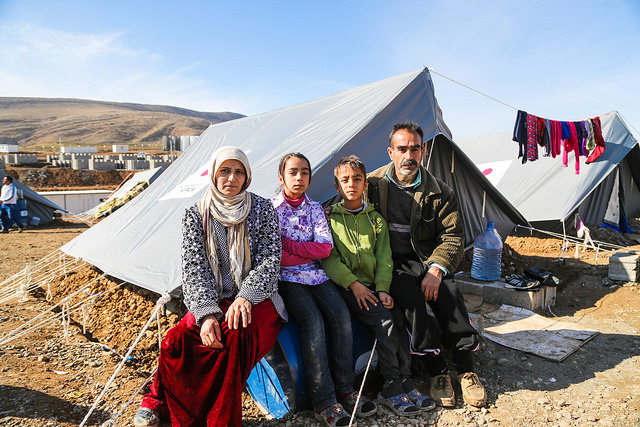
The first one, Refuge: Human Stories from the Refugee Crisis, lets a number of Syrian refugees speak to the camera. In Making Refuge: Behind the Scenes of the Refuge Project, the film’s director, Matthew K. Firpo, tells why he and his crew made the trip to meet the Syrians in Greece:

We wanted to focus on the simple, important fact that every refugee is a human being, with hopes and losses and families just like each of us. And in sharing their stories, we wanted audiences to understand what it means to leave behind everything you know, to finally have faces to put to headlines.

In the next video, The Island of All Together, Syrians who have arrived on Lesvos (Lesbos) as refugees sit down to talk with Europeans who have come to the Greek island as vacationers. What a wonderful idea.

They pairs converse on a range of topics, some profound, some mundane, all poignant in their simplicity and touching openness. In one conversation, Otis asks the Syrian Rashad what he would do with a million Euros.

Rashad: A million Euros? I would help all of the people who have not been able to flee Syria.

Otis: That’s beautiful.

Rashad: And what would you do with a million?

Otis: I would buy a nice car, pay for my education, and give the rest to charities.

Rashad: I hope that God gives you a beautiful car. . . . I had to sell my car in Syria to get the money to come here.

Otis: What kind of car did you have?

Rashad: I had a Kia Morning.

Otis: I now have a Citroen Saxo.


[photo: “Refugee Crisis in Europe,” by CAFOD Photo Library, used under a Creative Commons license]

Why I Don’t Pray for the Syrian Refugees

12165699863_532825beec_z

Since the start of Syria’s civil war, 12.5 million Syrians have been displaced, including 4.8 million living as refugees in other countries, with the rest forced out of their homes but still living in Syria. According to the Pew Research Center, this total number represents 60% of the country’s population of 2011, before the conflict began. The center calls the situation of Syrian displacement “unprecedented in recent history for a single country,” part of a global crisis that has nearly 1 out of 100 people worldwide forcibly displaced—the highest percentage since UNHCR began collecting those numbers in 1951.

In the face of this, a survey from World Vision and Ipsos Public Affairs shows that currently only 14% of Americans “pray for refugees and the conflict in Syria.” This is down from 22% in 2015. Of those surveyed who self-identify as “committed Christians,” 41% say that they are willing to pray, but only 19% actually do so. These numbers, too, are lower than a year ago, when 51% said they were willing to pray, with 30% praying.

If I had been contacted for the survey when it was held in September of last year, I would have described myself as a committed Christian. I also would have told them that I don’t pray for the Syrians. Here’s why:

  • I’m pretty busy, and it’s hard to find time to pray at all, even for my family and for personal issues.
  • I don’t understand what’s going on in Syria well enough to know how to pray intelligently. Who are the good guys? Who are the bad guys? The situation seems so complex—politically, culturally, and religiously—and it seems to change constantly.
  • Whatever outcome that we can hope for will be a very long time coming. It’s taken so many years to get to this place, and there are no quick solutions. I can’t commit to praying indefinitely.
  • It seems as if one tragedy after another is happening in our world today, and I’ve stopped trying to keep up. Which one should I pray for? Which one is the most tragic? It’s all so numbing. And the news outlets jump around so much in their coverage. They’re easily distracted and so am I.
  • I don’t personally know any Syrians, so theirs is not a problem that I can relate to.
  • Since I’m not giving money or taking any other action, it would be hypocritical for me only to pray.

To me it’s about knowing, understanding, caring, and acting—and back in September, concerning the Syrian crisis, I was lacking in all these areas. But since I started writing this post, things have been changing. I now know more, I understand more, I care more . . . and I’ve started praying.

If the surveyors called me today, I’m still not sure I could say, “I pray for refugees and the conflict in Syria.” I have prayed. And I plan to pray. But I’ve got a ways to go before I can say with confidence I do pray.

How about you?

Know

Would you like to know more? Take a closer look at the statistics from the Pew Research Center and the UN Refugee Agency.

Understand

To better understand the situation, you can read “Syria: The Story of the Conflict,” from BBC News, or watch this video:

Care

If you need help caring, if you need faces and stories to go with the numbers . . .

Pray

If you don’t know how to pray, then you can go to World Vision’s prayer guide, and listen to this prayer from a Syrian Christian:

More

And if you’d like to help financially, here are two options for giving funds to help alleviate this great need:

World Vision

UNCHR: The UN Refugee Agency

I have started praying, and I hope that in the future, if I get a call for a survey, I’ll be able to say I’m praying still.

(Philip Connor and Jens Manuel Krogstad, “About Six-in-Ten Syrians Are Now Displaced,” Fact Tank, Pew Research Center, June 13, 2016; Connor and Krogstad, “Key Facts about the World’s Refugees,” Fact Tank, Pew Research Center, October 5, 2016; “Survey: While Aleppo and Mosul Burn, American Christians Less Likely to Pray for, Help Refugees than a Year Ago,” World Vision)

[photo: “IOM and Japan continue to help Syrian refugees,” by IOM | UN Migration Agency, used under a Creative Commons license]

Hard Rain A-Fallin’: Singing, and Struggling, before the King

28205337141_1fa9907bee_z

In my last post, I talked about imagining God, the father, the king, singing to us.

This post is about someone singing to a king—not the heavenly king, mind you, but Sweden’s King Carl XVI Gustaf, and Queen Silvia and Crown Princess Victoria, as well. Turns out that’s not easy, even for a musical superstar.

As organizers planned last year’s Nobel Prize awards ceremony, they asked Patty Smith to perform at the event. Then, when it was announced that her friend Bob Dylan had been named the Nobel laureate in literature, she chose to sing his “A Hard Rain’s A-Gonna Fall.”

You’ve probably heard how she faltered during her performance and had to stop singing. She writes in The New Yorker that she was struck with an “overwhelming case of nerves.” It wasn’t that she’d forgotten the words, she says (though who could blame her, there are so many words in that song), she just couldn’t “draw them out.”

“I’m sorry,” she said meekly to the crowd as the orchestra softly played behind her. “Sorry.” She looked at the conductor, standing close by. “I’m sorry. Could we start that section?” And then to the audience, “I apologize. I’m so nervous.” The people responded with applause.

On the video of her performance, you can hear the announcer narrating the restart sotto voce, sounding as if he were calling a golf tournament. Smith gathered herself and completed the song, overcoming another, smaller lapse on the way.

Smith writes:

It was not lost on me that the narrative of the song begins with the words “I stumbled alongside of twelve misty mountains,” and ends with the line “And I’ll know my song well before I start singing.” As I took my seat, I felt the humiliating sting of failure, but also the strange realization that I had somehow entered and truly lived the world of the lyrics.

My guess is that Smith spent the night replaying her mistakes over and over in her mind. How could she fail on such a grand, international stage? But that wasn’t the end of it.

When I arose the next morning, it was snowing. In the breakfast room, I was greeted by many of the Nobel scientists. They showed appreciation for my very public struggle. They told me I did a good job. I wish I would have done better, I said. No, no, they replied, none of us wish that. For us, your performance seemed a metaphor for our own struggles.

There’s another phrase in the last stanza of “A Hard Rain’s A-Gonna Fall” that grabs my attention. It’s “Then I’ll stand on the ocean until I start sinkin’.” I don’t think it’s too much of a stretch to think that Dylan, who is fond of biblical imagery, had the apostle Peter in mind when he wrote that. It was Peter who stepped out of the boat to meet Jesus, who was walking on the water. It was Peter who saw the waves and began to sink. It was Peter who then called out to Jesus, “Lord, save me!” And it was Jesus who reached out and caught him.

An artist lip syncing a song in a pre-packaged, flawless performance. How many times do we see that and move on, quickly letting it slide from our memory? Someone stepping out into the rain and waves, and struggling publicly, struggling beautifully, showing that struggles aren’t the same as failures. That I’ll remember for a long time.

(Patti Smith, “How Does It Feel,” The New Yorker, December 14, 2016)

[photo: “Puddles & Flip Flops,” by Phil Roeder, used under a Creative Commons license]

So, What Does God Look Like to You? [—at A Life Overseas]

3984772746_7cd6b66c64_b

Imagine getting a handwritten invitation from God the Father requesting your presence for a meeting. You quickly get ready, and you’re on your way. When you arrive at his door, you knock twice and hear, “Come in.” You turn the knob, push the door open slowly . . . and there he is.

But before you enter, let’s back up a second. How’s your imagination? What kind of invitation did God send? What about his handwriting? What sort of clothes are you wearing to your meeting? Formal? Business casual? Shorts and flip flops? And his door, is it simple or ornate? What kind of voice does he have? And what does God look like?

For many years, I could most easily picture God sitting on a throne, an ancient sculpture come to life. He had long hair and a long beard, and he must have been at least 10-feet tall, as he was large enough for me—even as an adult—to crawl up onto his lap and burrow my face into the billowy robes that flowed down from his shoulders.

I like that image, and it still gives me comfort. But it’s not always the one that now first comes to my mind. Instead, I sometimes think of God standing before me with his arms crossed, a disappointed look on his face. On a particularly bad day, he uncrosses his arms to shake a finger at me. This change in how I view God seems to have come about sometime overseas, when I realized that my accomplishments and abilities weren’t matching my own expectations and what I thought were the expectations of others.

What does God look like to you? I’m not talking about God appearing in a bona fide vision. I’m thinking of how your imagination pictures him being present—right in front of you. It’s an interesting question for missionaries, relief workers, and the nationals next door. It’s an interesting question for all of us, because the answers we give tell a lot about who God is to us and about how we see our relationship with him—about how we see ourselves and think God sees us. Does he resemble your father, president, prime minister, or king? Does he look like a church leader or a boss you’ve known? Does he give you his full attention, or is he busy with the crowds around him? Does he have your features, or is he a foreigner?

Continue reading at A Life Overseas. . . .

[photo: “Peek,” by Wesley de Ridder, used under a Creative Commons license]