When he was a child, Van Bo Le-Mentzel’s family relocated as refugees from Laos to Germany. Now an architect, he is redefining home.
“All my life,” Le-Mentzel tells CNN, “I was confronted with the question, What is home? Where do I belong to? Where is my home base? And where do I want to settle?”
One of his answers is his creation, the “one square meter house.” With it, he says, “I can settle wherever I want, because this is the one square meter that nobody is allowed to touch. It’s mine.”
Not only does he want do-it-yourselfers to build their own One SQM Houses, he also envisions them placed in public places in urban areas, each available as “one square meter of freedom,” a place to calm down, concentrate, pray, cry, or “whatever.”
Le-Mentzel is giving away plans for constructing his “world’s smallest house” (which, when completed costs about $300) at Hartz IV Möbel. The site also offers instructions on several other DIY projects, including the Berliner Hocker (Berlin Stool), shown in the video below. It’s a stackable modular bookshelf (a frugal man’s BrickBox?) that, with it’s asymmetrical design, can also serve as a desk, end table, and chair—I think he’s sitting on one inside his house in the video above.
Here’s to creativity spurred on by a cross-cultural life.
“In October 2011, 1.2 billion users around the world visited social networking sites, accounting for 82 percent of the world’s [internet] population. Nearly 1 in every 5 minutes spent online around the world is now spent on social networking sites, making Social Networking the most popular content category in engagement worldwide.”
Any two people in the world on Facebook are separated by an average of 4.74 “hops,” meaning that for “even the most distant Facebook user in the Siberian tundra or the Peruvian rainforest, a friend of your friend probably knows a friend of their friend.”
60 Second Marketer contributing writer Nicole Hall took a deep look at the claim that the world has more mobile phones than toothbrushes. Her conclusion is “that there are almost certainly more mobile phone subscriptions than there are toothbrushes on the planet. And, if you make some additional assumptions based on our research, in all likelihood,more people own a mobile phone on the planet than own a toothbrush.”
Globally, “22% of online shoppers made their first online purchases within the past year.”
Chinese online consumers lead the world with an average of 8.4 purchase online each month. This compares with 5.2 purchases in the US and 4.3 in the UK.
There is a phrase in Mandarin Chinese, bei xi jiao ji (悲喜交集), meaning “mixed feelings of grief and joy.” Grief and joy aren’t commonly thought of as partners, but when faced with loss, cross-cultural workers need to understand that one doesn’t necessarily cancel the other one out.
Expressing Grief
Dr. Steve Sweatman, president and CEO of Mission Training International (MTI), says that the call to take the gospel of Christ to another culture “inevitably is a call to sacrifice, to losses, to things that you will have to leave behind or give up.” This sacrifice takes many forms, and MTI has identified five categories of loss experienced by Christian cross-cultural workers. They are
a stable home
identity
competence
support systems
a sense of safety
In an audio presentation at Member Care Radio (entitled “Good Grief“), Sweatman also discusses the differences between concrete and abstract losses felt by cross-cultural workers, with the latter being such things as the loss of dreams or hopes. He tells the story of a Christian worker named John who came to him for counseling. While serving in central Asia, John had experienced both concrete and abstract losses. He had lost his status and effectiveness as a youth pastor in the US. His wife had had two miscarriages. And he and the rest of his team had been forced to evacuate their host country with little hope of returning.
With painful honesty, John revealed:
I know that all things work together for the good. I know that the joy of the Lord should be my strength, but it’s not. I know that I’m going to see my unborn children in heaven. I don’t want to commit suicide, but I . . . um . . . wish that I wasn’t alive.
Sweatman went on to talk with John about the way his family had taught him to deal with grief as he grew up, and then helped him learn how to grieve in a healthier way. Healthy sadness, says Dr. Sweatman, is the “antidote to depression.” It includes two important steps: acknowledging our losses to God and expressing grief publicly to allow others to “be the arms of God.”
“How we handle loss,” says Sweatman, “determines a number of things. It determines the longevity of you in cross-cultural work, the depth of joy you will experience in your life, the wisdom that you will gain, and especially your closeness to God and your need for him.”
If this summary strikes a chord with you, please listen to Dr. Sweatman’s talk in its entirety. That way you’ll get to hear all that he has to say on this topic, and you’ll get to hear his heart as well as his words.
Redefining Joy
When John said, “I know that the joy of the Lord should be my strength . . .” he’s referring to a verse from Nehemiah 8. But we’re most familiar with the phrase “The joy of the Lord is my strength [clap, clap, clap]” from the peppy song of the same name. What happens when we don’t feel the Lord’s joy? James says, “Consider it pure joy, my brothers, whenever you face trials of many kinds” (James 1:2). Can we be sad or afraid or confused, and still have joy?
There’s another song about joy that is familiar to those who’ve grown up in the church. It repeats over and over the line “I’ve got the joy, joy, joy, joy down in my heart.” But what does that joy look like in the face of loss? Is it always a smile? What does that joy sound like in the midst of trials? It is always an upbeat song?
I’m so glad to have come across The Autumn Film’s rendition of “I’ve Got the Joy”/”Down in My Heart.” Tifah Phillips, the group’s vocalist writes on her blog how she wrote “Joy.” It happened the night of her father’s death, as she sat at the piano, “the only place that felt safe that night to me”:
I remembered my eyes were blurred with tears and I literally began to play the now familiar progression of Joy. I kept cycling through the progression and then, as if it had already been written, I began to sing a different melody to a song I sang in VBS as a child, “I’ve got the joy, joy, joy, joy down in my heart. . . .” The truth is that I was terribly and profoundly sad. The reality of grief had not even entirely hit me yet. But at the same moment I had a deep sense of peace. He was no longer in pain. He was no longer sick. He was free from all his ailments and restored. Although I still miss him, I know that God has weaved redemption through death into my father’s story. That brings me great joy. It was not until grief became a part of my story that I realized that joy is not simply an expression, but an attitude and acknowledgment of the deep peace of knowing a Savior.
Often when I’m grieving, my joy doesn’t show on the surface, even though I wish it did. But just because it’s not visible, doesn’t mean that I don’t have joy “down in my heart.” “Joy is not simply an expression, but an attitude and acknowledgment of the deep peace of knowing a Savior.” I like that. And I like the lines from the song that say,
I can’t understand
And I can’t pretend
That this will be all right in the end.
So I’ll try my best
And lift up my chest
To sing about this joy.
This really is a beautiful and meaningful song to me, heartbreaking and heartmending. I hope it speaks to you, too.
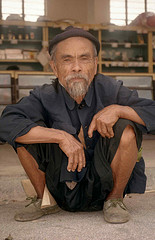
If you’re a Westerner who’s traveled to Asia, you’ve probably marveled at the locals’ ability to relax in their preferred alternative to just standing around—the Asian squat. You’ve also probably brought back stories (and photos) of “squatty potties,” and you understand why the bathrooms in international airports have signs that read, “No Standing on the Toilet.”
But if all this is new to you and you see the need for more information, or if you’d like help in pulling off the squat yourself, I refer you to Daniel Hsia’s mockumentary, How to Do the Asian Squat. Watch it because you want to know the history behind the Asian squat. Watch it because you want to know the physics behind the Asian squat. Or watch it simply because “Each and every day, more and more tired-legged, stiff-backed Americans are discovering a new and exciting way to squat!”
And if you really want to get on board (pun intended), take a look at “Nature’s Platform” for how you can convert a Western toilet into your very own squatty potty. The site is complete with testimonials from physicians, anthropologists, and yoga instructors. Unfortunately, it looks as if the company is not accepting new orders at this time. But don’t be disheartened, you can go here for their instructions on how to create your own conversion kit from concrete blocks and plywood. Or as an alternative, you can visit Lillipad of New Zealand, where their trendy (?) looking “squatting platform” is on sale . . . and available. They sell plans for building your own, too. (But hurry, the plans are 50% off till the end of July.)
What makes a city international? Is it the foreign cuisine? The languages spoken? The diverse cultures celebrated? One barometer is the number of foreign-born residents, and the top city, Dubai, is winning by a landslide. With 82% of its population born outside of the United Arab Emirates, Dubai is well ahead of the next city, Miami, which has 51% of its residents foreign born. Following is a list of the top-10. (All figures are dated 2002 or before.):
Dubai 82%
Miami 51%
Amsterdam 47%
Toronto 45%
Muscat 45%
Vancouver 39%
Auckland 39%
Geneva 38%
Mecca 38%
The Hague 37%
The authors note that 7 of the top 25 cities are in the Middle East, due to large guest workforces and the drawing power of religious centers. They also mention some “surprises,” mega-cities that didn’t make the top 25: Tokyo and Seoul, with about 2% each (ranked 92 and 96); Sao Paolo, 1% (100); Jakarta, .9% (105); and Mexico City, less than .5% (109).
Of course,the world’s expats include children, and while many attend typical, national schools, others get their education at international institutions. According toISC Research, the number of international-school students worldwide has grown to over 3 million, attending over 6,000 institutions in 236 countries. Providing the education at these schools are over 290,000 staff. It’s probably not surprising that the country with the most international schools is the United Arab Emirates, as its national population mirrors that of Dubai, its largest city, with the country having 83.5% of its residents foreign born. Here’s a list of the top 10:
UAE, 372 schools
Pakistan, 349
China, 327
India, 317
Japan, 219
Spain, 183
Indonesia, 173
Germany, 170
Hong Kong, 165
Thailand, 161
The number of students attending international schools has tripled over the last 10 years, but not all of the current number are expats. In fact, the great majority, 80%, are local citizens. And as more and more people raise their children outside their passport countries, as more and more locals seek the best track for the world’s best universities, the demand for international schools is increasing. ISC Research’s prediction is that the number of international-school students will grow to 6 million in the next 10 years, and the number of schools will reach 10,000.
Her 50th birthday is around the corner and she can no longer keep up with fashion. Can anyone save Sindy, the doll created to be a British rival to Barbie?
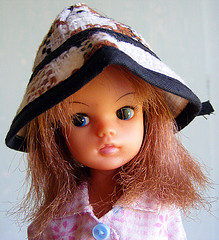
So begins David Sillito in his article for BBC News, “How Barbie Crushed Sindy” (July 2, 2012).” The “she” he is referring to is Sindy, a doll created by England’s Pedigree Toys in 1963. Like Iran’s Sara and Dara, Sindy was presented as an alternative to the American-made Barbie.
Sindy was the “British girl-next-door.” Compared to Barbie, she had a rounder face, a younger look, shorter legs, and a flatter chest. Sindy had great success through the 80s, peaking in 1985 with 80% of the UK doll market. But as the 90s began, Sindy was losing out to the ever glamorous and trendy Barbie, so Pedigree remade her, more in the image of her American rival. Mattel, Barbie’s manufacturer, noticed and filed a lawsuit against Pedigree. The British company responded with another makeover.
Helen Carter, “an avid Sindy collector and fashion lecturer” misses the old look, telling BBC “[The original Sindy] has got such a warm, friendly expression on her face, she’s got side-glancing eyes. She’s not challenging in any way, she’s pretty, she’s the English Rose.”
Up until 2009, the newest generation Sindy was being sold by Woolworth’s, but when that chain closed, Sindy said goodbye, as well. Now, Pedigree is looking for someone else to take over the Sindy name. “We don’t really have the skills to keep up with all the fashions,” says Pedigree’s Jerry Reynolds. “If it’s a retailer or a manufacturer, they have to change her clothes every year to keep up with trends.”
I think I have a solution. Sindy should go back to her origins, and she should be marketed as the “Third Culture Kid” doll. Here are 6 reasons why it makes sense:
In 1984, Michigan State University sociologist Ted Ward called TCKs “the prototype citizens of the future.” The future has arrived and Sindy can help lead the way.*
Many of the earlier Sindys are proud of their TCK heritage, as they have “Made in Hong Kong” printed on their waists.
TCKs don’t always “keep up with the trends.” Sometimes it’s because they aren’t aware of the trends, sometimes because they disdain the trends. Either way, Sindy can create her own fashion statements. (And, as the BBC article mentions, Sindy could re-adopt her original wardrobe, going “retro to cash in on the popularity of vintage looks.”)
Barbie has a closetful of international costumes, but they’re just that, costumes. Sindy could show the world what the real global citizen wears, as she transitions in and out of countries. Think of the culturally-relevant clothing possibilities. Collect them all!
If Sindy could talk, what global stories she could tell, and all with a cosmopolitan British accent.
Sindy should get back her “side-glancing eyes” (they turned forward in the makeover). This would represent the inquisitiveness of the TCK mind, mixed with a little bit of suspicion.
Sindy looks like a TCK name, doesn’t it?
So who will save Sindy? Raise your hand and give Mr. Reynolds a call.
I recently wrote about the trials of choosing cereal at Wal-Mart, and friend and fellow blogger MaDonna followed up with her own post calling the cereal aisle “one of the top 5 places expats hate to visit in the US.”
Sheena Iyengar, a professor at Columbia University and leading expert on choice, understands our pain. She writes in her book The Art of Choosing,
In 1994, the year I had my first inkling that there might be such a thing as too much choice, over 500,000 different consumer goods were already available in the United States. By 2003, the number had increased to nearly 700,000, an upward trend that shows no signs of letting up. Technological advances frequently introduce new categories of products into our lives. Some of them—cell phones, computers, digital cameras—become indispensable, and soon enough the options proliferate. Just as importantly, not only are there more goods on the market, there are more ways to get at them. The typical supermarket, which carried 3,750 different items in 1949, now boasts some 45,000 items. Walmart and other “big-box” retailers offer smorgasbords of over 100,000 products to Americans in just about every part of the country. And if you don’t find what you’re looking for within a few blocks, you’ll certainly find it with a few clicks. The Internet extends your reach well beyond local venues, providing access to the 100,000 DVDs on Netflix.com, 24 million books (and millions of other products) on Amazon.com, and 15 million singles on Match.com.
Following is a fascinating TedGlobal talk by Iyangar in which she discusses cultural differences in the valuing of choice. In her introduction to the video on her website, she says,
In America, choice is sacred. We believe in its limitless power and we worship it for the possibilities it offers. For Americans, choice is liberty, which is subordinate only to life itself in the Declaration of Independence. So it can be almost impossible to accept that not only are there countries and cultures that do not subscribe to the American ideal of choice, but that they wouldn’t necessarily be better off if more choice suddenly became available to them. I explore the great variation across the globe in beliefs about who should choose and when, how much choice should be available, and when choice is a burden rather than a pleasure.
Iyangar starts her presentation with an experience she had in a Japanese restaurant and ends in the US with a story of how her blindness affected how she chose the right fingernail polish. In between she shares research and anecdotes from around the world. Enjoy.
Disenfranchised grief, also called “hidden sorrow,” is caused by “a loss that is not or cannot be openly acknowledged, publicly mourned or socially supported.” This definition comes from an article I recently came across from Australian Family Physician, discussing the response of general practitioners (family physicians) to repatriated cross-cultural workers affected by grief.
What makes their grief disenfranchised is that their losses are not typical to the population at large, so others often discount those losses or don’t understand them. It is difficult to have compassion for a person when you don’t recognize why he is grieving. Others with disenfranchised grief include “ex-spouses, caregivers, nursing home staff, pet owners, children, adoptees, individuals with developmental disabilities, . . . those who may be grieving suicide or AIDs victims or other forms of stigmatised death, . . . victims of sexual abuse, indigenous people and prisoners re-entering their original subcultures.” While this seems to be a list made up of disparate groups, their commonality is that the losses they suffer are often easy to ignore or downplay.
The part of the article that most helped me understand the concept was the authors’ explanation of six types of disenfranchised grief. I am presenting the list here, but I’ve taken the liberty of providing my own examples of how they might apply to repatriated cross-cultural workers:
The griever’s relationships are unacknowledged [“You can enjoy yourself now that you’re back with your own people.”]
Lack of acknowledgment of the griever’s loss
[“People move all the time. It’s not like somebody died.”]
Exclusion of the griever as not being capable of grieving
[“She’s just a child. She’ll make new friends.”]
Exclusion of the griever due to the circumstances of the loss
[“You knew what you were getting into when you decided to go overseas.”]
Exclusion of the griever due to their way of grieving which is not deemed appropriate by the community
[“The Bible says ‘Consider it pure joy, my brothers, whenever you face trials of many kinds.'”]
Self initiated disenfranchised grief where shame plays a significant role
[“Why don’t I trust God more?”]
The authors go on to stress how important it is that general practitioners understand disenfranchised grief and take steps to deal with it. Not only may family doctors be asked to treat physical symptoms that are a result of grief, but they may also be the only affordable and “safe” help that is available to the re-entering worker.
I wish that we could all understand and acknowledge others’ grief, whatever the source, so that we could “mourn with those who mourn,” giving them the community they need so they don’t have to grieve alone.





 Clearing Customs