Soaring Heights and Tragic Depths in the Life of Anne Morrow Lindbergh

5734550792_0e8ec76034

In 1929, Anne Morrow Lindbergh was on board the first ever passenger-paying flight, part of Transcontinental Air Transport’s (TAT’s) combination plane-and-train trip linking New York and California. Her husband, Charles, was the pilot, while Anne, the only female passenger, recorded her experience, later published as part of Hour of Gold, Hour of Lead: Diaries and Letters of Anne Morrow Lindbergh, 1929-1932. How things have changed:

The ship is beautifully decorated inside, painted a cool gray-green, with the most comfortable green leather-covered chairs, that are adjustable. Little green curtains and blue-shaded lights. There is a white uniformed attendant shouting in my ear that he will get anything I want—reading or writing material. . . .

We have each been given an envelope full of data on the TAT organization. . . . Also I have been handed a large folding map (decorated à la old picture-map style) of our route. Postcards of places along the route. The “courier” has just offered me a little aluminum table to write on; there is plenty of room for knees and a table.

. . . .

At Kingman [AZ] we took on two square tin cupboards and one large thermos. The little table was set up by me, covered with a lavender linen tablecloth (tied on), and on metal plates I had passed me a delicious meal: cold chicken or tongue, etc. . . .

After researching Lindbergh’s life for my post on Gift from the Sea. That led me to Hour of Gold, Hour of Lead, which I’ve just finished reading. It covers her wedding to Charles—the first global celebrity—their flights together, the birth of their son, and his kidnapping and murder 20 months later. The first three of the years covered in the book are the golden years, the last one, leaden. Hour of Gold, Hour of Lead is certainly an absorbing read, with Lindbergh’s account of the happiness and the tragedy written down in “real time,” not in the typical reflective style of a memoir.

Another event recorded by Lindbergh is her flight with Charles to Asia, with stops in Canada, Alaska, Russia, Japan, and China.  In a letter to her mother, she wrote about visiting a missionary station among the Inuit at Point Barrow, the northernmost point of Alaska. Again, how things have changed:

The afternoon after we arrived we heard all the little Eskimo children screaming and all the dogs howling, and coming out of the bungalow we were told excitedly, “The boat’s coming, the boat! See—the smoke!” . . . By the time it got in sight every man, woman, child, and dog was down on the mudbank to see it. It was tragedy not to be there. “Oh, poor Kay, she’s on duty at the hospital and won’t see it!” someone said.

An old white boat (like the Hudson excursion boats), the water wheel churning foam, was towing a big barge. Everyone speculated:

“Perhaps my shoes will be on it!”

“Doesn’t look like much gasoline—hope there’s more inside.”

. . . .

“Perhaps Mother sent me some fresh tomatoes.”

. . . .

Everyone trooped on board very excited and looked over lists of packages.

We’ve got a bathtub! You won’t be able to lord it over us any more—a regular bathtub.”

“That’s the new tank for my motorboat. They’ve sent the wrong kind! Look, Lenny, they’ve sent the wrong kind—and I sent them all the specifications. Can’t use it—have to wait till next year.”

In another letter, Lindbergh wrote about the difficulties faced by the missionaries:

I felt as though my life didn’t count for anything against the terrific sternness of that life. And terribly sad. They had been there so long and were old and tired and they dreaded sending David [their 15-year-old son] out. When they first went up there there was no radio, only the one boat, and they heard about the death of one of their sons four months after he died.

About a church service, led by the Presbyterian missionary Henry Griest, she wrote,

It was so strange, terribly strange, to hear Dr. Greist explain the Bible to them.

“‘We have gone astray like sheep.’ Like the reindeer who have scattered on the tundras.”

“‘The power of God.’ Force—like dynamite that blows up the ice sometimes and lets us get a ship out—the dynamite of God.”

During their time in China, the Lindberghs’ trip was cut short when they got news that Anne’s father had died. A few months later, after they were settled back into their rural New Jersey home, Charles, Jr. was taken from his bedroom and killed.

Forty years after the events of 1932, Lindbergh published Hour of Gold, Hour of Lead. In the introduction to the “Hour of Lead” section, she discusses suffering, grief, and courage, and the—sometimes painful—necessity of vulnerability.

What I am saying is not simply the old Puritan truism that “suffering teaches.” I do not believe that sheer suffering teaches. If suffering alone taught, all the world would be wise, since everyone suffers. To suffering must be added mourning, understanding, patience, love, openness, and the willingness to remain vulnerable. All these and other factors combined, if the circumstances are right, can teach and can lead to rebirth.

. . . .

One must grieve, and one must go through periods of numbness that are harder to bear than grief. One must refuse the easy escapes offered by habit and human tradition. The first and most common offerings of famiy and friends are always distractions (“Take her out”—”Get her away”—”Change the scene”—”Bring in people to cheer her up”—”Don’t let her sit and mourn” [when it is mourning one needs]). On the other hand, there is the temptation to self-pity or glorification of grief. . . .

Courage is a first step, but simply to bear the blow bravely is not enough. Stoicism is courageous, but it is only a halfway house on the long road. It is a sheild, permissible for a short time only. In the end one has to discard shields and remain open and vulnerable. Otherwise, scar tissue will seal off the wound and no growth will follow. To grow, to be reborn, one must remain vulnerable—open to love but also hideously open to the possibility of more suffering.

Lindbergh wrote a full account of her Asia voyage in her first book, North to the Orient. Newsreel footage from the trip can be seen at this link, courtesy of PBS’s Chasing the Sun.

(Anne Morrow Lindbergh, Hour of Gold, Hour of Lead: Diaries and Letters of Anne Morrow Lindbergh, 1929-1932, Orlando: Mariner, 1993)

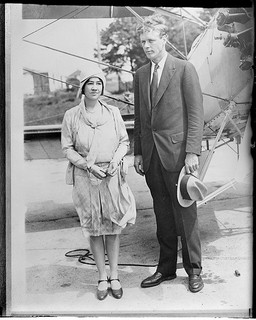
[photo: “Col. Lindbergh and Wife Get Ready to Fly the Pacific,” courtesy of the Boston Public Library, Leslie Jones Collection, used under a Creative Commons license]

Back Home to Papua, 50 Years after Peace Child

Home is an elusive concept for many Third Culture Kids. Paul Richardson, who was born in Papua, Indonesia, is no exception.

“Because I lived so many places in different parts of the world, traveled so much,” he says, “I’d never been able to really say where’s home.”

5712238389_d4bb32ba5f_nBut this summer, he, along with his father and two brothers, returned to the place where he was “born and raised.” That return is the subject of the 15-minute film Never the Same: Celebrating 50 Years since Peace Child.

Paul is part of a famous family, at least among evangelical Christians and the missionary community. Don and Carol, his parents, moved to Papua in 1962 to take the gospel to the Sawi, a tribe of cannibals and headhunters. Their story is the subject of the book Peace Child: An Unforgettable Story of Primitive Jungle Treachery in the 20th Century, later made into a movie, also called Peace Child.

When missionary historian Ruth Tucker wrote From Jerusalem to Irian Jaya: A Biographical History of Christian Missions, it was the work of the Richardsons in Papua (formerly Irian Jaya) that made up the final chapter.

Ministering to a warring tribe was not easy, and at one point, Don told the Sawis that if they didn’t stop fighting, he and his family would have to leave. In order to keep the missionaries there, each Sawi village gave an infant boy to its enemies as a sign of peace. This idea of the “peace child” became a door for the message that the Richardsons were trying to tell them, that God, likewise, had given the world a peace gift, his only son.

This experience among the Sawi formed the basis for Don’s belief that every culture has a “redemptive analogy,” a story, practice, or tradition that can be used to help the people understand the gospel of Christ.  He expounds on this concept in his book Eternity in Their Hearts: Startling Evidence of Belief in the One True God in Hundreds of Cultures throughout the World.

Fifty years after first arriving in Papua, Don revisited the Sawi tribe, which had not only embraced Christianity but had become a base for reaching out to the tribes around them with the message of Christ. Making the trip with him were his sons: Steve, who was seven months old when his family moved to be with the Sawi, and Paul and Shannon, who were born in Papua.

Steve is now the president of the mission agency Pioneers-USA, and he serves as the narrator for Never the Same, which you can view below. It begins with a short overview of the Richardson’s work with the Sawi people and then shows their reunion with their old friends. This is where Paul talks about returning to the place where he lived as a child:

There’s no electricity except for a little generator, and . . . there’s no emails, there’s no text messages . . . just, you know . . . it’s just quiet here. And it’s beautiful, and . . . and there’s a connection with the people here. And, uh, just waking up in the morning, hearing the sounds of the jungle, and, I don’t know, I slept better last night than I have in years, even though I’m just sleeping on the floor in this village.

So there is something to going back. I . . . Because I lived so many places in different parts of the world, traveled so much, I’d never been able to really say where’s home. But I think this would probably be more than anywhere else . . . is where I was born and raised. So this will always be special for me.

I heard about this video from Brian Stankich at Fulfill. In response to my post on eating insects, he pointed to a scene where Steve is eating some grubs on a stick, given to him by his Sawi hosts. Showing his snack to the camera, he says,

Oh this is um . . . these are grubs. And inside they’re just full of grease, and the heads are really . . . very strange, actually, the more I think about it. But [chewing and clearing his throat] they grow on you.

[photo: “Papua-Indonesia, 2008,” by CIFOR, used under a Creative Commons license]

Playing Games with World Proverbs

2706821422_b976cbc1db_mLooking for a game to play with family and friends? Here’s one you might like.

I’ll call it simply The World Proverbs Game. I came up with the idea several years ago after playing a version of Balderdash, just using a dictionary. (As you probably know, Balderdash is a board game in which players try to come up with believable sounding definitions for obscure words.) Similar to Balderdash, there’s a game called Wise and Otherwise that requires players to complete proverbs that come from around the world. I found out about it after I’d already bought a book of world proverbs and made up my own rules. Honest.

Judging by the reviews at Amazon.com, Wise and Otherwise is a great game. For about $43.00, you get a game board, a die, paper and pencils, playing pieces, and 500 cards containing 2,500 proverbs. But if you can do without most of that and would like to save some money, here’s how to play The World Proverbs Game:

First, you need an encyclopedia of proverbs. There are several out there, but the one I got is Wolfgang Mieder’s Prentice-Hall Encyclopedia of World Proverbs. It says it’s “the largest compilation of its kind,” and I won’t argue with that claim, since it includes 18,520 sayings from all over the globe (that’s a big increase over Wise and Otherwise). The proverbs are arranged by topic, and each one is followed by the place from which it comes. As I write this, I see there are a couple used copies at Amazon for under $3.00.

Next, cut up some scratch paper and gather up some pencils. That’s it. You’re ready.

The rules are simple: One person in the group (you need three or more players) looks through the encyclopedia and chooses a proverb. He then reads it to the other players, leaving out one or several words. For example, he might read, “Nine out of ten matchmakers are BLANK.” Then everyone writes down the full phrase, filling in the blank with a word or phrase of his choosing.

After everyone is done, the players hand in their papers to the reader, who has written down the real proverb on his own piece of paper. He then reads them all out loud. The rest of the players then vote on which one they think is the real proverb. You can work out your own scoring system, but here’s one to start with:

  • 10 points go to a player for every person who mistakenly chooses his made-up proverb
  • 10 points go to a player if he completed the proverb correctly—regardless of whether anyone chooses it
  • 20 points go to the reader if no one chooses the actual proverb as being correct (he gets no points if anyone correctly picks his phrase as the real saying)

Each player takes a turn being the reader. To save time, the person next in line should vote first and then make her own selection from the encyclopedia while the others are voting.

Play continues until someone reaches 100 points (or that can be higher or lower, depending on how long you want the game to last).

It’s fun to see how people with different personalities play the game. Some people are very logical. Some people would rather go for laughs. Some are experts at bluffing. Some, not so much. And some people can’t keep a straight face when they read the false proverbs, no matter how hard they try.

What about you and your friends? If you want to find out, start playing. As the Russians say, “One gets to know people during games and on journeys.”

By the way, according to the Chinese, “Nine out of ten matchmakers are liars.”

[photo: “A Bird in the Hand,” by Dave S., used under a Creative Commons license]

Reconciling the Planetal and the Personal: Anne Morrow Lindbergh’s Lessons from the Beach

Planetal awareness.

That’s what Anne Morrow Lindbergh, in  Gift from the Seacalls an attentiveness to what is going on around the globe. In her bestselling book, she wonders how we can balance a “planetal point of view [which] has burst upon mankind” with a “search for outward simplicity, for inner integrity, for fuller relationship.”

Throughout Gift from the Sea, she examines shells that she finds during a respite by herself at the beach, finding lessons from them on how to escape the constant distractions and overwhelming demands of life. It is in the final chapter, entitled “The Beach at My Back,” that she discusses the need to return from the seashore while remembering what was learned there.

Lindbergh’s book was published in 1955, and it uses the language of her day (planetal has since given way to global, and the Internet has replaced “public print” as the dominant media), but it is striking how much her thoughts apply to our present world, with the flood of global information and news threatening to overwhelm our senses and our empathy. She writes,

The world is rumbling and erupting in ever-widening circles around us. The tensions, conflicts and sufferings even in the outermost circle touch us all, reverberate in all of us. We cannot avoid these vibrations.

But just how far can we implement this planetal awareness? We are asked today to feel compassionately for everyone in the world, to digest intellectually all the information spread out in public print, and to implement in action every ethical impulse aroused by our hearts and minds. The interrelatedness of the world links us constantly with more people than our hearts can hold. Or rather—for I believe the heart is infinite—modern communication loads us with more problems than the human frame can carry. It is good, I think, for our hearts, our minds, our imaginations to be stretched, but body, nerve, endurance and life-span are not as elastic. My life cannot implement in action the demands of all the people to whom my heart responds. I cannot marry all of them, or bear them all as children, or care for them all as I would my parents in illness or old age. Our grandmothers, and even—with some scrambling—our mothers, lived in a circle small enough to let them implement in action most of the impulses of their hearts and minds. We were brought up in a tradition that has now become impossible, for we have extended our circle throughout space and time.

Faced with this dilemma what can we do? How can we adjust our planetal awareness to our Puritan conscience? We are forced to make some compromise. Because we cannot deal with the many as individuals, we sometimes try to simplify the many into an abstraction called the mass. Because we cannot deal with the complexity of the present, we often over-ride it and live in a simplified dream of the future. Because we cannot solve our own problems right here at home, we talk about problems out there in the world. An escape process goes on from the intolerable burden we have placed upon ourselves. But can one really feel deeply for an abstraction called the mass? Can one make the future a substitute for the present? And what guarantee have we that the future will be any better if we neglect the present? Can one solve world problems when one is unable to solve one’s own? Where have we arrived in this process? Have we been successful, working at the periphery of the circle and not at the center?

The answer, writes Lindbergh, is to affect the wider circles of the there, the future, and the mass by concentrating on—by enjoying—the centers of “the here, the now, [and] the individual and his relationships.” We must leave the beach, but we leave with our pockets full of shells, reminding us how to “find again some of the joy in the now, some of the peace in the here, some of the love in me and thee which go to make up the kingdom of heaven on earth.”

“It may be our special function to emphasize again these neglected realities,” writes Lindbergh, “not as a retreat from greater responsibilities but as a first real step toward a deeper understanding and solution of them.”

____________________________________

In 1929, Anne Morrow Lindbergh married Charles Lindbergh, already a worldwide celebrity, being the first person to fly from New York to Paris. They met when Charles visited Anne’s family in Mexico, where her father was serving as ambassador from the US.  After their marriage, Anne learned to fly and became Charles’s copilot and navigator as the two flew the globe exploring and mapping out routes.

Though America’s “first couple of the air” seemed destined to live out a fairy tale, their life together was beset by turmoil. Tragedy struck their family in 1932 when the Lindbergh’s 20-month-old son was kidnapped and killed. A highly sensationalized trial resulted in the conviction of Bruno Richard Hauptmann, who was later executed for the murder. To escape the media and public attention, the Lindberghs moved secretly to Europe, living in England and France for over three years.

A theme through much of Anne’s writing is the struggle to find the right path in the face of outward pressures and distractions. In living out this struggle in her own life, she sometimes made regrettable decisions. As Hitler began his offensive in Europe, Anne wrote The Wave of the Future, declaring the inevitability of fascism and calling for America not to oppose the Nazis. Also, in a letter, she called Hitler “a very great man, like an inspired religious leader—and as such rather fanatical—but not scheming, not selfish, not greedy for power.” In her personal life, too, Anne had her failings, having an affair with her doctor shortly after writing Gift from the Sea. (Unknown to Anne, Charles was later unfaithful to her, fathering seven children by three women in Europe.)

Anne wrote more than a dozen books, with Gift from the Sea being her most popular. She died in Vermont in 2001, at the age of 94.

(Anne Morrow Lindbergh, Gift from the Sea, New York: Pantheon, 1955)

[photo: “Mr. and Mrs. Lindbergh,” Courtesy of the Boston Public Library, Leslie Jones Collection, used under a Creative Commons license]


Get Steve McCurry’s “Afghan Girl” for $8,000 or More, or How about Much, Much Less?

Most online introductions of Steve McCurry say something like “He’s the guy who took the photo of the Afghan girl.” Yes, his portrait of Sharbat Gula, a girl in a refugee camp, was featured on the cover of National Geographic in 1985—and became one of the most recognized photographs of all time. But it should also go without saying that McCurry has produced many, many more remarkable photos over his career. He continues to travel the world, capturing the images as they develop before him. As reported in the blog CNN Photos, his philosophy is “travel to a place, work with the locals, and see what emerges.”

If you’d like to own some of McCurry’s photos, including Afghan Girl, there are numerous ways to acquire them, covering a wide range of budgets—from really, really expensive to free. Just in time for Christmas, here are your pricing options, arranged for your convenience from highest to lowest:

$8,000 to $12,000 (estimate)
For the first time, the National Geographic Society is auctioning off some of its vast collection of 11.5 million photographs and illustrations. The sale will take place December 6, at Christie’s, and will include a special print of McCurry’s Afghan Girl. The 240 pieces offered are expected to bring a total of about $3 million, so don’t expect too many bargain-basement prices. (For an update on the auction, see “Sorry You Weren’t the One to Buy ‘Afghan Girl.’“)

Something less than $8,000, I presume
McCurry offers signed fine-art prints of his work at his website. A pdf catalog is available, but prices aren’t included. If you want to find out how much a print costs, you’ll need to contact a lady named Bonnie.

$65
Also available at McCurry’s site. At this price you can get a 20 x 24 inch poster of one of ten McCurry photos. Proceeds go to Imagine Asia.

$37.46
McCurry has just published a new book, titled Steve McCurry: The Iconic Photographs. It covers his best of the best (165 images) from the last 30 years. Amazon sells the standard hardback at the above price, but if you absolutely have to spend more, there’s the deluxe edition for $248.85 and a signed edition at Phaidon for $79.99.

Free
If you’re like me, then browsing the photos on the Internet will have to do for now. But it’s not a bad alternative. It certainly gives you the best selection. Several of the links above can get you started, but for the most images, go to the galleries at stevemccurry.com. Wow, he definitely has had some amazing things “emerge” in front of his lens.

Hear McCurry tell how he captured the photo Beggar Girl, Bombay, India:

(Elizabeth I. Johnson, “Curiosity Inspires Iconic Photographer,” CNN Photos; Ula Ilnytzky, “National Geographic to Auction Famous Photos, Art,” San Francisco Chronicle, October 23, 2012)

[top photo: “Steve McCurry Exhibit,” by Steve Evans, used under a Creative Commons license; Bottom photo: “Occhi che scrutano” (Eyes that stare), by Giuseppe Nicoloro, used under a Creative Commons license]

Managing Missionary Finances: New Book Launched This Week

What is the number one stressor for missionaries? According to the results of a survey conducted by member-care trainer Brenda Bosch, the answer is “financial pressure.”

Not only can a lack of funds cause headaches, but so can keeping track of income and outflow, reporting to supporters, handling exchange rates, filing taxes . . . and the list goes on. I dare say that most missionaries don’t enter the vocation because of a love for bookkeeping, so any help on the financial-tracking front is welcome.

One such help is Money Management for Cross-Cultural Workers, written by Ryan Eidson, of Copper Coin Coaching. This workbook is targeted at missionaries who, for tax purposes, are considered self-employed, but it contains a wealth of information for all people working overseas—regardless of their particular financial situation.

Organized as a 90-day tutorial, Money Management leads the reader through a step-by-step process for understanding, organizing, and tracking funds, developed by Eidson and his wife while they served as missionaries in East Asia. The book also includes access to a spreadsheet template—with detailed instructions on using it—links to audio interviews with experts in the field, discussions of the Biblical principles guiding financial decisions, and links to and summaries of many applicable documents from the IRS.

While I and my family served as direct-support missionaries in Taiwan, we followed the financial guidelines of our missions organization, but Eidson’s book would have certainly been a valuable tool in helping us in answering questions that, at the time, we didn’t even know to ask. For me, one of the big stressors of our financial year was filing taxes. Not only was I sometimes confused by all the forms and schedules and rules, but it was tax time that often made me rethink my figures from throughout the previous year. About two-thirds of the way through his daily lessons, Eidson gives these encouraging words: “Remember, after you complete this entire workbook, you won’t have to fret when tax season comes. You’ll have all your records ready. Press on!”

Discounts for “Launch Week”

During this week’s launch of the second edition of Money Management for Cross-Cultural Workers, the Kindle version is available free at Amazon today and tomorrow (Nov. 13 and 14). Also, Eidson is giving away a set of free bonus digital goods to those who purchase the book this week. Details here.

(Brenda Bosch, “Summary of Missionary Survey Outcomes,” Global Member Care Network Conference, April 2012)

[photo: “Foreign Currency and Coins,” by Philip Brewer, used under a Creative Commons license]

Henri Nouwen’s “Inner Voice of Love”: Finding the Path Home

I’m a fan of the writings of Henri Nouwen. Before his death in 1996, the Holland-born author and theologian served as a Catholic priest; taught at the Menninger Foundation in Topeka, Kansas, and at Notre Dame, Yale, and Harvard; worked with Trappist monks in New York’s Abbey of the Genesee; lived with the poor in Peru; and became pastor at a L’Arche community for the mentally disabled in Canada. Along the way, he wrote over 40 books.

One of the hallmarks of Nouwen’s works is his honest sharing of his personal struggles. This is probably nowhere more apparent than in his Inner Voice of Love, originally a series of “secret journal” entries written during a period of deep depression. In the introduction to the book, Nouwen writes that it was only at the urging of friends that he decided to have The Inner Voice of Love published.

In the book’s pages, Nouwen touches on themes that strike chords with many cross-cultural children and adults, global nomads, and others who are physical or spiritual “strangers in a strange land”—with those who are looking for a community and home to call their own. In fact, it was shortly after he joined the community of L’Arche, what he called his “true home,” that Nouwen was faced with his depression. “Just when I had found a home,” he writes, “I felt absolutely homeless. . . . It was if the house I had finally found had no floors.”

Over the course of the next six months, Nouwen moved from agony “to a new inner freedom, a new hope, and a new creativity.” Following are some of the “spiritual imperatives” that Nouwen wrote to himself during this journey, as he sought the path home:

Coming Home and Trusting Your Heart

Sometimes people who do not know your heart will altogether miss the importance of something that is part of your deepest self, precious in your eyes as well as God’s. They might not know you well enough to be able to respond to your genuine needs. It is then that you have to speak your heart and follow your own deepest calling.

There is a part of you that too easily gives in to others’ influence. As soon as someone questions your motives, you start doubting yourself. You end up agreeing with the other before you have consulted your own heart. Thus you grow passive and simply assume that the other knows better.

Here you have to be very attentive to your inner self. “Coming home” and “being given back to yourself” are expressions that indicate that you have a solid inner base from which you can speak and act—without apologies—humbly but convincingly.

Sharing Your Pain as a Fellow Traveler

You wonder whether it is good to share your struggles with others, especially with those to whom you are called to minister. you find it hard not to mention your own pains and sorrows to those you are trying to help. You feel that what belongs to the core of your humanity should not be hidden. You want to be a fellow traveler, not a distant guide.

The main question is “Do you own your pain?” As long as you do not own your pain—that is, integrate your pain into your way of being in the world—the danger exists that you will use the other to seek healing for yourself. . . .

But when you fully own your pain and do not expect those to whom you minister to alleviate it, you can speak about true freedom. Then sharing your struggle can become a service; then your openness about yourself can offer courage and hope to others.

For you to be able to share your struggle as a service, it is also essential to have people to whom you can go with your own needs. You will always need safe people to whom you can pour out your heart.

You Are Welcome Here

Not being welcome is your greatest fear. . . . It is the deepseated fear that it would have been better if you had not lived.

Everything Jesus is saying to you can be summarized in the words “Know that you are welcome.” Jesus offers you his own most intimate life with the Father. He wants you to know all he knows and to do all he does. He wants his home to be yours. Yes, he wants to prepare a place for you in his Father’s house.

Keep reminding yourself that your feelings of being unwelcome do not come from God and do not tell the truth. The Prince of Darkness wants you to believe that your life is a mistake and that there is no home for you. But every time you allow these thoughts to affect you, you set out on the road to self-destruction. So you have to keep unmasking the lie and think, speak, and act according to the truth that you are very, very welcome.

(Henri Nouwen, The Inner Voice of Love: A Journey through Anguish to Freedom, New York: Doubleday, 1996)

[photo: “To die by your side,” by Hugo Marcelo Mendez Campos, used under a Creative Commons license]

Parents of Missionaries, Another Group with Hidden Sorrow

POMbookEarly on in their book Parents of Missionaries, Cheryl Savageau and Diane Stortz address the topic of disenfranchised grief. Not only is unaccepted grief an issue for cross-cultural workers when they return but also for those they leave behind when they go to serve.

The authors write that disenfranchised grief “results when we deny or condemn our feelings or believe God doesn’t care about our pain. It also occurs when others criticize our feelings or consider us too strong to need support.”

Grief for the parents of missionaries (POMs) should not be minimized or ignored, nor should parents feel guilty for this normal emotion. It is very real, as is the loss that is experienced. For some it is a loss of physical or emotional closeness to their children and grandchildren. For some it is a loss of dreams for the family. For some it is a loss of confidence in discerning God’s will.

At times the grief can feel overwhelming. One mother quoted in Parents of Missionaries says, “My prayers turned from asking God to keep you safe and bless you . . . to please take my life away because surely I was not created to live with pain that . . . hurts more than childbirth.”

As I was making my way through Savageau and Stortz’s great book on this often neglected part of the missionary team—parents—I focused on this topic of disenfranchised grief, making note of instances where healthy grieving over the absence of missionary children was stifled. Following are those examples, quoted directly from Parents of Missionaries. Each one is followed by its page number, in part to demonstrate how they show up throughout the work.

I hope this list will be an encouragement to POMs who are grieving, letting them know they are not alone. I hope it will also help us all be better companions in grief to those who are letting their children go without letting go of them. May we not repeat these discouraging words or represent these unhealthy attitudes, to others or to ourselves:

[One mother] experienced profound self-doubt and feared others would take a critical view if they knew of her inner struggle. She believed having an adult child enter missions would not upset a real Christian. (24)

One workshop attendee asked, “What’s the big deal? It’s not like they’re dead,” while another said, “Having a child enter missions isn’t as bad as having a child outside the faith.” A few missions-minded people have . . . argued that only joy should abound when young people choose a career in missions. (28)

[Some] have honestly asked how POM grief differs from whining. (28)

“We’re not supposed to have needs of our own since we’re in the ministry.” (32)

Men often mask their grief. They typically cope with conscious grief privately, downplay their feelings, intellectualize about loss, and focus on solving loss-related problems. (34)

Our culture’s lack of patience with grief causes many of us to feel ashamed of our feelings and hide our grief. (35)

The assertion that “I can do all things through Him who strengthens me” (Philippians 4:13) does not qualify as a rationale for running away from our feelings. (80)

“I feel like a whiner and complainer after typing up what I wrote in my journal. Maybe you can use it as a bad example of a missionary mom.” (94)

“I miss [my daughter] more than ever before—and I feel really guilty about it.” (94)

“I know I should be excited and thankful that my daughter and her husband will leave for the mission field in August, but I’m having a hard time with my emotions!” (120)

Other POMs who cry easily are not as willing to be seen as vulnerable. One missionary observed about his mom, “Talk of kids, vacation, future plans, how long before we see you again can make her cry instantly. We pretty much can’t talk to her about anything. That was her request, and my dad’s. I think it’s not healthy, and she agrees.” (130)

We sometimes erroneously assume everyone else feels happy amid the holiday bustle and blame ourselves for feeling down or blame others for stealing our joy. Our culture conditions us to expect happiness during the holidays, making normal life problems (that don’t magically disappear on command) seem particularly hard to accept on festive occasions. (216)

Some POMs hesitate to cast their cares upon God because they feel ashamed of their own emotions. This keeps them from enjoying the relief and freedom He wants to offer. (262)

Of course, Parents of Missionaries isn’t just about grief. In fact, Savageau and Stortz write that the need for parent’s to grieve is “only half the story”:

You need to both grieve and change what you can in your life. Make decisions that move you toward fullness of life even though your missionary lives far away. What does God want to do with the rest of your life? . . . If you’re a POM, please look in the mirror and see yourself through our eyes as someone who has made a blessed sacrifice for the kingdom and someone God wants to use in unforeseen ways in days to come. You struggle because you love. Accept your feelings. Ask for and accept help. . . . And do all you can to help yourself.

So if you are a POM, read the whole book to learn how to better understand your loss and grief, how to seek out and receive help, from God and from others, and how to be the best support and teammate for your family members overseas. There can be joy even in the midst of grieving.

(Cheryl Savageau and Diane Stortz, Parents of Missionaries: How to Thrive and Stay Connected when Your Children and Grandchildren Serve Cross-Culturally, Downers Grove, IL: InterVarsity, 2008)