An Ambassador from the Brazilian Rain Forest to New York’s Concrete Jungle

516818391_0849517be5_mIn September of last year, Nilson Tuwe Huni Kui traveled from a village of 600 in the Amazon rain forest to New York City. The 29-year-old Tuwe has a unique way of describing jet lag: “First you arrive physically and you are very tired,” he told BBC. “But only after a while, your soul gets here, too. Because the plane is very fast, but the soul takes longer to arrive.”

Tuwe is set to finish up his nine months in the US at the end of May, having come to New York to study English as a Second Language and to take filmmaking and film-editing classes. His trip is sponsored by Tribal Link’s Indigenous Fellowship Program and the Nataasha van Kampen Foundation. Tuwe is working on a documentary called Us and Them, showing the challenges faced by peoples living in voluntary isolation near the border of Peru and Brazil as they are confronted by illegal loggers, narco-traffickers, and oil prospectors. His goal is to learn English and sharpen his technical skills so that he can become a professional filmmaker, to get the message out to a wider audience.

This is not Tuwe’s first trip as an ambassador to the outside world. Tribal Link originally met him five years ago at the UN Convention on Biological Diversity‘s 9th Conference of the Parties in Bonn, German, and then, last summer, talked with him again in Rio de Janeiro at Rio+20.

Following are a BBC video highlighting Tuwe’s introduction to New York and an interview from Tribal Link in which Tuwe further explains his role as “a spokesperson and a messenger of [his] people.”

I can only wonder about the effects of reverse culture shock on Tuwe as he returns to his tribe. It may take even longer for his soul to catch up on the return trip.

(“Culture Shock for Amazon Chief’s Son Who Left Rainforest for New York,” BBC News, March 17, 2013; “Tribal Link Welcomes to New York Nilson Tuwe Huni Kuin, 2012 Indigenous Fellow,” Tribal Link, December 15, 2012)

[photo: “New York City,” by Kaysha, used under a Creative Commons license]

Doing Time: Culture Stress behind Bars

421070422_b297bf634a_nI don’t have cable or satellite TV, so I’d never seen National Geographic’s Locked Up Abroad until I stumbled across it on YouTube. It’s a series that combines interviews of people who have spent time in foreign prisons with dramatic re-enactments of their stories. I wouldn’t call it must-see TV, but the one episode I’ve watched so far grabbed my interest. Entitled “Tokyo” (see the trailer), it’s about Jackie Nichols, an American who traveled to Japan, met a drug smuggler from Israel, helped him transport hashish from Nepal to Tokyo, and, after several successful trips . . . got caught. In the end, Nichols says that her 18-month stay (shortened from a five-year sentence) in a Japanese prison turned her life around for the better. The conformity and rules of prison gave her the stability that she’d been missing in her life, and she ended up reconciling with her mother.

If you’ve ever been nervous in the ticket line because you were checking a bag that might be a couple pounds overweight, Nichol’s airport stories—as she carries hashish in her clothing and in her stomach—will put your fears in perspective. And you’ll see that culture shock takes on a whole new meaning when the “culture” is dictated by prison guards.

The International Centre for Prison Studies reports that of the world’s more than 10.1 million prisoners, nearly 12% are locked up in foreign prisons:

  • The country with the highest proportion of foreign inmates is the United Arab Emirates, at 92.2%—out of 11,000 prisoners. Next comes Monaco, at 91.7%, but it has only 12 prisoners in all.
  • The other countries with foreign-prisoner populations over 50% are (in order) Qatar, Saudi Arabia, Lichtenstein, Switzerland, Andorra, Luxembourg, Gambia, American Samoa (USA), French Guiana, Macau (China), Cyprus, Greece, and Israel.
  • The US has the highest number of prisoners in the world, at 2.2 million. Of that number, 5.9% are non-citizens.

Not that you would ever want to be jailed in any country, but four years ago Foreign Policy named five places you definitely want to avoid—the worst of the worst, the “most notorious prisons” in the world:

  • La Sant, in France
  • Black Beach, in Equatorial Guinea
  • Russia’s Vladimir Central Prison
  • Camp 1391, in Israel, and
  • The North Korean Gulag

(“World Prison Brief,” International Centre for Prison Studies; Greg Shtraks, “The List: The World’s Most Notorious Prisons,” Foreign Policy, January 21, 2009)

[photo: “TT,” by TTTT, used under a Creative Commons license][photo: “Prison Cells,” by Ambuj Saxena, used under a Creative Commons license]

An Interview with Jessica Stahl of Voice of America

307933_693320373262_563685602_nI first “met” Jessica Stahl after I wrote about a post from The Student Union, a blog she edits for Voice of America. A native of Long Island, she now lives in Washington, D.C., where she works across the street from the Capitol building.

I’ve enjoyed reading Jessica’s blog and then chatting with her through email. I’m interested in the work she does at VOA (see the end of this post for more info about her employer), so I asked if I could interview her. She graciously agreed.

When I asked Jessica what she does at VOA, she told me she is “a producer for social media and special digital projects.” That led me to my first question:

What does “a producer for social media and special digital projects” do?

So, my actual title is “Audience Engagement Analyst,” which is one of those phrases that makes less sense the more you think about it. I call myself a social and digital media producer because that’s much more accurate to what I do. Basically, I manage VOA’s social media presences in English and advise our reporters and programs on how to use social media in their own work, and then I also put together projects and coverage that has a social media or user-generated component to it. Sometimes that’s an article that’s based on something that’s happening on social media (like when the Israelis and Palestinians were basically live tweeting the Gaza conflict a few weeks ago), and sometimes that’s a big project around an event like the presidential inauguration (which is what I’m working on at the moment).

You also edit The Student Union. How did you get started with that?

The Student Union came about a bit by accident. When I started in this job, I was looking around our website and familiarizing myself with what we had going on, looking for areas for improvement. One that jumped out at me immediately was our coverage of international-student issues. We would do these profiles of international students, which were fairly formulaic, and I immediately thought how much more interesting it would be to have international students telling their own stories. It was one of those things where I pitched the idea and was essentially told, “Great, go do it.” So I did. At the time I didn’t know anything about international-student issues, so that first year was a pretty big learning curve!

But I really love working on it. I love editing, and I like writing/reporting without the deadline pressure of breaking news, and I find working with the students so incredible. Their stories are fascinating, and they are so talented, and I love being in a position to help them mold that (not that they always need my input). If I’m honest, it makes me feel important and useful in a way that my regular job doesn’t always!

How did your life before VOA get you ready for what you do now?

That’s a tough one, because I fell into this a bit by accident. My degrees are both in international relations and economics—I did journalism as a hobby in college and grad school but never seriously considered pursuing it as a career. But I ended up at this job at VOA and I absolutely love what I do. I didn’t really have a lot of knowledge about social media when I started, but I’ve learned as I went and now I’d say (humbly, I hope) that I’m very good at my job.

I do think that the training I got in college as a print journalist has been absolutely vital though—that’s where I had the principles of journalism and of good writing drilled into me.

And my interest in/knowledge of international relations comes in handy pretty much every day, since I’m constantly dealing with world news and expected to have a really solid grasp on everything happening around the world.

Back to The Student Union: You have a great mix of students contributing to the blog. How did you meet them?

I find the writers in a whole bunch of different ways—a lot of it is actually dumb luck from students stumbling across the blog and then asking how they can get involved. That’s how I got matched up with two of my best writers: Anna Malinovskaya, from Russia, and Sarah Bosha, from Zimbabwe. I also do a lot of outreach towards the end of the summer with EducationUSA advisors around the world and with international student advisors at US universities, and they’ve been really helpful in spreading the word among their students and helping connect me with people who might be interested. And then, of course, I put it out there on our social media channels as well.

There is actually an application process, so I get to shape the group to make sure it’s pretty diverse in terms of country of origin, location in the US, major, and level of education. But most of that stuff sort of works itself out naturally, and the biggest things I look for are whether the student has ideas and is comfortable sharing things about their own life.

Can you give us examples of posts that give us a taste of how interesting/insightful The Student Union can be?

I’m personally interested in questions of identity and how that’s challenged in cross-cultural situations, and we’ve had some amazing posts on that topic, including from an African girl who had to confront her bias against gay people, “Just when I Learn the Answers, They Change the Questions: A Zimbabwean’s Journey“; from a Chinese girl who tried out several American personas, “What Does It Mean to ‘Be American’ as a Chinese Student“; and from an Afghan guy about the burden of showing American classmates that Afghans are normal people, “‘Who Are You?’ What It Means to Be an Afghan among Americans.”

But we also discuss quirks of American culture, like in this post about classroom discipline (by Anna), “Two Russians Discussing American Education,” or this one about the meaning of the phrase, “How are you?” “The ‘Wrong’ Way to Answer ‘How Are You?’” as well as more informational things like admissions procedures/requirements.

No matter what the topic is, it’s always from a first-person perspective, which I think is what makes it interesting. We’re not just telling people do this or do that (I have a serious pet peeve about “advice” articles that are so vague they can’t possibly be actionable or have no context to help you apply the advice to your own life); we’re sharing what we’ve done and what we learned from it, which someone can just read as a compelling story or can use as an input to make their own decisions.

The international students you work with, did they know about Voice of America before they met you? Did they listen to it in their home countries? What ideas/opinions did they have about VOA?

Depends. Some did, some didn’t. This year, I think, most didn’t. So I think for the most part they don’t really have a pre-existing opinion about VOA. During winter break a bunch will be traveling through D.C., and I’m really psyched to have them over to VOA and show them around so they can get a better sense of what they’re part of.

That sounds like a great time, for them and for you. I’d enjoy seeing DC through their eyes (I hope they get to blog about it). I’d also like to see DC through the eyes of an “insider.” So one last question: If I were to bring some international students to visit DC, after going to all the standard must-see sights—and VOA, of course—what would be a place off the beaten path that you think we should experience? What is a place that you’ve discovered because you’ve made D.C. your home?

One of our bloggers who spent a semester in D.C. did a nice insider’s look at some of the things she discovered, so you can check that out: “A Shifting Identity in Photos: Jihve’s Story.” For me, one of the things I love about D.C. is just the feeling of gravitas you get walking past the US Capitol and the White House. I still always get chills going past the White House. So I recommend walking the National Mall and seeing those sights, both during the day and at night when they’re all lit up. There’s an amazing spot on the steps of the Jefferson Memorial where you can look across the Tidal Basin and see the Capitol on your right, the White House through the trees straight ahead and the Lincoln Memorial on your left, and it’s just gorgeous.The other thing that people probably don’t know about D.C. is how many different neighborhoods we have. It’s not just downtown that’s interesting. I love to walk (probably obvious from my previous suggestion), so I’ve really enjoyed just wandering through the neighborhoods and absorbing their different characters. I recommend Capitol Hill, particularly Eastern Market (which is a giant open-air food/crafts market), U Street (for something that is more authentic to DC’s homegrown culture), and Georgetown.

____________________________________

Voice of America began broadcasting in 1942 and in the 70 years since has grown to reach a television and radio (including shortwave) audience of 141 million each week, in 43 languages. Begun “as a response to the need of peoples in closed and war-torn societies for reliable news,” VOA is under the direction of the Broadcasting Board of Governors, an independent agency of the US government. The BBG’s mission is “to inform, engage and connect people around the world in support of freedom and democracy.”

(“VOA Fast Facts,” Voice of America)
Eleven Tips for Helping Someone with Cross-Cultural Transitional Loss

7016973613_ded8a0eac1_mIf you want to help people in transition—cultural, geographic, and vocational transition—then you’ll need to deal with the grief that comes with their losses. Here’s a great resource for that, A LifeCare Guide to Helping Others Cope with Grief. (LifeCare is a leading provider of “work-life services.”) While this publication is aimed at comforting people who have lost a loved one, the advice it gives can be applied to those with cross-cultural transitional loss as well.

It opens with the second half of this quotation from Henri Nouwen, from Out of Solitude: Three Meditations on the Christian Life:

[W]hen we honestly ask ourselves which persons in our lives mean the most to us, we often find that it is those who, instead of giving much advice, solutions, or cures, have chosen rather to share our pain and touch our wounds with a gentle and tender hand. The friend who can be silent with us in a moment of despair or confusion, who can stay with us in an hour of grief or bereavement, who can tolerate not knowing, not curing, not healing and face with us the reality of our powerlessness, that is a friend who cares.

Here are eleven tips from Helping Others Cope with Grief to guide us in being that “friend who cares.” Each one is followed by a short excerpt to help explain the idea. I have, when necessary, replaced some words (in brackets) in order to to apply the advice to people experiencing loss due to cross-cultural transition—a group including all cross-cultural workers, their parents and family left back “home,” Third Culture Kids, expats, and repats:

  1. Mention the [lost relationships, places, and things], and acknowledge your awareness of the loss.
    . . . . Many people avoid mentioning the [loss], fearing it will remind the grieving person of his or her pain. . . . [B]ut behaving as if you don’t remember or are unaware of your [friend’s] pain often leaves him or her feeling very alone.
  2. Listen to your [friend].
    . . . . The most important thing you can offer someone who is grieving is your ability to listen without judgment. A good rule to follow is to listen 80 percent of the time and talk 20 percent. . . .
  3. Insist that your [friend] see a doctor if he or she exhibits signs of depression.
    Intense grief can lead to depression. If your friend seems unusually depressed or withdrawn, suggest that he or she seek professional help. . . .
  4. Encourage your [friend] to make wise choices.
    Urge the person who is grieving to pay attention to his or her own needs, and make choices accordingly. . . .
  5. Offer practical help; don’t wait to be asked.
    . . . . Make specific offers several times, and encourage your friend to take you up on your offers. Avoid phrases such as, “Let me know if I can help.” Usually, he or she won’t let you know for fear of imposing on you. . . .
  6. Remember that grieving is a long process.
    The person you care about may be grieving for a long time. Several months or more after the transition, he or she may actually be feeling the loss more acutely, and much of his or her support system will have backed off. . . .
  7. Offer your companionship.
    Your presence can be comforting to a grieving [friend]; you don’t have to do anything special. Often, grieving people just do not want to be alone.
  8. Don’t minimize the loss.
    Be careful not to say, “I know exactly how you feel.” . . . Instead, use statements such as, “I know this is difficult,” . . .  or some other statement that is heartfelt and accurate, but leaves room for the uniqueness of your [friend’s] experience.
  9. Encourage your [friend] to share his or her feelings.
    Avoid saying things like, “Be strong for…” or “Don’t cry.” This sends the message that you are uncomfortable with your [friend’s] intense feelings and, therefore, you will leave him or her emotionally alone. . . . Instead, encourage your [friend] by saying, “It’s okay to cry,” or “You don’t have to be so strong.”
  10. Help your [friend] create new traditions/rituals/activities.
    . . . . Holidays and other events filled with tradition can . . . be especially hard to deal with; try to help your [friend] discover new ways to experience these events. At the same time, he or she should be encouraged to cherish the memories and/or traditions associated with the [people and places no longer close by].
  11. Give advice cautiously.
    Avoid offering advice with phrases such as, “You should…” or “You need to….” . . . . Instead, give advice that encourages the grieving person to trust him or herself and make choices based on his or her needs, rather than on what others think he or she should be doing or feeling.

(A LifeCare Guide to Helping Others Cope with Grief, LifeCare, 2001)
[photo: “B,” by Eugene’s Likeness, used under a Creative Commons license]

Can’t We Just Be Friends? Bridging the Cultural Divide on Campus

 In my last post, on friendships between international and American students, I pulled some statistics from Voice of America’s “Student Union” blog. Actually, rather than a lot of numbers, much of what you’ll find at “Student Union” are first-hand accounts of what it’s like to study in American colleges and universities, while facing the challenges of a new culture.

There’s a lot of insight and candor there, on a great variety of topics. Take, for example, these posts:

But back to the topic of friendships. In my post I cited a recent study that says over half of students from China and other East Asian countries have no close American friends. Under the title “Whose Fault Is It when American and International Students Don’t Mix?” Jessica Stahl discusses a video from the Office for International Students and Scholars at Michigan State University, in which students from China and the US talk about the ins and outs of cross-cultural friendships. Part of what makes the video especially interesting is that the group of four female Chinese students and the group of three male Americans are not interviewed at the same time. While this means they don’t respond directly to what their counterparts are saying, it does give them a greater opportunity for honesty and frankness.

After the introduction, the video opens with a segment called “Forming Friendships: Finding Common Ground.” One of the Chinese students begins by saying, “Finding something in common is really hard, because you don’t make friends with someone without having something in common with them.” I think she makes a good point.

When we meet people, we usually start with questions that will reveal what we have in common. And when we find that we share something—place of origin, interests, likes, beliefs, friends, experiences—we pursue it in conversation to see how good a fit we are. It takes time and patience to get past the superficials to track down deeper commonalities, and people from different cultures often don’t get past the opening conversation . . . or they don’t even begin the conversation in the first place.

On the other hand, just looking like you’re from “someplace else” is enough to draw attention from others with significant cross-cultural experience. So Third Culture Kids often seek out international students, and international students find community among each other, regardless of how far apart their home countries are. But while this can lead to some wonderful opportunities for friendship, it is often a small pool to draw from, and it can further limit one’s feeling of fitting in to the general population.

To pique your curiosity, I’ve transcribed below more of the students’ comments on this topic of making friends. But really, if you’re interested in any aspect of cross-cultural interactions, watch the whole video. It’s 17 minutes long but well worth your time.

FYI: The video description at YouTube states that the panelists are all undergraduate students at Michigan State, and the American students “have all spent time in China and have meaningful Chinese friendships.”

Here are some of the comments made by the Chinese students.

Students’ get-togethers start off by talking about high school life. When they came from the same area, well they have some kind of similar backgrounds and experiences that we don’t really have.

Some Chinese students, when they talk with an American, when they cannot find anything in common, they’ll just keep quiet. So they just ignore you. . . .

They care about their baseball game, football game, everything else, instead of this bunch of Chinese people just arrived.

If you make friends . . . you want to get involved in the American community, they will treat you as either a joke or just ignore you.

I’d rather just be with my Chinese friends.

I’ve met a lot of great American friends who are willing to sit down and listen to you and also share their story.

And by the American students:

For someone who hasn’t been to China before or who doesn’t know the culture, I think it’s going to be difficult for them to kickstart a conversation.

The closest relationships that I’ve had with Chinese students are the ones where the Chinese students make it an effort to also start a relationship as well.

My feeling, from my experience of why Chinese students don’t necessarily form close relationships with Americans and why Americans don’t form necessarily close relationships with  Chinese is more so the flaw of the Chinese students.

Man, all the Asians are always together. You’ll never see one by themselves. They’re always in a group.

Besides those certain things that do make an impact, we’re all very similar, and you don’t need to stress the differences too much, because those are easily overlooked. . . . Differences aren’t a problem. Differences are what make life.

[photo: “When Chopstick Meet Fork & Spoon,” by Lohb, used under a Creative Commons license]

Departures and Repatriations: Crossing the Great Divide

“Never die in Taiwan.”

That’s what the poor man at the American Institute in Taiwan said. AIT serves as a de facto US embassy in Taiwan, and I was there taking care of some routine matters. Others, like the student I met who had been so excited about navigating the city in a taxi by himself that he left his backpack and passport in the cab, had more pressing issues.

The man who turned away from the window in despair, who told us all, “Never die in Taiwan,” had just presented documentation concerning his recently deceased wife. He needed to prove that she had died to show that he wasn’t trying to remove his children from the country against her wishes. This was his second or third visit, and the person behind the window was sending him back for translated copies—from Chinese to English, or from English to Chinese—or for some other paperwork that seemed impossible to obtain. The man looked so defeated. The death of a loved one overseas must truly be a distressing experience, in so many ways. I can only imagine how hard it is.

Recently I was jumping around the Web and looked up repats just to see what was out there on the repatriation process, say, for returning cross-cultural workers. One of the top sites listed was repats.com. That seemed like just what I was looking for, but the text underneath wasn’t what I expected:

Funeral Repatriations – Rapatriements funéraire – Funeraire repatriëring

So repats.com is a funeral site. That means, I thought, that repatriation must refer to sending a person’s spirit back “home,” to heaven. What an interesting use of the word. But as it turns out (as most of you probably already knew), for funeral operators, repatriation means returning the deceased’s remains to the country of origin.

Obviously, there is a lot to take care of in this kind of repatriation process: There are laws to follow, the paperwork, the physical aspect of transporting the body, the expense, the disruption of normal day-to-day life overseas, the stress and grief, and the coordination of cultural and religious customs. Avalon Repatriation Services, located in the United Kingdom, gives the following overview of some of the varied practices around the world:

  • In France for example, a body must be embalmed and placed in a wooden coffin 24 hours after death.
  • In Islamic countries, it is the widely-held belief that the deceased should be buried before sundown or within 24 hours, without embalming.
  • In the United States, embalming is common practice. In many countries—when embalming does take place—it is a qualified embalmer’s job, whereas in some countries, for example Portugal and Spain, it is against the law for anyone but a qualified doctor to undertake this procedure.
  • Those of Jewish faith believe that the body should be returned to the earth it came from and are therefore against cremation.
  • Hindus cremate their dead, believing that the burning of a dead body signifies the release of the spirit and that the flames represent Brahma, the creator.

My misunderstanding the meaning of repatriation reminds me of the Japanese film Departures, winner of the 2009 Academy Award for Best Foreign Language Film. It tells the story of an unemployed cellist, Daigo, who answers a newspaper ad titled “Departures.” He thinks he’s applying for a travel-agency job but instead ends up taking a job as a nokanshi, someone who ceremonially prepares bodies for burial. Daigo learns the trade from Sasaki, his boss, who becomes his mentor. And Daigo learns also to overcome opposition from his family and friends and to face his own fears, finding deep meaning in his new vocation.

This is a great film. It’s been one of my family’s favorites ever since my son brought home a copy. Just listening to the theme song in the trailer reminds me of the deep emotions that are explored in the story. I think it’s about time I watched it again.

(“Catering for Different Religions,” Avalon Repatriation Services)

[photo: “Go West,” by halfrain, used under a Creative Commons license]

Please Don’t Ask Me to Eat That

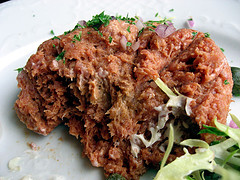
Earlier this year we were with a group of missionaries who were asked to name the worst food in their host country. One lady, who had spent time in Belgium told us about a raw hamburger dish that I remember her calling something like “American beef.” No, not American beef, but American something. . . . Then I saw this article from Public Radio International. Filet américain. That’s what it’s called. Of all the dishes named by the missionaries, this is the one that most kicked in my gag reflex—just to hear about it. Some people eat it with a raw egg on top. That’s just going too far. The author of the article voices his own fear of this Belgian favorite, but not for health reasons. Rather, he’s afraid he’ll actually like it. And then, one thing would lead to another . . . .

Try it once, and soon you’re asking for it regularly at lunch, along with half a liter of red wine. And then you’re having coffee after, along with a digestif. Your afternoon productivity, what’s left of it, starts to slump. Like a good Belgian, you simply shrug your shoulders. . . . Six months go by, and you’re slipping out after you’ve finished a plate for a few quick drags on an unfiltered Lucky Strike. You try to go grow a handlebar mustache. . . .

And then you apply for Belgian citizenship because you know you’ll never get your filet américain fix back in the US.

Maybe it’s not an unwarranted fear, that you’ll become addicted to something that disgusts you. One of the foulest foods in Asia is the durian. Most people can’t even stand the smell. But, they say, try it once, you hate it. Taste it the second time, it’s tolerable. Try it again, and it’s your favorite.

I have a theory. One day our great great great grandparents were going through a famine, and they were forced to eat something that no one had ever needed to eat before. Out of necessity they got used to it. And then when times got better, they still kept it as part of their diet. Maybe it didn’t taste good, but it felt right. It became part of them, part of their story. And then it became part of everyone’s story, kept alive, if by no one else then by the person who could always get attention with “No, I really do think it’s good. Watch me eat some.”

Having grown up on a farm in the Midwest US, I learned to like a few things that might make my city friends squeamish: cow tongue and heart, calf brains (well, I never really enjoyed that one), and Rocky Mountain oysters (fried calf testicles). But I don’t have to go back to old-time examples of Americana to find foods that could gag my international friends. Take for instance a new item soon to be introduced on Burger King’s menu. I’d love to see what my non-American friends would think about their recently announced sundae: vanilla ice cream topped with fudge, caramel, and that all-américain favorite topping, bacon.

(Clark Boyd, “The ‘Américain’ Dream,” PRI’s The World, May 31, 2012; Dylan Stableford, “Burger King to Introduce Bacon Sundae,” Yahoo! News, June 12, 2012)

[photo: “Filet Americain (Raw Beef),” by Kyle Taylor, used under a Creative Commons license]