Eight Years Ago, “The Impossible” Happened

2947856952_e93daa6e15_mToday marks the eighth anniversary of the 2004 Indian Ocean tsunami that killed over 220,000 in 14 countries.

The disaster is the focal point of The Impossible, a movie starring Naomi Watts and Ewan McGregor. They play a British couple who, with their three young sons, are vacationing on the beach in Thailand when the tsunami hits. The film is based on the true story of Maria and Henry Belon, from Spain, and reviews from many who have seen The Impossible say that it portrays the tragedy in a realistic way. Though they were separated and injured, the Belons survived, due in large part to the compassion and kindness of the locals who helped them.

My first thought when I saw the movie trailer was, why must we tell non-western stories through the eyes of westerners? Surely there were stories about Indonesians, Sri Lankans, Indians, Thais, and others in Southeast Asia worth telling.

I was glad to hear Maria Belon address this during an appearance on The View. According to her, the movie is about the people of Southeast Asia. She said that her family’s story is not more important than theirs, but it serves as a way to show what was happening to the tens of thousands of people around them:

It needed to be told just as an excuse to tell everybody else’s stories. That’s the only reason why we wanted our story to be told is because nothing happened to us. . . . I will tell that thousands of times. Nothing happened to us, but from so many people were so painful, so difficult, that that was the only reason why we wanted to tell this story, just an excuse to tell everybody else’s stories. . . . Only for them. Only for them.

When she was asked about “survivor’s guilt,” she gave this interesting response:

I hate this concept, I hate this word. . . . Really, I will struggle to change this concept. It’s not guilt what you feel. Somebody else tells you you’re feeling guilty, and some people will say . . . OK, thank you, I’m feeling that. No, it’s not that what you’re feeling. You’re feeling pain. Pain. It’s a very strong pain that will remain for you forever, forever. I mean you can’t do anything about that.

So with PTSD and all the pain, how did Maria “move on”? She answered,

Moving on. I mean, moving on. I mean . . . no choice. . . . You have pain, OK, go on, Maria, with your pain. Tell the story. Help Naomi. Help the director. I mean, how do you cope when your knee’s in pain? You go on with pain, that’s all.

(The View, ABC, December 21, 2012)

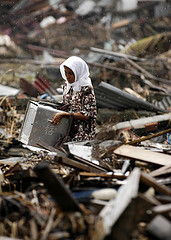
[photo: “Woman searches through debris . . . Banda Aceh, Sumatra, Indonesia,” by Chuck Simmins, used under a Creative Commons license]
Book a Trip to Raoul Silva’s Island Lair

While working on my post about Last Chance Harvey, I needed to find the location of a conversation between Harvey and Kate. My search not only led me to London’s Somerset House but to a slew of sites on the topic of “movie tourism,” as well, where I found that travelers can also visit the place where the wedding was filmed—Grosvenor House—and the setting for one of the couple’s walks—Belsize Park.

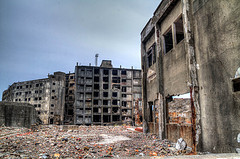
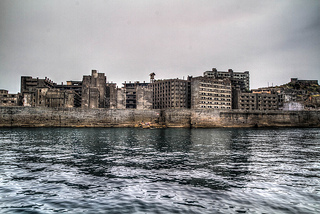
Now these places are impressive in their own way, but none of them is quite as fascinating as a locale in the latest James Bond film, Skyfall: the evil lair of Raoul Silva, 007’s latest nemesis. While the scenes inside Silva’s hideout were shot in a built-for-the-movie set at London’s Pinewood Studios, the long-distance shots are of a real-life place located nine miles off the coast of Japan—Hashima Island (pictured above). Not only does the island look sinister—a pile of abandoned and crumbling concrete apartment buildings jutting out of the ocean—but its backstory could supply an unsettling script for a film of its own. Clark Boyd, at PRI’s The World, writes that the island’s “true history is even creepier than you can imagine.”

Boyd goes on to give an overview of that history in this audio story (or you can read the article here).

Also, for a more in-depth treatment, including more details about life on the island, you can read Brian Burke-Gaffney’s article in the magazine Cabinet.

Hashima Island’s story in a nutshell is this:

In 1890 Mitsubishi bought the small outcropping of rock  for the coal that lay below the seabed underneath it. As coal production increased, so did the need for workers, and in 1916, the company built the first of many concrete structures to house them. In time, over 30 multi-story buildings were constructed, and in 1959 they were home to 5,259 people, including Japanese employees, their families, and forced laborers from China and Korea. Its 1,391 people per hectare (2.47 acres) in the residential area at that time is thought to be the highest population density ever recorded in the world.

Many of the people who lived on the island died there as well. Burke-Gaffney reports that by mid 1949, around 1,300 residents had lost their lives—from mining accidents, exhaustion, or malnutrition. “Still others had chosen a quicker, less gruesome death,” he writes, “by jumping over the sea-wall and trying in vain to swim to the mainland.”

In the late 1960s, petroleum replaced coal as Japan’s preferred energy source. Then, in 1974, Mitsubishi closed the mine, and all the inhabitants still there hastily left.

Following is a short documentary by Swedish filmmaker Thomas Nordanstad. In the film, Nordanstad follows Dotokou Sakamoto, a Japanese man who moved to Hashima Island with his family at the age of four, as he visits, among other places, the “hotel,” where new arrivals awaited permanent housing, his school, and the crumbling remains of his family home.

At the beginning of the documentary, Sakamoto says,

Some people say that your roots exist in the place where you were born, but that’s not the case for me. My roots are here, in this place.

And at the end, he adds,

In Japan, things are being thrown away so easily, just like that. But you can’t throw away your memories. The roots sit there, in your heart.

While the bulk of the island is closed to the public, in 2009 observation decks were opened at the island’s edge, with the boat ride from Nagasaki and a tour costing about $50.

To find the rest of the venues featured in Skyfall, go to The Worldwide Guide to Movie Locations, the self-described “ultimate travel guide to film locations around the world.” It’s a great resource that ties detailed info on places with plot points in the movie. And if you want to look up a film that’s not included there, you can try IMDb (International Movie Database). The location info there is less specific, but its movie list is much more comprehensive. (Search for “Filming Locations” on a movie’s page.)

(Clark Boyd, “The History of Hashima, the Island in Bond Film ‘Skyfall,'” PRI’s The World, November 23, 2012; Brian Burke-Gaffney, “Hashima: The Ghost Island,” Cabinet, Summer 2002)

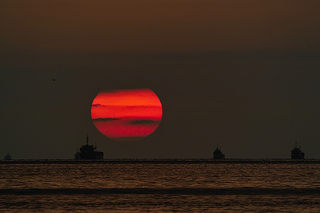
[photos: “Nagasaki Hashima Island (端島) Gunkajima Tour” (top and bottom) by Ronald Woan, used under a Creative Commons license]

Better the Disappointment You Know?

Just last week, my wife and I watched Last Chance Harvey (2008) for the umpteenth time—well, maybe not the umpteenth time, but at least the umpth time. It evokes some particular emotions for us, as we first watched it on a plane ride back to the States during our time in Asia. We were coming back with some disappointments, and the movie—especially a conversation near the end—resonated with each of us. If you’re not familiar with the story, here’s a short synopsis, leading up to that exchange:

Harvey Shine (Dustin Hoffman) is a down-on-his-luck jingle writer from New York, flying to London for his daughter’s wedding. Kate Walker (Emma Thompson) is a Heathrow employee with the tedious job of interviewing travelers. Their first meeting begins with Kate’s attempts to ask Harvey the questions on her clipboard. It ends with Harvey rudely brushing her off.

Not only are things going poorly for Harvey on the job front, but he later finds out that his daughter has chosen her stepfather to walk her down the aisle—and there are obviously some family skeletons that reside in Harvey’s closet.

Things begin to look up, though, when Harvey meets up with Kate the next day at a Heathrow bar. Harvey has just missed his flight back to the States, and Kate is using a novel as an escape from failed blind dates and phone calls from her mother, with whom she lives.

Over the next several hours, Harvey and Kate begin to enjoy each other’s company, and they even see glimpses of a happy future together. The two attend Harvey’s daughter’s wedding reception and then wander around London, ending up at the fountains at Somerset House. They agree to meet there again at noon the next day. A spirited climb up his hotel steps puts Harvey in the hospital, just long enough to keep him from making the appointment. Not knowing the cause, Kate is crushed at having her emotions stood up . . . again.

Harvey tracks Kate down, even though she no longer wants to see him. She is wounded and fears being wounded even more. As Harvey tries to convince her that she should give their relationship a chance, they have their pivotal conversation, in which Kate says,

I’m not going to do it. I’m not going to do it, because it’ll hurt. . . . and I won’t do it. . . .

You see, what I think it is, is . . . is that I think I’m more comfortable with being disappointed. I think I’m angry with you for trying to take that away.

Since we were escorting our five children across the Pacific, my wife and I were separated during our flight, catching pieces of movies on our individual screens in between naps and meals. Sometime later during the trip, our youngest was asleep and we got to sit together for a while. We’d both watched Last Chance Harvey, and we both remembered what Kate had said. At the time we understood that even though disappointment is painful, it can become more comfortable than hoping for miracles and risking deeper loss. Maybe that’s why we continue to watch the film from time to time. . . because we still understand that. And when fear accompanies hope, as it often does, we do our best to press on, more guarded, but pressing on.

Last Chance Harvey doesn’t end with “happily ever after,” but it does end with a hopeful beginning. Harvey decides to stay longer in London, and Kate agrees to open her heart to the possibilities with him. As the two start down this new road together, Harvey remembers their first encounter and asks Kate to continue the interview that she’d started with him at the airport. She does:

“Name?” she asks.

He replies, “Harvey Shine.”

“Place of residence?”

“I’m in transition.”

Here’s the trailer:

And here’s a “Back Stage interview with Thompson and Hoffman, in which they talk about the mood and personality of the movie. When discussing the on-screen relationship between the two characters and how that was reflected in the film-making process, Hoffman says,

I always said that you always know who your friends are [. . . .] Your really good friends are the people that you can sit at a table with and not talk [. . . .] And we said, whatever the specialness about that relationship was, could we do this movie like that?

[photo: “Yellow Point: Somerset House Fountains,” by Tania Caruso, used under a Creative Commons license]

Now That the Hobbit Air-Safety Video Has Gone Viral, Here’s a Look at the Prequels

If you think all air-safety videos are boring, then you probably haven’t flown Air New Zealand. Their latest effort, the Hobbit-inspired “An Unexpected Briefing,” has gone well beyond the simple objective of capturing the attention of passengers, as it has gone viral and has already entertained millions of viewers on the ground. While this one is by far the most successful tongue-in-cheek video from “the airline of Middle-earth,” it’s certainly not the first.

Before “An Unexpected Briefing,” there was “Mile-High Madness with Richard Simmons,” “Crazy about Rugby,” featuring the All Blacks, and  “Bare Essentials of Safety,” with the cast/crew dressed only in body paint. Here’s a “best of the best” mash-up of all three versions:

And New Zealand’s national airline has also given us “Ed and Melanie’s Safety Sketch,” with the voice talents of Ed O’Neill (Wreck It RalphModern Family) and Melanie Lynskey (Two and a Half Men, Up in the Air):

Air New Zealand isn’t the only carrier using humor to grab eyeballs for this very important message. Three years ago, the UK’s Thomson Airways recast their video using children. It looks as if their lead spokes-girl might some day become a rival for Deltalina. She certainly has mastered the finger wag.

Who’s Deltalina? She’s Katherine Lee, the flight attendant chosen in 2008 to be the main presenter for Delta’s safety videos. He nickname comes from what some see as her resemblance to Angelina Jolie. Air safety has made Lee a star.

Back in 2007, Virgin American came up with this animated video, featuring such lines as “For the point zero zero zero one per cent of you who have never operated a seat belt before, it works like this.”

And finally, for the point zero zero zero zero one per cent of you who haven’t seen “An Unexpected Briefing,” with its cameos by Peter Jackson and Gollum, here it is. Enjoy.

Related post:
Inflight Magazines: My Virtual Seat-Back Pocket Runneth Over

Roundball Diplomacy in Iran: A Documentary

Here’s another entry in the category of basketball diplomacy*. When director Till Schauder found Kevin Sheppard, a point guard from the US Virgin Islands, playing professionally in the Iranian Super League, he made him the focus of his documentary, The Iran Job. The film follows Sheppard’s season with his team, A.S. Shiraz, and his spirited interactions with the Iranian people. In particular, Sheppard forms a relationship with three women—who bravely face the cameras, remove their head coverings, and share their views about the current culture in Iran. Shauder writes:

Iran is often portrayed as a terrorist nation, a nuclear threat, and a charter member of the Axis of Evil bent on the destruction of Israel. But behind the headlines—and the aggressive rhetoric of Iran’s hard-line leaders—lies one of the most fascinating nations, as sensuous as it can be challenging, with a life-loving people. This film focuses on Iran’s people, rather than its government, and I hope it can challenge perceptions of Iran by providing an authentic perspective that may be crucial when choices are made between war and peace. It is probably safe to say that getting Iran “right” is as impossible as getting any culture “right.” Nonetheless, for their people and for ours, it should be a high priority. . . . More than a fish-out-of-water sports documentary this film focuses on social issues including women’s rights, political freedom and religious conflict, through the lens of a black American basketball player.

The Iran Job is being screened in selected US theaters, and DVDs are available at Kickstarter.

*For more examples of basketball diplomats, see my other posts on Stephon MarburyYao Ming, and Jeremy Lin.

[photo of a basketball goal in Varamin, Iran: “Retired hoop!” by Blake Amin Tabrizi, used under a Creative Commons license]

Departures and Repatriations: Crossing the Great Divide

“Never die in Taiwan.”

That’s what the poor man at the American Institute in Taiwan said. AIT serves as a de facto US embassy in Taiwan, and I was there taking care of some routine matters. Others, like the student I met who had been so excited about navigating the city in a taxi by himself that he left his backpack and passport in the cab, had more pressing issues.

The man who turned away from the window in despair, who told us all, “Never die in Taiwan,” had just presented documentation concerning his recently deceased wife. He needed to prove that she had died to show that he wasn’t trying to remove his children from the country against her wishes. This was his second or third visit, and the person behind the window was sending him back for translated copies—from Chinese to English, or from English to Chinese—or for some other paperwork that seemed impossible to obtain. The man looked so defeated. The death of a loved one overseas must truly be a distressing experience, in so many ways. I can only imagine how hard it is.

Recently I was jumping around the Web and looked up repats just to see what was out there on the repatriation process, say, for returning cross-cultural workers. One of the top sites listed was repats.com. That seemed like just what I was looking for, but the text underneath wasn’t what I expected:

Funeral Repatriations – Rapatriements funéraire – Funeraire repatriëring

So repats.com is a funeral site. That means, I thought, that repatriation must refer to sending a person’s spirit back “home,” to heaven. What an interesting use of the word. But as it turns out (as most of you probably already knew), for funeral operators, repatriation means returning the deceased’s remains to the country of origin.

Obviously, there is a lot to take care of in this kind of repatriation process: There are laws to follow, the paperwork, the physical aspect of transporting the body, the expense, the disruption of normal day-to-day life overseas, the stress and grief, and the coordination of cultural and religious customs. Avalon Repatriation Services, located in the United Kingdom, gives the following overview of some of the varied practices around the world:

  • In France for example, a body must be embalmed and placed in a wooden coffin 24 hours after death.
  • In Islamic countries, it is the widely-held belief that the deceased should be buried before sundown or within 24 hours, without embalming.
  • In the United States, embalming is common practice. In many countries—when embalming does take place—it is a qualified embalmer’s job, whereas in some countries, for example Portugal and Spain, it is against the law for anyone but a qualified doctor to undertake this procedure.
  • Those of Jewish faith believe that the body should be returned to the earth it came from and are therefore against cremation.
  • Hindus cremate their dead, believing that the burning of a dead body signifies the release of the spirit and that the flames represent Brahma, the creator.

My misunderstanding the meaning of repatriation reminds me of the Japanese film Departures, winner of the 2009 Academy Award for Best Foreign Language Film. It tells the story of an unemployed cellist, Daigo, who answers a newspaper ad titled “Departures.” He thinks he’s applying for a travel-agency job but instead ends up taking a job as a nokanshi, someone who ceremonially prepares bodies for burial. Daigo learns the trade from Sasaki, his boss, who becomes his mentor. And Daigo learns also to overcome opposition from his family and friends and to face his own fears, finding deep meaning in his new vocation.

This is a great film. It’s been one of my family’s favorites ever since my son brought home a copy. Just listening to the theme song in the trailer reminds me of the deep emotions that are explored in the story. I think it’s about time I watched it again.

(“Catering for Different Religions,” Avalon Repatriation Services)

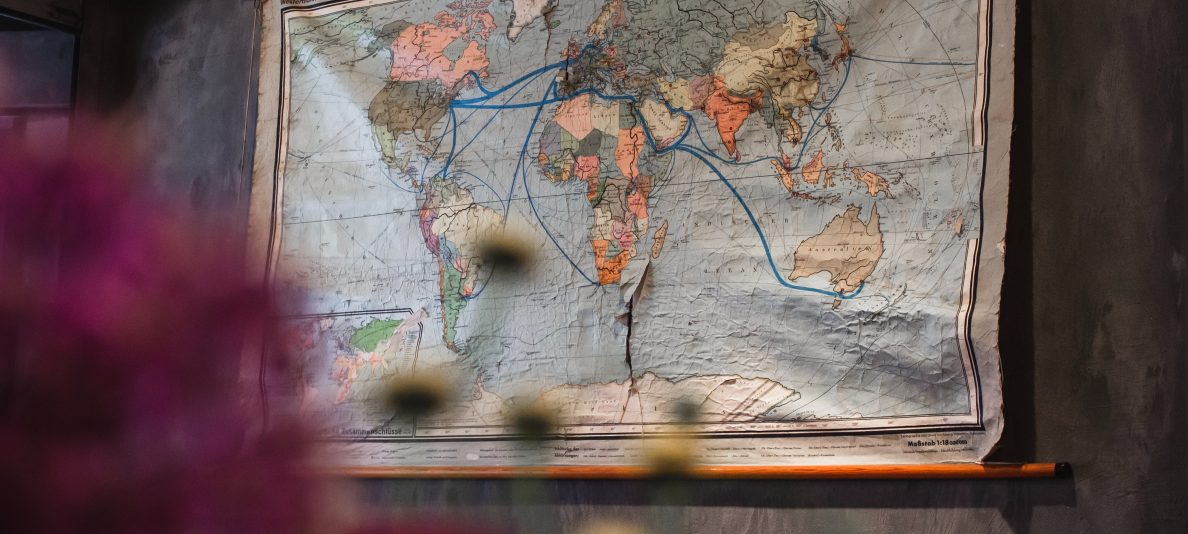
[photo: “Go West,” by halfrain, used under a Creative Commons license]

Samsara and Baraka, Our World in Film

Coming soon to a theater near you. We’ve all heard those words. (At least I think we have. Do movie advertisements say that any more?) But for a lot of the movies I’d like to see, it’s not true. That’s because my community doesn’t have a local venue for foreign films and documentaries. We do, though, have a library that does a pretty good job of keeping up with off-the-beaten-path movies. For these kinds of films, maybe the slogan should be “Coming later to a library near you.”

That brings me to a new production that premiers today in New York and Seattle. The title is Samsara, which the production’s website says is “a Sanskrit word that means ‘the ever turning wheel of life.'” It’s a series of video clips filmed in 25 countries over a period of nearly five years. With a musical score but no dialogue or commentary, it is director Ron Fricke’s followup to his earlier Baraka (1992). Both follow the same format, and both were shot on high-resolution 70 mm film. Baraka, a word present in several languages, means “blessing.”

Of Baraka, Chicago Sun-Times film critic Roger Ebert writes, “Of course there is a ‘message’ somewhere in ‘Baraka’—the same message we have heard before, about how man must love and respect the planet.” But Mark Magidson, who produced and co-edited Samsara and worked on Baraka as well, tells The New York Times that with Samsara, “We’re not trying to say anything.”

Maybe the editing of Samsara will end up showing an obvious message, but it looks to me right now that the film is a video Rorschach test, with the meaning varying from viewer to viewer. In fact, I envision getting a copy and showing it to some groups—for instance, college students or potential missionaries or veteran cross-cultural workers—and asking them, “What do you think the filmmakers are trying to say? What one-word title would you give to the movie? What does it mean to you?”

In 2008, Baraka was digitally restored and released on Blu-ray (it’s also available on DVD). In response to the restoration, Ebert writes, “If man sends another Voyager to the distant stars and it can carry only one film on board, that film might be “Baraka.” And as for the Blu-ray version:

[It] is the finest video disc I have every viewed or ever imagined. . . . It is comparable to what is perceptible to the human eye, the restorers say. “Baraka” by itself is sufficient reason to acquire a Blu-ray player.

While I’m waiting for Samsara to come to my library, I think I’ll check out—or buy—a copy of Baraka. And maybe both will be aboard Voyager 3, going soon to a galaxy far, far away.

(Nicolas Rapold, “Planetary Poetry, Woven into a Movie,” The New York Times, August 18, 2012; Roger Ebert, “Baraka,” November 12, 1993; Ebert, “Baraka [1992],” October 16, 2008)

[photo: “holi amusedness!” by Elijah Nouvelage, used under a Creative Commons license]

Documentary Shows Adoptees’ Journeys from China to the US to “Somewhere Between”


In the process of sharing in the story of her daughter, adopted from China, Linda Goldstein Knowlton decided to tell the story of four other girls, Chinese adoptees living in the United States. The vehicle for her storytelling is the documentary Somewhere Between. On the film’s website, Goldstein Knowlton says,

I am making this film for everyone. For the girls, so they can see their experiences in connection with each other, and for everyone who grapples with issues of race, culture, identity, and being “different.” By necessity, we must all try to comprehend the experience of being “other” in America, to see how each individual finds his or her own way in society. This film explores the emotional and psychological fallout on our daughters and our selves, and our cultural experience when stereotypes and assumptions collide.

The film follows the experiences of four young teenagers:

  • Jenna Cook, a 13 year old in New Hampshire (now a student at Yale). “As strong as she is, she breaks down discussing the word ‘abandonment’ and its effect on her life. . . . The film documents her courage and commitment to facing her past as she volunteers for summer work at the very Chinese orphanage that housed her as an infant.”
  • Haley Butler, 13 years old in Nashville, TN (currently studying at Nashville School of the Arts). While she is on a trip to China to find her birth parents, “miraculously, a man comes forward and claims her as his biological daughter, which sends Haley on a rollercoaster ride of excitement, trepidation, and self doubt until, at the end of the film, Haley discovers some surprising and shocking truths about herself and her history.”
  • Ann Boccuti, 14 years old, living in a Philadelphia, PA, suburb (now a student at Indiana University of Pennsylvania). “She loves her life and has little desire to know anything about where she came from. . . . Her attitude, however, shifts when she meets other adopted girls in the CAL/Global Girls organization, and signs up for a trip to Europe with them. Once she is exposed to the innermost thoughts of other girls like her, girls who admit they have a nagging desire to find their roots, her world cracks open.”
  • Fang “Jenni” Lee, a 14-year-old in Berkely, CA (currently a student at Mt. Holyoke). “Her adopted parents divorce, and Fang must relive the ‘abandonment’ she faced as a small child. Amid this emotional turmoil, Fang travels to China and sees a little girl in a Chinese foster home, unmoving because of her cerebral palsy. Touched, Fang becomes determined to find the little girl a home.”

“This film is about these four girls,” says Goldstein Knowlton, “and the 79,562 girls growing up in America.  Right now.”

The award-winning Somewhere Between has screenings scheduled in several cities, but if there isn’t one near you, join me in waiting for the DVD. Having adopted a boy from Taiwan, I think we could learn some things from these girls. As our son grows up, he’ll be asking more and more questions, and we want to do our best to help him find the right answers.

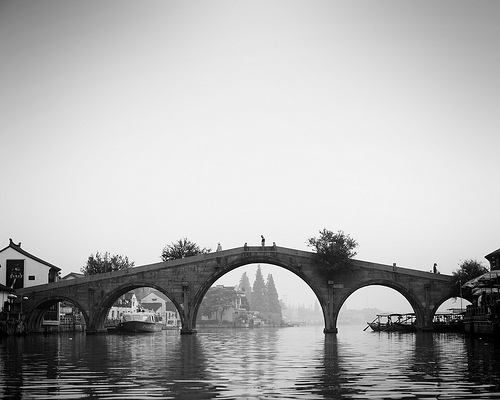
[photo: “Bridge,” by Andrew Hefter, used under a Creative Commons license]