
Why Is IKEA One of the Most “Meaningful” Companies in the World? 10 Reasons

4406947248_d6183b9d05_z

What is it that makes IKEA a global phenomenon? Is it the DIY furniture? Is it the maze-like stores with free childcare? Is it the lingonberry jam?

Whatever the cause, the behemoth that is IKEA is not only the biggest producer and manufacturer of furniture in the world but also the most “meaningful.”

According to Paris-based Havas Media, IKEA ranks #6 on its list of “Meaningful Brands,” the result of a global survey measuring how people think companies benefit their “personal and collective well-being.” (Three years ago, IKEA was #1.)

(“Meaningful Brands,” Havas Media; Jennifer Rooney, “Ikea, Google, Nestle Tops in ‘Meaningful’ Impact: Survey,” Forbes, November 8, 2011)

Here’s my list of 10 things that give IKEA meaning in today’s world.

1. It’s big, Big, BIG

As of October 15, IKEA has 364 stores in 46 countries (map). These include the two stores in Taipei, where I was first introduced to the chain, and the newest store in the US, which opened last month in Meriam, KS, about two hours from my home.

(“Bringing the IKEA Concept Worldwide,” Inter IKEA Systems B.V.)

2. It has an “effect” named after it

IKEA is known for it’s “flat box” furniture, bought in a box at the store and assembled at home by the customer. While this can cause frustrations, especially if a piece is missing, it has it’s upsides. Researchers from Harvard, Yale, and Duke found that when people put effort into creating something, they like it more, even valuing their creations over others of higher quality. They dub this the “IKEA effect.”

(Michael Norton, “The IKEA Effect: When Labor Leads to Love,” Harvard Business Review, 2009)

3. Now it’s a kind of diplomacy, as well

It’s too early to say for sure, but I think the term IKEA diplomacy is going to catch on, too. Just a little over a week ago, Sweden recognized Palestinian statehood. This was followed by a swift condemnation from Israel’s foreign minister, Avigdor Lieberman, who said, “Sweden must understand that relations in the Middle East are much more complicated than self-assembly furniture at Ikea.”

“I will be happy to send Israeli FM Lieberman an Ikea flat pack to assemble,” responded the Swedish foreign minister, Margot Wallstrom. “He’ll see it requires a partner, co-operation, and a good manual.”

(Inna Lazareva, “Ikea and Peace in the Middle East,” The Telegraph, November 1, 2014)

4. IKEA’s catalog is published in biblical proportions

Each year, IKEA prints millions of its catalogs each year. According to the Wall Street Journal, in 2012 the company planned to distribute 208 million, which is estimated to be more than twice the amount of Bibles that are produced each year.

In 2012, the IKEA catalog made news when the company removed images of women from photos in the version distributed in Saudi Arabia. IKEA later apologized.

And September marked the announcement of the 2015 catalog in the highly innovative—dare I say groundbreakingform of the “bookbook.” Genius.

(Jens Hansard, “IKEA’s New Catalogs: Less Pine, More Pixels,” Wall Street Journal, August 23, 2012; “Is the IKEA Catalogue Being Distributed in More Prints than the Bible?” Skeptics Stack Exchange; Ben Quinn, “IKEA Apologises over Removal of Women from Saudi Arabia Catalogue,” The Guardian, October 1, 2012; )

5. Its product names are just so Kwïrki

If you’ve shopped at an IKEA or browsed a catalog, then you know that each product carries some kind of Swedish—or Swedish-ish—name. They often sound odd (a shelf named Ekby Bjärnmum), sometimes funny (a soil block is called Kokosnöt), and sometimes unfortunate (I’ll let you Google for these yourself).

Of course, this isn’t just a Swedish-to-English issue. The Wall Street Journal reports that before opening a store in Thailand, IKEA put together a team with the sole purpose of catching names that sound off-color to the Thai ear, such as Redalen (a bed) and Jättebra (a plant pot), both of which sound like Thai sexual terms.

And then there’s Lufsig, IKEA’s stuffed wolf toy. In December of last year, an anti-government protestor in Hong Kong threw one at Hong Kong’s Chief Executive Cy Leung during a town-hall meeting. The man tossed the toy because Leung is called “wolf” by his critics. The action took on more meaning since the Cantonese name for the stuffed toy sounds like a crude sexual term in that language. Lfusigs became a must-have item and soon sold out.

(James Hookway, “IKEA’s Products Make Shoppers Blush in Thailand,” The Wall Street Journal, June 5, 2012; Per Lilies, “Stuffed IKEA Toy Becomes Offensive Anti-Government Symbol in Hong Kong,” Time, December 10, 2013)

6. Name another furniture store that’s known for it’s food

According to The Wall Street Journal, IKEA’s food division is on par in sales with Panera’s and Arby’s. And the cornerstone of its in-store restaurants and grocery products is the humble Swedish meatball, of which they sell around 150 million each year.

The meatballs are nothing fancy, just really, really good. Here’s how they’re described on the company website, in typical Scandinavian understatement:

KÖTTBULLAR
Meatballs, frozen
Key features
– Meatballs are minced meat formed into round balls and then fried. Serve with boiled potatoes, lingonberry jam and cream sauce.

Even after its meatballs were recalled across Europe early last year, the store’s culinary reputation survived. Why the recall? Trace amounts of horse meat were discovered in a batch made by a Swedish supplier. If that news still gives you pause, have patience. Next year IKEA plans to roll out meatless vegetarian meatballs.

In the UK, IKEA even brews its own line of dark lager and regular brew beers.

Remember, this is a furniture chain we’re talking about.

(Jens Hansegard, “IKEA’s Path to Selling 150 Million Meatballs,” The Wall Street Journal, October 17, 2013; Andrew Higgins and Stephen Castle, “Ikea Recalls Meatballs after Detection of Horse Meat,” The New York Times, February 25, 2013; April Gosden, “Ikea Plans ‘Green’ Meatballs to Help Tackle Climate Change,” The Telegraph, April 17, 2014; Laura Stampler, “IKEA Now Brews and Sells Its Own Beer,” Business Insider, July 18, 2012)

7. It doesn’t want only to sustain its business, it wants to sustain the planet, too

Vegetarian meatballs aren’t the only thing “green” about IKEA.

The company started selling roof-top solar panels in the UK last year and in September it announced plans to expand that offering to 8 more countries in the following 18 months. It’s starting with the Netherlands and Switzerland and will move on from there.

As reported by Reuters, IKEA has installed 700,000 solar panels on its own rooftops at stores around the world and has plans to up its global use of wind turbines to 224. Other green initiatives include plans to replace, by 2020, all the plastic in its products with recycled plastic or renewable materials, such as wood.

And if you’re driving your electric car in the United Kingdom, you’ll appreciate IKEA’s announcement that all UK stores now have free electric vehicle rapid recharging points installed in their parking lots.

(“IKEA to Widen Solar Panel Sales to Eight New Nations from UK,” Reuters, September 22, 2014; “Electric Vehicle Charging,” IKEA)

8. In the time it takes to put together a couple bookcases, you could build a shelter for a refugee

Bloomberg Businessweek reports that the IKEA Foundation has invested $4.8 million to develop portable shelters, to be used by the Office of the United Nations High Commissioner for Refugees (UNHCR). Last year, 50 prototypes were shipped, in flat-pack boxes, to Syrian refugee camps. Olivier Delarue, UNHCR head of innovation, says that his agency was looking for an improvement on the tents typically used to house the displaced around the world and turned to IKEA for its “expertise in certain areas—such as logistics and flatpacking—that we could learn from.”

According to The Boston Globe, each 188-square-foot unit takes about four hours to assemble. The cost of a prototypes is $10,000 but is expected to fall below $1,000.

(Caroline Winter, “Ikea Sends its New Flatpack Refugee Shelter to Syria,” Bloomberg Businessweek, September 11, 2013; “Ikea: Refuge in a Flat Box,” The Boston Globe, July 5, 2013)

9. An IKEA store is like a 20-bedroom home away from home

It seems that many IKEAs not only have lines of people waiting to buy home furnishings, they also have lines of people wanting to make themselves at home.

Take, for instance, shoppers in China who lounge on the couches and climb under the covers for naps in the beds (photos at ChinaHush). Camilla Hammar, marketing director for IKEA in China, tells Advertising Age that stores there don’t just allow the try-it-out approach, they welcome it, embracing the idea that for the Chinese, shopping at IKEA can be an emotional experience. “It tends to initiate very romantic feelings,” she says. “The first time some couples start talking about getting married is in our showrooms. So that’s something we’ve tapped into.” And that’s why the store in Nanjing hosted three Swedish-style weddings for three couples as a PR event.

But it’s not just the Chinese who want to take advantage of the store’s sleeping—or wedding—accommodations. When Havas Media UK was looking for a way to promote the chain, they found a Facebook group called “I wanna have a sleepover at IKEA.” They latched on to the idea and organized “IKEA’s Big Sleepover” for 100 lucky customers.

And when couple in Maryland looked for a venue for their wedding in 2012, they chose the IKEA store where they had their first date. Another pair, this time in New Jersey, got married last year in  an IKEA framing department, the same place where they’d met eight years earlier.

Even Hollywood knows that domestic magic can happen in IKEA.

(Key, “IKEA in China, ‘Our Home Is Your Home,” ChinaHush, July 27, 2012; “Happy to Bed,” Havas Media; “A Wedding in Aisle 3? Why Ikea Encourages Chinese to Make Its Stores Their Own,” Ad Age, December 10, 2013; David Boroff, “Couple Gets Married in Maryland IKEA,” New York Daily News, April 20, 2012; Eliza Murphy, “Couple Says ‘I Do’ in IKEA’s Framing Department,” ABC News, June 11, 2013)

10. And it can put your love to the ultimate test

Of course, adding IKEA to a relationship doesn’t ensure bliss—even in Sweden. A story in The Local last year recounts how police were called to a home in Strömstad by neighbors who were concerned about loud noises during the early morning hours. The authorities found that the “banging and screaming” was caused by a couple putting together a piece of IKEA furniture, and by their crying child.

There’s nothing like assembling furniture to check your love for your significant other. Well, maybe shopping for furniture can have the same effect. A trip to IKEA could be the perfect premarital outing for couples wanting to see if their love has what it takes to go the distance. Take a look at the video below to get an off-kilter view of the store that just might be “the number one place where couples realize they actually can’t stand each other.”

(“Police Called to Swedish Family’s IKEA Nightmare,” The Local, November 8, 2013)

[photo: “IKEA of Sweden,” by Håkan Dahlström, used under a Creative Commons license]

Sorry—No Ifs, Sos, or Buts

139499559_0248586250_nIf you were following the news a couple weeks ago, you got to hear a great example of a straightforward, unequivocal apology from MSNBC host Melissa Harris-Perry. Earlier, on her show, she and her guests had made fun of a photograph showing Mitt and Ann Romney with their 21 grandchildren. The subject of their jokes was that everyone in the photo was white, except for the adopted African-American baby sitting on Mr. Romney’s knee.

In a tweet following the show, Harris-Perry wrote, “I am sorry. Without reservation or qualification. I apologize to the Romney family.”

That kind of an apology is hard to come by. It’s hard to get, and it’s hard to give. But it’s the kind of apology necessary for healthy repentance and healthy relationships—and for healthy good-byes.

R is for Reconciliation

In their book, Third Culture Kids: Growing Up among Worlds, Third Culture Kid experts David Pollock and Ruth Van Reken advise that those transitioning from one country to another should build a “RAFT.” The four parts of that raft are

  • Reconciliation
  • Affirmation
  • Farewells, and
  • Think Destination

“Reconciliation,” say the authors, “includes both the need to forgive and to be forgiven.” And this forgiveness is especially important preceding a move across time zones and oceans.

When transitions approach, those leaving—and those staying—have a small window of opportunity for a face-to-face healing of wounded relationships, a window that gets smaller as the departure gets closer. That’s why apologies become more and more necessary, even at a time when they may seem more and more difficult.

But simply deciding to say “I’m sorry” isn’t enough, because not all apologies are created equal. In fact, we live in the age of the “non-apology apology.” When you say, “I’m sorry,” do you add on any qualifiers? Do extra words reveal your true feelings?

Or do your words of remorse stand on their own, with no ifs, sos, or buts?

No Ifs

The “If” apology is probably the most popular way to get out of a full confession. It goes something like this: “I’m sorry if my choice of words offended you.” What that says is “If my words offended you, then you must be very thin skinned. You should not be offended by what I said, because it wasn’t really offensive. But because you are upset, I would like you to know that had I known I was dealing with someone as sensitive as you, I would not have said what I said . . in your presence.” When this kind of apology is given, is there any real doubt in the speaker’s mind that someone is offended, hurt, etc.?

No Sos

Sos aren’t usually spoken—unless we’re particularly brazen—but they appear when we require something in return for our apologies. If they were actually to emerge from the recesses of our hidden motives and be vocalized, we might say, “I’m sorry . . . so now I’ll listen while you tell me there’s nothing to apologize for,” or “I’m sorry . . . so you need to stop blaming me,” or “I’m sorry . . . so you’re sorry too, right? (I’m more than willing to meet you halfway. That is the way it works, isn’t it?)”

No Buts

By definition, but means that what comes second is going to contrast with what came first. Sometimes the I’m sorry is just a way to softly introduce the “truth”: “I’m sorry, but you had it coming to you.” The but can also announce excuses: “I’m sorry, but I was really tired.” It can spread around the blame: “I’m sorry, but I’m not the only guilty party here.” Or it can even pass the buck on to all of humanity: “I’m sorry, but anyone else in my situation would have done the same thing. (And any reasonable person would agree.)”

Sorry Does Seem to Be the Hardest Word

It’s difficult to apologize without tacking on a weasel word or two, to just let our “I’m sorry” resonate in silence. I should know, as I’m guilty of using every kind of disclaimer above myself, several times. I’ve also left apologies unsaid.

So why is it so hard?

Maybe it’s habit. It’s easy to fall into old patterns, in particular when we’re under stress. And few things are more stressful than voicing an apology that’s been a long time coming. If you don’t want it to come out wrong, you might need to practice beforehand.

Maybe it’s self preservation. A real apology leaves us truly vulnerable. We have to drop our guard and be willing to take our licks.

Or maybe it’s because of the word sorry itself, coming from the Old English sarig, meaning “full of sorrow.” Today, sorry can range from a deep, sorrowful regret over something said or done to a simple usage that means “excuse me,” such as when we’re walking through a crowded hallway. And we also use it to express our sympathy for someone else’s sorrow, as in “I’m sorry for your loss.” I think it’s this last usage, in the context of an apology, that often get’s us in trouble. As with several examples above, our words sound less like “I’m sorry that I wronged you” and more like “I’m sorry you feel that way.”

Regardless of why it’s hard, it’s worth the effort. We need to mend relationships, and we need to bring healing to our own hearts. And we need to do it as soon as possible, so we don’t have to try to work it in at the airport.

And one more thing. There’s no guarantee that the person on the other end of an apology will forgive us. In fact, the deepest apologies come when we don’t think we deserve to be forgiven. And the greatest relief comes when we receive forgiveness anyway.

A Final Disclaimer

Maybe I’ve stepped on some toes with this post. I apologize if you’re bothered by what I’ve written, but sometimes I have a hard time getting my real meaning across, so please don’t think that any of it was on purpose.

I guess what I’m trying to say is “I’m sorry.”

Well, no. Not really.

(Melissa Harris-Perry, “An Apology from Melissa Harris-Perry,” MSNBC, January 4, 2014; David C. Pollock and Ruth E. Van Reken, Third Culture Kids: Growing Up among Worlds, Boston: Nicholas Brealey, 2009)

[photo: “Sorry!” by Andrew Yee, used under a Creative Commons license]

Repost – Merry Christmas, Colonel Sanders-san

Here’s a repost of something I wrote back in March of 2012—it was only my fifth entry—back when I had no followers and very few readers. It’s an interesting and timely story, and helps give me a break during the busyness of the holidays. May you enjoy the blessings of Christmas, wherever you are in the world.

SONY DSCIn the early 1970s, a Christian missionary school in Tokyo was looking for turkey for Christmas dinner. Finding none, a representative contacted the local Kentucky Fried Chicken and ordered chicken instead. A KFC employee suggested the company turn the request into an ad campaign, and Japan has never been the same since. Today, KFC’s Christmas Party Barrels are so popular that sales for December 23rd, 24th, and 25th usually equal half of what is sold during a normal month, and Christmastime customers wait in long lines to pick up their orders, placed as early as October. Very few in Japan celebrate Christmas for its religious meaning, as less than 2% of Japanese even call themselves Christian. Instead, consumerism is emphasized, and the focus is on gifts, decorations . . . and chicken from the Colonel.
(Lindsay Whipp, “All Japan Wants for Christmas Is Kentucky Fried Chicken,” Financial Times, Dec. 19, 2010)

[photo: “KFC Colonel Santa” by Kleemo, used under a Creative Commons license]

11 Ways Moving Abroad Is like Skiing to the North Pole

34961051_5302f8458a
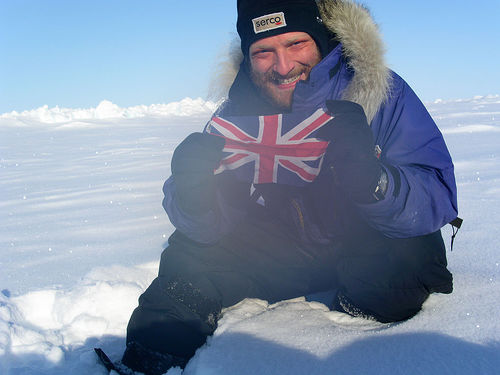
Ben Saunders sits on top of the world, the youngest person to reach the North Pole alone and by foot.

In 2004, 26-year-old Briton Ben Saunders became only the third person, and the youngest ever, to ski unaccompanied to the North Pole. As it turns out, there are a lot of ways that making a solo trek to the North Pole is a like moving to another country. Here are 11 things that the two adventures have in common, all taken from Saunder’s February 2005 TED Talk, “Why Did I Ski to the North Pole?”

  1. Luggage is a drag
    Saunders describes his specialty as “dragging heavy things around cold places.” He says, for his trip to the North Pole, “I was dragging all the food I needed, the supplies, the equipment, sleeping bag, one change of underwear—everything I needed for nearly three months.” That sounds like trying to put every necessary item in your carry-on bag, just in case your checked luggage gets lost. (If you think your bags are heavy, Saunder’s supply of food and fuel weighed 400 pounds.) Sometimes your destination has harsh conditions. And sometimes it doesn’t have chocolate chips. How many bags of those should you bring? Can’t be too prepared.
  2. It can be lonely out there
    One of the challenges of Saunder’s voyage was that he had to make it alone. Very alone. When he arrived at the northern-most point on the globe, he was the only “human being in an area one-and-a-half times the size of America, five-and-a-half thousand square miles.” Most of us don’t go to such remote places, but even if you’re in the biggest city, surrounded by millions of other souls, you can easily feel all by yourself.
  3. No, Virginia, there isn’t a Santa Claus
    When Saunders got to the top of the world, he didn’t find Santa. No Santa’s workshop. No elves. In fact, he says, “There isn’t even a pole at the Pole. There’s nothing there, purely because it’s sea ice.” When you go to another country, expect the unexpected. Don’t be surprised when what you find doesn’t match the photos in the magazine article. “I’d read lots of books,” says Saunders. “I studied maps and charts. But I realized on the morning of day one that I had no idea exactly what I’d let myself in for.” Photoshopped and cropped pics don’t do us any favors. If GPS and street signs say we’re in the right place, don’t waste time—or emotions—trying to find something that doesn’t exist.
  4. Sometimes it’s one step forward, two steps back
    According to NASA, during the year of Saunders journey, the ice conditions were the worst on record. Ninety percent of the time he was skiing into headwinds and the drifting ice pulled him backwards. “My record,” he says, “was minus 2.5 miles. I got up in the morning, took the tent down, skied north for seven-and-a-half hours, put the tent up, and I was two and a half miles further back than when I’d started. I literally couldn’t keep up with the drift of the ice.” When you’re in a new place, learning the language and culture, get used to those backward drifts. But always keep your compass set on your true north.
  5. The only constant is change
    Because the ice is constantly drifting over the North Pole, Saunders says that if he’d planted a flag there, it wouldn’t be long before it would be heading toward Canada or Greenland. Like Saunders, don’t be surprised when the emotional flags you plant aren’t permanent. The ground may not move under your feet (earthquakes not withstanding), but other kinds of landscapes certainly will. Find a special restaurant that serves your favorite dishes? Wake up the next day and it’s become a plumber’s shop. Make friends with some other expats? You may soon have to say goodbye. But, repeat after me, “Change can be good. Change can be good. Change can be good.” Maybe, just maybe, that plumber’s shop will end up being exactly what you need.
  6. Culture stress can be a bear
    Literally. On his first try at the North Pole, Saunders went with a partner, but they failed to reach their goal. Saunders says that from the outset “almost everything that could have gone wrong did go wrong. We were attacked by a polar bear on day two. I had frostbite in my left big toe. We started running very low on food. We were both pretty hungry, losing lots of weight.” Yup. Sounds like culture stress to me.
  7. Coming back can feel like the bear wins
    When his first attempt fell short, Saunders says he “was physically exhausted, mentally an absolute wreck, considered myself a failure, in a huge amount of debt personally to this expedition, and lying on my mum’s sofa, day in day out, watching daytime TV.” His brother texted him an encouraging quotation from Homer Simpson:
    “You tried your hardest and failed miserably. The lesson is: don’t even try.” Repatriation can feel that way. Maybe all the people who’d said you shouldn’t go were right. But Saunders didn’t let his failure define him. Instead, three years later he made history.
  8. People aren’t sitting around waiting to hear your stories
    When Saunders reached the North Pole, he got out his satellite phone. After warming up the battery in his armpit, he made three calls: “I dialed my mum. I dialed my girlfriend. I dialed the CEO of my sponsor. And I got three voicemails.” OK, that’s unfair to say they didn’t want to hear what he’d done. They were just busy at the time, that’s all. But . . .
  9. Some people really do want to listen
    “I finally got through to my mum,” says Saunders. “She was at the queue of the supermarket. She started crying. She asked me to call her back.” There are special people who will make time to listen—when they can focus on your story without distractions. Thanks, Mum.
  10. Don’t let others draw boundaries on your map
    When Saunders was 13, he got a school report that said, “Ben lacks sufficient impetus to achieve anything worthwhile.” Saunder’s response—”I think if I’ve learned anything, it’s this: that no one else is the authority on your potential. You’re the only person that decides how far you go and what you’re capable of.”
  11.  One of the three most important questions will always be “Where is the bathroom?”
    Saunders gave his TED Talk to answer three questions:
    (1 ) Why?
    (2) How do you go to the loo at minus 40?
    (3) What’s next?
    That second question is very important at the North Pole, because it seems that “at minus 40, exposed skin becomes frostbitten in less than a minute.” Your question number two will be more like “Where’s the bathroom?” or just “Bathroom? Bathroom?” Then, once you see the facilities, you may ask yourself, “How?”

As for the answers to those question, in short, Saunder’s responses go something like this:

(1) “For me,” says Saunders, “this is about exploring human limits, about exploring the limits of physiology, of psychology, and of technology. They’re the things that excite me. And it’s also about potential, on a personal level. This, for me, is a chance to explore the limits—really push the limits of my own potential, see how far they stretch.”
(2) That’s a trade secret, no answer here.
(3) Antarctica. Saunders and Tarka L’Herpiniere are currently on the first leg of their trek from the coast of Antarctica to the South Pole and back again—1,800 miles in all—unsupported and on foot. You can follow Saunder’s daily blog posts here. Why the South Pole? See answer number one above.

Somebody’s got a severe case of wanderlust.

[photo: “North Pole (3),” by Ben Saunders, used under a Creative Commons license]

It Won’t Be the Same without You: Join The Expat Survey 2013

2444717300_abb533fa6d_mThe logo for The Expat Survey 2013 is a hummingbird, “because just like human beings each one has its own migratory flight pattern.”

If you’re an expatriate, the Expat Survey wants to hear about your migrations, as well as your “remarkable diversity of habitats.”

The survey is made up of three parts, each rolled out separately, with the final section going live tomorrow (update: the third section went live November 27). All portions of the survey will remain available online until December 31.

The three sections are

  • Migration & Lifestyle
    “[H]ave you found it easy to integrate, what do you like or dislike about your adopted home, has life changed considerably and how do you stay in touch with family, friends and the outside world?”
  • Retail & Finance
    “Whether you are working or not, what are your important considerations when it comes to personal or household expenditure, banking and investments; and what information resources do you now tend to turn to when making these decisions and future fiscal planning?”
  • Travel & Health
    “Has your move to a warmer or colder climate changed your perspective of the world and the places and people you choose to visit; and what modes of transport do you use to get there? Do you enjoy a better diet and benefit from improved health and if you have had cause to call upon your local medical services were they sufficient?”

Besides having their voices heard, expats who fill out all three portions of the survey will be entered into a drawing for £1,000.

An independent London organization, i-World Research Limited, is conducting The Expat Survey, and it’s being promoted by 10 “collaborative partners.” One of those partners, Max Media International, calls the survey “the largest and most extensive independent global research programme ever conducted on those residing outside of their country of origin.”

To take part, go to The Expat Survey 2013.

(“Expatriate Specialism Agency Joins Expat Survey 2013,” Max Media International, July 10, 2013)

[photo: “Rufous Hummingbird—All fired up to impress the ladies!,” by Rick Leche, used under a Creative Commons license]

One Missionary’s Emotions . . . Honest, Unedited, and Unsanitized

I’ve been following Under the Big Topp for a while now. It’s from a missionary and mom who is committed to honestly blogging about what she calls her “very unremarkable journey in God’s remarkable mission.”

6032654897_d5d7b008cc_nI appreciate her willingness to let us hear her deep thoughts and feelings, and that is what she does in a recent post, “a secret reluctance of faith.” It’s a look back to the time this past May after her 16-month-old son (whom she calls Roo) pulled a cup of boiling water onto himself, giving him second- and third-degree burns over 25% of his body.

Her story tugs deeply at me, as it brings back memories of what happened to my own son while we were in Taiwan. When he was 14 months old, he grabbed a hot clothes iron, burning the palm of his hand. At first, the hospital staff thought it was not so serious, and we went home with his hand wrapped in bandages. But then he developed an infection and we found out that he had third-degree burns. That led to a hospital stay of over 40 days for him—and because in Taiwanese hospitals the family provides much of the day-to-day care, that meant that my wife spent more than 40 days there, as well. All of this led to several surgeries, skin grafts, and therapy sessions over the next two and a half years.

Mrs. BigTopp writes that her son was flown by air ambulance to a neighboring country for treatment. The surgeon there “predicted months of specialist care, a surgery or two and then more outpatient care. . . . But then suddenly, Roo was healed.”

She then shares what she wrote down the night before flying back to her host country, as she struggled with her emotions. As is often the case, the emotions surrounding trauma are confusing and seem to betray us. With the healing of her little boy came the reality that he would no longer need long-term care back home in Australia. But that also meant she would not be “rescued” from the difficulties she has faced as a missionary.

She apologizes for the “full on” nature of her words—unedited and, she says, unsanitized.

Man! I should just be happy. Happy that Roo is well and safe and healed, and I know I am happy…
….but I am not ready.
I scared again. Inwardly I’m screaming again.
I am hyperventilating and screaming.
I’m screaming, ‘No! No! No! Please God, please’
outwardly I’m quietly packing suitcases and booking flights.
We are going back.

I am so tired and scared and full of guilt and I’m hurting.

And then they flew back to the mission field.

Please go to her blog and read the full post here. What I have shared above is only a small, small taste of her story.

[photo: “Reisdagboek,” by Audringje, used under a Creative Commons license]

Live and Learn Abroad to Boost Creativity

You’ve been overseas and you’re back in the US looking for work. Not many job descriptions say that the “ideal candidate will have lived outside the US.” So what transferable qualities or skills have your experiences developed in you? How about adaptability, flexibility, resilience, and empathy?

Here’s something else you can add to your qualifications, and there’s research to back up the claim: creativity.

Finding the Relationship between Creativity and Living Cross-Culturally

A few years ago, William Maddux and Adam Galinsky conducted a series of experiments that demonstrate the link between living abroad and creativity.

  1. In the first, the pair showed that the more time a subject had spent living (though not traveling) abroad, the more likely it was for him to solve a particular puzzle. But the cause-effect relationship wasn’t clear. What if it’s simply because creative people choose more often to live abroad?
  2. The second experiment verified the results, this time using built-in controls for personality factors that are linked to creativity in order to isolate the effects of living abroad.
  3. The third study had subjects who had previously lived abroad think and write about their experiences. They were then tested, showing a temporary increase in creativity.
  4. Study number four looked at adaption to a new culture as the main driver of increased creativity. It showed that the more a person adapted, immersing herself in a culture, the higher the creativity.
  5. And, finally, the fifth study followed up by showing that subjects with past living-abroad experience who then imagined and wrote about adapting to a foreign culture exhibited higher levels of creativity in a subsequent exercise.

(William Maddux and Adam Galinsky, “Cultural Borders and Mental Barriers: The Relationship between Living Abroad and Creativity,” Journal of Personality and Social Psychology, May 2009)

Wanting to Live Abroad Isn’t the Same

As described in a recent article in Pacific Standard, researchers at the University of Florida, Gainesville, further validated the idea that studying abroad increases creativity, rather than vice versa. The study, by Christine Lee, David Therriault, and Tracy Linderholm, looked at three groups of students: those who had studied abroad, those who were planning to study abroad, and those who had not nor were planning to study abroad. The first group scored higher than the other two in levels of creative thinking, suggesting that it’s the actual experience of living overseas, rather than a personality type that is inclined to do so.

(Tom Jacobs, “To Boost Creativity, Study Abroad,” Pacific Standard, August 6, 2012; Christine Lee, David Therriault, and Tracy Linderholm, abstract of “On the Cognitive Benefits of Cultural Experience: Exploring the Relationship between Studying Abroad and Creative Thinking,” Applied Cognitive Psychology, July 2012)

Diversification and Flexibility

In the abstract to their research published in the Journal of Experimental Social Psychology, researchers from the Netherlands and California note that “past research has linked creativity to unusual and unexpected experiences, such as early parental loss or living abroad.” Their experiments suggest that it is the “diversifying” aspect of these experiences that brings about great “cognitive flexibility.”

(Simone Ritter, et al., abstract of “Diversifying Experiences Enhance Cognitive Flexibility,” Journal of Experimental Social Psychology, July 2012)

Learning the Whys of Culture Helps Even More

Back to Maddux and Galinsky, this time joined by Hajo Adam. Working on the idea that adapting to a new culture brings about novel ways of thinking, the researchers asked, “What is it about adaptation to foreign environments that is critical for facilitating the creative process?” They hypothesized that it is learning about a foreign culture in a multicultural setting that boosts creativity, To test this, the researchers assembled a group of university students in Paris who had previously lived abroad. They then “primed” part of the group by having them think and write about a time when they had learned about another culture. Others in the group did the same about a time of learning about their own culture. As predicted, the first group scored higher in a followup test of creativity.

The three then focused on “functional learning,” or “learning about the underlying reasons for observed foreign rituals, rules, and behaviors.” Subsequent experiments showed that creativity increased even more when the priming focused on not only on learning something new about another culture but learning when the subjects were actually able to find out the reason behind the cultural differences.

(William Maddux, Hajo Adam, and Adam Galinsky, “When in Rome . . . Learn Why the Romans Do What They Do: How Multicultural Learning Experiences Facilitate Creativity,” Personality and Social Psychology Bulletin, June 2010)

Boosting Your Resume in a Globalized World

So, in review, if you want to develop your creativity, here’s the plan:

  1. live overseas
  2. adapt to another culture
  3. learn about that culture
  4. and learn why a culture is the way it is

In an article posted by the Kellogg School of Management, Maddux tells the American Psychological Association that their research

may have something to say about the increasing impact of globalization on the world, a fact that has been hammered home by the recent financial crisis. Knowing that experiences abroad are critical for creative output makes study abroad programs and job assignments in other countries that much more important, especially for people and companies that put a premium on creativity and innovation to stay competitive.

(Audrey Hamilton, “Living Outside the Box: New Research by Kellogg Professor Adam Galinsky Suggests That Living Abroad Boosts Creativity,” Kellogg School of Management, April 23, 2009)

[photo: “Globeism,” by Joel Ormsby, used under a Creative Commons license]