“An Extraordinary Theory of Objects”: A TCK in Paris and the Things That Keep Her Sane, Sort of

31703109_4ad6f7ce2c_nI just finished reading a cool little book entitled An Extraordinary Theory of Objects: A Memoir of an Outsider in Paris. It was a Christmas gift from my son, the one who got a Moleskine Journal from me.

An Extraordinary Theory of Objects is a series of vignettes by Stephanie LaCava about her move to France as a twelve-year-old in 1993, her years there growing up, and then her visits back again after attending college in the States.

On the cover of my copy of the book are romantically filtered and tinted photos of the Eiffel Tower, and on the pages inside, her writing style evokes the same kind of mood. If stories could be sepia-toned, this is how they might sound.

Actually, the filter through which LaCava encounters the world is her attachment to things. First, there are the small, curious relics—a skeleton key, a mushroom, an opal necklace found in the mud—that she gathers and places on her windowsill. Initially they replace her old collection, “everything that represented [her] past life and its predictable ways,” which is on a container ship making its way across the ocean from New York.

And then there are the objects she encounters from day to day, common things that she illuminates in copious footnotes often taking up more than half a page. Cataloging these objects gives her security and makes sense of her life in a new city . . . as she faces depression and what she calls her own “kind of crazy.”

Some might find her footnotes distracting, but they cover just the kind of obscure topics that intrigue me, such as a Japanese smuggler of black-market butterflies, a photo book dedicated to Salvador Dali’s mustache, and the origins of the tea bag. And they are replete with references to a variety of figures, from Pliny the Elder to Kurt Cobain, from Anne Boylen to Kate Moss.

Much of LaCava’s narrative is about time spent with her father, often searching flea markets for items to fulfill their eccentric tastes. At other times, she talks about her classmates at the international school. She says she was “mostly alone” her first year there. Even among these other outsiders, she doesn’t fit in.

I rode the bus to school and listened to my Discman while the girl in the back row threw gum wrappers at my head. The girls at school didn’t like me very much. They had never given me a chance, decided immediately that I didn’t belong, which was funny, as they didn’t either—at least not in France. They made me feel as if I had done something wrong, and they spoke badly about me to each other. Through my own odd rationalization, I decided excommunicating me meant they belonged to something, simply because I did not. . . .

Come the new academic year, the old class would be replaced with another set of students who had just moved overseas. Only a few remained year after year—and still the same insensitivity.

One day, a classmate tells her that she looks like Angela from the TV series My So-Called Life.

“I haven’t seen it,” she replies.

“Everyone’s seen that show,” he says. “Don’t you have friends in the States? They can send it to you.”

In a footnote, LaCava delves into the significance of the series, quoting Matt Zoller Seitz of The New York Times, who writes, “What the series’ narration does best: it shows how teen-agers try to control their chaotic inner lives by naming things, defining them, generalizing about them.”

That’s what LaClava does, as well—controlling the inner chaos of her life in a Paris suburb by naming the objects she encounters. Then, years later, she examines them even more closely and writes about them so that she can share with us her own kind of strange . . . and her own kind of normal.

(Stephanie LaCava, An Extraordinary Theory of Objects: A Memoir of an Outsider in Paris, New York: Harper Perennial, 2013)
[photo: “Eiffel Tower,” by charley1965, used under a Creative Commons license]

Repost – You Remember You’re a Repat when . . . (Part 1)

Repatriation—to borrow a phrase from John Denver—is coming home to a place you’ve never been before.

Here’s a repost from my first year blogging, with 92 things that remind repats that they’ve been out of the country for a while. As time goes by, more and more of them are happening less and less for me. But some will never go away.

_______________________________

In the hallowed tradition of “You Know You’re an Expat / Third Culture Kid / Missionary when . . .” lists, I offer my own version for repats. This is for the times when you’re reminded that your plug doesn’t always fit the outlet.

Since I’m a former missionary to Asia who’s repatriated back to the US, a lot of my list leans in that direction, but I hope there’s something here for repats of every stripe (or voltage, as it were).

You remember you’re a repat when . . .

1. Your passport is your preferred form of ID.
2. You comment on how cheap gas is in the US.
3. You ask your friends who they’re picking to win the World Cup.
4. Your CNN web page is set on “International.”
5. You accidentally try to pay for something with the strange coins from the top of your dresser.
6. You don’t trust your friends when they say they’ve found a “good” Italian restaurant.
7. You ask the clerk at the convenience store if you can pay your electric bill there.
8. You don’t know how to fill out taxes without Form 2555.
9. You think Americans are loud.
10. You talk about Americans overseas and call them “foreigners.”
11. You find out that living overseas is not the top qualification employers are looking for.
12. You learn to stop talking about the nanny and groundskeeper you used to employ.
13. You have to ask how to write a check.
14. You forgot how many numbers to dial for a local phone call.
15. You tell your toddler, “No seaweed until you finish all your hamburger.”
16. You try to order fried chicken at Burger King.
17. You check prices by converting from what a similar item cost overseas.
18. You think American paper money is boring because it lacks color and the bills are all the same size.
19. You don’t know how to respond when people say, “I bet you’re glad to be back home.”
20. You prefer to hear news reports from someone with a British accent.
21. You wonder why all the commentators on TV are yelling.
22. You wish you’d brought back ten of your favorite kitchen utensil because you didn’t know it’s not sold in the States.
23. You realize international students are you’re kind of people.
24. You ask where you can get a late-model, low-mileage Toyota for around $2000.
25. You turn on the subtitles on an English movie because you don’t want to miss anything.
26. You ask the clerk at the video store if they have VCDs.
27. You wonder if organization should be spelled with an s.
28. You load up your suitcase and you try not to “pack like an American.”
29. You stop bringing your bi-lingual Bible to church.
30. You smirk inside because someone calls a 4.3 earthquake “a big one.”

(Part 2Part 3)

[top photo: “Electrical Outlet,” by grendelkhan, used under a Creative Commons license; bottom photo: “Having It Both Ways,” by Keith Williamson, used under a Creative Commons license]

An Oscars’ Shortlisted Film on a TCK’s Long “Road Home”—Watch It Online

RoadHome

It’s not easy being shortlisted for the Academy Awards, but that’s what Rahul Gandotra did in 2011 with his live-action short film, The Road Home.

A Hidden-Immigrant Story

Gandotra was born in Belfast, Northern Ireland, and grew up in eight countries, spending time in Europe, the Middle East, Asia, and the US. He attended the University of Michigan and then got an MA in film directing from The London Film School. For his master’s thesis, he returned to Woodstock, a boarding school in the Himalayas, to shoot The Road Home. When Gandotra attended school there in the 10th grade, his class of 52 had students from 26 countries.

The Road Home tells the story of Pico, a Woodstock student who runs away from the school, hoping to get to the airport and return to London. Pico looks Indian on the outside, but on the inside, he is British. He doesn’t speak Hindi, and the culture is foreign to him. He is a “hidden immigrant” who desperately wants to escape this assault on his identity.

In an interview with Jedda Blog, Gandotra says that while he was filming in India, he was introduced to David Pollock and Ruth Van Reken’s book Third Culture Kids: Growing Up among Worlds. “That book described me really well,” he says.

I realized these are the type of people I am making the film for and that this film is for anyone who questions where they are from, at any time of their life. Any one who has had an outsider experience or has left their country can relate to this movie.

Later, when Van Reken previewed The Road Home, she wrote the following on the film’s IMDb site:

Just three weeks ago, I watched as two people watched this with tears of both joy and sadness streamed down their faces. Joy that what they had felt but been unable to articulate for their whole lives was finally given voice. Sadness as they identified so deeply with the pain Pico feels when others assume who he is by outward appearance rather than by his life experiences.

They also understood only too well how the frustration Pico felt of not being known by other [sic] as he knows himself to be and how that frustration comes out in a way others see as anger instead of pain. . . .

Best of all, The Road Home reminds us of one of the most fundamental truths for our globalizing world: until we know each person’s story, we cannot make judgments of who that person is regardless of skin color or apparent ethnicity. That’s why this film is so needed and important.

Watch The Road Home for Free

At the film’s website, you can enter your email address to receive a “sampler” packet of commentaries, interviews, web resources, and—best of all—a link to watch the entire 23-minute film online.

In Gandotra’s “Welcome” clip, he tells how Van Reken was instrumental in getting the packet put together. When he sent the video to her, he was, he says, “floored and shocked by what she said.” She wanted him to put the film on DVD so everyone could see it, and even though he was busy with the film-festival circuit she persisted. “She felt,” he says, “that she had the right to literally push and harass me into making this DVD. . . .”

He demurred, but it did no good. On her own, Van Reken recruited people from around the world who created a set of resources for the sampler packet. The final result is the full professional version of the DVD (available for purchase here).

One of the highlights of the packet is a 5-minute commentary on the film, with Van Reken, Gandotra, and Third Culture Kid expert Heidi Tunberg talking about TCKs. The professional DVD includes an additional 92 minutes of commentary.

Gandotra is currently working on a feature-lengh film based on the story of The Road Home, calling it a “a coming-of-age, adventure road movie.” In the new version, Pico runs away from Woodstock with Rachel, an American female classmate. The two come to the attention of a terrorist organization that wants to kidnap them. As they are pursued across India, Rachel discovers the nation, while Pico discovers his own identity.

Gandotra’s “Feature Preview” page says, “Although the feature script is faster paced than the short, it stays true to the ‘flavor’ and themes of the original film.” I look forward to hearing more about this longer version, and I hope to see it someday.

I also hope that amid the chase scenes it does, in fact, hold on to The Road Home‘s poignant insights. Because it is Pico’s inner journey—as he tries to reach the airport—that brings the most power to his search for home.

(Emily Rome, “Oscar Shorts: An Autobiographical Journey in ‘The Road Home,'” Los Angeles Times, January 14, 2012; Zareen Muzaffar, “The Road Home. An Exclusive Interview with Director and Film-maker Rahyl Gandotra,” Jedda Blog, October 2013; )

[photo courtesy of The Road Home / Rahul Gandotra]

Steve Saint and Elisabeth Elliot and the Revealing Epilogues to Their Stories

2325686115_9baa8eafd4_nIn doing research on Scott Wallace’s work with isolated tribes of the Amazon, I came across his March report about two Waorani Indians who had been killed by members of an “uncontacted” tribe. According to witnesses, “the assailants belonged to a clan of Taromenane, a branch of the Waorani who spurned contact with evangelical missionaries in the 1950s and continue to roam the forests of Yasuní as nomads.”

I knew about the Waorani (Woadani, Huaorani, Auca) story, that their original contact with Western Christians had resulted in the spearing death of five missionaries in 1956, but I hadn’t updated myself on what was currently going on with the tribe. I also knew that the son of one of those missionaries, Steve Saint, had continued the work with the Waorani and that last year an accident had left him partially paralyzed. Again, I hadn’t kept up with his situation and assumed that his recovery was complete.

Following through a number of links, here is what I found: Steve Saint and Elisabeth Elliot (wife of one of the slain missionaries) living out their lives after tragedy, grabbing hold of their all-too-often idealized stories, stripping away the neatly tied bows, and letting the loose ends speak.

Our stories are part of God’s story, and by adding their epilogues, Saint and Elliot show that all our stories are best told completely, fairly, and honestly.

Steve Saint: All Is Not Good, but Let God Write Your Story

One year ago this past June, an accident left Steve Saint partially paralyzed from the neck down. Saint, the founder of the Indigenous Peoples Technology and Education Center (I-TEC), was testing an aluminum wing when it became unmounted from its stand, striking him in the head.

Steve Saint was five years old when his father, Nate Saint, was killed by the Waorani Indians in Ecuador. The story of their deaths is told in Elisabeth Elliot’s book Through Gates of Splendor and in the film End of the Spear.

Due to the continued efforts of Saint’s Aunt Rachel and Elliot—wife of Jim Elliot, another of the five killed—many of the Waorani became Christians. And as teenagers, Steve and his sister, Kathy, were baptized by two of the men who had killed their father—in the Curaray River next to the beach where the killings had taken place.

After Rachel Saint’s death, Steve Saint was invited by the Waorani to come live with them, which he, his wife, and children did, for a year and a half. Later, he started I-TEC to “enabl[e] indigenous churches to overcome the technological and educational hurdles that stand in the way of their independence.” I-TEC’s most famous invention is the Maverick, a “flying car” developed to help Christian workers reach “frontier” areas.

Since his accident, Saint has produced a series of six videos, called “The Next Chapter,” telling about his injury and recovery. The first was filmed a week after the accident, with Steve speaking from his hospital bed. The last came a year later. In it, Saint begins, over footage of him struggling to get up in the morning,

I think, maybe in some of the recordings we made earlier on, what I wanted to show was, you know, how wonderful things were, and I think we gave the impression that, you know, all is good now. And there is good now, but not all is good. . . . You know, stand up, and that’s the worst, standing up is just agony in the morning, you know, trying to get these stilts, ’cause I can’t feel from my waist on down . . . and I can’t feel most of my arms, and I certainly can’t feel my hands. . . .

I was privileged to meet Saint and his good friend Mincaye several years ago when they gave an interview at a ministry I worked for. Mincaye, now a Christian, was part of the group that speared Saint’s father. I am encouraged by Saint’s faith and dedication. Despite his current condition, he has kept his trust in God. Three months after his injury, he told the Ocala StarBanner, using much of the same language that is part of the video above:

My motto has been, “Let God write your story,” and that’s what I have always done. Opportunity comes in strange formats. You have a lot of people, nowadays, who want to write their own story and have God be their editor, when something goes wrong. I decided long ago to let God write my story.

Elisabeth Elliot: We Are Buffoons, but the Work is God’s

It’s been a long time since I read Elisabeth Elliot’s Shadow of the Almighty: The Life and Testament of Jim Elliot. I remember being inspired by Jim and Elisabeth’s lives, but also discouraged. It seemed that their level of faith was unattainable for someone like me. If they were the definition of missionary, then I probably shouldn’t even try.

I’ve had trouble in the past putting missionaries on pedestals. But experience has taught me that missionaries are imperfect people, too, especially my experience living out my own far-from-perfect missionary life.

In 1961, Elliot wrote The Savage My Kinsman, chronicling her two years working with the Waorani. Twenty years later, she penned an epilogue that includes a brief explanation of why she left them: because she wanted to provide a better education for her daughter and because the “differences” between her and her fellow missionary, Rachel Saint, meant that they were “not in any strictly truthful sense really working together.”

“One of us, it appeared, must go,” she writes. “My decision was a painful one.”

But while Elliot doesn’t want to gloss over the difficulties of her story, neither does she want to “magnify the trivial.” According to Elliot, there are two “dangerous” extremes in the way Christians interpret life, and the stories we tell:

One is the sheer triumphalism which is the coin of much religious telecasting. Make it appealing. Make it cheap. Make it easy. Be a Christian and watch your difficulties dissolve. Obey God and everything you touch will turn to gold. The other is the exposé. Out of a very muddy notion of something called equality, and perhaps also out of an exaggerated fear of hero-worship or cultism, springs an urge to spy out all weaknesses and inconsistencies and thereby discredit practically all human effort, especially when its intention is an unselfish one.

To be sure, the life of a missionary—the life of a Christian—is a natural mix of victories and defeats. Elliot saw this in her team’s contact with the Waorani: the highs (“the Auca Indians were finally reached”) and lows (“nine children were left fatherless”), the joys (“the Aucas heard the gospel”) and sorrows (“they also got polio”). And her list goes on.

How we long to point to something—anything—and say, “This works! This is sure!” But if it is something other than God Himself we are destined for disappointment. There is only one ultimate guarantee. It is the love of Christ. The love of Christ. . . .

God keep us from sitting in the seat of the scornful, concentrating solely on the mistakes, the paltriness of our efforts, the width of the gap between what we hoped for and what we got. How shall we call this “Christian” work? What are we to make of it?

Elliot continues with these thoughts in another epilogue, this one added to Through Gates of Splendor in 1996, marking the 40th anniversary of the missionaries’ deaths:

[W]e are tempted to assume a simple equation here. Five men died. This will mean x-number of Waorani Christians.

Perhaps so. Perhaps not. Cause and effect are in God’s hands. Is it not the part of faith simply to let them rest there? God is God. I dethrone Him in my heart if I demand that He act in ways that satisfy my idea of justice. . . .

The massacre . . . was interpreted according to the measure of one’s faith or faithlessness—full of meaning or empty. . . . The beginning of a great work, a demonstration of the power of God, a sorrowful first act that would lead to a beautifully predictable third act in which all puzzles would be solved, God would vindicate Himself, Waoranis would be converted, and we could all “feel good” about our faith. Bulletins about progress were hailed with joy and a certain amount of “Ah! You see!” But the danger lies in seizing upon the immediate and hoped-for, as though God’s justice is thereby verified, and glossing over as neatly as possible certain other consequences, some of them inevitable, others simply the result of a botched job. In short, in the Waorani story as in other stories, we are consoled as long as we do not examine too closely the unpalatable data. By this evasion we are willing still to call the work “ours,” to arrogate to ourselves whatever there is of success, and to deny all failure. . . .

I think back to the five men themselves, remembering Pete’s agony of indecision as to whether he should join the others in the venture; Ed’s eagerness to go even though Marilou was eight months pregnant, his strong assurance that all would be well; Roj’s depression and deep sense of failure as a missionary; Nate’s extreme caution and determination; Jim’s nearly reckless exuberance. . . .

[W]e are sinners. And we are buffoons. . . .

It is not the level of our spirituality that we can depend on. It is God and nothing less than God, for the work is God’s and the call is God’s and everything is summoned by Him and to His purposes, the whole scene, the whole mess, the whole package—our bravery and our cowardice, our love and our selfishness, our strengths and our weaknesses.

(Scott Wallace, “Uncontacted Group Kills Two Natives in Ecuador,” National Geographic News Watch, March 11, 2013; Doug Engle, “Partially Paralyzed, Inventor and Missionary Saint Letting God Write His Story,” Ocala StarBanner, September 2, 2012; Shadow of the Almighty: The Life and Testament of Jim Elliot, Grand Rapids, MI: Zondervan, 2009; Elisabeth Elliot, The Savage My Kinsman, Ventura, CA: Regal, 1996; Elisabeth Elliot, Through Gates of Splendor, Carol Stream, IL: Tyndale House, 2002)

[photo: “Humility,” by Toni Verdú Carbó, used under a Creative Commons license]

Our TCK Makes Plans for the Peace Corps—Wait, Not So Fast

Here’s another article from my son Peter. It’s about his time at the Summer Peace Institute in San José, Costa Rica, and also about his post-graduation plans. Peter spent nearly half his life overseas before graduating from high school, so another trip to another culture should have been a piece of cake, right? And heading back to Asia with the Peace Corps shouldn’t be a problem, either. Here, Peter shares about how it can be hard to cross cultures alone, even for a TCK.

IMG_0167
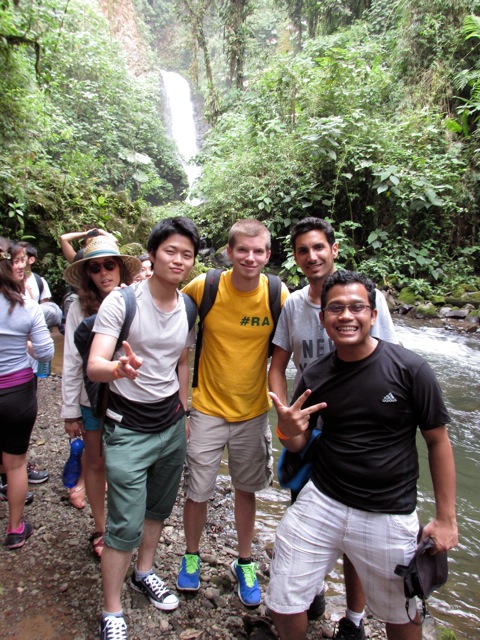
Peter (in yellow shirt) enjoys the Costa Rican outdoors with some of his friends in the Summer Peace Institute.

In 1999, my family and I left Joplin, Mo., for the other side of the world—Taipei, Taiwan. Before that, I’d never been outside the Midwest, let alone the United States.

If you are not familiar with Taiwan, it is a small tobacco-leaf-shaped island off the southeast coast of China, having about one-fifth the land area of Missouri with four times the population.

When we took our first trip to Taiwan, my parents were in the process of considering whether they wanted to become missionaries there. We spent two weeks traveling around the island, sightseeing and meeting Taiwanese friends who had once been international students at Pittsburg State University and at my father’s alma mater, the University of Missouri.

Two years later, my family and I left Joplin again for Taiwan. This time, I stayed for eight years.

After I graduated high school, I returned to Joplin to attend MSSU. I have enjoyed my time at this university more than any other time in my life, but now I am near the end. I will graduate this December with two bachelor’s degrees and, like many of you, still have no idea what I want to do next.

Well, I should not say, “No idea.”

Ever since returning from Taiwan, I have been fascinated by the world outside Joplin, outside Missouri, outside the US. I had tasted another culture—Taiwanese food is delicious, by the way—and I was ready to experience more.

When I heard about the Peace Corps, it sounded like a perfect fit. Started in 1958, the Peace Corps is a US government-run volunteer program that sends American citizens out into the world to learn about other cultures and serve the people of developing countries. Volunteers spend two year stints anywhere from Zambia to China to Peru to Jordan.

About six months ago, I submitted an application for the Peace Corps. Even before that, I had watched as two friends, fellow MSSU students and past McCaleb winners Luke and Caitlan Smith, were sent off by the Peace Corps to Rwanda.

By the time I left for Costa Rica, I was several months into the Peace Corps application process.

During the UPEACE-Berkeley program, I got to talk with two people who have experience with the Peace Corps: Dr. Jerry Sanders, a former Peace Corps volunteer [and co-founder of World Policy Journal and director of the Summer Peace Institute], and Manuel Davila, a former employee of the Honduran Peace Corps office. I asked them about their thoughts on the Peace Corps.

Sanders volunteered in Colombia in the 1970s and became disenchanted with the Peace Corps halfway through his two years there.

“I wasn’t any more satisfied with [the Peace Corps’s] policies—so-called development policies—than I was with the war in Vietnam,” he said.

Sanders felt the policies prevented efficiency. He encouraged me to go into the Peace Corps with a willingness to criticize the system.

Davila said the volunteers he met had great experiences, and he became friends with some of them. He told me the Peace Corps takes very good care of its volunteers.

I thought my time in Costa Rica would make me more excited for the Peace Corps. Instead, it made me realize how hard the Peace Corps would be. Though I had lived and traveled internationally, I had always done it with family or friends.

By the end of my first day in Costa Rica, I had already faced several difficulties.

My luggage was held up in Houston, Texas, so I lacked a change of clothes, toiletries, and even cleaning solution for my contacts. I was overwhelmed by 30 students whom I had never met before and who already seemed to know each other. I could not keep up the lectures on topics I had never studied. I could not speak Spanish. I did not know my way around town and got myself lost wandering home from the bus stop.

As I familiarized myself with my host town, learned a few Spanish phrases and befriended—and was befriended by—the other students, I felt more and more comfortable in Costa Rica.

Some of my favorite moments of the trip were whitewater rafting down the Pecuare River, learning how to say “God bless you” in Spanish, taking walks around my host town, visiting the Caribbean coast, trying new Costa Rican dishes, having intellectual and non-intellectual discussions with fellow students and watching soccer on television with my host family.

Nevertheless, being away from my family, my church community and my other close friends in Joplin was difficult throughout the trip.

While I truly enjoyed my time in Costa Rica, it did open my eyes to the realities of living overseas by myself.

In a Facebook message about the Peace Corps, Luke Smith writes, “The hardest part for me though has just been being away from my family. Diet and living conditions are a cake walk compared to not being able to see the people you love.”

Two weeks into this semester, I received a Peace Corps invitation to volunteer in Indonesia as a secondary English teacher, with a March starting date. I was given seven days to make my decision.

About an hour later, I decided to decline it. It feels like the coward’s move. But right now, I am not ready for the Peace Corps, and that is okay.

Now I am trying to figure out what is next. I will still graduate in December, and I still have no jobs waiting for me. Though I am not yet ready to live in Indonesia for two years, I am ready to explore more of the US, especially her big cities.

I do not plan to give up my aspirations of international studies. I know if I do move somewhere like Chicago or Philadelphia, I will meet people from other countries and cultural backgrounds, and that is exciting.

Maybe I will pursue a master’s degree in international relations. I am still very interested in cross-cultural issues. I follow global current events in my free time, and I try to pick up bits and pieces of other languages.

My thirst for cultural diversity will never be quenched. The Peace Corps may still be in my future, but I am not looking that far ahead. I am looking at what is next, one decision at a time.

Do You Hear What They Hear? Babies Are Listening Bilingually Even before They Can Speak

I remember having a conversation with an American raising his children in Taiwan. The father was fluent in Mandarin, and he’d started teaching that language to his son at a young age. He told me that it hadn’t worked for him and that he’d read that parents who speak more than one language to their small children only confuse them, as they aren’t able to tell one language from another.

It seemed like sound reasoning to me.

42052685_df923ad167So it surprised me to see new research showing that infants are better at becoming bilingual than I’d thought. As it turns out, by the age of seven months, babies can distinguish between languages by recognizing their different grammar structures.

The study, published in Nature Communications, focused on languages with opposite grammar patterns—such as English, which most often has the verb before the object, and Turkish, which follows the object-then-verb arrangement. Infants in bilingual environments pick up on these patterns and can distinguish between the languages, by listening to differences in pitch, duration, and word frequency.

Janet F. Werker, of the University of British Columbia, is co-author of the study, along with Judit Gervain, of the Université Paris Descartes. Werker reassures parents in bilingual households. “If you speak two languages at home, don’t be afraid, it’s not a zero-sum game,” she says. “Your baby is very equipped to keep these languages separate and they do so in remarkable ways.”

Mental Cartography

Werker and Gervain’s research is one more step forward in what we know about infants and language learning. In 2001, Patricia Kuhl, the director of the University of Washington’s Center for Mind, Brain, and Learning, told the Smithsonian magazine that six-to-eight-month olds can already distinguish between different vowel and consonant sounds in the languages they hear everyday and in languages “foreign” to them. But by their first birthday, they can no longer differentiate between sounds that are not part of a language that they’ve been exposed to. This is because they have developed a focus on familiar sounds, while “tuning out” unfamiliar ones. Then, later on in life, when the familiar competes against the unfamiliar, say, when learning a new language, the old sounds will usually win out. The result is a non-native accent.

To register what sounds infants can differentiate, Kuhl used a “head-turn” study (similar to that used by Werker and Gervain). In one example, two-thirds of both American and Japanese six-month olds could hear the difference between “la” and “ra.” But by the one-year mark, 80% of American children responded to the difference, while only 59% of the Japanese children did. Since the latter rate is only 9 percentage points above chance, this showed that the Japanese children had joined their parents in no longer being able to distinguish between the two sounds.

According to Kuhl,

The baby early begins to draw a kind of map of the sounds he hears. That map continues to develop and strengthen as the sounds are repeated. The sounds not heard, the synapses not used, are bypassed and pruned from the brain’s network. Eventually the sounds and accent of the language become automatic. You don’t think about it, like walking. [Familiar sounds] become more and more embedded into the map, until eventually they are almost ineradicable.

This accent map gets harder and harder to change as time goes by. On the other hand, if a child is exposed to multiple languages early enough—while the map is being drawn—the child can create more than one map at once.

Kuhl also has found (as shown in the TED Talk below) that if this exposure to languages is to have an effect on an infant, it must come from a live person. Listening to audio, even with an accompanying video of the speaker, does no good.

It’s Never Too Early to Learn

According to DNAinfo New York, some parents in the Big Apple are even learning a new language themselves in order to make sure that exposure to multiple languages happens for their children at an early age.

Take, for instance, Rhonda Ross, of Harlem, who went to a boarding school in a French-speaking area of Switzerland when she was a student. Later, when her son, Raif, turned one, she began speaking to him only in French. “I started with a French babysitter,” she said, “but a friend convinced me I would have to speak French to my son myself if I really wanted him to be fluent.”

Not being fluent herself, that means that Ross has to keep learning as she teaches her son. But she feels that the effort is worth it. In fact, she is so pleased with the outcome, that she’s introduced Raif to Mandarin and Spanish, as well.

Linguist Jennifer Wilkin, of Brooklyn, is another advocate of early bilingual education. In 2001, she founded Science, Language & Arts, where parents and children can learn French and Mandarin. “There is certainly a trend among New Yorkers to give a language to their children,” said Wiklin, who “knows several parents who are learning, and speaking, Spanish, Japanese, French and German to their children.”

While Wilkin’s school has students from preschool through fifth grade, Lyndsey St. John started Baby French in a Brooklyn ice-cream parlor and candy shop named The Candy Rush. The class caters to children who haven’t even learned to talk yet. “It’s really good to start those [language] pathways forming at a very early age,” said Wilkins. “Anywhere from 8 months to 3 years is when children are really sponges. They’re picking up everything.”

(Judit Gervain and Janet F. Werker, “Prosody Cues Word Order in 7-Month-Old Bilingual Infants,” Nature Communications, February 14, 2013; “Bilingual Babies Know Their Grammar by Seven Months,” The University of British Columbia Public Affairs, February 14, 2013; Edwin Kiester, Jr., “Accents Are Forever,” Smithsonian, January 2001; Julie Norwell, “New York Parents Learn Foreign Languages to Help Kids Become Fluent,” DNAinfo New York, March 6, 2013; “Even before They Utter First Words, Brooklyn Babies Take French Lessons,” DNAinfo New York, August 22, 2012)

[photo: “Mommy Tells a Story,” by Dan LaVange, used under a Creative Commons license]


The Psychological Health of Missionaries—Adding to the Research

6903821997_e0a95ce498_nHere’s a quick question:

What percentage of returned missionaries and aid workers report psychological disorders during their time overseas or shortly after their return? What do you think? About a quarter, a third, half, two thirds, three quarters?

According to a 1997 study conducted by Debbie Lovell-Hawker of Oxford University, the answer is “about half.” More precisely, Lovell-Hawker’s findings show that among the returned missionaries and aid workers she studied,

46% reported that they had experienced a clinically diagnosed psychological disorder either while working overseas or shortly after returning to the United Kingdom.

Before I went overseas, I would have guessed much lower than half, but after I first heard this statistic referenced in a debriefing I attended, in my mind, the number began to grow much higher than 46%. Statistics have a way of doing that.

Lovell-Hawker’s research included 145 aid and development workers and missionaries from 62 organizations. Though not definitive, the findings are significant as a wake-up call to cross-cultural workers, sending agencies, NGOs, churches, and member-care givers. And they also can assure those repats who are struggling that they are not alone.

Other  findings include

• 18% reported that their problems developed while they were overseas—82% said they began after returning to their home country
• Depression was the most frequently reported problem, occuring in 87% of the cases
• Those who reported having psychological problems had spent significantly longer time overseas than those who reported having none

(Debbie Lovell-Hawker, “Specialist Care: Psychological Input,” Global Connections Member Care Conference, February 18, 2002)

Moving forward from this study, there are some things I’d still like to know: Has anything changed in the 26 years since the findings were published? What would the numbers be for all missionaries and aid workers, not just those who’ve returned? What would the breakdown be among those working in relief and development vs other settings, such as teaching or church planting in developed areas? Are the numbers consistent for workers returning to countries other than the UK? And what about TCKs?

The good news is that there are researchers who are working on these and similar questions.

The Research Continues

One of those researchers is Lynette H. Bikos. Lynette served as a guest editor (along with M. Elizabeth Lewis Hall) of a special issue of Mental Health, Religion & Culture in 2009, titled “Missionaries.” Lynette is director of research and professor of clinical psychology in the School of Psychology, Family, and Community at Seattle Pacific University—and she also happens to be a friend who lived next to me, on an adjoining farm, as we grew up in northeast Missouri. We’ve kept in touch over the years, and she corresponded with my family and me as she worked on her research.

The special issue includes 10 articles dealing with several aspects of cross-cultural adjustment among those whom the editors call “religiously motivated sojourners.” I’d like to highlight four of those articles:

“Social Support, Organisational Support, and Religious Support in Relation to Burnout in Expatriate Humanitarian Aid Workers”
(Cynthia B. Eriksson et al., Mental Health, Religion, & Culture, November 2009)

This assessment found that 40% of expat middle managers in an international faith-based agency were at “high risk” of burnout in one of three areas—lack of personal accomplishment, emotional exhaustion, and disconnection or distance from those being cared for—but less than 4% reported high levels of burnout in all three.

According to the authors of the study, “This suggests that despite intense work and chaotic environments a majority of workers find ways to identify accomplishments, stay connected to others in their work, and rejuvenate. Team relationships, friendships, and positive organisational support may contribute to the resilience for these workers.”

The findings also indicate that younger workers are at a greater risk of burnout, as they register greater negatives in all three burnout areas. But while age was a factor, the number of years serving with the agency was not.

“Resilience in Re-Entering Missionaries: Why Do Some Do Well?”
(Susan P. Selby et al., Mental Health, Religion, & Culture, November 2009)

The authors posed the question ‘‘Why do some re-entering missionaries do well while others do not?’’ and interviewed 15 Australian cross-cultural missionary workers to help find the answer.

All the participants were over 25 years old and had spent at least 2 out of the previous 3 years in a non-Western country. Based on their responses, the researchers divided the missionaries into two categories: “resilient” and “fragile.”

In the interviews, the eight resilient missionaries described having

• flexibility
• higher expectancy and self-determination
• denial in the form of minimization to deal with their distress
• good mental health
• more social support
• a positive reintegration
• a personal spiritual connection to God

In contrast, the seven who were considered fragile described

• less flexibility
• lower expectancy and self-determination
• less use of denial with minimization
• poorer mental health
• less social support
• difficulty reintegrating
• a decreased or fluctuating personal spiritual connection to God

It is interesting that while the results of a questionnaire measuring depression, anxiety, and stress (DASS 21) showed higher levels for the fragile group, the scale showed that only one out of the entire group (including resilient and fragile) had an actual perception of being “personally stressed.”

“Psychological Well-Being and Sociocultural Adaptation in College-Aged, Repatriated, Missionary Kids”
(Michael J. Klemens and Lynette H. Bikos, Mental Health, Religion, & Culture, November 2009)

When the researchers compared a group of MKs to non-MKs at a Christian university, they found that while both groups scored in the healthy range of psychological well-being (PWB),  the missionary kids’ scores were significantly lower.

The missionary kids’ MK status accounted for only 4% of the variance in psychological well-being but was responsible for nearly a quarter (23%) of the difference in sociocultural adaptation (SCA). In this latter area, the MKs reported the most difficulty in “taking a US’ perspective on the culture; seeing things from an American’s point of view; understanding the US’ worldview; understanding the US’ value system; and making yourself understood.”

“Curiously,” report Klemens and Bikos, “neither the age of the participant, nor the number of years abroad, nor the number of years since repatriation was related to PWB or SCA for the MKs.”

“Reduction in Burnout May Be a Benefit for Short-Term Medical Mission Volunteers”
(Clark Campbell et al., Mental Health, Religion, & Culture, November 2009)

This assessment looked at how international short-term mission trips affect burnout among volunteers.

The participants in the study, most of whom were physicians and nurses, travelled to South America for two weeks to provide medical care in a non-disaster-relief setting. Prior to their departure, the group members’ responses to questionnaires showed that they were experiencing moderate burnout. Their burnout levels were again assessed one month and six months after the trip.

“The major finding of this study,” report the researches, “is counter-intuitive: that medical personnel who are emotionally exhausted, have an impersonal response towards their patients, and lack a sense of [personal accomplishments] (moderately burned out) benefit by working hard with numerous patients in an international context.”

They found that levels of emotional exhaustion and perceived personal accomplishments showed significant improvements following the short-term trip and continued in a positive direction in the 6-month followup.

___________________________________________________

All good research builds about what has been learned before and leads to questions for new studies in the future. I join with Lynette and her co-editor in hoping that the information in their special issue of Mental Health, Religion & Culture encourages others to join in the “exploration” of the psychological health of missionaries. There is so much more to be discovered.

(Lynette H. Bikos and M. Elizabeth Lewis Hall, “Psychological Functioning of International Missionaries: Introduction to the Special Issue,” Mental Health, Religion, & Culture, November 2009)

This special journal issue also includes several articles specific to the experiences of female missionaries. I hope to discuss these in a future post.

[photo: “Confused,” by Mary T Moore, used under a Creative Commons license]
Pico Iyer on Home, Travel, and Stillness (plus, Have You Seen the TED Commandments?)

161335960_3c30374d20_nPico Iyer, best-selling author on the topic of crossing cultures, finds the concept of “home” difficult to describe. It’s no wonder. His parents are Indian. He was born in England. At the age of eight he moved with his family to California. And currently, between his many travels, he lives with his Japanese wife in Japan.

In a TED Talk from 3 months ago, Iyer “meditates on the meaning of home, the joy of traveling and the serenity of standing still.”

Some great writers are not great speakers, but Iyer expresses his thoughts with eloquence in both forms. Here are a few of those thoughts:

On multi-cultural children:
“[T[heir whole life will be spent taking pieces of many different places and putting them together into a stained-glass whole.”

On traveling:
“The real voyage of discovery, as Marcel Proust famously said, consists not in seeing new sights, but in looking with new eyes. And of course, once you have new eyes, even the old sights, even your home become something different.”

On the concept of home:
“[H]ome, we know, is not just the place where you happen to be born. It’s the place where you become yourself.”

On collecting 1 million miles on a frequent-flyer program:
“You all know that crazy system, six days in hell, you get the seventh day free.”

And on spending three days in silence at a monastery:
“I began to think that something in me had really been crying out for stillness, but of course I couldn’t hear it because I was running around so much.”

Following the TED Commandments

I’ve watched several TED Talks, and I’m always impressed with how the speakers seem to present their thoughts articulately and effortlessly. I’ve always wondered if they use teleprompters. I found my answer at Jimmy Guterman’s blog. Guterman, a TED Talk presenter, wrote that the TED Talk stage includes “confidence monitors.” These floor-mounted monitors show the slides used in the presentation, to which presenter notes can be added. He added these notes, but regretted it later, as he was distracted by the monitors and felt that he looked down at them too often.

Guterman goes on to list the “TED Commandments” that TED sends to every speaker. It’s a great list of advice, and most of it applies to even casual conversations:

I. Thou shalt not steal time.
II. Thou shalt not sell from the stage.
III. Thou shalt not flaunt thine ego.
IV. Thou shalt not commit obfuscation.
V. Thou shalt not murder PowerPoint.
VI. Thou shalt shine a light.
VII. Thou shalt tell a story.
VIII. Thou shalt honor emotion.
IX. Thou shalt bravely bare thy soul.
X. Thou shalt prepare for impact.

To this, Guterman adds a number eleven: Trust thyself. (In other words, Don’t use monitors.)

If you’re thinking about brushing up your public-speaking skills and want to imitate that TED Talk style, you might want to take a look at this “Onion Talk,” produced by the folks at The Onion. It’s called “Ducks Go Quack, Chickens Say Cluck” . . . sort of a lesson on cross-cultural communication.

(Jimmy Guterman, “How to Give a TED Talk (and How Not To),” Jimmy Guterman’s blog, March 12, 2002)

[photo: “Loneliness,” by David Jakes, used under a Creative Commons license]