At the Night Market, Some Flavors Are Better Left Untried

3387528058_9e0064f799_nWhile living in Taipei, we got many opportunities to try new and (to us) strange foods, especially at the night markets. I was game for tasting most things at least once. But sometimes it took me a little while to work up my nerve—like when I waited a few years before trying “stinky tofu.” (Ends up it’s not as bad as it sounds, or smells.)

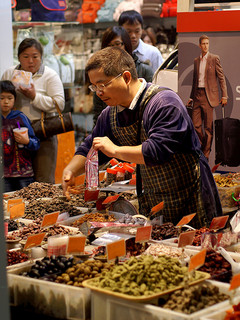
For a long time, I’d seen mounds of small black spiral shells sold as a snack at night markets, and I wondered what they tasted like. Actually, I also wondered how you’d eat them. I figured a snail, or some sort of other creature, was cooked inside, so maybe you sucked the meat out, or maybe the shell was cooked to the point where it was soft and you were supposed to eat the whole thing. I didn’t know, but I saw the locals walking around with plastic bags full of them, so I assumed they tasted good.

One evening I finally gave in to my curiosity and confidently walked over to the lady selling the black shells. It’s the custom for vendors at the markets to provide a small bowl of samples for potential customers to try. This lady was no exception, as she had a paper bowl holding a few shells sitting on the front of the table. I grabbed one of the samples, put it in my mouth, and sucked on it as I walked away. While the shells looked spicy piled up on display—with a few peppers mixed in—I tasted nothing. Flavorless. And I was disappointed to find no meat inside.

The next night, I was at the same market, and I wanted to try one more time. So I grabbed another sample from the shell lady. Again, no matter how much I worked it around in my mouth, no meat, no flavor, just a shell. Come on. Why do people buy those things? I walked back to my family and told them how I’d wasted my time and was glad I hadn’t wasted my money.

That’s when my son looked back at the table . . . and said, “Dad, that’s not the bowl for samples. That’s where people put the shell after they’ve tried one and need to throw it away.”

[photo: “Taiwan 2009,” by bill_bly_ca, used under a Creative Commons license]

If You’re Stuck in Customs, Browse Trey Ratcliff’s Photos

Farewell India
Farewell India, by Trey Ratcliff

When I  saw the tag on Stuck in Customs, “Welcome to the #1 Travel Photography Blog,” one of my first thoughts was a paraphrase of Buddy the Elf: “You did it! Congratulations! The #1 travel blog! Great job, everybody! It’s great to be here.”

Then I read more about Trey Ratcliff, the blog’s author, on his “About Trey” page and learned that his photos register over a million views each week. I guess that probably does make him number one.

And somewhere along the way, I added to his view total by looking at a bunch of his photographs. His work is pretty amazing. Not only does it span the globe, but he is an expert in—and proponent of—high dynamic range (HDR) imaging. By Ratcliff’s definition, HDR “is a post-processing method of taking either one image or a series of images, combining them, and adjusting the contrast ratios to do things that are virtually impossible with a single aperture and shutter speed.” The result is a picture that better imitates what is actually seen by the eye, and remembered by the brain, with a fuller range of light and color. If you’re interested in creating your own HDR masterpieces, take a look at Ratcliff’s free tutorial (in nine languages).

A gallery of Ratcliff’s photos are at his online portfolio or at his Flickr account, or you can follow his blog and see a photo a day.

Oh, yeah. The other part of Ratcliff’s blog that caught my attention is its name. For a site focused on global/cross-cultural content, Stuck in Customs is quite possibly the #2 title out there.

Customs: If you can’t clear ’em, enjoy some photos while you’re stuck in ’em.

Miracle in Iceland
Miracle in Iceland
River Runs through the Andes
A Moody Evening at the Great Wall

[photos:  “Farewell India,” “Miracle in Iceland,” “River Runs through the Andes,” and “A Moody Evening at the Great Wall,” by Trey Ratcliff at Stuck in Customs, used under a Creative Commons license]

A Scholar, a Footballer, and a Tourist Walk into a Foreign Country . . .

Did you hear the one about the Fulbright Scholar in China studying stand-up comedy? The student, Jesse Appell, put together a spoof of Psy’s “Gangnam Style,” called “Laowai Style.” Lao wai is a Mandarin term for foreigner—literally meaning “old” and “outside.” Here’s the video, with subtitles:

And then there’s the former amateur soccer player from Norway, Havard Rugland, who watched the Super Bowl in 2011 and started working on his American-football-kicking skills. The result was a video of amazing trick kicks, called “Kickalicious.” It went viral and caught the attention of some NFL franchises, with a couple giving him tryouts. Last week, the Detroit Lions announced that they had signed him to their team. No joke.

I heard about the two stories above on “PRI’s The World” while I was listening to NPR in my car last Friday afternoon. This last video isn’t related, but it shows some cross-cultural miscommunication, between an English-speaking tourist and a couple French locals—and I think it’s pretty funny. It’s “Do You Speak English?” by BBC’s Big Train comedy team:

(Nina Porzucki, “Humoring the Chinese: An American Comedian Has a Run-in with Chinese Censorship,” PRI’s The World, April 12, 2013; Steven Davy, “Norwegian Kicker Havard Rugland Signs Detroit Lions NFL Deal after YouTube Video Goes Viral,” PRI’s The World, April 12, 2013)

Help for Infrequent Fliers with Frequent-Flyer Miles

4068907085_388379498d_nDON’T LET YOUR MILES EXPIRE!

Chances are if you have a frequent-flyer account, you’ve probably seen that message, or something like it, in your email inbox.

Few things last forever, including airline miles, but keeping your miles available may not be as difficult as you think. There are a lot of ways to keep your account active, and though I’m not an expert on all the tricks of the trade, here are some things I’ve learned about one option: MagsforMiles:

  1. MagsforMiles (or Magazines for Miles) offers one of the cheapest ways to create account activity, at least for these airlines: Alaska, American, Delta, Frontier, Hawaiian, Spirit, United, and US Airways. For as few as 500 miles, you can get a year’s subscription to a wide variety of magazines.
  2. While some think that you need to clean out all your miles before they expire, you simply have to  show some kind of activity—just spend or add as few miles as possible. That means one subscription with MagsforMiles will do.
  3. According to MagsforMiles FAQ page, you should wait 6-12 weeks for the first issue of your subscription to be delivered. Save the reply email you get showing that your order is being processed so you’ll know the order date and magazine name in case you need to follow up later.
  4. Don’t wait until the last minute. The required amount of miles will be taken out of your account within 2-4 weeks, and it could possibly take up to 6 weeks. This is important to remember, as you’ll not be able to redeem your miles on the last day of the deadline. I found this out when I got a postcard in the mail saying that MagsforMiles couldn’t fulfill my order because there were insufficient miles in my account. That was because after the deadline passed, the airline zeroed my account before MagsforMiles could take out the miles they needed.
  5. MagsforMiles has a customer service page, but when I called their number, all I got was an automated help line. This didn’t help me a lot, since the magazine subscription I was checking on wasn’t in the system, since it hadn’t been fulfilled.
  6. If, like me, you do your best and your miles get cancelled anyway, all is not lost. Call the airline and explain your situation. In my case, they called MagsforMiles (I assume they talked to a real person) and then gave me back all my miles as a one-time courtesy. I’m not sure how far you could go with that, but even if you miss the deadline with no really good excuse, it would be worth the call to see if the same policy would apply.

After all’s said and done, with MagsforMiles you’ll save your miles and you’ll get some pretty good magazines. Some, like Afar, Coastal Living, and Condé Nast Traveler can even make you feel as if you’re traveling from the comfort of your own easy chair. (OK. I know. It’s not the same, but it’s better than nothing.)

[photo: “The Chase,” by Luis Argerich, used under a Creative Commons license]

 

POYi, the Best Show-and-Tell of the Year

2847121492_6f780597fc_n
The bust of Donald W. Reynolds is displayed in the Reynolds Journalism Institute at MU.

Last week, Pictures of the Year International completed its slate of winners for 2013, marking its 70th annual competition. POYi, “the oldest and most prestigious photojournalism program in the world,” is sponsored by the Reynolds Journalism Institute at the University of Missouri School of Journalism.

Below is a list of 14 winning photo collections that offer a great show-and-tell of global and cross-cultural issues. There’s a lot here, but it’s still only a small part of this year’s entire POYi gallery. It’s well worth your time to settle down with a cup (or a pot) of coffee and click through all the winners, including the work of Paul Hansen, who was awarded Photographer of the Year honors in the newspaper division. Earlier in February, Hansen’s “Gaza Burial,” was named World Press Photo of the Year.

If, after looking at these photos, you’re inspired to try the challenging life of an international photojournalist yourself, watch the video at the end of this post. It’s Ed Kashi’s Photojournalisms, the third-place multimedia documentary winner. A companion to his book Witness #8: Photojournalisms, the short video was made from a compilation of Kashi’s photos and nearly 20 year of journal entries and emails addressed to his wife. “Home for me,” he writes, “has always been a shifting term, with shifting people and shifting objects vying for my attention.”

Here, in no particular order, are some of the people and objects that caught the attention of some very talented and dedicated photographers in 2012:

Life without Lights, Peter DiCampo
+++1.5 billion people around the globe don’t have access to electricity.

The Siege of Aleppo, Javier Manzano (includes graphic images of war)
+++The U.N. recently reported that nearly 70,000 have died in Syria’s civil war.

Beyond 7 Billion, Rick Loomis, et al.
+++“The biggest generation in history is just entering its childbearing years.”

North Korea—Collectivism, Vincent Yu
+++While the majority of North Koreans suffer, the government presents a “glossy” image to the world.

Water Is Personal, Brent Stirton
+++Drought, floods, and lack of clean water affect people all over the world.

A Long Walk, Shannon Jensen
+++These are the shoes of refugees who fled northern Sudan.

Paris Suburbs, Arnau Bach
+++Poverty and drug trafficking are prevalent in the neighborhoods surrounding Paris.

Dark Isolation, Tokyo, Salvi Danés Vernedas
+++“It is easy to find oneself isolated and alone among a crowd.”

Labor Movement, Alejandro Cargagena
+++From an overpass above a highway in Monterrey, Mexico, one can see laborers traveling to work in the open beds of pickup trucks.

Uncounted Casualties, Jay Janner
+++“They survived the battlefields of Iraq and Afghanistan. But they did not survive the homecoming.”

In the Devil’s Footsteps, Tyler Anderson
+++The people of Northern Uganda try to recover from the devastation left by Joseph Kony and his Lord’s Resistance Army.

Buzkashi, Casper Hedberg
+++North of Kabul, thousands gather to watch Afghanistan’s national sport in which men on horseback fight over an animal carcass.

Zone of Absolute Discomfort, Justin Jin
+++Few people live in the frozen tundra of the Russian Arctic.

Fukushima: Taking Back a Nuclear No-Man’s Land, James Whitlow Delano
+++Japan’s 2011 nuclear disaster left “a vast network of nuclear ghost towns” waiting to be reclaimed.

[photo: “Reynolds Statue, Reynolds Journalism Institute,” by moohappy, used under a Creative Commons license]

Does This Suitcase Make Me Look Fat? Save Money by Wearing Your Luggage

3652899243_4bd9148ffb_nThe first time I flew overseas, the lady at the counter weighed my carry-on. When she saw that it was a pound or two overweight, she was quick to come up with a solution. Did I have any books or a jacket inside? I could take them out, and she’d re-weigh my bag. I did, and she did, and then I was free to carry them onto the plane separately, or put them right back in the carry-on. Either way, my overall weight was the same—so I can’t vouch for the logic of the change—but I was glad for a workable solution.

But what happens if you’re a lot overweight on your baggage? What if your carry-on looks like a balloon and won’t begin to fit into that metal cage/scales combination next to the check-in line? (You know the thing I’m talking about, the one that’s there just to weed out first-time flyers who might want to turn themselves in.) Or what if you need to leave a whole bag behind? (As in, I’m not going to pay that fee!)

Well that calls for more drastic measures than just carrying a book. It can be done. It’s just that you might need to check your self-esteem at the gate.

Do It Yourself
First, I give you the example of an “unidentified passenger” at China’s Guangzhou Baiyun International Airport. The man, from Kenya, didn’t want to pay for his excess baggage, so he decided to wear it. According to Want China Times, he donned 61 items of clothing, among them 9 pairs of jeans. (Other news outlets report that he was wearing more than 60 shirts with his 9 pairs of pants. We may never know the exact count. In intense stories like this, accuracy is often the first thing sacrificed.)

The obese-looking man’s scheme was uncovered, layer by layer, when he set off the metal detector, prompting a full-body search. Apparently, (and this is where you can learn a valuable lesson) the batteries, USB sticks, and toys he was carrying weren’t in the pockets of his outermost garment.

(“Layer Hater: Guangzhou Airport Blocks Man Wearing 60 Items of Clothing,” Want China Times, December 16, 2012)

Jaktogo
If you admire this gentleman’s thinking—but the sumo-wrestler look isn’t quite your thing—maybe you’re part of Jaktogo‘s demographic. The Jaktogo, along with its cousins, the Dresstogo and Ponchotogo, is a jacket that holds a myriad of items in its 14 pockets. It folds into a bag, complete with carrying straps, so you can wear your “coat” through the gate and, once on board the flight, place your “bag” in the overhead bin. Or you can follow the lead of Irish engineer John Power, the Jaktogo’s inventor, and carry your fully-loaded coat by its straps through the gate and spar with the attendant over definitions. That’s not my idea of fun, but then again, I do have to remember, “Only fools pay for extra luggage, clever people have a Jaktogo!!”

Rufus Roo
Looking for something a little cheaper? You might want to try the Rufus Roo Big Pocket Travel Jacket. The Rufus Roo has only six pockets and doesn’t convert into a piece of luggage, but it’s designed by Rebecca Morter of the London College of Fashion, and some would say it’s more stylish.

Keep in mind, though, that when it comes to style, you are still wearing your luggage.


[photo: “Heavy Luggage,” by David Bakker, used under a Creative Commons license]
‘Tis the Season for International Photo Awards

2865183436_189dee1a69_mNot only is it the month for the Oscars, but February is also a busy time for selecting the prize winners in international photography. The judges have hard work wading through the thousands of photos, but we are the beneficiaries, as we get to browse through the best of the best.

Sony World Photography Awards
On the 6th of this month, the World Photography Organisation announced the shortlist winners for its 2013 Sony World Photography Awards. The finalists, in the professional, open, and youth categories, were selected from 122,000 entries representing 170 countries.

Lens Culture has a high-resolution slideshow of 45 of the shortlisted photos, or you can click through the galleries at the WPO site here. Final winners will be announced in April.

56th World Press Photo Contest
On February 15, World Press Photo announced the winner of its “Photo of the Year” for 2012. It is Paul Hansen’s “Gaza Burial,”  an image of men carrying the bodies of a young brother and sister to be buried after the two were killed by an Israeli missile strike.

Galleries containing all the winning photos, selected from the work of 5,666 photographers from 124 countries, are on display here.

Coinciding with the photo contest is World Press Photo’s third annual multimedia competition. The gallery of winners is here, including the following videos covering subjects outside the US (viewer discretion advised):

Into the Shadows, Pep Bonet, dir. (1st prize, Online Short)
Desperate Africans who migrate to Johannesburg face terrible circumstances.

Aleppo Battleground, Clément Saccomani, ed. dir. (3rd prize, Online Short)
A photojournalist joins the Free Syria Army at the front lines.

Too Young to Wed, Jessica Dimmock, dir. (1st prize, Online Feature)
Destaye was 11 when she married a priest in Ethiopia. Now 15, she has a 6-month-old son.

Dreams on FreewheelsYang Enze, dir. (3rd prize, Online Feature)
The seven members of the China Disabled Track Cycling Team train for the 2012 London Paralympic Games.
(This video not available for embedding.)

Pictures of the Year International
POYi started announcing their latest winners on February 5, with the final group announced today. I figured I’d wait until they were finished to start working my way through the results—it does take a while. And after I’m done, I plan to post again with links to some of their photos that tell stories from around the world.

[photo: “Flickr Photographers : Mauronster,” by Sergio Bertolini, used under a Creative Commons license]

Sorry You Weren’t the One to Buy “Afghan Girl”

My apologies.

It’s been more than two months since the National Geographic auction at Christie’s, and I need to set something right.

It’s quite likely that at least one of you, dear readers, saw my post about the sale of Steve McCurry’s Afghan Girl at auction, arrived at Christie’s on December 6 with only $12,000 in your pocket, and watched in horror as other bidders immediately left you behind . . . far behind . . . so far behind that you weren’t able to lift your paddle even once.

The pre-auction estimate that I quoted for McCurry’s iconic photo was indeed cited at $8,000 to $12,000 in October, but the estimate listed on Christie’s website, where the photo was displayed, was $30,000 to $50,000. Not that that would have helped a lot anyway, as the print’s winning bid came in at a whopping $178,900 (with the buyer’s premium added to the “hammer price”).

And Afghan Girl wasn’t the only item to bring in an enormous amount of money. N.C. Wyeth’s Duel on the Beach topped the sale at $1,082,500. The entire auction brought in $3,776,587.

I was wondering what would make a print of a photograph worth so much. The anonymous buyer didn’t get the original Kodachrome slide. He didn’t purchase future licensing rights. And he didn’t buy the last copy of the photo ever made.

I think I’ve figured it out, though. The print is signed, of course, and dated. But then comes the really special part. Next to the signature is the marking “1/1.”

That does it for me. Not 1 of 200 or 1 of 10 . . . but 1 of 1.

Afghan Girl truly is an iconic photo. Monica Hess of The Washington Post calls it “the photograph of photographs of photographs” and then describes “the ragged red scarf, the scissors-sharp green eyes, the hungry, hunted, haunted beauty.”

Ah, yes, the eyes.

If you’d like to get a better view of what $178,900 got for one bidder, do this: Go to this link—which will bring you a larger-than-life image of Christie’s “Sale 2603 / Lot 194″—and click on the zoom-in symbol a few times. Re-center the photo and look into those “scissors-sharp green eyes.”

Those eyes. Two of two.

(Monica Hess, “National Geographic’s Auction of Images Fetches $3.8 million,” The Washington Post, December 6, 2012)

[photo: “Steve McCurry: On the Outside Looking In,” by Steve Evans, used under a Creative Commons license]