Now That the Hobbit Air-Safety Video Has Gone Viral, Here’s a Look at the Prequels

If you think all air-safety videos are boring, then you probably haven’t flown Air New Zealand. Their latest effort, the Hobbit-inspired “An Unexpected Briefing,” has gone well beyond the simple objective of capturing the attention of passengers, as it has gone viral and has already entertained millions of viewers on the ground. While this one is by far the most successful tongue-in-cheek video from “the airline of Middle-earth,” it’s certainly not the first.

Before “An Unexpected Briefing,” there was “Mile-High Madness with Richard Simmons,” “Crazy about Rugby,” featuring the All Blacks, and  “Bare Essentials of Safety,” with the cast/crew dressed only in body paint. Here’s a “best of the best” mash-up of all three versions:

And New Zealand’s national airline has also given us “Ed and Melanie’s Safety Sketch,” with the voice talents of Ed O’Neill (Wreck It RalphModern Family) and Melanie Lynskey (Two and a Half Men, Up in the Air):

Air New Zealand isn’t the only carrier using humor to grab eyeballs for this very important message. Three years ago, the UK’s Thomson Airways recast their video using children. It looks as if their lead spokes-girl might some day become a rival for Deltalina. She certainly has mastered the finger wag.

Who’s Deltalina? She’s Katherine Lee, the flight attendant chosen in 2008 to be the main presenter for Delta’s safety videos. He nickname comes from what some see as her resemblance to Angelina Jolie. Air safety has made Lee a star.

Back in 2007, Virgin American came up with this animated video, featuring such lines as “For the point zero zero zero one per cent of you who have never operated a seat belt before, it works like this.”

And finally, for the point zero zero zero zero one per cent of you who haven’t seen “An Unexpected Briefing,” with its cameos by Peter Jackson and Gollum, here it is. Enjoy.

Related post:
Inflight Magazines: My Virtual Seat-Back Pocket Runneth Over

Waiter, What’s This Maggot Doing in My Soup?

As a boy growing up in rural Missouri, I was very interested in insects and ended up with a rather sizable collection of mounted specimens that I took to the local 4-H fair. Later, when I became a 4-H leader to a younger friend nearby, I passed on what I’d learned. I remember once, after running out of ideas, spicing things up with a snack of deep-fried insects. As I recall, we ate grasshoppers, bees, and possibly cicadas. Little did I know that I could have been on the brink of a future career.

If you travel much outside the US and Europe, you run a good chance of running across insects served up as snacks or side dishes. But if people like China’s Li Jinsui have their way, edible insects will become a global main course.

As reported in Le Monde, Li runs an “insect factory,” which has as its focus the housefly—in particular, the immature housefly, or maggot. You can read the entire article here, but if you need some coaxing, let me whet your appetite with some quotations. Where else can you read such phrases as this?

China’s Maggot Factories Hoping to Feed the World (the headline)
Li says he can deliver about 150kg of maggots a day . . .
As he walks into a room filled with two million flies . . . , and
With the price of wasp larvae on the rise . . .

For Li, raising insects for human consumption isn’t just a novelty. He’s hoping to educate his countrymen, develop his business, and become “the industry’s world leader.” One obstacle that he has to overcome on the maggot front, though, is to figure out how to raise his flies on a diet of rice. That’s because housefly maggots typically feed on animal feces, which makes them unsuitable for human consumption.

Sounds like Li has a lot of educating and persuading to do.

But he’s not alone. There’s a whole movement devoted to “entomophagy,” or the eating of insects. It touts the health and environmental benefits of insect eating and presents it as an effective solution to the problem of feeding a rapidly growing world. For more information, check out these interesting sites:

Also, at NOVA’s “Bugs You Can Eat,” you can follow a couple American journalists, Peter Menzel and Faith D’Aluisio, as they trek around the world trying a variety of insect and spider dishes. With a twist on the “tastes like chicken” meme, Menzel describes deep-fried tarantulas in Cambodia, saying,

If day-old deep-fried chickens had no bones, had hair instead of feathers, and were the size of a newborn sparrow, they might taste like tarantulas.

And finally, if you’re in the States and want to get your taste buds ready for the insect-eating future, go to HOTLIX to order some “larvets,” hand-dipped chocolate crickets, or other varieties of insect candy. Or go to Hollywood location scout Scott Trimble’s Entomophagy, inspired by “the seeming lack of a concise smartphone-friendly list of American restaurants that serve insect options on their menus.”

Who knows, maybe someday you’ll ask, “Waiter, what’s this fly doing in my soup?” and his answer will be “Why, adding flavor, protein, and pizazz, of course!”

(Harold Thibault, “China’s Maggot Factories Hoping to Feed the World,”  Worldcrunch, October 1, 2012, translated from “Des Usines d’Insectes pour Nourrir les Chinois,” Le Monde, September 28, 2012;

[photo: “Fly larva,” by Susannah Anderson, used under a Creative Commons license]

Keep Calm and Roll On Your Carry-On

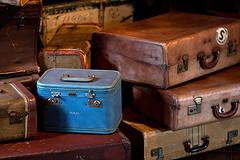
USA Today reports that 2012 marks the 25th anniversary of the Rollaboard suitcase. After seeing passengers struggling with their luggage, wheeled trolleys, and bungee cords, Bob Plath, a pilot at Northwest Airlines came up with the idea to create a suitcase with a built-in handle and wheels.

Now, two and a half decades later, two new inventors have come up with a product that they hope will change traveling again. The creators are Darryl Lenz, a flight attendant, and her husband, Randy. After they watched parents struggling with their luggage, strollers, and children, they designed a chair that straps on to your wheeled luggage. It’s called the “Ride-On Carry-On.”

We first saw this product on ABC’s Shark Tank, where the Lenzes won backing from investor Barbara Corcoran. Since then, they’ve been featured on several TV shows, including The View, Good Morning America, and Inside EditionClips from these shows are available on the Ride-On Carry-On website, but my favorite is this one. Not only does it introduce the product, but it also has that great YOU’VE GOT TO HAVE ONE! infomercial style.

So what are you waiting for? ORDER YOURS TODAY! (Luggage not included.)

But then again, maybe you don’t have kids young enough to ride on your carry-on. Or maybe you’re just not sold on the idea. You’re probably not alone. It’s not easy being an early adapter.

In fact, there’s at least one person who still isn’t a fan of the Rollaboard-style carry-on. Richard Bangs, host of American Public Television’s Richard Bangs’ Adventures with Purpose, tells USA Today that the Rollaboard marked “the beginning of human devolution.” According to Bangs,

It used to be, as we ran through airports carrying our bags,  there was a measure of physical exertion that countered, to a degree, the hours spent motionless in an airline seat. It toned muscles and prepared us for the adventure ahead.

Regardless, the evolution of the suitcase continues. When USA Today asked what’s “next on the horizon,” Michele Marini Pittenger, president of the Travel Goods Association, said, “Luggage that packs itself? Now that would be a problem-solver.”

While that’s probably not going to happen soon, what about luggage that moves itself?

Cutting-edge travelers, I present you hop! “the following suitcase.” Hop! is the brain child of Rodrigo Garcia Gonzalez, a designer who has studied in Canada, India, Chile, Spain, and Sweden. (Hmmm. . . . I wonder if one of these could work with a Roll-On Carry-On. . . .)

(Jayne Clark, “Rollaboard Luggage Celebrates a Wheelie Big Birthday,” USA Today, August 16, 2012)

[photo: “Blue Suitcase,” by Drew Coffman, used under a Creative Commons license]

Get Your Head out of the Sand . . . and into a Pillow

It’s a perfect example of function over form. It’s great for those long flights across the ocean and those layovers in the airport. It’s a head-sized space for a power nap. It’s the Ostrich Pillow.

Here’s a description from the press release by designers kawamura-ganjavian and Studio Banana Things:

Ostrich Pillow offers a microenvironment in which to take a warm and comfortable power nap at ease. It is neither a pillow, nor cushion, bed or garment, but a bit of each, all at the same time. It’s soothing cave-like interior shelters and isolates both your head and hands, perfect for a power nap. You can use the Ostrich Pillow at your desk, on a bench, on the train or while you wait at the airport to catch a flight. In fact, you can use the Ostrich Pillow whenever and wherever you feel like a nap is needed.

Now watch it in action, because the above paragraph just doesn’t do it justice:

The architecture and design studio kawamura-ganjavian is made up of a team of cross-cultural creative types. They seem like the kind of people who wonder how to make a better mousetrap and come up with a new kind of cheese. Among others, they are

Pablo Carrascal, from Spain, studied in Spain and Mexico
Maki Portilla Kawamura, Spanish-Japanese, studied in London, worked in Spain and Switzerland
Amir Afshar, British-Iranian, studied and works in London
Mónica Mejía, Colombian, studied in Colombia, USA, and Spain, works in Paris
Cornelia Tapparelli, Swiss-Italian, studied in Lausanne and Zurich, works in Lausanne

Other products from kawamura-ganjavian include the Twist&Brush, a toothbrush for travelers that has a built-in toothpaste dispenser, and Eat with Your Fingers, a knife-spoon-and-fork set that fits on the ends of your fingers.

I think the Ostrich Pillow is a great idea, but I’m just not daring enough to be the first one on my block to use one. So how about you go first and make it a trend? (It’s currently available by donation through Kickstarter. ) I’ll be right behind you.

[photo from Studio Banana Things, used with permission]

About Your Passport, from Past to Future

The number of US passports in circulation continues rising steadily, which makes sense, as the population is rising steadily, too. In 2011, there were over 109 million valid passports, putting the percentage of US citizens with passports at about 35%. But while the overall number is growing, the number of passports issued last year dropped by over 2 million from 2010. And last year’s total of 12.6 million (including passport cards) is well below the record year of 2007, when more than 18 million passports were issued as new laws were enacted that began requiring passports for travel to and from Mexico, Canada, the Caribbean, and Bermuda.

Passports of the Stars

If you’d like to see some passports from days gone by, go to Tom Topol’s site at Passport-Collector.com, where he has a gallery of celebrity passports, including those belonging to the likes of Marilyn Monroe, Muhammad Ali, Sammy Davis, Jr., and Ernest Hemingway. Topol also has a page showing the prices paid for celebrity passports at auction, the top three being Monroe ($115,000), James Joyce ($98,696), and Albert Einstein ($93,000).

And Indiana Jones, Too

Film and theater prop maker, Anthony “Indy” Magnoli, has his own gallery of vintage passports. But his aren’t of celebrities, they’re of fictional characters, such as Charlie Chan, MacGyver, and, of course, Henry “Indiana” Jones (young and old). Each replica is complete with stamps and details corresponding to the character’s time period and global travels.

Future Tech

While all that gives a glimpse at where passports have been, where are they going? One possibility comes from the German company Bundesdruckerei, which two years ago rolled out an e-passport containing an AMOLED display. The thin, flexible display, showing a rotating headshot, does not need batteries, but instead the image begins moving when the card is placed close to an RF power source.

This does look cool, and I’m sure it provides increased security, but if (when?) something like this goes into effect, I’ll miss the look and feel of the “old” passports: the visa stamps, the weathered pages, the memories.

(“Passport Statistics,” U.S. Department of State; Juniper Foo, “E-Passport Gets AMOLED Screen,” CNET News: Crave, March 11, 2010)

[photo: “Passport User’s Manual,” by Cowtools, used under a Creative Commons license; chart courtesy of U.S. Department of State, public domain]

Samsara and Baraka, Our World in Film

Coming soon to a theater near you. We’ve all heard those words. (At least I think we have. Do movie advertisements say that any more?) But for a lot of the movies I’d like to see, it’s not true. That’s because my community doesn’t have a local venue for foreign films and documentaries. We do, though, have a library that does a pretty good job of keeping up with off-the-beaten-path movies. For these kinds of films, maybe the slogan should be “Coming later to a library near you.”

That brings me to a new production that premiers today in New York and Seattle. The title is Samsara, which the production’s website says is “a Sanskrit word that means ‘the ever turning wheel of life.'” It’s a series of video clips filmed in 25 countries over a period of nearly five years. With a musical score but no dialogue or commentary, it is director Ron Fricke’s followup to his earlier Baraka (1992). Both follow the same format, and both were shot on high-resolution 70 mm film. Baraka, a word present in several languages, means “blessing.”

Of Baraka, Chicago Sun-Times film critic Roger Ebert writes, “Of course there is a ‘message’ somewhere in ‘Baraka’—the same message we have heard before, about how man must love and respect the planet.” But Mark Magidson, who produced and co-edited Samsara and worked on Baraka as well, tells The New York Times that with Samsara, “We’re not trying to say anything.”

Maybe the editing of Samsara will end up showing an obvious message, but it looks to me right now that the film is a video Rorschach test, with the meaning varying from viewer to viewer. In fact, I envision getting a copy and showing it to some groups—for instance, college students or potential missionaries or veteran cross-cultural workers—and asking them, “What do you think the filmmakers are trying to say? What one-word title would you give to the movie? What does it mean to you?”

In 2008, Baraka was digitally restored and released on Blu-ray (it’s also available on DVD). In response to the restoration, Ebert writes, “If man sends another Voyager to the distant stars and it can carry only one film on board, that film might be “Baraka.” And as for the Blu-ray version:

[It] is the finest video disc I have every viewed or ever imagined. . . . It is comparable to what is perceptible to the human eye, the restorers say. “Baraka” by itself is sufficient reason to acquire a Blu-ray player.

While I’m waiting for Samsara to come to my library, I think I’ll check out—or buy—a copy of Baraka. And maybe both will be aboard Voyager 3, going soon to a galaxy far, far away.

(Nicolas Rapold, “Planetary Poetry, Woven into a Movie,” The New York Times, August 18, 2012; Roger Ebert, “Baraka,” November 12, 1993; Ebert, “Baraka [1992],” October 16, 2008)

[photo: “holi amusedness!” by Elijah Nouvelage, used under a Creative Commons license]

Eight Olympic Facts for Impressing Your Friends

Since you’re probably not competing in the London Games, your best bet for standing out from the crowd may be in the area of Olympics trivia. With that in mind, here are eight facts that you can slip into conversation at the water cooler. Hurry, while there’s still time.

  1. Frenchman Pierre de Coubertin is considered the founder of the modern Olympics, which began in 1896 in Athens, Greece. Coubertin pushed for the inclusion of an arts competition, which became part of the games in 1912. From that time until 1948, 151 medals were awarded in the areas of sport-themed architecture, music, painting, sculpture, and literature.
  2. Women first joined the Games in Paris in 1900, with 22 females competing in tennis and golf.
  3. In the 1904 Olympics, held in St. Louis, Missouri, in conjunction with the World’s Fair, George Eyser won gold for the vault, parallel bars, and rope climbing, all after having lost his left leg in a train accident when he was a child. He competed with a wooden prosthesis.
  4. The 1912 Games in Stockholm, Sweden, were the first to include athletes from all five continents.
  5. The five rings on the Olympic flag represent the five continents, while their five colors—blue, black, red, yellow, and green—plus the white of the background, includes at least one color from the flag of every country in the world. The flag was first used in 1920.
  6. In the 1924 Paris Olympics, Dr. Benjamin Spock, author of the famous Baby and Child Care, won a gold medal as part of the US rowing team.
  7. At the 1964 Tokyo Games, the final torchbearer was Yashinori Sakai, who was born in Hiroshima on the day that the US dropped an atomic bomb on the city.
  8. The 2012 Summer Games in London mark the first time every participating country has sent at least one female athlete, with Brunei, Qatar, and Saudi Arabia adding women to their delegations.

And to round it all off, you’ll also want to have the following ready for when someone asks, “Where will next Olympics be?”

(How Well Do You Know the Olympic Games? The Olympic Museum; “Factsheet: The Games of the Olympiad,” International Olympic Committee, May 2012 update; “‘Sporting Art’ An Olympic Event Left by the Wayside,” National Public Radio, July 27, 2012; “Test Your Olympic Trivia Knowledge,” National Public Radio, July 28, 2012; Scott Stump, “For First Time, Women from Every Nation Ready to Rock Olympics,” TODAY in London, July 24, 2012)

[photo: “Olympic Rings,” by Danny Nicholson, used under a Creative Commons license]