Do You Have Your Own Version of “Penn Face”?

6477204169_94e8aed7bc_z

“My experiences at Penn so far have been overwhelming,” writes Karisma Maheshwari in the Daily Pennsylvanian‘s 34th Street. An exchange student from Mumbai, she says,

My idea of time has changed; it turned into little blocks, each with an allotted productive function, with a few stolen gaps to watch BoJack Horseman. The blank wall above my desk turned into a system of aggressive yellow Post–its detailing my to–do list, which ranged from attending resume workshops to buying razors.

Not only is Maheshwari experiencing a new culture in the US, she’s also acclimating to the University of Pennsylvania’s “hyper-productiveness”—and learning to cope by putting on what her fellow students at the Ivy League school call “Penn Face.” Penn Face is the outer look of I’ve-got-it-all-together even though my stomach is in knots. It’s matching the smiles of those around you, regardless of how you feel. It’s . . . well, Penn students can define it better themselves:

Those on the Penn campus aren’t unique in how they handle stress. Students at Stanford have their own version of hiding what’s inside, calling it “Duck Syndrome.” It refers to the image of a duck placidly floating on the surface of the water while underneath its feet are paddling frantically. Tiger Sun writes in The Stanford Daily,

We put on a brave face and a wide smile when we go to our classes and see our friends, but on the inside, the pressure is slowly tearing us apart. During one of my first weeks at Stanford, I had a talk about this with some other kids: It sometimes feels like the Stanford experience is shrouded in a cloud of superficiality. I think it really helped to talk about this, and I encourage others to engage in this kind of discussion. What’s really going on inside everyone’s heads? Are people what they seem?

Chances are you’re not studying at an Ivy League school (or at Stanford), but that doesn’t mean you aren’t familiar with your own type of Penn Face. Maybe you’re part of another group that puts on masks to make a show of strength.

Below is how Lucy Hu, another Penn student, illustrates Penn Face in The Daily Pennsylvanian. As you read it, replace the occurrences of Penn with your job title or the name of the place where you live. Does it describe your version of the face that you put on for others to see?

Last semester, I was depressed. I had separation anxiety. I planned to take a leave of absence. Above all, I was convinced that I wasn’t strong enough to be at Penn. But sitting at Commons one lunch, I laughed along with friends even though I was too anxious to eat. I described how busy my classes were even though I couldn’t swallow my food.

When your mind tells you that you weren’t cut out for Penn, you desperately protect yourself from others finding out. The last thing you would do is reveal that you cannot handle this place and risk being seen as weak. The facade of being OK manifests as a shield for your reputation.

Hu says this type of behavior “is intrinsic to competitive environments.” And Yana Milcheva, an exchange student from Bulgaria, agrees that competition is a factor. “I think that students [at Penn] are more inclined to be competitive rather than collaborative,” she tells Maheshwari. “They would prefer to work on their own and get a better grade, rather than just helping each other out.”

Funny that the students at the University of Pennsylvania feel as if they’re in competition with each other when they’re all part of the same team.

Funny, too, when the rest of us do the same thing.

(Karisma Maheshwari, “Exchange Students Share Their Experiences with Penn Face,” 34th Street, March 16, 2018; Tiger Sun, “Duck Syndrome and a Culture of Misery,” The Stanford Daily, January 30, 2018; Lucy Hu, “Penn Face Is a Part of Who We Are,” The Daily Pennsylvania,” September 26, 2017)

[photo: “Smile in Subway,” by Maxime Guilbot, used under a Creative Commons license]

Hackneys, Mews, and a Trap-Pumping Mouse (you’ll, uh, see what I mean)

Mews

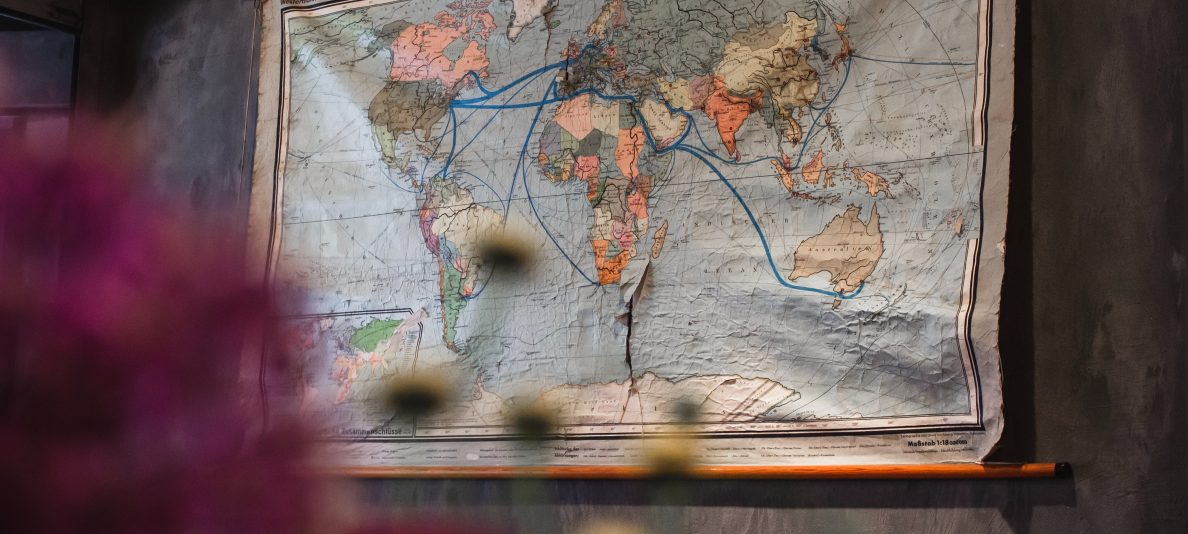
So after a long hiatus, I went back to the Bellerby and Co. Globemakers’ website (I’ve written about them here and here), and I saw they’d posted a Great Big Story video that CNN had made about them. It’s a cool video, but what really caught my attention was Bellerby’s address posted on the outside of their studio. Yes, their address:

London Borough of Hackney, Bouverie Mews, N16

I like the sound of it. It sounds so . . . British. But beyond that, it’s provided me a learnable moment, with help from the Online Etymology Dictionary, one of my favorite sites.

First, there’s Borough of Hackney. Hackney originally meant “Haca’s Isle” or “Hook Island,” the name for a dry patch in the middle of a marsh within the current boundaries of London. In early medieval times, horses were kept there. These horses were hired out for regular things like riding and pulling, not for specialized purposes, and the horses themselves came to be called “hackneys.” That led to the shortened form hack, which is now used for someone, such as a writer or artist, who does dull or routine work for pay. In the past, hackney was also a verb, meaning “to use a horse for riding,” which gave us our current adjective hackneyed, for something that is overused or trite.

Then there’s Mews. Turns out that has nothing to do with cats but a lot to do with horses. Mew used to mean “cage,” and the king’s hawks were kept at the mews at London’s Charing Cross. The site later became the home for the royal horse stables, called the Royal Mews. By the early 1800s, mews meant “a street of stables converted into homes for people.”

Finally, a blog post by Bellerby and Co. tells us that their mews (street) is named after John Bouverie, a British antiquarian and art collector, who died in 1750.

Bellerby’s blog also points out another nearby occupant of Bouverie Mews: John Nolan Studio, where they make animatronics, such as those in the commercials below. In the first one, for McVities Digestive Cookies, it’s a little hard to tell what’s real and what’s fake. It’s a little easier to make that distinction in the advert (as the Brits say) for Nolan’s Cheddar. That’s not at all because the mouse doesn’t look lifelike.

You’ll see what I mean.

(“Balls on Bouverie: N16 History,” Globemakers, May 28, 2014)

Steps, 2, 3, 4

“The World’s Longest Staircase Is in Switzerland”

In 1910, a funicular railway was completed from the village of Mülenen up to the peak [of Mount Niesen in the Swiss Alps]. . . .

But more interesting than the funicular, in my opinion, is what runs up the mountain right alongside it: a two-mile staircase with a slope that gets up to a glute-grinding 65-percent gradient. There are a world record 11,674 steps up the mountainside—enough steps to climb the Burj Khalifa skyscraper in Dubai four times, and enough to climb the Statue of Liberty 33 times.

For safety reasons, the stairs are just used for maintenance and not open to the public. But once a year, 500 lucky participants get to tackle the world’s longest staircase climb, the Niesen Treppenlauf. . . . And the record for running up the equivalent of seven Empire State Buildings? A remarkable one hour and two minutes.

Ken Jennings, Condé Nast Traveler, June 14, 2018

Cultural Low Bridges [—at A Life Overseas]

When you go to a new culture and miss the signs . . . or don’t realize how you don’t quite fit in.

At first I thought I’d just let the above stand on its own . . . but I have more to say.

I’m fascinated by these clips of trucks getting stopped in their tracks, of them having their tops peeled back in shiny silver ribbons, of drivers second guessing themselves and hitting the overpass anyway. Yes, it makes me laugh, but it makes me cringe, too. I have empathy for these drivers, especially the ones in moving trucks, heading to a new place with all their worldly possessions packed up behind, having left the rental company after confidently telling the agent at the counter that they’d waive the insurance. “I won’t be needing that, thank you very much.”

When we moved overseas, we had our share of cultural miscues and language faux pas and just mistakes in general. Then after that, we had some more. And while we laughed at many, some were cringeworthy and some were painful to us or even hurtful to others. That’s what happens when you don’t see the signs or can’t understand what they say. That’s what happens when you think somebody needs to lower the road or raise the bridge, because “It’s not me. My truck is the right size!”

And then when we travelled back to our passport country, somehow the bridges were lower there than when we left. Or had our truck gotten taller? Either way, something didn’t fit anymore.

During one of our furloughs we borrowed a van from some friends for our visits to see supporters. It was a conversion van with a raised roof that the owners had just had repainted. (Spoiler: Yes, this is going where you think it’s going.)

Finish reading at A Life Overseas. . . .

Getting Religion in Cross-Cultural News

2760817801_4caf8e0c99_z

Have you every been to GetReligion? Edited by columnist Terry Mattingly, it’s a site that covers news coverage of religious issues. The authors, journalists themselves, point out areas where media personnel ignore or play down the spiritual aspects of news, fail to pursue spiritual leads when they are uncovered or hinted at (they call those “holy ghosts”), or demonstrate an ignorance of things religious. On the other hand, they also draw attention to journalists who show a keen understanding of religion and its impact.

The title of the site comes from a former senior political analyst at CNN, William Schneider, who once said, “On the national level, the press is one of the most secular institutions in American society. It just doesn’t get religion or any idea that flows from religious conviction.”

GetReligion wasn’t set up to target today’s much-referenced idea of “fake news,” as the blog’s origin in 2004 easily predates Donald Trump’s accusations. Its authors are also too broad and nuanced in their viewpoints to simply parrot political (or presidential) perspectives. And the stories they comment on reach well beyond the boundaries, and national concerns, of the US.

Every so often, GetReligion writers delve into their “guilt files,” where they keep stories  that they’ve wanted to write about but haven’t gotten to yet. I have my own guilt file for GetReligion, as over time, I’ve collected bookmarks from their site for posts that I’d like to comment on, all of which deal with cross-cultural issues.

Here are a few of them. If you’ve not been over there before, may these serve as entry points into the territory of GetReligion.

“Should Amazon Tribes Be Allowed to Kill Their Young? Foreign Policy Editors Aren’t Sure” (June 6, 2018)

Julia Duin’s subject is a Foreign Policy article that discusses a bill currently under debate in Brazil. If passed, the law will aim to stop indigenous tribes from committing infanticide and killing certain older children. That’s because, writes Cleuci de Oliveira, some Amazon tribes in Brazil see disabled children, the children of single mothers, twins, and children who identify as transgender as “bad omens” and believe they should not be allowed to live.

Not only is this practice controversial, but so is the law opposing it. On one side are those who agree with YWAM missionaries Marcia and Edson Suzuki. The couple helped formulate the bill and have founded a nonprofit to save endangered children from death. On the other side are those who see child-killing as a part of the tribes’ cultures and, as such, something that should be protected. The Brazilian Association of Anthropology says that the law would continue a history of colonization and violence toward indigenous peoples, “the most repressive and lethal actions ever perpetrated against the indigenous peoples of the Americas, which were unfailingly justified through appeals to noble causes, humanitarian values and universal principles.”

Duin wonders, what with today’s atmosphere of advocacy journalism, why Foreign Policy seems to play it down the middle rather than taking the side of the disabled children. She asks, “Isn’t infanticide one of those issues that doesn’t require debate?”

“Reporting on the Unthinkable: Ancient, Multicultural Roots of Female Genital Mutilation” (June 9, 2018)

In this post, Terry Mattingly highlights an essay in The Media Project on the violent and oppressive practice of Female Genital Mutilation (FGM), writing, “Reporters and editors will want to file the information, and the sources, for future reporting projects on this issue.” Mattingly cites several “stunning facts” from the article, written by Jenny Taylor, which include the following:

  • FGM predates both Christianity and Islam, with Egyptian mummies showing clear signs of the practice.
  • In areas of Sudan without access to antibiotics, up to one-third of girls who are subjected to FGM will die.
  • UNICEF reports that 200 million women and girls living today have undergone FGM, with more than half living in Egypt, Ethiopia, and Indonesia.
  • In Tanzania, more Christians than Muslims practice “female circumcision.”
  • Even though FGM has been outlawed in the UK since 1985, no prosecution against it has succeeded. Tayor writes that this is because “the West is slow to tackle it for fear of being accused of racism.”

And chief among the article’s sources is Ann-Marie Wilson, founder of 28 Too Many, a British nonprofit with the goal of eliminating FGM in the 28 countries that allowed it at the time the charity was formed. (Since then, six have made it illegal.)

“The root of the problem is beyond just the physical,” says Wilson, “the root is spiritual and religious and that can only be approached in love.”

“Jehovah’s Witnesses: Why Some Persecuted Faiths Grab Consistent Headlines and Others Don’t” (August 7, 2018)

“The world is inundated with sad examples of persecuted religious, ethnic and racial minorities,” writes Ira Rifkin for GetReligion. So he asks, “Why do some persecuted minorities trigger persistent journalistic attention while others do not?”

Rifkin looks at an article in The Los Angeles Times about Jehovah’s Witnesses who have fled Russia and are seeking asylum in Finland. This is the result of a 2017 decision by the Russian Supreme Court to outlaw the religion, saying that its adherents are members of an extremist group. This has resulted in persecution and the threat of imprisonment for Russian’s approximately 175,000 Jehovah’s Witnesses. Geraldine Fagan, author of Believing in Russia: Religious Policy after Communism, calls this “easily the worst attack on religious freedom in post-Soviet Russia.”

But while there has been sporadic coverage of the Jehovah’s Witnesses’ plight in the news, journalists in the west have given more attention to groups such as the Muslim Rohingya in Myanmar, European Jews, and Tibetan Buddhists. Why is that? The “short answer,” writes Rifkin, is

Groups that are relatively small and politically insignificant or are oppressed by powerful governments—Russia in the case of Jehovah’s Witnesses—get far less ongoing coverage than groups connected to globally significant constituencies. Think Christians in North Korea and China, for example.

Take a look at the rest of Rifkin’s post for the long answer.

And take a look at GetReligion for a religion-informed take on the news.

(Terry Mattingly, “The Mainstream Press ‘Just Doesn’t Get Religion,'” GetReligion, March 7, 2004; Cleuci de Oliveira, “The Right to Kill: Should Brazil Keep Its Amazon Tribes from Taking the Lives of Their Children?Foreign Policy, April 9, 2018; Jenny Taylor, “Fighting FGM Is a Spiritual War,” The Media Project, May 2018; Sabra Ayres, “Facing Religious Persecution in Russia, Jehovah’s Witnesses Find Refuge in Finland,” The Los Angeles Times, August 3, 2018)

[photo: “Newsstand,” by Thomas Hawk, used under a Creative Commons license]
Unmasking What’s Inside for Others to See

6588051805_f59d8a3e40_z

In the past, I’ve written about “the need for safe confidants in the lives of cross-cultural workers,” using parallel anecdotes from the world of athletics to illustrate my point. In that vein, here’s some insight from UK professional bicyclist Molly Weaver into how, in the area of mental health, the need for outward perfection conflicts with the inner need for honesty.

Actually, my introduction of Weaver is somewhat misleading. Technically she’s not a professional bike racer, at least not right now. On her website, she labels herself “Former Cyclist. Future Cyclist? Current Media Type.”

Early last year, during a training ride, Weaver was hit head on by a car and suffered 13 broken bones, including fractures in her back and neck. And yet, less than six months later, she was competing again . . . until she wasn’t. In May, she wrote a blog post announcing that she was stepping away from racing.

She makes her announcement and then continues:

I originally wrote this blog without the next part. I simply stated that I was taking a break from professional cycling, and then moved straight onto the ‘what’s next’ part of the story. I wanted to keep things private. But I’ve decided now is the time for an honest reflection.

Her physical injuries weren’t the issue, she writes. Those healed over time. It was the “mental scars”—the depression—that had stolen her passion.

My biggest mistake was doing nothing to stamp it out at the first signs of trouble. But at the time, in the grips of the demon, I couldn’t see this. I didn’t want to admit I was struggling. That isn’t who I am. I’m stronger than that.

Turns out strength has nothing to do with it. Depression can find anyone, and most of the time you don’t even see it coming.

But finding help, at least within bike racing, wasn’t easy. She tells BBC Sport that only one of her former teams had a sports psychologist. She calls this a “fundamental problem with the industry.”

Victoria Garrick is another high-level athlete who deals with depression. She’s a senior starter on the University of Southern California volleyball team, and last year she gave an in-depth TED talk in which she covers her experience as a D1 athlete, the stigma of depression and anxiety in sports, and the cultural environment athletes live in:

The culture of athletics preaches, “Where there’s a will there’s a way,” “The best don’t rest,” “Unless you puke, faint, or die, keep going.” Mental illness is associated with weakness. To appear weak is the last thing an athlete wants.

Not showing weakness is something that Weaver speaks about as well. Cycling, she writes in her blog, “is as much about your image as anything else.”

The social media lie is all too present in the world of cycling. Riders outwardly presenting the picture of the perfect life. The dream of being a professional athlete documented for all to see. For some this is probably the truth: for a lot of people it’s not.

The constant distortion of reality can be more destructive than we recognise. It looks like everyone else has it better than you. Everyone else is happier than you. But you don’t ever know what’s happening behind the filter.

I hid away my depression and put on a smile through it all. I said the right things. Some of which were true, and some of which I just wished were true. This felt like the only option. I thought I needed to paint myself in a certain light if I wanted to be successful. Mould reality around what people wanted to hear.

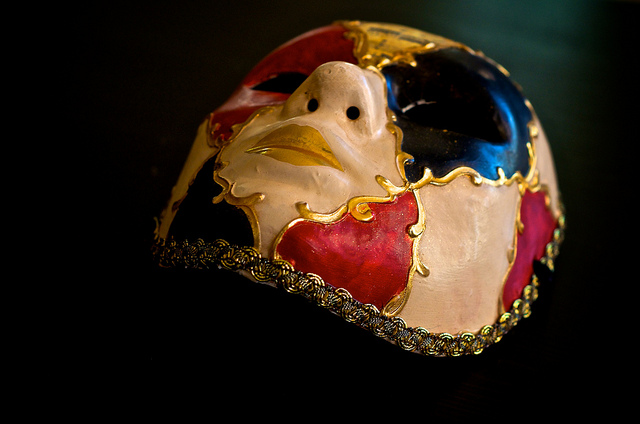
Then I would get home and take off the mask.

Now, by taking off their masks publicly, Weaver and Garrick are encouraging others to do the same, to be honest about mental-health issues, to be vulnerable in our humanity, regardless of our profession.

(Molly Weaver, “Behind the Mask,” May 22, 2018; Katie Falkingham, “Cyclist Molly Weaver on the Crash That Led to Depression and the Unhealthy Drive for Perfection,” BBC Sport, June 10, 2018)

[photo: “Venetian Mask,” by Rawle C. Jackman, used under a Creative Commons license]

Moving Abroad Can Sure Mess with Your Autocomplete [—at A Life Overseas]

94489102_2fb8aad566_b

We can tell a lot about each other by looking at our autocompletes. For instance, start typing “I can’t find my” into a text message and see what it thinks will come next. For me, it’s “keys,” “wallet,” and “phone.” That’s pretty insightful: I have a car, I’m a guy, and I’m absent-minded enough to have my phone in my hand and wonder where it is. But I’m not all that unique. You’re autocomplete may very well say the same thing (even if you’re not a guy). We, and our autocompletes, are products of the cultures that produced us.

So what happens when you relocate to someplace new and different? Your old autocomplete is now out of whack and needs to be retrained to match your new surroundings. Sure, some of it is dealing with single-word typing discrepancies like theatre vs theater or fighting spell-check battles over your friends’ names (Yes, I really do mean Mrak!). But it also goes deeper than that. It’s a change in how you live and act and think. It’s transitioning from normal to strange to new normal.

I just texted “I can’t find my llama” to my wife. On my third try my phone gave in and swapped out “wallet” for “llama” as one of my choices. It may take a while, but as you transition, your autocomplete will catch up—maybe just in time for a trip back home, far away, that place where the foreigners come from.

So what are your autocomplete settings right now? Where do you fit in with the sentences below?

It all depends on where you are, and where you are in your getting there.

From normal to strange to new normal.

Wow, you can speak two languages? You
. . . must be a genius!
. . . must be average.
. . . must be ready to move to another assignment where you’ll need to learn two more.

Read the rest here. . . .

[photo: “Qwerty,” by Xosé Castro Roig, used under a Creative Commons license]

Beetles, 2, 3, 4


“Loveland Woman Creates Insect Farms to Feed African Orphans”

Loveland resident Amy Franklin found a solution for the hunger and malnutrition besetting Congolese orphanages in a delicacy that thrives in the wild in the African country—the palm weevil.

With no land for traditional farming, she has created small “farms” inside plastic containers to raise larvae, which are a protein-rich food source that can be farmed inside small rooms within the orphanages themselves.

“These orphanages are blocked in on every side by concrete and buildings,” said Franklin, who established Farms for Orphans, a nonprofit, with her husband, Alan. “They don’t have any land. They can’t even grow a small garden or any type of livestock production.”

. . . . .

The palm weevil is a beetle native to the Democratic Republic of the Congo. The larvae, which thrive within readily available sugar cane, are packed with protein as well as other nutrients, said Franklin.

. . . . .

They taste like breakfast sausages, Franklin said, and 10-12 grubs can meet a child’s daily recommended nutritional needs.

Pamela Johnson, Loveland News, Reporter-Herald, July 29, 2018