POYi, the Best Show-and-Tell of the Year

2847121492_6f780597fc_n
The bust of Donald W. Reynolds is displayed in the Reynolds Journalism Institute at MU.

Last week, Pictures of the Year International completed its slate of winners for 2013, marking its 70th annual competition. POYi, “the oldest and most prestigious photojournalism program in the world,” is sponsored by the Reynolds Journalism Institute at the University of Missouri School of Journalism.

Below is a list of 14 winning photo collections that offer a great show-and-tell of global and cross-cultural issues. There’s a lot here, but it’s still only a small part of this year’s entire POYi gallery. It’s well worth your time to settle down with a cup (or a pot) of coffee and click through all the winners, including the work of Paul Hansen, who was awarded Photographer of the Year honors in the newspaper division. Earlier in February, Hansen’s “Gaza Burial,” was named World Press Photo of the Year.

If, after looking at these photos, you’re inspired to try the challenging life of an international photojournalist yourself, watch the video at the end of this post. It’s Ed Kashi’s Photojournalisms, the third-place multimedia documentary winner. A companion to his book Witness #8: Photojournalisms, the short video was made from a compilation of Kashi’s photos and nearly 20 year of journal entries and emails addressed to his wife. “Home for me,” he writes, “has always been a shifting term, with shifting people and shifting objects vying for my attention.”

Here, in no particular order, are some of the people and objects that caught the attention of some very talented and dedicated photographers in 2012:

Life without Lights, Peter DiCampo
+++1.5 billion people around the globe don’t have access to electricity.

The Siege of Aleppo, Javier Manzano (includes graphic images of war)
+++The U.N. recently reported that nearly 70,000 have died in Syria’s civil war.

Beyond 7 Billion, Rick Loomis, et al.
+++“The biggest generation in history is just entering its childbearing years.”

North Korea—Collectivism, Vincent Yu
+++While the majority of North Koreans suffer, the government presents a “glossy” image to the world.

Water Is Personal, Brent Stirton
+++Drought, floods, and lack of clean water affect people all over the world.

A Long Walk, Shannon Jensen
+++These are the shoes of refugees who fled northern Sudan.

Paris Suburbs, Arnau Bach
+++Poverty and drug trafficking are prevalent in the neighborhoods surrounding Paris.

Dark Isolation, Tokyo, Salvi Danés Vernedas
+++“It is easy to find oneself isolated and alone among a crowd.”

Labor Movement, Alejandro Cargagena
+++From an overpass above a highway in Monterrey, Mexico, one can see laborers traveling to work in the open beds of pickup trucks.

Uncounted Casualties, Jay Janner
+++“They survived the battlefields of Iraq and Afghanistan. But they did not survive the homecoming.”

In the Devil’s Footsteps, Tyler Anderson
+++The people of Northern Uganda try to recover from the devastation left by Joseph Kony and his Lord’s Resistance Army.

Buzkashi, Casper Hedberg
+++North of Kabul, thousands gather to watch Afghanistan’s national sport in which men on horseback fight over an animal carcass.

Zone of Absolute Discomfort, Justin Jin
+++Few people live in the frozen tundra of the Russian Arctic.

Fukushima: Taking Back a Nuclear No-Man’s Land, James Whitlow Delano
+++Japan’s 2011 nuclear disaster left “a vast network of nuclear ghost towns” waiting to be reclaimed.

[photo: “Reynolds Statue, Reynolds Journalism Institute,” by moohappy, used under a Creative Commons license]

Does This Suitcase Make Me Look Fat? Save Money by Wearing Your Luggage

3652899243_4bd9148ffb_nThe first time I flew overseas, the lady at the counter weighed my carry-on. When she saw that it was a pound or two overweight, she was quick to come up with a solution. Did I have any books or a jacket inside? I could take them out, and she’d re-weigh my bag. I did, and she did, and then I was free to carry them onto the plane separately, or put them right back in the carry-on. Either way, my overall weight was the same—so I can’t vouch for the logic of the change—but I was glad for a workable solution.

But what happens if you’re a lot overweight on your baggage? What if your carry-on looks like a balloon and won’t begin to fit into that metal cage/scales combination next to the check-in line? (You know the thing I’m talking about, the one that’s there just to weed out first-time flyers who might want to turn themselves in.) Or what if you need to leave a whole bag behind? (As in, I’m not going to pay that fee!)

Well that calls for more drastic measures than just carrying a book. It can be done. It’s just that you might need to check your self-esteem at the gate.

Do It Yourself
First, I give you the example of an “unidentified passenger” at China’s Guangzhou Baiyun International Airport. The man, from Kenya, didn’t want to pay for his excess baggage, so he decided to wear it. According to Want China Times, he donned 61 items of clothing, among them 9 pairs of jeans. (Other news outlets report that he was wearing more than 60 shirts with his 9 pairs of pants. We may never know the exact count. In intense stories like this, accuracy is often the first thing sacrificed.)

The obese-looking man’s scheme was uncovered, layer by layer, when he set off the metal detector, prompting a full-body search. Apparently, (and this is where you can learn a valuable lesson) the batteries, USB sticks, and toys he was carrying weren’t in the pockets of his outermost garment.

(“Layer Hater: Guangzhou Airport Blocks Man Wearing 60 Items of Clothing,” Want China Times, December 16, 2012)

Jaktogo
If you admire this gentleman’s thinking—but the sumo-wrestler look isn’t quite your thing—maybe you’re part of Jaktogo‘s demographic. The Jaktogo, along with its cousins, the Dresstogo and Ponchotogo, is a jacket that holds a myriad of items in its 14 pockets. It folds into a bag, complete with carrying straps, so you can wear your “coat” through the gate and, once on board the flight, place your “bag” in the overhead bin. Or you can follow the lead of Irish engineer John Power, the Jaktogo’s inventor, and carry your fully-loaded coat by its straps through the gate and spar with the attendant over definitions. That’s not my idea of fun, but then again, I do have to remember, “Only fools pay for extra luggage, clever people have a Jaktogo!!”

Rufus Roo
Looking for something a little cheaper? You might want to try the Rufus Roo Big Pocket Travel Jacket. The Rufus Roo has only six pockets and doesn’t convert into a piece of luggage, but it’s designed by Rebecca Morter of the London College of Fashion, and some would say it’s more stylish.

Keep in mind, though, that when it comes to style, you are still wearing your luggage.


[photo: “Heavy Luggage,” by David Bakker, used under a Creative Commons license]

‘Tis the Season for International Photo Awards

2865183436_189dee1a69_mNot only is it the month for the Oscars, but February is also a busy time for selecting the prize winners in international photography. The judges have hard work wading through the thousands of photos, but we are the beneficiaries, as we get to browse through the best of the best.

Sony World Photography Awards
On the 6th of this month, the World Photography Organisation announced the shortlist winners for its 2013 Sony World Photography Awards. The finalists, in the professional, open, and youth categories, were selected from 122,000 entries representing 170 countries.

Lens Culture has a high-resolution slideshow of 45 of the shortlisted photos, or you can click through the galleries at the WPO site here. Final winners will be announced in April.

56th World Press Photo Contest
On February 15, World Press Photo announced the winner of its “Photo of the Year” for 2012. It is Paul Hansen’s “Gaza Burial,”  an image of men carrying the bodies of a young brother and sister to be buried after the two were killed by an Israeli missile strike.

Galleries containing all the winning photos, selected from the work of 5,666 photographers from 124 countries, are on display here.

Coinciding with the photo contest is World Press Photo’s third annual multimedia competition. The gallery of winners is here, including the following videos covering subjects outside the US (viewer discretion advised):

Into the Shadows, Pep Bonet, dir. (1st prize, Online Short)
Desperate Africans who migrate to Johannesburg face terrible circumstances.

Aleppo Battleground, Clément Saccomani, ed. dir. (3rd prize, Online Short)
A photojournalist joins the Free Syria Army at the front lines.

Too Young to Wed, Jessica Dimmock, dir. (1st prize, Online Feature)
Destaye was 11 when she married a priest in Ethiopia. Now 15, she has a 6-month-old son.

Dreams on FreewheelsYang Enze, dir. (3rd prize, Online Feature)
The seven members of the China Disabled Track Cycling Team train for the 2012 London Paralympic Games.
(This video not available for embedding.)

Pictures of the Year International
POYi started announcing their latest winners on February 5, with the final group announced today. I figured I’d wait until they were finished to start working my way through the results—it does take a while. And after I’m done, I plan to post again with links to some of their photos that tell stories from around the world.

[photo: “Flickr Photographers : Mauronster,” by Sergio Bertolini, used under a Creative Commons license]

Happiness Is As Happiness Does

517517380_2c489713abWhat are the happiest countries in the world?

Well, that depends. It depends on how you define happiness and how you figure out if people fit your definition.

Do You Feel Good?
In 2011, the Gallup organization measured “positive emotions” by asking people in 148 countries about their previous day, asking whether they felt well-rested, were treated with respect, smiled or laughed a lot, learned or did something interesting, and experienced enjoyment. The countries with the highest percentage of respondents answering “yes” to all five questions are labeled the “most positive.” They are

  1. Panama
  2. Paraguay
  3. El Salvador
  4. Venezuela
  5. Trinidad and Tobago
  6. Thailand
  7. Guatemala
  8. Philippines
  9. Ecuador
  10. Costa Rica

(Jon Clifton, “Latin Americans Most Positive in the World,” Gallup World, December 29, 2012)

Do You Not Feel Bad?
Gallup also asked people if they had experienced physical pain, worry, sadness, stress, or anger. Those answers produce the following list of places with the least negative emotions:

  1. Somaliland region
  2. Uzbekistan
  3. Thailand
  4. Kyrgyzstan
  5. Kosovo
  6. Turkmenistan
  7. Mali
  8. Singapore
  9. Mongolia
  10. China

(Jon Clifton, “Middle East Leads World in Negative Emotions,” Gallup World, June 6, 2012)

Are You Prosperous?
The Legatum Institutes Prosperity Index measures wealth and wellbeing by looking at the eight categories of economy, entrepreneurship and opportunity, governance, education, health, safety and security, personal freedom, and social capital. This gives us the following list of top-ten countries in 2012:

  1. Norway
  2. Denmark
  3. Sweden
  4. Australia
  5. New Zealand
  6. Canada
  7. Finland
  8. Netherlands
  9. Switzerland
  10. Ireland

(The 2012 Legatum Prosperity Index, The Legatum Institute, 2012)

Are You Thriving?
To measure whether people are “thriving,” “struggling,” or “suffering,” Gallup uses the “Cantril Self-Anchoring Striving Scale.” Participants are asked to imagine a ladder, with rungs numbered 0 to 10 from bottom to top, with 0 being the worst and 10 being the best. The poll then asks two questions: “On which step of the ladder would you say you personally feel you stand at this time?” and “On which step do you think you will stand about five years from now?” Results in 2010 produce the following ranking, showing the ten countries with the highest levels of thriving people:

  1. Denmark
  2. Sweden
  3. Canada
  4. Australia
  5. Finland
  6. Venezuela
  7. Netherlands
  8. Ireland
  9. Panama
  10. United States

(Julie Ray, “Nearly One in Four Worldwide Thriving,Gallup World, April 10, 2012)

Deeper Analysis, Anyone?
Last year, Columbia University’s Earth Institute published the first World Happiness Report. It contains in-depth evaluations of the hows and whys of measuring happiness around the world, as well as lists based on its own examination of survey responses. One such ranking is the “Average Net Effect by Country,” which combines the averages of the positive and negative emotion results from Gallup (like those shown above). Those results give these top-10 countries:

  1. Iceland
  2. Laos
  3. Ireland
  4. Panama
  5. Somaliland region
  6. Thailand
  7. Taiwan
  8. Austria
  9. Sweden
  10. New Zealand

Another ranking shown in the World Happiness Report is called the “Happy Index.” It uses information from the combined World Values Survey/European Values Survey, asking the question, “All things considered, how satisfied are you with your life as a whole these days/nowadays?” putting these countries at the top.

  1. Iceland
  2. New Zealand
  3. Denmark
  4. Netherlands
  5. Northern Ireland
  6. Ireland
  7. Singapore
  8. Malaysia
  9. Norway
  10. Tanzania

(John Helliwell, Richard Layard, and Jeffrey Sachs, eds., World Happiness Report, The Earth Institute, 2012)

Or Would an Anecdotal Approach Make You Feel Better?
And finally, if all this data crunching is not your cup of tea—or if it leaves you somewhat confused—you can do what documentarian Werner Herzog did, and simply recognize happiness where you find it. Even if it’s in the most unlikely places, under the most unlikely circumstances. Even if it’s in the wilderness of Siberia.

Happy People: A Year in the Taiga (Werner Herzog and Dmitry Vasyukov, dirs., 2010)

[photo: “A Happy Man,” by Sukanto Debnath, used under a Creative Commons license]

These Newsletters Aren’t Sent Either

3742918775_f3b2aee5be_mRuth E. Van Reken’s honest revelations in Letter’s Never Sent has me thinking about all the missionary newsletters I’ve written and read. Missionaries are a good group for emphasizing the positives and putting a good spin on the negatives. Newsletters just aren’t a safe place to share deep struggles, especially when many of the readers are current or potential donors.

I’m not saying that every newsletter should be filled with pain. I’m not even saying that every missionary has enough pain to fill a newsletter. What I am saying is that if the only things you know about missionaries come from newsletters, presentations, and answer-the-routine-questions conversations, then you don’t know the whole story. And what I am saying is that if you are a missionary who is hurting, you are not alone in what you’re going through.

In fact, if you’re any kind of cross-cultural worker or a Third Culture Kid or a trailing spouse or an expat or a repat or a soldier overseas or a family member left behind, and if, at one time or another, any of the following could serve as a heading for your next newsletter or blog or prayer update . . . believe me, you are not alone.

Nobody cares.
God has been silent for a long time.
This was a mistake.
I’ve changed, and I don’t like who I’ve become.
I feel betrayed.
I’m overwhelmed.
I don’t care anymore.
I think I’m going crazy.
Where is my joy?
I wish I could die.
I feel like a failure.
I’m afraid.
I’m lonely.
I’m angry.
I’m disappointed in myself, and I think God is, too.
I don’t belong.

Let me say it one more time: If this is where you’re at or where you’ve been, You are not alone.

And I hope you’re never, ever left to feel as if you are.

[photo: “Creativity,” by Mark van Laere, used under a Creative Commons license]

Sorry You Weren’t the One to Buy “Afghan Girl”

My apologies.

It’s been more than two months since the National Geographic auction at Christie’s, and I need to set something right.

It’s quite likely that at least one of you, dear readers, saw my post about the sale of Steve McCurry’s Afghan Girl at auction, arrived at Christie’s on December 6 with only $12,000 in your pocket, and watched in horror as other bidders immediately left you behind . . . far behind . . . so far behind that you weren’t able to lift your paddle even once.

The pre-auction estimate that I quoted for McCurry’s iconic photo was indeed cited at $8,000 to $12,000 in October, but the estimate listed on Christie’s website, where the photo was displayed, was $30,000 to $50,000. Not that that would have helped a lot anyway, as the print’s winning bid came in at a whopping $178,900 (with the buyer’s premium added to the “hammer price”).

And Afghan Girl wasn’t the only item to bring in an enormous amount of money. N.C. Wyeth’s Duel on the Beach topped the sale at $1,082,500. The entire auction brought in $3,776,587.

I was wondering what would make a print of a photograph worth so much. The anonymous buyer didn’t get the original Kodachrome slide. He didn’t purchase future licensing rights. And he didn’t buy the last copy of the photo ever made.

I think I’ve figured it out, though. The print is signed, of course, and dated. But then comes the really special part. Next to the signature is the marking “1/1.”

That does it for me. Not 1 of 200 or 1 of 10 . . . but 1 of 1.

Afghan Girl truly is an iconic photo. Monica Hess of The Washington Post calls it “the photograph of photographs of photographs” and then describes “the ragged red scarf, the scissors-sharp green eyes, the hungry, hunted, haunted beauty.”

Ah, yes, the eyes.

If you’d like to get a better view of what $178,900 got for one bidder, do this: Go to this link—which will bring you a larger-than-life image of Christie’s “Sale 2603 / Lot 194″—and click on the zoom-in symbol a few times. Re-center the photo and look into those “scissors-sharp green eyes.”

Those eyes. Two of two.

(Monica Hess, “National Geographic’s Auction of Images Fetches $3.8 million,” The Washington Post, December 6, 2012)

[photo: “Steve McCurry: On the Outside Looking In,” by Steve Evans, used under a Creative Commons license]

“Letters Never Sent” but, Thankfully, Published Instead

It’s been 25 years since Ruth E. Van Reken125933835_e355fbcad2_m first published Letters Never Sent, but I hope it doesn’t ever become a book rarely read.

Following her experiences as a Third Culture Kid, born to missionary parents in Nigeria, and later as a missionary to Africa herself, Van Reken wrote a series of “letters,” to her mother and father, and to God, expressing feelings that earlier she wasn’t able to fully share.

While it would be easy to assume that the details of Van Reken’s story are dated—the book begins with her trip to boarding school in 1951—her expressions of honest emotions cut through the years and show the wonderings and pleadings of a heart that beats in many missionaries and their children today. But it is a heart that is all too often hidden and quieted.

One of the feelings voiced by the young Ruth Ellen is guilt . . . guilt that her inner thoughts are a betrayal of her parents’ calling. During her high-school years, she and her sister stayed in the States, while their parents returned to their work in Nigeria. As her mother and father’s departure nears, Ruth Ellen fights with her emotions, writing in a “never sent” letter:

If I throw myself into your arms and sob my heart out, it might keep you from going. And even though that’s what I want, how could I ever bear the guilt of being the one who kept you from doing God’s work? I’ve always vowed I wouldn’t be one of “those kids,” the kind that other missionaries talk about in whispers, with a sad shake of their heads. “So-and-so couldn’t come back to the field because of their children.” They must be pretty bad kids, I’ve always figured. I don’t want anyone to say that about me or our family.

And I can’t very well come to God with this because, in a way I feel like it’s all His fault.

Years later, as Ruth Ellen ponders her approaching wedding to David Van Reken, she expresses a distrust of God, developed from many years of having, as a TCK, to let go of what is dear to her:

I can’t believe God will let me keep David. It’s like He’s dangling Dave on a rope, letting him come closer and closer. I’m afraid that at the last moment, when I put out my hand to take him, the string will be jerked back and God will laugh.

“Ha ha. Thought you finally had someone you could keep. Don’t count on it. Whatever you depend on, I will surely take that, so that you’ll depend solely on Me.”

Ruth does get to keep David, and the two are soon joined by a baby daughter. But depression comes to Ruth, seeming to be at odds with the spirituality that she longs to possess. “How many hundreds of testimonies have I heard about the joy that Jesus gives?” she writes. “He surely isn’t giving it to me right now—or maybe I just don’t know how to receive it.”

Her depression becomes deep enough that she thinks about suicide:

I’ve actually wondered what it would be like to take pills and never wake up. But in my heart I know that wouldn’t solve anything. I have a child I’m responsible for, and I want to see her grow up. And I want to live, if I can be the person that I’ve always thought I had the potential to be. But right now that seems like a hopeless dream.

Then, using words that are reminiscent of those penned by the Psalmist in Psalm 13, she writes,

The thread I’m hanging on to is an intellectual belief that God still has a purpose for my life. I can’t imagine how He can ever put all the pieces back together and make me whole, but it’s my only hope. I told Him today that He could forget helping me to do better—there’s nothing left of me to help. If He doesn’t do something new, I’m finished.

But there is hope. There is help for her to do better. And it comes in the form of a new friend, Linda, who opens a path for Ruth by sharing her own personal struggles in a Sunday school class. This is something that Ruth hasn’t experienced before, and it gives her courage. This leads to many conversations with Linda, in which Ruth shares her pain, and Linda listens without judgment.

Within a few years, the Van Rekens are preparing for their own missionary work in Africa, and Ruth continues to learn how to function without hiding behind masks. Sometimes the masks come off gently, as with Linda, but at other times, they are pulled off forcefully, as when a pastor shares from the pulpit about some of her struggles. But to her amazement, she writes, when “[t]he awful, naked ugliness of my soul was exposed, . . . I was still accepted!”

Healing also comes through forgiveness: forgiving her parents for her many separations from them and forgiving “all those who locked me up with pat answers or quick words of encouragement, when what I needed was understanding and a hug.” Following the death of her uncle, Ruth gets a different kind of response from Jesus: “He held me and understood. He acknowledge my pain. He didn’t try to talk me out of my hurt. . . . I’m learning about God as the Comforter and binder of broken hearts.”

But in letters dated less than two years later, as she and David are serving in Liberia, Ruth writes that the depression has returned. She tells God, barring a change in the next month, to let her die. In her conversations with God that follow, she learns that she has not addressed all of the anger that is leading to her depressed feelings. She still needs to “forgive” God.

“Why don’t you leave me alone?” she hears herself say. “Ever since I came to Liberia to serve you, You’ve done nothing but bad things to me. I’m sick and tired of it.” And she hears God say to her that he isn’t at all shocked by her anger. He can handle it. “You can love someone and still be angry at him,” God tells her. Acknowledging this anger is an important step for Ruth, a step that leads to more healing.

One of the final letters penned by Ruth is dated 1984. That’s 24 years after Ruth Ellen had voiced her struggle with guilt because she wasn’t the perfect missionary child. In it, she says, after reading through all of her previous letters, that there still was one more person to forgive:

I can forgive the little girl I was, for not being all she thought she was supposed to be. The greatest joy has been to understand for the first time in my life that God is the “God of all Comfort.” I could not understand that until I recognized how much I needed His comfort.

Ruth’s story is one of faith and anger and hope and fear and sadness and peace, all flowing one into another. It is a story beautifully and sincerely told. It is a story that can speak to generations of TCKs and cross-cultural workers and to those who want to understand them. And it’s a story that continues. Last year, Van Reken published a newly revised edition of Letters Never Sent, containing 30 additional pages, with photos and an epilogue addressing her later life, including a bout with cancer.

It’s been 25 years since Ruth E. Van Reken first published Letters Never Sent, but I hope it doesn’t ever become a book rarely read.

The above quotations are taken from the 1988 edition of Letters Never Sent. The book was first printed in the US in 1987 under the title Letters I Never Wrote.

[photo: “unreachable,” by Daniel Zimmel, used under a Creative Commons license]
“Life Is What Happens . . .” Isn’t a John Lennon Original

3051471866_f12b1460f5_mWho says you can’t learn anything from the comics? (Actually, I’ve never heard anyone say that, but it sounds like something somebody might say.)

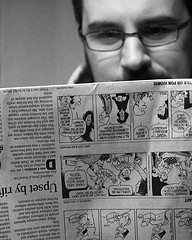
Last week, in Jimmy Johnson’s Arlo and Janis comic strip, Arlo is looking at a calendar and ponders, “Life is what happens while you’re making other plans.” He comments that we’ve probably heard that that line came from John Lennon, but it actually originated with Allen Saunders, the writer of the dramatic comic strips Mary Worth and Kerry Drake. Arlo closes with, “Lucky so-and-so never had to be funny!” (See the February 1 strip here.)

While I was a missionary in Taipei, I helped some Taiwanese friends study the Bible with the hopes that they would continue meeting when I wasn’t with them. One group was made up of students at a technology university and another consisted of former university students who had degrees from the US. This second group had started meeting at a McDonald’s for a weekly Bible study even before I met them. During one of my family’s trips to the States, hosts for each group planned to keep the meetings going while we were gone. One group met for two weeks, but then the host had to travel outside the country. And in the other group, the hosts weren’t able to continue organizing the meetings because of an illness in the family. In our monthly newsletter, I wrote,

It reminds us of John Lennon’s famous phrase: “Life is what happens to you while you’re busy making other plans.”  But even though their schedules didn’t work out as well as they, and we, had hoped, we are greatly encouraged by their desire and willingness to try.

I stand corrected by a comic-strip character. Lennon used the “Life is what happens . . .” line in his song “Beautiful Boy” in 1980, but according to Garson O’Toole of the Quote Investigator, that was over 20 years after a nearly identical phrase appeared in the “Quotable Quotes” section of Reader’s Digest. In the January 1957 issue, Saunders was given as the source of “Life is what happens to us while we are making other plans.”

So there you have it. All those quotation sites on the web should replace John Lennon with Allen Saunders.

Life often does get in the way of our plans, doesn’t it? Reminds me of the Yiddish proverb, “Man plans, God laughs.” At least I’m pretty sure it’s a Yiddish proverb. And I guess I’ll stick with that until Dilbert says otherwise.

(Garson O’Toole, “Life Is What Happens to You while You’re Busy Making Other Plans,” Quote Investigator, May 6, 2012)

[photo: “Funny Pages,” by summerbl4ck, used under a Creative Commons license]