Chinese Towns with Châteaus and Pubs

421040590_416a162457If imitation truly is the greatest form of flattery, then many in China believe that flattery will get them everywhere.

Over the past decade, China has experienced a boom in the building of look-alike cities and structures, fashioned after architecture from non-Chinese locales. Leading the trend is Shanghai’s “One City, Nine Towns” project, building foreign-inspired housing developments to draw residents out of the city’s crowded center—though it seems that the people have been a little reluctant to make the move.

There’s been a bunch written about the carbon-copy construction—lots of photos, too. Here are links to some of the articles around the Web:

Welcome To the Bizarre Chinese Ghost Town That Looks Like It Was Plucked from the British Countryside
(Julie Zeveloff, Business Insider, June 14, 2011)
“Thames Town is not nestled in the British countryside; it’s located in the northeast corner of China in Songjiang, near Shanghai. And it didn’t grow gradually over hundreds of years.”

Anting New Town: Car Museum, Cafes and Homes, but No People
(CNN Travel, September 24, 2010)
“The Anting New Town development was designed by Albert Speer, the son of Hitler’s favorite architect, to accommodate 50,000 inhabitants in apartment buildings and stand-alone houses.”

Going Dutch: Shanghai’s “Holland Town” Brings Europe to the City
(Mathias Guillin, CNN Travel, July 8, 2010)
“Life in Shanghai can be a bit monotonous: work, party, brunch and then do it all over again the next weekend. If you need to break things up and don’t want to hop on plane, head over the river and check out Pudong’s Nederland, aka ‘Holland Town.'”

Luodian—a Slice of Sweden in China
(Ulrika K Engström, Sweden.se, February 10, 2006)
“Luodian is a fully fledged copy of a Scandinavian town. Even the weather seems to have been specially imported to this newly built development in Baoshan, one of 16 districts in Shanghai.”

China: Shanghai: Citta di Pujiang
(Bret Wallach, The Great Mirror)
“An Italian city in Shanghai? But of course: this is another of Shanghai’s new towns, like Thames Town, but in this case Venice. Well, that’s what you’ll read in the press, but this new town doesn’t ape Europe: it has lots of water, in other words, but an intensely modern architectural style.”

China Builds Its Own Eiffel Tower
(Metro News, September 21, 2007)
“Chinese architects copied the Eiffel Tower, the Arc de Triomphe and the famous fountain in the gardens of the Palace of Versaille to make their own version of the French capital. Famous buildings and Parisienne style gardens are surrounded by rows of European-style villas where up to 100,000 Chinese people will live in a special gated community called Tianducheng just outside Shanghai.”

Made in China: An Austrian Village
(Reuters, June 5, 2012)
“A $940 million Chinese clone of one of Austria’s most picturesque villages, the UNESCO World Heritage-listed Hallstatt, recently opened its doors to visitors in the southern Chinese province of Guangdong amidst some controversy.”

Photos: Jiangsu City Has Four Fake US Capitols
(Michael Evans, Shanghaiist, December 3, 2012)
“The Jiangsu city of Wuxi is home to not one, not two, but four buildings with a less-than-coincidental resemblance to the US Capitol.”

Village Uses Famous Site Replicas to Draw Tourists
(Wang Hongyi, China Daily, October 12, 2011)
“[T]ourists can also see replicas of the US Capitol building, the Arch of Triumph in France and the Sydney Opera House by going to Huaxi village, which is deemed the richest village in China.”

Dorset Town is Re-built in China
(BBC News, July 26, 2007)
“A town in China has been modelled on Dorchester after planners saw the town’s picture on a Christmas card. The development in Chengdun, Sichuan province, named British Town, is complete with mock Victorian and Georgian architecture.”

Mr. Zhang Builds His Dream Town
(James Fallows, The Atlantic, March 2007)
“After lunch, Zhang thanked the guests for coming and invited them to spend time seeing some of the other highlights of Broad Town: the 130-foot-high gold-colored replica of an Egyptian pyramid, for instance.”

China’s Elite Learn to Flaunt It while the New Landless Weep
(Joseph Kahn, The New York Times, December 24, 2004)
“Chateau Zhang Laffitte is no ordinary imitation. It is the oriental twin of Château Maisons-Laffitte, the French architect François Mansart’s 1650 landmark on the Seine. Its symmetrical facade and soaring slate roof were crafted using the historic blueprints, 10,000 photographs and the same white Chantilly stone. . . . ‘It cost me $50 million,’ Mr. Zhang said. ‘But that’s because we made so many improvements compared with the original.'”

Château China: $30 Million “Hobby”
(Sheila Melvin, The New York Times, January 10, 2006)
“The town of Changli, in Hebei Province, resembles any other nondescript county seat in northern China. . . . But just outside the town center is a 200-hectare, or 500-acre, vineyard replete with a state-of-the-art wine production facility; a villa with tasting rooms and restaurants; a three-story wine school; a luxury hotel, and an immense private château. The Tuscan-style complex is so opulent and incongruous in the Hebei countryside that it at first seems like a mirage.”

Related Post:
Shanghai Calling: “Come Home”

[photo: “07/02/23 15:10:06 Shanghai,” by 2 Dogs, used under a Creative Commons license]

Back Home to Papua, 50 Years after Peace Child

Home is an elusive concept for many Third Culture Kids. Paul Richardson, who was born in Papua, Indonesia, is no exception.

“Because I lived so many places in different parts of the world, traveled so much,” he says, “I’d never been able to really say where’s home.”

5712238389_d4bb32ba5f_nBut this summer, he, along with his father and two brothers, returned to the place where he was “born and raised.” That return is the subject of the 15-minute film Never the Same: Celebrating 50 Years since Peace Child.

Paul is part of a famous family, at least among evangelical Christians and the missionary community. Don and Carol, his parents, moved to Papua in 1962 to take the gospel to the Sawi, a tribe of cannibals and headhunters. Their story is the subject of the book Peace Child: An Unforgettable Story of Primitive Jungle Treachery in the 20th Century, later made into a movie, also called Peace Child.

When missionary historian Ruth Tucker wrote From Jerusalem to Irian Jaya: A Biographical History of Christian Missions, it was the work of the Richardsons in Papua (formerly Irian Jaya) that made up the final chapter.

Ministering to a warring tribe was not easy, and at one point, Don told the Sawis that if they didn’t stop fighting, he and his family would have to leave. In order to keep the missionaries there, each Sawi village gave an infant boy to its enemies as a sign of peace. This idea of the “peace child” became a door for the message that the Richardsons were trying to tell them, that God, likewise, had given the world a peace gift, his only son.

This experience among the Sawi formed the basis for Don’s belief that every culture has a “redemptive analogy,” a story, practice, or tradition that can be used to help the people understand the gospel of Christ.  He expounds on this concept in his book Eternity in Their Hearts: Startling Evidence of Belief in the One True God in Hundreds of Cultures throughout the World.

Fifty years after first arriving in Papua, Don revisited the Sawi tribe, which had not only embraced Christianity but had become a base for reaching out to the tribes around them with the message of Christ. Making the trip with him were his sons: Steve, who was seven months old when his family moved to be with the Sawi, and Paul and Shannon, who were born in Papua.

Steve is now the president of the mission agency Pioneers-USA, and he serves as the narrator for Never the Same, which you can view below. It begins with a short overview of the Richardson’s work with the Sawi people and then shows their reunion with their old friends. This is where Paul talks about returning to the place where he lived as a child:

There’s no electricity except for a little generator, and . . . there’s no emails, there’s no text messages . . . just, you know . . . it’s just quiet here. And it’s beautiful, and . . . and there’s a connection with the people here. And, uh, just waking up in the morning, hearing the sounds of the jungle, and, I don’t know, I slept better last night than I have in years, even though I’m just sleeping on the floor in this village.

So there is something to going back. I . . . Because I lived so many places in different parts of the world, traveled so much, I’d never been able to really say where’s home. But I think this would probably be more than anywhere else . . . is where I was born and raised. So this will always be special for me.

I heard about this video from Brian Stankich at Fulfill. In response to my post on eating insects, he pointed to a scene where Steve is eating some grubs on a stick, given to him by his Sawi hosts. Showing his snack to the camera, he says,

Oh this is um . . . these are grubs. And inside they’re just full of grease, and the heads are really . . . very strange, actually, the more I think about it. But [chewing and clearing his throat] they grow on you.

[photo: “Papua-Indonesia, 2008,” by CIFOR, used under a Creative Commons license]
Eight Years Ago, “The Impossible” Happened

2947856952_e93daa6e15_mToday marks the eighth anniversary of the 2004 Indian Ocean tsunami that killed over 220,000 in 14 countries.

The disaster is the focal point of The Impossible, a movie starring Naomi Watts and Ewan McGregor. They play a British couple who, with their three young sons, are vacationing on the beach in Thailand when the tsunami hits. The film is based on the true story of Maria and Henry Belon, from Spain, and reviews from many who have seen The Impossible say that it portrays the tragedy in a realistic way. Though they were separated and injured, the Belons survived, due in large part to the compassion and kindness of the locals who helped them.

My first thought when I saw the movie trailer was, why must we tell non-western stories through the eyes of westerners? Surely there were stories about Indonesians, Sri Lankans, Indians, Thais, and others in Southeast Asia worth telling.

I was glad to hear Maria Belon address this during an appearance on The View. According to her, the movie is about the people of Southeast Asia. She said that her family’s story is not more important than theirs, but it serves as a way to show what was happening to the tens of thousands of people around them:

It needed to be told just as an excuse to tell everybody else’s stories. That’s the only reason why we wanted our story to be told is because nothing happened to us. . . . I will tell that thousands of times. Nothing happened to us, but from so many people were so painful, so difficult, that that was the only reason why we wanted to tell this story, just an excuse to tell everybody else’s stories. . . . Only for them. Only for them.

When she was asked about “survivor’s guilt,” she gave this interesting response:

I hate this concept, I hate this word. . . . Really, I will struggle to change this concept. It’s not guilt what you feel. Somebody else tells you you’re feeling guilty, and some people will say . . . OK, thank you, I’m feeling that. No, it’s not that what you’re feeling. You’re feeling pain. Pain. It’s a very strong pain that will remain for you forever, forever. I mean you can’t do anything about that.

So with PTSD and all the pain, how did Maria “move on”? She answered,

Moving on. I mean, moving on. I mean . . . no choice. . . . You have pain, OK, go on, Maria, with your pain. Tell the story. Help Naomi. Help the director. I mean, how do you cope when your knee’s in pain? You go on with pain, that’s all.

(The View, ABC, December 21, 2012)

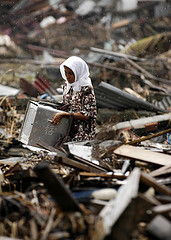
[photo: “Woman searches through debris . . . Banda Aceh, Sumatra, Indonesia,” by Chuck Simmins, used under a Creative Commons license]

An Interview with Jessica Stahl of Voice of America

307933_693320373262_563685602_nI first “met” Jessica Stahl after I wrote about a post from The Student Union, a blog she edits for Voice of America. A native of Long Island, she now lives in Washington, D.C., where she works across the street from the Capitol building.

I’ve enjoyed reading Jessica’s blog and then chatting with her through email. I’m interested in the work she does at VOA (see the end of this post for more info about her employer), so I asked if I could interview her. She graciously agreed.

When I asked Jessica what she does at VOA, she told me she is “a producer for social media and special digital projects.” That led me to my first question:

What does “a producer for social media and special digital projects” do?

So, my actual title is “Audience Engagement Analyst,” which is one of those phrases that makes less sense the more you think about it. I call myself a social and digital media producer because that’s much more accurate to what I do. Basically, I manage VOA’s social media presences in English and advise our reporters and programs on how to use social media in their own work, and then I also put together projects and coverage that has a social media or user-generated component to it. Sometimes that’s an article that’s based on something that’s happening on social media (like when the Israelis and Palestinians were basically live tweeting the Gaza conflict a few weeks ago), and sometimes that’s a big project around an event like the presidential inauguration (which is what I’m working on at the moment).

You also edit The Student Union. How did you get started with that?

The Student Union came about a bit by accident. When I started in this job, I was looking around our website and familiarizing myself with what we had going on, looking for areas for improvement. One that jumped out at me immediately was our coverage of international-student issues. We would do these profiles of international students, which were fairly formulaic, and I immediately thought how much more interesting it would be to have international students telling their own stories. It was one of those things where I pitched the idea and was essentially told, “Great, go do it.” So I did. At the time I didn’t know anything about international-student issues, so that first year was a pretty big learning curve!

But I really love working on it. I love editing, and I like writing/reporting without the deadline pressure of breaking news, and I find working with the students so incredible. Their stories are fascinating, and they are so talented, and I love being in a position to help them mold that (not that they always need my input). If I’m honest, it makes me feel important and useful in a way that my regular job doesn’t always!

How did your life before VOA get you ready for what you do now?

That’s a tough one, because I fell into this a bit by accident. My degrees are both in international relations and economics—I did journalism as a hobby in college and grad school but never seriously considered pursuing it as a career. But I ended up at this job at VOA and I absolutely love what I do. I didn’t really have a lot of knowledge about social media when I started, but I’ve learned as I went and now I’d say (humbly, I hope) that I’m very good at my job.

I do think that the training I got in college as a print journalist has been absolutely vital though—that’s where I had the principles of journalism and of good writing drilled into me.

And my interest in/knowledge of international relations comes in handy pretty much every day, since I’m constantly dealing with world news and expected to have a really solid grasp on everything happening around the world.

Back to The Student Union: You have a great mix of students contributing to the blog. How did you meet them?

I find the writers in a whole bunch of different ways—a lot of it is actually dumb luck from students stumbling across the blog and then asking how they can get involved. That’s how I got matched up with two of my best writers: Anna Malinovskaya, from Russia, and Sarah Bosha, from Zimbabwe. I also do a lot of outreach towards the end of the summer with EducationUSA advisors around the world and with international student advisors at US universities, and they’ve been really helpful in spreading the word among their students and helping connect me with people who might be interested. And then, of course, I put it out there on our social media channels as well.

There is actually an application process, so I get to shape the group to make sure it’s pretty diverse in terms of country of origin, location in the US, major, and level of education. But most of that stuff sort of works itself out naturally, and the biggest things I look for are whether the student has ideas and is comfortable sharing things about their own life.

Can you give us examples of posts that give us a taste of how interesting/insightful The Student Union can be?

I’m personally interested in questions of identity and how that’s challenged in cross-cultural situations, and we’ve had some amazing posts on that topic, including from an African girl who had to confront her bias against gay people, “Just when I Learn the Answers, They Change the Questions: A Zimbabwean’s Journey“; from a Chinese girl who tried out several American personas, “What Does It Mean to ‘Be American’ as a Chinese Student“; and from an Afghan guy about the burden of showing American classmates that Afghans are normal people, “‘Who Are You?’ What It Means to Be an Afghan among Americans.”

But we also discuss quirks of American culture, like in this post about classroom discipline (by Anna), “Two Russians Discussing American Education,” or this one about the meaning of the phrase, “How are you?” “The ‘Wrong’ Way to Answer ‘How Are You?’” as well as more informational things like admissions procedures/requirements.

No matter what the topic is, it’s always from a first-person perspective, which I think is what makes it interesting. We’re not just telling people do this or do that (I have a serious pet peeve about “advice” articles that are so vague they can’t possibly be actionable or have no context to help you apply the advice to your own life); we’re sharing what we’ve done and what we learned from it, which someone can just read as a compelling story or can use as an input to make their own decisions.

The international students you work with, did they know about Voice of America before they met you? Did they listen to it in their home countries? What ideas/opinions did they have about VOA?

Depends. Some did, some didn’t. This year, I think, most didn’t. So I think for the most part they don’t really have a pre-existing opinion about VOA. During winter break a bunch will be traveling through D.C., and I’m really psyched to have them over to VOA and show them around so they can get a better sense of what they’re part of.

That sounds like a great time, for them and for you. I’d enjoy seeing DC through their eyes (I hope they get to blog about it). I’d also like to see DC through the eyes of an “insider.” So one last question: If I were to bring some international students to visit DC, after going to all the standard must-see sights—and VOA, of course—what would be a place off the beaten path that you think we should experience? What is a place that you’ve discovered because you’ve made D.C. your home?

One of our bloggers who spent a semester in D.C. did a nice insider’s look at some of the things she discovered, so you can check that out: “A Shifting Identity in Photos: Jihve’s Story.” For me, one of the things I love about D.C. is just the feeling of gravitas you get walking past the US Capitol and the White House. I still always get chills going past the White House. So I recommend walking the National Mall and seeing those sights, both during the day and at night when they’re all lit up. There’s an amazing spot on the steps of the Jefferson Memorial where you can look across the Tidal Basin and see the Capitol on your right, the White House through the trees straight ahead and the Lincoln Memorial on your left, and it’s just gorgeous.The other thing that people probably don’t know about D.C. is how many different neighborhoods we have. It’s not just downtown that’s interesting. I love to walk (probably obvious from my previous suggestion), so I’ve really enjoyed just wandering through the neighborhoods and absorbing their different characters. I recommend Capitol Hill, particularly Eastern Market (which is a giant open-air food/crafts market), U Street (for something that is more authentic to DC’s homegrown culture), and Georgetown.

____________________________________

Voice of America began broadcasting in 1942 and in the 70 years since has grown to reach a television and radio (including shortwave) audience of 141 million each week, in 43 languages. Begun “as a response to the need of peoples in closed and war-torn societies for reliable news,” VOA is under the direction of the Broadcasting Board of Governors, an independent agency of the US government. The BBG’s mission is “to inform, engage and connect people around the world in support of freedom and democracy.”

(“VOA Fast Facts,” Voice of America)

Playing Games with World Proverbs

2706821422_b976cbc1db_mLooking for a game to play with family and friends? Here’s one you might like.

I’ll call it simply The World Proverbs Game. I came up with the idea several years ago after playing a version of Balderdash, just using a dictionary. (As you probably know, Balderdash is a board game in which players try to come up with believable sounding definitions for obscure words.) Similar to Balderdash, there’s a game called Wise and Otherwise that requires players to complete proverbs that come from around the world. I found out about it after I’d already bought a book of world proverbs and made up my own rules. Honest.

Judging by the reviews at Amazon.com, Wise and Otherwise is a great game. For about $43.00, you get a game board, a die, paper and pencils, playing pieces, and 500 cards containing 2,500 proverbs. But if you can do without most of that and would like to save some money, here’s how to play The World Proverbs Game:

First, you need an encyclopedia of proverbs. There are several out there, but the one I got is Wolfgang Mieder’s Prentice-Hall Encyclopedia of World Proverbs. It says it’s “the largest compilation of its kind,” and I won’t argue with that claim, since it includes 18,520 sayings from all over the globe (that’s a big increase over Wise and Otherwise). The proverbs are arranged by topic, and each one is followed by the place from which it comes. As I write this, I see there are a couple used copies at Amazon for under $3.00.

Next, cut up some scratch paper and gather up some pencils. That’s it. You’re ready.

The rules are simple: One person in the group (you need three or more players) looks through the encyclopedia and chooses a proverb. He then reads it to the other players, leaving out one or several words. For example, he might read, “Nine out of ten matchmakers are BLANK.” Then everyone writes down the full phrase, filling in the blank with a word or phrase of his choosing.

After everyone is done, the players hand in their papers to the reader, who has written down the real proverb on his own piece of paper. He then reads them all out loud. The rest of the players then vote on which one they think is the real proverb. You can work out your own scoring system, but here’s one to start with:

  • 10 points go to a player for every person who mistakenly chooses his made-up proverb
  • 10 points go to a player if he completed the proverb correctly—regardless of whether anyone chooses it
  • 20 points go to the reader if no one chooses the actual proverb as being correct (he gets no points if anyone correctly picks his phrase as the real saying)

Each player takes a turn being the reader. To save time, the person next in line should vote first and then make her own selection from the encyclopedia while the others are voting.

Play continues until someone reaches 100 points (or that can be higher or lower, depending on how long you want the game to last).

It’s fun to see how people with different personalities play the game. Some people are very logical. Some people would rather go for laughs. Some are experts at bluffing. Some, not so much. And some people can’t keep a straight face when they read the false proverbs, no matter how hard they try.

What about you and your friends? If you want to find out, start playing. As the Russians say, “One gets to know people during games and on journeys.”

By the way, according to the Chinese, “Nine out of ten matchmakers are liars.”

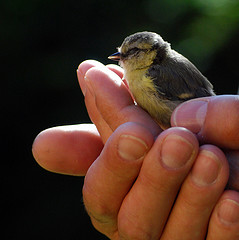
[photo: “A Bird in the Hand,” by Dave S., used under a Creative Commons license]

Go Eat a Bug! Seriously

WEBSITEento_cubes2_1259“Most of the world already eats insects,” says Arnold van Huis, entomologist at Wageningen University in the Netherlands and collaborator with the UN’s Food and Agriculture Organization. “It is only in the western world that we don’t. Psychologically we have a problem with it. I don’t know why. . . .”

These comments from van Huis appeared in The Observer, in 2010. Two years later, it seems that we westerners are not much closer to wide-scale acceptance of edible bugs. In a post last month, I had fun writing about entomophagy, but for people like van Huis, the eating of insects is a very serious topic.

It’s a serious topic for the folks behind the Ento project, too. If they have their way, insects will be an accepted part of our menus and shopping lists in the next ten years. Seriously.

The team behind Ento is made up of four postgraduate students at London’s Royal College of Art and Imperial College London. They are Aran Dasan, Jacky Chung, Jonathan Fraser, and Julene Aguirre-Bielschowsky, working with Kim Insu, a chef-in-training at Le Cordon Bleu.

They’ve put together a video, explaining their goals and methods, embedded below. In it, they lay out reasons for why we should all be eating insects, including the following:

  • The rapid growth in the world’s population requires us to look into alternatives for meeting the increasing demand for sustainable foods.
  • Compared to cattle, edible insects can provide nine times the amount of protein for the same amount of feed.
  • Insects are also lower in fat than beef.
  • Raising insects uses much less energy and space than traditional livestock and produces far less greenhouse gases.

But even with this information, and even though over 1000 different insects are already being eaten in 80% of the world’s countries, we in the West have a general disgust at the thought of eating bugs. Van Huis, a westerner himself, understands this. “It is very important how you prepare them,” he says. “You have to do it very nicely, to overcome the yuk factor.”

That’s where Ento comes in. They have developed a “roadmap,” consisting of 6 steps for introducing edible insects into the mainstream, culminating in the year 2020:

2012: Travel to festivals and markets WEBSITEento_entobox-closeup_1259to grab the attention of “adventurous eaters”
2013: Create the first Ento restaurant, serving insects in the form of innovative “entocubes”
2015: After opening more restaurants, market entocubes in “takeaway entoboxes” for lunch
2017: Sell a line of “ready meals” in supermarkets
2018: Introduce Ento ingredients for use in cooking
2020: Sell fresh insects as an accepted staple in the supermarket meat aisle

This seems like a rather aggressive plan, so I asked Fraser how things are going so far. He tells me that they are in the process of developing the roadmap above into a business plan. “Festivals and markets will still be a major goal for us in 2013, but we have also added event catering and pop-up restaurants to our plans.” All this to create a buzz about Ento. “Primarily we want as many people as possible to experience our food in a fun and social context,” he says.

So when will the first Ento restaurant be open for business? “As we improve our recipes and refine the Ento brand, a London restaurant will be our next major milestone,” says Fraser. And at this point in the progress, the restaurant opening is still on schedule: “We can’t reveal much about it at this stage, but it is in the works for later next year.”

And even though the group sees overcoming westerners’ aversion to entomophagy as a major obstacle, Fraser believes that once eating insects becomes more popular, then will come the biggest challenge: keeping up with demand. “At the moment we use external suppliers to source our insects, and currently the infrastructure base is quite small,” Fraser says. “This is why we proposed the creation of an adaptable network of urban farms that could meet the growing demand requirements as insects become accepted by more and more western eaters.”

The Ento team’s 10-year plan seems rather aggressive, but in an article in the design magazine Core77, they point out that something similar has happened before: Just three decades ago, they write, “tourist guides warned British tourists about the strange and off-putting Japanese habit of eating raw fish.” But now, sushi has become a global phenomenon.

Maybe, with the help of these creative students, it won’t take quite so long to get us eating bugs.

(Damian Carrington, “Insects Could Be the Key to Meeting Food Needs of Growing Global Population,” The Observer, July 31, 2010; “Case Study: Ento, the Art of Eating Insects,” February 27, 2012)

[photos from Ento, used with permission]

Cooking Up a Trip “Around the World”

8050162462_87cdc95d86_nBack when I was a kid, waaaaay back before self-serve soda dispensers, we used to ask our friends behind the counter for an “Around the World.” That meant we wanted a little bit of every flavor in one cup. Can’t say that it tasted so great, but it was fun. I see that others call it a “Suicide” or “Swamp Water.” As I said, it wasn’t the flavor that made us order it.

This past weekend, my family and I were at a Burger King that had a “Coca-Cola freestyle,” serving over 100 flavors of drinks out of one machine. It’s just one example of how our kids’ globe is shrinking. My Around the World recipe had only about six ingredients. Now there’s a lot more “world” available for them to go “around.”

So much for my intro. What I’m really looking at in this post are other kinds of recipes—ones that don’t make an Around the World, but ones that come from around the world. Want to cook up some piri-piri sauce, vartabit, or bun ho? Here are some recipe sites I’ve found that will show you how, and take you on a world tour along the way. (Each of these sites is searchable by ingredient, recipe name, or country, and a couple have background information on each region and its food.)

And in honor of the tradition that’s become a part of this time of the year—putting pumpkin flavor in just about everything that’s edible—here are some pumpkin recipes, one from each site:

Who knows, maybe Coca-Cola will take a cue from Maine Root Handcrafted Beverages and add another soda flavor to their drink machine: Pumpkin Pie.

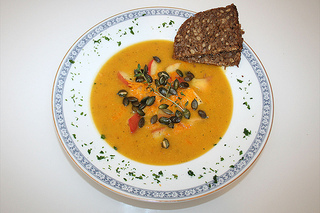
[photo: “Pumpkin carrot soup with cheddar, fried apples & pumpkin seeds,” by Blake JaBB, used under a Creative Commons license]

Eleven Tips for Helping Someone with Cross-Cultural Transitional Loss

7016973613_ded8a0eac1_mIf you want to help people in transition—cultural, geographic, and vocational transition—then you’ll need to deal with the grief that comes with their losses. Here’s a great resource for that, A LifeCare Guide to Helping Others Cope with Grief. (LifeCare is a leading provider of “work-life services.”) While this publication is aimed at comforting people who have lost a loved one, the advice it gives can be applied to those with cross-cultural transitional loss as well.

It opens with the second half of this quotation from Henri Nouwen, from Out of Solitude: Three Meditations on the Christian Life:

[W]hen we honestly ask ourselves which persons in our lives mean the most to us, we often find that it is those who, instead of giving much advice, solutions, or cures, have chosen rather to share our pain and touch our wounds with a gentle and tender hand. The friend who can be silent with us in a moment of despair or confusion, who can stay with us in an hour of grief or bereavement, who can tolerate not knowing, not curing, not healing and face with us the reality of our powerlessness, that is a friend who cares.

Here are eleven tips from Helping Others Cope with Grief to guide us in being that “friend who cares.” Each one is followed by a short excerpt to help explain the idea. I have, when necessary, replaced some words (in brackets) in order to to apply the advice to people experiencing loss due to cross-cultural transition—a group including all cross-cultural workers, their parents and family left back “home,” Third Culture Kids, expats, and repats:

  1. Mention the [lost relationships, places, and things], and acknowledge your awareness of the loss.
    . . . . Many people avoid mentioning the [loss], fearing it will remind the grieving person of his or her pain. . . . [B]ut behaving as if you don’t remember or are unaware of your [friend’s] pain often leaves him or her feeling very alone.
  2. Listen to your [friend].
    . . . . The most important thing you can offer someone who is grieving is your ability to listen without judgment. A good rule to follow is to listen 80 percent of the time and talk 20 percent. . . .
  3. Insist that your [friend] see a doctor if he or she exhibits signs of depression.
    Intense grief can lead to depression. If your friend seems unusually depressed or withdrawn, suggest that he or she seek professional help. . . .
  4. Encourage your [friend] to make wise choices.
    Urge the person who is grieving to pay attention to his or her own needs, and make choices accordingly. . . .
  5. Offer practical help; don’t wait to be asked.
    . . . . Make specific offers several times, and encourage your friend to take you up on your offers. Avoid phrases such as, “Let me know if I can help.” Usually, he or she won’t let you know for fear of imposing on you. . . .
  6. Remember that grieving is a long process.
    The person you care about may be grieving for a long time. Several months or more after the transition, he or she may actually be feeling the loss more acutely, and much of his or her support system will have backed off. . . .
  7. Offer your companionship.
    Your presence can be comforting to a grieving [friend]; you don’t have to do anything special. Often, grieving people just do not want to be alone.
  8. Don’t minimize the loss.
    Be careful not to say, “I know exactly how you feel.” . . . Instead, use statements such as, “I know this is difficult,” . . .  or some other statement that is heartfelt and accurate, but leaves room for the uniqueness of your [friend’s] experience.
  9. Encourage your [friend] to share his or her feelings.
    Avoid saying things like, “Be strong for…” or “Don’t cry.” This sends the message that you are uncomfortable with your [friend’s] intense feelings and, therefore, you will leave him or her emotionally alone. . . . Instead, encourage your [friend] by saying, “It’s okay to cry,” or “You don’t have to be so strong.”
  10. Help your [friend] create new traditions/rituals/activities.
    . . . . Holidays and other events filled with tradition can . . . be especially hard to deal with; try to help your [friend] discover new ways to experience these events. At the same time, he or she should be encouraged to cherish the memories and/or traditions associated with the [people and places no longer close by].
  11. Give advice cautiously.
    Avoid offering advice with phrases such as, “You should…” or “You need to….” . . . . Instead, give advice that encourages the grieving person to trust him or herself and make choices based on his or her needs, rather than on what others think he or she should be doing or feeling.

(A LifeCare Guide to Helping Others Cope with Grief, LifeCare, 2001)
[photo: “B,” by Eugene’s Likeness, used under a Creative Commons license]