Put Your Phone under a Bushel

Since having someone to listen to them is so important to missionaries and other cross-cultural workers, I thought I’d put together a list of ways to be a good listener. One of the first things I thought of was

Let the person you’re talking with know that you’re giving him your full attention by turning your cell phone to silent and putting it on the table.

phonecupSounds good, right?

Wrong. And here’s why:

Just having a cell phone in view, even when it’s not being used—even when it’s not turned on—hinders the development of relationships. This is the finding of a study conducted by Andrew Przybylski and Netta Weinstein, of the University of Essex, as published in the Journal of Social and Personal Relationships.

In the first of two experiments, Przybylski and Weinstein paired up strangers and asked them to talk about something that had happened to them over the past month. The participants left their belongings in a waiting area, and then they went to a private booth for their conversations. The booth contained two chairs, facing each other, with a table off to the side. For half of the pairs, on the table was a cell phone on top of a book. For the other half, the phone was replaced  with a pocket notebook.

The result was that partners who had a conversation in the presence of a cell phone felt less close to each other and had a lower quality of relationship compared to their counterparts who talked without a phone nearby.

Since the conversation in the first experiment dealt with a “moderately intimate topic,” the second experiment looked at the effects of a cell phone on less intimate conversations (about plastic trees) and more intimate conversations (about “the most meaningful events of the past year”).

In this exercise, the researchers continued to look at the quality of relationships and also added evaluations of the levels of trust and empathy. The results showed that the phone had little or no effect on those who were talking on the casual topic, but participants reported lower levels of relationship quality, trust, and perceived empathy when the phone was in view. And even though the more meaningful conversation topics encouraged more closeness and trust when the phone was absent, when the phone was present, the levels of intimacy were actually lower than when the topic was focused only on plastic trees.

It’s notable that these effects happened even when participants didn’t remember seeing the phone in the room.

So what is a good listener to do?

Here are some suggestions:

  1. Turn your phone to silent or turn it off. Turning it to vibrate won’t do. Anything that pulls your attention to the phone, even if you ignore it, will disrupt the relationship you’re trying to form.
  2. Don’t put your phone where it can be seen.
  3. You might suggest to your partner that he not get out his phone either. Explain to him how important your meeting is and tell him how you don’t want anything to hinder him or you. (Cross-cultural workers who have visited an embassy know what it’s like to have a meeting and have to leave their cell phones outside. If the meeting’s important enough, the sacrifice can be made.)
  4. If a true emergency requires you to keep your phone on, understand that you will be distracted not only by every call and text that comes in, emergency or not, but by the presence of the phone itself. At the very least, apologize and understand the limitations of a meeting under those conditions.

Don’t let your phone, or anyone’s phone, hinder you from fully investing in someone. Don’t let the Siren song of your social networks pull you away from the person across from you who needs a face-to-face conversation. And, of course, don’t be the person who answers calls, who texts, who tweets, and who checks Facebook while he’s supposed to be paying attention to the person in front of him. That’s not the way to grow a relationship, to foster trust, and to show empathy. And aren’t those the things that a good listener wants to do?

(Anddrew K. Przybylski and Netta Weinstein, “Can You Connect with Me Now? How the Presence of Mobile Communication Technology Influences Face-to-Face Conversation Quality,” Journal of Social and Personal Relationships, July 19, 2012)

[photo: “iPhone + COFFEE,” by Kondo Atsushi, used under a Creative Commons license]
Book a Trip to Raoul Silva’s Island Lair

While working on my post about Last Chance Harvey, I needed to find the location of a conversation between Harvey and Kate. My search not only led me to London’s Somerset House but to a slew of sites on the topic of “movie tourism,” as well, where I found that travelers can also visit the place where the wedding was filmed—Grosvenor House—and the setting for one of the couple’s walks—Belsize Park.

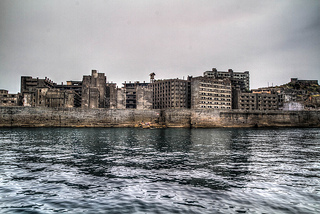
Now these places are impressive in their own way, but none of them is quite as fascinating as a locale in the latest James Bond film, Skyfall: the evil lair of Raoul Silva, 007’s latest nemesis. While the scenes inside Silva’s hideout were shot in a built-for-the-movie set at London’s Pinewood Studios, the long-distance shots are of a real-life place located nine miles off the coast of Japan—Hashima Island (pictured above). Not only does the island look sinister—a pile of abandoned and crumbling concrete apartment buildings jutting out of the ocean—but its backstory could supply an unsettling script for a film of its own. Clark Boyd, at PRI’s The World, writes that the island’s “true history is even creepier than you can imagine.”

Boyd goes on to give an overview of that history in this audio story (or you can read the article here).

Also, for a more in-depth treatment, including more details about life on the island, you can read Brian Burke-Gaffney’s article in the magazine Cabinet.

Hashima Island’s story in a nutshell is this:

In 1890 Mitsubishi bought the small outcropping of rock  for the coal that lay below the seabed underneath it. As coal production increased, so did the need for workers, and in 1916, the company built the first of many concrete structures to house them. In time, over 30 multi-story buildings were constructed, and in 1959 they were home to 5,259 people, including Japanese employees, their families, and forced laborers from China and Korea. Its 1,391 people per hectare (2.47 acres) in the residential area at that time is thought to be the highest population density ever recorded in the world.


Many of the people who lived on the island died there as well. Burke-Gaffney reports that by mid 1949, around 1,300 residents had lost their lives—from mining accidents, exhaustion, or malnutrition. “Still others had chosen a quicker, less gruesome death,” he writes, “by jumping over the sea-wall and trying in vain to swim to the mainland.”

In the late 1960s, petroleum replaced coal as Japan’s preferred energy source. Then, in 1974, Mitsubishi closed the mine, and all the inhabitants still there hastily left.

Following is a short documentary by Swedish filmmaker Thomas Nordanstad. In the film, Nordanstad follows Dotokou Sakamoto, a Japanese man who moved to Hashima Island with his family at the age of four, as he visits, among other places, the “hotel,” where new arrivals awaited permanent housing, his school, and the crumbling remains of his family home.

At the beginning of the documentary, Sakamoto says,

Some people say that your roots exist in the place where you were born, but that’s not the case for me. My roots are here, in this place.

And at the end, he adds,

In Japan, things are being thrown away so easily, just like that. But you can’t throw away your memories. The roots sit there, in your heart.

While the bulk of the island is closed to the public, in 2009 observation decks were opened at the island’s edge, with the boat ride from Nagasaki and a tour costing about $50.

To find the rest of the venues featured in Skyfall, go to The Worldwide Guide to Movie Locations, the self-described “ultimate travel guide to film locations around the world.” It’s a great resource that ties detailed info on places with plot points in the movie. And if you want to look up a film that’s not included there, you can try IMDb (International Movie Database). The location info there is less specific, but its movie list is much more comprehensive. (Search for “Filming Locations” on a movie’s page.)

(Clark Boyd, “The History of Hashima, the Island in Bond Film ‘Skyfall,'” PRI’s The World, November 23, 2012; Brian Burke-Gaffney, “Hashima: The Ghost Island,” Cabinet, Summer 2002)

[photos: “Nagasaki Hashima Island (端島) Gunkajima Tour” (top and bottom) by Ronald Woan, used under a Creative Commons license]

The Britishisms Are Coming! So Are the Americanisms! Is Any Language Safe?

In his new book, All the Countries We’ve Ever Invaded: And the Few We Never Got Round To, British historian Stuart Laycock claims that Britain has attacked more nations than any other. In fact, according to Laycock, Britain has “invaded, had some control over, or fought conflicts in the territory of something like 171 out of 193 UN member states in the world today (and maybe more).”

Of course, Britain’s incursions aren’t limited to the military variety. Who hasn’t heard of the British Invasion, when the Beatles and Rolling Stones came to American shores? And now those sneaky Brits are at it again.

It’s Enough to Get One’s Knickers in a Twist

This time they’re assailing something as personal to us Americans as our English language. (Yes, yes, we originally got it from them, but we’ve made it our own.) The headlines speak for themselves:

We have Ben Yagoda, a professor of English at the University of Delaware, to thank for keeping track of the incursions. Such is his acumen, his work is sourced in each of the articles above. Yagoda’s blog, “Not One-Off Britishisms,” keeps track of the invasion as it occurs, one word and phrase at a time. Britishisms such as spot oncheekychippy, and have a look have already taken up residence within our borders, and it looks as if there are more to come, what with Harry PotterDowntown Abbey, and Doctor Who helping with the assault.

American Offensives and Offenses

In all fairness, though, as an American, I must admit that my country has done its fair share of invading over the years, militarily and culturally. And evidence suggests that this most recent verbal offensive by the British might actually be a counter offensive.

Take, for instance, the following from Alistair Cooke’s 1984 radio broadcast, Letter from America. The host of PBS’s Masterpiece Theater for 20 years, Cooke had one foot planted firmly on each side of the Atlantic, being born in Lancashire and later becoming an American citizen. Letter from America ran for 58 years, and the BBC has just recently put over 900 of Cooke’s audio installments online.

The “letter” of note is “Americanisms,” in which Cooke discusses American words that have made the jump across the pond. There’s caucus and pow-wow (both of which came initially from American Indians) and hunky-doryparolescientist, and awful.

French and Chinese under Siege

French has not been immune to the encroachment of English, as well. (Granted, this isn’t all the fault of us Americans. Maybe we should consider it a joint invasion from the US and Britain.) An article in Les Echos gives several examples of Franglais in the French business world, which now “has French people talking about ‘addressing’ problems, ‘delivering’ solutions, attending ‘meetings’ and ‘workshops’ and ‘conf calls.'”

Finally, we can’t ignore the awful things that American English is doing to the Chinese language. According to Jin Zhao, of the blog Things You Don’t Know about China, online Chinese have latched onto Oh my Lady Gaga!—a phrase from the TV series Ugly Betty and a variation on the globally ubiquitous Oh my God. (Now there’s a phrase I wish we could put a stop to.) And then there’s “Chinglish” like geilivable, a combination of the Mandarin gei li, meaning “give” and “strength,” and the English adjective ending able. The result means something like “cool” or “impressive.”

Chinese innovators have also created new words completely out of English, such as antizen (from ant and citizen) for “college graduates who share a small apartment with several roommates, working hard, yet making little money,” and smilence, meaning “smiling silently” to show mutual agreement.

Is the government of China taking this lying down? Of course not. Two years ago, China’s People’s Daily Online reported that the General Administration of Press and Publication had declared a ban in official publications on geilivable and other forms of “abuse of foreign languages, including arbitrary use of English words; acronym mixing in Mandarin and coined half-English, half-Chinese terms that are intelligible to nobody.” “All these have seriously damaged to [sic] the purity of the Chinese language,” says People’s Daily, “and resulted in adverse social impacts to the harmonious and healthy cultural environment.”

Maybe It’s Nothing to Be Gobsmacked About

So what are we to do? What is the world to do? Maybe we can learn from Alistair Cooke, who says, given time, it will all be OK. “The invasion of Americanisms into Britain is never a problem to any generation born after a particular invasion,” he asserts, “since they don’t know they were invaded, but only to the generation that can see the invaders offshore.”

So no worries. Carry on.

(Stuart Laycock, All the Countries We’ve Ever Invaded: And the Few We Never Got Round To, History Press, 2012; Alistair Cooke, “Americanisms,” Letter from America, BBC Radio, February 24, 1984; Philippe Bertrand, “Franglais: How English is Ruining the French of the French,” Worldcrunch, July 21, 2012, translated from “Le Français, l’Anglais et Notre Crise d’Identité” Les Echos, July 19, 2012; Jin Zhao, “‘Oh My Lady Gaga! This Is So Geilivable!’: Chinglish Entering Globish?” Things You Don’t Know about China, June 4, 2011; Li Mu, “Authorities Ban Mixed English Words ‘Ungelivable’ in Publications,” People’s Daily Online, December 21, 2010)

Thanks to Chris WoolfClark Boyd, and Patrick Cox of PRI’s The World, whose stories pointed me towards much of the the source material above. Well played! I say. Well played!

[photo: “250th Fort Necessity,” by ryanophilly, used under a Creative Commons license]

Reconciling the Planetal and the Personal: Anne Morrow Lindbergh’s Lessons from the Beach

Planetal awareness.

That’s what Anne Morrow Lindbergh, in  Gift from the Seacalls an attentiveness to what is going on around the globe. In her bestselling book, she wonders how we can balance a “planetal point of view [which] has burst upon mankind” with a “search for outward simplicity, for inner integrity, for fuller relationship.”

Throughout Gift from the Sea, she examines shells that she finds during a respite by herself at the beach, finding lessons from them on how to escape the constant distractions and overwhelming demands of life. It is in the final chapter, entitled “The Beach at My Back,” that she discusses the need to return from the seashore while remembering what was learned there.

Lindbergh’s book was published in 1955, and it uses the language of her day (planetal has since given way to global, and the Internet has replaced “public print” as the dominant media), but it is striking how much her thoughts apply to our present world, with the flood of global information and news threatening to overwhelm our senses and our empathy. She writes,

The world is rumbling and erupting in ever-widening circles around us. The tensions, conflicts and sufferings even in the outermost circle touch us all, reverberate in all of us. We cannot avoid these vibrations.

But just how far can we implement this planetal awareness? We are asked today to feel compassionately for everyone in the world, to digest intellectually all the information spread out in public print, and to implement in action every ethical impulse aroused by our hearts and minds. The interrelatedness of the world links us constantly with more people than our hearts can hold. Or rather—for I believe the heart is infinite—modern communication loads us with more problems than the human frame can carry. It is good, I think, for our hearts, our minds, our imaginations to be stretched, but body, nerve, endurance and life-span are not as elastic. My life cannot implement in action the demands of all the people to whom my heart responds. I cannot marry all of them, or bear them all as children, or care for them all as I would my parents in illness or old age. Our grandmothers, and even—with some scrambling—our mothers, lived in a circle small enough to let them implement in action most of the impulses of their hearts and minds. We were brought up in a tradition that has now become impossible, for we have extended our circle throughout space and time.

Faced with this dilemma what can we do? How can we adjust our planetal awareness to our Puritan conscience? We are forced to make some compromise. Because we cannot deal with the many as individuals, we sometimes try to simplify the many into an abstraction called the mass. Because we cannot deal with the complexity of the present, we often over-ride it and live in a simplified dream of the future. Because we cannot solve our own problems right here at home, we talk about problems out there in the world. An escape process goes on from the intolerable burden we have placed upon ourselves. But can one really feel deeply for an abstraction called the mass? Can one make the future a substitute for the present? And what guarantee have we that the future will be any better if we neglect the present? Can one solve world problems when one is unable to solve one’s own? Where have we arrived in this process? Have we been successful, working at the periphery of the circle and not at the center?

The answer, writes Lindbergh, is to affect the wider circles of the there, the future, and the mass by concentrating on—by enjoying—the centers of “the here, the now, [and] the individual and his relationships.” We must leave the beach, but we leave with our pockets full of shells, reminding us how to “find again some of the joy in the now, some of the peace in the here, some of the love in me and thee which go to make up the kingdom of heaven on earth.”

“It may be our special function to emphasize again these neglected realities,” writes Lindbergh, “not as a retreat from greater responsibilities but as a first real step toward a deeper understanding and solution of them.”

____________________________________

In 1929, Anne Morrow Lindbergh married Charles Lindbergh, already a worldwide celebrity, being the first person to fly from New York to Paris. They met when Charles visited Anne’s family in Mexico, where her father was serving as ambassador from the US.  After their marriage, Anne learned to fly and became Charles’s copilot and navigator as the two flew the globe exploring and mapping out routes.

Though America’s “first couple of the air” seemed destined to live out a fairy tale, their life together was beset by turmoil. Tragedy struck their family in 1932 when the Lindbergh’s 20-month-old son was kidnapped and killed. A highly sensationalized trial resulted in the conviction of Bruno Richard Hauptmann, who was later executed for the murder. To escape the media and public attention, the Lindberghs moved secretly to Europe, living in England and France for over three years.

A theme through much of Anne’s writing is the struggle to find the right path in the face of outward pressures and distractions. In living out this struggle in her own life, she sometimes made regrettable decisions. As Hitler began his offensive in Europe, Anne wrote The Wave of the Future, declaring the inevitability of fascism and calling for America not to oppose the Nazis. Also, in a letter, she called Hitler “a very great man, like an inspired religious leader—and as such rather fanatical—but not scheming, not selfish, not greedy for power.” In her personal life, too, Anne had her failings, having an affair with her doctor shortly after writing Gift from the Sea. (Unknown to Anne, Charles was later unfaithful to her, fathering seven children by three women in Europe.)

Anne wrote more than a dozen books, with Gift from the Sea being her most popular. She died in Vermont in 2001, at the age of 94.

(Anne Morrow Lindbergh, Gift from the Sea, New York: Pantheon, 1955)

[photo: “Mr. and Mrs. Lindbergh,” Courtesy of the Boston Public Library, Leslie Jones Collection, used under a Creative Commons license]

Get Steve McCurry’s “Afghan Girl” for $8,000 or More, or How about Much, Much Less?

Most online introductions of Steve McCurry say something like “He’s the guy who took the photo of the Afghan girl.” Yes, his portrait of Sharbat Gula, a girl in a refugee camp, was featured on the cover of National Geographic in 1985—and became one of the most recognized photographs of all time. But it should also go without saying that McCurry has produced many, many more remarkable photos over his career. He continues to travel the world, capturing the images as they develop before him. As reported in the blog CNN Photos, his philosophy is “travel to a place, work with the locals, and see what emerges.”

If you’d like to own some of McCurry’s photos, including Afghan Girl, there are numerous ways to acquire them, covering a wide range of budgets—from really, really expensive to free. Just in time for Christmas, here are your pricing options, arranged for your convenience from highest to lowest:

$8,000 to $12,000 (estimate)
For the first time, the National Geographic Society is auctioning off some of its vast collection of 11.5 million photographs and illustrations. The sale will take place December 6, at Christie’s, and will include a special print of McCurry’s Afghan Girl. The 240 pieces offered are expected to bring a total of about $3 million, so don’t expect too many bargain-basement prices. (For an update on the auction, see “Sorry You Weren’t the One to Buy ‘Afghan Girl.’“)

Something less than $8,000, I presume
McCurry offers signed fine-art prints of his work at his website. A pdf catalog is available, but prices aren’t included. If you want to find out how much a print costs, you’ll need to contact a lady named Bonnie.

$65
Also available at McCurry’s site. At this price you can get a 20 x 24 inch poster of one of ten McCurry photos. Proceeds go to Imagine Asia.

$37.46
McCurry has just published a new book, titled Steve McCurry: The Iconic Photographs. It covers his best of the best (165 images) from the last 30 years. Amazon sells the standard hardback at the above price, but if you absolutely have to spend more, there’s the deluxe edition for $248.85 and a signed edition at Phaidon for $79.99.

Free
If you’re like me, then browsing the photos on the Internet will have to do for now. But it’s not a bad alternative. It certainly gives you the best selection. Several of the links above can get you started, but for the most images, go to the galleries at stevemccurry.com. Wow, he definitely has had some amazing things “emerge” in front of his lens.

Hear McCurry tell how he captured the photo Beggar Girl, Bombay, India:

(Elizabeth I. Johnson, “Curiosity Inspires Iconic Photographer,” CNN Photos; Ula Ilnytzky, “National Geographic to Auction Famous Photos, Art,” San Francisco Chronicle, October 23, 2012)

[top photo: “Steve McCurry Exhibit,” by Steve Evans, used under a Creative Commons license; Bottom photo: “Occhi che scrutano” (Eyes that stare), by Giuseppe Nicoloro, used under a Creative Commons license]

Better the Disappointment You Know?

Just last week, my wife and I watched Last Chance Harvey (2008) for the umpteenth time—well, maybe not the umpteenth time, but at least the umpth time. It evokes some particular emotions for us, as we first watched it on a plane ride back to the States during our time in Asia. We were coming back with some disappointments, and the movie—especially a conversation near the end—resonated with each of us. If you’re not familiar with the story, here’s a short synopsis, leading up to that exchange:

Harvey Shine (Dustin Hoffman) is a down-on-his-luck jingle writer from New York, flying to London for his daughter’s wedding. Kate Walker (Emma Thompson) is a Heathrow employee with the tedious job of interviewing travelers. Their first meeting begins with Kate’s attempts to ask Harvey the questions on her clipboard. It ends with Harvey rudely brushing her off.

Not only are things going poorly for Harvey on the job front, but he later finds out that his daughter has chosen her stepfather to walk her down the aisle—and there are obviously some family skeletons that reside in Harvey’s closet.

Things begin to look up, though, when Harvey meets up with Kate the next day at a Heathrow bar. Harvey has just missed his flight back to the States, and Kate is using a novel as an escape from failed blind dates and phone calls from her mother, with whom she lives.

Over the next several hours, Harvey and Kate begin to enjoy each other’s company, and they even see glimpses of a happy future together. The two attend Harvey’s daughter’s wedding reception and then wander around London, ending up at the fountains at Somerset House. They agree to meet there again at noon the next day. A spirited climb up his hotel steps puts Harvey in the hospital, just long enough to keep him from making the appointment. Not knowing the cause, Kate is crushed at having her emotions stood up . . . again.

Harvey tracks Kate down, even though she no longer wants to see him. She is wounded and fears being wounded even more. As Harvey tries to convince her that she should give their relationship a chance, they have their pivotal conversation, in which Kate says,

I’m not going to do it. I’m not going to do it, because it’ll hurt. . . . and I won’t do it. . . .

You see, what I think it is, is . . . is that I think I’m more comfortable with being disappointed. I think I’m angry with you for trying to take that away.

Since we were escorting our five children across the Pacific, my wife and I were separated during our flight, catching pieces of movies on our individual screens in between naps and meals. Sometime later during the trip, our youngest was asleep and we got to sit together for a while. We’d both watched Last Chance Harvey, and we both remembered what Kate had said. At the time we understood that even though disappointment is painful, it can become more comfortable than hoping for miracles and risking deeper loss. Maybe that’s why we continue to watch the film from time to time. . . because we still understand that. And when fear accompanies hope, as it often does, we do our best to press on, more guarded, but pressing on.

Last Chance Harvey doesn’t end with “happily ever after,” but it does end with a hopeful beginning. Harvey decides to stay longer in London, and Kate agrees to open her heart to the possibilities with him. As the two start down this new road together, Harvey remembers their first encounter and asks Kate to continue the interview that she’d started with him at the airport. She does:

“Name?” she asks.

He replies, “Harvey Shine.”

“Place of residence?”

“I’m in transition.”

Here’s the trailer:

And here’s a “Back Stage interview with Thompson and Hoffman, in which they talk about the mood and personality of the movie. When discussing the on-screen relationship between the two characters and how that was reflected in the film-making process, Hoffman says,

I always said that you always know who your friends are [. . . .] Your really good friends are the people that you can sit at a table with and not talk [. . . .] And we said, whatever the specialness about that relationship was, could we do this movie like that?

[photo: “Yellow Point: Somerset House Fountains,” by Tania Caruso, used under a Creative Commons license]

Managing Missionary Finances: New Book Launched This Week

What is the number one stressor for missionaries? According to the results of a survey conducted by member-care trainer Brenda Bosch, the answer is “financial pressure.”

Not only can a lack of funds cause headaches, but so can keeping track of income and outflow, reporting to supporters, handling exchange rates, filing taxes . . . and the list goes on. I dare say that most missionaries don’t enter the vocation because of a love for bookkeeping, so any help on the financial-tracking front is welcome.

One such help is Money Management for Cross-Cultural Workers, written by Ryan Eidson, of Copper Coin Coaching. This workbook is targeted at missionaries who, for tax purposes, are considered self-employed, but it contains a wealth of information for all people working overseas—regardless of their particular financial situation.

Organized as a 90-day tutorial, Money Management leads the reader through a step-by-step process for understanding, organizing, and tracking funds, developed by Eidson and his wife while they served as missionaries in East Asia. The book also includes access to a spreadsheet template—with detailed instructions on using it—links to audio interviews with experts in the field, discussions of the Biblical principles guiding financial decisions, and links to and summaries of many applicable documents from the IRS.

While I and my family served as direct-support missionaries in Taiwan, we followed the financial guidelines of our missions organization, but Eidson’s book would have certainly been a valuable tool in helping us in answering questions that, at the time, we didn’t even know to ask. For me, one of the big stressors of our financial year was filing taxes. Not only was I sometimes confused by all the forms and schedules and rules, but it was tax time that often made me rethink my figures from throughout the previous year. About two-thirds of the way through his daily lessons, Eidson gives these encouraging words: “Remember, after you complete this entire workbook, you won’t have to fret when tax season comes. You’ll have all your records ready. Press on!”

Discounts for “Launch Week”

During this week’s launch of the second edition of Money Management for Cross-Cultural Workers, the Kindle version is available free at Amazon today and tomorrow (Nov. 13 and 14). Also, Eidson is giving away a set of free bonus digital goods to those who purchase the book this week. Details here.

(Brenda Bosch, “Summary of Missionary Survey Outcomes,” Global Member Care Network Conference, April 2012)

[photo: “Foreign Currency and Coins,” by Philip Brewer, used under a Creative Commons license]

New Data Show a Record Number of International Students in the US, Let’s Welcome Them

Several years ago my family and I were finishing up our Chinese New Year’s Day at a local Taipei mall. While we stood in front of a KFC and contemplated our “festive” holiday plans, taking some food home and maybe renting a movie, a Taiwanese lady walked up to us and asked in English, “Would you like to come to my home and eat a traditional Chinese New Year’s meal?”

“But our family is so large,” we said.

Not a problem.

“Can we bring something?”

Not a thing.

But it was already 5:00 and the meal was at 6:00.

“That’s OK, we live close by, and we can come pick you up at your house.”

We accepted the invitation but protested again about all the trouble we were causing.

Her response? When she was a university student in Texas two years earlier, a family had invited her into their home, and she wanted to pass it on. (Three cheers for southern hospitality.)

Increase of International Students Remains Steady

Figures released today in the 2012 Open Doors Report on International Educational Exchange show that the number of international students studying at US colleges and universities during the 2011/12 school year hit an all-time high. The 764,495 students from countries outside America represents a 6% increase over the previous year.

The new data mean that the number of international students has increased for six years in a row and that over the last 10 years, the total has grown by 31%.

“International education creates strong, lasting relationships between the US and emerging leaders worldwide,” says Ann Stock, Assistant Secretary of State for Educational and Cultural Affairs. “Students return home with new perspectives and a global skill set that will allow them to build more prosperous, stable societies.”

Allan E. Goodman, president and CEO of the Institute of International Education, publisher of the annual Open Doors report, adds, “Academic and intellectual exchange fuels innovation and prepares the next generation for global citizenship. Today’s students will become future business and government leaders whose international experience will equip them to build a prosperous and more peaceful world.”

China Leads Surge of International Undergrads

For the first time in 12 years, the number of international undergraduate students has surpassed the number of international students attending graduate school. This is in large part because of China, which sent 194,029 students to the US in 2011/12. This is an increase for that country of 23% overall and 31% for undergraduate students. Saudi Arabia showed large increases in undergraduate enrollment, as well.

The top ten countries sending students to the US in 2011/12 were

  1. China
  2. India
  3. South Korea
  4. Saudi Arabia
  5. Canada
  6. Taiwan
  7. Japan
  8. Vietnam
  9. Mexico
  10. Turkey

The ten schools receiving the most students were

  1. University of Southern California
  2. University of Illinois—Urbana-Champaign
  3. New York University
  4. Purdue University
  5. Columbia University
  6. University of California—Los Angeles
  7. Northeastern University
  8. University of Michigan—Ann Arbor
  9. Michigan State University
  10. Ohio State University

Now It’s Your Turn

We had a wonderful time that evening in Taipei, sharing a wonderful meal with our new friend, her mother, and her two brothers and their families. We ate our fill, and the mother gave each of our kids hong bao, the traditional gift of red envelopes with money inside.

For all of you who have shown kindness to international students (and other “outsiders”) by inviting them into your homes, we thank you. In Taiwan, we were the outsiders, but our Chinese New Year was brightened because a Texan’s kindness toward a student from Taiwan made a difference for us.

With Thanksgiving and Christmas coming up, are there international students close by you who could benefit from your kindness? You don’t have to live near one of the top-ten campuses to have internationals in your community. One of the great thing about international students in the US is that they attend all sorts of institutions of higher learning—large and small, four-year and two-year, universities and community colleges—all over the country

And by helping the students near you, you may also be helping future American students studying overseas. The number of study abroad students from the US has tripled over the past 20 years. Add to that the thousands of Americans living, working, and traveling in other countries, and that means the odds are growing that your friends or relatives will someday be outside the US, hoping for someone to show them hospitality. Maybe someone will come up to them and invite them for a meal or a cup of coffee and say, “When I was a university student in America, someone invited me.”

[photo: “ISA S’Mores,” by Lafayette College, used under a Creative Commons license]