TCK Theater

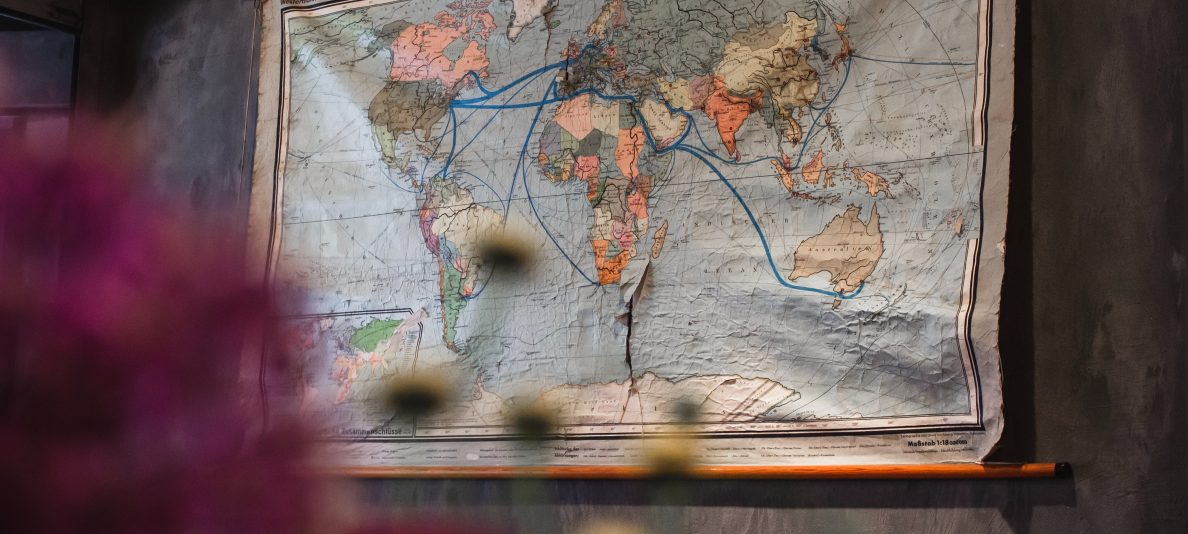
The first video below is one I’ve seen posted recently on a couple TCK blogs. It was made by a student at Georgetown University. Really well done. Then when I went to its Vimeo site, I read the comments section and saw links to the three others here. Some have been around for a while, but they’re all new to me. Enjoy:

So Where’s Home? A Film about Third Culture Kid Identity, Adrian Bautista

A short documentary that “explores the unique perspectives and identities of Third Culture Kids, people who have spent a significant portion of their childhood overseas.”

Teaser for Neither Here nor There, Ema Ryan Yamazaki

This teaser introduces a 35-minute documentary, also by a college student, that “investigates the often overlooked effects on adults who had international upbringings, their struggles to fit in and an eternal search to belong.” The full video is available for purchase here.

Trailer for Les Passagers: A TCK Story, Aga Magdolen

This trailer is for a documentary “about Third Culture Kids and their journey to find where they belong.”

Thoughts on Traveling, Sanii Fiina

By another university student, this is kind of a visual, multi-language poem. It’s an “idea based on identity and how different languages can create one nationality… or something like that!”

Soap and Water for the World

When Ugandan Derreck Kayongo first stayed in an American hotel in the 1990s, he was surprised to see that his partially used bar of soap was replaced with a new one each morning. He told CNN (Ebonne Ruffins, “Recycling Hotel Soap to Save Lives,” June 16, 2011) that he thought he was being charged for it, so he tried to return the new soap to the concierge. After learning that it was complementary—and the old soap had been thrown away—Kayongo, the son of a former soap maker in Uganda, decided to become a middleman to get the used soap to those who need it. In 2009, Kayongo and his wife, Sarah, founded the Global Soap Project. The organization receives used soap from over 600 hotels across the US, then cleans, processes, and remolds it into new bars. As of February of this year, they had distributed over 250,000 bars of soap to 21 countries, including Haiti, Kenya, South Sudan, Guatemala, and Afghanistan.

As a child, Kayongo and his family fled Uganda to live in Kenya, escaping the dictatorship of Idi Amin. There he saw the conditions of the refugee camps, where basics like soap were scarce. According to the Global Soap Project, many places in the world today have the same problem. Their “Soap Facts” page gives the following information:

  • 1.4 million deaths can be prevented each year by handwashing with soap
  • Children under 5 who wash with soap can reduce their risk of pneumonia by 50%
  • 1/3 of the world’s soap is used by the U.S
  • 7 million children have died due to disease that could have been prevented with proper hygiene since 2009
  • 2.6 million bars of soap are discarded daily by the hotel industry in the U.S. alone

Between the two of them, the Kayongos have spent many years in humanitarian relief, working for such NGOs as World Vision, CARE International, Amnesty International, and the American Friends Service Committee. But it is his work with the Global Soap Project that has garnered Mr. Kayongo the most attention, making him one of CNN’s “Top 10 Heroes” last year. He told CNN,

As a new immigrant and a new citizen to this country, I feel very blessed to be here. But it’s important, as Africans living in the Diaspora, that we don’t forget what we can do to help people back at home. It’s not good enough for us to complain about what other people aren’t doing for us. It’s important that we all band together, think of an idea and pursue it.

In February, Christianity Today ran the story “Cost Effective Compassion: The 10 Most Popular Strategies for Helping the Poor” (February 17, 2012), in which the author, Bruce Wydick, had asked “top development economists” to rank development programs for their cost effectiveness. “Soap” wasn’t on the list, but it is similar to the kinds of projects at the top: those that provide direct aid to individuals to meet immediate health needs. Here is the list, starting with the most effective—

  1. Clean water for rural villages
  2. De-worming treatments for children
  3. Mosquito nets
  4. Child sponsorship
  5. Wood-burning stoves
  6. Microfinance loans
  7. Reparative surgeries
  8. Farm animals
  9. Fair-trade coffee
  10. Laptop computers

In the CT blog Her.meneutics, Elrena Evans (“Amid Bribery Scandal, Wal-Mart Contest Attracts Christians” April 25, 2012) wrote that the bottled-water company, HumanKind Water (HKW), had reached the top ten in Wal-Mart’s “Get on the Shelf” contest. The competition had product developers vying for online votes, with the overall winner receiving a contract to sell its item in Wal-Mart’s Web and brick-and-mortar stores. Evans highlighted HumanKind because the companies founder, T. J. Foltz, is a former Christian youth minister and because 100% of HumanKind’s profits go to providing clean water to needy communities around the globe. She also pointed out that the group’s strategy was consistent with the findings of the CTarticle above. HKW started bottling water in October of last year, and Foltz found out about Wal-Mart’s contest only three months later. “Our entire marketing plan got put on hold, and we went all in on plans to try and win this competition,” said Foltz. “Literally a half an hour after I got that e-mail, we were strategizing on how we could try and win this thing.”

And win it they did, as the Wal-Mart corporation announced HKW as the top vote getter on May 3.

So  the next time you’re at a hotel, ask them if they’ve heard about the Global Soap Project, and the next time you’re at Wal-Mart, look for HumanKind Water (it should be there soon).

[photos: “Scavenger Hunt – Bar of Soap,” by Lucille Pine, used under a Creative Commons license; “Soap,” by Sam Sabbagh, used under a Creative Commons license]
Thank You, Nurses, Wherever You Are

Nurses. They’re people you’d rather not need, but when you do, they can be angels of mercy. And no matter what language they speak, no matter the color of their skin, no matter the style of their uniform, we are grateful for the care they give and healing they bring.

Today is International Nurses Day. In honor of that, here is a link to a collage of photos showing nurses uniforms from around the world, circa 1950. Buried deep in a Wired post entitled “Rare, Beautiful, and Disturbing Objects from the National Library of Medicine” (Betsy Mason, April 2, 2012), the photos come from the Helene Fuld Health Foundation.

Nurses. We need more of them. While the US has a shortage, some of the shortfall is made up by recruiting from other countries. The US doesn’t have the most nurses per capita, but we’re much closer to the top than to the bottom. Below are the 15 countries with the highest density of nurses and midwives (showing the number per 1000 population), followed by the 15 countries with the least—using the most recent data available from the World Health Organization:

  1. Iceland 16.48
  2. Switzerland 15.96
  3. Ireland 15.67
  4. Finland 15.52
  5. Norway 14.76
  6. Denmark 14.54
  7. Belarus 12.56
  8. Sweden 11.57
  9. Luxembourg 11.32
  10. New Zealand 10.87
  11. Germany 10.82
  12. Uzbekistan 10.81
  13. United Kingdom 10.30
  14. Canada 10.05
  15. USA 9.82

  1. Guinea .04
  2. Somalia .11
  3. Niger .14
  4. Netherlands .15
  5. Sierra Leone .17
  6. Bhutan .24
  7. Ethiopia .24
  8. Tanzania .24
  9. Bangladesh .27
  10. Liberia .27
  11. Togo .27
  12. Malawi .28
  13. Belgium .3
  14. Mali .3
  15. Mozambique .31

(“Health Workforce: Aggregated Data, Density per 1000,” Global Health Observatory Data Repository, World Health Organization)

[photo: “Nurse Roberta,” (c1949) by Douglas Coulter, used under a Creative Commons license]

Maybe the Best Exotic Marigold Hotel is #19

When it comes to global best-of lists, I gravitate toward ones that point to something cheap (like “10 Fast Food Items You Can’t Have“), rather than pricey (like “The World’s 50 Best Restaurants“). I think that “The 18 Best Places to Retire Overseas” (Kathleen Peddicord, US News & World Report, March 19, 2012) falls closer to that second category, even though the author promises that these locations are places where “an interesting, adventure-filled lifestyle is available for a better-than-reasonable cost.” But I’m printing the list here anyway, if for no other reason than to show that Jaipur, India, didn’t make the cut.

  1. Panama
  2. Belize
  3. Colombia
  4. Uruguay
  5. Ecuador
  6. Nicaragua
  7. Roatan, Honduras
  8. Argentina
  9. Mexico
  10. Chile
  11. France
  12. Italy
  13. Ireland
  14. Spain
  15. Croatia
  16. Thailand
  17. Vietnam
  18. Malaysia

So what’s so special about Jaipur? That’s the destination of the seven British retirees in the movie The Best Exotic Marigold Hotel, which opened in US theaters this past weekend. Maybe if the film does well, the “Pink City” (as Jaipur is called), or Udaipur, where much of the movie was shot, will find a place on future lists.

Good movie? I haven’t seen it yet, but I’ve heard good things about it. One person who saw it and liked it is an adult TCK who grew up in a place not too far culturally from Jaipur. Read her review at Communicating Across Boundaries.

[photo: “Jaipur Lake Palace,” by jkuba!, used under a Creative Commons license]

Cultural Plate Tectonics

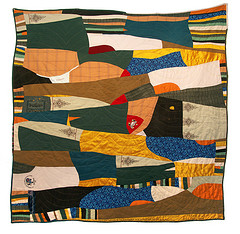
Since we’re all globally savvy, we could find all the countries on a world map, right? (Well, most of them . . . at least the big ones.) But could you locate the countries on a map arranged by culture? That’s the kind of map that the World Values Survey has produced, with each nation positioned along two axes: Traditional/Secular-rational and Survival/Self-expression. The result is a graphic on a square grid that puts like-minded countries into distinct groupings, like the stitched-together pieces of an abstract quilt.

The Traditional/Secular-rational scale measures the importance placed on religion, while Survival/Self-expression distinguishes, in large part, between the haves and the have-nots, where the survival cultures are concerned with basic needs, and the self-expression cultures focus more on “subjective well-being” and “quality of life.”

The countries that sit closest to the four corners of the 2005-2008 map are

  • Taiwan, Hong Kong, and Bulgaria: Secular-rational and Survival
  • Zimbabwe and Morocco: Traditional and Survival
  • Sweden: Secular-rational and Self-expression
  • US and Ireland: Traditional and Self-expression

This more recent layout is interesting, but what makes it even more interesting is to see how it compares with the 1999-2004 map, showing the shifting of cultures over time.

Both maps are part of an article, “The WVS Culture Map of the World,” written by Ronald Inglehart and Christ Welzel. After explaining the survey findings, the authors go on to evaluate them as they relate to the development of democracy in societies around the globe, giving particular attention to the correlation between the move toward self-expression and, therefore, interpersonal trust:

This produces a culture of trust and tolerance, in which people place a relatively high value on individual freedom and self-expression, and have activist political orientations. These are precisely the attributes that the political culture literature defines as crucial to democracy.

This seems to be a basic theme of the World Values Survey organization. My guess is that not everyone across political and ideological spectrums agree with their conclusions. But their interpretation of the survey results are certainly thought provoking, especially in light of recent world events, such as the Arab Spring.

[photo: “Blue Mountain Center (September 2007),” by Sherri Lynn Wood, used under a Creative Commons license]

On Second Thought: Your Second-Language Decisions May Be Better

If you learn a second language, there’s evidence that thinking in that language leads to better decisions. Citing research from the University of Chicago, Tom Jacobs reports in Pacific Standard that “using one’s second language reduces or eliminates certain biases that otherwise infiltrate our decision-making.”

In the abstract to their article in Psychological Science, the researchers state that one would assume

that the difficulty of using a foreign language would make decisions less systematic. We discovered, however, that the opposite is true: Using a foreign language reduces decision-making biases. Four experiments show that the framing effect disappears when choices are presented in a foreign tongue. Whereas people were risk averse for gains and risk seeking for losses when choices were presented in their native tongue, they were not influenced by this framing manipulation in a foreign language.

It seems that decisions made in a second, and therefore less familiar, language are more rational, depending less on emotional responses. One of the researchers’ experiments dealt with a game in which participants were presented with a choice to either keep a dollar or to bet it on a coin toss, given certain factors. The statistically wise move would be to take the bet, but those using their first language were less likely to bet the money. On the other hand, those who heard the presentation in their second language were more likely to make the bet. In other words, the first group listened to their ingrained, less-rational fears, while the second group thought through the situation more clearly.

So how would this affect everyday life? “People who routinely make decisions in a foreign language rather than their native tongue might be less biased in their savings, investment, and retirement decisions,” say the researchers. Hmmm. No word on how this would affect our decisions while visiting a foreign casino.

Addendum: While I was looking at the page in Psychological Science, I saw a link to the abstract of “Losing Access to the Native Language while Immersed in a Second Language: Evidence for the Role of Inhibition in Second-Language Learning” (Jared A. Linck, Judith F. Kroll, and Gretchen Sunderman). From what I can tell, the gist of the study verifies that immersion learning is more effective than classroom learning, and that this is in part because immersion learning serves to inhibit the use of one’s native language. That’s somewhat interesting, but that’s not what caught my attention. The opening sentence is what grabbed me: “Adults are notoriously poor second-language learners.” Now that doesn’t pull any punches. I wish I could have had that printed on a t-shirt to wear when I started learning Mandarin at the age of 37.

(Tom Jacobs, “Second Language Translates into Clearer Thinking,” Pacific Standard, April 24, 2012; Boaz Keysar, Sayuri L. Hayakawa, and Sun Gyu An, abstract of “The Foreign-Language Effect: Thinking in a Foreign Tongue Reduces Decision Biases,” Psychological Science, July 21, 2011)

[photo: “think hard,” by Mutiara Karina, used under a Creative Commons license]
World’s Best Airline Awards, Do You Agree?

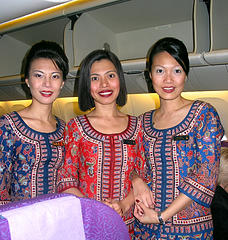
Last week I wrote about the best airports in the world. But if you want to get to one of them, which airline should you take? Skytrax has that covered, too. Here’s a list of the top five airlines from 2011, followed by the winners in specific categories, all from World Airline Awards, “the most prestigious and coveted awards for the airline industry”:

  1. Qatar Airlines
  2. Singapore Airlines
  3. Asiana Airlines (South Korea)
  4. Cathay Pacific Airways (Hong Kong)
  5. Thai Airways International

(Singapore is the only one of these I’ve had the pleasure of flying. Maybe I took Cathay once, but I can’t remember. Flying Singapore was great for our family of six, but that was several years ago. Too bad they’re so expensive now.)

Best cabin staff:

  1. Asiana Airlines
  2. Malaysia Airlines
  3. Singapore Airlines

(Our family flew Malaysia once, too. In our estimation, it’s pretty close to Singapore overall. It’s hard to beat Asian hospitality.)

And best economy class meals:

  1. Thai Airways
  2. Turkish Airlines
  3. Asiana Airlines

(Any airline that served Dr. Pepper would get a vote from me.)

[photo: “Fabulous Flight Attendants,” by Carol Schafer, used under a Creative Commons license]

Global Nomads—Loss, Grief, and Comfort

In November of 2007, I had the pleasure of hearing a presentation by Ruth Van Reken, co-author, with David Pollock, of the classic Third Culture Kids. One of her main points was that people who have changed countries often don’t acknowledge their losses, nor do they commonly grieve those losses in a healthy way. But because I didn’t take notes (or if I did, they’re packed away somewhere), I don’t remember a lot of specific details from what she said.

Recently I found a couple resources that have helped me fill in the blanks. One was an article in Columbia News from earlier in the same year, in which Van Reken told the reporter about the losses felt by Third Culture Kids and Adult Third Culture Kids:

Every time there’s transition, there is loss. So when people are feeling strange about their situation I ask them, “What did you lose?” Because where there’s loss, there’s grief. And when there’s no language for it, it comes out at your boss or in your marriage.

And the other was an interview that Expat Women conducted with Van Reken, again in 2007, in which she expanded on this topic:

[T]he challenge that I see keeping some ATCKs from fully using the great gifts their life has offered them is the issue of unresolved grief. There are several key reasons for this.

First it’s the cycle of mobility itself that is inherent in this lifestyle. Although every person in this world suffers loss, the high mobility of the third culture experience increases the number of times significant loss happens. But beyond the obvious losses mobility brings, TCKs have many other unrecognized or hidden losses as well. They can lose an entire world with the closing of an airplane door but because the country isn’t “theirs,” too often no one seems to understand or honor all that is entailed with that loss.

Other times, TCKs do recognize their losses and try to tell their parents or others how sad they are feeling but people tell them they “shouldn’t” feel like that because they have such an interesting life. Or they may remind the TCK of the greater purposes for which they are in this place . . . God, country, or to make enough money to put the TCK through college. At that point, the permission to grieve openly is gone and the child has no way to process it. Oddly, it seems the very richness and benefits of this life create many of these responses which then take away the permission to grieve because we (or others) believe the grief is a sign of ingratitude for all we have received. In fact, the opposite is true . . . we are grieving because we have lost what we loved! It is an affirmation of our lives, not a negation

In addition, another reason many TCKs can’t work through their various losses is simply that well-meaning people (including parents!) often try to encourage TCKs before they comfort them. There is a proper place for encouragement (“you’ll do fine,” “just think about others who have so much less,” etc.) but when it happens too soon, it can also abort the grieving process. Comfort is simply acknowledging the loss, validating its reality, and giving the person space to grieve properly before pushing him or her to move on or past it.

This distinction between encouragement and comfort is another aspect of Van Reken’s presentation that stuck with me. It’s a lesson that applies to all of us as we deal with people going through difficult times. And it’s a point that I plan on visiting again here in the near future—especially since I’ve found another article online that shows how Van Reken uses a story from the life of Jesus to teach this point, just like she did when I heard her speak.

Three cheers for Google and Yahoo! As long as I have the Internet, I may never have to take notes again.

(Peter Katona, “More and More Americans Consider Themselves ‘Hidden Immigrants,'” Columbia News Service, February 27, 2007; “Expat Women’s Interview with Ruth,” Expat Women, August 2007 [archived at Wayback Machine])

[photo: “Day 42,” by Amy Riddlei, used under a Creative Commons license]