The real voyage of discovery consists not in seeing new sights, but in looking with new eyes.
When I Googled that phrase, I came up with several similar, though slightly different, versions. The most popular one comes up on over 800,000 sites, often used, as Iyer did, in the context of travel:
The real voyage of discovery consists not in seeking new landscapes, but in having new eyes.
But I wasn’t done yet. I don’t trust “famous quote” sites, nor do I trust the democracy of the Internet. A little more searching led me to the actual quotation, and the original source. It’s Proust’s seven-volume work, Remembrance of Things Past (or In Search of Lost Time). The quotation above is a paraphrase of text in volume 5—The Prisoner—originally published in French, in 1923, and first translated into English by C. K. Moncrief.
In chapter 2 of The Prisoner, the narrator is commenting at length on art, rather than travel. Listening for the first time to a work by the composer Vinteuil, he finds himself transported not to a physical location, but to a wonderful “strange land” of the composer’s own making. “Each artist,” he decides, “seems thus to be the native of an unknown country, which he himself has forgotten. . . .” These artists include composers, such as Vinteuil, and painters, such as the narrator’s friend, Elstir. He continues:
This lost country composers do not actually remember, but each of them remains all his life somehow attuned to it; he is wild with joy when he is singing the airs of his native land, betrays it at times in his thirst for fame, but then, in seeking fame, turns his back upon it, and it is only when he despises it that he finds it when he utters, whatever the subject with which he is dealing, that peculiar strain the monotony of which—for whatever its subject it remains identical in itself—proves the permanence of the elements that compose his soul. But is it not the fact then that from those elements, all the real residuum which we are obliged to keep to ourselves, which cannot be transmitted in talk, even by friend to friend, by master to disciple, by lover to mistress, that ineffable something which makes a difference in quality between what each of us has felt and what he is obliged to leave behind at the threshold of the phrases in which he can communicate with his fellows only by limiting himself to external points common to us all and of no interest, art, the art of a Vinteuil like that of an Elstir, makes the man himself apparent, rendering externally visible in the colours of the spectrum that intimate composition of those worlds which we call individual persons and which, without the aid of art, we should never know? A pair of wings, a different mode of breathing, which would enable us to traverse infinite space, would in no way help us, for, if we visited Mars or Venus keeping the same senses, they would clothe in the same aspect as the things of the earth everything that we should be capable of seeing. The only true voyage of discovery, the only fountain of Eternal Youth, would be not to visit strange lands but to possess other eyes, to behold the universe through the eyes of another, of a hundred others, to behold the hundred universes that each of them beholds, that each of them is; and this we can contrive with an Elstir, with a Vinteuil; with men like these we do really fly from star to star.
So there you have it. Maybe this adds to the meaning of the more-familiar “quotation.” Or maybe it lessens it, in your mind.
Maybe, for you, this is no longer a phrase about travel. Or maybe it is now much, much more so.
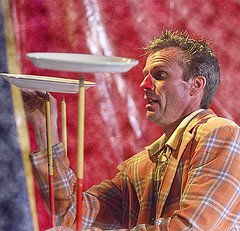
[photo: “New Eyes,” by Brian Talbot, used under a Creative Commons license—the photo’s caption at Flickr.com is the “most popular” version of Proust’s words, above]
In doing research on Scott Wallace’s work with isolated tribes of the Amazon, I came across his March report about two Waorani Indians who had been killed by members of an “uncontacted” tribe. According to witnesses, “the assailants belonged to a clan of Taromenane, a branch of the Waorani who spurned contact with evangelical missionaries in the 1950s and continue to roam the forests of Yasuní as nomads.”
I knew about the Waorani (Woadani, Huaorani, Auca) story, that their original contact with Western Christians had resulted in the spearing death of five missionaries in 1956, but I hadn’t updated myself on what was currently going on with the tribe. I also knew that the son of one of those missionaries, Steve Saint, had continued the work with the Waorani and that last year an accident had left him partially paralyzed. Again, I hadn’t kept up with his situation and assumed that his recovery was complete.
Following through a number of links, here is what I found: Steve Saint and Elisabeth Elliot (wife of one of the slain missionaries) living out their lives after tragedy, grabbing hold of their all-too-often idealized stories, stripping away the neatly tied bows, and letting the loose ends speak.
Our stories are part of God’s story, and by adding their epilogues, Saint and Elliot show that all our stories are best told completely, fairly, and honestly.
Steve Saint: All Is Not Good, but Let God Write Your Story
One year ago this past June, an accident left Steve Saint partially paralyzed from the neck down. Saint, the founder of the Indigenous Peoples Technology and Education Center (I-TEC), was testing an aluminum wing when it became unmounted from its stand, striking him in the head.
Steve Saint was five years old when his father, Nate Saint, was killed by the Waorani Indians in Ecuador. The story of their deaths is told in Elisabeth Elliot’s book Through Gates of Splendor and in the film End of the Spear.
Due to the continued efforts of Saint’s Aunt Rachel and Elliot—wife of Jim Elliot, another of the five killed—many of the Waorani became Christians. And as teenagers, Steve and his sister, Kathy, were baptized by two of the men who had killed their father—in the Curaray River next to the beach where the killings had taken place.
After Rachel Saint’s death, Steve Saint was invited by the Waorani to come live with them, which he, his wife, and children did, for a year and a half. Later, he started I-TEC to “enabl[e] indigenous churches to overcome the technological and educational hurdles that stand in the way of their independence.” I-TEC’s most famous invention is the Maverick, a “flying car” developed to help Christian workers reach “frontier” areas.
Since his accident, Saint has produced a series of six videos, called “The Next Chapter,” telling about his injury and recovery. The first was filmed a week after the accident, with Steve speaking from his hospital bed. The last came a year later. In it, Saint begins, over footage of him struggling to get up in the morning,
I think, maybe in some of the recordings we made earlier on, what I wanted to show was, you know, how wonderful things were, and I think we gave the impression that, you know, all is good now. And there is good now, but not all is good. . . . You know, stand up, and that’s the worst, standing up is just agony in the morning, you know, trying to get these stilts, ’cause I can’t feel from my waist on down . . . and I can’t feel most of my arms, and I certainly can’t feel my hands. . . .
I was privileged to meet Saint and his good friend Mincaye several years ago when they gave an interview at a ministry I worked for. Mincaye, now a Christian, was part of the group that speared Saint’s father. I am encouraged by Saint’s faith and dedication. Despite his current condition, he has kept his trust in God. Three months after his injury, he told the Ocala StarBanner, using much of the same language that is part of the video above:
My motto has been, “Let God write your story,” and that’s what I have always done. Opportunity comes in strange formats. You have a lot of people, nowadays, who want to write their own story and have God be their editor, when something goes wrong. I decided long ago to let God write my story.
Elisabeth Elliot: We Are Buffoons, but the Work is God’s
It’s been a long time since I read Elisabeth Elliot’s Shadow of the Almighty: The Life and Testament of Jim Elliot. I remember being inspired by Jim and Elisabeth’s lives, but also discouraged. It seemed that their level of faith was unattainable for someone like me. If they were the definition of missionary, then I probably shouldn’t even try.
I’ve had trouble in the past putting missionaries on pedestals. But experience has taught me that missionaries are imperfect people, too, especially my experience living out my own far-from-perfect missionary life.
In 1961, Elliot wrote The Savage My Kinsman, chronicling her two years working with the Waorani. Twenty years later, she penned an epilogue that includes a brief explanation of why she left them: because she wanted to provide a better education for her daughter and because the “differences” between her and her fellow missionary, Rachel Saint, meant that they were “not in any strictly truthful sense really working together.”
“One of us, it appeared, must go,” she writes. “My decision was a painful one.”
But while Elliot doesn’t want to gloss over the difficulties of her story, neither does she want to “magnify the trivial.” According to Elliot, there are two “dangerous” extremes in the way Christians interpret life, and the stories we tell:
One is the sheer triumphalism which is the coin of much religious telecasting. Make it appealing. Make it cheap. Make it easy. Be a Christian and watch your difficulties dissolve. Obey God and everything you touch will turn to gold. The other is the exposé. Out of a very muddy notion of something called equality, and perhaps also out of an exaggerated fear of hero-worship or cultism, springs an urge to spy out all weaknesses and inconsistencies and thereby discredit practically all human effort, especially when its intention is an unselfish one.
To be sure, the life of a missionary—the life of a Christian—is a natural mix of victories and defeats. Elliot saw this in her team’s contact with the Waorani: the highs (“the Auca Indians were finally reached”) and lows (“nine children were left fatherless”), the joys (“the Aucas heard the gospel”) and sorrows (“they also got polio”). And her list goes on.
How we long to point to something—anything—and say, “This works! This is sure!” But if it is something other than God Himself we are destined for disappointment. There is only one ultimate guarantee. It is the love of Christ. The love of Christ. . . .
God keep us from sitting in the seat of the scornful, concentrating solely on the mistakes, the paltriness of our efforts, the width of the gap between what we hoped for and what we got. How shall we call this “Christian” work? What are we to make of it?
Elliot continues with these thoughts in another epilogue, this one added to Through Gates of Splendor in 1996, marking the 40th anniversary of the missionaries’ deaths:
[W]e are tempted to assume a simple equation here. Five men died. This will mean x-number of Waorani Christians.
Perhaps so. Perhaps not. Cause and effect are in God’s hands. Is it not the part of faith simply to let them rest there? God is God. I dethrone Him in my heart if I demand that He act in ways that satisfy my idea of justice. . . .
The massacre . . . was interpreted according to the measure of one’s faith or faithlessness—full of meaning or empty. . . . The beginning of a great work, a demonstration of the power of God, a sorrowful first act that would lead to a beautifully predictable third act in which all puzzles would be solved, God would vindicate Himself, Waoranis would be converted, and we could all “feel good” about our faith. Bulletins about progress were hailed with joy and a certain amount of “Ah! You see!” But the danger lies in seizing upon the immediate and hoped-for, as though God’s justice is thereby verified, and glossing over as neatly as possible certain other consequences, some of them inevitable, others simply the result of a botched job. In short, in the Waorani story as in other stories, we are consoled as long as we do not examine too closely the unpalatable data. By this evasion we are willing still to call the work “ours,” to arrogate to ourselves whatever there is of success, and to deny all failure. . . .
I think back to the five men themselves, remembering Pete’s agony of indecision as to whether he should join the others in the venture; Ed’s eagerness to go even though Marilou was eight months pregnant, his strong assurance that all would be well; Roj’s depression and deep sense of failure as a missionary; Nate’s extreme caution and determination; Jim’s nearly reckless exuberance. . . .
[W]e are sinners. And we are buffoons. . . .
It is not the level of our spirituality that we can depend on. It is God and nothing less than God, for the work is God’s and the call is God’s and everything is summoned by Him and to His purposes, the whole scene, the whole mess, the whole package—our bravery and our cowardice, our love and our selfishness, our strengths and our weaknesses.
Members of an isolated tribe in the Brazilian state of Acre react to a plane flying over them.
After I wrote about Nilson Tuwe Huni Kui‘s trip to New York, a friend asked why Tuwe would want to bring attention to his tribe if they wanted to remain isolated. At first, I had the same question, but then I read that his tribe is not one of those seeking seclusion. Instead, Tuwe’s village is being threatened by isolated groups who are pushed from their territories by illegal loggers, narco-traffickers, and oil prospectors.
Encroachment on their land also seems to be the reason why, in June, more than 100 members of the Mashco-Piro tribe came out of isolation in Peru’s Amazon. The group asked people in the village of Monte Salvado for bananas, rope, and machetes, but rangers with the Native Federation of the Rio Madre de Dios (FENAMAD) kept them from crossing to the village’s side of the river.
There are an estimated 15 tribes in Peru, made up of about 12,000 to 15,000 individuals, that are considered “uncontacted.” Peruvian law prohibits physical contact with these groups, largely to protect them from germs and viruses that their immune systems are not equipped to fight off.
Contact with the tribes can be dangerous for outsiders as well.
Searching for the Tribes
In 2002, Scott Wallace, a writer for National Geographic, accompanied a team of 34—including Sydney Possuelo, explorer and founder of Brazil’s National Indian Foundation (FUNAI)—looking for the “Arrow People” of Brazil. Also known as the flecheiros, the tribe is known for its aggressive use of poison-tipped arrows to defend its territory.
Wallace chronicled the risky expedition in his book, The Unconquered: In Search of the Amazon‘s Last Uncontacted Tribes (2011). The group was walking a figurative tightrope: trying to get close enough to make visual contact with the tribe while not getting too close and becoming the victims of an attack. But they braved the risks in order to prove that the tribes exist and to show their location. Isolated tribes need to be identified if they are to be protected.
Wallace writes that after some in their party caught sight of a few Arrow People, the group left some metal pots tied to low branches as a peace offering. Then, knowing that they were close to the tribe’s villages, they decided to ensure their safety before making camp for the night. (The following excerpt of Unconquered was reprinted in MIZZOU, the Alumni Association magazine of the University of Missouri, where Wallace earned a master’s degree from the School of Journalism.)
“Spread out down the beach,” commanded Possuelo. “Let them see that we are many.” We staggered along the shoreline, feet slipping in the loose sand. We turned to face the towering wall of trees on the opposite bank, no more than a hundred feet away. “Stand up straight, look strong! Hold your guns up high!” Possuelo ordered. “Let them see how well armed we are.” Rifles came up off hips and shoulders, tilting toward the manila tufts of evening clouds that drifted overhead. Of course, Possuelo had no intention to turn our rifles on them. He’d sooner have died than fire upon the Arrow People. But he needed them to think that we might. It was an odd combination: gifts on the one hand, guns on the other.
We stared across the river into the trees beyond the far bank. We saw nothing but the high wall of jungle, but we could feel their eyes upon us. All we could hear was the incessant flow of the water and the rush of blood pounding in our ears.
Missionary Member Care I recently found out about an ebook by Ronald L. Koteskey, Missionary Member Care: An Introduction. Koteskey and his wife, Bonnie, have served in member care for over 16 years and share this and other “resources for missions and mental health” at the website Missionary Care.
There is a wealth of useful information in Missionary Member Care‘s 169 pages, but the parts that interested me the most were
An overview of the trials faced by the “father of modern missions,” William Carey, and his family. (I’d read about some of what they went through, but hadn’t known the full extent of it.)
The writings of other early missionaries, revealing their struggles and their need for member care.
Numerous books and websites dealing with member care.
Information on a number of member-care organizations.
A list of conferences for member-care givers.
Brigada And the second great resource? That’s where I heard about Missionary Member Care. In case you’ve never seen it, it’s Brigada, a weekly “web journal offering resources, strategy tips, tools and ‘hacks’ to Great Commission Christians.”
There are a couple ways to read Brigada, edited by Doug Lucas, founder and director of Team Expansion. One is to go to the website, where the newest issues are displayed, as well as a link to the archives, with issues dating back to 1994. The other way is to join thousands of other subscribers by signing up for weekly updates.
Brigada‘s information comes from a myriad of sources, and if you’d like to submit your own items for publication, you can do that, as well.
If Anne Frank hadn’t died in the Bergen-Belsen concentration camp in 1945 and had gone on to survive the normal maladies of life, she would have turned 84 on June 12 last week.
It was on her 13th birthday, 71 years ago, that she received the gift of a red-plaid autograph book and began using it as a diary. The first words she wrote were,
I hope I will be able to confide everything to you, as I have never been able to confide in anyone, and I hope you will be a great source of comfort and support.
She then continued to chronicle her life as a young German-born Jewish girl living in Amsterdam under the tyranny of German occupation, as she and her family hid from the Nazis in a set of secret rooms. After two years, in 1944, they were discovered and deported to Auschwitz.
In describing the role of her diary, Anne is also defining the roles of a good listener: A rare confidant who values acceptance over judgment (realizing there will be time for editing and feedback later). A safe friend who reflects back what is heard, allowing the speaker to work through her problems rather than forcing quick solutions. A concerned companion who offers silence—like blank pages—to be filled with another’s valuable stories. An empathetic advocate not afraid to hear raw emotions and honest truth.
May we all be givers of that kind of comfort and support. May we share the qualities of Anne’s red-plaid diary. May we be that kind of gift to someone who needs to be heard.
Though I often looked for one, I finally had to admit that there could be no cure for Paris.
These are the opening words of Paula McClain’s novel, The Paris Wife. Told from the viewpoint of Ernest Hemingway’s first wife, Hadley, the book shares the story of the young couple as they dive into life in Jazz-Age Paris.
I’ve not read the book, but I’ve read the first page, on the back of the most recent issue of the travel magazine Afar (which, by the way, I purchased with frequent-flier miles). The page is part of an advertisement, displayed on a Kindle Paperwhite held by a tourist overlooking the iconic white and blue buildings of Santorini, Greece. The caption for the ad reads, “Perfect for Getaways.”
It seems that some Japanese travelers have the same view of Paris as Mrs. Hemingway: It’s a condition in need of a remedy.
Back in 2006, BBC published an oft-quoted story about a phenomenon called “Paris Syndrome.” According to the article, each year, a dozen or so Japanese tourists have a psychiatric breakdown of sorts upon visiting the French capital. First identified by Hiroaki Ota, a Japanese psychiatrist in France, the syndrome is brought about when the realities of Paris don’t match the visitors’ romanticized expectations. While some of the symptoms sound like culture shock, others, such as delusions and hallucinations, are more extreme.
While some deny the existence of an actual syndrome, BBC reports that the Japanese embassy in France has set us a 24-hour hotline to help deal with the situation.
Below is a short documentary from John Menick, Paris Syndrome(2010). It takes a more in-depth—and sometimes sceptical—look at the condition, including interviews with French psychiatric professionals. Besides Paris Syndrome, the video also touches on such topics as Stendhal Syndrome, psychiatric portraiture, and historical views of travel-related mental illnesses. It even looks at Mehran Karimi Nasseri, the inspiration for the movie The Terminal.
So . . . what is the cure for Paris? While some are searching for one, most see no need. The author Gertrude Stein, a friend of the Hemingways from their time in France, saw the City of Light as a place that nurtured her creativity. “America is my country,” she said, “and Paris is my hometown.”
It’s been 25 years since Ruth E. Van Reken first published Letters Never Sent, but I hope it doesn’t ever become a book rarely read.
Following her experiences as a Third Culture Kid, born to missionary parents in Nigeria, and later as a missionary to Africa herself, Van Reken wrote a series of “letters,” to her mother and father, and to God, expressing feelings that earlier she wasn’t able to fully share.
While it would be easy to assume that the details of Van Reken’s story are dated—the book begins with her trip to boarding school in 1951—her expressions of honest emotions cut through the years and show the wonderings and pleadings of a heart that beats in many missionaries and their children today. But it is a heart that is all too often hidden and quieted.
One of the feelings voiced by the young Ruth Ellen is guilt . . . guilt that her inner thoughts are a betrayal of her parents’ calling. During her high-school years, she and her sister stayed in the States, while their parents returned to their work in Nigeria. As her mother and father’s departure nears, Ruth Ellen fights with her emotions, writing in a “never sent” letter:
If I throw myself into your arms and sob my heart out, it might keep you from going. And even though that’s what I want, how could I ever bear the guilt of being the one who kept you from doing God’s work? I’ve always vowed I wouldn’t be one of “those kids,” the kind that other missionaries talk about in whispers, with a sad shake of their heads. “So-and-so couldn’t come back to the field because of their children.” They must be pretty bad kids, I’ve always figured. I don’t want anyone to say that about me or our family.
And I can’t very well come to God with this because, in a way I feel like it’s all His fault.
Years later, as Ruth Ellen ponders her approaching wedding to David Van Reken, she expresses a distrust of God, developed from many years of having, as a TCK, to let go of what is dear to her:
I can’t believe God will let me keep David. It’s like He’s dangling Dave on a rope, letting him come closer and closer. I’m afraid that at the last moment, when I put out my hand to take him, the string will be jerked back and God will laugh.
“Ha ha. Thought you finally had someone you could keep. Don’t count on it. Whatever you depend on, I will surely take that, so that you’ll depend solely on Me.”
Ruth does get to keep David, and the two are soon joined by a baby daughter. But depression comes to Ruth, seeming to be at odds with the spirituality that she longs to possess. “How many hundreds of testimonies have I heard about the joy that Jesus gives?” she writes. “He surely isn’t giving it to me right now—or maybe I just don’t know how to receive it.”
Her depression becomes deep enough that she thinks about suicide:
I’ve actually wondered what it would be like to take pills and never wake up. But in my heart I know that wouldn’t solve anything. I have a child I’m responsible for, and I want to see her grow up. And I want to live, if I can be the person that I’ve always thought I had the potential to be. But right now that seems like a hopeless dream.
Then, using words that are reminiscent of those penned by the Psalmist in Psalm 13, she writes,
The thread I’m hanging on to is an intellectual belief that God still has a purpose for my life. I can’t imagine how He can ever put all the pieces back together and make me whole, but it’s my only hope. I told Him today that He could forget helping me to do better—there’s nothing left of me to help. If He doesn’t do something new, I’m finished.
But there is hope. There is help for her to do better. And it comes in the form of a new friend, Linda, who opens a path for Ruth by sharing her own personal struggles in a Sunday school class. This is something that Ruth hasn’t experienced before, and it gives her courage. This leads to many conversations with Linda, in which Ruth shares her pain, and Linda listens without judgment.
Within a few years, the Van Rekens are preparing for their own missionary work in Africa, and Ruth continues to learn how to function without hiding behind masks. Sometimes the masks come off gently, as with Linda, but at other times, they are pulled off forcefully, as when a pastor shares from the pulpit about some of her struggles. But to her amazement, she writes, when “[t]he awful, naked ugliness of my soul was exposed, . . . I was still accepted!”
Healing also comes through forgiveness: forgiving her parents for her many separations from them and forgiving “all those who locked me up with pat answers or quick words of encouragement, when what I needed was understanding and a hug.” Following the death of her uncle, Ruth gets a different kind of response from Jesus: “He held me and understood. He acknowledge my pain. He didn’t try to talk me out of my hurt. . . . I’m learning about God as the Comforter and binder of broken hearts.”
But in letters dated less than two years later, as she and David are serving in Liberia, Ruth writes that the depression has returned. She tells God, barring a change in the next month, to let her die. In her conversations with God that follow, she learns that she has not addressed all of the anger that is leading to her depressed feelings. She still needs to “forgive” God.
“Why don’t you leave me alone?” she hears herself say. “Ever since I came to Liberia to serve you, You’ve done nothing but bad things to me. I’m sick and tired of it.” And she hears God say to her that he isn’t at all shocked by her anger. He can handle it. “You can love someone and still be angry at him,” God tells her. Acknowledging this anger is an important step for Ruth, a step that leads to more healing.
One of the final letters penned by Ruth is dated 1984. That’s 24 years after Ruth Ellen had voiced her struggle with guilt because she wasn’t the perfect missionary child. In it, she says, after reading through all of her previous letters, that there still was one more person to forgive:
I can forgive the little girl I was, for not being all she thought she was supposed to be. The greatest joy has been to understand for the first time in my life that God is the “God of all Comfort.” I could not understand that until I recognized how much I needed His comfort.
Ruth’s story is one of faith and anger and hope and fear and sadness and peace, all flowing one into another. It is a story beautifully and sincerely told. It is a story that can speak to generations of TCKs and cross-cultural workers and to those who want to understand them. And it’s a story that continues. Last year, Van Reken published a newly revised edition of Letters Never Sent, containing 30 additional pages, with photos and an epilogue addressing her later life, including a bout with cancer.
It’s been 25 years since Ruth E. Van Reken first published Letters Never Sent, but I hope it doesn’t ever become a book rarely read.
The above quotations are taken from the 1988 edition of Letters Never Sent. The book was first printed in the US in 1987 under the title Letters I Never Wrote.
“In the gospel accounts, we don’t see Jesus scurrying around driven by what we might call ‘hurry sickness,'” writes Stephen W. Smith. “We don’t sense Jesus navigating white water. We don’t see Him spinning plates or trying to live a balanced life. None of the four biographers of Jesus show Him in a hurry—ever.”
In his book, The Jesus Life: Eight Ways to Recover Authentic Christianity, Smith teaches that we not only need to listen to the words of Jesus but watch the lifestyle of Jesus, as well. And if we look closely, we’ll see that Jesus’ life is marked by a rhythm. This is especially clear, says Smith, in the Gospel of Luke:
Engage then disengage; work in the crowds but always make time to rejuvenate with time alone. Luke revealed that Jesus was not always on, He was not always available. This important lesson is key to sustaining a resilient and satisfying life.
Smith then goes on to tell the story of two “modern pilgrims,” Rich and Carla, who “graduated from a Christian college, got married, and moved to the mission field.”
They both had a dream of sharing Jesus with others who had never heard His teachings. But eighteen months after they arrived in their assigned country, they came back home. They left enthusiastic and invigorated. They returned broken and discouraged. Both shared that they had worked over seventy hours a week in a tireless effort with dozens of volunteer teams to build a children’s center from a crumbling building. They said, “We never had a day off. We never had one moment to ourselves. We hosted college students in our homes who stayed up late playing games, and we found ourselves playing the games with them until the early-morning hours. We went to bed exhausted, got up exhausted, did our work exhausted, and fought all the time—it seemed.”
Sound familiar? Feel familiar?
If so, and if you’d like help in imitating the rhythmic life of Jesus, pick up a copy of The Jesus Life.
(Stephen W. Smith, The Jesus Life: Eight Way to Recover Authentic Christianity, Colorado Springs: David C Cook, 2012)

 But I wasn’t done yet. I don’t trust “famous quote” sites, nor do I trust the democracy of the Internet. A little more searching led me to the actual quotation, and the original source. It’s Proust’s seven-volume work, Remembrance of Things Past (or In Search of Lost Time). The quotation above is a paraphrase of text in volume 5—The Prisoner—originally published in French, in 1923, and first translated into English by C. K. Moncrief.


 Clearing Customs