Chris Jodan’s Art Helps Us “Feel” Some “Enormous Statistics”

Chris Jordan produces some really big artwork to represent some really big numbers. For example, this first piece below “depicts 92,500 agricultural plant seeds, equal to one hundredth of one percent of the number of people in the world today who suffer from malnutrition.”

This next one “depicts 240,000 plastic bags, equal to the estimated number of plastic bags consumed around the world every ten seconds.”

And this one “depicts 270,000 fossilized shark teeth, equal to the estimated number of sharks of all species killed around the world every day for their fins.”

All are part of the collection “Running the Numbers II: Portraits of Global Mass Culture.” Click on the thumbnails above and you’ll go to Jordan’s site, where you can see what makes these images so interesting. By clicking on the selected photos there, you’ll zoom all the way in to see the tiny parts—the seeds, the plastic bags, the shark teeth—that make up the larger whole.

In the TED Talk below, Jordan discusses the motivation behind his work, as he talks specifically about his earlier “Running the Numbers: An American Self-Portrait,” which looks at excesses and issues in US culture, such as personal bankruptcy, deaths caused by smoking, and the country’s high rate of incarceration.

“Now I want to emphasize that these are just examples,” Jordan tells the TED audience. “I’m not holding these out as being the biggest issues. They’re just examples. And the reason that I do this . . . it’s because I have this fear that we aren’t feeling enough as a culture right now. There’s this kind of anesthesia in America at the moment.”

Using his creative talents, Jordan’s goal is, as he says, to take “gigantic numbers” and “enormous statistics” and “translate them into a more universal visual language that can be felt.”

It makes me think about what numbers I’d like to see shown in this way, such as those representing worldwide refugees and displaced people, abortions, human trafficking, and child soldiers, to name a few. I’m sure that we each have our own list of statistics that we believe need to be heard, seen . . . and felt.

And finally, we can see Jordan’s ability to challenge and educate using more traditional images in Ushirikiano: Building a Sustainable Future in Kenya’s Northern Rangelands. This book chronicles, in words and photographs, “the Nakuprat-Gotu Conservancy in Northern Kenya, an initiative led by tribal Elders, which aims to bring peace and prosperity to a region ravaged by violence and climate change.” Go here to see over 70 stunning photos from the collection, including many beautiful portraits of Kenya’s Turkana, Samburu, Borana, and Meru people.

[all images are by Chris Jordan, used under a Creative Commons license]

Comfort vs Encouragement: Jesus’ Responses to Mary and Martha

The past few weeks have been kind of tough for my wife and me. Not long ago, we marked the one year anniversary of our return to the States after living in Taiwan for 10 years. We assumed that by this time we’d have this next stage of our life on track, but instead, we’ve got a lot of loose ends, still looking for full-time work and long-term housing. As Ruth Van Reken says (talking about Third Culture Kids, but it has broad applications), “Every time there’s transition, there is loss,” and then she adds that “where there’s loss, there’s grief.”

One of the ways I’ve dealt with our losses is by attending a “grief group.” While most of the other people in the meetings have lost loved ones, I have found it very helpful to hear their stories and learn general principles for dealing with grief.

The more I hear the experiences of those who are going through difficult times, the more I’m convinced that good listeners are hard to find—and I’m sure I don’t always fall into that category, myself. Too many people would rather offer quick-fix cliches than to share in another person’s grief. In fact, we even have a hard time accepting our own grief. Grief counselor Dr. Alan Wolfelt, in The Journey through Grief: Reflections on Healingwrites about the grieving process,

I must keep opening and changing through it all until I become the unique person who has transcended the pain and discovered self-compassion—a vulnerable yet grounded me who chooses to live again.

“Self-compassion” is an interesting concept, as compassion comes from the Latin com and pati, meaning “with” and “suffer,” respectively. So according to Wolfelt, we must discover how to “suffer with” ourselves.

In a previous post, I quoted Van Reken as saying,

There is a proper place for encouragement (“you’ll do fine,” “just think about others who have so much less,” etc.) but when it happens too soon, it can also abort the grieving process. Comfort is simply acknowledging the loss, validating its reality, and giving the person space to grieve properly before pushing him or her to move on or past it.

She elaborated on this idea in a presentation I heard her give several years ago, citing a wonderful example from the New Testament: When Jesus traveled to Bethany after the death of his friend Lazarus, Lazarus’s sister Martha came out to meet him:

“Lord,” Martha said to Jesus, “if you had been here, my brother would not have died. But I know that even now God will give you whatever you ask.”

Jesus said to her, “Your brother will rise again.”

Martha answered, “I know he will rise again in the resurrection at the last day.”

Jesus said to her, “I am the resurrection and the life. He who believes in me will live, even though he dies; and whoever lives and believes in me will never die. Do you believe this?”

“Yes, Lord,” she told him, “I believe that you are the Christ, the Son of God, who was to come into the world.”

(John 11:221-27 NIV 1984)

This, says Van Reken, is an example of encouragement, given by Jesus because he knew the needs of Martha. But Van Reken sees herself more as a Mary, Lazarus’s other sister. According to Van Reken, Mary didn’t need encouragement, she needed comfort:

When Mary reached the place where Jesus was and saw him, she fell at his feet and said, “Lord, if you had been here, my brother would not have died.”

When Jesus saw her weeping, and the Jews who had come along with her also weeping, he was deeply moved in spirit and troubled. “Where have you laid him?” he asked.

“Come and see, Lord,” they replied.

Jesus wept.

(John 11:32-35 NIV 1984)

While both sisters said the same thing to Jesus, he responded to them in different ways. Van Reken, in an e-mail discussion by the SIM AMK Task Force, says that while Jesus “appealed to [Martha’s] reason and gave her truth as information,” with Mary

Jesus entered into her experience with the truth of his compassion and comfort. Words to her would have bounced like icicles on her heart. Didn’t anyone CARE? And He showed, He cared. I love it that Jesus knows us well enough to meet us as the people He made us to be. I love it when He meets others in their way—but sometimes when they try to meet ME in their way, or I try to meet them in MY way, we can clash. I think they don’t care because they aren’t on the floor crying with me, and they think I’m a basket case who needs to look at the facts a little more clearly and I’ll be “just fine.”

I think that many of us are Marys. We need tears of compassion rather than words of reason. And I would suggest that, lacking the insight of the Son of God, we would do well to start with the kind of comfort that comes alongside those who are grieving, instead of trying to pull them out of their grief with our words or actions. There will be time for encouragement, when the griever is ready. For many of us, it’s not that we don’t understand the encouraging truths, it’s just that other truths, of loss and pain and sadness, are demanding our attention, and we push them away too soon at our own peril.

“My process has been hard at times because so much of our system of faith precludes the simplicity of the ‘Jesus wept’ verse,” says Van Reken. “And for whoever I am, those kinds of tears will change more for me than anything else. The problem with a quick spiritual answer is I actually KNOW the answer; I’m just not there yet.”

(Peter Katona, “More and More Americans Consider Themselves ‘Hidden Immigrants,’” Columbia News Service, February 27, 2007; Alan Wolfelt, The Journey through Grief: Reflections on Healing, Fort Collins: Companion Press, 1997, p 42; Ruth Van Reken, “Mary and Martha,” Simroots Open Dialogue)

[photo: “The Eye of Eliza,” by Augusto Serna, used under a Creative Commons license]

Barack Obama, TCK President

A new biography is out on the president, David Maraniss’s Barack Obama: The Story, and it’s getting some media attention, mostly because of the input from former girlfriends and because parts seem to contradict Obama’s own earlier writings. But what interests me more are the insights on how the president’s international upbringing has been a factor in shaping his personality.

As Obama grew up, he was exposed to a variety of different cultures. He was born in Hawaii to a Kenyan father and a white American mother from Kansas, and after his parents divorced, his mother married an Indonesian man. The family later moved to Jakarta, where Obama lived from 6 to 10 years old, before returning to Hawaii, finishing out his elementary and secondary schooling there.

In adaptations from the book, published in Vanity Fair this month, Maraniss writes,

At age 20, Obama was a man of the world. He had never been to south-central Kansas or western Kenya, the homelands of his ancestors, yet his divided heritage from Africa and the American heartland had defined him from the beginning. He could not be of one place, rooted and provincial. From his years living in Indonesia, where he was fully immersed in Javanese schools and culture; from his adolescence in Hawaii, where he was in the polyglot sea of hapa and haole, Asians and islanders; from his mother’s long-term commitment to development work overseas; from his friendship with Pakistani students at Occidental and his extended visit to their country—from all of these he had experienced far more global diversity than the average college junior. He knew the ways of different cultures better than he knew himself.

In 1979, Obama began his post-secondary education at Occidental College, in Los Angeles. Then, after transferring to Columbia University two years later, he reconnected with Alex McNear, a friend from Occidental, who was spending the summer in New York. Obama wrote her that he envied his friends who were heading into business and other mainstream pursuits, but that didn’t feel right for him:

Caught without a class, a structure or tradition to support me, in a sense the choice to take a different path is made for me. The only way to assuage my feelings of isolation are to absorb all the traditions [and] classes; make them mine, me theirs.

Obama first met a later girlfriend, Genevieve Cook, in 1983 at a Christmas party. In one of those TCK “me too!” moments, they discovered that both had spent time in Jakarta as children. Maraniss writes,

He noticed her accent. Australian, she said. He knew many Aussies, friends of his mother’s, because he had lived in Indonesia when he was a boy. So had she, before her parents divorced, and again briefly in high school. As it turned out, their stays in Jakarta had overlapped for a few years, starting in 1967. They talked nonstop, moving from one subject to another, sharing an intense and immediate affinity, enthralled by the randomness of their meeting and how much they had in common. They had lived many places but never felt at home.

John Richardson, himself a TCK who grew up in Asia, believes that Obama’s time overseas has had a big impact on shaping his personality and how he goes about solving problems. What some—from both the right and left—see as Obama’s frustrating bipartisanship, writes Richardson, isn’t “exactly bipartisanship. It’s something else—something strange and essential. It is, though we don’t quite realize it yet, the real reason we elected him.”

Some, fellow TCKs and non TCKs alike, would argue that this form of bipartisanship is what kept them from voting for him. It’s not my purpose here to argue politics or the rightness or wrongness of Obama’s views or “the real reason we elected him.” Rather, I want to look at how his TCKness affects him. When TCKs meet each other, they soon find out that while their common experiences have often produced shared attitudes, that does not mean that they share the same beliefs and convictions. Some TCKs passionately defend Obama’s policies while others passionately attack them. Being a Third Culture Kid certainly doesn’t produce cookie-cutter people, political or otherwise.

Richardson goes on to quote from what he calls “the TCK bible,” David C. Pollock and Ruth E. Van Reken’s Third Culture Kids: The Experience of Growing Up among Worlds:

While growing up in a multiplicity of countries and cultures, TCKs not only observe firsthand the many geographical differences around the world but they also learn how people view life from different philosophical and political perspectives. . . . [TCKs] have lived in other places long enough to appreciate the reasons and understanding behind some of the behavioral differences rather than simply being frustrated by them as visitors tend to be.

But, writes Richardson, when TCKs arrive in the US, their disconnect with American culture makes those around them wonder if there is a disconnect in values, too. He goes back to Third Culture Kids:

It seems the very awareness which helps TCKs view a situation from multiple perspectives can also make TCKs seem impatient or arrogant with others who only see things from their own perspective—particularly people from their home culture . . . others may notice how the TCK’s behavior changes in various circumstances and begin to wonder if they can trust anything the TCK does or says. It looks to them as if he or she has no real convictions about much of anything.

According to Van Reken, TCKs often call themselves “chameleons” because “after spending a little time observing what is going on, they can easily switch language, style of relating, appearance, and cultural practices to take on the characteristics needed to blend better into the current scene.” She quotes an article in the Financial Times that states President Obama “benefited from his chameleon power to make a lot of different people feel he represents them. . . .”

Shortly after Obama’s election, Van Reken wrote for The Daily Beast that the new president and the other adult TCKs that he appointed to his cabinet “share certain emotional and psychological traits that may exert great influence in the new administration.” To Van Reken, Obama’s Dreams of My Father “could serve as a textbook in the TCK syllabus, a classic search for self-definition, described in living color,” and she calls Obama’s “exceptional skill at mediating among competing arguments,” his seeming aloofness, and his “cool manner” as common traits of Third Culture Kids.

Aloofness is one of the descriptors that President Obama’s critics use to tag him. It is similar to some of the ways his girlfriend, Cook, also describes him in her diary: “something also there of smoothed veneer, of guardedness . . . but I’m still left with this feeling of . . . a bit of a wall—the veil,” “Distance, distance, distance, and wariness,” “that coolness,” and “his withheld-ness.”

During his relationship with Cook, when the two went to social functions, it was usually with Pakistani friends. But there came a time when Obama began to draw away from them, which Beenu Mahmood, one of those friends, noticed. Maraniss writes that Mahmood

could see Obama slowly but carefully distancing himself as a necessary step in establishing his political identity as an American. For years when Barack was around [the Pakistanis], he seemed to share their attitudes as sophisticated outsiders who looked at politics from an international perspective. He was one of them, in that sense. But to get to where he wanted to go he had to change.

Where am I from? Where am I going? These are questions that are sometimes difficult for Third Culture Kids to answer. But for at least one TCK, the answer to the second question ended up being the White House.

(David Maraniss, “Young Barack Obama in Love: A Girlfriend’s Secret Diary,” Vanity Fair, June 2012; John H. Richardson, “How Obama Really  Thinks: A Primer for the Left and Right,” Esquire, June 21, 2010; David C. Pollock and Ruth E. Van Reken, Third Culture Kids: The Experience of Growing Up among Worlds, Boston: Nicholas Brealey, 2009; Ruth E. Van Reken, “Obama’s ‘Third Culture’ Team,” The Daily Beast, Nov. 26, 2008)

[photo: “Obama plaque,” by Stefan Geens, used under a Creative Commons license. The plaque is located at State Elementary School Menteng 01, Menteng, Jakarta, Indonesia. The inscription reads, “Barack Hussein Obama II, the 44th President of the United States of America, attended this school from 1969-1971.”]
Two Books for Helping Us Picture the Kids of the World

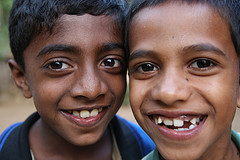
When people miss home, they often say they wish they could be back in their own beds. Children, especially, find comfort underneath familiar covers. Of course, there is a great variety of beds, and bedrooms, around the world. That’s the theme of James Mollison’s Where Children Sleep (2010), “stories of diverse children around the world, told through portraits and pictures of their bedrooms.” It’s aimed a 9-13 year olds, but the photos of the bedrooms and portraits of the children are engaging for adults, as well. See for yourself at the author’s site, where you can view 27 of the photo/portrait pairs.

And another book that shows the diversity of children around the globe is Children of the World: How We Live, Learn, and Play in Poems, Drawings, and Photographs (2011). Authored by Anthony Asael and Stephanie Rabemiafara, founders of Art in All of Us, the book helps us “learn a little of the geography, traditions, and peoples of 192 countries around the globe—including our cultural similarities and differences—ultimately discovering that children everywhere draw, smile, play, and rejoice in their different backgrounds and in their universal friendship.” More information about Art in All of Us and a gallery of children’s artwork and photos is at the organization’s site.

[photo: “Portrait two boys – Sri Lanka,” by World Bank Photo Collection, used under a Creative Commons license]

Back in the States after Being Gone for a Long Time (poem)

Back in the States after being gone for a long time,
I’m standing
in the cereal aisle at Wal-Mart.
My list says “bran cereal” with no instructions
on how to pick out the right kind.
I tell the kids to quiet down
and remind them
that “everybody here knows English
so they can understand everything you say
now.”

A friend turns the corner and sees us: “Hey!
Long time no see.
Didn’t know you were back.
Look at you.
A little grey around the edges,
but not too bad.
Bet you’re glad to be
home.”

He’s describing me like you’d describe a used book:
Acceptable.
Slight shelf wear.
Dust jacket missing.
Discoloration on edge of spine.
A few underlined passages and extensive notes in margins.
Some dogeared
pages.

We chat about
how big the kids look and about
the new high school being built,
and then he says again,
“Bet you’re glad to be home.”
This time I respond with “Well,
both places have their advantages.”
My daughter shows me a box of
off-brand Fruit Loops,
raising her eyebrows like two question marks.
I shrug my shoulders and she puts it in the
cart.

That is the way I feel,
like a used
book.

But deep inside, I’d rather
be a manuscript.
Like one of those manuscripts
that’s been sent to
44 publishers and rejected
44 times.
Then the author’s wife sees it
in the trash folder
on the computer and sends it
in for one last try.
It’s picked up
and becomes a bestseller,
and it’s made into a movie
that wins two or
three Academy Awards.
That’s what I’d like to be, now
that I’m starting over
with this new life
in a new place that everybody says is
home.

Books, Boxes, Building Blocks

Like books? (check) Need to be organized? Move often? (check, check)

Here’s a great idea. Simple, stackable, interlocking cubes that serve equally well as bookshelves and moving boxes. That’s the upside—watch them in action in the video below. But there’s also a downside: They’re only available in Europe, and the large cubes start at around US$50.

Kazam! is looking for people to buy at least 3,000 of their BrickBoxes for distribution in the US, Canada, Brazil, or Australia. Any takers? Here’s hoping these things go global and the price goes way down.

African-American Expats

Here’s a book that I’d like to read . . . as soon as it’s written.

The Center for Intercultural Dialogue is calling for chapters and chapter proposals for a proposed book with the working title The Hidden Lives of African Americans Living Abroad Series, Book 1: Articulating the Opportunities and Challenges of Living Internationally. The overview of the book includes the following:

While anecdotal data indicate that the experiences of African Americans living abroad qualitatively differs from those of European Americans, there is a substantial lack of scholarship that investigates the ways in which national and ethnic identities are expressed (and experienced) cross culturally by Black Americans living overseas. In many ways, the everyday lived experiences of African American expatriates living abroad remain unknown—and largely neglected by mainstream media and academic research. This series seeks to examine and highlight what life is like for African Americans living abroad.

And here are some of the suggested chapter topics that look particularly interesting to me:

  • What it’s like to be the only African American in the country
  • “But you don’t have blonde hair or blue eyes”: Encountering and overcoming stereotypes of the “All American” image abroad
  •  “How do they treat Black people there?” Addressing the pre-departure fears of friends
  • Perceptions of African Americans abroad
  • African American Image in Overseas Advertising
  • Returning to the U.S. and Readjusting to Home

As a White American, I’ve often wondered what it is like for Black Americans living overseas, with the extra challenges of facing stereotypes and prejudices . . . layered on top of and intertwined with the other difficulties of cross-cultural living. Hopefully this book—and the whole series—will draw together some good stories and research and create a meaningful discussion.

Go to “CFP African Americans Living Abroad” for more information and submission guidelines.

[illustration: “Blank Open Book,” by DonkeyHotey, used under a Creative Commons license]

Global Nomads—Loss, Grief, and Comfort

In November of 2007, I had the pleasure of hearing a presentation by Ruth Van Reken, co-author, with David Pollock, of the classic Third Culture Kids. One of her main points was that people who have changed countries often don’t acknowledge their losses, nor do they commonly grieve those losses in a healthy way. But because I didn’t take notes (or if I did, they’re packed away somewhere), I don’t remember a lot of specific details from what she said.

Recently I found a couple resources that have helped me fill in the blanks. One was an article in Columbia News from earlier in the same year, in which Van Reken told the reporter about the losses felt by Third Culture Kids and Adult Third Culture Kids:

Every time there’s transition, there is loss. So when people are feeling strange about their situation I ask them, “What did you lose?” Because where there’s loss, there’s grief. And when there’s no language for it, it comes out at your boss or in your marriage.

And the other was an interview that Expat Women conducted with Van Reken, again in 2007, in which she expanded on this topic:

[T]he challenge that I see keeping some ATCKs from fully using the great gifts their life has offered them is the issue of unresolved grief. There are several key reasons for this.

First it’s the cycle of mobility itself that is inherent in this lifestyle. Although every person in this world suffers loss, the high mobility of the third culture experience increases the number of times significant loss happens. But beyond the obvious losses mobility brings, TCKs have many other unrecognized or hidden losses as well. They can lose an entire world with the closing of an airplane door but because the country isn’t “theirs,” too often no one seems to understand or honor all that is entailed with that loss.

Other times, TCKs do recognize their losses and try to tell their parents or others how sad they are feeling but people tell them they “shouldn’t” feel like that because they have such an interesting life. Or they may remind the TCK of the greater purposes for which they are in this place . . . God, country, or to make enough money to put the TCK through college. At that point, the permission to grieve openly is gone and the child has no way to process it. Oddly, it seems the very richness and benefits of this life create many of these responses which then take away the permission to grieve because we (or others) believe the grief is a sign of ingratitude for all we have received. In fact, the opposite is true . . . we are grieving because we have lost what we loved! It is an affirmation of our lives, not a negation

In addition, another reason many TCKs can’t work through their various losses is simply that well-meaning people (including parents!) often try to encourage TCKs before they comfort them. There is a proper place for encouragement (“you’ll do fine,” “just think about others who have so much less,” etc.) but when it happens too soon, it can also abort the grieving process. Comfort is simply acknowledging the loss, validating its reality, and giving the person space to grieve properly before pushing him or her to move on or past it.

This distinction between encouragement and comfort is another aspect of Van Reken’s presentation that stuck with me. It’s a lesson that applies to all of us as we deal with people going through difficult times. And it’s a point that I plan on visiting again here in the near future—especially since I’ve found another article online that shows how Van Reken uses a story from the life of Jesus to teach this point, just like she did when I heard her speak.

Three cheers for Google and Yahoo! As long as I have the Internet, I may never have to take notes again.

(Peter Katona, “More and More Americans Consider Themselves ‘Hidden Immigrants,'” Columbia News Service, February 27, 2007; “Expat Women’s Interview with Ruth,” Expat Women, August 2007 [archived at Wayback Machine])

[photo: “Day 42,” by Amy Riddlei, used under a Creative Commons license]