
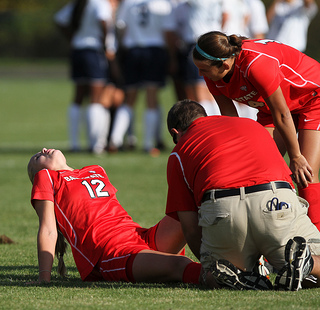
This post is about the need for safe confidants in the lives of cross-cultural workers. But before I address that directly, I’d like to share three relevant stories from the world of sports:
From Major League Baseball
In 1978, All-Star catcher Carlton Fisk played a key role in the Boston Red Sox’s tight pennant race. But he was playing hurt—with injuries that had the potential for long-term harm. In a Sports Illustrated article published the next year, pitcher Bill Lee described Fisk as one of those players who “like to gut it out.” “He’s just going out there because of his puritanical upbringing,” he said, “you know, staunch, quiet, archconservative, play-with-an-arrow-in-your-heart type of thing.”
Even though Lee thought Fisk should take some time off, no one on staff with the Red Sox told him to sit down—not the manager, not the owner, not even the team doctor, Arthur Pappas.
The role of team doctors and “especially the question of where their loyalties lie” was the focus of the SI article. What was Pappas’s top priority, Fisk’s welfare, or the team’s? Should a player expect a team doctor to look out for him the same way a personal physician would? Is there a conflict of interest built into the system?
While Fisk praised the qualifications of Boston’s physician, he also knew that Pappas not only worked for the team’s owners but was a part owner himself. Fisk admitted that the decision to play was ultimately his own, but he wondered if he’d gotten the best advice. “He’d be wanting to get you better,” he said about Pappas, “but not with the players’ interest at heart. He’d want to get you better for the team.”
(William Nack, “Playing Hurt—the Doctors’ Dilemma,” Sports Illustrated, June 11, 1979)
From the NFL
Twenty-nine years later, Sports Illustrated looked at this difficult issue again. (The titles of both articles include the word Dilemma.) This time, reporter Selena Roberts talked to an NFL player who told her about being injured on the field the previous season. When he’d seen his team’s medical staff rushing toward him, he’d wondered, “Whose side are they on?”
Roberts also talked with Andrew Tucker, team physician for the Baltimore Ravens, on the topic of confidentiality concerning “personal matters.” “This is where that unique situation of dual responsibility comes in,” he said. “If a player’s medical issue—like depression—gets to the point where performance is affected, then I have the responsibility to certain people in the club. . . . Now, sometimes players will choose to share that information with other people.”
One answer to the problem, wrote Roberts, is an NFL-wide health-care system that puts doctors under a “league-union cooperative” rather than on the payroll of individual teams. This would increase trust in the patient-doctor relationship and encourage more openness and honesty.
Robert Huizenga, former team doctor for the Oakland Raiders, said that after he left the organization, he was surprised at how many players only then sought him out for help. “How much was hidden from me?” he asked.
(Selena Roberts, “Rx for a Medical Dilemma,” Sports Illustrated, November 3, 2008)
From the NBA
In 2007, Greg Oden was selected by the Portland Trail Blazers as the #1 pick in the NBA draft, but since then things have mostly gone downhill from there. He soon had microfracture surgery on his right knee and missed his entire first season. He played most of the following season, but by his own admission, during that time he “pretty much became an alcoholic.” Before his third year with Portland, he got his drinking under control and got himself into shape, but his season was cut short when he fractured his left kneecap. Then a couple weeks later nude photos he had taken of himself were leaked to the Internet.
Oden was in need of counseling, and he contacted sports psychologist Joseph Carr. Paying for sessions out of his own pocket, Oden met with Carr regularly, but that ended when the Blazers also hired Carr. When Oden saw Carr talking with people from the Blazers’ front office, he was suspicious that Carr was disclosing information from their sessions, and he stopped their meetings. According to Oden, it “seemed like a conflict of interest.”
(Mark Titus, “Oden on Oden,” Grantland, May 9, 2012)
Member Care—Safety First
When athletes don’t feel “safe” with team doctors or counselors, they don’t get the care they need, and they suffer. When cross-cultural workers don’t have safe confidants, they suffer, as well.
We all need safe people to talk to. Safe people care about us as individuals. They accept us for who we are, not for what we can do. They don’t listen to us with competing agendas or loyalties. (For more on what makes a person safe, see Drs. Henry Cloud and John Townsend’s Safe People: How to Find Relationships That Are Good for You and Avoid Those That Aren’t [Grand Rapids: Zondervan, 1995].)
While this safety is important to everyone, it is especially crucial for cross-cultural workers, because they have been removed from their natural support network. That makes safe, trustworthy confidants more difficult to find and often more needed. With fewer and fewer casual and informal relationships, cross-cultural workers must often turn to those in their own organization, who have a vested interest in the organization’s success or who sit in the workers’ line of authority.
In the Christian community, the giving of emotional and spiritual help to missionaries, and other cross-cultural workers, is often called “member care.” Ronald L. Koteskey, in “What Missionaries Ought to Know about Member Care,” writes that it includes many facets:
friendship, encouragement, affirmation, help, and fellowship as well as sharing, communicating, visiting, guiding, comforting, counseling and debriefing.
For some, the person who fulfills these roles is called a “coach” or “mentor.” I am using the term “member-care giver” because it is what I’m more familiar with and because I don’t think that what it represents needs to be limited to the church. Neither does it necessarily carry the meaning of someone with specialized education or training, though those things can sometimes be beneficial.
Using the definition above, I can say that member care is necessary for all cross-cultural workers. But when it comes to safety, not all member care is equal. So what can we do to promote true safety?
Safety is vital to deep, healthy, trusting relationships, the kind of relationships that cross-cultural workers desperately need. Here are some observations to help in making those relationships a reality.
- Safety can’t be claimed, it must be earned. We can argue all we want about how someone should be seen as safe, but if the worker doesn’t feel that way, then should doesn’t matter. The doctors and counselors in the sports examples above would say that they are trustworthy, but that doesn’t take away the athletes’ concerns. A member-care giver can take steps to make himself more safe, but he can’t force someone else to see him that way.
- Where there is a lack of safety, it is only natural that there will be a lack of openness. And when there is a lack of openness, those giving member care will hear only incomplete stories.
- Safety is damaged when the worker is accountable in his job to the member-care giver—or when the member-care giver reports to someone else who has that role of authority. And this authority isn’t always clearly defined. Take, for instance, missionaries, whose emotional and spiritual supporters back home now support them financially. How open will missionaries be with people who are investing in their work? What about the leadership of the sending church, or the member-care professionals on staff with the sending agency? Do missionaries wonder, “Whose side are they on?” Can missionaries even ask this question without feeling disloyal to their church, to God?
- Who can honestly say to a cross-cultural worker, “In this relationship, you are my priority. I am more concerned about your physical, emotional, and spiritual wellbeing than I am about the success of your work. If you quit this vocation, I will still support you because I am invested in you”?
- We can learn from counselors who begin their sessions by saying, “What you say to me is confidential. I won’t share it with anyone (your boss, your organization, your parents, your coworkers, etc.) without your permission, unless you pose a danger to yourself or someone else.”
- If a member-care giver talks to a worker about others’ personal problems, that worker can assume that her problems are being shared with others, as well.
- In discussing the situation in the NFL, Selena Roberts suggests the formation of a “league-union cooperative.” To date, the football powers that be haven’t implemented such a system. And while there’s no “league” or “union” for cross-cultural workers, concerned people have come together to form “cooperatives” of sorts to provide safe member care (or coaching or mentoring). There are many of these groups, and a wide range of them can be found in a quick search of the Internet. Among them you’ll find trained member-care givers, professional counselors, people who “get” what cross-cultural workers are going through, those with their own overseas experience, and opportunities for extended care and training, on the field and at dedicated facilities. For those looking for help or training coming from a Christian worldview, or for those just wanting to get a taste of what is out there, here are three groups which I’d recommend:
– Mission Training International (MTI)
– Barnabas International
– Link Care
If you are a cross-cultural worker, don’t go it alone. And don’t simply go through the motions of member care with someone you don’t trust. It is vital—and well worth the effort—to find someone who is truly safe . . . a confidant, an advocate, a friend.
(Ronald L. Koteskey, “What Missionaries Ought to Know about Member Care,” Missionary Care: Resources for Missions and Mental Health)
[photo: “Flashes vs Cardinal Soccer,” by lindsayjf91, used under a Creative Commons license]


 Clearing Customs