Steve Saint and Elisabeth Elliot and the Revealing Epilogues to Their Stories

2325686115_9baa8eafd4_nIn doing research on Scott Wallace’s work with isolated tribes of the Amazon, I came across his March report about two Waorani Indians who had been killed by members of an “uncontacted” tribe. According to witnesses, “the assailants belonged to a clan of Taromenane, a branch of the Waorani who spurned contact with evangelical missionaries in the 1950s and continue to roam the forests of Yasuní as nomads.”

I knew about the Waorani (Woadani, Huaorani, Auca) story, that their original contact with Western Christians had resulted in the spearing death of five missionaries in 1956, but I hadn’t updated myself on what was currently going on with the tribe. I also knew that the son of one of those missionaries, Steve Saint, had continued the work with the Waorani and that last year an accident had left him partially paralyzed. Again, I hadn’t kept up with his situation and assumed that his recovery was complete.

Following through a number of links, here is what I found: Steve Saint and Elisabeth Elliot (wife of one of the slain missionaries) living out their lives after tragedy, grabbing hold of their all-too-often idealized stories, stripping away the neatly tied bows, and letting the loose ends speak.

Our stories are part of God’s story, and by adding their epilogues, Saint and Elliot show that all our stories are best told completely, fairly, and honestly.

Steve Saint: All Is Not Good, but Let God Write Your Story

One year ago this past June, an accident left Steve Saint partially paralyzed from the neck down. Saint, the founder of the Indigenous Peoples Technology and Education Center (I-TEC), was testing an aluminum wing when it became unmounted from its stand, striking him in the head.

Steve Saint was five years old when his father, Nate Saint, was killed by the Waorani Indians in Ecuador. The story of their deaths is told in Elisabeth Elliot’s book Through Gates of Splendor and in the film End of the Spear.

Due to the continued efforts of Saint’s Aunt Rachel and Elliot—wife of Jim Elliot, another of the five killed—many of the Waorani became Christians. And as teenagers, Steve and his sister, Kathy, were baptized by two of the men who had killed their father—in the Curaray River next to the beach where the killings had taken place.

After Rachel Saint’s death, Steve Saint was invited by the Waorani to come live with them, which he, his wife, and children did, for a year and a half. Later, he started I-TEC to “enabl[e] indigenous churches to overcome the technological and educational hurdles that stand in the way of their independence.” I-TEC’s most famous invention is the Maverick, a “flying car” developed to help Christian workers reach “frontier” areas.

Since his accident, Saint has produced a series of six videos, called “The Next Chapter,” telling about his injury and recovery. The first was filmed a week after the accident, with Steve speaking from his hospital bed. The last came a year later. In it, Saint begins, over footage of him struggling to get up in the morning,

I think, maybe in some of the recordings we made earlier on, what I wanted to show was, you know, how wonderful things were, and I think we gave the impression that, you know, all is good now. And there is good now, but not all is good. . . . You know, stand up, and that’s the worst, standing up is just agony in the morning, you know, trying to get these stilts, ’cause I can’t feel from my waist on down . . . and I can’t feel most of my arms, and I certainly can’t feel my hands. . . .

I was privileged to meet Saint and his good friend Mincaye several years ago when they gave an interview at a ministry I worked for. Mincaye, now a Christian, was part of the group that speared Saint’s father. I am encouraged by Saint’s faith and dedication. Despite his current condition, he has kept his trust in God. Three months after his injury, he told the Ocala StarBanner, using much of the same language that is part of the video above:

My motto has been, “Let God write your story,” and that’s what I have always done. Opportunity comes in strange formats. You have a lot of people, nowadays, who want to write their own story and have God be their editor, when something goes wrong. I decided long ago to let God write my story.

Elisabeth Elliot: We Are Buffoons, but the Work is God’s

It’s been a long time since I read Elisabeth Elliot’s Shadow of the Almighty: The Life and Testament of Jim Elliot. I remember being inspired by Jim and Elisabeth’s lives, but also discouraged. It seemed that their level of faith was unattainable for someone like me. If they were the definition of missionary, then I probably shouldn’t even try.

I’ve had trouble in the past putting missionaries on pedestals. But experience has taught me that missionaries are imperfect people, too, especially my experience living out my own far-from-perfect missionary life.

In 1961, Elliot wrote The Savage My Kinsman, chronicling her two years working with the Waorani. Twenty years later, she penned an epilogue that includes a brief explanation of why she left them: because she wanted to provide a better education for her daughter and because the “differences” between her and her fellow missionary, Rachel Saint, meant that they were “not in any strictly truthful sense really working together.”

“One of us, it appeared, must go,” she writes. “My decision was a painful one.”

But while Elliot doesn’t want to gloss over the difficulties of her story, neither does she want to “magnify the trivial.” According to Elliot, there are two “dangerous” extremes in the way Christians interpret life, and the stories we tell:

One is the sheer triumphalism which is the coin of much religious telecasting. Make it appealing. Make it cheap. Make it easy. Be a Christian and watch your difficulties dissolve. Obey God and everything you touch will turn to gold. The other is the exposé. Out of a very muddy notion of something called equality, and perhaps also out of an exaggerated fear of hero-worship or cultism, springs an urge to spy out all weaknesses and inconsistencies and thereby discredit practically all human effort, especially when its intention is an unselfish one.

To be sure, the life of a missionary—the life of a Christian—is a natural mix of victories and defeats. Elliot saw this in her team’s contact with the Waorani: the highs (“the Auca Indians were finally reached”) and lows (“nine children were left fatherless”), the joys (“the Aucas heard the gospel”) and sorrows (“they also got polio”). And her list goes on.

How we long to point to something—anything—and say, “This works! This is sure!” But if it is something other than God Himself we are destined for disappointment. There is only one ultimate guarantee. It is the love of Christ. The love of Christ. . . .

God keep us from sitting in the seat of the scornful, concentrating solely on the mistakes, the paltriness of our efforts, the width of the gap between what we hoped for and what we got. How shall we call this “Christian” work? What are we to make of it?

Elliot continues with these thoughts in another epilogue, this one added to Through Gates of Splendor in 1996, marking the 40th anniversary of the missionaries’ deaths:

[W]e are tempted to assume a simple equation here. Five men died. This will mean x-number of Waorani Christians.

Perhaps so. Perhaps not. Cause and effect are in God’s hands. Is it not the part of faith simply to let them rest there? God is God. I dethrone Him in my heart if I demand that He act in ways that satisfy my idea of justice. . . .

The massacre . . . was interpreted according to the measure of one’s faith or faithlessness—full of meaning or empty. . . . The beginning of a great work, a demonstration of the power of God, a sorrowful first act that would lead to a beautifully predictable third act in which all puzzles would be solved, God would vindicate Himself, Waoranis would be converted, and we could all “feel good” about our faith. Bulletins about progress were hailed with joy and a certain amount of “Ah! You see!” But the danger lies in seizing upon the immediate and hoped-for, as though God’s justice is thereby verified, and glossing over as neatly as possible certain other consequences, some of them inevitable, others simply the result of a botched job. In short, in the Waorani story as in other stories, we are consoled as long as we do not examine too closely the unpalatable data. By this evasion we are willing still to call the work “ours,” to arrogate to ourselves whatever there is of success, and to deny all failure. . . .

I think back to the five men themselves, remembering Pete’s agony of indecision as to whether he should join the others in the venture; Ed’s eagerness to go even though Marilou was eight months pregnant, his strong assurance that all would be well; Roj’s depression and deep sense of failure as a missionary; Nate’s extreme caution and determination; Jim’s nearly reckless exuberance. . . .

[W]e are sinners. And we are buffoons. . . .

It is not the level of our spirituality that we can depend on. It is God and nothing less than God, for the work is God’s and the call is God’s and everything is summoned by Him and to His purposes, the whole scene, the whole mess, the whole package—our bravery and our cowardice, our love and our selfishness, our strengths and our weaknesses.

(Scott Wallace, “Uncontacted Group Kills Two Natives in Ecuador,” National Geographic News Watch, March 11, 2013; Doug Engle, “Partially Paralyzed, Inventor and Missionary Saint Letting God Write His Story,” Ocala StarBanner, September 2, 2012; Shadow of the Almighty: The Life and Testament of Jim Elliot, Grand Rapids, MI: Zondervan, 2009; Elisabeth Elliot, The Savage My Kinsman, Ventura, CA: Regal, 1996; Elisabeth Elliot, Through Gates of Splendor, Carol Stream, IL: Tyndale House, 2002)

[photo: “Humility,” by Toni Verdú Carbó, used under a Creative Commons license]

Dialogue of Cultures: Free International Films Online for Next 9 Days

8315397336_2a1fd9706a_mThis year, the Dialogue of Cultures International Film Festival is being held online. That means you don’t have to travel to someplace like Tokyo or New York to watch the entries, since all are available for online viewing at MUBI.com from November 1-14—for free.

According to the festival site at MUBI, the event is “dedicated to the worldwide phenomenon of people in search of their identity in the era of mass migration and globalisation. Its goal is to jumpstart a dialogue between cultures through the universal language of cinema.”

The 23 films, from 14 countries, are in the running for the Audience Award Grand Prix, which carries an award of $5,000.  Vote for your favorites by clicking their “Become a Fan” buttons.

An example of the global diversity represented in the entries is Old Is the New, a film from Switzerland about a Chinese tourism worker who visits a Greek-speaking region of southern Italy.

The festival is also calling for submissions for its short-film competition. Entries must be no longer than seven minutes, and the deadline for submitting a film is February 1, 2014. The winner of the competition will receive $3,000.

[photo: “Old Theater Seats,” by Joey Lax-Salinas, used under a Creative Commons license]
Hyper Realism: A Russian Farmer Lands an Esquire Cover and a Trip to New York

9168908261_6e344e2bb4_n
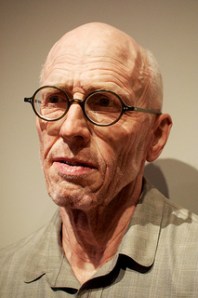
Evan Penny’s Old Self, Variation #2, an example of hyper-realistic art

Ever since, as a child, I saw Duane Hanson’s lifelike sculpture Janitor at the Milwaukee Art Museum, I’ve loved hyper-realistic art. Then last month, when I visited Crystal Bridges Museum of Modern Art, in Bentonville, Arkansas, I was surprised to see another Hanson work, Man on a Bench. (I really was surprised, since it looked for all the world like a museum visitor taking a break from his tour.) And in a room close by, there was an oversized bust by Evan Penny, Old Self, Variation #2. Unlike with Hanson’s pieces, no one will mistake Old Self for an actual person—it’s only a head with shoulders, and it’s way too big. But still, it just looks so real.

Martin Schoeller is another artist in the same vein, except he doesn’t exactly create hyper realism, he captures it—with a camera. Born in Germany, but now based out of New York, Schoeller is best known for his “hyper-detailed” large-scale portraits of celebrities, which have appeared in magazines such as GQ, The New Yorker, and Entertainment Weekly.

But his photographic subjects also include common people, like you and me. In fact, if you’d like to see what you’d look like in a Schoeller portrait, next time you’re in Bed Bath & Beyond, do like I did and take a look at yourself in the 10x-magnification of the Zadro Dimmable Florescent Dual-Sided Mirror. (That’s hyper realism.)

Schoeller recently took a cover photo for Esquire Russia of Vasiliy Ilyn, a retired farmer from Russia, who’s featured in this month’s magazine. Ilyn is one of Schoeller’s non-celebrity subjects, as the September Esquire is devoted to the rules that govern the lives of ordinary Russians.

For three days, Ilyn was something more than ordinary, as he was flown to New York for the photo shoot. His encounter with the city is chronicled in the 20-minute film Vasily, from Stereotactic. (Thanks to Carla Williams for telling me about the video.)

The film shows Ilyn’s first trip outside the Kursk region of Russia, his first time to see the ocean, and, of course, his first visit to America. As he looks around New York, he’s a fish out of water, but he’s an ordinary fish. And I’m not sure that his reactions are much different from those many retired farmers in the flyover portions of the US would have.

Ilyn narrates the documentary, and he has a lot to say about Russia, the US, and life in general. He thinks of himself as a joker, but much of what he says shows a solemn acceptance of the way things are. He’s pretty straightforward and plain spoken. At one point, while talking about his disdain for past Russian leaders, Ilyn drops an F-bomb. Actually, it’s more of an F-hand grenade since we read it in the subtitles.

When he gets back to his home, he tells a woman about the 80,000 Russians who live in New York. “I wish a flood would come and they would die,” she says. “Let the locals survive, but these traitors should die.”

Ilyn replies, “They were just looking for a better life. . . . Let them go.”

Shoeller’s type of hyper-realism doesn’t come from a lack of preparation and artistic manipulation. The lighting and focus has to be just right, and there’s a lot of time spent on Ilyn’s makeup. But the result is striking for its unglamorized detail.

That’s the way the documentary looks to me, too. I can tell a lot of work went into the making of Vasily, but it’s that work—the shot selection, the editing, the scoring of the music—that makes it feel more real . . . much more real than what usually passes for “reality” on TV today.

(“Russian Farmer Lands in Esquire and NYC,” Voices of NY, October 15, 2013)

[photo: Old Self, Variation #2” by Nils Gore, used under a Creative Commons license]
I Love You, I Hate You: “Girl, Adopted”

After writing about some documentaries on adoption that used to be, but are no longer, available for online viewing, I finally went to the PBS site and found one that is still up—but not for long. If you want to see Girl, Adopted, you’ll have to watch it before the end of this month.

girl_adopted-01-thumb-large
Weynsht with her adoptive parents before their flight to the States

Documentaries are at their best when the filmmakers step out of the way and just let the subjects of the films speak for themselves. That seems to be what happens in Girl, Adopted. It presents the story of Weynsht (pronounced win-shet), who, at the age of 13, is adopted from an orphanage in Ethiopia by a family from Pyatt, Arkansas. The ups and downs don’t come in the adoption process itself—with the finalization providing the climax. Instead, the adoption is the beginning of the story, with the relationship between Weynsht and her new parents supplying the joys and frustrations.

Near the beginning of the film, Melanie, the adoptive mother, says, “We feel like everything happens for a reason and in perfect timing, and I think that we were meant for her and she was meant for us.”

After living in Arkansas for some time, Weynsht shares her own view. “Things happen for a reason sometimes,” she says, “and I still just waiting for a reason.”

Throughout the film, covering five years, Weynsht voices competing emotions concerning America, her parents, and her own identity. And, as young people often do, she talks a lot about love and hate.

Soon after her arrival in the States, she voices her love for Usher, her mother, a Barbie doll, and Wal-Mart.

Later, she says to her white girl friends, “I love you hair.” And when she talks about her desire to find another family, she tells her parents, “I never say, ‘I love you, too,’ because I hate you.”

After more time has passed, Weynsht says, “I really like being Ethiopian person, but I hate being black,” and, “I hate my hair.”

girl_adopted-02-thumb-large
Weynsht on her visit back to Ethiopia

When her father takes Weynsht and her sisters to Ethiopia to visit her orphanage, she finds out that she has an older brother, and her confusion deepens: “I don’t care. I do care, actually, but . . . ,” she says. “I’m just . . . so many things in my head.”

Her mixed emotions turn to anger when she thinks that her father is forcing her to meet her brother. And then she’s afraid: “If I met my brother, why would I want you guys? What makes you think I need somebody else? If I have a brother, I’m wanna stay with my brother.” Then she adds, “And I don’t want that ’cause I love you guys, and just stop.”

Girl, Adopted is certainly not a simple advocacy piece for adoption. In fact, while Weynsht’s father, Chris, concludes that adoption is “worth it, even if it’s hard,” he also says,

At one point, I thought that everyone should adopt a child. It’s something that everybody can do. All they’d have to do is just open up their homes and their hearts and let a kid in, but I don’t really hold those same views today. I don’t think that everybody should do it. You have an idealistic view of adoption, and then as you go along, the details of that view are filled in.

Chris, Melanie, and Weynsht are brave to have let the cameras follow their lives for five years. I’m glad they did, because the result is a compelling work that helps the rest of us fill in a multitude of powerful details.

Produced and directed by Melanie Judd and Susan Motamed, Girl, Adopted (2013) is part of the Global Voices series from Independent Television Service (ITVS) and the WORLD channel. The 78-minute video is available for online viewing until October 30. It can also be purchased on DVD.

[photos courtesy of ITVS]

In Someone Else’s Shoes: Two Adoptees Search for Who They Were and Who They Could Have Been

Deann Borshay Liem shows the shoes that she wore that were meant for someone else.
Deann Borshay Liem shows the shoes—from her adoptive parents—that were meant for another girl in her orphanage.

These are the stories of two Asian girls, adopted by families in North America.

One of the girls is now a teenager. One is in her 50s. Both are the subjects of documentaries.

Both look back and wonder “What if?”

The Invisible Red Thread

Li Bao was born in 1995 and abandoned on the steps of a hospital, a victim of China’s one-child policy. Six months later, she was adopted by a Canadian couple, who renamed her Vivian.

As a fifteen-year-old, Vivian traveled back to China. She wanted to see what her life would have been like if she had been adopted by a Chinese family, instead of one in Canada.

Chronicled in the one-hour documentary, The Invisible Red Thread (2012), her visit includes a trip to the orphanage where she once lived and her time spent with Shumin Zhu, a fourteen-year-old who was also adopted as an infant, but by a family in rural China. The two learn about each other’s lives and see in each other a life that she could have lived.

The Invisible Red Threadis available on DVD from Picture This Productions.

The Matter of Cha Jung Hee

Cha Jung Hee was 8 years old when she came to the US, adopted by Arnold and Alveen Borshay in California. But 40 years later, she found out that she wasn’t really Cha Jung Hee. Instead, the actual Cha Jung Hee was a girl whom the Borshays had supported through a charity and then decided to adopt. But when her father appeared at the orphanage and took her away, the social worker there gave her identity to another girl—who came to America and became Deann Borshay. In time, she forgot that the name on her birth certificate and passport wasn’t hers, and then, in time, she remembered.

Now a filmmaker, Deann Borshay Liem has completed two documentaries on her life. The first is First Person Plural (2000), in which Borshay Liem and her adoptive parents travel to Korea to meet her family there—a family that the Borshays had been told didn’t exist.

The second is The Matter of Cha Jung Hee, (2010, available at New Day Films) which focuses on another trip back to Korea in search of the real Cha Jung Hee, the woman who, as a girl, had written letters to the Borshays and whom the Borshays had planned to adopt.

In an interview with PBS’s POV, Borshay Liem talks about the too-large shoes that she wore when she arrived in the US. They were bought by her new family to fit the traced footprints of Cha Jung Hee:

[The shoes] represent how any of us might have had a different life. What are the possibilities of living someone else’s life or walking in someone else’s shoes?

Borshay Liem is now working on a new documentary, Geographies of Kinship, telling the stories of Korean adoptees around the world—in Sweden, France and the US, including a woman whose father was an African-American fighting in the Korean War.

(“Interview: In the Matter of Cha Jung Hee,” POV, PBS)

[photo courtesy of MU Films]

Rainbows, True Colors, the iPhone 5c, and The British Paraorchestra

I saw one of the new iPhone 5C commercials a couple days ago. It’s a great collage of people around the world saying hello on their phones. I guess Apple wants their cheaper, more colorful smart phone to catch on all over the globe. (Who am I kidding? Of course Apple wants all their phones to catch on all over the globe.)

There are two versions of the ad, “Greetings” and “Greetings Too,” but the one-minute extended version combines both. Are the languages you speak buried inside?

We certainly live in a rainbow-colored world.

After I watched this, I got nostalgic for the song “True Colors,” so I clicked around YouTube and found Cindy Lauper’s and Phil Collin’s versions. Then I came to last year’s cover by The British Paraorchestra (“the world’s first ensemble of professional disabled musicians”), The Kaos Signing Choir for Deaf and Hearing Children, and ParalympicsGB athletes. Very moving.

You with the sad eyes
Don’t be discouraged
Oh, I realize
It’s hard to take courage
In a world full of people
You can lose sight of it all
And the darkness inside you
Can make you feel so small

But I see your true colors
Shining through
I see your true colors
And that’s why I love you
So don’t be afraid to let them show
Your true colors
True colors
Are beautiful like a rainbow

Pico Iyer on Home, Travel, and Stillness (plus, Have You Seen the TED Commandments?)

161335960_3c30374d20_nPico Iyer, best-selling author on the topic of crossing cultures, finds the concept of “home” difficult to describe. It’s no wonder. His parents are Indian. He was born in England. At the age of eight he moved with his family to California. And currently, between his many travels, he lives with his Japanese wife in Japan.

In a TED Talk from 3 months ago, Iyer “meditates on the meaning of home, the joy of traveling and the serenity of standing still.”

Some great writers are not great speakers, but Iyer expresses his thoughts with eloquence in both forms. Here are a few of those thoughts:

On multi-cultural children:
“[T[heir whole life will be spent taking pieces of many different places and putting them together into a stained-glass whole.”

On traveling:
“The real voyage of discovery, as Marcel Proust famously said, consists not in seeing new sights, but in looking with new eyes. And of course, once you have new eyes, even the old sights, even your home become something different.”

On the concept of home:
“[H]ome, we know, is not just the place where you happen to be born. It’s the place where you become yourself.”

On collecting 1 million miles on a frequent-flyer program:
“You all know that crazy system, six days in hell, you get the seventh day free.”

And on spending three days in silence at a monastery:
“I began to think that something in me had really been crying out for stillness, but of course I couldn’t hear it because I was running around so much.”

Following the TED Commandments

I’ve watched several TED Talks, and I’m always impressed with how the speakers seem to present their thoughts articulately and effortlessly. I’ve always wondered if they use teleprompters. I found my answer at Jimmy Guterman’s blog. Guterman, a TED Talk presenter, wrote that the TED Talk stage includes “confidence monitors.” These floor-mounted monitors show the slides used in the presentation, to which presenter notes can be added. He added these notes, but regretted it later, as he was distracted by the monitors and felt that he looked down at them too often.

Guterman goes on to list the “TED Commandments” that TED sends to every speaker. It’s a great list of advice, and most of it applies to even casual conversations:

I. Thou shalt not steal time.
II. Thou shalt not sell from the stage.
III. Thou shalt not flaunt thine ego.
IV. Thou shalt not commit obfuscation.
V. Thou shalt not murder PowerPoint.
VI. Thou shalt shine a light.
VII. Thou shalt tell a story.
VIII. Thou shalt honor emotion.
IX. Thou shalt bravely bare thy soul.
X. Thou shalt prepare for impact.

To this, Guterman adds a number eleven: Trust thyself. (In other words, Don’t use monitors.)

If you’re thinking about brushing up your public-speaking skills and want to imitate that TED Talk style, you might want to take a look at this “Onion Talk,” produced by the folks at The Onion. It’s called “Ducks Go Quack, Chickens Say Cluck” . . . sort of a lesson on cross-cultural communication.

(Jimmy Guterman, “How to Give a TED Talk (and How Not To),” Jimmy Guterman’s blog, March 12, 2002)

[photo: “Loneliness,” by David Jakes, used under a Creative Commons license]

Miniscule: An Animated Series with a Lot of Buzz

457539675_d5c2d43dc9_mIt’s been over two years since we moved back to the US, and we’ve finally relieved our friends/forwarding agents of the things that we’ve had stored in their basement. Inside the boxes and Rubbermaid containers were several items that I’d forgotten about. But there were others that I knew we had—I just couldn’t figure out where they were.

One of those that I’d been looking for was a DVD set that I’d bought in Taiwan and left in Missouri during one of our times in the States. It’s the first season of the French series, Miniscule: The Private Life of Insects.

So why would an English-speaking American in Taiwan buy DVDs of a program from France?

First of all, while Miniscule is produced by the French company Futurikon, it’s not in the French language. Actually, it’s not in any language at all . . . unless you count bug sounds. And second, with—according to Encyclopedia Smithsonian—around 10 quintillion (10,000,000,000,000,000,000) insects on the planet at any given time, the program’s storylines have near universal appeal.

Combining computer animation and live footage, the award-winning series has been aired around the globe, counting young—like my son—and old—like me—among its fans. According to the Futurikon Website, the production company has sold Miniscule for broadcast in over 80 countries, including a deal with the Disney Channel in the US.

To watch Miniscule at your leisure, you can buy a 6-disc set of DVDs at HIDVDS.com.

Or . . . you can fly to Spain this week for the San Sebastián Film Festival, where Futurikon’s first feature-length, 3-D film, Miniscule: Valley of the Lost Ants, will have its world premiere (September 20 and 21).

Or . . . you can just take a look at these clips below:

“zzzeplin”

“libellules” (“dragonflies”)

Teaser for Miniscule: Valley of the Lost Ants

(“Number of Insects [Species and Individuals],” Encyclopedia Smithsonian)

[photo: “Ladybird, About to Leave a Dandelion,” by nutmeg66, used under a Creative Commons license]