Why Is IKEA One of the Most “Meaningful” Companies in the World? 10 Reasons

4406947248_d6183b9d05_z

What is it that makes IKEA a global phenomenon? Is it the DIY furniture? Is it the maze-like stores with free childcare? Is it the lingonberry jam?

Whatever the cause, the behemoth that is IKEA is not only the biggest producer and manufacturer of furniture in the world but also the most “meaningful.”

According to Paris-based Havas Media, IKEA ranks #6 on its list of “Meaningful Brands,” the result of a global survey measuring how people think companies benefit their “personal and collective well-being.” (Three years ago, IKEA was #1.)

(“Meaningful Brands,” Havas Media; Jennifer Rooney, “Ikea, Google, Nestle Tops in ‘Meaningful’ Impact: Survey,” Forbes, November 8, 2011)

Here’s my list of 10 things that give IKEA meaning in today’s world.

1. It’s big, Big, BIG

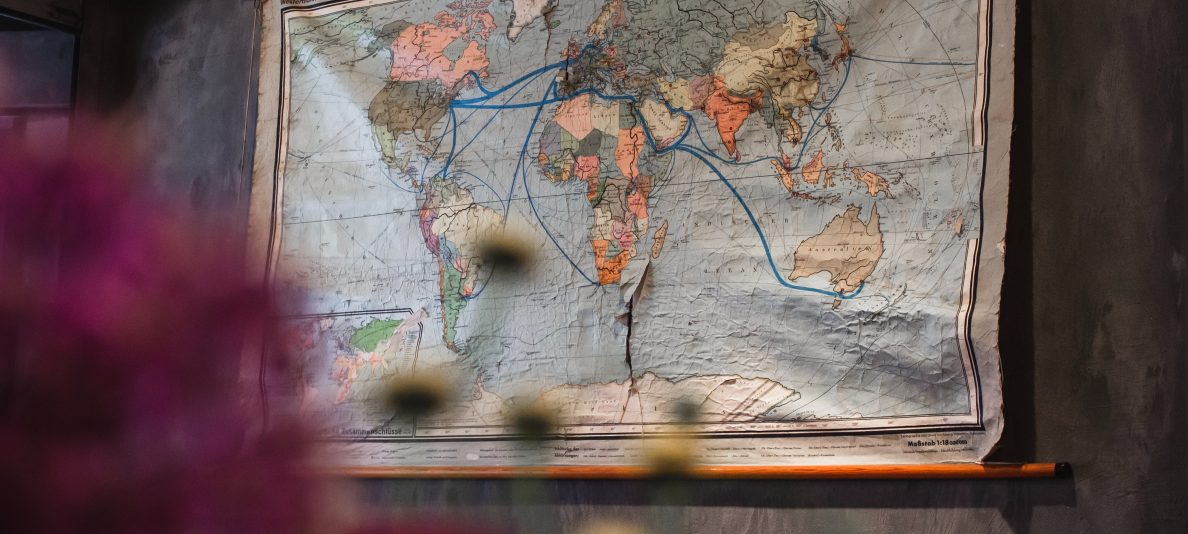
As of October 15, IKEA has 364 stores in 46 countries (map). These include the two stores in Taipei, where I was first introduced to the chain, and the newest store in the US, which opened last month in Meriam, KS, about two hours from my home.

(“Bringing the IKEA Concept Worldwide,” Inter IKEA Systems B.V.)

2. It has an “effect” named after it

IKEA is known for it’s “flat box” furniture, bought in a box at the store and assembled at home by the customer. While this can cause frustrations, especially if a piece is missing, it has it’s upsides. Researchers from Harvard, Yale, and Duke found that when people put effort into creating something, they like it more, even valuing their creations over others of higher quality. They dub this the “IKEA effect.”

(Michael Norton, “The IKEA Effect: When Labor Leads to Love,” Harvard Business Review, 2009)

3. Now it’s a kind of diplomacy, as well

It’s too early to say for sure, but I think the term IKEA diplomacy is going to catch on, too. Just a little over a week ago, Sweden recognized Palestinian statehood. This was followed by a swift condemnation from Israel’s foreign minister, Avigdor Lieberman, who said, “Sweden must understand that relations in the Middle East are much more complicated than self-assembly furniture at Ikea.”

“I will be happy to send Israeli FM Lieberman an Ikea flat pack to assemble,” responded the Swedish foreign minister, Margot Wallstrom. “He’ll see it requires a partner, co-operation, and a good manual.”

(Inna Lazareva, “Ikea and Peace in the Middle East,” The Telegraph, November 1, 2014)

4. IKEA’s catalog is published in biblical proportions

Each year, IKEA prints millions of its catalogs each year. According to the Wall Street Journal, in 2012 the company planned to distribute 208 million, which is estimated to be more than twice the amount of Bibles that are produced each year.

In 2012, the IKEA catalog made news when the company removed images of women from photos in the version distributed in Saudi Arabia. IKEA later apologized.

And September marked the announcement of the 2015 catalog in the highly innovative—dare I say groundbreakingform of the “bookbook.” Genius.

(Jens Hansard, “IKEA’s New Catalogs: Less Pine, More Pixels,” Wall Street Journal, August 23, 2012; “Is the IKEA Catalogue Being Distributed in More Prints than the Bible?” Skeptics Stack Exchange; Ben Quinn, “IKEA Apologises over Removal of Women from Saudi Arabia Catalogue,” The Guardian, October 1, 2012; )

5. Its product names are just so Kwïrki

If you’ve shopped at an IKEA or browsed a catalog, then you know that each product carries some kind of Swedish—or Swedish-ish—name. They often sound odd (a shelf named Ekby Bjärnmum), sometimes funny (a soil block is called Kokosnöt), and sometimes unfortunate (I’ll let you Google for these yourself).

Of course, this isn’t just a Swedish-to-English issue. The Wall Street Journal reports that before opening a store in Thailand, IKEA put together a team with the sole purpose of catching names that sound off-color to the Thai ear, such as Redalen (a bed) and Jättebra (a plant pot), both of which sound like Thai sexual terms.

And then there’s Lufsig, IKEA’s stuffed wolf toy. In December of last year, an anti-government protestor in Hong Kong threw one at Hong Kong’s Chief Executive Cy Leung during a town-hall meeting. The man tossed the toy because Leung is called “wolf” by his critics. The action took on more meaning since the Cantonese name for the stuffed toy sounds like a crude sexual term in that language. Lfusigs became a must-have item and soon sold out.

(James Hookway, “IKEA’s Products Make Shoppers Blush in Thailand,” The Wall Street Journal, June 5, 2012; Per Lilies, “Stuffed IKEA Toy Becomes Offensive Anti-Government Symbol in Hong Kong,” Time, December 10, 2013)

6. Name another furniture store that’s known for it’s food

According to The Wall Street Journal, IKEA’s food division is on par in sales with Panera’s and Arby’s. And the cornerstone of its in-store restaurants and grocery products is the humble Swedish meatball, of which they sell around 150 million each year.

The meatballs are nothing fancy, just really, really good. Here’s how they’re described on the company website, in typical Scandinavian understatement:

KÖTTBULLAR
Meatballs, frozen
Key features
– Meatballs are minced meat formed into round balls and then fried. Serve with boiled potatoes, lingonberry jam and cream sauce.

Even after its meatballs were recalled across Europe early last year, the store’s culinary reputation survived. Why the recall? Trace amounts of horse meat were discovered in a batch made by a Swedish supplier. If that news still gives you pause, have patience. Next year IKEA plans to roll out meatless vegetarian meatballs.

In the UK, IKEA even brews its own line of dark lager and regular brew beers.

Remember, this is a furniture chain we’re talking about.

(Jens Hansegard, “IKEA’s Path to Selling 150 Million Meatballs,” The Wall Street Journal, October 17, 2013; Andrew Higgins and Stephen Castle, “Ikea Recalls Meatballs after Detection of Horse Meat,” The New York Times, February 25, 2013; April Gosden, “Ikea Plans ‘Green’ Meatballs to Help Tackle Climate Change,” The Telegraph, April 17, 2014; Laura Stampler, “IKEA Now Brews and Sells Its Own Beer,” Business Insider, July 18, 2012)

7. It doesn’t want only to sustain its business, it wants to sustain the planet, too

Vegetarian meatballs aren’t the only thing “green” about IKEA.

The company started selling roof-top solar panels in the UK last year and in September it announced plans to expand that offering to 8 more countries in the following 18 months. It’s starting with the Netherlands and Switzerland and will move on from there.

As reported by Reuters, IKEA has installed 700,000 solar panels on its own rooftops at stores around the world and has plans to up its global use of wind turbines to 224. Other green initiatives include plans to replace, by 2020, all the plastic in its products with recycled plastic or renewable materials, such as wood.

And if you’re driving your electric car in the United Kingdom, you’ll appreciate IKEA’s announcement that all UK stores now have free electric vehicle rapid recharging points installed in their parking lots.

(“IKEA to Widen Solar Panel Sales to Eight New Nations from UK,” Reuters, September 22, 2014; “Electric Vehicle Charging,” IKEA)

8. In the time it takes to put together a couple bookcases, you could build a shelter for a refugee

Bloomberg Businessweek reports that the IKEA Foundation has invested $4.8 million to develop portable shelters, to be used by the Office of the United Nations High Commissioner for Refugees (UNHCR). Last year, 50 prototypes were shipped, in flat-pack boxes, to Syrian refugee camps. Olivier Delarue, UNHCR head of innovation, says that his agency was looking for an improvement on the tents typically used to house the displaced around the world and turned to IKEA for its “expertise in certain areas—such as logistics and flatpacking—that we could learn from.”

According to The Boston Globe, each 188-square-foot unit takes about four hours to assemble. The cost of a prototypes is $10,000 but is expected to fall below $1,000.

(Caroline Winter, “Ikea Sends its New Flatpack Refugee Shelter to Syria,” Bloomberg Businessweek, September 11, 2013; “Ikea: Refuge in a Flat Box,” The Boston Globe, July 5, 2013)

9. An IKEA store is like a 20-bedroom home away from home

It seems that many IKEAs not only have lines of people waiting to buy home furnishings, they also have lines of people wanting to make themselves at home.

Take, for instance, shoppers in China who lounge on the couches and climb under the covers for naps in the beds (photos at ChinaHush). Camilla Hammar, marketing director for IKEA in China, tells Advertising Age that stores there don’t just allow the try-it-out approach, they welcome it, embracing the idea that for the Chinese, shopping at IKEA can be an emotional experience. “It tends to initiate very romantic feelings,” she says. “The first time some couples start talking about getting married is in our showrooms. So that’s something we’ve tapped into.” And that’s why the store in Nanjing hosted three Swedish-style weddings for three couples as a PR event.

But it’s not just the Chinese who want to take advantage of the store’s sleeping—or wedding—accommodations. When Havas Media UK was looking for a way to promote the chain, they found a Facebook group called “I wanna have a sleepover at IKEA.” They latched on to the idea and organized “IKEA’s Big Sleepover” for 100 lucky customers.

And when couple in Maryland looked for a venue for their wedding in 2012, they chose the IKEA store where they had their first date. Another pair, this time in New Jersey, got married last year in  an IKEA framing department, the same place where they’d met eight years earlier.

Even Hollywood knows that domestic magic can happen in IKEA.

(Key, “IKEA in China, ‘Our Home Is Your Home,” ChinaHush, July 27, 2012; “Happy to Bed,” Havas Media; “A Wedding in Aisle 3? Why Ikea Encourages Chinese to Make Its Stores Their Own,” Ad Age, December 10, 2013; David Boroff, “Couple Gets Married in Maryland IKEA,” New York Daily News, April 20, 2012; Eliza Murphy, “Couple Says ‘I Do’ in IKEA’s Framing Department,” ABC News, June 11, 2013)

10. And it can put your love to the ultimate test

Of course, adding IKEA to a relationship doesn’t ensure bliss—even in Sweden. A story in The Local last year recounts how police were called to a home in Strömstad by neighbors who were concerned about loud noises during the early morning hours. The authorities found that the “banging and screaming” was caused by a couple putting together a piece of IKEA furniture, and by their crying child.

There’s nothing like assembling furniture to check your love for your significant other. Well, maybe shopping for furniture can have the same effect. A trip to IKEA could be the perfect premarital outing for couples wanting to see if their love has what it takes to go the distance. Take a look at the video below to get an off-kilter view of the store that just might be “the number one place where couples realize they actually can’t stand each other.”

(“Police Called to Swedish Family’s IKEA Nightmare,” The Local, November 8, 2013)

[photo: “IKEA of Sweden,” by Håkan Dahlström, used under a Creative Commons license]

Personalities, Profiles, Preferences, and Crossing Cultures

795619869_c1c80a9a37_zWhat personality types make for the best cross-cultural workers? I like to think that there’s room for all kinds, but it makes sense that certain types of people would find themselves drawn to or more suited for vocations that cross cultures.

When Peter Farley surveyed female missionaries from the UK, he found that, using the Myers-Briggs scale, there  are more “intuitive” (N) and less “sensing” (S) women among missionaries than in the general population. (The numbers are 42% Ns and 58% Ss among missionary women compared to 21% Ns and 79% Ss as a norm). The most common personality type is ISFJ, at 23%, but that is similar to the overall female population, while INFJs make up 12% of female missionaries, significantly more than the 2% norm.

Erin Meyer, author of The Culture Map: Breaking Through the Invisible Boundaries of Global Business, has a different scale for evaluating personality. It’s the “Culture Profile.” By answering the 24 questions of the assessment and choosing your country, you can see how you compare to your countrymen in eight areas:

  • low vs high context communication
  • direct vs indirect criticism
  • principles-first vs applications-first arguments
  • egalitarian vs hierarchical leading
  • consensual vs top-down decision making
  • task-based vs relationship-based trust
  • confrontation as a help vs hindrance
  • linear vs flexible time

You can take the assessment online at Harvard Business Review. Before you begin, I have a suggestion. Grab a pen and paper so you can jot down your answer to each question (you respond to each one on a scale ranging from “strongly agree” to “strongly disagree”). This way you can see your evaluation alongside different norms by choosing a different country each time. Otherwise, when you retake the profile, your answers are reset, and it’s difficult to exactly duplicate your responses each time, especially since it’s easy to start overthinking your responses after seeing the outcomes.

When I took the test, I found that in several areas I don’t fit in with the American norm. One of these is the high context/low context scale. Here is Meyer’s description of “context”:

In low-context cultures (such as the U.S., Germany, and the Netherlands), good communication is precise, simple, and explicit. Messages are expressed and understood at face value. Repetition and written confirmation are appreciated, for clarity’s sake. In high-context cultures (such as China, India, and France), communication is sophisticated, nuanced, and layered. Reading between the lines is expected. Less is put in writing, and more is left to interpretation.

So the US is a poster child when it comes to low-context cultures. But my answers to the profile put me closer to the high-context extreme, where China resides. Maybe that’s because my ten years living in Taiwan altered my preferences, or maybe I was originally drawn to the Chinese culture because it fit my personality. It’s probably a little bit of both.

So take the survey. It may tell you something about yourself you didn’t know. It may show you that you’re a prime example of your country’s cultural norm. It may help you see why you sometimes don’t “get” the people around you, and why they sometimes don’t get you. It may show you some changes you should make in behaviors or expectations. And it may show you a place far away where being yourself would be the perfect way to fit in.

(Peter C. Farley, “Psychological Type Preferences of Female Missionaries,” Mental Health, Religion & Culture, November 2009; Erin Meyer, “What’s Your Cultural Profile?” Harvard Business Review)

[photo: “Me, Myself and . . . Dr,” by DraconianRain, used under a Creative Commons license]

The Faith of a Bicycle

60328782_d8ad8b40c9_z

When we first moved to Taipei, we lived across the street from a park. One day, in that park, I was approached by three college-age students who asked me in English, “Do you know Jesus?”

“Yes,” I said.

“OK,” they replied. “But do you really know him?” This was a logical question, because while English has the one word for knowing someone, Chinese has two. The first would be the one in “I know who he is,” while the second means “I know him personally.”

I had the perfect response. Not only was I a Christian, but I was a missionary . . . and I’d been studying Chinese, too. So, I told them, somewhat smugly, in their language, “Yes, I know him. I’m a . . . bicycle.”

I wish I could say that the Chinese words for missionary and bicycle sound just alike, but they don’t. The first is chuan jiao shi, and the second is jiao ta che. I think I must have learned them on the same day, because they are forever confused in my mind. The young people in the park laughed with me and let me correct myself. “Chinese is hard,” they said. I didn’t argue.

Over the years, that encounter became a symbol to me for the good and bad times in Taiwan: Some days I was a missionary. Some days I was just a bicycle.

Flat Tires and Slipped Chains

In an article published by Christianity Today this month, John Wilson interviews British author Francis Spufford about defending the Christian faith in a post-Christian culture. Spufford talks about a chapter in his latest book, Unapologetic: Why, Despite Everything, Christianity Can Still Make Surprising Emotional Sense, that gives a summary of the New Testament:

[T]he reason why I have Yeshua, my de-familiarized Christ, saying, “Far more can be mended than you know,” which I think is actually true to the New Testament, is that I want mending. Not flying free, not transformation, but humble, ordinary, everyday, get-you-back-on-your-feet mending, to be at the center of the Christian story.

When the book was being translated into Dutch, the translator sent me an email: “This word mend, I’ve looked it up in the dictionary, and it seems to be the same word you use for repairing bicycles. You must mean something else.”

I wrote back, “No. No. No. I want the bicycle-repair word.” What I absolutely want is to suggest that before it’s anything else, redemption is God mending the bicycle of our souls; God bringing out the puncture repair kit, re-inflating the tires, taking off the rust, making us roadworthy once more. Not so that we can take flight into ecstasy, but so that we can do the next needful mile of our lives.

We all need that kind of mending from God. I guess being a bicycle isn’t so far from being a Christian—and a missionary—after all.

(John Wilson, “Faith for the Post-Christian Heart: A Conversation with Francis Spufford,” Christianity Today, April 3, 2014)

[photo: “Bicycle,” by Marcella, used under a Creative Commons license]

Park-Bench Conversations

[I’ve written a new “page” to point readers to posts in this blog that are the most meaningful to me. It’s called “park bench,” and it’s linked in the banner above. And to save you a click, here it is below.]

The posts on this blog, while all under the umbrella of cross-cultural issues, cover an array of topics. All of these are interesting to me, but some of the most important to me are on the subject of transitioning between cultures.

142023581_52b616759aIt’s often a difficult process and lasts well beyond the plane ride. Though there are many voices telling us about the challenges of redefining “home,” many of the stories are not shared eagerly or in public. Rather, they come out in safe places and only in response to careful and gentle prodding.

There are several images that conjure up thoughts of those conversations: a kitchen table, side-by-side cups of coffee, the corner booth in a cafe, a front porch.

For me, it’s a park bench.

I’m not always comfortable with talking face-to-face. It’s easier for me to sit next to someone, with the option of staring into the distance or getting up for a walk. Some of my deepest conversations, with people and with God, have taken place on park benches—at the edge of a mountain trail, in a park, next to a playground, in the courtyard of an apartment complex, at a bus stop on a busy street.

At Clearing Customs, the park-bench talks center on the difficulties of transition, on the grief that comes from losses associated with moves, on finding confidants who are able to listen without judgment. If those topics are relevant to you, too, please follow the category links below.

All of the topics in this blog are interesting to me, but these are some of the most important to me.

[photo: “City Park in Fall,” by Michael Williams, used under a Creative Commons license]

Doing the Culture Slide: Living with the Confusing Effects of Globalization

5043651435_3d6a657c89
Donald McDonald at an iCon’Chicken event in Japan

The culture slide. It’s not a dance for expats—though sometimes it may feel like it.

Culture slide is the name I’ve given to the confusion and shifts in thinking brought about by globalization.

It’s when your kids grow up in Taipei and think that Giordano clothing stores must be from Italy (they’re actually from Hong Kong) and they must have outlets in the US (they don’t). Likewise, Napoli sounds Italian, but the pizza chain is Taiwanese. Then there’s NET (from Taiwan), Fnac (from France), and B&Q (from the UK). And as much as they may feel like GAP, Best Buy, and Home Depot, the kids didn’t find any of them when they traveled to the US.

It cuts the other way, too. Back in the States, we think we should be able to order corn soup and extra-spicy extra-crispy chicken at KFC. . . and tuna and peas should be available as toppings at Pizza Hut. And we’re pleasantly surprised to find out that IKEA and Yoshinoya are in the good ol’ US of A, too—even if they haven’t made it to our part of the country yet.

That last part reminds me of a story attributed to Den Fujita, founder of McDonald’s in Japan. In Asian Brand Strategy: How Asia Builds Strong Brands, Martin Roll writes about Fujita saying, “Once a group of Japanese Boy Scouts visited the United States and were asked by a local television station what their impression of America was. One boy replied, ‘I didn’t know that they had McDonald’s in the United States, too.’” Maybe you’ve heard that story before, but that time it was a Japanese boy in Florida or a Japanese girl in Los Angeles or a French girl in Times Square or a European boy or a little boy from Indonesia. It’s all so confusing.

Donald McDonald

Ahhh, McDonald’s, the king of globalization, and the instigator of so much culture slide.

Not only does McDonald’s localize their menus wherever they go—which might make Germans think that all the world’s restaurants have McCurrywurst—but they’re selections also cross borders in some fairly strange ways. A couple years ago, Germany’s McDonald’s introduced bubble tea, a drink with chewy tapioca balls that was invented in Taiwan. Here’s the commercial:

As others have pointed out, why is the actor yelling, “Bubblezzaaiii”? Is he trying to sound Japanese?

So that brings us back to Japan, the country with the second most McDonald’s restaurants, next to the US. Fujita brought “Donald McDonald” (it’s easier to pronounce that way) to his country in 1971, writes John Love in McDonald’s: Behind the Arches, with the idea that the restaurants would have to look “100 percent Japanese.” Love quotes Fujita as saying, “If I insisted that this was something that came from America, the Japanese would say, ‘This is American, and we don’t like it because we don’t like Americans.'” It seems that in Fujita’s eyes, they didn’t disdain all things Western, as he’s also credited in Love’s book with telling reporters,

The reason Japanese people are so short and have yellow skins is because they have eaten nothing but fish and rice for two thousand years. If we eat McDonald’s hamburgers and potatoes for a thousand years, we will become taller, our skin will become white, and our hair blond.

It will be some time before that can be proven or disproven, but it didn’t take nearly as long for McDonald’s in Japan to warm up to its American roots. Right now it’s in the middle of a campaign with throwback menus featuring “American Vintage” food from the ’50s, ’70s, and ’80s—or at least it features what some in Japan think is vintage American food. The offerings include a burger with two beef patties, an egg, and mashed potatoes between the buns (’50s), “Hot & Groovy” chicken sandwiches topped with salsa (’70s), and sandwiches with the addition of BBQ sauce (’80s).

Now that’s the way, uh-huh, uh-huh, I like it, uh-huh, uh-huh.

Sing Along with Me: “Baseball, Hot Dogs . . .”

I’m just glad that here in the US, we’ve got a pretty good handle on who we are and what is ours. We know that McDonald’s is a genuine American export, even if the menu changes around the globe. We also know that no matter how much the world tilts on its cultural axis, we’ll always be able to count on things like baseball, hot dogs, apple pie, and Chevrolet. Remember that chorus from the Chevy commercial in 1975?

To review, that’s baseball (where all the balls used in the Major Leagues are made in Costa Rica), hot dogs (which originated in Germany), apple pie (first made in England), and Chevrolet (which is the third-best-selling auto brand in the US, behind Toyota).

In 2006, Chevrolet came out with a new version of their song, once again advertising America’s “favorite brand.” The chorus was updated with several new versions, such as “stolen bases, goat-cheese pizza, bottled water, and Chevrolet.” The commercial ended with the tagline “The world has changed. But the love affair continues.”

I can’t attest to the love affair, but, boy, the world sure has changed.

Step, two, three, four. Doing the culture slide.

(Martin Roll, Asian Brand Strategy: How Asia Builds Strong Brands, New York: Palgrave Macmillan, 2006; John F. Love, McDonald’s: Behind the Arches, New York: Bantam, 1995; Michelle Lynn Dinh, “McDonald’s Japan Serving ‘American Vintage’ Burgers Starting This January,” RocketNews24, December 28, 2013)

[photo: “iCon’ Chiken FES._064,” by TAKA@P.P.R.S, used under a Creative Commons license]

Sorry—No Ifs, Sos, or Buts

139499559_0248586250_nIf you were following the news a couple weeks ago, you got to hear a great example of a straightforward, unequivocal apology from MSNBC host Melissa Harris-Perry. Earlier, on her show, she and her guests had made fun of a photograph showing Mitt and Ann Romney with their 21 grandchildren. The subject of their jokes was that everyone in the photo was white, except for the adopted African-American baby sitting on Mr. Romney’s knee.

In a tweet following the show, Harris-Perry wrote, “I am sorry. Without reservation or qualification. I apologize to the Romney family.”

That kind of an apology is hard to come by. It’s hard to get, and it’s hard to give. But it’s the kind of apology necessary for healthy repentance and healthy relationships—and for healthy good-byes.

R is for Reconciliation

In their book, Third Culture Kids: Growing Up among Worlds, Third Culture Kid experts David Pollock and Ruth Van Reken advise that those transitioning from one country to another should build a “RAFT.” The four parts of that raft are

  • Reconciliation
  • Affirmation
  • Farewells, and
  • Think Destination

“Reconciliation,” say the authors, “includes both the need to forgive and to be forgiven.” And this forgiveness is especially important preceding a move across time zones and oceans.

When transitions approach, those leaving—and those staying—have a small window of opportunity for a face-to-face healing of wounded relationships, a window that gets smaller as the departure gets closer. That’s why apologies become more and more necessary, even at a time when they may seem more and more difficult.

But simply deciding to say “I’m sorry” isn’t enough, because not all apologies are created equal. In fact, we live in the age of the “non-apology apology.” When you say, “I’m sorry,” do you add on any qualifiers? Do extra words reveal your true feelings?

Or do your words of remorse stand on their own, with no ifs, sos, or buts?

No Ifs

The “If” apology is probably the most popular way to get out of a full confession. It goes something like this: “I’m sorry if my choice of words offended you.” What that says is “If my words offended you, then you must be very thin skinned. You should not be offended by what I said, because it wasn’t really offensive. But because you are upset, I would like you to know that had I known I was dealing with someone as sensitive as you, I would not have said what I said . . in your presence.” When this kind of apology is given, is there any real doubt in the speaker’s mind that someone is offended, hurt, etc.?

No Sos

Sos aren’t usually spoken—unless we’re particularly brazen—but they appear when we require something in return for our apologies. If they were actually to emerge from the recesses of our hidden motives and be vocalized, we might say, “I’m sorry . . . so now I’ll listen while you tell me there’s nothing to apologize for,” or “I’m sorry . . . so you need to stop blaming me,” or “I’m sorry . . . so you’re sorry too, right? (I’m more than willing to meet you halfway. That is the way it works, isn’t it?)”

No Buts

By definition, but means that what comes second is going to contrast with what came first. Sometimes the I’m sorry is just a way to softly introduce the “truth”: “I’m sorry, but you had it coming to you.” The but can also announce excuses: “I’m sorry, but I was really tired.” It can spread around the blame: “I’m sorry, but I’m not the only guilty party here.” Or it can even pass the buck on to all of humanity: “I’m sorry, but anyone else in my situation would have done the same thing. (And any reasonable person would agree.)”

Sorry Does Seem to Be the Hardest Word

It’s difficult to apologize without tacking on a weasel word or two, to just let our “I’m sorry” resonate in silence. I should know, as I’m guilty of using every kind of disclaimer above myself, several times. I’ve also left apologies unsaid.

So why is it so hard?

Maybe it’s habit. It’s easy to fall into old patterns, in particular when we’re under stress. And few things are more stressful than voicing an apology that’s been a long time coming. If you don’t want it to come out wrong, you might need to practice beforehand.

Maybe it’s self preservation. A real apology leaves us truly vulnerable. We have to drop our guard and be willing to take our licks.

Or maybe it’s because of the word sorry itself, coming from the Old English sarig, meaning “full of sorrow.” Today, sorry can range from a deep, sorrowful regret over something said or done to a simple usage that means “excuse me,” such as when we’re walking through a crowded hallway. And we also use it to express our sympathy for someone else’s sorrow, as in “I’m sorry for your loss.” I think it’s this last usage, in the context of an apology, that often get’s us in trouble. As with several examples above, our words sound less like “I’m sorry that I wronged you” and more like “I’m sorry you feel that way.”

Regardless of why it’s hard, it’s worth the effort. We need to mend relationships, and we need to bring healing to our own hearts. And we need to do it as soon as possible, so we don’t have to try to work it in at the airport.

And one more thing. There’s no guarantee that the person on the other end of an apology will forgive us. In fact, the deepest apologies come when we don’t think we deserve to be forgiven. And the greatest relief comes when we receive forgiveness anyway.

A Final Disclaimer

Maybe I’ve stepped on some toes with this post. I apologize if you’re bothered by what I’ve written, but sometimes I have a hard time getting my real meaning across, so please don’t think that any of it was on purpose.

I guess what I’m trying to say is “I’m sorry.”

Well, no. Not really.

(Melissa Harris-Perry, “An Apology from Melissa Harris-Perry,” MSNBC, January 4, 2014; David C. Pollock and Ruth E. Van Reken, Third Culture Kids: Growing Up among Worlds, Boston: Nicholas Brealey, 2009)

[photo: “Sorry!” by Andrew Yee, used under a Creative Commons license]

“An Extraordinary Theory of Objects”: A TCK in Paris and the Things That Keep Her Sane, Sort of

31703109_4ad6f7ce2c_nI just finished reading a cool little book entitled An Extraordinary Theory of Objects: A Memoir of an Outsider in Paris. It was a Christmas gift from my son, the one who got a Moleskine Journal from me.

An Extraordinary Theory of Objects is a series of vignettes by Stephanie LaCava about her move to France as a twelve-year-old in 1993, her years there growing up, and then her visits back again after attending college in the States.

On the cover of my copy of the book are romantically filtered and tinted photos of the Eiffel Tower, and on the pages inside, her writing style evokes the same kind of mood. If stories could be sepia-toned, this is how they might sound.

Actually, the filter through which LaCava encounters the world is her attachment to things. First, there are the small, curious relics—a skeleton key, a mushroom, an opal necklace found in the mud—that she gathers and places on her windowsill. Initially they replace her old collection, “everything that represented [her] past life and its predictable ways,” which is on a container ship making its way across the ocean from New York.

And then there are the objects she encounters from day to day, common things that she illuminates in copious footnotes often taking up more than half a page. Cataloging these objects gives her security and makes sense of her life in a new city . . . as she faces depression and what she calls her own “kind of crazy.”

Some might find her footnotes distracting, but they cover just the kind of obscure topics that intrigue me, such as a Japanese smuggler of black-market butterflies, a photo book dedicated to Salvador Dali’s mustache, and the origins of the tea bag. And they are replete with references to a variety of figures, from Pliny the Elder to Kurt Cobain, from Anne Boylen to Kate Moss.

Much of LaCava’s narrative is about time spent with her father, often searching flea markets for items to fulfill their eccentric tastes. At other times, she talks about her classmates at the international school. She says she was “mostly alone” her first year there. Even among these other outsiders, she doesn’t fit in.

I rode the bus to school and listened to my Discman while the girl in the back row threw gum wrappers at my head. The girls at school didn’t like me very much. They had never given me a chance, decided immediately that I didn’t belong, which was funny, as they didn’t either—at least not in France. They made me feel as if I had done something wrong, and they spoke badly about me to each other. Through my own odd rationalization, I decided excommunicating me meant they belonged to something, simply because I did not. . . .

Come the new academic year, the old class would be replaced with another set of students who had just moved overseas. Only a few remained year after year—and still the same insensitivity.

One day, a classmate tells her that she looks like Angela from the TV series My So-Called Life.

“I haven’t seen it,” she replies.

“Everyone’s seen that show,” he says. “Don’t you have friends in the States? They can send it to you.”

In a footnote, LaCava delves into the significance of the series, quoting Matt Zoller Seitz of The New York Times, who writes, “What the series’ narration does best: it shows how teen-agers try to control their chaotic inner lives by naming things, defining them, generalizing about them.”

That’s what LaClava does, as well—controlling the inner chaos of her life in a Paris suburb by naming the objects she encounters. Then, years later, she examines them even more closely and writes about them so that she can share with us her own kind of strange . . . and her own kind of normal.

(Stephanie LaCava, An Extraordinary Theory of Objects: A Memoir of an Outsider in Paris, New York: Harper Perennial, 2013)
[photo: “Eiffel Tower,” by charley1965, used under a Creative Commons license]
If You Can’t Take a Walk in Someone Else’s Shoes, Try Taking a Good Look at Them

111377949_149f00bba9
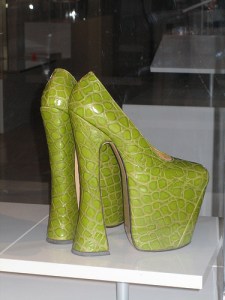
A pair of shoes on display at Toronto’s Bata Shoe Museum, which houses the world’s largest collection of shoes and footwear-related objects..

When my family first moved to Asia, I seemed to see Americans every time we rode the subway. Later, I lost some of my cultural myopia and realized that a lot of those “Americans” were Europeans, or South Africans, or . . . . Of course the biggest giveaway was to hear them speak. Hairstyles and clothing helped, too.

Then I started looking at shoes. There’s just something telling about our shoes. Maybe it’s flip-flops vs dress shoes, or Nikes vs a brand of indoor soccer shoes I’ve never heard of. I’m no expert on footwear, and I can’t always put my finger on what’s different, but I know it when I see it.

You can tell a lot by looking at people’s shoes.

Take, for instance, the “array of worn-down, ill-fitting, and jerry-rigged shoes” worn by refugees fleeing military campaigns in Sudan, escaping into South Sudan in 2012. Shannon Jensen chronicled their journey by photographing their shoes. Her series of photos, “A Long Walk,” won an Award of Excellence from Pictures of the Year International (POYi).

Take, for instance, Yuxin Horatio Han’s Unifold shoes. Han grew up in China and developed his “origami” shoes, inspired by Indian moccasins, at Pratt Institute’s School of Art and Design in Brooklyn. Each of Han’s shoes—he’s created two different prototypes—are made from a single piece of foam rubber. After the pattern is cut with a die, the shoe can be folded together in a two-minute process. Han is currently tinkering with the design and looking at alternate fabrics, and when he’s done, cheap, easily assembled shoes could become available to the world market.

Take, for instance, the thousands of pairs of footwear on display at the Bata Shoe Museum in Toronto. If you’re in the area, check out their exhibit “Collected in the Field: Shoemaking Traditions from around the World.” Or online, browse through “The Shoe Project,” a collection of stories by 14 women who have immigrated to Canada from several countries, including Nigeria, Panama, Pakistan, Afghanistan, and Turkey. Each contributor, aided by novelist Katherine Govier, writes about a significant pair of shoes and how they help give insight into a special occasion in her life.

Konsentrasjonsleiren KS Auschwitz I
Some of the over 110,000 shoes at the Auschwitz-Birkenau Memorial and Museum.

And take, for instance, the 110,000 shoes of Holocaust victims on display at the Auschwitz-Birkenau Memorial and Museum . . . or the pile of 4,000 shoes exhibited at Washington, D.C.’s United States Holocaust Memorial Museum—shoes collected by the Nazis in the concentration camp in Majdanek, Poland. According to the museum’s website, visitors often say that seeing the shoes and smelling the shoes “is the most searing memory from their time in the Permanent Exhibition.” Also from the site:

When Soviet troops liberated the Auschwitz-Birkenau and Majdanek camps, they discovered huge mounds of shoes, hundreds of thousands of pairs, but very few living prisoners. At the sight of these inanimate witnesses, veteran CBS News correspondent Edward R. Murrow commented, “One shoe, two shoes, a dozen shoes, yes. But how can you describe several thousand shoes?”

You can tell a lot by looking at people’s shoes.

(Andrew Lampard, “Check Out These New Origami Kicks!” Yahoo! News, November 22, 2013; Katherine Boyle)

[photos: “Crocodile Shoes,” by Sheila Thomson, used under a Creative Commons license; and “Shoes from Prisoners – Auschwitz I,” by Jorge Láscar , used under a Creative Commons license]