Can There Be Too Much Choice? It’s a Cultural Thing

I recently wrote about the trials of choosing cereal at Wal-Mart, and friend and fellow blogger MaDonna followed up with her own post calling the cereal aisle “one of the top 5 places expats hate to visit in the US.”

Sheena Iyengar, a professor at Columbia University and leading expert on choice, understands our pain. She writes in her book The Art of Choosing,

In 1994, the year I had my first inkling that there might be such a thing as too much choice, over 500,000 different consumer goods were already available in the United States. By 2003, the number had increased to nearly 700,000, an upward trend that shows no signs of letting up. Technological advances frequently introduce new categories of products into our lives. Some of them—cell phones, computers, digital cameras—become indispensable, and soon enough the options proliferate. Just as importantly, not only are there more goods on the market, there are more ways to get at them. The typical supermarket, which carried 3,750 different items in 1949, now boasts some 45,000 items. Walmart and other “big-box” retailers offer smorgasbords of over 100,000 products to Americans in just about every part of the country. And if you don’t find what you’re looking for within a few blocks, you’ll certainly find it with a few clicks. The Internet extends your reach well beyond local venues, providing access to the 100,000 DVDs on Netflix.com, 24 million books (and millions of other products) on Amazon.com, and 15 million singles on Match.com.

Following is a fascinating TedGlobal talk by Iyangar in which she discusses cultural differences in the valuing of choice. In her introduction to the video on her website, she says,

In America, choice is sacred. We believe in its limitless power and we worship it for the possibilities it offers. For Americans, choice is liberty, which is subordinate only to life itself in the Declaration of Independence. So it can be almost impossible to accept that not only are there countries and cultures that do not subscribe to the American ideal of choice, but that they wouldn’t necessarily be better off if more choice suddenly became available to them. I explore the great variation across the globe in beliefs about who should choose and when, how much choice should be available, and when choice is a burden rather than a pleasure.

Iyangar starts her presentation with an experience she had in a Japanese restaurant and ends in the US with a story of how her blindness affected how she chose the right fingernail polish. In between she shares research and anecdotes from around the world. Enjoy.

[photo: “Fi,” by Michael Hopkinsii, used under a Creative Commons license]

Disenfranchised Grief and the Returning Cross-Cultural Worker

Disenfranchised grief, also called “hidden sorrow,” is caused by “a loss that is not or cannot be openly acknowledged, publicly mourned or socially supported.”  This definition comes from an article I recently came across from Australian Family Physician, discussing the response of general practitioners (family physicians) to repatriated cross-cultural workers affected by grief.

What makes their grief disenfranchised is that their losses are not typical to the population at large, so others often discount those losses or don’t understand them. It is difficult to have compassion for a person when you don’t recognize why he is grieving. Others with disenfranchised grief include “ex-spouses, caregivers, nursing home staff, pet owners, children, adoptees, individuals with developmental disabilities, . . . those who may be grieving suicide or AIDs victims or other forms of stigmatised death, . . . victims of sexual abuse, indigenous people and prisoners re-entering their original subcultures.” While this seems to be a list made up of disparate groups, their commonality is that the losses they suffer are often easy to ignore or downplay.

The part of the article that most helped me understand the concept was the authors’ explanation of six types of disenfranchised grief. I am presenting the list here, but I’ve taken the liberty of providing my own examples of how they might apply to repatriated cross-cultural workers:

  • The griever’s relationships are unacknowledged
    [“You can enjoy yourself now that you’re back with your own people.”]
  • Lack of acknowledgment of the griever’s loss
    [“People move all the time. It’s not like somebody died.”]
  • Exclusion of the griever as not being capable of grieving
    [“She’s just a child. She’ll make new friends.”]
  • Exclusion of the griever due to the circumstances of the loss
    [“You knew what you were getting into when you decided to go overseas.”]
  • Exclusion of the griever due to their way of grieving which is not deemed appropriate by the community
    [“The Bible says ‘Consider it pure joy, my brothers, whenever you face trials of many kinds.'”]
  • Self initiated disenfranchised grief where shame plays a significant role
    [“Why don’t I trust God more?”]

The authors go on to stress how important it is that general practitioners understand disenfranchised grief and take steps to deal with it. Not only may family doctors be asked to treat physical symptoms that are a result of grief, but they may also be the only affordable and “safe” help that is available to the re-entering worker.

I wish that we could all understand and acknowledge others’ grief, whatever the source, so that we could “mourn with those who mourn,” giving them the community they need so they don’t have to grieve alone.

(Susan Selby, et al, “Disenfranchised Grievers: The GP’s Role in Management,” Australian Family Physician, Vol. 36, No. 9, September 2007)

[photo: “grief,” by Tomek.pl, used under a Creative Commons license]

Coca-Cola: Selling Soda and Marketing Global Happiness

Remember the Coca-Cola chorus in the 70s singing “I’d like to buy the world a Coke”? Well, The Coca-Cola Company is getting one step closer to that goal. Myanmar, one of only three countries left where Coke is not sold, will soon join the rest of the globe in serving the world’s most popular soft drink. After being gone for more than 60 years, Coca-Cola plans to re-enter the Myanmar market soon, when the US government officially allows investments there, this in response to Myanmar’s recent turn to democracy. This will leave only Cuba and North Korea on the outside of the Coke market.

Buying the world a Coke wasn’t The Coca-Cola Company’s only plan. It also wanted to “teach the world to sing” and “buy the world a home and furnish it with love.” Today, Coke’s hopes are still lofty. Their current campaign is “open happiness,” and they are spreading the message that “There are reasons to believe in a better world.” Below are three videos demonstrating this theme—citing what seem to me to be some odd pairings of vague statistics (“While one scientist is creating a new weapon . . . 1 million moms are baking chocolate cakes”). Oh well. They’re fun videos, and the music is cool. It’s the thought that counts, right? It’s Coca-Cola.

The first video is the global edition. The second is for Africa. The third is for India. And finally, the fourth video is of a guy who traveled around the world and drank a Coke in every country he visited.

(Tony Jordan, “Coca-Cola Announces Will Return to Myanmar after 60 Years,” Yahoo! Finance, June 15, 2012)

[photo: “Faces, Langa, Cape Town,” by Dietmar Temps, used under a Creative Commons license]

Barack Obama, TCK President

A new biography is out on the president, David Maraniss’s Barack Obama: The Story, and it’s getting some media attention, mostly because of the input from former girlfriends and because parts seem to contradict Obama’s own earlier writings. But what interests me more are the insights on how the president’s international upbringing has been a factor in shaping his personality.

As Obama grew up, he was exposed to a variety of different cultures. He was born in Hawaii to a Kenyan father and a white American mother from Kansas, and after his parents divorced, his mother married an Indonesian man. The family later moved to Jakarta, where Obama lived from 6 to 10 years old, before returning to Hawaii, finishing out his elementary and secondary schooling there.

In adaptations from the book, published in Vanity Fair this month, Maraniss writes,

At age 20, Obama was a man of the world. He had never been to south-central Kansas or western Kenya, the homelands of his ancestors, yet his divided heritage from Africa and the American heartland had defined him from the beginning. He could not be of one place, rooted and provincial. From his years living in Indonesia, where he was fully immersed in Javanese schools and culture; from his adolescence in Hawaii, where he was in the polyglot sea of hapa and haole, Asians and islanders; from his mother’s long-term commitment to development work overseas; from his friendship with Pakistani students at Occidental and his extended visit to their country—from all of these he had experienced far more global diversity than the average college junior. He knew the ways of different cultures better than he knew himself.

In 1979, Obama began his post-secondary education at Occidental College, in Los Angeles. Then, after transferring to Columbia University two years later, he reconnected with Alex McNear, a friend from Occidental, who was spending the summer in New York. Obama wrote her that he envied his friends who were heading into business and other mainstream pursuits, but that didn’t feel right for him:

Caught without a class, a structure or tradition to support me, in a sense the choice to take a different path is made for me. The only way to assuage my feelings of isolation are to absorb all the traditions [and] classes; make them mine, me theirs.

Obama first met a later girlfriend, Genevieve Cook, in 1983 at a Christmas party. In one of those TCK “me too!” moments, they discovered that both had spent time in Jakarta as children. Maraniss writes,

He noticed her accent. Australian, she said. He knew many Aussies, friends of his mother’s, because he had lived in Indonesia when he was a boy. So had she, before her parents divorced, and again briefly in high school. As it turned out, their stays in Jakarta had overlapped for a few years, starting in 1967. They talked nonstop, moving from one subject to another, sharing an intense and immediate affinity, enthralled by the randomness of their meeting and how much they had in common. They had lived many places but never felt at home.

John Richardson, himself a TCK who grew up in Asia, believes that Obama’s time overseas has had a big impact on shaping his personality and how he goes about solving problems. What some—from both the right and left—see as Obama’s frustrating bipartisanship, writes Richardson, isn’t “exactly bipartisanship. It’s something else—something strange and essential. It is, though we don’t quite realize it yet, the real reason we elected him.”

Some, fellow TCKs and non TCKs alike, would argue that this form of bipartisanship is what kept them from voting for him. It’s not my purpose here to argue politics or the rightness or wrongness of Obama’s views or “the real reason we elected him.” Rather, I want to look at how his TCKness affects him. When TCKs meet each other, they soon find out that while their common experiences have often produced shared attitudes, that does not mean that they share the same beliefs and convictions. Some TCKs passionately defend Obama’s policies while others passionately attack them. Being a Third Culture Kid certainly doesn’t produce cookie-cutter people, political or otherwise.

Richardson goes on to quote from what he calls “the TCK bible,” David C. Pollock and Ruth E. Van Reken’s Third Culture Kids: The Experience of Growing Up among Worlds:

While growing up in a multiplicity of countries and cultures, TCKs not only observe firsthand the many geographical differences around the world but they also learn how people view life from different philosophical and political perspectives. . . . [TCKs] have lived in other places long enough to appreciate the reasons and understanding behind some of the behavioral differences rather than simply being frustrated by them as visitors tend to be.

But, writes Richardson, when TCKs arrive in the US, their disconnect with American culture makes those around them wonder if there is a disconnect in values, too. He goes back to Third Culture Kids:

It seems the very awareness which helps TCKs view a situation from multiple perspectives can also make TCKs seem impatient or arrogant with others who only see things from their own perspective—particularly people from their home culture . . . others may notice how the TCK’s behavior changes in various circumstances and begin to wonder if they can trust anything the TCK does or says. It looks to them as if he or she has no real convictions about much of anything.

According to Van Reken, TCKs often call themselves “chameleons” because “after spending a little time observing what is going on, they can easily switch language, style of relating, appearance, and cultural practices to take on the characteristics needed to blend better into the current scene.” She quotes an article in the Financial Times that states President Obama “benefited from his chameleon power to make a lot of different people feel he represents them. . . .”

Shortly after Obama’s election, Van Reken wrote for The Daily Beast that the new president and the other adult TCKs that he appointed to his cabinet “share certain emotional and psychological traits that may exert great influence in the new administration.” To Van Reken, Obama’s Dreams of My Father “could serve as a textbook in the TCK syllabus, a classic search for self-definition, described in living color,” and she calls Obama’s “exceptional skill at mediating among competing arguments,” his seeming aloofness, and his “cool manner” as common traits of Third Culture Kids.

Aloofness is one of the descriptors that President Obama’s critics use to tag him. It is similar to some of the ways his girlfriend, Cook, also describes him in her diary: “something also there of smoothed veneer, of guardedness . . . but I’m still left with this feeling of . . . a bit of a wall—the veil,” “Distance, distance, distance, and wariness,” “that coolness,” and “his withheld-ness.”

During his relationship with Cook, when the two went to social functions, it was usually with Pakistani friends. But there came a time when Obama began to draw away from them, which Beenu Mahmood, one of those friends, noticed. Maraniss writes that Mahmood

could see Obama slowly but carefully distancing himself as a necessary step in establishing his political identity as an American. For years when Barack was around [the Pakistanis], he seemed to share their attitudes as sophisticated outsiders who looked at politics from an international perspective. He was one of them, in that sense. But to get to where he wanted to go he had to change.

Where am I from? Where am I going? These are questions that are sometimes difficult for Third Culture Kids to answer. But for at least one TCK, the answer to the second question ended up being the White House.

(David Maraniss, “Young Barack Obama in Love: A Girlfriend’s Secret Diary,” Vanity Fair, June 2012; John H. Richardson, “How Obama Really  Thinks: A Primer for the Left and Right,” Esquire, June 21, 2010; David C. Pollock and Ruth E. Van Reken, Third Culture Kids: The Experience of Growing Up among Worlds, Boston: Nicholas Brealey, 2009; Ruth E. Van Reken, “Obama’s ‘Third Culture’ Team,” The Daily Beast, Nov. 26, 2008)

[photo: “Obama plaque,” by Stefan Geens, used under a Creative Commons license. The plaque is located at State Elementary School Menteng 01, Menteng, Jakarta, Indonesia. The inscription reads, “Barack Hussein Obama II, the 44th President of the United States of America, attended this school from 1969-1971.”]
Two Books for Helping Us Picture the Kids of the World

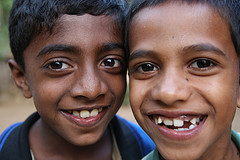
When people miss home, they often say they wish they could be back in their own beds. Children, especially, find comfort underneath familiar covers. Of course, there is a great variety of beds, and bedrooms, around the world. That’s the theme of James Mollison’s Where Children Sleep (2010), “stories of diverse children around the world, told through portraits and pictures of their bedrooms.” It’s aimed a 9-13 year olds, but the photos of the bedrooms and portraits of the children are engaging for adults, as well. See for yourself at the author’s site, where you can view 27 of the photo/portrait pairs.

And another book that shows the diversity of children around the globe is Children of the World: How We Live, Learn, and Play in Poems, Drawings, and Photographs (2011). Authored by Anthony Asael and Stephanie Rabemiafara, founders of Art in All of Us, the book helps us “learn a little of the geography, traditions, and peoples of 192 countries around the globe—including our cultural similarities and differences—ultimately discovering that children everywhere draw, smile, play, and rejoice in their different backgrounds and in their universal friendship.” More information about Art in All of Us and a gallery of children’s artwork and photos is at the organization’s site.

[photo: “Portrait two boys – Sri Lanka,” by World Bank Photo Collection, used under a Creative Commons license]

Aesha’s Complex Story: Fleeing the Taliban and “Spreading Her Wings”

Two years ago, Aesha Mohammadzai, came to the US from Afghanistan after having her nose and ears cut off by her Taliban husband and in-laws. Her face was on the cover of Time and became a symbol for the Taliban’s persecution of women. This past Thursday, the 22-year-old was admitted to  Walter Reed National Military Medical Center to begin the long process of reconstructive surgery.

As stated in the CNN video below, when Aesha arrived in the States, expecting surgery, she was “deemed too emotionally fragile to undergo the procedures.” Since then, her story has been of a young woman dealing with the trauma of her past, adjusting to life in a new culture, and preparing for a future that is far from what she could have imagined as a girl growing up in her home country. Watch “Saving Aesha: Life after Taliban Attack” to get a sense of where Aesha is now.

[gigya src=”http://i.cdn.turner.com/cnn/.element/apps/cvp/3.0/swf/cnn_416x234_embed.swf?” flashvars=”context=embed&contentId=world/2012/05/17/orig-saving-aesha.cnn” width=”416″ height=”374″ quality=”high” wmode=”transparent” allowFullScreen=”true”]

But stopping with the video will give you only part of the story. If you don’t remember seeing many reports about Aesha since the Time cover, you’d not be alone. That’s because Esther Hyneman, a 73-year-old volunteer with Women for Afghan Women who had become Aesha’s “unofficial guardian,” barred the media from filming, photographing, or interviewing her. This was an effort to protect Aesha from the pressures and harmful influence of fame. In a CNN article from May, Hyneman says,

We’re hoping she’ll spread her wings. But when you’re 20 years old, from a village in Taliban-controlled southern Afghanistan where you’ve never been to school and can’t read or write in your own language, and you’ve never heard of France or Italy or Canada, and you don’t speak the language in the country you’re living in, and you’ve been through hell—it’s a little hard to spread your wings, even if you want to do it.

The author of this in-depth article is journalist Jessica Ravitz, who had to interview those around Aesha to learn her story. Her opportunity to talk with Aesha directly came only after Aesha moved away from New York—and the influence of Women for Afghan Women—to live with an expat Afghan couple in Maryland.

When I first watched the video, attached to a story announcing the start of Aesha’s surgery, I was struck by the progress Aesha has made and the community of people who had gathered around her. I particularly enjoyed the scenes from her ESL classroom, scenes that should inspire anyone considering a future in teaching English. It made me want to find out more, and I’m glad I kept looking, otherwise I wouldn’t have found the earlier article that, while not denying the progress and inspiration, deals more with the complexity and difficulties of Aesha’s life in the US: the tantrums, the “psychologically induced faux seizures,” the borderline personality disorder, the manipulations from a victim who “hurts people before they can hurt her.”

The difficulties are sobering, but they shouldn’t be surprising. What a life of trauma and upheaval this woman has experienced. Now that Aesha’s surgery has begun (actually a series of surgeries that may take two years to complete), we are tempted to smile and move on, happy that she is finally “OK.” But it will take more time and more hard work and more help from wise and compassionate people before everything will be OK. I am grateful for Ravitz’s article. It shows that frustration, disagreement, and disappointment often accompany our best efforts to help others, especially those who have the greatest needs. It makes me glad to know that when we keep trying to make a difference in complex situations, when we do our best even though it’s not appreciated, and even when we loosen our grip to let others find their own way, we are walking on the same path as those who have stepped into Aesha’s life. Their stories, and Aesha’s story, are inspiring, not because they are simple and tidy but because they are complicated and messy and hopeful and real.

(Jessica Ravitz, “Saving Aesha,” CNN, May 2012)

Language Apps Beat Flat Abs

Want to become more attractive to the opposite sex? Learn another language. A poll from car-maker smart USA and Harris Interactive shows that 69% of Americans “would prefer their spouse to speak another language than have washboard abs.” And if you’re looking for some high-tech help in becoming bilingual, Wired How-To Wiki provides a list of apps for foreign-language learning, broken down into four sections. (If you want to go for a second language and a flat stomach, I suggest number three, because you’ll be pretty busy at the gym.):

  1. For story-based learners
  2. For visual learners
  3. For the time-strapped
  4. Basic translators

(“Americans’ Attitude towards Consumption May Be Shifting,” BusinessNewsDaily, February 28, 2012; Adrienne So, “Use Apps to Learn a Foreign Language,” Wired How-To Wiki, April 18, 2012)

[photo: “Gym wash,” by Michael Clark, used under a Creative Commons license]

Back in the States after Being Gone for a Long Time (poem)

Back in the States after being gone for a long time,
I’m standing
in the cereal aisle at Wal-Mart.
My list says “bran cereal” with no instructions
on how to pick out the right kind.
I tell the kids to quiet down
and remind them
that “everybody here knows English
so they can understand everything you say
now.”

A friend turns the corner and sees us: “Hey!
Long time no see.
Didn’t know you were back.
Look at you.
A little grey around the edges,
but not too bad.
Bet you’re glad to be
home.”

He’s describing me like you’d describe a used book:
Acceptable.
Slight shelf wear.
Dust jacket missing.
Discoloration on edge of spine.
A few underlined passages and extensive notes in margins.
Some dogeared
pages.

We chat about
how big the kids look and about
the new high school being built,
and then he says again,
“Bet you’re glad to be home.”
This time I respond with “Well,
both places have their advantages.”
My daughter shows me a box of
off-brand Fruit Loops,
raising her eyebrows like two question marks.
I shrug my shoulders and she puts it in the
cart.

That is the way I feel,
like a used
book.

But deep inside, I’d rather
be a manuscript.
Like one of those manuscripts
that’s been sent to
44 publishers and rejected
44 times.
Then the author’s wife sees it
in the trash folder
on the computer and sends it
in for one last try.
It’s picked up
and becomes a bestseller,
and it’s made into a movie
that wins two or
three Academy Awards.
That’s what I’d like to be, now
that I’m starting over
with this new life
in a new place that everybody says is
home.