Three Ways to Find Out Where You Fit into the Global Work World—Hours, Pay, and Real Slave Labor

Back in 2003, the Taipei Times reported that the Taiwanese put in the most working hours of anyone in the world, averaging 2,282 per year, or 44 per week. According to a recent BBC article on workplace suicides in Taiwan, the current situation hasn’t improved much, if at all, stating that the average Taiwan employee works “about 2,200 hours annually.” Even this number would put Taiwan at the top of the Organisation for Economic Co-operation and Development’s  list of  hours worked per country, as reported by BBC. (My guess is that the OECD left Taiwan out because it does not recognize it as a country. They list Taiwan on their website as “Chinese Taipei.”)

So where does your work schedule fit in? Are you above or below the global average? To find out, enter your information on the BBC News site “Who Works the Longest Hours?

And while you’re at it, take a look at “Where Are You on the Global Pay Scale?

And finally, go to Slavery Footprint’s “How Many Slaves Work for You?” to find out how your lifestyle depends on slave labor around the world. It’s a pretty slick site that brings attention to a very important topic.

(“Taiwan Works Too Hard: Survey,” Taipei Times, August 31, 2003; Cindy Sui, “Deaths Spotlight Taiwan’s ‘Overwork’ Culture,” BBC News, March 19, 2012)

[photo: “kill me now,” by Katrine Thielke, used under a Creative Commons license]
Books, Boxes, Building Blocks

Like books? (check) Need to be organized? Move often? (check, check)

Here’s a great idea. Simple, stackable, interlocking cubes that serve equally well as bookshelves and moving boxes. That’s the upside—watch them in action in the video below. But there’s also a downside: They’re only available in Europe, and the large cubes start at around US$50.

Kazam! is looking for people to buy at least 3,000 of their BrickBoxes for distribution in the US, Canada, Brazil, or Australia. Any takers? Here’s hoping these things go global and the price goes way down.

Inflight Magazines: My Virtual Seat-Back Pocket Runneth Over

Nothing beats a good inflight magazine. It’s kind of hard for me to read a book on a flight, maybe because I’m too easily distracted, and I fall asleep too easily. But magazines . . . that’s different. I love the photos of exotic foods, the stories about eccentric locales, the ads for ridiculously expensive watches. Some time ago, I went on the internet to see if any international airlines offered free subscriptions for their magazines. I didn’t find any, but I did discover that several offer them online. Then, when I  searched some more, those several turned into a whole lot. So I put together this list (English-language only) and tracked down the links. I’d love to have them all spread out on my coffee table, but since that’s not going to happen, this is the next-best thing. (And in case you think your seat-back pocket is still missing something, I know what it is. What inflight library would be complete without a copy of SkyMall?)

(Updated, July 2021)

Any additions? Please let me know.

[photo: “In-Flight Magazine and Sky Time,” by Hideyuki KAMON, used under a Creative Commons license]

Mom and Dad, Thanks for Letting Us Go without Letting Go of Us

Following is an open letter my wife and I wrote to all parents who give so much to their children who are missionaries. We wrote it several years ago, while we were serving in Taiwan.

Dear Mom and Dad:

Thank you for raising us to know about God and his love for the world.

Thank you for letting us go without letting go of us.

Thank you for forgiving late birthday cards.

Thank you for praying for us.

Thank you for giving up time with your grandchildren.

Thank you for your e-mails and letters and calls.

Thank  you for sending Barbie Dolls, Tic Tacs, Koolaid, socks, Reader’s Digests, and Lucky Charms cereal.

Thank you for your questions about our new home and work.

Thank you for being patient and understanding when we tell you how exciting it is to live in another part of the world.

Thank you for being patient and understanding when, two days later, we complain about living in that same place.

Thank you for not making us feel selfish for wanting to go.  Sometimes we feel that way on our own.

Thank you for listening to our stories about people you’ll never meet with names you can’t pronounce.

Thank you for being our ambassadors.

Thank you for sending clippings from our hometown newspaper.

Thank you for telling us about our neighbors, classmates, and cousins—all the stories that don’t make the news.

Thank you for letting our brothers and sisters stand in for us when we’re too far away to do our part in the family.  (They really should get their own letter.)

Thank you for loving us.

Thank you for trusting Jesus to take care of us when you can’t.

Thank you for being proud of us.  We are proud of you.

We chose to be a missionary family, not you, and we understand that our move has meant many sacrifices for you.  You are not only a part of our family but an invaluable part of our team.

With all our love,

Your children

[photo: “leaving us,” by Petras Gagilas, used under a Creative Commons license]
Got a Couple Hours? Take Time for Cairo

When it comes to movies, I’m often late to the game, as I usually catch them on DVD well after they’ve been released in the theaters. So only last week did I bring Cairo Time (2009) home from the library and watch it with my wife. I had not heard about it before and only picked it out because of the title and synopsis on the case. Sometimes that leads to disappointment, but this time, it paid off.

Cario Time is directed by Ruba Nadda, an Arab-Canadian, and stars Patricia Clarkson and Alexander Siddig. Clarkson plays Juliette, the wife of a UN worker who travels to Egypt to meet her husband for a long-awaited vacation. When she arrives, her husband is unable to leave his work in Gaza, so his friend, Tareq (Siddig) picks her up at the airport and introduces her to the city. Tareq is a dashing gentleman, and he and Juliette develop a relationship over the next several days. As several reviewers mention, Cairo is another major character in the story, as Juliette is swept off her feet by a city that also frustrates her. In a way, her relationship with Tareq mirrors how she feels about Cairo, enchanted yet perplexed by her own feelings . . . infatuated by the exotic newness while drawn back by her own “culture.”

Included on the DVD is a “Making Of” segment, in which Nadda says that the reason she became a filmmaker was because she “was desperate to shed light on the common misconceptions the West has of the Middle East.” The segment also includes behind-the-scenes footage from a “very Islamic, very religious” part of Egypt where they filmed a scene. The director was warned not to go there, but they did anyway, and she says it turned out being “one of the best days of [her] life.” They met a poor family there who welcomed them, gave them sodas, and asked about Seinfeld. With accompanying footage, Nadda tells this story:

The man’s wife, she’s veiled, she said “I need to be validated, I need to show the world what I look like.” And she began to unveil. And I was like, “But you’re going to be on camera. The West will see you.” And she said, “I don’t care. I want to show people that I exist.”

Cairo Time is not a fast-paced movie. Rather it moves at a deliberate, thoughtful pace. As Clarkson says in “Toronto Q & A” (also on in the “Bonus” section of the DVD), the director “had the courage to let there be silence.” Nadda adds,

I wanted to show a story that wasn’t about immediate gratification, you know, which is, I find, sometimes, a bit North American. It was “Cairo time.” . . . Cairo is so crazy and chaotic and beautiful, bustling, but it’s also an assault to the senses, and that chips away at your guard and it forces you to slow down whether you like it or not.

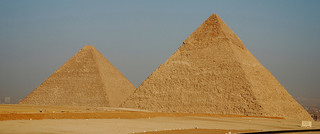
[photo: “Pyramids,” by Wilhelm Joys Andersen, used under a Creative Commons license]
Grilled-Corn KitKats and Other Worldly Cuisine

Approved by more than 90% of shareholders who voted, Mondelez (pronounced “mon-dah-LEEZ”) has been officially chosen as the name of Kraft’s new global snack food business. Later this year, Kraft will split into two divisions, Mondelez International, Inc., which will include worldwide brands such as Oreo, Cadbury, and Nabisco, while the North American business will continue under the Kraft banner. The new name is a combination of the Latin word for world and delicious.

Kraft isn’t the only American food company ramping up its global business. An article from the Associated Press takes a look at how several brands are glocalizing their products to meet the tastes and preferences of people around the world. Have you had any of these?

  • in China: Kraft’s (soon to be Mondelez’s) Oreo wafer cookies and “regular” Oreos with green-tea, raspberry-and-blueberry, and mango-and-orange fillings. Oreos now claim a 13% share in the Chinese cookie market, making them number one.
  • in Saudi Arabia: lemon-pepper-flavored Tang
  • in Mexico: Tang in tamarind, mandarin, and hibiscus versions
  • in Spain: Kellog’s All-Bran cereal sold to be eaten in coffee instead of milk
  • in Russia: Lay’s Potato Chips in crab, caviar, and “pickled cucumber” flavors

And here are just a few of the many products listed by a blogger at Mental Floss:

  • Fanta: honeydew, lactic white grape, and toffee flavors in Taiwan; tamarind in Mexico; and melon cream in Japan
  • Lay’s Potato Chips: wasabi, poutine, and spicy curry flavors in Canada; blueberry in China; cucumber and goat cheese in Belgium; spicy chill squid in Thailand; Tzatziki in Greece and South America
  • Nestle KitKats: Japan wins the prize here with many, many flavors, including aloe vera, banana, beet, bubblegum, cheese, cucumber, ginger ale, miso, pepper, pumpkin, rose, soybean, wasabi, wine and yakimorokoshi (grilled corn)

I’m remembering a couple unique “American” snacks I’ve had: sea-weed flavored Pringles and Nestle’s red-bean and taro ice creams. How about you? What are your favorites—or not-so favorites? Or maybe it was something you saw but were afraid to try.

(“Kraft Shareholders Give ‘Mondelez’ Thumbs Up for New Snack Food Business,” The Washington Post, May 23, 2012; Candice Choi, “Crab’ Chips, Fruity Oreos? They’re Big Overseas,” Yahoo! News, May 6, 2012; Jill Harness, “8 American Snacks and Their Foreign Flavors,” Mental Floss, September 14, 2011)

[photo: “KitKat Candy from Japse,” by Dan Century, used under a Creative Commons license]

African-American Expats

Here’s a book that I’d like to read . . . as soon as it’s written.

The Center for Intercultural Dialogue is calling for chapters and chapter proposals for a proposed book with the working title The Hidden Lives of African Americans Living Abroad Series, Book 1: Articulating the Opportunities and Challenges of Living Internationally. The overview of the book includes the following:

While anecdotal data indicate that the experiences of African Americans living abroad qualitatively differs from those of European Americans, there is a substantial lack of scholarship that investigates the ways in which national and ethnic identities are expressed (and experienced) cross culturally by Black Americans living overseas. In many ways, the everyday lived experiences of African American expatriates living abroad remain unknown—and largely neglected by mainstream media and academic research. This series seeks to examine and highlight what life is like for African Americans living abroad.

And here are some of the suggested chapter topics that look particularly interesting to me:

  • What it’s like to be the only African American in the country
  • “But you don’t have blonde hair or blue eyes”: Encountering and overcoming stereotypes of the “All American” image abroad
  •  “How do they treat Black people there?” Addressing the pre-departure fears of friends
  • Perceptions of African Americans abroad
  • African American Image in Overseas Advertising
  • Returning to the U.S. and Readjusting to Home

As a White American, I’ve often wondered what it is like for Black Americans living overseas, with the extra challenges of facing stereotypes and prejudices . . . layered on top of and intertwined with the other difficulties of cross-cultural living. Hopefully this book—and the whole series—will draw together some good stories and research and create a meaningful discussion.

Go to “CFP African Americans Living Abroad” for more information and submission guidelines.

[illustration: “Blank Open Book,” by DonkeyHotey, used under a Creative Commons license]

President Obama to Joplin Seniors: “Pay It Forward”

Last night I and my family were honored to hear President Obama speak to the graduating seniors, including my son, at the Joplin High School commencement. The president came to commemorate the one-year anniversary of the tornado that ripped through the town shortly after last year’s commencement, destroying thousands of buildings and killing 161.

In March I blogged about Toshiya Muto, the man from Japan who came to Joplin to help in the cleanup efforts, and about the $500,000 gift to Joplin Schools from the United Arab Emirates. Last night, President Obama mentioned both, telling the students, “You’ll always remember that in a town of 50,000 people, nearly 50,000 more came to help in the weeks after the tornado—perfect strangers who’ve never met you, and would never ask for anything in return.” This included Muto, who  “traveled all the way from Japan, because he remembered that Americans were there for his country after last year’s tsunami, and he wanted the chance to pay it forward.” And later he added, “You’ll remember the school supplies donated by your neighboring towns, but also the brand new laptops that were sent from the United Arab Emirates—a small country on the other side of the world.”

Though he didn’t make it part of his speech, President Obama could have also mentioned another gift from the UAE, a newly announced $5 million donation to Mercy Health Systems. The money will pay for a wing in the new hospital that will replace St. John’s Regional Medical Center, which was destroyed in the storm.

The president gave several more examples of generosity shown to the people of Joplin over the past year, and then he came back again to the story of the man who came from thousands of miles away: “There are so many good people in the world. There is such a decency, a bigness of spirit, in this country of ours. Remember that. Remember what people did here. And like the man from Japan who came to Joplin, make sure to pay it forward in your own life.”

(Photo: President Obama looks over the commencement program before speaking to Joplin High seniors)