
Let’s Hear It for Mundaneness!

4524690685_6a89580df5_z

You’ve seen those images of all the fish swimming in one direction with one fish swimming agains the flow. The message: That one fish is the only one going the right way, despite the crowd.

It’s not always a lot of fun being that fish, especially when it seems as if you’re the one going in the wrong direction.

During what would become our last State-side service, I and my wife had decided that our time as missionaries would come to an end. But before making that public, I attended a missionary convention held by our fellowship of churches. I remember sitting with several thousand others in Lexington’s Rupp Arena, listening to a plenary speaker give a passionate call to the audience of potential missionaries. “Let someone else build the houses,” he said. “You follow Christ, go into ministry.”

Let someone else be a doctor or an attorney and argue cases in court. You go follow Christ. Let someone else teach in the public schools. You follow Christ. Listen, there will always be people who will go into all those other occupations. But there are a rare few who will say, “I’ll follow my Christ wherever he leads me.”

I’d said similar things, at least to myself. I should be on the front lines. Others would fill in behind. I’d told myself I could never settle for regular work. How could I ever be satisfied living a commonplace life in the US?

And yet, here I was traveling in the opposite direction, burned up and burned out. I was leaving the mission field, not heading to it. I was stepping away, hoping someone might hire me to build that house or teach that class. . . and in time, hoping just to get hired, for just about any job.

Five years ago, David Platt, mega-church pastor and now president of the Southern Baptist Convention’s International Mission Board, wrote Radical: Taking Back Your Faith from the American Dream. I have a copy on my bookshelf, but I’ve never read it. I’ve heard good things about Platt’s book, and I’m sure it’s challenging. But it’s not the kind of challenge I’m looking for right now. The book I chose to read instead has a different kind of title. It’s The God of the Mundane: Reflections on Ordinary Life for Ordinary People.

Pastor Matt B. Redmond wrote The God of the Mundane as a response to what he had heard himself preach many times:

Change your world. Change the world of someone. Anyone. Sell everything. Sell anything. Give it away. Do something crazy. Be radical. Make people stand up and notice. Take a risk. Jesus moved from heaven to earth and gave up his life and yet you—you just go about your daily life.

But in time, his ponderings, expressed in his blog, Echoes and Stars, led him to ask if there is a God for the bulk of people who live out their lives performing mundane tasks. “Is there a God, for instance, for those who are not changing anything but diapers?”

In his book, Redmond answers the question with a “Yes,” writing to and about stay-at-home moms, dental hygienists, plumbers, children taking care of elderly parents, and bankers. In a blog post, he addresses the youth of a church where he once ministered:

Don’t be afraid of being small. Too often I probably made it sound like if you were really serious about your faith, you should think about ministry. Being a teacher or doctor or farmer was not worthy of your time. Well, that’s just stupid. Don’t be afraid to be in a “small” part of the kingdom. Be ordinary and unknown and be content. That’s more radical than anything else you will hear in the church today.

When he wrote The God of the Mundane, one of the images in Redmond’s mind was of a banker, frustrated and stuck in a job he doesn’t love. After writing his book, he left his career in ministry and became that frustrated banker.

Before reading his book, I had left my position as a missionary and had become frustrated, too. So often in Christian circles, the missionary life is considered the opposite of mundaneness. Redmond refers to it that way, too. But he doesn’t believe that a mundane life, lived in devotion to God, is unimportant.

Neither does he believe that we should stop asking people if they are “willing to give it all and go overseas as a missionary.” “It’s not a bad question to ask,” he says. “There is no question in my mind that this question needs to be out there.” But he also wants other questions asked:

[A]re you willing to be numbered among the nameless believers in history who lived in obscurity? Do you have the courage to be forgotten by everyone but God and the heavenly host? Are you willing to be found only by God as faithful right where you are? Are you willing to have no one write a book about you and what you did in the name of Christ?

When someone studying for a non-missionary career asked him his advice on selecting a missionary biography, Redmond suggested she begin by reading one about a Christian banker.

By that I meant she needed to read a book about a Christian living a mundane life. She told me she could not find one. Figures.

I would characterize Redmond as someone who is trying to be content in his present occupation, but who is not satisfied. He struggles with wanting to do something that better fits who he is, but he doesn’t want to turn his back on those like him who are not doing the BIG THING. He admits that it’s often hard for him to accept his own advice with confidence.

I find myself in the same place. I miss so much of being a missionary and still want to be a part of that work and community. And yet I don’t believe that God loved me more, valued me more then than he does now.

I still have my copy of Radical. I plan to read it someday. Someday, but not today. Today I’m reading and rereading Redmond’s book.

Maybe he’s written the closest thing you’ll find to a biography about a “Christian banker.” But rather than writing about something he’d lived, he wrote it first and now he’s living it. And as he’s been writing in his blog, it’s the living of it that has given him a real understanding of his own words.

Life often works out that way. Figures.

(Barry Cameron, closing session, National Missionary Convention, Lexington, KY, November 21, 2010; Matt B. Redmond, The God of the Mundane: Reflections on Ordinary Life for Ordinary People, Kalos, 2012; Matt B. Redmond, “Tuesday’s 10: What I’d Like to Tell My Former Youth,” Echoes and Stars, August 13, 2012)

[photo: “Fish Vane,” by Mike Gifford, used under a Creative Commons license]

It Can Rain on My Parade

6677854125_b6671e2b79_z

Is rain a good or bad thing? It depends, you’d probably say, on what you’re doing at the time.

But when we hear “The rain falls on the just and the unjust,” we usually interpret it as “Bad things happen to good and bad people.”

I don’t think that’s what Jesus meant when he said, in the Sermon on the Mount,

You have heard that it was said, “Love your neighbor and hate your enemy.” But I tell you, love your enemies and pray for those who persecute you, that you may be children of your Father in heaven. He causes his sun to rise on the evil and the good, and sends rain on the righteous and the unrighteous. (Matthew 5:43-45 NIV)

In context, Jesus is talking about how we should give something good (love) to bad people, in the same way God gives the sunshine and rain to them. There certainly are places in the Bible that talk about bad things happening to good people, but I don’t think this is one of them.

E. Randolph Richards and Brandon J. O’Brien, in Misreading Scripture with Western Eyes, point out that we often miss the meaning of Bible passages when we don’t see from the point of view of the authors and audiences of Bible times. (I’ve written about that here.) This seems to be one of those passages.

In our modern American culture, we often pray for nice, sunny days. We want good weather for an outdoor wedding, for a trip to the lake, or for a long drive. And by good weather, we usually mean the absence of rain—and warm, but not too warm, temperatures are great, too.

If all of our prayers were answered, we’d probably have the longest drought in history. Of course, then our attitude would change and we’d think of rain as a blessing. That’s the way farmers most often see it. Of course, an ill-timed rain can keep them out of the fields, and over saturation and flooding can ruin a harvest. But it’s the lack of rain that causes the most problems.

Last year, the UN reported that the majority of the world’s population, 54%, now live in urban areas. According to the World Health Organization, 55 years ago, the urban population accounted for just 34% of the total. Two thousand years ago, that percentage was much less.

In Jesus’ day, the people had a direct tie to the land and the goods that it produced. Think of all the agricultural metaphors Jesus used to get his message across. But today, living and working in air-conditioned buildings with drinkable water only a faucet handle away, much of my thinking about rain centers around my walk to and from the car.

I try to pray less about the weather than I used to. Rather, I want to pray that I will be able to make the best of my day regardless of whether it rains or not. I realize that God is not going to tailor every weather pattern to my scheduled activities, in part because my wishes for that day may be just the opposite of what others want or need. As C. S. Lewis puts it, my downhill could be someone else’s uphill:

Yet again, if the fixed nature of matter prevents it from being always, and in all its dispositions, equally agreeable even to a single soul, much less is it possible for the matter of the universe at any moment to be distributed so that it is equally convenient and pleasurable to each member of a society. If a man travelling in one direction is having a journey down hill, a man going in the opposite direction must be going up hill. If even a pebble lies where I want it to lie, it cannot, except by a coincidence, be where you want it to lie. And this is very far from being an evil: on the contrary, it furnishes occasion for all those acts of courtesy, respect, and unselfishness by which love and good humour and modesty express themselves.

Yes, I pray fervently when tornados touch down or typhoons threaten or droughts bring about famine. But I pray less for weather variations simply to enhance my day. Actually, let me restate that first part: I pray fervently when severe weather threatens me, but my sporadic prayers are less than fervent when it comes to famine or flooding half a world away.

We all need to pray less for our corners of the world and more for the huge swaths of people who face disastrous weather each day. We need to pray that those of us with much will help those with little who are at the mercy of the elements. We need to pray that our down-hill walk does not cause someone else a more difficult journey. We need to pray less for our will and more for God’s will to be done, “on earth as it is in heaven.”

(“World’s Population Increasingly Urban with More than Half Living in Urban Areas,” United Nations, July 10, 2014; “Global Health Observatory (GHO) Data: Urban Population Growth,” World Health Organization; C. S. Lewis, The Problem of Pain, Centenary Press, 1940)

[photo: “Face à Face,” by D. Julien, used under a Creative Commons license]

TCKs as Prototypical Citizens and Culture Shock as Exaggerated Poop: Ted Ward’s Views on Growing Up Abroad

16241388115_fec39f427a_zQuotation tracing. It’s almost as exhilarating as tracing a river.

According to the Taipei Times, the sport of river tracing may have been birthed in Taiwan in 1982. That year, a Japanese expedition team representing the Osaka Grassshoes Society traced the Nantsi River to the top of Taiwan’s Jade Mountain. (How’s that for an epic-sounding adventure?) Years ago I got to chaperone a group of junior-high-school students in a much less demanding trek, hiking in and up a fast-moving mountain river in northern Taiwan. We had a great time wading, swimming, crawling, and climbing. Not only did we find the spring that was the river’s source, but we also enjoyed—and discovered a lot during—the getting there.

So it is with quotation tracing, finding the origin and context of well-known, though often misquoted and misattributed, quotations. There’s much to be learned from tracking down quotations, and now that I’m older, I find that quotation tracing is more suited to a more sedentary lifestyle, as well.

My target quotation this time is one that we read often in literature about Third Culture Kids. And just like river tracing in Taiwan, it comes from the 80s. It’s Ted Ward’s

TCKs are the prototype citizens of the future.

I used this form of the quotation a few years ago in a blog post that I wrote. Sadly, at the time, I hadn’t checked the source. Had I done so, I would have seen that the original comes from page 57 of “The MK’s Advantage: Three Cultural Contexts,” in Understanding and Nurturing the Missionary Family. The chapter from Ward is an abridged version of a presentation he made in Quito, Ecuador, at the International Conference on Missionary Kids, held in 1987. (David Pollock and Ruth Van Reken, in Third Culture Kids: Growing Up among Worlds, are two who point to this source.) I would have also seen that the quotation has been paraphrased over time.

Speaking about the qualities that define Missionary Kids (MKs) as world Christians, Ward says,

Another characteristic is the loyalty to Christian values, even above the social pragmatics that we deal with in any society. There are characteristics of the internationalizing community of Christ that may very well, in this increasingly shrunken world, become characteristic of the church in general in the twenty-first century. One of my propositions is that the missionary kid of the nineties will be the prototype of the Christian of the twenty-first century [emphasis mine].

Because Missionary Kids are a subset of Third Culture Kids, it’s not a stretch to apply what Ward said to the larger group as a whole, but it’s interesting that his comments in this context refer not to general global citizens but to citizens of the community of Christians. This is understandable, though, as Ward’s audience was missionary families, and if he were talking to expat families in general, I would think it logical that he would apply the same principle to the broader category of all TCKs.

But looking at Ward’s presentation as a whole, I find something even more interesting. It’s his strong pronouncements of how MKs should embrace the advantages of their lives abroad and should not focus on the perceived negatives. “I view the MK growing up experience,” he says, “as very positive and very valuable, in comparison with the experiences available to their cousins who are stuck back home.”

To combat negative stereotypes applied to MKs, Ward uses somewhat blunt language, language that grates against my way of thinking. But one of his goals seems to be to shake up our assumptions, and my discomfort shows that he has been successful in that with me.

At the time that he spoke at the Quito conference, Ward was serving as dean of International Studies, Mission, and Education at Trinity Evangelical Divinity School. Before that, he spent 30 years at Michigan State University, teaching in the areas of education and curriculum research, and taking a leading role in the field of theological education.

While at Michigan State, Ward was a colleague of Ruth Hill Useem, the sociologist and anthropologist who coined the term Third Culture Kid. Ward describes Useem’s technical usage of TCK as being in the context of

cultural variables that are not definable in terms of ours and theirs. She was talking about the dynamic of that which is different because people from outside settings residing in an inside setting do not take their primary identities ultimately from either, but they take it from the commonness that they have with others who are doing the same thing.

But Ward goes on to point out that Useem’s definition of third culture is based on her study of “the overseas intellectual communities of Western European and American people in the sciences and technology.” And he writes that the paper in which she coins the term Third Culture Kid has “no reference to anything like what we would call the MK.” Therefore, he believes that today’s use (or “misuse”) of TCK has made it a “static term,” with “standard values” and “generalizations about it which lead us to the wrong questions.” (edited 5/11/21*)

What are some of the wrong questions? They are nonsense questions. “Is it OK to be an MK?” “What are the problems of being an MK?” They’re dumb questions, but they’re the questions that a static view of culture leads you to.

Then you get preoccupied by rootlessness. Oh, come on. Millions of people in the world are rootless. Don’t get paranoid about thirty thousand kids when ten percent of them are rootless.

It is this kind of negative thinking, especially by parents of MKs, that Ward opposes. For instance, in the area of culture shock:

Words like culture shock—good grief! Talk about popularization of some bad research! Culture shock—for the most part largely exaggerated poop! Incompetency, yes, but incompetency comes in all kinds of forms.

And about American expat parents who are concerned about their children’s lack of understanding of US culture, he responds,

I find more MKs understanding the nature of American society than people who are raised wholly within it. Would that we could get that message across to parents. Paranoid parents have got to be helped.

Ward also laments missionary parents’ worries about reverse culture shock. Years ago, it wasn’t so easy for missionaries or their children to return “home,” so they weren’t so apt to influence their children towards the inevitability of going back. One qualification of MKs as prototypical world Christians, says Ward, is their ability to serve God anywhere, without being tied down to a particular country or culture, especially the one from which they came.

Ward believes that the long-term work of missionaries has changed. “A career missionary today does not get buried in China at age forty-seven under great mounds of Chinese soil,” he states. “He gets buried at age forty-seven at a North American mission office desk under mounds of paper.” Ward doesn’t want this sort of mindset to be passed on to Missionary Kids.

Ward has given me, a former missionary and current parent of several MKs, a lot to think about, and I wonder how I would have responded if I had been in his audience 27 years ago.

While tracing Ward’s quotation to its source, I’ve been challenged, affirmed, and stretched. I’ve learned a few things and I’ve read some things that I’ll be pondering for a while. I’m grateful for the work that Ted Ward has done for and with cross-cultural workers and their families. And while I’m not on board with everything he’s said (for instance, I don’t think that culture shock is “largely exaggerated poop”), I do understand that there can be a tendency toward paranoia and excessive navel gazing.

We need balance. It’s good to look inward, with caution. But it’s also good to look up and out and aim for some mountaintops, to hike some rivers, to look with optimism at the path ahead, and to see the landscape from a different perspective.

(*In my original post, I misunderstood Ward’s view of how Useem defines the term Third Culture Kid, writing “According to Ward, Hill Useem applied it to particular new cultures—new communities in a distinct time and place—that expats form inside their host country. This is different from how we currently use TCK (or MK) to describe a broad group of people raised overseas.” I have rewritten the paragraph above to better express Ward’s objections to today’s usage of TCK.)

(Ian Bartholomew, “Taiwan’s Rivers Offer Vast Potential for Adventure,” Taipei Times, August 19, 2001; Ted Ward, “The MK’s Advantage: Three Cultural Contexts,” Understanding and Nurturing the Missionary Family: Compendium of the International Conference on Missionary Kids, Quito, Ecuador, January 4-8, 1987, Volume I, Pam Echerd and Alice Arathoon, eds., William Carey, 1989.)

[photo: “Consumer Confidence!” by Chris & Karen Highland, used under a Creative Commons license]

For Such a Time as This: The Need for Talking

282341925_11a546a84b_z

There’s an interesting discussion going on at Christianity Today’s her·meneutics blog. It begins with a post by Patricia Raybon, co-author of the soon-to-be-released Undivided: A Muslim Daughter, Her Christian Mother, Their Path to Peace.

In “A Nation of ‘Suspect Thy Neighbor,'” Raybon writes about her husband’s suspicion upon seeing an unfamiliar car parked in front of their house. She writes that following 9/11, “We’ve become not just a nation of strangers, but strangers who suspect each other on principle.” And then she shares another family story.

Ten years ago, Raybon’s daughter, Alana, left the church and became a Muslim. Recently, while mother and daughter were together, a man saw Alana, with her head covered, and yelled to her, “Go home!”

That man wasn’t interested in a conversation, but Raybon is. In the comments following her post, several readers have responded. Some are supportive. Some are not.

Dagney Reardon writes, “I’m sorry—I’ve having a hard time wrapping my head around the fact that I’m suppose to feel sorry for a Muslim-convert American woman for being subjected to a verbal insult . . .” He compares her situation to that of women in Islamic countries and then refers to the recent beheadings of Coptic Christians by the Islamic State in Lybia. “God has not even begun to give me the wisdom or insight to relate to a person who would deliberately choose to align themselves with a religion that condones such unspeakable horror.”

I don’t usually read comment sections on the internet. There’s just too much vitriol. But Christianity Today‘s policy of allowing only subscribers or registered users ups the level of  engagedness and civility. And what I appreciate the most is the willingness of CT authors to answer back. I’m not sure what I would have said in response to the above comment, but Raybon was obviously prepared. “Thank you, Dagney, for your comments,” she writes. “Your argument is interesting. You are right, in fact, about one key thing. No reasonable person would deliberately choose to align with a religion that condones unspeakable horror.” And she ends her response with this:

I’m reaching different conclusions than you. But at least you and I are talking. For such a time as this, talking is a seriously good place to start. Thank you, indeed, for sharing your thoughts. Measured conversations need to happen on these matters. Thank you for taking part in this one. Kind regards, Patricia.

As I’m writing this, Reardon and Raybon have responded again to each other. And to another commenter who disagrees with her, Raybon writes, “Thanks, meantime, for sharing your thoughts. Another view always stretches my thinking.”

I appreciate the “measured conversation” that Raybon has begun. I hope it continues, at her·meneutics and beyond.

(Patricia Raybon, “A Nation of ‘Suspect Thy Neighbor,'” her·meneutics, February 20, 2015)

[photo: “Brighton Beach,” by Mark Belokopytov, used under a Creative Commons license]
Toward Racial Reconciliation: Conversations, Advocacy, and Overcoming Fear

“My dear children, I write this to you so that you will not sin. But if anybody does sin, we have an advocate with the Father—Jesus Christ, the Righteous One.” I John 2:1 (NIV)

A couple weeks ago I was preparing a lesson for the adult Sunday-school class I help teach. (Sounds a little old fashioned and quaint, doesn’t it?) The text was the second chapter of John’s first letter.

As I took notes on my computer, I checked the news as it developed through the day—and the developing news that day was the demonstrations following the grand-jury decisions concerning two white police officers, Darren Wilson and Daniel Pantaleo, and the deaths of two black men, Michael Brown and Eric Garner.

I am a white man, in a predominantly white Sunday-school class, in a predominantly white church, in a predominantly white city, in the predominantly white state of Missouri. I probably don’t have to remind you that Ferguson is in our state, too.

My lesson ended up tracing through the themes of I John 2. If we know Jesus, we will obey him. If you hate your brother, you live in darkness. Do not love the world. Beware of antichrists, who deny the Son.

But mixed with the verses on my computer screen were the headlines about the protests, the demonstrations, the riots, and the arrests.

Becoming Advocates

15941251841_25661c6f8a_mWhen I taught the class, after working through the chapter, I returned to the first verse, that verse that touches on the tension between justice and grace. Do not sin, John says, but if you do, Jesus will take your side. Jesus is our advocate before God, the judge. While Satan is the prosecutor, Jesus is the defense attorney.

Maybe it was a stretch, I told my class, but I needed to address what was going on in our country. I needed to talk about it, even if I had to shoehorn it in a little. If we Christians want to “live as Jesus did” (v 6),  then we need to make ourselves advocates, too.

It’s an odd thing to think of God pleading our case to God. But the creator has shown us his love, his concern, his grace by mingling with us, talking with us, sharing meals with us. Through Jesus’ life on earth, he has empathy for us (Hebrews 4:15), and he has become our intercessor in heaven (Romans 8:34).

We need to listen to those who have different experiences than ours, to learn their perspective. As a white person, I realize my need to listen to the stories of blacks, to try to see the world through their eyes.

Don’t get me wrong. I’m not saying in this picture that I am Jesus and blacks are the sinners needing my advocacy. Instead, I’m saying that all us Christians—of all races—need to imitate Jesus in breaching the walls that divide us and to plead for each other, before man and before God.

Months ago, well before these two high-profile incidents, many black people were already afraid of police officers. I could argue all I wanted that they shouldn’t be afraid, but my arguments would probably show how out of touch I am. Theirs is a fear that goes well beyond the nervousness I have when a police car pulls up behind me at an intersection.

Why is that? If we hope to understand, we’ll need to do a lot of listening, and not just to those who would reaffirm our comfortable assumptions. We’ll need to read viewpoints of people who’ve lived lives unlike our own. We’ll need to try to see the world through the eyes of people who don’t look like us. That doesn’t mean that we must always agree with what we hear. Often, the loudest, most strident voices are not the most reasonable. But if we want to hear the quieter voices, then we’ll need to listen that much harder. And then we can pass on what we hear, speaking on behalf of our brothers and sisters, to each other and to God.

The Other Side of Fear

15757482677_09f5c0f8c6_mBlack civil rights attorney Constance Rice has worked for years building trust between minorities and the police in Los Angeles. While she started out as an adversary to LAPD Chief Charlie Beck, suing the department multiple times, they are now partners in reform.

During an 19-month period, Rice interviewed over 900 police officers. On NPR’s Morning Edition, she says that their talks became like “therapy sessions,” with some opening up to her about their own fears. “Miss Rice, I’m scared of black men. Black men terrify me,” they said. “Miss Rice, can you teach me how not to be afraid of black men?”

Are the people who said this racists? Rice says not consciously so, but a policeman’s fear can produce the same outcome as racism:

He doesn’t feel like it’s racism. The black community experiences it as racism, that’s very clear. So what I’m saying is that for people who have to be in the business of solving this dilemma you have to be able to step into the frightened tennis shoes of black kids, black male kids in particular. You have to be able to step into the combat boots of scared cops, and racist cops, and cruel cops, and good cops. And you have to be able to distinguish amongst all of those human experiences and then bring them together on a single platform of we’re going to solve this by empathizing. We’re going to solve it with compassion and we’re going to solve it with common sense.

Reconciliation Is Hard Work

Nearly twenty years ago, one of the books on my bookshelf was More Than Equals: Racial Healing for the Sake of the Gospel, written in 1993 by Chris Rice (no relation to Constance Rice) and Spencer Perkins. Side by side on the cover were the smiling faces of the authors—one white and one black.

The two not only wrote a book together, but they and their families lived together in a community called Antioch, showing by example what they believed. The philosophy of their work can be summed up succinctly by the titles of their book’s three sections: Admit, Submit, and Commit.

Four years after they wrote More Than Equals, I assumed that the two were still smiling in the glow of their togetherness. But it wasn’t so. In 2010, Chris Rice told Christianity Today that he and Perkins “could hardly sit at the same dinner table” and living in Antioch had become too difficult for him and his wife. They wanted out.

Upon hearing the Rice’s desire to leave, an angry Perkins asked, “Why do only white folks make ultimatums like this?”

They called in two mentors to help keep them together, but meetings with them led to an outpouring of old grievances. Finally, as the mentors were about to leave, Rice says that he and Perkins were “interrupted by grace.” Perkins chose to allow the Rices to leave. The Rices chose to stay. Three months later, Perkins died of a heart attack.

The Need to Communicate

Some who have never heard of Spencer Perkins would be familiar with his father, the minister and civil-rights activist John Perkins. Born in 1930 into a family of sharecroppers, John was raised by his grandmother after his mother died before his first birthday. When John was 17, his older brother was shot and killed by a local sheriff. Later, with his own family, John became a Christian after Spencer, not yet in kindergarten, invited him to Sunday School. Even though he didn’t study beyond the third grade, John has authored numerous books and has been given honorary doctorates many times over.

I know of John Perkins through the writings of his son, and, more recently, from when he spoke at a service at my church this year. So while preparing my Sunday-school lesson, when I saw his name in another Christianity Today article, it grabbed my attention.

The article is entitled “A United Evangelical Response: The System Failed Eric Garner.” In it, a multi-racial group of 28 give their reactions to the grand jury decision following the death of Garner. The entire article is worth a read, but I will end here with John Perkins’ comments, as he discusses the need for the kind of talking and listening that leads to true reconciliation.

It seems like our nation is out of control, and some of this is the result of our polarization and our own victimization in both the black and white community. We have not found ways to confess to each other our wrongdoings and haven’t been able to make the kind of peace that could come from having that type of conversation. We haven’t been able to take the responsibility as God’s people or as citizens. As a nation, as individuals, and as communities, we need to start taking responsibility for our communities. As blacks, we need to take some responsibility for how we raise our children, and the whites need to take responsibility for their lack of forgiveness and imperialism and for some of the failure in our school and education systems. We also need to take responsibility for not training our police officers to affirm the dignity of humanity. We are all victims and have not found ways to truly reconcile to each other. I think that is the issue before us, and our task is learning how to actually communicate and have conversations, so we can get at some of these issues.

John Perkins is a great advocate for those who need his voice. I want to be an advocate, too.

(“Civil Rights Attorney on How She Built Trust with Police,” Morning Edition, NPR, December 5, 2014; Chris Rice, “Born Again . . . Again,” Christianity Today, March 26, 2010; “A United Evangelical Response: The System Failed Eric Garner,” Christianity Today, December 4, 2014)

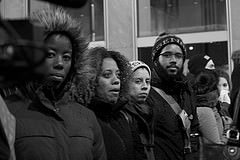
[photos: “Eric Garner Protest-Rockefeller Center” and “Eric Garner Protest-Rockefeller Center (3),” by Tina Leggio, used under a Creative Commons license]
Pick a Name, Any Name (Well, Not Any Name)

2344959709_a50d4bffa5_z

For two years in the late 90s, Peter Hessler taught English in Fuling, China, as part of the Peace Corps. His experiences are the subject of his best-selling River Town: Two Years on the Yangtze.

In one passage, he writes about the interesting English names that his students had chosen for themselves, including a girl who was named Keller, after Helen Keller:

This was a common pattern; some of them had taken their names from people they admired, which explained why we had a Barbara (from Barbara Bush), an Armstrong (Neil Armstrong), and an idealistic second-year student called Marx. A few had translated their Chinese names directly—House, Yellow, North. There was one boy whose English name was Lazy. “My name is Lazy,” he said, on the first day of class. “I am very lazy. I do not like to play basketball or football or do many things. My hobbies are sleeping.”

Other names made less sense. There was a Soddy, a Sanlee, a Ker. Some were simply unfortunate: a very small boy called Pen, a very pretty girl named Coconut. One boy was called Daisy . . . .

Not all of the “unfortunate” names came from the students themselves. When the students asked for surnames to pair with their English given names, Adam, Hessler’s fellow teacher, gave Nancy the last name Drew. And when Mo asked Hessler for a surname, he became Mo Money.

I have some friends from Taiwan with less than mainstream English names. But who can blame them? Aren’t a lot of American names just a combination of letters, with no real meaning or heritage? And don’t people sometimes take common words and turn them into names for their children? Yes, both are true, but for some reason, some names seem to sound less right than others. Why not Mray? Why not Cabinet?

But who am I to judge? Before I moved to Taipei, I asked a friend from China for a Chinese name. He gave me Ke Lai, based on the sound of Craig. I liked it. And even after my new friends in Taiwan said it wasn’t a great name, I hung on to it, even going so far as to come up with a tortured defense for it. Ke means “overcome” and lai means “come,” so I figured that my name could match up with the first words spoken by the Master in The Analects of Confucius: “Is it not pleasant to learn with a constant perseverance and application?” (overcoming?) and “Is it not delightful to have friends coming from distant quarters?” (come).

“Okaaaaaay . . . ,” said my my gracious friends, “but maybe it’s not quite right. It doesn’t sound Chinese.”

I didn’t want to give in—it was my name—until I realized that the Chinese for Chrysler is Ke-lai-se-le. I didn’t mind that my name sounded foreign, but sounding like a foreign car company was a little too much.

So how would you help an international friend who’s looking for an English name? Maybe you’d like to point them to the Bible as a good source for names. According to the Social Security Administration, during the first decade of the 2000s, 8 of the top 10 baby-boy names came from the Bible. But the Bible isn’t failsafe. Not every biblical name should be considered a good candidate. Some names have bad backstories (think, Judas and Jezebel), and some just don’t pass the sound test (for example, Shammua and Abishag).

To help out, below is my contribution to the cause. It’s a list of over 170 biblical names that have, over the years, often been used in the US. Following each name is its designation for males or females, its meaning (if it’s known), and some of the more well-known people (or in a few cases, places) in the Bible with that name.

By the way, this list makes up an appendix to Putting Words in Our Mouths: A Look at Biblical Expressions in American English. I started in Genesis, and I’ve made it through Revelation, explaining over 150 entries along the way. If you haven’t already, please drop by. You’ll probably be surprised at how often we quote the Bible without even knowing it.

So from Aaron to Zachariah, here we go. (Sorry, Zuriel didn’t quite make the cut.)

Aaron (m), possibly “teacher, lofty, mountain of strength”—Moses’ brother, first high priest

Abigail (f), “father’s joy”—King David’s wife

Abraham (m), “father of a great multitude”—father of the Hebrew people

Adam (m), “earthy, red, human”—the first man

Alexander (m), “defender of man”—member of the Jewish ruling council; man expelled from the church

Amos (m), “carried, burden, weighty”—Old Testament prophet who wrote the Book of Amos

Andrew (m), “manly, strong man”—Jesus’ apostle

Anna (f), “grace”—New Testament prophetess

Bartholomew (m), “son of Tolmai”—Jesus’ apostle

Benjamin (m), “son of the right hand”—Jacob’s son

Bethany (f), “house of dates, house of misery”—village east of Jerusalem

Caleb (m), “dog”—one of the Israelite spies sent to bring back a report about Canaan

Candace (f) possibly “one who is contrite”—queen of Ethiopia

Claudia (f) possibly “lame”—follower of Jesus in Rome

Dan (m), “judge, judgment”—son of Jacob

Daniel (m), “judgment of God” —Old Testament prophet and writer of the Book of Daniel

David (m), “beloved”—king of Israel who wrote many of the Psalms

Deborah (f), “bee”—nurse of Rebekah, Isaac’s wife; prophetess and judge of Israel

Eli (m), “lifting up”—Old Testament high priest

Elisabeth (Elizabeth) (f), “God is her oath”—John the Baptist’s mother

Ethan (m), “enduring, strong”—descendant of Judah; descendant of Levi

Eve (f), possibly “life, giver of life”—first woman

Gabriel (m), “God is my strength, champion of God”—angel

Hannah (f), “grace”—mother of Samuel, the Old Testament prophet

Isaac (m), “laughter”—Abraham’s son

Jacob (m), “one who grabs the heel, supplanter, deceiver“—son of Isaac, father of the Israelites

James (m), “supplanter”—Jesus’ apostle, brother of John; Jesus’ apostle, son of Alphaeus; Jesus’ brother and writer of the Book of James

Jared (m), “descent”—ancestor of Noah

Jason (m), “one who heals”—Thessalonian Christian; Paul’s relative

Jeremiah (m) “raised up by God”—Old Testament prophet who wrote the Book of Jeremiah and Lamentations (and possibly 1 and 2 Kings); Old Testament priest

Jesse (f/m) possibly “gift, wealthy”—King David’s father

Joel (m), “the Lord is his God”—Old Testament prophet who wrote the Book of Joel

Joanna (f) “the Lord’s grace”—manager of King Herod’s household and follower of Jesus

John (m), “the Lord’s grace”—”John the Baptist,” prophet who announced the arrival of Jesus and baptized him; Jesus’ apostle and writer of the Gospel of John, Revelation,  and 1, 2, and 3 John; “John Mark,” companion of Paul and Barnabas, writer of the Gospel of Mark

Jonathan (m), “the Lord’s gift”—son of King Saul and friend of David

Jordan (m/f), “descender”—river in Israel

Joseph (m), “increase”—Jacob’s son who was sold as a slave by his brothers and who gained great authority in Egypt; husband of Mary, Jesus’ mother; Jesus’ brother; “Joseph of Arimathea” in whose grave Jesus was buried; one of two Christians presented as possible replacements for Judas as an apostle

Joshua (m), “the Lord saves”—leader of the Israelites after Moses died, writer of the Book of Joshua

Judith (f), “of Judea”—Esau’s wife

Julia (f), “downy, soft hair”—Christian in Rome

Leah (f), possibly “weary”—Jacob’s wife

Lois (f), possibly “better”—grandmother of Timothy, who was Paul’s companion

Luke (m), “light giving”—a physician and Paul’s companion who wrote the Gospel of Luke and Acts

Lydia (f), possibly “woman of the province of Lydia”—the first European to become a Christian

Mark (Marcus) (m), possibly “polite, shining”—companion of Paul, Barnabas, and Peter and writer of the Gospel of Mark

Martha (f), “lady, bitterness”—sister of Mary and Lazarus

Mary (f), possibly “rebellion”—Jesus’ mother; Martha and Lazarus’ sister who anointed Jesus feet with perfume; “Mary Magdalene,” follower of Jesus who was first to see him after the resurrection

Matthew (m), “gift of God”—Jesus’ apostle who wrote the Gospel of Matthew

Micah (m), “who is like God?”—Old Testament prophet and writer of the Book of Micah

Michael (m), “who is like God?”—angel

Miriam (f), possibly “rebellion”—Moses’ sister

Moriah (f)—possibly “chosen by the Lord”—region where Abraham went to sacrifice Isaac; “Mount Moriah” where Solomon built the temple

Naomi (f), ”lovable, my delight”—mother-in-law of Ruth

Nathan (m), “gift, given”—Old Testament prophet

Nathaniel (Nathanael) (m), “gift of God”—Jesus’ apostle

Nicolas (m), “conqueror of the people, victory of the people”—one of the seven chosen to serve the church in Jerusalem

Noah (m), possibly “rest” —man who built the ark and whose family was saved from the flood

Paul (m), “little”—Jesus’ apostle who wrote 13 books of the New Testament

Peter (m), “rock, stone”—Jesus’ apostle who wrote 1 and 2 Peter

Philip (m), “lover of horses”—Jesus’ apostle; one of the seven chosen to serve the church in Jerusalem

Rachel (f), “sheep, ewe”—Jacob’s wife and mother of Joseph and Benjamin

Rebekah (f), possibly “ensnarer”—Isaac’s wife and mother of Jacob and Esau

Ruth (f), possibly “friend”—non-Jewish woman who married Boaz and became an ancestor of Jesus, subject of Old Testament book named after her

Samuel (m), “heard of God, asked of God”—Old Testament judge and prophet, and possible writer of Judges and 1 and 2 Samuel

Sarah (f), “princess”—wife of Abraham, mother of Isaac

Seth (m), “compensation, a substitute”—son of Adam and Eve

Sharon (f), “a plain”—coastal plain in Israel

Simon (m), “he hears, hearing”—original name of Jesus’ apostle Peter; “Simon the Zealot,” Jesus’ apostle; Jesus’ brother; man who carried Jesus’ cross

Stephen (m), “crown”—one of the seven chosen to serve the church in Jerusalem, first Christian martyr

Tabitha (f), “gazelle”—Christian woman with a reputation for helping others, she died and Peter brought her back to life

Thomas (m), “twin”—Jesus’ apostle

Timothy (m), “honored by God, honoring God”—companion of Paul, who wrote 1 and 2 Timothy to him

Titus (m), “honorable”—companion of Paul, who wrote the Book of Titus to him

Zachariah (Zechariah) (m), “God remembered”—king of Israel; Old Testament prophet; father of John the Baptist

(Peter Hessler, River Town: Two Years on the Yangtze, Harper, 2001)

[photo: “This is not my name,” by Jasper Visser, used under a Creative Commons license]

A New Blog: “Putting Words in Our Mouths”

2250062732_5d9670fba0_zThe Bible has been called the most quoted, most translated, most published, most sold, and most shoplifted book of all time. It is difficult to overestimate the impact of its ideas on Western culture. And, particularly in the translation completed under the direction of King James I of England in 1611, it has had a leading role in shaping the English language and English literature. Alister McGrath, in his book In the Beginning: The Story of the King James Bible and How It Changed a Nation, a Language, and a Culture, writes,

No other book has so permeated and penetrated the hearts and speech of the English race as has the Bible. . . . The King James Bible, along with the words of William Shakespeare, is regularly singled out as one of the most foundational influences on the development of the modern English language.

I wrote Putting Words in Our Mouths: A Look at Biblical Expressions in American English with English learners in mind, to teach them the meanings of commonly used phrases and to familiarize them with the stories and concepts of the Bible. Familiarity with the Bible leads to a better understanding of the art, history, music, politics, and customs of English-speaking peoples. The authors of The Bible Literacy Report II state, “Almost without exception, English professors we surveyed at major American colleges and universities see knowledge of the Bible as a deeply important part of a good education.” The report quotes a professor from Northwestern University who calls the Bible the “most influential text in all of Western culture.”

But this doesn’t mean that all English speakers are aware of or understand the Bible’s influence. In fact, serious English-language students who gain a basic knowledge of the Bible may find themselves ahead of many native speakers.

Today, biblical words and phrases—including idioms—appear in informal conversation, news articles, blogs, television shows, movies, popular songs, and literature. Even the word bible itself has a place in modern English as any “authoritative book on a particular subject.” Bible comes from a Greek word meaning “books.” This is because the Bible is a collection of 66 books, written by at least 40 men over about 1500 years. And on the pages of these books are written many well-known stories, some of which take place on a grand scale or involve huge groups of people—such as Noah and the flood, the 10 plagues of Egypt, and the journey of the Israelites to the Promised Land. Therefore, something that is “enourmous or extremely extensive” can be said to be of biblical proportions or on a biblical scale.

I invite you to join me on a journey through the Bible, using common English expressions as our stepping stones.  We’ll start at the best place possible . . . in the beginning.


The format of Putting Words in Our Mouths is simple. Each word or phrase is introduced with its definition and a sample sentence showing how it can be used in conversation. Then an explanation of the word/phrase’s origin follows, along with the biblical passage from which it comes. Where it differs from the more modern translation, I’ve included in brackets the expression in its King James version.

I will be adding expressions as time permits, moving from Genesis to Revelation. You can view all the posts in order by clicking on Browse All Entries in the right-hand column. You can also look for specific topics by using the search field.

(Wachlin, Mary, and Byron R. Johnson, The Bible Literacy Report II: What University Professors Say Incoming Students Need to Know, Bible Literacy Project, 2006)

[photo: “Used Bible,” by Doug 1021, used under a Creative Commons license]

Listening and the Spirit of Unhurried Leisure

9563583010_8d7fb48cc5_z

“Get busy.”

That’s the mantra of many a boss.

“Look busy.”

That’s what coworkers say when the boss is coming.

Busyness isn’t always a synonym for work. In fact, busyness can get in the way of productivity.

Eugene Peterson, best known for his translation of the Bible, The Message, also served as a pastor of Christ Our King Presbyterian Church in Bel Air, Maryland, for 30 years. One of the consistent themes in his teaching and writing is that pastors should not fall into the seductive trap of busyness. Instead, as he writes in “The Unbusy Pastor,” his goal in his role as a church leader was to do three things, things that are too easily pushed aside by a busy life: to pray, to preach, and to listen.

Listening, he says, needs “unhurried leisure.” This leisure is the opposite of busyness. And just as busyness does not equal work, neither is leisure the same thing as laziness. Instead, leisure is having time at one’s disposal, and when one chooses to use that time for listening to what someone else has to say, it is a very valuable gift.

The passage below was written by Peterson in 1981. It is about and for pastors, but it can help any of us listen better, unless, of course, listening is something else we’ve ceded over to the professionals.

I want to be a pastor who listens. A lot of people approach me through the week to tell me what is going on in their lives. I want to have the energy and time to really listen to them so when they are through, they know at least one other person has some inkling of what they’re feeling and thinking.

Listening is in short supply in the world today; people aren’t used to being listened to. I know how easy it is to avoid the tough, intense work of listening by being busy (letting the hospital patient know there are ten more persons I have to see). Have to? But I’m not indispensable to any of them, and I am here with this one. Too much of pastoral visitation is punching the clock, assuring people we’re on the job, being busy, earning our pay.

Pastoral listening requires unhurried leisure, even if it’s for only five minutes. Leisure is a quality of spirit, not a quantity of time. Only in that ambience of leisure do persons know they are listened to with absolute seriousness, treated with dignity and importance. Speaking to people does not have the same personal intensity as listening to people. The question I put to myself is not “How many people have you spoken to about Christ this week?” but “How many people have you listened to in Christ this week?” The number of persons listened to must necessarily be less than the number spoken to. Listening to a story always takes more time than delivering a message, so I must discard my compulsion to count, to compile the statistics that will justify my existence.

(Eugene Peterson, “The Unbusy Pastor,” Leadership, Summer, 1981, also in The Contemplative Pastor: Returning to the Art of Spiritual Direction, reprint edition, Eerdmans, 1993)

[photo: “Railway Chit Chat,” by Brett Davies, used under a Creative Commons license]