
Parents of Missionaries, Another Group with Hidden Sorrow

POMbookEarly on in their book Parents of Missionaries, Cheryl Savageau and Diane Stortz address the topic of disenfranchised grief. Not only is unaccepted grief an issue for cross-cultural workers when they return but also for those they leave behind when they go to serve.

The authors write that disenfranchised grief “results when we deny or condemn our feelings or believe God doesn’t care about our pain. It also occurs when others criticize our feelings or consider us too strong to need support.”

Grief for the parents of missionaries (POMs) should not be minimized or ignored, nor should parents feel guilty for this normal emotion. It is very real, as is the loss that is experienced. For some it is a loss of physical or emotional closeness to their children and grandchildren. For some it is a loss of dreams for the family. For some it is a loss of confidence in discerning God’s will.

At times the grief can feel overwhelming. One mother quoted in Parents of Missionaries says, “My prayers turned from asking God to keep you safe and bless you . . . to please take my life away because surely I was not created to live with pain that . . . hurts more than childbirth.”

As I was making my way through Savageau and Stortz’s great book on this often neglected part of the missionary team—parents—I focused on this topic of disenfranchised grief, making note of instances where healthy grieving over the absence of missionary children was stifled. Following are those examples, quoted directly from Parents of Missionaries. Each one is followed by its page number, in part to demonstrate how they show up throughout the work.

I hope this list will be an encouragement to POMs who are grieving, letting them know they are not alone. I hope it will also help us all be better companions in grief to those who are letting their children go without letting go of them. May we not repeat these discouraging words or represent these unhealthy attitudes, to others or to ourselves:

[One mother] experienced profound self-doubt and feared others would take a critical view if they knew of her inner struggle. She believed having an adult child enter missions would not upset a real Christian. (24)

One workshop attendee asked, “What’s the big deal? It’s not like they’re dead,” while another said, “Having a child enter missions isn’t as bad as having a child outside the faith.” A few missions-minded people have . . . argued that only joy should abound when young people choose a career in missions. (28)

[Some] have honestly asked how POM grief differs from whining. (28)

“We’re not supposed to have needs of our own since we’re in the ministry.” (32)

Men often mask their grief. They typically cope with conscious grief privately, downplay their feelings, intellectualize about loss, and focus on solving loss-related problems. (34)

Our culture’s lack of patience with grief causes many of us to feel ashamed of our feelings and hide our grief. (35)

The assertion that “I can do all things through Him who strengthens me” (Philippians 4:13) does not qualify as a rationale for running away from our feelings. (80)

“I feel like a whiner and complainer after typing up what I wrote in my journal. Maybe you can use it as a bad example of a missionary mom.” (94)

“I miss [my daughter] more than ever before—and I feel really guilty about it.” (94)

“I know I should be excited and thankful that my daughter and her husband will leave for the mission field in August, but I’m having a hard time with my emotions!” (120)

Other POMs who cry easily are not as willing to be seen as vulnerable. One missionary observed about his mom, “Talk of kids, vacation, future plans, how long before we see you again can make her cry instantly. We pretty much can’t talk to her about anything. That was her request, and my dad’s. I think it’s not healthy, and she agrees.” (130)

We sometimes erroneously assume everyone else feels happy amid the holiday bustle and blame ourselves for feeling down or blame others for stealing our joy. Our culture conditions us to expect happiness during the holidays, making normal life problems (that don’t magically disappear on command) seem particularly hard to accept on festive occasions. (216)

Some POMs hesitate to cast their cares upon God because they feel ashamed of their own emotions. This keeps them from enjoying the relief and freedom He wants to offer. (262)

Of course, Parents of Missionaries isn’t just about grief. In fact, Savageau and Stortz write that the need for parent’s to grieve is “only half the story”:

You need to both grieve and change what you can in your life. Make decisions that move you toward fullness of life even though your missionary lives far away. What does God want to do with the rest of your life? . . . If you’re a POM, please look in the mirror and see yourself through our eyes as someone who has made a blessed sacrifice for the kingdom and someone God wants to use in unforeseen ways in days to come. You struggle because you love. Accept your feelings. Ask for and accept help. . . . And do all you can to help yourself.

So if you are a POM, read the whole book to learn how to better understand your loss and grief, how to seek out and receive help, from God and from others, and how to be the best support and teammate for your family members overseas. There can be joy even in the midst of grieving.

(Cheryl Savageau and Diane Stortz, Parents of Missionaries: How to Thrive and Stay Connected when Your Children and Grandchildren Serve Cross-Culturally, Downers Grove, IL: InterVarsity, 2008)

Jeremy Lin Takes to Taipei Streets in Hello Kitty Head

Jeremy Lin recently took a trip to Hong Kong and Taiwan and has pretty much mapped out a solution to the whole “hidden immigrant” problem. Lin—for those who don’t follow the NBA and aren’t conversant about “Linsanity”— is the 24-year-old Taiwanese-American who became an overnight sensation as a point guard with the New York Knicks and who now plays for the Houston Rockets.

If you’re a cross-cultural kid who travels back to your “homeland” but finds that you don’t quite fit in, you might want to follow Lin’s lead to make things easier: First, become wildly popular in a professional sport that’s wildly popular around the globe. That way, people will know all about you before you arrive, and they won’t care about your language skills or your grasp of local culture. They’ll simply want to get your autograph and snap your photo. Next, when you realize that your celebrity makes you a prisoner in your hotel room, and you want to escape to play some streetball, borrow a giant Hello Kitty head for the perfect disguise. (At least that seemed to work with the Taipei paparazzi.)

Watch the video below to see a scripted look at Lin’s adventures in Taipei, including his airport arrival, his hotel escape, and his evening of playing basketball on public courts in the city. It was put together as a promo for an upcoming 60 Minutes segment on Lin, scheduled for this fall:

I assume 60 Minutes will delve into Lin’s cross-cultural experiences. I hope they also ask him about the role his Christian faith has played in his outlook on life. It’s a big part of his story. In fact, Lin closed out his 9-day trip to Taiwan by sharing about his beliefs at an event titled “Jeremy Lin’s Miracle Night.”

Here’s what I wrote about Lin for a newsletter back when he first came on the scene in the NBA two years ago, followed by a video from NBA.com detailing his rise to stardom:

Jeremy Shu-how Lin, a second-generation Taiwanese American has become the first person of Taiwanese descent to play in the NBA. Even though he was undrafted coming out of college, the Golden State Warriors signed him to a two-year contract before the current season began, making the 6’ 3” Lin the first Harvard graduate to join the NBA in 57 years. In 2009, Time featured Lin in an article, discussing his faith in reference to his calm demeanor in the face of racial taunts from opposing fans:

Lin’s maturity could lead him to the ministry. A devout Christian, Lin, who is an economics major, is considering becoming a pastor in a church near his Palo Alto home. “I’ve never really preached before,” Lin says. “But I’m really passionate about Christianity and helping others. There’s a beauty in seeing people change their lifestyles for the better.”

(Jeff Schapiro, “‘Jeremy Lin’s Miracle Night’ Marks End of Star’s Tour of Taiwan,” Christian Post, September 3, 2012; Sean Gregory, “Harvard’s Hoops Star Is Asian. Why’s That a Problem?” Time, Dec. 31)

[photo: “Hello Missy,” by Nawal, used under a Creative Commons license]

Pop Quiz: World Religions

In 2010, The Pew Forum on Religion and Public Life conducted a phone survey of over 3,000 Americans, asking them factual questions on a variety of topics, including religion. Eleven of those questions dealt with “world religions other than Christianity.”

Answers were tracked by the religion of those surveyed, showing that the group with the highest score on the world-religions questions were Jewish (with 7.9 correct answers), followed by Atheist/Agnostic (7.5) and Mormon (5.6). Catholics as a whole answered 4.7 questions correctly, while Protestants were right on 4.6.

To see how you compare, take a look at the 11 questions below. Do not click on the answer you choose (that will simply reload this page). Rather, hover your pointer over your selection and wait for the verdict to appear. Hovering over the correct answer will also show the percentage of participants in the original survey who answered correctly.

  1. Is Ramadan the Hindu festival of lightsthe Islamic holy month, or a Jewish day of atonement?
  2. Do you happen to know the name of the holy book of Islam? (answer)
  3. Which religion aims at nirvana, the state of being free from suffering? HinduismIslam, or Buddhism?
  4. Is the Dalai Lama Buddhist, Hindu, Jewish, Catholic, or Mormon?
  5. In which religion are Vishnu and Shiva central figures? TaoismHinduism, or Islam?
  6. What is the religion of most people in India? Buddhist, MuslimChristian, or Hindu?
  7. What is the religion of most people in Pakistan? HinduBuddhistMuslim, or Christian?
  8. What is the religion of most people in Indonesia? ChristianMuslim, Hindu, or Buddhist?
  9. Who is the king of Gods in Greek mythology? MarsZeus, or Apollo?
  10. When does the Jewish Sabbath begin? Friday, Saturday, or Sunday?
  11. Was Maimonides Catholic, MormonBuddhist, Jewish, or Hindu?

(“U.S. Religious Knowledge Survey,” The Pew Forum on Religion and Public Life, September 28, 2010)

[photo: “The Prayer,” by Connor Tarter, used under a Creative Commons license]

Mom and Dad, Thanks for Letting Us Go without Letting Go of Us

Following is an open letter my wife and I wrote to all parents who give so much to their children who are missionaries. We wrote it several years ago, while we were serving in Taiwan.

Dear Mom and Dad:

Thank you for raising us to know about God and his love for the world.

Thank you for letting us go without letting go of us.

Thank you for forgiving late birthday cards.

Thank you for praying for us.

Thank you for giving up time with your grandchildren.

Thank you for your e-mails and letters and calls.

Thank  you for sending Barbie Dolls, Tic Tacs, Koolaid, socks, Reader’s Digests, and Lucky Charms cereal.

Thank you for your questions about our new home and work.

Thank you for being patient and understanding when we tell you how exciting it is to live in another part of the world.

Thank you for being patient and understanding when, two days later, we complain about living in that same place.

Thank you for not making us feel selfish for wanting to go.  Sometimes we feel that way on our own.

Thank you for listening to our stories about people you’ll never meet with names you can’t pronounce.

Thank you for being our ambassadors.

Thank you for sending clippings from our hometown newspaper.

Thank you for telling us about our neighbors, classmates, and cousins—all the stories that don’t make the news.

Thank you for letting our brothers and sisters stand in for us when we’re too far away to do our part in the family.  (They really should get their own letter.)

Thank you for loving us.

Thank you for trusting Jesus to take care of us when you can’t.

Thank you for being proud of us.  We are proud of you.

We chose to be a missionary family, not you, and we understand that our move has meant many sacrifices for you.  You are not only a part of our family but an invaluable part of our team.

With all our love,

Your children

[photo: “leaving us,” by Petras Gagilas, used under a Creative Commons license]

200 Years of American Missions: Names and Numbers

On February 6, 1812, Gordon Hall, Adoniram Judson, Samuel Newell, Samuel Nott, and Luther Rice became the first North Americans commissioned as missionaries, set apart by the American Board of Commissioners for Foreign Missions at the Tabernacle Church in Salem, Massachusetts. A few days later,  Judson—along with his wife, Nancy—and Newell—with his wife, Harriett—set sail for India, arriving there in June. Samuel and Roxanna Nott, Hall, and Rice joined them there two months later.

On the occasion of this 200-year anniversary Todd Johnson, director of the Center for the Study of Global Christianity at Gordon-Conwell Theological Seminary in Massachusetts, announced that since that time, by 2010, the number of Christian missionaries sent from the US had grown to 127,000, or 32% of the 400,000 missionaries worldwide. The US is top on the list, while in 2010 Brazil sent the second-most number of missionaries at 34,000.

So if the US sends the most missionaries, who receives the most? Well, that would the US as well, with 32,400 missionaries arriving from other countries (again, using 2010 numbers). Turns out that many of the Brazilian missionaries are sent to work among Brazilian communities in states in the Northeast.

There’s also another person who is sometimes mentioned along with Adoniram Judson and his group when the first missionaries are listed, not because he went out with them, but because he went out before them. He was George Liele, an African-American former slave in Savannah, Georgia. He gained his freedom before the Civil War, and then he and his family escaped re-enslavement by sailing to Jamaica with a British colonel (sometime around 1782 to 1784). In Jamaica, Liele planted a Baptist church, reporting in 1791, “I have baptized 400 in Jamaica. . . . We have nigh three hundred and fifty members; a few white people among them.”

So who was the first American missionary? That depends on our definitions. The first American “citizens” “commissioned” and “sent,” those would be the ones from Salem. The first ones born in America to travel to another country and make disciples, that would be Liele and his family. My guess is that there would not have been a lot of jealous arguing about “firsts” coming from either group. And who knows? Maybe someone had already gone out earlier, someone now unnamed, someone unremembered, someone who simply went, without fanfare, spreading the hope of the gospel.

(Daniel Lovering, “In 200-Year Tradition, Most Christian Missionaries Are American,” Reuters, February 20, 2012; “People and Events: George Liele,” PBS; Billy Hall, “George Liele: Should Be a National Hero,” Jamaica Gleaner, April 8, 2003)

[photo: “Vintage Globes,” by The Shopping Sherpa, used under a Creative Commons license]

Octopi, Jellyfish, Cross-Cultural Partnerships, and Making Plans

An article in Wired discusses lessons we can learn from the octopus. One of them touches on cross-cultural partnerships, formed when sometimes antagonistic groups come together to combat immediate problems:

Some life-forms engage in symbiotic partnerships with other organisms. An octopus may provide shelter for toxic bacteria, which then give the octopus yet another tool in its arsenal—the ability, found in certain species, to inflict a deadly bite.

This skill, too, can translate to the man-made world. Symbiosis is at the heart of a remarkable partnership between Israeli, Palestinian, and Jordanian health practitioners who are sharing technology, databases, medicines, and knowledge to identify and reduce the threat of infectious diseases regardless of where they appear. These symbioses work not because they are perfect, all-encompassing solutions but because they solve immediate problems. The doctors in this coalition didn’t set out to create peace in the Middle East, but if peace does break out there, it will undoubtedly owe some credit to symbiotic relationships like this one.

And this isn’t the only place where these partnerships have born fruit:

[T]he facilitators of this Middle Eastern infectious-disease consortium have replicated their success in the mutually hostile southeast Asian countries bordering the Mekong River and are now bringing the model to southern Africa.

This reminds me of a book I’ve read that has found a place on my “favorites” bookshelf—Me, Myself, and Bob: A True Story about God, Dreams, and Talking Vegetables. In it, Phil Vischer tells how he founded Big Idea Productions, home of Veggie Tales, and built it into a major producer of Christian entertainment, only to see his dreams and his ministry end in bankruptcy. After having his grand plan, his “big idea,” fail, Vischer decided to imitate another sea creature . . . the jellyfish. He explained this approach in an interview with In Touch Magazine:

[M]y new company is called Jellyfish Labs—very intentionally, because jellyfish can’t choose their own course. They can’t locomote. They are carried by the current. And they have to trust the current will take them where they need to be and keep them alive.

I went off the track with Big Idea when I started making 20-year plans. I was like, “Okay, God, this is what I’m going to do for You in the next 20 years. Now, all You need to do is just bless it.” When we do this, we don’t have to listen anymore, because we’ve already figured out what we’re going to do. God is in some sort of subservient role where He gets to sit in the back seat and hand out the credit card when we need resources.

But for a jellyfish to make a 20-year plan—it’s humorous. It’s lunatic. I had viewed myself as a big macho barracuda in the ocean of life. In reality, I was a jellyfish—basically a spineless bag of goo that has no form.

. . . . 

In reality, if I’ve given Christ lordship of my life, and if I understand the concept of lordship, where I am in 20 years is really none of my business. It’s my business to say, “Okay, God, what have You called me to do today?”

Expats, repats, TCKs, ATCKs, missionaries, ex-missionaries, and others who face life-changing transitions can find it hard to make, and keep, long-term plans. What does the future hold? Will my transitions define my life? Where am I headed? Who have I become? There is a time for making big plans and for having big ideas, but thanks to Phil Vischer for reminding us that even though the jellyfish doesn’t control the currents, it still gets where it needs to go.

(Rafe Sagarin, “When Catastrophe Strikes, Emulate the Octopus,” Wired, March 21, 2012; Tonya Stoneman, “Mighty like a Jellyfish,” InTouch Ministries)

[top photo: “Octopus at Mothra,” by Neptune Canada, used under a Creative Commons license; bottom photo: “Jellyfish” by CodyHanson, used under a Creative Commons license]

Merry Christmas, Colonel Sanders-san

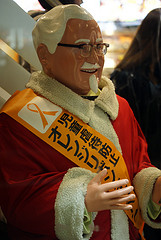
In the early 1970s, a Christian missionary school in Tokyo was looking for turkey for Christmas dinner. Finding none, a representative contacted the local Kentucky Fried Chicken and ordered chicken instead. A KFC employee suggested the company turn the request into an ad campaign, and Japan has never been the same since. Today, KFC’s Christmas Party Barrels are so popular that sales for December 23, 24, and 25 usually equal half of what is sold during a normal month, and Christmastime customers wait in long lines to pick up their orders, placed as early as October. Very few in Japan celebrate Christmas for its religious meaning, as less than 2% of Japanese even call themselves Christian. Instead, consumerism is emphasized, and the focus is on gifts, decorations . . . and chicken from the Colonel.

(Lindsay Whipp, “All Japan Wants for Christmas Is Kentucky Fried Chicken,” Financial Times, Dec. 19, 2010)

[photo: “KFC Colonel Santa” by Kleemo, used under a Creative Commons license]

The Global Church Is on the Move

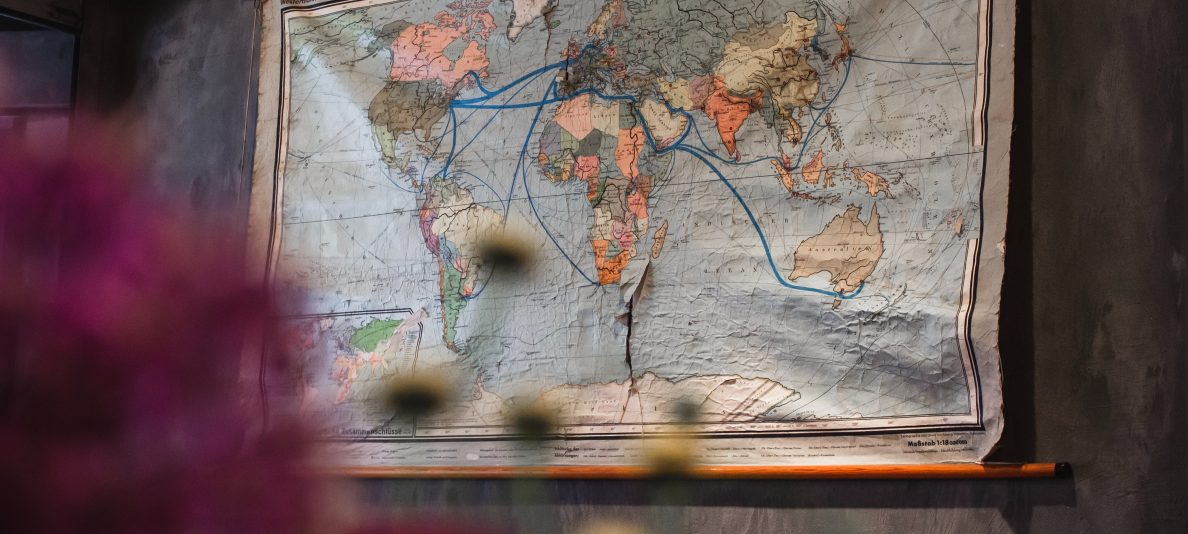
According to Peter Crossing of the Center for the Study of Global Christianity, one hundred years ago, the statistical center of Christianity was in Spain, with over 80% of Christians living in Europe and Northern America. But today, broad changes in the Christian population have moved the statistical center to Western Africa. “This 100-year shift is the most dramatic in Christian history,” said Crossing, who spoke in October of last year at the Global Christian Forum in Manado, Indonesia. Other statistics noted at the forum were

• In 1910, less than 2% of Christians were in Africa. Today, 20% live there.

• While 60% of Christians now live outside of Europe and Northern America, their share of Christian income is only 17%.

• The top five languages used in churches are Spanish, Portuguese, English, French, and Chinese.

• 32.39% of the world’s population consider themselves Christian. The next largest group, Muslims, make up 22.9%.

• In 1960, evangelical Christians were 2.9% of the world’s population. Today they have reached 7.9%.

(Mazda Rosalya, “For 100 Years, Christians Make up One-Third of World’s Population” and “Christianity Underwent Greatest Cultural Shift in 2,000 Years, Says Scholar,” Oct. 10, 2011, The Christian Post.)

[photo: “Praying Together” by Boyznberry, used under a Creative Commons license]