“An Extraordinary Theory of Objects”: A TCK in Paris and the Things That Keep Her Sane, Sort of

31703109_4ad6f7ce2c_nI just finished reading a cool little book entitled An Extraordinary Theory of Objects: A Memoir of an Outsider in Paris. It was a Christmas gift from my son, the one who got a Moleskine Journal from me.

An Extraordinary Theory of Objects is a series of vignettes by Stephanie LaCava about her move to France as a twelve-year-old in 1993, her years there growing up, and then her visits back again after attending college in the States.

On the cover of my copy of the book are romantically filtered and tinted photos of the Eiffel Tower, and on the pages inside, her writing style evokes the same kind of mood. If stories could be sepia-toned, this is how they might sound.

Actually, the filter through which LaCava encounters the world is her attachment to things. First, there are the small, curious relics—a skeleton key, a mushroom, an opal necklace found in the mud—that she gathers and places on her windowsill. Initially they replace her old collection, “everything that represented [her] past life and its predictable ways,” which is on a container ship making its way across the ocean from New York.

And then there are the objects she encounters from day to day, common things that she illuminates in copious footnotes often taking up more than half a page. Cataloging these objects gives her security and makes sense of her life in a new city . . . as she faces depression and what she calls her own “kind of crazy.”

Some might find her footnotes distracting, but they cover just the kind of obscure topics that intrigue me, such as a Japanese smuggler of black-market butterflies, a photo book dedicated to Salvador Dali’s mustache, and the origins of the tea bag. And they are replete with references to a variety of figures, from Pliny the Elder to Kurt Cobain, from Anne Boylen to Kate Moss.

Much of LaCava’s narrative is about time spent with her father, often searching flea markets for items to fulfill their eccentric tastes. At other times, she talks about her classmates at the international school. She says she was “mostly alone” her first year there. Even among these other outsiders, she doesn’t fit in.

I rode the bus to school and listened to my Discman while the girl in the back row threw gum wrappers at my head. The girls at school didn’t like me very much. They had never given me a chance, decided immediately that I didn’t belong, which was funny, as they didn’t either—at least not in France. They made me feel as if I had done something wrong, and they spoke badly about me to each other. Through my own odd rationalization, I decided excommunicating me meant they belonged to something, simply because I did not. . . .

Come the new academic year, the old class would be replaced with another set of students who had just moved overseas. Only a few remained year after year—and still the same insensitivity.

One day, a classmate tells her that she looks like Angela from the TV series My So-Called Life.

“I haven’t seen it,” she replies.

“Everyone’s seen that show,” he says. “Don’t you have friends in the States? They can send it to you.”

In a footnote, LaCava delves into the significance of the series, quoting Matt Zoller Seitz of The New York Times, who writes, “What the series’ narration does best: it shows how teen-agers try to control their chaotic inner lives by naming things, defining them, generalizing about them.”

That’s what LaClava does, as well—controlling the inner chaos of her life in a Paris suburb by naming the objects she encounters. Then, years later, she examines them even more closely and writes about them so that she can share with us her own kind of strange . . . and her own kind of normal.

(Stephanie LaCava, An Extraordinary Theory of Objects: A Memoir of an Outsider in Paris, New York: Harper Perennial, 2013)
[photo: “Eiffel Tower,” by charley1965, used under a Creative Commons license]
11 Ways Moving Abroad Is like Skiing to the North Pole

34961051_5302f8458a
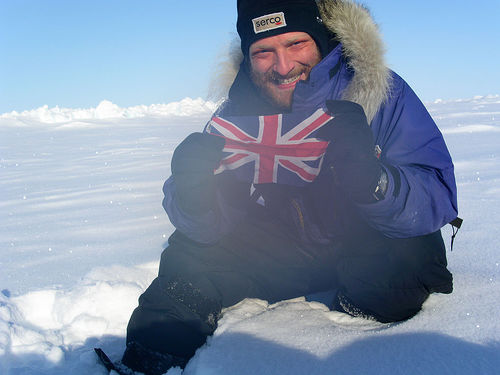
Ben Saunders sits on top of the world, the youngest person to reach the North Pole alone and by foot.

In 2004, 26-year-old Briton Ben Saunders became only the third person, and the youngest ever, to ski unaccompanied to the North Pole. As it turns out, there are a lot of ways that making a solo trek to the North Pole is a like moving to another country. Here are 11 things that the two adventures have in common, all taken from Saunder’s February 2005 TED Talk, “Why Did I Ski to the North Pole?”

  1. Luggage is a drag
    Saunders describes his specialty as “dragging heavy things around cold places.” He says, for his trip to the North Pole, “I was dragging all the food I needed, the supplies, the equipment, sleeping bag, one change of underwear—everything I needed for nearly three months.” That sounds like trying to put every necessary item in your carry-on bag, just in case your checked luggage gets lost. (If you think your bags are heavy, Saunder’s supply of food and fuel weighed 400 pounds.) Sometimes your destination has harsh conditions. And sometimes it doesn’t have chocolate chips. How many bags of those should you bring? Can’t be too prepared.
  2. It can be lonely out there
    One of the challenges of Saunder’s voyage was that he had to make it alone. Very alone. When he arrived at the northern-most point on the globe, he was the only “human being in an area one-and-a-half times the size of America, five-and-a-half thousand square miles.” Most of us don’t go to such remote places, but even if you’re in the biggest city, surrounded by millions of other souls, you can easily feel all by yourself.
  3. No, Virginia, there isn’t a Santa Claus
    When Saunders got to the top of the world, he didn’t find Santa. No Santa’s workshop. No elves. In fact, he says, “There isn’t even a pole at the Pole. There’s nothing there, purely because it’s sea ice.” When you go to another country, expect the unexpected. Don’t be surprised when what you find doesn’t match the photos in the magazine article. “I’d read lots of books,” says Saunders. “I studied maps and charts. But I realized on the morning of day one that I had no idea exactly what I’d let myself in for.” Photoshopped and cropped pics don’t do us any favors. If GPS and street signs say we’re in the right place, don’t waste time—or emotions—trying to find something that doesn’t exist.
  4. Sometimes it’s one step forward, two steps back
    According to NASA, during the year of Saunders journey, the ice conditions were the worst on record. Ninety percent of the time he was skiing into headwinds and the drifting ice pulled him backwards. “My record,” he says, “was minus 2.5 miles. I got up in the morning, took the tent down, skied north for seven-and-a-half hours, put the tent up, and I was two and a half miles further back than when I’d started. I literally couldn’t keep up with the drift of the ice.” When you’re in a new place, learning the language and culture, get used to those backward drifts. But always keep your compass set on your true north.
  5. The only constant is change
    Because the ice is constantly drifting over the North Pole, Saunders says that if he’d planted a flag there, it wouldn’t be long before it would be heading toward Canada or Greenland. Like Saunders, don’t be surprised when the emotional flags you plant aren’t permanent. The ground may not move under your feet (earthquakes not withstanding), but other kinds of landscapes certainly will. Find a special restaurant that serves your favorite dishes? Wake up the next day and it’s become a plumber’s shop. Make friends with some other expats? You may soon have to say goodbye. But, repeat after me, “Change can be good. Change can be good. Change can be good.” Maybe, just maybe, that plumber’s shop will end up being exactly what you need.
  6. Culture stress can be a bear
    Literally. On his first try at the North Pole, Saunders went with a partner, but they failed to reach their goal. Saunders says that from the outset “almost everything that could have gone wrong did go wrong. We were attacked by a polar bear on day two. I had frostbite in my left big toe. We started running very low on food. We were both pretty hungry, losing lots of weight.” Yup. Sounds like culture stress to me.
  7. Coming back can feel like the bear wins
    When his first attempt fell short, Saunders says he “was physically exhausted, mentally an absolute wreck, considered myself a failure, in a huge amount of debt personally to this expedition, and lying on my mum’s sofa, day in day out, watching daytime TV.” His brother texted him an encouraging quotation from Homer Simpson:
    “You tried your hardest and failed miserably. The lesson is: don’t even try.” Repatriation can feel that way. Maybe all the people who’d said you shouldn’t go were right. But Saunders didn’t let his failure define him. Instead, three years later he made history.
  8. People aren’t sitting around waiting to hear your stories
    When Saunders reached the North Pole, he got out his satellite phone. After warming up the battery in his armpit, he made three calls: “I dialed my mum. I dialed my girlfriend. I dialed the CEO of my sponsor. And I got three voicemails.” OK, that’s unfair to say they didn’t want to hear what he’d done. They were just busy at the time, that’s all. But . . .
  9. Some people really do want to listen
    “I finally got through to my mum,” says Saunders. “She was at the queue of the supermarket. She started crying. She asked me to call her back.” There are special people who will make time to listen—when they can focus on your story without distractions. Thanks, Mum.
  10. Don’t let others draw boundaries on your map
    When Saunders was 13, he got a school report that said, “Ben lacks sufficient impetus to achieve anything worthwhile.” Saunder’s response—”I think if I’ve learned anything, it’s this: that no one else is the authority on your potential. You’re the only person that decides how far you go and what you’re capable of.”
  11.  One of the three most important questions will always be “Where is the bathroom?”
    Saunders gave his TED Talk to answer three questions:
    (1 ) Why?
    (2) How do you go to the loo at minus 40?
    (3) What’s next?
    That second question is very important at the North Pole, because it seems that “at minus 40, exposed skin becomes frostbitten in less than a minute.” Your question number two will be more like “Where’s the bathroom?” or just “Bathroom? Bathroom?” Then, once you see the facilities, you may ask yourself, “How?”

As for the answers to those question, in short, Saunder’s responses go something like this:

(1) “For me,” says Saunders, “this is about exploring human limits, about exploring the limits of physiology, of psychology, and of technology. They’re the things that excite me. And it’s also about potential, on a personal level. This, for me, is a chance to explore the limits—really push the limits of my own potential, see how far they stretch.”
(2) That’s a trade secret, no answer here.
(3) Antarctica. Saunders and Tarka L’Herpiniere are currently on the first leg of their trek from the coast of Antarctica to the South Pole and back again—1,800 miles in all—unsupported and on foot. You can follow Saunder’s daily blog posts here. Why the South Pole? See answer number one above.

Somebody’s got a severe case of wanderlust.

[photo: “North Pole (3),” by Ben Saunders, used under a Creative Commons license]

It Won’t Be the Same without You: Join The Expat Survey 2013

2444717300_abb533fa6d_mThe logo for The Expat Survey 2013 is a hummingbird, “because just like human beings each one has its own migratory flight pattern.”

If you’re an expatriate, the Expat Survey wants to hear about your migrations, as well as your “remarkable diversity of habitats.”

The survey is made up of three parts, each rolled out separately, with the final section going live tomorrow (update: the third section went live November 27). All portions of the survey will remain available online until December 31.

The three sections are

  • Migration & Lifestyle
    “[H]ave you found it easy to integrate, what do you like or dislike about your adopted home, has life changed considerably and how do you stay in touch with family, friends and the outside world?”
  • Retail & Finance
    “Whether you are working or not, what are your important considerations when it comes to personal or household expenditure, banking and investments; and what information resources do you now tend to turn to when making these decisions and future fiscal planning?”
  • Travel & Health
    “Has your move to a warmer or colder climate changed your perspective of the world and the places and people you choose to visit; and what modes of transport do you use to get there? Do you enjoy a better diet and benefit from improved health and if you have had cause to call upon your local medical services were they sufficient?”

Besides having their voices heard, expats who fill out all three portions of the survey will be entered into a drawing for £1,000.

An independent London organization, i-World Research Limited, is conducting The Expat Survey, and it’s being promoted by 10 “collaborative partners.” One of those partners, Max Media International, calls the survey “the largest and most extensive independent global research programme ever conducted on those residing outside of their country of origin.”

To take part, go to The Expat Survey 2013.

(“Expatriate Specialism Agency Joins Expat Survey 2013,” Max Media International, July 10, 2013)

[photo: “Rufous Hummingbird—All fired up to impress the ladies!,” by Rick Leche, used under a Creative Commons license]

Our TCK Makes Plans for the Peace Corps—Wait, Not So Fast

Here’s another article from my son Peter. It’s about his time at the Summer Peace Institute in San José, Costa Rica, and also about his post-graduation plans. Peter spent nearly half his life overseas before graduating from high school, so another trip to another culture should have been a piece of cake, right? And heading back to Asia with the Peace Corps shouldn’t be a problem, either. Here, Peter shares about how it can be hard to cross cultures alone, even for a TCK.

IMG_0167
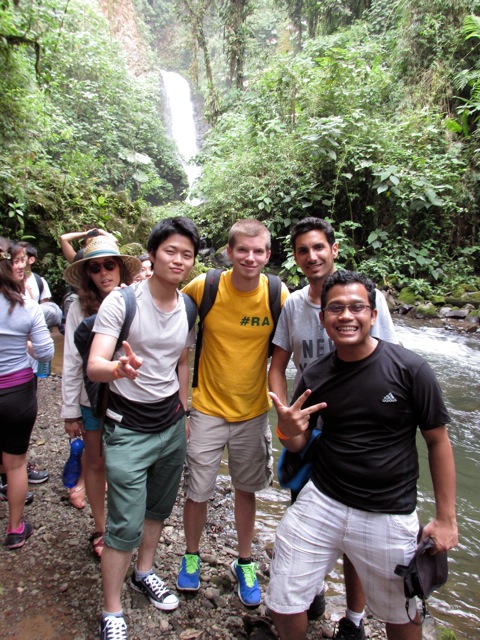
Peter (in yellow shirt) enjoys the Costa Rican outdoors with some of his friends in the Summer Peace Institute.

In 1999, my family and I left Joplin, Mo., for the other side of the world—Taipei, Taiwan. Before that, I’d never been outside the Midwest, let alone the United States.

If you are not familiar with Taiwan, it is a small tobacco-leaf-shaped island off the southeast coast of China, having about one-fifth the land area of Missouri with four times the population.

When we took our first trip to Taiwan, my parents were in the process of considering whether they wanted to become missionaries there. We spent two weeks traveling around the island, sightseeing and meeting Taiwanese friends who had once been international students at Pittsburg State University and at my father’s alma mater, the University of Missouri.

Two years later, my family and I left Joplin again for Taiwan. This time, I stayed for eight years.

After I graduated high school, I returned to Joplin to attend MSSU. I have enjoyed my time at this university more than any other time in my life, but now I am near the end. I will graduate this December with two bachelor’s degrees and, like many of you, still have no idea what I want to do next.

Well, I should not say, “No idea.”

Ever since returning from Taiwan, I have been fascinated by the world outside Joplin, outside Missouri, outside the US. I had tasted another culture—Taiwanese food is delicious, by the way—and I was ready to experience more.

When I heard about the Peace Corps, it sounded like a perfect fit. Started in 1958, the Peace Corps is a US government-run volunteer program that sends American citizens out into the world to learn about other cultures and serve the people of developing countries. Volunteers spend two year stints anywhere from Zambia to China to Peru to Jordan.

About six months ago, I submitted an application for the Peace Corps. Even before that, I had watched as two friends, fellow MSSU students and past McCaleb winners Luke and Caitlan Smith, were sent off by the Peace Corps to Rwanda.

By the time I left for Costa Rica, I was several months into the Peace Corps application process.

During the UPEACE-Berkeley program, I got to talk with two people who have experience with the Peace Corps: Dr. Jerry Sanders, a former Peace Corps volunteer [and co-founder of World Policy Journal and director of the Summer Peace Institute], and Manuel Davila, a former employee of the Honduran Peace Corps office. I asked them about their thoughts on the Peace Corps.

Sanders volunteered in Colombia in the 1970s and became disenchanted with the Peace Corps halfway through his two years there.

“I wasn’t any more satisfied with [the Peace Corps’s] policies—so-called development policies—than I was with the war in Vietnam,” he said.

Sanders felt the policies prevented efficiency. He encouraged me to go into the Peace Corps with a willingness to criticize the system.

Davila said the volunteers he met had great experiences, and he became friends with some of them. He told me the Peace Corps takes very good care of its volunteers.

I thought my time in Costa Rica would make me more excited for the Peace Corps. Instead, it made me realize how hard the Peace Corps would be. Though I had lived and traveled internationally, I had always done it with family or friends.

By the end of my first day in Costa Rica, I had already faced several difficulties.

My luggage was held up in Houston, Texas, so I lacked a change of clothes, toiletries, and even cleaning solution for my contacts. I was overwhelmed by 30 students whom I had never met before and who already seemed to know each other. I could not keep up the lectures on topics I had never studied. I could not speak Spanish. I did not know my way around town and got myself lost wandering home from the bus stop.

As I familiarized myself with my host town, learned a few Spanish phrases and befriended—and was befriended by—the other students, I felt more and more comfortable in Costa Rica.

Some of my favorite moments of the trip were whitewater rafting down the Pecuare River, learning how to say “God bless you” in Spanish, taking walks around my host town, visiting the Caribbean coast, trying new Costa Rican dishes, having intellectual and non-intellectual discussions with fellow students and watching soccer on television with my host family.

Nevertheless, being away from my family, my church community and my other close friends in Joplin was difficult throughout the trip.

While I truly enjoyed my time in Costa Rica, it did open my eyes to the realities of living overseas by myself.

In a Facebook message about the Peace Corps, Luke Smith writes, “The hardest part for me though has just been being away from my family. Diet and living conditions are a cake walk compared to not being able to see the people you love.”

Two weeks into this semester, I received a Peace Corps invitation to volunteer in Indonesia as a secondary English teacher, with a March starting date. I was given seven days to make my decision.

About an hour later, I decided to decline it. It feels like the coward’s move. But right now, I am not ready for the Peace Corps, and that is okay.

Now I am trying to figure out what is next. I will still graduate in December, and I still have no jobs waiting for me. Though I am not yet ready to live in Indonesia for two years, I am ready to explore more of the US, especially her big cities.

I do not plan to give up my aspirations of international studies. I know if I do move somewhere like Chicago or Philadelphia, I will meet people from other countries and cultural backgrounds, and that is exciting.

Maybe I will pursue a master’s degree in international relations. I am still very interested in cross-cultural issues. I follow global current events in my free time, and I try to pick up bits and pieces of other languages.

My thirst for cultural diversity will never be quenched. The Peace Corps may still be in my future, but I am not looking that far ahead. I am looking at what is next, one decision at a time.

Hyper Realism: A Russian Farmer Lands an Esquire Cover and a Trip to New York

9168908261_6e344e2bb4_n
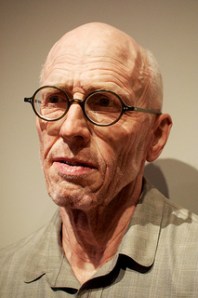
Evan Penny’s Old Self, Variation #2, an example of hyper-realistic art

Ever since, as a child, I saw Duane Hanson’s lifelike sculpture Janitor at the Milwaukee Art Museum, I’ve loved hyper-realistic art. Then last month, when I visited Crystal Bridges Museum of Modern Art, in Bentonville, Arkansas, I was surprised to see another Hanson work, Man on a Bench. (I really was surprised, since it looked for all the world like a museum visitor taking a break from his tour.) And in a room close by, there was an oversized bust by Evan Penny, Old Self, Variation #2. Unlike with Hanson’s pieces, no one will mistake Old Self for an actual person—it’s only a head with shoulders, and it’s way too big. But still, it just looks so real.

Martin Schoeller is another artist in the same vein, except he doesn’t exactly create hyper realism, he captures it—with a camera. Born in Germany, but now based out of New York, Schoeller is best known for his “hyper-detailed” large-scale portraits of celebrities, which have appeared in magazines such as GQ, The New Yorker, and Entertainment Weekly.

But his photographic subjects also include common people, like you and me. In fact, if you’d like to see what you’d look like in a Schoeller portrait, next time you’re in Bed Bath & Beyond, do like I did and take a look at yourself in the 10x-magnification of the Zadro Dimmable Florescent Dual-Sided Mirror. (That’s hyper realism.)

Schoeller recently took a cover photo for Esquire Russia of Vasiliy Ilyn, a retired farmer from Russia, who’s featured in this month’s magazine. Ilyn is one of Schoeller’s non-celebrity subjects, as the September Esquire is devoted to the rules that govern the lives of ordinary Russians.

For three days, Ilyn was something more than ordinary, as he was flown to New York for the photo shoot. His encounter with the city is chronicled in the 20-minute film Vasily, from Stereotactic. (Thanks to Carla Williams for telling me about the video.)

The film shows Ilyn’s first trip outside the Kursk region of Russia, his first time to see the ocean, and, of course, his first visit to America. As he looks around New York, he’s a fish out of water, but he’s an ordinary fish. And I’m not sure that his reactions are much different from those many retired farmers in the flyover portions of the US would have.

Ilyn narrates the documentary, and he has a lot to say about Russia, the US, and life in general. He thinks of himself as a joker, but much of what he says shows a solemn acceptance of the way things are. He’s pretty straightforward and plain spoken. At one point, while talking about his disdain for past Russian leaders, Ilyn drops an F-bomb. Actually, it’s more of an F-hand grenade since we read it in the subtitles.

When he gets back to his home, he tells a woman about the 80,000 Russians who live in New York. “I wish a flood would come and they would die,” she says. “Let the locals survive, but these traitors should die.”

Ilyn replies, “They were just looking for a better life. . . . Let them go.”

Shoeller’s type of hyper-realism doesn’t come from a lack of preparation and artistic manipulation. The lighting and focus has to be just right, and there’s a lot of time spent on Ilyn’s makeup. But the result is striking for its unglamorized detail.

That’s the way the documentary looks to me, too. I can tell a lot of work went into the making of Vasily, but it’s that work—the shot selection, the editing, the scoring of the music—that makes it feel more real . . . much more real than what usually passes for “reality” on TV today.

(“Russian Farmer Lands in Esquire and NYC,” Voices of NY, October 15, 2013)

[photo: Old Self, Variation #2” by Nils Gore, used under a Creative Commons license]

I Love You, I Hate You: “Girl, Adopted”

After writing about some documentaries on adoption that used to be, but are no longer, available for online viewing, I finally went to the PBS site and found one that is still up—but not for long. If you want to see Girl, Adopted, you’ll have to watch it before the end of this month.

girl_adopted-01-thumb-large
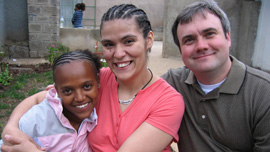
Weynsht with her adoptive parents before their flight to the States

Documentaries are at their best when the filmmakers step out of the way and just let the subjects of the films speak for themselves. That seems to be what happens in Girl, Adopted. It presents the story of Weynsht (pronounced win-shet), who, at the age of 13, is adopted from an orphanage in Ethiopia by a family from Pyatt, Arkansas. The ups and downs don’t come in the adoption process itself—with the finalization providing the climax. Instead, the adoption is the beginning of the story, with the relationship between Weynsht and her new parents supplying the joys and frustrations.

Near the beginning of the film, Melanie, the adoptive mother, says, “We feel like everything happens for a reason and in perfect timing, and I think that we were meant for her and she was meant for us.”

After living in Arkansas for some time, Weynsht shares her own view. “Things happen for a reason sometimes,” she says, “and I still just waiting for a reason.”

Throughout the film, covering five years, Weynsht voices competing emotions concerning America, her parents, and her own identity. And, as young people often do, she talks a lot about love and hate.

Soon after her arrival in the States, she voices her love for Usher, her mother, a Barbie doll, and Wal-Mart.

Later, she says to her white girl friends, “I love you hair.” And when she talks about her desire to find another family, she tells her parents, “I never say, ‘I love you, too,’ because I hate you.”

After more time has passed, Weynsht says, “I really like being Ethiopian person, but I hate being black,” and, “I hate my hair.”

girl_adopted-02-thumb-large
Weynsht on her visit back to Ethiopia

When her father takes Weynsht and her sisters to Ethiopia to visit her orphanage, she finds out that she has an older brother, and her confusion deepens: “I don’t care. I do care, actually, but . . . ,” she says. “I’m just . . . so many things in my head.”

Her mixed emotions turn to anger when she thinks that her father is forcing her to meet her brother. And then she’s afraid: “If I met my brother, why would I want you guys? What makes you think I need somebody else? If I have a brother, I’m wanna stay with my brother.” Then she adds, “And I don’t want that ’cause I love you guys, and just stop.”

Girl, Adopted is certainly not a simple advocacy piece for adoption. In fact, while Weynsht’s father, Chris, concludes that adoption is “worth it, even if it’s hard,” he also says,

At one point, I thought that everyone should adopt a child. It’s something that everybody can do. All they’d have to do is just open up their homes and their hearts and let a kid in, but I don’t really hold those same views today. I don’t think that everybody should do it. You have an idealistic view of adoption, and then as you go along, the details of that view are filled in.

Chris, Melanie, and Weynsht are brave to have let the cameras follow their lives for five years. I’m glad they did, because the result is a compelling work that helps the rest of us fill in a multitude of powerful details.

Produced and directed by Melanie Judd and Susan Motamed, Girl, Adopted (2013) is part of the Global Voices series from Independent Television Service (ITVS) and the WORLD channel. The 78-minute video is available for online viewing until October 30. It can also be purchased on DVD.

[photos courtesy of ITVS]

One Missionary’s Emotions . . . Honest, Unedited, and Unsanitized

I’ve been following Under the Big Topp for a while now. It’s from a missionary and mom who is committed to honestly blogging about what she calls her “very unremarkable journey in God’s remarkable mission.”

6032654897_d5d7b008cc_nI appreciate her willingness to let us hear her deep thoughts and feelings, and that is what she does in a recent post, “a secret reluctance of faith.” It’s a look back to the time this past May after her 16-month-old son (whom she calls Roo) pulled a cup of boiling water onto himself, giving him second- and third-degree burns over 25% of his body.

Her story tugs deeply at me, as it brings back memories of what happened to my own son while we were in Taiwan. When he was 14 months old, he grabbed a hot clothes iron, burning the palm of his hand. At first, the hospital staff thought it was not so serious, and we went home with his hand wrapped in bandages. But then he developed an infection and we found out that he had third-degree burns. That led to a hospital stay of over 40 days for him—and because in Taiwanese hospitals the family provides much of the day-to-day care, that meant that my wife spent more than 40 days there, as well. All of this led to several surgeries, skin grafts, and therapy sessions over the next two and a half years.

Mrs. BigTopp writes that her son was flown by air ambulance to a neighboring country for treatment. The surgeon there “predicted months of specialist care, a surgery or two and then more outpatient care. . . . But then suddenly, Roo was healed.”

She then shares what she wrote down the night before flying back to her host country, as she struggled with her emotions. As is often the case, the emotions surrounding trauma are confusing and seem to betray us. With the healing of her little boy came the reality that he would no longer need long-term care back home in Australia. But that also meant she would not be “rescued” from the difficulties she has faced as a missionary.

She apologizes for the “full on” nature of her words—unedited and, she says, unsanitized.

Man! I should just be happy. Happy that Roo is well and safe and healed, and I know I am happy…
….but I am not ready.
I scared again. Inwardly I’m screaming again.
I am hyperventilating and screaming.
I’m screaming, ‘No! No! No! Please God, please’
outwardly I’m quietly packing suitcases and booking flights.
We are going back.

I am so tired and scared and full of guilt and I’m hurting.

And then they flew back to the mission field.

Please go to her blog and read the full post here. What I have shared above is only a small, small taste of her story.

[photo: “Reisdagboek,” by Audringje, used under a Creative Commons license]

The Psychological Health of Missionaries—Adding to the Research

6903821997_e0a95ce498_nHere’s a quick question:

What percentage of returned missionaries and aid workers report psychological disorders during their time overseas or shortly after their return? What do you think? About a quarter, a third, half, two thirds, three quarters?

According to a 1997 study conducted by Debbie Lovell-Hawker of Oxford University, the answer is “about half.” More precisely, Lovell-Hawker’s findings show that among the returned missionaries and aid workers she studied,

46% reported that they had experienced a clinically diagnosed psychological disorder either while working overseas or shortly after returning to the United Kingdom.

Before I went overseas, I would have guessed much lower than half, but after I first heard this statistic referenced in a debriefing I attended, in my mind, the number began to grow much higher than 46%. Statistics have a way of doing that.

Lovell-Hawker’s research included 145 aid and development workers and missionaries from 62 organizations. Though not definitive, the findings are significant as a wake-up call to cross-cultural workers, sending agencies, NGOs, churches, and member-care givers. And they also can assure those repats who are struggling that they are not alone.

Other  findings include

• 18% reported that their problems developed while they were overseas—82% said they began after returning to their home country
• Depression was the most frequently reported problem, occuring in 87% of the cases
• Those who reported having psychological problems had spent significantly longer time overseas than those who reported having none

(Debbie Lovell-Hawker, “Specialist Care: Psychological Input,” Global Connections Member Care Conference, February 18, 2002)

Moving forward from this study, there are some things I’d still like to know: Has anything changed in the 26 years since the findings were published? What would the numbers be for all missionaries and aid workers, not just those who’ve returned? What would the breakdown be among those working in relief and development vs other settings, such as teaching or church planting in developed areas? Are the numbers consistent for workers returning to countries other than the UK? And what about TCKs?

The good news is that there are researchers who are working on these and similar questions.

The Research Continues

One of those researchers is Lynette H. Bikos. Lynette served as a guest editor (along with M. Elizabeth Lewis Hall) of a special issue of Mental Health, Religion & Culture in 2009, titled “Missionaries.” Lynette is director of research and professor of clinical psychology in the School of Psychology, Family, and Community at Seattle Pacific University—and she also happens to be a friend who lived next to me, on an adjoining farm, as we grew up in northeast Missouri. We’ve kept in touch over the years, and she corresponded with my family and me as she worked on her research.

The special issue includes 10 articles dealing with several aspects of cross-cultural adjustment among those whom the editors call “religiously motivated sojourners.” I’d like to highlight four of those articles:

“Social Support, Organisational Support, and Religious Support in Relation to Burnout in Expatriate Humanitarian Aid Workers”
(Cynthia B. Eriksson et al., Mental Health, Religion, & Culture, November 2009)

This assessment found that 40% of expat middle managers in an international faith-based agency were at “high risk” of burnout in one of three areas—lack of personal accomplishment, emotional exhaustion, and disconnection or distance from those being cared for—but less than 4% reported high levels of burnout in all three.

According to the authors of the study, “This suggests that despite intense work and chaotic environments a majority of workers find ways to identify accomplishments, stay connected to others in their work, and rejuvenate. Team relationships, friendships, and positive organisational support may contribute to the resilience for these workers.”

The findings also indicate that younger workers are at a greater risk of burnout, as they register greater negatives in all three burnout areas. But while age was a factor, the number of years serving with the agency was not.

“Resilience in Re-Entering Missionaries: Why Do Some Do Well?”
(Susan P. Selby et al., Mental Health, Religion, & Culture, November 2009)

The authors posed the question ‘‘Why do some re-entering missionaries do well while others do not?’’ and interviewed 15 Australian cross-cultural missionary workers to help find the answer.

All the participants were over 25 years old and had spent at least 2 out of the previous 3 years in a non-Western country. Based on their responses, the researchers divided the missionaries into two categories: “resilient” and “fragile.”

In the interviews, the eight resilient missionaries described having

• flexibility
• higher expectancy and self-determination
• denial in the form of minimization to deal with their distress
• good mental health
• more social support
• a positive reintegration
• a personal spiritual connection to God

In contrast, the seven who were considered fragile described

• less flexibility
• lower expectancy and self-determination
• less use of denial with minimization
• poorer mental health
• less social support
• difficulty reintegrating
• a decreased or fluctuating personal spiritual connection to God

It is interesting that while the results of a questionnaire measuring depression, anxiety, and stress (DASS 21) showed higher levels for the fragile group, the scale showed that only one out of the entire group (including resilient and fragile) had an actual perception of being “personally stressed.”

“Psychological Well-Being and Sociocultural Adaptation in College-Aged, Repatriated, Missionary Kids”
(Michael J. Klemens and Lynette H. Bikos, Mental Health, Religion, & Culture, November 2009)

When the researchers compared a group of MKs to non-MKs at a Christian university, they found that while both groups scored in the healthy range of psychological well-being (PWB),  the missionary kids’ scores were significantly lower.

The missionary kids’ MK status accounted for only 4% of the variance in psychological well-being but was responsible for nearly a quarter (23%) of the difference in sociocultural adaptation (SCA). In this latter area, the MKs reported the most difficulty in “taking a US’ perspective on the culture; seeing things from an American’s point of view; understanding the US’ worldview; understanding the US’ value system; and making yourself understood.”

“Curiously,” report Klemens and Bikos, “neither the age of the participant, nor the number of years abroad, nor the number of years since repatriation was related to PWB or SCA for the MKs.”

“Reduction in Burnout May Be a Benefit for Short-Term Medical Mission Volunteers”
(Clark Campbell et al., Mental Health, Religion, & Culture, November 2009)

This assessment looked at how international short-term mission trips affect burnout among volunteers.

The participants in the study, most of whom were physicians and nurses, travelled to South America for two weeks to provide medical care in a non-disaster-relief setting. Prior to their departure, the group members’ responses to questionnaires showed that they were experiencing moderate burnout. Their burnout levels were again assessed one month and six months after the trip.

“The major finding of this study,” report the researches, “is counter-intuitive: that medical personnel who are emotionally exhausted, have an impersonal response towards their patients, and lack a sense of [personal accomplishments] (moderately burned out) benefit by working hard with numerous patients in an international context.”

They found that levels of emotional exhaustion and perceived personal accomplishments showed significant improvements following the short-term trip and continued in a positive direction in the 6-month followup.

___________________________________________________

All good research builds about what has been learned before and leads to questions for new studies in the future. I join with Lynette and her co-editor in hoping that the information in their special issue of Mental Health, Religion & Culture encourages others to join in the “exploration” of the psychological health of missionaries. There is so much more to be discovered.

(Lynette H. Bikos and M. Elizabeth Lewis Hall, “Psychological Functioning of International Missionaries: Introduction to the Special Issue,” Mental Health, Religion, & Culture, November 2009)

This special journal issue also includes several articles specific to the experiences of female missionaries. I hope to discuss these in a future post.

[photo: “Confused,” by Mary T Moore, used under a Creative Commons license]