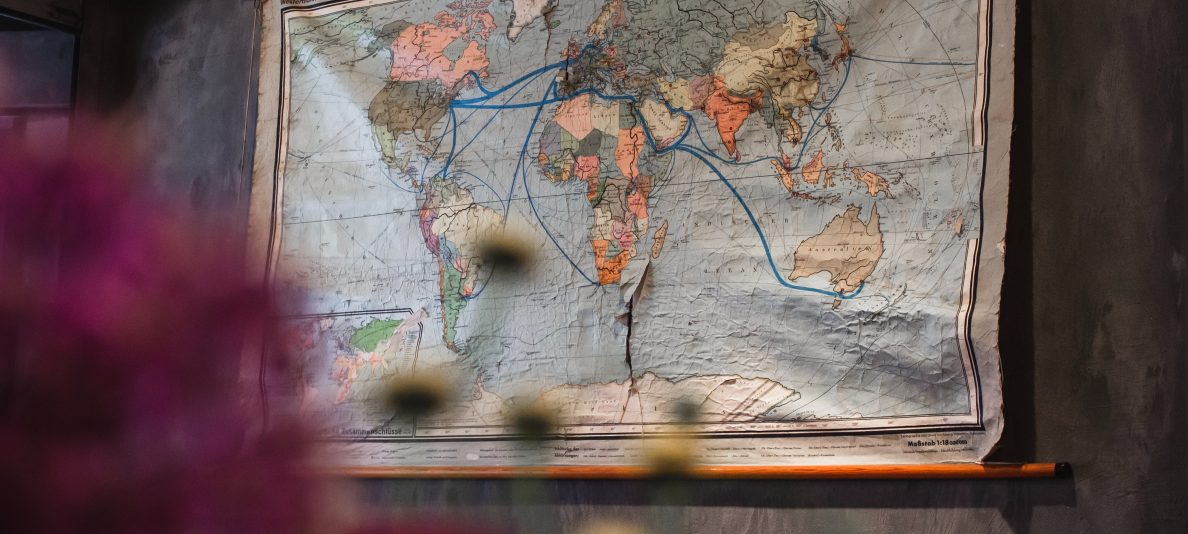
A Little Slice of Germany on a Mountainside in South Korea

As I was finishing up writing about China’s penchant for imitating foreign architecture, I thought I’d end with something like “Not to be left behind, South Korea has its own German village.” But when I looked into the history of that town, I realized it deserved more attention, so . . . here it is:

567294129_6fbce2ca50In the early 1960s, South Korea’s economy was in shambles. Unemployment was high, and per capita annual income was low (only US$87 in 1961). In order to help the desperate situation, in 1962, the government began sending its citizens to work in West Germany. This continued until 1973, when West Germany stopped accepting gastarbeiters, or guest workers. Over that time, more than 8,000 miners and 13,000 nurses made the move, sending most of the money they earned back to family in South Korea. In all, they contributed US$50 million to the Korean economy, and in exchange for the influx of needed workers, West Germany gave South Korea credit at reduced rates.

When President Park Chung-Hee visited West Germany in 1964, he met with about 300 Korean miners and nurses. According to an article in The Chosun Ilbo, Park told the group,

Let’s work for the honor of our country. Even if we can’t achieve it during our lifetime, let’s work hard for the sake of our children so that they can live in prosperity like everyone else.

The president’s speech ended when he choked up with emotion, and the final strains of the Korean national anthem were nearly drowned out by all of the crying.

Years later, South Korea showed its appreciation for the sacrifice of those who went to Germany by inviting them and their families back to take advantage of discounted plots of land. Namhae County, in 2002, even founded Dogil Maeul, or German Village, on a mountainside overlooking the ocean. The community is open to those returnees who spent at least 20 years in Germany and who want to build a subsidized house following a prescribed German style.

Buim Ulmer, from South Korea, and her German husband, Ulrich, moved to German Village in 2006. She told Spiegel Online last year that she came back because she “didn’t want to take [her] homesickness to the grave.” But she still doesn’t feel completely comfortable in Korea. For instance, her Korean, she says, is the Korean from “40 years ago.” And while Ulrich says, “My home is where my wife is,” Buim disagrees: “We have no home, there is always something missing.”

In the Engelfried family, too, the German husband seems more content living in South Korea than his Korean wife. Wilhelm Engelfried has lived in German Village for more than 10 years. “It would hurt me to leave here,” he tells Spiegel Online, but his wife, concerned about issues such as healthcare, wants to move back to Germany: “What should I do here if he gets sick? How should I take care of him?”

In a 2005 New York Times article, former miner Bai Jung-Il says, “I left when I was 26; I’m now 65. I’m more accustomed to the customs in Germany and the people there. When I come here, I feel I’ve come to a foreign country.” During his time in Germany, Bai became a home builder, and back in South Korea, he refused to follow the home designs provided by Namhae County. “The other houses here are German on the outside but on the inside they’re Korean,” he said. “Only my house will be German on the inside and outside.”

Take a look at this trailer for a documentary by Cho Sung-Hyung on German Village. The film is titled Endstation der Sehnsüchte, or  Home from Home:

The head of Namhae County, Ha Young-Je, told The New York Times that one problem with the village is that some residents still live in Germany and make their house in Korea a holiday home, traveling back to Europe every nine months to retain their citizenship there.

At the time the article was written, Namhae County was making plans for an American town for returning Korean-American retirees. One difference from its German counterpart is that people who move there would need to give up their foreign citizenship, said Ha, requiring them to live in South Korea full-time.

Since then, American Village has been completed, and you can see photos of it at the blog Daniel’s Rants. (I particularly like the entryway sporting a miniature Statue of Liberty.)

And for Korean Americans looking for a more urban experience to return to, there’s Korean American Village, scheduled to be built in the Songdo International Business District. The Korea Economic Daily reports that the finished multi-structure high-rise project will contain over 3,000 residential units, including apartments, office-residence complexes, and residence hotels.

(“60 Years of the Republic: Koreans Go to Work in West Germany,” The Chosun Ilbo, July 18, 2008; Manfred Ertel, “Weisswurst and Beer: Tourists Flock to South Korea’s ‘German Village,‘” Spiegel Online, July 12, 2012; Norimitsu Onishi, “In a Corner of South Korea, A Taste of German Living,” The New York Times, August 9 2005; “Korean-Americans Flocking to Songdo for Residential Town Development Project,” The Korea Economic Daily, November 16, 2012)

[photo: “More German Houses,” by Ian Burrett, used under a Creative Commons license]

Music for the Unsettled Soul

I re4473073565_3871119347_nally, really, really like the music of Page CXVI (formerly The Autumn Film). This group of three is “re-imagining” classic hymns for new generations, and just by reworking the melody and tempo, they bring new meaning to old songs. My favorite is “Joy,” which I highlighted in a post about dealing with grief.

Maybe there’s a special place for their music in the lives of those facing cross-cultural transition and stress.  Adam, who (like me) travelled with his family from the corn fields of the American Midwest to a “city of millions” overseas, sent an email to Page CXVI last year, and they posted it on their blog.

Adam writes about a “journey of faith” that took him, his wife, and their two-year-old son to “a place where hearts are ripe for harvest but the fields have many fences,” a place where they faced many trials:

Financial difficulties, spiritual conflict, and multiple miscarriages deepened my desire for God’s presence but also created questions for which I did not have answers. There were many nights that seemed very dark. Not the dark you see, but the dark you feel when you don’t have peace. In the midst of our many struggles, I would sit and watch the city lights and listen to Page CXVI.

Adam first heard the band before he went abroad when they led worship at a missions conference he attended.  Then, when he flew to his new home, he carried with him some of the group’s music.

The slow movement of traffic and the colored lights did little to bring comfort when I would sit staring out my window, but the music, with its rich lyrics and calming arrangement, did something nothing else could. When the elements madly around me were raging, God used the music and through the music biddeth them cease, turneth their fury to peace.

Here are two videos of the group performing the hymns “How Deep the Father’s Love” and “Come Thou Fount.” In the third, they sing “Peace Like a River,” from their latest project, Lullabies.

In another video, Page CXVI – Explains the Deeper Meaning of Hymns, lead singer Tifah Phillips, née Al-Attas, smiles and says matter-of-factly, “I grew up in this all-Chinese church. . . .” I bet there’s an interesting story there. I’d like to hear more about her background, about how her cross-cultural experiences have affected her faith and creativity. Maybe her bandmates, Reid Phillips (her husband) and Dann Stockton have their own stories to tell.

Continuing on, Phillips talks about the depth of the hymn “Be Still, My Soul,” noting how the song deals with some important questions:

What does it really look like to trust God? What does it look like to trust God when you’re dealing with anxiety or fear or unrest . . . ? What does he offer us in return? Stillness and peace?

I think these are the kinds of questions that were on Adam’s mind when he looked out his apartment window. I think they are the kinds of questions that a lot of us have on our minds.

(Page CXVI’s web site explains that the group’s name refers to the 116th page of C. S. Lewis’s The Magician’s Nephew, where Aslan “begins to sing Narnia into creation out of a black void.”)

[photo: “Rain,” by Josef Stuefer, used under a Creative Commons license]


These Newsletters Aren’t Sent Either

3742918775_f3b2aee5be_mRuth E. Van Reken’s honest revelations in Letter’s Never Sent has me thinking about all the missionary newsletters I’ve written and read. Missionaries are a good group for emphasizing the positives and putting a good spin on the negatives. Newsletters just aren’t a safe place to share deep struggles, especially when many of the readers are current or potential donors.

I’m not saying that every newsletter should be filled with pain. I’m not even saying that every missionary has enough pain to fill a newsletter. What I am saying is that if the only things you know about missionaries come from newsletters, presentations, and answer-the-routine-questions conversations, then you don’t know the whole story. And what I am saying is that if you are a missionary who is hurting, you are not alone in what you’re going through.

In fact, if you’re any kind of cross-cultural worker or a Third Culture Kid or a trailing spouse or an expat or a repat or a soldier overseas or a family member left behind, and if, at one time or another, any of the following could serve as a heading for your next newsletter or blog or prayer update . . . believe me, you are not alone.

Nobody cares.
God has been silent for a long time.
This was a mistake.
I’ve changed, and I don’t like who I’ve become.
I feel betrayed.
I’m overwhelmed.
I don’t care anymore.
I think I’m going crazy.
Where is my joy?
I wish I could die.
I feel like a failure.
I’m afraid.
I’m lonely.
I’m angry.
I’m disappointed in myself, and I think God is, too.
I don’t belong.

Let me say it one more time: If this is where you’re at or where you’ve been, You are not alone.

And I hope you’re never, ever left to feel as if you are.

[photo: “Creativity,” by Mark van Laere, used under a Creative Commons license]

“Letters Never Sent” but, Thankfully, Published Instead

It’s been 25 years since Ruth E. Van Reken125933835_e355fbcad2_m first published Letters Never Sent, but I hope it doesn’t ever become a book rarely read.

Following her experiences as a Third Culture Kid, born to missionary parents in Nigeria, and later as a missionary to Africa herself, Van Reken wrote a series of “letters,” to her mother and father, and to God, expressing feelings that earlier she wasn’t able to fully share.

While it would be easy to assume that the details of Van Reken’s story are dated—the book begins with her trip to boarding school in 1951—her expressions of honest emotions cut through the years and show the wonderings and pleadings of a heart that beats in many missionaries and their children today. But it is a heart that is all too often hidden and quieted.

One of the feelings voiced by the young Ruth Ellen is guilt . . . guilt that her inner thoughts are a betrayal of her parents’ calling. During her high-school years, she and her sister stayed in the States, while their parents returned to their work in Nigeria. As her mother and father’s departure nears, Ruth Ellen fights with her emotions, writing in a “never sent” letter:

If I throw myself into your arms and sob my heart out, it might keep you from going. And even though that’s what I want, how could I ever bear the guilt of being the one who kept you from doing God’s work? I’ve always vowed I wouldn’t be one of “those kids,” the kind that other missionaries talk about in whispers, with a sad shake of their heads. “So-and-so couldn’t come back to the field because of their children.” They must be pretty bad kids, I’ve always figured. I don’t want anyone to say that about me or our family.

And I can’t very well come to God with this because, in a way I feel like it’s all His fault.

Years later, as Ruth Ellen ponders her approaching wedding to David Van Reken, she expresses a distrust of God, developed from many years of having, as a TCK, to let go of what is dear to her:

I can’t believe God will let me keep David. It’s like He’s dangling Dave on a rope, letting him come closer and closer. I’m afraid that at the last moment, when I put out my hand to take him, the string will be jerked back and God will laugh.

“Ha ha. Thought you finally had someone you could keep. Don’t count on it. Whatever you depend on, I will surely take that, so that you’ll depend solely on Me.”

Ruth does get to keep David, and the two are soon joined by a baby daughter. But depression comes to Ruth, seeming to be at odds with the spirituality that she longs to possess. “How many hundreds of testimonies have I heard about the joy that Jesus gives?” she writes. “He surely isn’t giving it to me right now—or maybe I just don’t know how to receive it.”

Her depression becomes deep enough that she thinks about suicide:

I’ve actually wondered what it would be like to take pills and never wake up. But in my heart I know that wouldn’t solve anything. I have a child I’m responsible for, and I want to see her grow up. And I want to live, if I can be the person that I’ve always thought I had the potential to be. But right now that seems like a hopeless dream.

Then, using words that are reminiscent of those penned by the Psalmist in Psalm 13, she writes,

The thread I’m hanging on to is an intellectual belief that God still has a purpose for my life. I can’t imagine how He can ever put all the pieces back together and make me whole, but it’s my only hope. I told Him today that He could forget helping me to do better—there’s nothing left of me to help. If He doesn’t do something new, I’m finished.

But there is hope. There is help for her to do better. And it comes in the form of a new friend, Linda, who opens a path for Ruth by sharing her own personal struggles in a Sunday school class. This is something that Ruth hasn’t experienced before, and it gives her courage. This leads to many conversations with Linda, in which Ruth shares her pain, and Linda listens without judgment.

Within a few years, the Van Rekens are preparing for their own missionary work in Africa, and Ruth continues to learn how to function without hiding behind masks. Sometimes the masks come off gently, as with Linda, but at other times, they are pulled off forcefully, as when a pastor shares from the pulpit about some of her struggles. But to her amazement, she writes, when “[t]he awful, naked ugliness of my soul was exposed, . . . I was still accepted!”

Healing also comes through forgiveness: forgiving her parents for her many separations from them and forgiving “all those who locked me up with pat answers or quick words of encouragement, when what I needed was understanding and a hug.” Following the death of her uncle, Ruth gets a different kind of response from Jesus: “He held me and understood. He acknowledge my pain. He didn’t try to talk me out of my hurt. . . . I’m learning about God as the Comforter and binder of broken hearts.”

But in letters dated less than two years later, as she and David are serving in Liberia, Ruth writes that the depression has returned. She tells God, barring a change in the next month, to let her die. In her conversations with God that follow, she learns that she has not addressed all of the anger that is leading to her depressed feelings. She still needs to “forgive” God.

“Why don’t you leave me alone?” she hears herself say. “Ever since I came to Liberia to serve you, You’ve done nothing but bad things to me. I’m sick and tired of it.” And she hears God say to her that he isn’t at all shocked by her anger. He can handle it. “You can love someone and still be angry at him,” God tells her. Acknowledging this anger is an important step for Ruth, a step that leads to more healing.

One of the final letters penned by Ruth is dated 1984. That’s 24 years after Ruth Ellen had voiced her struggle with guilt because she wasn’t the perfect missionary child. In it, she says, after reading through all of her previous letters, that there still was one more person to forgive:

I can forgive the little girl I was, for not being all she thought she was supposed to be. The greatest joy has been to understand for the first time in my life that God is the “God of all Comfort.” I could not understand that until I recognized how much I needed His comfort.

Ruth’s story is one of faith and anger and hope and fear and sadness and peace, all flowing one into another. It is a story beautifully and sincerely told. It is a story that can speak to generations of TCKs and cross-cultural workers and to those who want to understand them. And it’s a story that continues. Last year, Van Reken published a newly revised edition of Letters Never Sent, containing 30 additional pages, with photos and an epilogue addressing her later life, including a bout with cancer.

It’s been 25 years since Ruth E. Van Reken first published Letters Never Sent, but I hope it doesn’t ever become a book rarely read.

The above quotations are taken from the 1988 edition of Letters Never Sent. The book was first printed in the US in 1987 under the title Letters I Never Wrote.

[photo: “unreachable,” by Daniel Zimmel, used under a Creative Commons license]
“Life Is What Happens . . .” Isn’t a John Lennon Original

3051471866_f12b1460f5_mWho says you can’t learn anything from the comics? (Actually, I’ve never heard anyone say that, but it sounds like something somebody might say.)

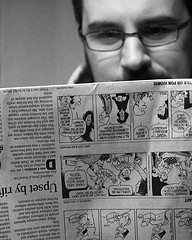
Last week, in Jimmy Johnson’s Arlo and Janis comic strip, Arlo is looking at a calendar and ponders, “Life is what happens while you’re making other plans.” He comments that we’ve probably heard that that line came from John Lennon, but it actually originated with Allen Saunders, the writer of the dramatic comic strips Mary Worth and Kerry Drake. Arlo closes with, “Lucky so-and-so never had to be funny!” (See the February 1 strip here.)

While I was a missionary in Taipei, I helped some Taiwanese friends study the Bible with the hopes that they would continue meeting when I wasn’t with them. One group was made up of students at a technology university and another consisted of former university students who had degrees from the US. This second group had started meeting at a McDonald’s for a weekly Bible study even before I met them. During one of my family’s trips to the States, hosts for each group planned to keep the meetings going while we were gone. One group met for two weeks, but then the host had to travel outside the country. And in the other group, the hosts weren’t able to continue organizing the meetings because of an illness in the family. In our monthly newsletter, I wrote,

It reminds us of John Lennon’s famous phrase: “Life is what happens to you while you’re busy making other plans.”  But even though their schedules didn’t work out as well as they, and we, had hoped, we are greatly encouraged by their desire and willingness to try.

I stand corrected by a comic-strip character. Lennon used the “Life is what happens . . .” line in his song “Beautiful Boy” in 1980, but according to Garson O’Toole of the Quote Investigator, that was over 20 years after a nearly identical phrase appeared in the “Quotable Quotes” section of Reader’s Digest. In the January 1957 issue, Saunders was given as the source of “Life is what happens to us while we are making other plans.”

So there you have it. All those quotation sites on the web should replace John Lennon with Allen Saunders.

Life often does get in the way of our plans, doesn’t it? Reminds me of the Yiddish proverb, “Man plans, God laughs.” At least I’m pretty sure it’s a Yiddish proverb. And I guess I’ll stick with that until Dilbert says otherwise.

(Garson O’Toole, “Life Is What Happens to You while You’re Busy Making Other Plans,” Quote Investigator, May 6, 2012)

[photo: “Funny Pages,” by summerbl4ck, used under a Creative Commons license]
Regrets and Remembrances: A Prayer for Those Who Leave Home

With one plane ride the whole world as TCKs have known it can die. Every important place they’ve been, every tree climbed, pet owned, and virtually every close friend they’ve made are gone with the closing of the airplane door.
—David Pollock and Ruth Van Reken, Third Culture Kids

5420666395_e086b79cf9_mThis closing door doesn’t just happen to Third Culture Kids. It’s also the experience of immigrants who leave behind many what-could-have-beens in their old country. Cross-cultural workers feel the door close when they leave their work and return “home.” (What other job requires you to leave the country once you’re no longer on the payroll?) International students close the door with the hopes that new opportunities will open many more. And refugees often see the door slammed and locked by soldiers carrying guns.

5420666545_cd2c078381_mBut while the door is closed, the mind is still open to thoughts about what was left behind. Some thoughts are joyous and life giving. Some are hurtful and life stealing. And often they come intricately, painfully intertwined, called up by a scent, a word, a sound, a flavor, a feeling or a dream. Bittersweet.

For those who find themselves on the other side of a closed door, I offer this prayer, inspired by Reinhold Niebuhr’s “Serenity Prayer.”

God, grant me the confidence to let go of the regrets that I should not hold on to,
The ability to hold on to the memories I should not let go of,
And the wisdom to separate the one from the other. Amen.

(David C. Pollock and Ruth E. Van Reken, Third Culture Kids: Growing Up among Worlds, Boston: Nicholas Brealey, 2009)

[illustrations: (upper) “Joined” and (lower) “Cupped“) by Pete Hobden, used under a Creative Commons license]

An Interview with Jessica Stahl of Voice of America

307933_693320373262_563685602_nI first “met” Jessica Stahl after I wrote about a post from The Student Union, a blog she edits for Voice of America. A native of Long Island, she now lives in Washington, D.C., where she works across the street from the Capitol building.

I’ve enjoyed reading Jessica’s blog and then chatting with her through email. I’m interested in the work she does at VOA (see the end of this post for more info about her employer), so I asked if I could interview her. She graciously agreed.

When I asked Jessica what she does at VOA, she told me she is “a producer for social media and special digital projects.” That led me to my first question:

What does “a producer for social media and special digital projects” do?

So, my actual title is “Audience Engagement Analyst,” which is one of those phrases that makes less sense the more you think about it. I call myself a social and digital media producer because that’s much more accurate to what I do. Basically, I manage VOA’s social media presences in English and advise our reporters and programs on how to use social media in their own work, and then I also put together projects and coverage that has a social media or user-generated component to it. Sometimes that’s an article that’s based on something that’s happening on social media (like when the Israelis and Palestinians were basically live tweeting the Gaza conflict a few weeks ago), and sometimes that’s a big project around an event like the presidential inauguration (which is what I’m working on at the moment).

You also edit The Student Union. How did you get started with that?

The Student Union came about a bit by accident. When I started in this job, I was looking around our website and familiarizing myself with what we had going on, looking for areas for improvement. One that jumped out at me immediately was our coverage of international-student issues. We would do these profiles of international students, which were fairly formulaic, and I immediately thought how much more interesting it would be to have international students telling their own stories. It was one of those things where I pitched the idea and was essentially told, “Great, go do it.” So I did. At the time I didn’t know anything about international-student issues, so that first year was a pretty big learning curve!

But I really love working on it. I love editing, and I like writing/reporting without the deadline pressure of breaking news, and I find working with the students so incredible. Their stories are fascinating, and they are so talented, and I love being in a position to help them mold that (not that they always need my input). If I’m honest, it makes me feel important and useful in a way that my regular job doesn’t always!

How did your life before VOA get you ready for what you do now?

That’s a tough one, because I fell into this a bit by accident. My degrees are both in international relations and economics—I did journalism as a hobby in college and grad school but never seriously considered pursuing it as a career. But I ended up at this job at VOA and I absolutely love what I do. I didn’t really have a lot of knowledge about social media when I started, but I’ve learned as I went and now I’d say (humbly, I hope) that I’m very good at my job.

I do think that the training I got in college as a print journalist has been absolutely vital though—that’s where I had the principles of journalism and of good writing drilled into me.

And my interest in/knowledge of international relations comes in handy pretty much every day, since I’m constantly dealing with world news and expected to have a really solid grasp on everything happening around the world.

Back to The Student Union: You have a great mix of students contributing to the blog. How did you meet them?

I find the writers in a whole bunch of different ways—a lot of it is actually dumb luck from students stumbling across the blog and then asking how they can get involved. That’s how I got matched up with two of my best writers: Anna Malinovskaya, from Russia, and Sarah Bosha, from Zimbabwe. I also do a lot of outreach towards the end of the summer with EducationUSA advisors around the world and with international student advisors at US universities, and they’ve been really helpful in spreading the word among their students and helping connect me with people who might be interested. And then, of course, I put it out there on our social media channels as well.

There is actually an application process, so I get to shape the group to make sure it’s pretty diverse in terms of country of origin, location in the US, major, and level of education. But most of that stuff sort of works itself out naturally, and the biggest things I look for are whether the student has ideas and is comfortable sharing things about their own life.

Can you give us examples of posts that give us a taste of how interesting/insightful The Student Union can be?

I’m personally interested in questions of identity and how that’s challenged in cross-cultural situations, and we’ve had some amazing posts on that topic, including from an African girl who had to confront her bias against gay people, “Just when I Learn the Answers, They Change the Questions: A Zimbabwean’s Journey“; from a Chinese girl who tried out several American personas, “What Does It Mean to ‘Be American’ as a Chinese Student“; and from an Afghan guy about the burden of showing American classmates that Afghans are normal people, “‘Who Are You?’ What It Means to Be an Afghan among Americans.”

But we also discuss quirks of American culture, like in this post about classroom discipline (by Anna), “Two Russians Discussing American Education,” or this one about the meaning of the phrase, “How are you?” “The ‘Wrong’ Way to Answer ‘How Are You?’” as well as more informational things like admissions procedures/requirements.

No matter what the topic is, it’s always from a first-person perspective, which I think is what makes it interesting. We’re not just telling people do this or do that (I have a serious pet peeve about “advice” articles that are so vague they can’t possibly be actionable or have no context to help you apply the advice to your own life); we’re sharing what we’ve done and what we learned from it, which someone can just read as a compelling story or can use as an input to make their own decisions.

The international students you work with, did they know about Voice of America before they met you? Did they listen to it in their home countries? What ideas/opinions did they have about VOA?

Depends. Some did, some didn’t. This year, I think, most didn’t. So I think for the most part they don’t really have a pre-existing opinion about VOA. During winter break a bunch will be traveling through D.C., and I’m really psyched to have them over to VOA and show them around so they can get a better sense of what they’re part of.

That sounds like a great time, for them and for you. I’d enjoy seeing DC through their eyes (I hope they get to blog about it). I’d also like to see DC through the eyes of an “insider.” So one last question: If I were to bring some international students to visit DC, after going to all the standard must-see sights—and VOA, of course—what would be a place off the beaten path that you think we should experience? What is a place that you’ve discovered because you’ve made D.C. your home?

One of our bloggers who spent a semester in D.C. did a nice insider’s look at some of the things she discovered, so you can check that out: “A Shifting Identity in Photos: Jihve’s Story.” For me, one of the things I love about D.C. is just the feeling of gravitas you get walking past the US Capitol and the White House. I still always get chills going past the White House. So I recommend walking the National Mall and seeing those sights, both during the day and at night when they’re all lit up. There’s an amazing spot on the steps of the Jefferson Memorial where you can look across the Tidal Basin and see the Capitol on your right, the White House through the trees straight ahead and the Lincoln Memorial on your left, and it’s just gorgeous.The other thing that people probably don’t know about D.C. is how many different neighborhoods we have. It’s not just downtown that’s interesting. I love to walk (probably obvious from my previous suggestion), so I’ve really enjoyed just wandering through the neighborhoods and absorbing their different characters. I recommend Capitol Hill, particularly Eastern Market (which is a giant open-air food/crafts market), U Street (for something that is more authentic to DC’s homegrown culture), and Georgetown.

____________________________________

Voice of America began broadcasting in 1942 and in the 70 years since has grown to reach a television and radio (including shortwave) audience of 141 million each week, in 43 languages. Begun “as a response to the need of peoples in closed and war-torn societies for reliable news,” VOA is under the direction of the Broadcasting Board of Governors, an independent agency of the US government. The BBG’s mission is “to inform, engage and connect people around the world in support of freedom and democracy.”

(“VOA Fast Facts,” Voice of America)

Eleven Tips for Helping Someone with Cross-Cultural Transitional Loss

7016973613_ded8a0eac1_mIf you want to help people in transition—cultural, geographic, and vocational transition—then you’ll need to deal with the grief that comes with their losses. Here’s a great resource for that, A LifeCare Guide to Helping Others Cope with Grief. (LifeCare is a leading provider of “work-life services.”) While this publication is aimed at comforting people who have lost a loved one, the advice it gives can be applied to those with cross-cultural transitional loss as well.

It opens with the second half of this quotation from Henri Nouwen, from Out of Solitude: Three Meditations on the Christian Life:

[W]hen we honestly ask ourselves which persons in our lives mean the most to us, we often find that it is those who, instead of giving much advice, solutions, or cures, have chosen rather to share our pain and touch our wounds with a gentle and tender hand. The friend who can be silent with us in a moment of despair or confusion, who can stay with us in an hour of grief or bereavement, who can tolerate not knowing, not curing, not healing and face with us the reality of our powerlessness, that is a friend who cares.

Here are eleven tips from Helping Others Cope with Grief to guide us in being that “friend who cares.” Each one is followed by a short excerpt to help explain the idea. I have, when necessary, replaced some words (in brackets) in order to to apply the advice to people experiencing loss due to cross-cultural transition—a group including all cross-cultural workers, their parents and family left back “home,” Third Culture Kids, expats, and repats:

  1. Mention the [lost relationships, places, and things], and acknowledge your awareness of the loss.
    . . . . Many people avoid mentioning the [loss], fearing it will remind the grieving person of his or her pain. . . . [B]ut behaving as if you don’t remember or are unaware of your [friend’s] pain often leaves him or her feeling very alone.
  2. Listen to your [friend].
    . . . . The most important thing you can offer someone who is grieving is your ability to listen without judgment. A good rule to follow is to listen 80 percent of the time and talk 20 percent. . . .
  3. Insist that your [friend] see a doctor if he or she exhibits signs of depression.
    Intense grief can lead to depression. If your friend seems unusually depressed or withdrawn, suggest that he or she seek professional help. . . .
  4. Encourage your [friend] to make wise choices.
    Urge the person who is grieving to pay attention to his or her own needs, and make choices accordingly. . . .
  5. Offer practical help; don’t wait to be asked.
    . . . . Make specific offers several times, and encourage your friend to take you up on your offers. Avoid phrases such as, “Let me know if I can help.” Usually, he or she won’t let you know for fear of imposing on you. . . .
  6. Remember that grieving is a long process.
    The person you care about may be grieving for a long time. Several months or more after the transition, he or she may actually be feeling the loss more acutely, and much of his or her support system will have backed off. . . .
  7. Offer your companionship.
    Your presence can be comforting to a grieving [friend]; you don’t have to do anything special. Often, grieving people just do not want to be alone.
  8. Don’t minimize the loss.
    Be careful not to say, “I know exactly how you feel.” . . . Instead, use statements such as, “I know this is difficult,” . . .  or some other statement that is heartfelt and accurate, but leaves room for the uniqueness of your [friend’s] experience.
  9. Encourage your [friend] to share his or her feelings.
    Avoid saying things like, “Be strong for…” or “Don’t cry.” This sends the message that you are uncomfortable with your [friend’s] intense feelings and, therefore, you will leave him or her emotionally alone. . . . Instead, encourage your [friend] by saying, “It’s okay to cry,” or “You don’t have to be so strong.”
  10. Help your [friend] create new traditions/rituals/activities.
    . . . . Holidays and other events filled with tradition can . . . be especially hard to deal with; try to help your [friend] discover new ways to experience these events. At the same time, he or she should be encouraged to cherish the memories and/or traditions associated with the [people and places no longer close by].
  11. Give advice cautiously.
    Avoid offering advice with phrases such as, “You should…” or “You need to….” . . . . Instead, give advice that encourages the grieving person to trust him or herself and make choices based on his or her needs, rather than on what others think he or she should be doing or feeling.

(A LifeCare Guide to Helping Others Cope with Grief, LifeCare, 2001)
[photo: “B,” by Eugene’s Likeness, used under a Creative Commons license]