
Better the Disappointment You Know?

Just last week, my wife and I watched Last Chance Harvey (2008) for the umpteenth time—well, maybe not the umpteenth time, but at least the umpth time. It evokes some particular emotions for us, as we first watched it on a plane ride back to the States during our time in Asia. We were coming back with some disappointments, and the movie—especially a conversation near the end—resonated with each of us. If you’re not familiar with the story, here’s a short synopsis, leading up to that exchange:

Harvey Shine (Dustin Hoffman) is a down-on-his-luck jingle writer from New York, flying to London for his daughter’s wedding. Kate Walker (Emma Thompson) is a Heathrow employee with the tedious job of interviewing travelers. Their first meeting begins with Kate’s attempts to ask Harvey the questions on her clipboard. It ends with Harvey rudely brushing her off.

Not only are things going poorly for Harvey on the job front, but he later finds out that his daughter has chosen her stepfather to walk her down the aisle—and there are obviously some family skeletons that reside in Harvey’s closet.

Things begin to look up, though, when Harvey meets up with Kate the next day at a Heathrow bar. Harvey has just missed his flight back to the States, and Kate is using a novel as an escape from failed blind dates and phone calls from her mother, with whom she lives.

Over the next several hours, Harvey and Kate begin to enjoy each other’s company, and they even see glimpses of a happy future together. The two attend Harvey’s daughter’s wedding reception and then wander around London, ending up at the fountains at Somerset House. They agree to meet there again at noon the next day. A spirited climb up his hotel steps puts Harvey in the hospital, just long enough to keep him from making the appointment. Not knowing the cause, Kate is crushed at having her emotions stood up . . . again.

Harvey tracks Kate down, even though she no longer wants to see him. She is wounded and fears being wounded even more. As Harvey tries to convince her that she should give their relationship a chance, they have their pivotal conversation, in which Kate says,

I’m not going to do it. I’m not going to do it, because it’ll hurt. . . . and I won’t do it. . . .

You see, what I think it is, is . . . is that I think I’m more comfortable with being disappointed. I think I’m angry with you for trying to take that away.

Since we were escorting our five children across the Pacific, my wife and I were separated during our flight, catching pieces of movies on our individual screens in between naps and meals. Sometime later during the trip, our youngest was asleep and we got to sit together for a while. We’d both watched Last Chance Harvey, and we both remembered what Kate had said. At the time we understood that even though disappointment is painful, it can become more comfortable than hoping for miracles and risking deeper loss. Maybe that’s why we continue to watch the film from time to time. . . because we still understand that. And when fear accompanies hope, as it often does, we do our best to press on, more guarded, but pressing on.

Last Chance Harvey doesn’t end with “happily ever after,” but it does end with a hopeful beginning. Harvey decides to stay longer in London, and Kate agrees to open her heart to the possibilities with him. As the two start down this new road together, Harvey remembers their first encounter and asks Kate to continue the interview that she’d started with him at the airport. She does:

“Name?” she asks.

He replies, “Harvey Shine.”

“Place of residence?”

“I’m in transition.”

Here’s the trailer:

And here’s a “Back Stage interview with Thompson and Hoffman, in which they talk about the mood and personality of the movie. When discussing the on-screen relationship between the two characters and how that was reflected in the film-making process, Hoffman says,

I always said that you always know who your friends are [. . . .] Your really good friends are the people that you can sit at a table with and not talk [. . . .] And we said, whatever the specialness about that relationship was, could we do this movie like that?

[photo: “Yellow Point: Somerset House Fountains,” by Tania Caruso, used under a Creative Commons license]

Managing Missionary Finances: New Book Launched This Week

What is the number one stressor for missionaries? According to the results of a survey conducted by member-care trainer Brenda Bosch, the answer is “financial pressure.”

Not only can a lack of funds cause headaches, but so can keeping track of income and outflow, reporting to supporters, handling exchange rates, filing taxes . . . and the list goes on. I dare say that most missionaries don’t enter the vocation because of a love for bookkeeping, so any help on the financial-tracking front is welcome.

One such help is Money Management for Cross-Cultural Workers, written by Ryan Eidson, of Copper Coin Coaching. This workbook is targeted at missionaries who, for tax purposes, are considered self-employed, but it contains a wealth of information for all people working overseas—regardless of their particular financial situation.

Organized as a 90-day tutorial, Money Management leads the reader through a step-by-step process for understanding, organizing, and tracking funds, developed by Eidson and his wife while they served as missionaries in East Asia. The book also includes access to a spreadsheet template—with detailed instructions on using it—links to audio interviews with experts in the field, discussions of the Biblical principles guiding financial decisions, and links to and summaries of many applicable documents from the IRS.

While I and my family served as direct-support missionaries in Taiwan, we followed the financial guidelines of our missions organization, but Eidson’s book would have certainly been a valuable tool in helping us in answering questions that, at the time, we didn’t even know to ask. For me, one of the big stressors of our financial year was filing taxes. Not only was I sometimes confused by all the forms and schedules and rules, but it was tax time that often made me rethink my figures from throughout the previous year. About two-thirds of the way through his daily lessons, Eidson gives these encouraging words: “Remember, after you complete this entire workbook, you won’t have to fret when tax season comes. You’ll have all your records ready. Press on!”

Discounts for “Launch Week”

During this week’s launch of the second edition of Money Management for Cross-Cultural Workers, the Kindle version is available free at Amazon today and tomorrow (Nov. 13 and 14). Also, Eidson is giving away a set of free bonus digital goods to those who purchase the book this week. Details here.

(Brenda Bosch, “Summary of Missionary Survey Outcomes,” Global Member Care Network Conference, April 2012)

[photo: “Foreign Currency and Coins,” by Philip Brewer, used under a Creative Commons license]

New Data Show a Record Number of International Students in the US, Let’s Welcome Them

Several years ago my family and I were finishing up our Chinese New Year’s Day at a local Taipei mall. While we stood in front of a KFC and contemplated our “festive” holiday plans, taking some food home and maybe renting a movie, a Taiwanese lady walked up to us and asked in English, “Would you like to come to my home and eat a traditional Chinese New Year’s meal?”

“But our family is so large,” we said.

Not a problem.

“Can we bring something?”

Not a thing.

But it was already 5:00 and the meal was at 6:00.

“That’s OK, we live close by, and we can come pick you up at your house.”

We accepted the invitation but protested again about all the trouble we were causing.

Her response? When she was a university student in Texas two years earlier, a family had invited her into their home, and she wanted to pass it on. (Three cheers for southern hospitality.)

Increase of International Students Remains Steady

Figures released today in the 2012 Open Doors Report on International Educational Exchange show that the number of international students studying at US colleges and universities during the 2011/12 school year hit an all-time high. The 764,495 students from countries outside America represents a 6% increase over the previous year.

The new data mean that the number of international students has increased for six years in a row and that over the last 10 years, the total has grown by 31%.

“International education creates strong, lasting relationships between the US and emerging leaders worldwide,” says Ann Stock, Assistant Secretary of State for Educational and Cultural Affairs. “Students return home with new perspectives and a global skill set that will allow them to build more prosperous, stable societies.”

Allan E. Goodman, president and CEO of the Institute of International Education, publisher of the annual Open Doors report, adds, “Academic and intellectual exchange fuels innovation and prepares the next generation for global citizenship. Today’s students will become future business and government leaders whose international experience will equip them to build a prosperous and more peaceful world.”

China Leads Surge of International Undergrads

For the first time in 12 years, the number of international undergraduate students has surpassed the number of international students attending graduate school. This is in large part because of China, which sent 194,029 students to the US in 2011/12. This is an increase for that country of 23% overall and 31% for undergraduate students. Saudi Arabia showed large increases in undergraduate enrollment, as well.

The top ten countries sending students to the US in 2011/12 were

  1. China
  2. India
  3. South Korea
  4. Saudi Arabia
  5. Canada
  6. Taiwan
  7. Japan
  8. Vietnam
  9. Mexico
  10. Turkey

The ten schools receiving the most students were

  1. University of Southern California
  2. University of Illinois—Urbana-Champaign
  3. New York University
  4. Purdue University
  5. Columbia University
  6. University of California—Los Angeles
  7. Northeastern University
  8. University of Michigan—Ann Arbor
  9. Michigan State University
  10. Ohio State University

Now It’s Your Turn

We had a wonderful time that evening in Taipei, sharing a wonderful meal with our new friend, her mother, and her two brothers and their families. We ate our fill, and the mother gave each of our kids hong bao, the traditional gift of red envelopes with money inside.

For all of you who have shown kindness to international students (and other “outsiders”) by inviting them into your homes, we thank you. In Taiwan, we were the outsiders, but our Chinese New Year was brightened because a Texan’s kindness toward a student from Taiwan made a difference for us.

With Thanksgiving and Christmas coming up, are there international students close by you who could benefit from your kindness? You don’t have to live near one of the top-ten campuses to have internationals in your community. One of the great thing about international students in the US is that they attend all sorts of institutions of higher learning—large and small, four-year and two-year, universities and community colleges—all over the country

And by helping the students near you, you may also be helping future American students studying overseas. The number of study abroad students from the US has tripled over the past 20 years. Add to that the thousands of Americans living, working, and traveling in other countries, and that means the odds are growing that your friends or relatives will someday be outside the US, hoping for someone to show them hospitality. Maybe someone will come up to them and invite them for a meal or a cup of coffee and say, “When I was a university student in America, someone invited me.”

[photo: “ISA S’Mores,” by Lafayette College, used under a Creative Commons license]
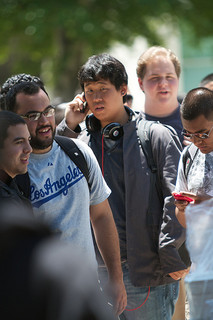
Can’t We Just Be Friends? Bridging the Cultural Divide on Campus

 In my last post, on friendships between international and American students, I pulled some statistics from Voice of America’s “Student Union” blog. Actually, rather than a lot of numbers, much of what you’ll find at “Student Union” are first-hand accounts of what it’s like to study in American colleges and universities, while facing the challenges of a new culture.

There’s a lot of insight and candor there, on a great variety of topics. Take, for example, these posts:

But back to the topic of friendships. In my post I cited a recent study that says over half of students from China and other East Asian countries have no close American friends. Under the title “Whose Fault Is It when American and International Students Don’t Mix?” Jessica Stahl discusses a video from the Office for International Students and Scholars at Michigan State University, in which students from China and the US talk about the ins and outs of cross-cultural friendships. Part of what makes the video especially interesting is that the group of four female Chinese students and the group of three male Americans are not interviewed at the same time. While this means they don’t respond directly to what their counterparts are saying, it does give them a greater opportunity for honesty and frankness.

After the introduction, the video opens with a segment called “Forming Friendships: Finding Common Ground.” One of the Chinese students begins by saying, “Finding something in common is really hard, because you don’t make friends with someone without having something in common with them.” I think she makes a good point.

When we meet people, we usually start with questions that will reveal what we have in common. And when we find that we share something—place of origin, interests, likes, beliefs, friends, experiences—we pursue it in conversation to see how good a fit we are. It takes time and patience to get past the superficials to track down deeper commonalities, and people from different cultures often don’t get past the opening conversation . . . or they don’t even begin the conversation in the first place.

On the other hand, just looking like you’re from “someplace else” is enough to draw attention from others with significant cross-cultural experience. So Third Culture Kids often seek out international students, and international students find community among each other, regardless of how far apart their home countries are. But while this can lead to some wonderful opportunities for friendship, it is often a small pool to draw from, and it can further limit one’s feeling of fitting in to the general population.

To pique your curiosity, I’ve transcribed below more of the students’ comments on this topic of making friends. But really, if you’re interested in any aspect of cross-cultural interactions, watch the whole video. It’s 17 minutes long but well worth your time.

FYI: The video description at YouTube states that the panelists are all undergraduate students at Michigan State, and the American students “have all spent time in China and have meaningful Chinese friendships.”

Here are some of the comments made by the Chinese students.

Students’ get-togethers start off by talking about high school life. When they came from the same area, well they have some kind of similar backgrounds and experiences that we don’t really have.

Some Chinese students, when they talk with an American, when they cannot find anything in common, they’ll just keep quiet. So they just ignore you. . . .

They care about their baseball game, football game, everything else, instead of this bunch of Chinese people just arrived.

If you make friends . . . you want to get involved in the American community, they will treat you as either a joke or just ignore you.

I’d rather just be with my Chinese friends.

I’ve met a lot of great American friends who are willing to sit down and listen to you and also share their story.

And by the American students:

For someone who hasn’t been to China before or who doesn’t know the culture, I think it’s going to be difficult for them to kickstart a conversation.

The closest relationships that I’ve had with Chinese students are the ones where the Chinese students make it an effort to also start a relationship as well.

My feeling, from my experience of why Chinese students don’t necessarily form close relationships with Americans and why Americans don’t form necessarily close relationships with  Chinese is more so the flaw of the Chinese students.

Man, all the Asians are always together. You’ll never see one by themselves. They’re always in a group.

Besides those certain things that do make an impact, we’re all very similar, and you don’t need to stress the differences too much, because those are easily overlooked. . . . Differences aren’t a problem. Differences are what make life.

[photo: “When Chopstick Meet Fork & Spoon,” by Lohb, used under a Creative Commons license]

(Too) Many International Students in the US Have No Close American Friends

For several years, while I was serving as a campus minister to international students at the University of Missouri, I kept a photo of a young Taiwanese couple tucked in my Bible. It was one of the those glamour wedding pictures that are popular in Taiwan. The husband, a student at MU, had given me the photo before he and his wife returned to their country. On the back it said, “To Craig, my best friend in America.” The trouble was, I didn’t remember much about him at all.

Of course, I met a lot of students during my five years in campus ministry. But what made this student stand out was that he considered me his best friend. Maybe I had introduced myself to him shortly after his arrival. Maybe I had given him a Bible in Chinese. Maybe I had helped him find some free furniture. Maybe I was his best friend. But that doesn’t mean I was an especially good friend.

According to Open Doors, last year there were over 720,000 international students attending US universities and colleges, and this number doesn’t include dependents who accompanied them. This total was a record high, and the numbers will surely show another increase when new data are released next month.

More Than One in Three Claim No Strong Friendships with Americans

While more and more students are coming to the US for higher education, more and more of them are finding an environment without significant friendships. This is the finding of a recent study, “Intercultural Friendship: Effects of Home and Host Region,” published in the Journal of International and Intercultural Communication.

As reported in The Chronicle of Higher Education, the article’s author, Elisabeth Gareis, of City University of New York’s Baruch College, found that 38% of students she surveyed reported “no strong American friendships.” Students from East Asia (including China) were more likely than those from English-speaking countries to report a lack of friends, with over half of them claiming no close friendships with Americans.

Not only was there a notable difference between the students’ area of origin, but also with the place of their American university. The study, which included students studying at southern and northeastern institutions, showed that those in the Northeast were less satisfied with their friendship situation than those in the South. Likewise, students in larger metropolitan areas were less happy about their friendships than those in smaller towns.

As for the cause of the problem, 54% of the surveyed students believed that Americans were responsible for the lack of friendships, while 46% blamed their own “internal factors,” such as shyness or a lack of English skills. A report on the study in Inside Higher Ed adds that among East Asian students, nearly 80% blamed their own shortcomings.

(“Open Doors 2011 Fast Facts,” Institute of International Education; Karin Fischer, “Many Foreign Students Are Friendless in the U.S., Study Finds,” The Chronicle of Higher Education, June 14, 2012; Scott Jaschik, “Friendless in America,” Inside Higher Ed, June 14, 2012)

Students Disagree on Whether Americans Are Trying

Voice of America took an online survey of its Student Union readers, asking “about how American students view their international classmates (and how international students think their American classmates view them).” One hundred ten students responded—54 Americans and 56 internationals—giving the following results:

  • 60% of American students said they “relate to international students as well as or better than Americans”
  • 50% of international students in the survey reported that they “relate to Americans as well as or better than international students”
  • 45% of American respondents said that they try to get to know their international schoolmates, 20% said they do not try, and 35% said that extra effort isn’t needed*
  • 30% of international students answering the survey said that Americans try to get to know them, 50% said the Americans don’t try, and 20% said that no extra effort is needed by the Americans*
    *Results from these last two items are approximations, as they were read from a graph.

(Jessica Stahl, “Why Aren’t Americans and International Students Becoming Friends?The Student Union, Voice of America, June 19, 2012)

Feelings of Not Belonging in the US

Last year, researchers from Ohio University and CATS College in England asked international students a different set of questions, focusing on their feelings of belonging and what universities can do to help. Inside Higher Ed reports that most students in the survey “rated their sense of belonging as a five out of five and their overall satisfaction with their college as a four out of five.” But when it comes to “belonging in the U.S.”—a feeling that can be strongly influenced by friendships on and off campus—the  majority of students rated that only a two or three.

Many international students feel that their school’s student services can do more. One student said,

I had a difficult time adjusting to the U.S. culture and educational system. I thought it would be cheaper and I made no friends. I asked for help at the office of International students and I was sent to the counseling services. The counselor sent me to the psych ward because she thought I was suicidal—which was not true. It has been a very dramatic experience that schools should consider when having international students.

(Allie Grasgreen, “At Home on Campus, Not in Country,” Inside Higher Ed, April 6, 2011)

See also my post, “Can’t We Just Be Friends? Bridging the Cultural Divide on Campus

[photo: “CSUN BBQ 19,” by Parker Michael Knight, used under a Creative Commons license]

Conversation: noun, “a turning with”

Steve Smith, author of The Jesus Life and co-founder of Potter’s Inn, recently wrote in his blog,

[I]n the course of life’s seasons, we need to have spiritual conversations with people who are good listeners. Let me be clear here, most people are not good listeners. They listen for facts not feelings. They listen for what they hope to hear. They listen when it may not cost them something.

A spiritual conversation is a reciprocal dialogue between two people where thoughts, opinions and feelings are shared and received. It’s two-way. Not one way.

People who have gone through major transitions—and others who have encountered loss—need good listeners. But what is necessary to be someone who listens well, to be someone who nurtures spiritual conversations? How about compassion and empathy and comfort?

Following is a list of words that I associate with good listeners. We all know what the words mean, but we’ve become fairly complacent in using them. Therefore, as a way to jumpstart our thinking and to help us do a better job of living them out, I’m pairing them with the literal meanings from their origins (with the help of the  Online Etymology Dictionary and other resources). My intent is not to “correct” their modern definitions but simply to give depth to what we already know.

For instance, today a companion is a friend or partner. But the word companion is formed from two parts that originally meant “with” and “bread.” So a companion was someone who shared a meal with another. Even now we understand the link between sharing food and sharing our hearts. Here’s what Smith says about companionship:

I wrote in The Jesus Life that spiritual conversations take place at the table where we eat our meals. . . . It’s never an intent when you ask someone for lunch–to share protein, carbs and water with someone. No, when you ask someone for lunch, you’re really meaning, “Hey, let’s get together so we can share what’s been going on in our lives. It’s been too long. How about next Tuesday at noon at the deli?”  That’s the stuff of conversations where hearts connect and souls meet and people who are lonely become spiritual companions.

Now, here’s the rest of my list:

acknowledge: “to admit understanding or knowing”
from a blending of Old English on, “into,” and cnawan, “recognize,” with Middle English knowlechen “admit”

affirm: “to strengthen”
from Latin ad, “to,” plus firmare, “make firm”

advocate: “someone called to help or plead”
Latin ad plus vocare, for “to” and “to call”

comfort: “to strengthen much”
Late Latin com, “very,” and fortis, “strong”

commiserate: “to lament with”
from Latin com, “with,” and miserari, “to feel pity”

communicate: “to make common”
from Latin commun, “common,” plus the verb suffix icare

companion: “eating partner”
Latin com, “with,” and panis, “bread, food”

compassion: “a suffering with”
Latin com and pati, meaning “with” and “to suffer”

concern: “a sifting” or “comprehension”
from Latin com, “with,” and cernere, “to sift”

condolence: “a sorrowing with”
from Late Latin com, “with,” and dolere, “to grieve”

confide: “to trust strongly”
Latin com plus fidere, meaning “very” and “to trust”

console: “to give much comfort or solace”
from Latin com, “very,” and solari, “to comfort”

contact: “to touch with”
from Latin com, “together,” and tangere, “to touch”

conversation: “a turning with”
Latin com, meaning “with,” and vertare, meaning “turn about”

empathy: “a feeling in”
Greek en and pathos, meaning “in” and “feeling”

encourage: “to add heart or bravery”
Old French en, “make, put in,” and corage, “heart, innermost feelings”

sympathy: “a feeling together”
Greek syn, “together,” plus pathos, “feeling”

understand: “to stand in the midst of”
Old English under, “between, among,” plus stand

May we better understand these ideas and, in so doing, better understand each other. May we put them into practice. May we all become better companions . . . and better listeners.

(Steve Smith, “The Power of a Spiritual Conversation,” Steve and Gwen Smith, September 26, 2012)

[photo: “61098,” by Drew Herron, used under a Creative Commons license]

Roundball Diplomacy in Iran: A Documentary

Here’s another entry in the category of basketball diplomacy*. When director Till Schauder found Kevin Sheppard, a point guard from the US Virgin Islands, playing professionally in the Iranian Super League, he made him the focus of his documentary, The Iran Job. The film follows Sheppard’s season with his team, A.S. Shiraz, and his spirited interactions with the Iranian people. In particular, Sheppard forms a relationship with three women—who bravely face the cameras, remove their head coverings, and share their views about the current culture in Iran. Shauder writes:

Iran is often portrayed as a terrorist nation, a nuclear threat, and a charter member of the Axis of Evil bent on the destruction of Israel. But behind the headlines—and the aggressive rhetoric of Iran’s hard-line leaders—lies one of the most fascinating nations, as sensuous as it can be challenging, with a life-loving people. This film focuses on Iran’s people, rather than its government, and I hope it can challenge perceptions of Iran by providing an authentic perspective that may be crucial when choices are made between war and peace. It is probably safe to say that getting Iran “right” is as impossible as getting any culture “right.” Nonetheless, for their people and for ours, it should be a high priority. . . . More than a fish-out-of-water sports documentary this film focuses on social issues including women’s rights, political freedom and religious conflict, through the lens of a black American basketball player.

The Iran Job is being screened in selected US theaters, and DVDs are available at Kickstarter.

*For more examples of basketball diplomats, see my other posts on Stephon MarburyYao Ming, and Jeremy Lin.

[photo of a basketball goal in Varamin, Iran: “Retired hoop!” by Blake Amin Tabrizi, used under a Creative Commons license]

Departures and Repatriations: Crossing the Great Divide

“Never die in Taiwan.”

That’s what the poor man at the American Institute in Taiwan said. AIT serves as a de facto US embassy in Taiwan, and I was there taking care of some routine matters. Others, like the student I met who had been so excited about navigating the city in a taxi by himself that he left his backpack and passport in the cab, had more pressing issues.

The man who turned away from the window in despair, who told us all, “Never die in Taiwan,” had just presented documentation concerning his recently deceased wife. He needed to prove that she had died to show that he wasn’t trying to remove his children from the country against her wishes. This was his second or third visit, and the person behind the window was sending him back for translated copies—from Chinese to English, or from English to Chinese—or for some other paperwork that seemed impossible to obtain. The man looked so defeated. The death of a loved one overseas must truly be a distressing experience, in so many ways. I can only imagine how hard it is.

Recently I was jumping around the Web and looked up repats just to see what was out there on the repatriation process, say, for returning cross-cultural workers. One of the top sites listed was repats.com. That seemed like just what I was looking for, but the text underneath wasn’t what I expected:

Funeral Repatriations – Rapatriements funéraire – Funeraire repatriëring

So repats.com is a funeral site. That means, I thought, that repatriation must refer to sending a person’s spirit back “home,” to heaven. What an interesting use of the word. But as it turns out (as most of you probably already knew), for funeral operators, repatriation means returning the deceased’s remains to the country of origin.

Obviously, there is a lot to take care of in this kind of repatriation process: There are laws to follow, the paperwork, the physical aspect of transporting the body, the expense, the disruption of normal day-to-day life overseas, the stress and grief, and the coordination of cultural and religious customs. Avalon Repatriation Services, located in the United Kingdom, gives the following overview of some of the varied practices around the world:

  • In France for example, a body must be embalmed and placed in a wooden coffin 24 hours after death.
  • In Islamic countries, it is the widely-held belief that the deceased should be buried before sundown or within 24 hours, without embalming.
  • In the United States, embalming is common practice. In many countries—when embalming does take place—it is a qualified embalmer’s job, whereas in some countries, for example Portugal and Spain, it is against the law for anyone but a qualified doctor to undertake this procedure.
  • Those of Jewish faith believe that the body should be returned to the earth it came from and are therefore against cremation.
  • Hindus cremate their dead, believing that the burning of a dead body signifies the release of the spirit and that the flames represent Brahma, the creator.

My misunderstanding the meaning of repatriation reminds me of the Japanese film Departures, winner of the 2009 Academy Award for Best Foreign Language Film. It tells the story of an unemployed cellist, Daigo, who answers a newspaper ad titled “Departures.” He thinks he’s applying for a travel-agency job but instead ends up taking a job as a nokanshi, someone who ceremonially prepares bodies for burial. Daigo learns the trade from Sasaki, his boss, who becomes his mentor. And Daigo learns also to overcome opposition from his family and friends and to face his own fears, finding deep meaning in his new vocation.

This is a great film. It’s been one of my family’s favorites ever since my son brought home a copy. Just listening to the theme song in the trailer reminds me of the deep emotions that are explored in the story. I think it’s about time I watched it again.

(“Catering for Different Religions,” Avalon Repatriation Services)

[photo: “Go West,” by halfrain, used under a Creative Commons license]