When in Rome, Quote Those Church Fathers . . . and Then Do That Roman Thing

7208901308_80bd938e30_z
It could be the mantra of cultural chameleons:

When in Rome, do as the Romans do.

It’s so well known that all you have to do is say, “When in Rome . . .” and we fill in the rest. But where did the phrase come from? Why Rome? And what is it that we should do when we’re there? To find that out, we have to go all the way back to the fourth century—and delve into the practices of the early church.

When Casulanus wrote a letter to Augustine asking “whether it is lawful to fast on the seventh day of the week,” the early church father replied with his “Letter 36,” written in 396 AD. The passage below is Chapter 14 of that letter:

Since, therefore (as I have said above), we do not find in the Gospels or in the apostolical writings, belonging properly to the revelation of the New Testament, that any law was laid down as to fasts to be observed on particular days; and since this is consequently one of many things, difficult to enumerate, which make up a variety in the robe of the King’s daughter, that is to say, of the Church,—I will tell you the answer given to my questions on this subject by the venerable Ambrose Bishop of Milan, by whom I was baptized. When my mother was with me in that city, I, as being only a catechumen, felt no concern about these questions; but it was to her a question causing anxiety, whether she ought, after the custom of our own town, to fast on the Saturday, or, after the custom of the Church of Milan, not to fast. To deliver her from perplexity, I put the question to the man of God whom I have just named. He answered, “What else can I recommend to others than what I do myself?” When I thought that by this he intended simply to prescribe to us that we should take food on Saturdays—for I knew this to be his own practice—he, following me, added these words: “When I am here I do not fast on Saturday; but when I am at Rome I do: whatever church you may come to, conform to its custom, if you would avoid either receiving or giving offence.” This reply I reported to my mother, and it satisfied her, so that she scrupled not to comply with it; and I have myself followed the same rule. Since, however, it happens, especially in Africa, that one church, or the churches within the same district, may have some members who fast and others who do not fast on the seventh day, it seems to me best to adopt in each congregation the custom of those to whom authority in its government has been committed. Wherefore, if you are quite willing to follow my advice, especially because in regard to this matter I have spoken at greater length than was necessary, do not in this resist your own bishop, but follow his practice without scruple or debate.

Augustine, “Letter 36,” to Casulanus, Chapter 14, 396 AD, in Philip Schaff, ed., Nicene and Post-Nicene Fathers Series I, Volume I, J.G. Cunningham, translator, Christian Literature Company, 1892

Thus, the ultimate source of “When in Rome” is Ambrose, quoted by Augustine, speaking on whether or not to fast on Saturday.

A few years later Augustine returned to the story of his mother and Ambrose in his reply to Januarius, who had posed these questions concerning taking communion (“the sacrifice”) during Lent:

What ought to be done on the Thursday of the last week of Lent? Ought we to offer the sacrifice in the morning, and again after supper, on account of the words in the Gospel, “Likewise also . . . after supper”?

Augustine replied that some practices in the church are authorized by Scripture, and some are set by traditions followed by the global church. But in a third category, there is room for freedom:

There are other things, however, which are different in different places and countries: e.g., some fast on Saturday, others do not; some partake daily of the body and blood of Christ, others receive it on stated days: in some places no day passes without the sacrifice being offered; in others it is only on Saturday and the Lord’s day, or it may be only on the Lord’s day. In regard to these and all other variable observances which may be met anywhere, one is at liberty to comply with them or not as he chooses; and there is no better rule for the wise and serious Christian in this matter, than to conform to the practice which he finds prevailing in the Church to which it may be his lot to come. For such a custom, if it is clearly not contrary to the faith nor to sound morality, is to be held as a thing indifferent, and ought to be observed for the sake of fellowship with those among whom we live.

I think you may have heard me relate before, what I will nevertheless now mention. When my mother followed me to Milan, she found the Church there not fasting on Saturday. She began to be troubled, and to hesitate as to what she should do; upon which I, though not taking a personal interest then in such things, applied on her behalf to Ambrose, of most blessed memory, for his advice. He answered that he could not teach me anything but what he himself practised, because if he knew any better rule, he would observe it himself. When I supposed that he intended, on the ground of his authority alone, and without supporting it by any argument, to recommend us to give up fasting on Saturday, he followed me, and said: “When I visit Rome, I fast on Saturday; when I am here, I do not fast. On the same principle, do you observe the custom prevailing in whatever Church you come to, if you desire neither to give offence by your conduct, nor to find cause of offence in another’s.” When I reported this to my mother, she accepted it gladly; and for myself, after frequently reconsidering his decision, I have always esteemed it as if I had received it by an oracle from heaven. For often have I perceived, with extreme sorrow, many disquietudes caused to weak brethren by the contentious pertinacity or superstitious vacillation of some who, in matters of this kind, which do not admit of final decision by the authority of Holy Scripture, or by the tradition of the universal Church or by their manifest good influence on manners raise questions, it may be, from some crotchet of their own, or from attachment to the custom followed in one’s own country, or from preference for that which one has seen abroad, supposing that wisdom is increased in proportion to the distance to which men travel from home, and agitate these questions with such keenness, that they think all is wrong except what they do themselves.

The above section is Chapter 2 of Augustine’s “Letter 54,” written in 400 AD. In the letter’s Chapter 4, he furthers his argument, not only saying it is inappropriate to take one’s customs into a new setting, but he also cautions against returning home with customs learned abroad and, acting the part of the enlightened traveler, promoting them as superior:

Suppose some foreigner visit a place in which during Lent it is customary to abstain from the use of the bath, and to continue fasting on Thursday. “I will not fast today,” he says. The reason being asked, he says, “Such is not the custom in my own country.” Is not he, by such conduct, attempting to assert the superiority of his custom over theirs? For he cannot quote a decisive passage on the subject from the Book of God; nor can he prove his opinion to be right by the unanimous voice of the universal Church, wherever spread abroad; nor can he demonstrate that they act contrary to the faith, and he according to it, or that they are doing what is prejudicial to sound morality, and he is defending its interests. Those men injure their own tranquillity and peace by quarrelling on an unnecessary question. I would rather recommend that, in matters of this kind, each man should, when sojourning in a country in which he finds a custom different from his own consent to do as others do. If, on the other hand, a Christian, when travelling abroad in some region where the people of God are more numerous, and more easily assembled together, and more zealous in religion, has seen, e.g., the sacrifice twice offered, both morning and evening, on the Thursday of the last week in Lent, and therefore, on his coming back to his own country, where it is offered only at the close of the day, protests against this as wrong and unlawful, because he has himself seen another custom in another land, this would show a childish weakness of judgment against which we should guard ourselves, and which we must bear with in others, but correct in all who are under our influence.

Augustine, “Letter 54,” to Januarius, 400 AD, in Philip Schaff, ed., Nicene and Post-Nicene Fathers Series I, Volume I, J.G. Cunningham, translator, Christian Literature Company, 1892

This English translation of Chapter 4 includes a summary of Ambrose’s advice that gets closer to the wording of our present-day “When in Rome”:

[E]ach man should, when sojourning in a country in which he finds a custom different from his own consent to do as others do.

Many years later, in 1599, the English playwright Henry Porter wrote The Pleasant History of the Two Angry Women of Abington. In it, one of the charactersNicholas Proverbs, says,

Nay, I hope, as I have temperance to forbeare drinke, so have I patience to endure drinke: Ile do as company doth; for when a man doth to Rome come, he must do as there is done.

Henry Porter, The Pleasant History of the Two Angry Women of Abington, 1599, in Charles Mills Gayley and Alwin Thaler, Representative English Comedies: From the Beginnings to ShakespeareMacmillan, 1903

And finally, in 1754, Pope Clement XIV wrote “Letter 44” to Dom Galliard, concerning the monks under his authority. The English translation that followed in 1777 gives us a form of “When in Rome” that brings us nearly to what we have today. This time the topic is the suitability of taking a nap during the day:

The siesto, or afternoon’s nap of Italy, my most dear and reverend Father, would not have alarmed you so much, if you had recollected, that when we are at Rome, we should do as the Romans do.—Cum Romano Romanus eris.

Is it either sin or shame, then, for a poor Monk, in a country where one is oppressed with excessive heat, to indulge in half an hour’s repose, that he may afterwards pursue his exercises with the more activity? Consider, that silence is best kept when one is asleep. You who reckon among the capital sins, the pronouncing of a single word when your rules forbid the use of speech,—take the example of Christ when he found his Apostles asleep: Alas, says he to them, with the greatest mildness, could you not watch with me one hour?

Clement, “Letter 44,” Interesting Letters of Pope Clement XIV (Ganganelli): To Which Are Prefixed, Anecdotes of His Life, Volume I, translated from the French, London, 1777.

Now that I’ve come to the end of my post, I’ve got to give credit where credit is due. Thanks to The Phrase Finder for identifying most of the sources above. And the photo, titled “Rome,” is by Luca Sartoni (used under a Creative Commons license). There’s some pretty nice architecture in the picture, behind the tourists. I’m thinking it took more than a day to build a place like that. By the way, that area is called Campo Marzio. If you’d like to see it in person, it should be pretty easy to find. I’m guessing that once you’re in Italy, all roads will lead there. And when you arrive, you’ll know what to do.

Frozen Smiles: It’s All Good at the Ice-Cold Edge of the World

990596018_12babc76ce_z-1

Quick. What countries came in first and second in the 2014 Miss Universe pageant? Chances are you don’t know now because you didn’t know then.

An easier question would be Who were the winner and first runner up in 2015? There’s a good chance you know the answer to that one, probably not because you watched the show, but because you heard about it afterwards. Thanks to Steve Harvey’s announcement gaff, Miss Colombia was the winner until she wasn’t, and Miss Philippines wasn’t until she was—and millions more people now know that the Miss Universe pageant is still a thing.

I’m impressed with Harvey’s quick apology. But I’m even more impressed with the ladies from Colombia. As the reigning Miss Columbia knelt down to have the crown removed by the past Miss Colombia (who was the Miss Universe from 2014, by the way), neither lost her beautiful smile.

They had on their game faces, pageant style.

But beauty-queen game faces aren’t really the ones I’m interested in. The one that’s caught my attention is in “Act One” of a podcast by Ira Glass of This American Life. The episode is titled, appropriately enough, “Game Face,” and the first segment is called “200 Dog Night.” In it, Blair Braverman tells about her experience living as a dogsled guide on an Alaskan glacier, hosting cruise-ship passengers who wanted “a taste of real Alaska.” Problem was, real life on a glacier includes UV rays reflecting off the snow and blistering the inside of your nostrils, humidity that causes the skin to slough off our hands, dangerously shifting ice, and often-unkind coworkers.

Eight times a day, helicopters brought a load of tourists to Braverman and her companions for a one-hour tour and dogsled ride. The guests were met with broad smiles and an unnaturally immaculate environment, courtesy of their hosts. Braverman’s best friend among the guides was Rebecca, an 18-year-old home-schooled girl from Indiana who was “guided by Jesus Christ and his teachings.” On good days, says Braverman, the guides called the glacier “summer camp on the moon.” On bad days, when the tourists weren’t around to hear, they called it . . . well, let’s just say it was a name that Rebecca probably didn’t use.

One day, after a group’s arrival, word came that a storm between the camp and the cruise ship was keeping the helicopters from taking their passengers back. The ship would leave without them, and the tourists, including an insulin-dependent diabetic, were stranded and would have to stay the night, maybe two. So it was time for the guides to put on their best game faces, to mask any hint of worry, to hide any threat of discomfort, or even disaster.

Two years ago, I wrote “11 Ways That Moving Abroad Is like Skiing to the North Pole.” I’m not sure why tales from frozen wastelands capture my imagination, but they do. As I listen to Braverman share her story, I can’t help but think about how, when we’re living overseas, we make sure to put on our game faces when visitors come to call. How often do we sweep our frustrations under the rug—the same way the  guides piled up the dog hair and dog poop out of sight behind the tents? How often do we organize activities like snowmobile rides and snowman-building contests, and then hear our guests say, “I can’t believe you get paid for this”? How often do we pretend that things couldn’t be better, when they could barely be worse?

“200 Dog Night” starts at the 4-minute mark.

[photo: “in snow smile,” by retrospects, used under a Creative Commons license]

Airport Chocolate: The Triangle and the Sphere

3260056871_8dabf75b6a_z

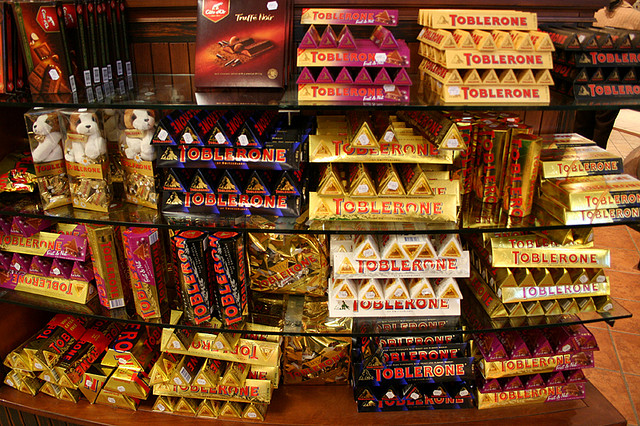
For me, they’re the airport candy: Toblerone and Ferrero Rocher. If you forgot to pick up a souvenir on your travels, you could always impress the kids with exotic chocolates from the airport. Even now that you can get them at Wal-Mart and Walgreens, to me they’re still the airport candy.

Toblerone
According to the Toblerone website, in 1900, a confectioner in Bern, Switzerland, Jean Tobler, handed his chocolate factory over to his son Theodor. Eight years later, Theodor, along with his cousin, created Toblerone, a chocolate bar made with honey and almond nougat and formed into a distinctive triangular shape. The name comes from Theodor’s family name and torrone, Italian for the type of nougat used in the bar.

Toblerone is now owned by the US company Mondelēz International, formerly Kraft Foods.

You can impress your friends by showing them the bear hidden in the picture of the mountain on the candy’s package. The bear has long been a heraldic symbol on the Bern coat of arms.

Ferrero Rocher
When it comes to chocolate, Ferrero Rocher has its own distinctive shape. Wrapped in golden foil, each candy is a small sphere made of a hazelnut, chocolaty cream, a crisp shell, and milk chocolate, sprinkled with chopped hazelnuts—in order, from the center out.

Italian confectioner Pietro Ferrero began selling chocolates in 1942, and the Ferrero company was founded four years later. But it wasn’t until 1982 that Ferrero Rocher was born. The Ferrero Group, now headquartered in Germany, has grown to become the third-largest producer of chocolate confectionaries, behind Mars and Mondelēz, and before Nestlé.

In the forty years before Ferrero Rocher was born, the Ferrero company was anything but dormant. During that time it introduced Nutella and Tic Tacs, as well as the Kinder line of candies. Kinder, of course, includes the Kinder Surprise, or Kinder Egg, an egg-shaped chocolate candy with a hollow center that contains a small toy.

While Kinder is also a staple of many airport stores, don’t make the mistake of trying to bring them into the US. If you do, and you’re caught, the candy will be confiscated, and you could get tagged with a fine. That’s because they’re considered a choking hazard and are banned in the States. U.S. Customs and Border Protection reports that in 2011 they seized more than 60,000 Kinder Eggs coming in with travelers and in international mail.

(“The Chocolate Industry,” International Cocoa Organization, January 23, 2015; “Don’t Be ‘Surprised’ by Kinder Eggs: Seizures Double,” April 5, 2012)

Islands, 2, 3, 4

“A Grim Military Past on Japan’s Cuddly ‘Rabbit Island'”

The pretty little island of Okunoshima is known for two things: It was there that the Japanese military once cooked up chemical weapons, a mission so guarded that the spot did not exist on official World War II-era maps. And it is totally overrun by fluffy bunny rabbits.

. . . .

For animal lovers, this sounds downright precious, and it is. But on a gray day, with a chill in the air, it also feels something like the establishing scenes of a Hitchcock movie, before things go so horrifically wrong.

Wander past enough English signs labeled “Remains of the poison gas storehouse” and you can’t help wondering whether the two things that make this island so unusual are, in fact, grimly linked. In 1997, the former director of the poison gas museum told Tokyo journalists that the rabbits now on the island had nothing to do with lab animals in bygone weapons tests. Instead, the story goes, rabbits were left on the island decades ago by schoolchildren — and did what rabbits do so well.

Emily Alpert, Los Angeles Times, July 7, 2013

A Much Too Long (like This Title) List of Place- and Culture-Themed Coloring Books for Adults and Colorists of All Ages (but It Could Be a Whole Lot Longer)

7148903697_5da9ea832e_z

OK, here’s the deal. Since adult coloring books are all the rage now, and because there are studies that show that coloring can reduce anxiety and stress, I decided I’d search Amazon to see what titles I could come up with on the topics of travel, places, cultures, and the like.

After I came up with 30 or so, I was feeling pretty good about myself, but then a few things happened. First, my tendency to be obsessive about lists kicked in and I felt the need to make my list not just longer, but all-inclusive. Then I realized that if I wanted to include designs and patterns (Indian, Celtic, Arabic, etc.) I’d never be done, so I eliminated them, as much as it pained me . . . because a lot of those book are pretty cool. But just when my list seemed more manageable, I discovered the whole library of Dover coloring books. I was bombarded with all their history-themed offerings, and I had to decide what made a coloring book “adult” rather than “for kids.” I put some more titles in, left some out (more pain), and expanded my category from adults to “colorists,” a term I see thrown around by publishers. I figure it means people who take their coloring seriously, even as they use it to wind down, people who are more-mature colorers who choose detailed pictures that can accommodate sharpened pencils, not just fat Crayons: colorists. Of course detailed pictures would include all those intricate designs and patterns. . . . Did I mention how much it pains me to leave them out?

So after all that, here’s the list I’ve come up with. It’s nearly 200 entries long, and it’s caused me no small amount of anxiety to put it together. It wasn’t just finding them all, but also arranging them (I gave up on working too hard on that), trying to get all the links straight, and realizing that my list is outdated before I hit the publish button.

What I’m trying to say is that my efforts to put together an exhaustive list have left me exhausted . . . and stressed.

I guess I need to order a coloring book so I can relax. Now, what about colored pencils? Is 24 enough, or should I go with 500?


Global


Cities


Asia


Latin America


Europe


North America/United States


Africa


Polynesia


Antarctica

[photo: “Crayons de couleur,” by Nicolas Buffler, used under a Creative Commons license]

The American Way, Way Up There

8147700813_d9552a7e4b_z

On a recent flight over the Pacific, I perused the October issue of American Way, the inflight magazine of American Airlines. Here are my thoughts:

  1. Gracing the cover, singer/songwriter Jessie J “continues to redefine herself.” I wasn’t familiar with her first definition.
  2. At CashInYourDiamonds.com, I can sell my “unwanted diamonds for cash.” Finally, a place to unload all those gemstones that have been dragging me down.
  3. People Tools, by Alan C. Fox, is not a book about people who are tools.
  4. Reading the tagline “Athlete and TV host Michael Strahan knows how to dress” didn’t quite pull me into that article.
  5. Voodoo comes from vous, the French word for you, and the English do. Who knew?
  6. Judging by all the advertisements, hair loss must be a big deal for travelers.
  7. Oh yeah, Bondi is a beach in Sydney, not just an iMac color.
  8. The mag writers’ favorite shirt is made by Ledbury, with its “fused canvas interlining” in the collar to keep it from collapsing. . . because “crushed collars are a business traveler’s nightmare.” Can you say, “First-world problems”?
  9. It took me a while to realize that Amber Kelleher-Andrews, of kelleher-international.com, has been awarded “top global matchmaker,” not “watchmaker.” By the way, who exactly gave her that award?
  10. The editors let me know that “78% of readers will act on an ad they’ve seen in this magazine.” If that includes people who blog about the advertisements, count me in.

If you’d like to read your favorite inflight magazine from the comfort of your web browser, take a look at Inflight Magazines: My Virtual Seat-Back Pocket Runneth Over.

[photo: “There’s no way like the American way (colorized),” by Whitewall Buick, used under a Creative Commons license]

Roads, 2, 3, 4

Silent Darien: The Gap in the World’s Longest Road

Stretching from Alaska to the pencil tip of Argentina, the 48,000km-long Pan-American Highway holds the record for the world’s longest motorable road. But there is a gap—an expanse of wild tropical forest—that has defeated travellers for centuries.

The gap stretches from the north to the south coast of Panama—from the Atlantic to the Pacific. It’s between 100km and 160km (60-100 miles) long, and there is no way round, except by sea.

It was only in 1960 that anyone managed to cross the Darien Gap by car—in a Land Rover dubbed The Affectionate Cockroach and a Jeep. It took nearly five months, averaging just 200m per hour.

Carolyn McCarthy, BBC News, August 14, 2014

Rain, 2, 3, 4

Making Perfume from the Rain: Indian Villagers Have Found a Way to Bottle the Fragrance of Monsoons

The mitti attar was in an inch-tall glass bottle on the counter. I twisted off the little gold cap, closed my eyes, and breathed in the scent of the Indian rain. It smelled like the earth. It smelled like the parched clay doused with pond water in the Siyarams’ backyard. The aroma was entirely different from the memory of rain I carried from my childhood and my part of the world—ozone-charged air, wet moss, Wolfe’s “clean but funky” scent of the south. But it was entirely appealing: warm, organic, mineral-rich. It was the smell of waiting, paid off: 40 years or more for a sandalwood tree to grow its fragrant heartwood; four months of hot, dust-blown summer in northern India before the monsoons arrive in July; a day for terra-cotta to slow-fire in a kiln.

Cynthia Barnett, The Atlantic, April 22, 2015