G. K. Chesterton, the Prince of Paradox, on Travel

4824820738_18cf5c7fbc_z

The whole object of travel is not to set foot on foreign land; it is at last to set foot on one’s own country as a foreign land.

So says G. K. Chesterton, prolific British author and Christian apologist, whose life bridged the 19th and 20th centuries.

Chesterton has much to say about travel, largely on how to do it well and how it can affect the traveller.

The quotation above comes from “The Riddle of the Ivy,” a short sketch in his Tremendous Trifles. When a friend asks why he is packing his luggage, Chesterton tells him he is traveling through Paris, Belfort, Heidelberg, and Frankfort, with the aim of finding the Battersea district of London.

Knowing that his destination is their current location, his friend says, “I suppose it is unnecessary to tell you that this is Battersea?”

“It is quite unnecessary,” I said, “and it is spiritually untrue. I cannot see any Battersea here; I cannot see any London or any England. I cannot see that door. I cannot see that chair: because a cloud of sleep and custom has come across my eyes. The only way to get back to them is to go somewhere else; and that is the real object of travel and the real pleasure of holidays. Do you suppose that I go to France in order to see France? Do you suppose that I go to Germany in order to see Germany? I shall enjoy them both; but it is not them that I am seeking. I am seeking Battersea. The whole object of travel is not to set foot on foreign land; it is at last to set foot on one’s own country as a foreign land.

And then the man who deals so much with paradox that he has been called “the prince of paradox” cautions his friend, with threat of physical harm, against referring to his thoughts as paradoxical:

“Now I warn you that this Gladstone bag is compact and heavy, and that if you utter that word ‘paradox’ I shall hurl it at your head. I did not make the world, and I did not make it paradoxical. It is not my fault, it is the truth, that the only way to go to England is to go away from it.”

A month later, his opinion is confirmed when he returns to England and sees it with a wonderful freshness. An American traveling companion is struck by England as well, but for her it is because this is her first time there.

“I have never been in England before,” said the American lady, “yet it is so pretty that I feel as if I have been away from it for a long time.”

For the American it is déjà vu. For Chesterton, is it déjà new?

Not Seeing What You See

Regardless of the destination, believes Chesterton, there is much more to traveling than simply taking a trip. He writes that “true” travelers let the experience of a destination come to them, without manipulating it with expectations and prejudices. He is quoted as saying,

The traveller sees what he sees. The tourist sees what he has come to see.

The actual version of this comes from the following passage in his Autobiography:

I had pottered about in France ever since my father took me there as a boy; and Paris was the only foreign capital I knew. I owe it to him that I was at least a traveller and not a tripper. The distinction is not snobbish; indeed it is one rather of epoch than education; half the trouble about the modern man is that he is educated to understand foreign languages and misunderstand foreigners. The traveller sees what he sees; the tripper sees what he has come to see. A true traveller in a primitive epic or folk-tale did not pretend to like a beautiful princess because she was beautiful. It is still true of a poor sailor; of a tramp; in short, of a traveller. Thus he need form no opinion of Paris newspapers; but if he wanted to, he would probably read them. The tripper never reads them, calls them rags, and knows as much about the rags as the chiffonnier who picks them up with a spike.

I understand why the common version of this quotation uses tourist in place of tripper. We don’t use tripper much today, at least not with this meaning. And I don’t think that Chesterton would mind. He writes,

It is the most sincere compliment to an author to misquote him. It means that his work has become a part of our mind and not merely of our library.

Bevis Hiller, in The Wit and Wisdom of G K Chesterton, gives the origin for this quotation as the December 31, 1927, issue of GK’s Weekly, though I couldn’t track down the original source. While I have no reason not to trust Hiller, wouldn’t it be ironic if Chesterton never said this?

The Broad and the Narrow Ways

They say travel broadens the mind; but you must have the mind.

One of the characters in Chesterton’s stories is the crime-solving poet Gabriel Gale. In “The Shadow and the Shark,” Gale discusses Mr. Amos Boon, a former missionary who has decided he prefers the Philistines of the Bible to those biblical characters who follow God. While defending Boon against charges of murder, he does not defend the “broadening” of his mind.

“Boon is a good man,” said Gale, calmly; “he is very stupid; that is why he is an atheist. There are intelligent atheists, as we shall see presently; but that stunted, stupid, sort is much commoner, and much nicer. But he is a good man; his motive is good; he originally talked all that tosh of the superiority of the savage because he thought he was the under-dog. He may be a trifle cracked, by now, about sharks and other things; but that’s only because his travels have been too much for his intellect. They say travel broadens the mind; but you must have the mind. He had a mind for a suburban chapel, and there passed before it all the panorama of gilded nature-worship and purple sacrifice. He doesn’t know if he’s on his head or his heels, any more than a good many others. But I shouldn’t wonder if heaven is largely populated with atheists of that sort, scratching their heads and wondering where they are.

If “they” say that travel broadens the mind, Chesterton himself says traveling presents the danger of making the mind more narrow:

I have never managed to lose my old conviction that travel narrows the mind. At least a man must make a double effort of moral humility and imaginative energy to prevent it from narrowing his mind. Indeed there is something touching and even tragic about the thought of the thoughtless tourist, who might have stayed at home loving Laplanders, embracing Chinamen, and clasping Patagonians to his heart in Hampstead or Surbiton, but for his blind and suicidal impulse to go and see what they looked like. This is not meant for nonsense; still less is it meant for the silliest sort of nonsense, which is cynicism. The human bond that he feels at home is not an illusion. On the contrary, it is rather an inner reality. Man is inside all men. In a real sense any man may be inside any men. But to travel is to leave the inside and draw dangerously near the outside. So long as he thought of men in the abstract, like naked toiling figures in some classic frieze, merely as those who labour and love their children and die, he was thinking the fundamental truth about them. By going to look at their unfamiliar manners and customs he is inviting them to disguise themselves in fantastic masks and costumes. Many modern internationalists talk as if men of different nationalities had only to meet and mix and understand each other. In reality that is the moment of supreme danger—the moment when they meet. We might shiver, as at the old euphemism by which a meeting meant a duel.

The paradox of travel.

(G. K. Chesterton, “The Riddle of the Ivy,” Tremendous Trifles, Methuen, 1909; Bevis Hiller, The Wit and Wisdom of G K Chesterton, Continuum, 2011; Chesterton, Autobiography, Hutchinson, 1936; Chesterton, “The Shadow of the Shark,” The Poet and the Lunatics: Episodes in the Life of Gabriel Gale, Cassell, 1929; Chesterton, “What Is America?” What I Saw in America, Hodder, 1922)

[illustration: “G.K. Chesterton,” by giveaway boy, used under a Creative Commons license]

A Modest List of Invented Expatisms, Inspired by the Dictionary of Obscure Sorrows

822518337_839b806a79_z

My son pointed me to The Dictionary of Obscure Sorrows, where John Koenig creates words to name before-unnamed emotions and ideas. Many of them are melancholy, such as amenuerosis, “the half-forlorn, half-escapist ache of a train whistle calling in the distance at night”; and chrysalism the amniotic tranquility of being indoors during a thunderstorm. . . .”

Others are more on the humorous side. For instance, a reverse shibboleth, is “the practice of answering a cellphone with a generic ‘Hello?’ as if you didn’t already know exactly who was calling . . .”; and lalalalia is “the realization while talking to yourself that someone else is within earshot, which leads you to crossfade into mumbled singing. . . .”

Expats have their own feelings and experiences that are yet to be named, and I think this needs to be remedied. So while I don’t have Koenig’s talent, here are a few of my offerings:

dyslistening
the condition by which your over preparation for answering an expected question in another language overwhelms your auditory senses and you answer the query you’ve anticipated, no matter what is actually said, as in responding to “How many would you like?” with “Yes, but no ice, please.”

welwelwel-ke-come
the glorious sound of the immigration agent thumbing through your passport looking for an empty page—and then adding the stamp that says you’re free to enter.

altivism
gazing out of an airplane window, seeing the new landscape below, and feeling joyfully overcome with the real and imagined possibilities.

visatrig
the act of trying to predict which agent in the office will be the most likely to give you your visa or other important document and then conducting complex calculations concerning the number of people in line in front of you to see if you will get the agent you hope for. A domestic version of this is sometimes encountered in the DMV.

unchewing
the physical and mental reaction that occurs when you realize that the chocolate-covered, cream-filled donut that you just took a bite of is in fact not a donut and that’s not chocolate and the filling might very well have gristle in it.

Finally, here’s one more from Koenig: onism

[photo: “The Dictionary,” by Bethany King, used under a Creative Commons license]

With Love Locks Leaving Paris, Give Peace a Chance

11567085873_fbb806e33b_z

‘Tis Better to Have Loved and Lost . . .

The French are turning their back on love! Oh, say it isn’t so! Well, it really isn’t so. But as you may have heard, last Monday, the city of Paris began removing the approximately 700,000 padlocks clinging to the Pont des Arts. As a symbol of their undying affection for each other, couples have been adding their “love locks” (not to be confused with “Locks of Love“) to the fencing of the pedestrian bridge, throwing the keys into the Seine river below.

The tradition started in Rome after the 2006 publication of Frederico Moccia’s best-selling novel I Want You, and the following movie adaptation, in which a young couple proclaim their love by fastening a padlock to the Milvian Bridge.

From there the practice has become something of a global phenomenon, with businesses springing up to cash in. For example, there are Lovelocks and MakeLoveLocks, which sell their own lines of locks and post maps showing sites around the globe for locking up love.

Looks as if they’ll need to remove at least one of those map markers, as Paris has decided that enough is enough. Actually, it’s too much, as sections of the Pont des Arts railing have begun to collapse under the padlocks’ 100-ton weight.

If US expats Lisa Anselmo and Lisa Taylor Huff have their way, Paris will soon be love-lock free. In January of last year, the two started No Love Locks with the slogan “Free your love. Save our bridges.” They’ve also started a petition asking the mayor of their city to ban the locks once and for all.

1394749720_aaed67acbb_z

Make Peace, Not Love

Where, oh where, then, will young lovers and tourists go to take selfies in a Paris sans love locks?

Well, the French capital does have another photo-worthy site. You might have heard of it, though probably not. It’s one of France’s best-kept secrets, but it may just turn the City of Love into the City of . . . Peace.

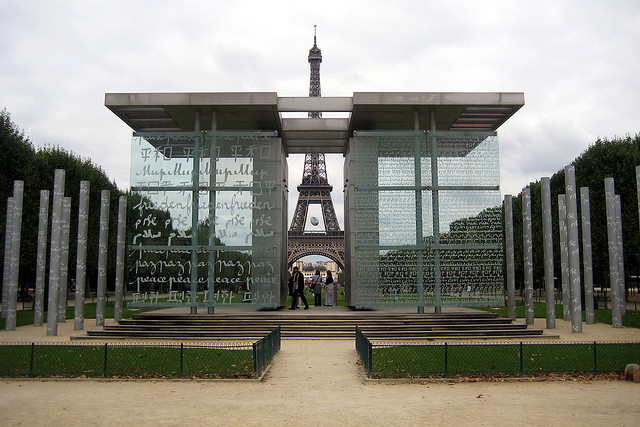
It’s the Mur de la Paix, or the Wall for Peace, situated on the Champ de Mars, in front of the École Militaire. Created by artist Clara halter and architect Jean-Michel Wilmotte, the wall was installed in 2000 to celebrate the arrival of the new millennium.

The structure is made of metal and glass panels and 20-foot-tall stainless-steel columns, all displaying the word peace in 32 languages. Inspired by the Wailing Wall in Jerusalem, the Wall for Peace contains slits so that visitors can leave messages in them. And virtual guests can leave their messages at the wall’s site to be displayed on monitors and online.

When it was built, the monument was supposed to be temporary, lasting only a few months. Some of the locals regret that its removal hasn’t happened, and a few are very vocal about it. In 2011, Rachida Dati, mayor of the area surrounding the Wall for Peace, was found guilty of defamation after accusing the wall’s creators of lying to keep their work in place. The wall has also been the target of vandalism. And yet, 15 years after its construction, it still stands.

3372837834_f11dcbdd97_zIf you look from the right vantage point, you’ll see that the Wall of Peace frames a nice view of a rather tall radio and TV antenna at the end of the Champ de Mars, opposite the École Militaire. It also was built as a temporary structure, to commemorate the 100-year anniversary of the French Revolution at the 1889 World’s Fair. Originally meant to stay for only 20 years, it was saved from the scrap pile when it’s creator realized how useful it could be for broadcasting. The tower’s still there, and if you’d like to get a glimpse of it, just go to the Wall for Peace and look southeast.

Ahh, Paris. What a fickle city. That which is meant to be forever is taken away. And that which is meant to be temporary lives on. C’est la vie.

C’est l’amour. C’est la paix.

(Emanuella Grinberg, “Paris Ends Relationship with ‘Love Locks,'” CNN, May 31, 2015; Angela Diffley, “Rachida Dati Libelled Peace Wall Couple, Court Rules,” RFI, November 22, 2011)

[photos: “Paris: Love Lock Bridge,” by Abi, used under a Creative Commons license; “Paris—Champ de Mars: Le Mur pour La Paix and Eiffel Tower,” by Wally Goetz, used under a Creative Commons license; “The Tower with Letters for Peace,” by Vincent Brassinne, used under a Creative Commons license]
McDonald’s, You’re like Framily

13988001407_c5579a5d5d_z

Growing up on a farm, we didn’t eat out much, but I seem to remember enjoying a few Quarter Pounders with fries during my high-school days.

Then, during my time as a student at the University of Missouri-Columbia, my go-to lunch was a salad with a side of fries at the basement McDonald’s on Lowery Mall, across from the library. When I took my daughter for a campus visit to MU a few weeks ago, our student tour guide (who did an excellent job, I might add) pointed out where the McDonald’s used to be. He said at one time it was the highest-grossing McDonald’s location in the US. In the 80s, when I was there, we heard it was the busiest McDonald’s in the world. I think both statements are part of a Columbia urban legend—though I’d love someone to prove me wrong with some documentation.

When my family lived in Taiwan, we found McDonald’s in every city. That was especially welcome when we first arrived and couldn’t speak Chinese. It’s a lot easier to ask for a “Number 5” than to learn the vocabulary for ordering à la carte.

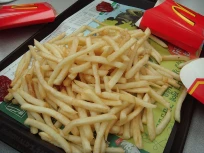
655846832_58ee159407_zMcDonald’s was popular with the locals, too, especially high school kids. It was common to see them gather there to study or work on class projects. It was a new experience for us to see young people in that group-centered culture pour all their french fries into a pile and share them together.

McDonald’s certainly is a global juggernaut. According to the company website, their more than 33,000 restaurants in over 100 countries serve over 69 million people each day. But there’s more to McDonald’s than just huge numbers. In honor of the chain’s 75th anniversary this year, Reader’s Digest ran a list of “75 Mind-blowing Facts.” Here are my favorites:

#2. The first McDonald’s drive-thru—in Sierra Vista, Arizona—didn’t open until 1975.

#22-22. French fries, McDonald’s best-selling item, were added to the menu in 1949. Before that, it was potato chips.

#50. As the result of a 1973 lawsuit, McDonald’s paid Sid and Marty Kroftt $1 million because the brothers claimed that McDonaldland had stolen the “concept and feel” of their Saturday-morning TV show H.R. Pufnstuf. (Remember that one?)

#58. Giving away (selling?) 1.5 billion toys each year in its Happy Meals makes McDonalds’ the largest distributer of toys in the world. (OK, that’s one of those “huge numbers.”)

#60. One out of every eight workers in the U.S. has at some time had a job at McDonald’s.

#66. Have you heard of the “Big Mac Index”? It was developed by The Economist in 1986 to use the local cost of a Big Mac to compare economies around the world.

I used to tell my Asian college-age friends that I don’t actually like McDonald’s, that most people in the US don’t actually like McDonald’s. But here’s what happens: You’re in a van with a bunch of young people on a trip and you ask them where they want to stop and eat and they say “Anywhere but McDonald’s” and they name other possibilities but when you exit the highway you don’t see any of the places they suggested and you’re running out of time and you decide to eat at the next place you see and—guess what?—it’s a McDonald’s. There’s always a McDonald’s close by, so that’s where you stop. It’s just too convenient.

This guy notwithstanding, McDonald’s burgers don’t garner much praise. In fact, when readers of Consumer Reports rated the hamburgers of 21 fast-food chains, they put the ones from McDonald’s dead last. The magazine called them a “Mc-disappointment.” When our local McDonald’s in Taipei ran out of hamburgers one day (I kid you not), maybe it wasn’t such a bad thing after all.

But there are those “world-famous fries.” McDonald’s calls them “golden on the outside, soft and fluffy on the inside.” I don’t disagree. And a whole lot of other people seem to be on board, as well.

Mark Eichenlaub, a graduate student in physics, decided to figure out just how many french fries McDonald’s has sold. He used the formula

equation

and came up with the figure “4 trillion, give or take a few.” I have a hard time following his detailed explanation (he lost me when I saw that squiggly S-thing before the numbers), but I’m pretty sure his estimate doesn’t even count fries sold outside the US.

Of course, McDonald’s gets knocked for a lot of things besides what’s on their menu. For instance, right now they’re the target of protests over low wages. Sometimes their negatives are symptomatic of the ills of American culture, but they’re magnified with McDonald’s because of the franchise’s large scale. And abroad, their ubiquity and visibility often make them a symbol of Western encroachment.

McDonald’s does give us plenty of reasons not to be “Lovin’ it.”

But again . . . there are those fries.

My second oldest son graduated from university last week. He drove about seven hours round trip to pick up my mother so she could attend the ceremony. The next day I took her back home, with an extra hour added on each way. After I dropped her off, she was worried that I’d fall asleep on the way back, but I told her I’d pull over and rest if I got tired.

4011734182_dc8d2f9bde_zA couple hours from home, in Lebanon, MO, I decided to stop and get something to eat. I parked at a McDonald’s, to go inside and stretch my legs and to use the free wifi. That and I got an order of fries.

The lady at the counter greeted me with “Welcome back.” How many businesses can say that to every customer and rarely, if ever, be wrong?

Sounds like framily. And when I say “framily,” I’m thinking of the Sprint commercials with their odd collection of characters—Ronald McDonald, Grimace, Hamburglar, Mayor McCheese, Captain Crook and the rest of the citizens of McDonaldland. It’s an imperfect, dysfunctional framily at times, but it’s still framily.

In the Lebanon McDonald’s, the fries were good, as they nearly always are.

There’s something to be said about consistency. And there’s something to be said about always being close by.

Framily.

(Daryl Chen and Brooke Wanser, “75 Mind-Blowing Facts about McDonald’s to Celebrate Its 75th Anniversary,” Reader’s Digest; “Best and Worst Fast-Food Restaurants in America,” Consumer Reports, July 2014; Mark Eichenlaub, “How Many Fries Has McDonald’s Served?Quora)

[photos: “McDonald’s,” by Mike Mozart, used under a Creative Commons license; “4 Combos Fries Mix,” by Shippou, used under a Creative Commons license; “plexi • burger.dude,” by Don Shall, used under a Creative Commons license]

What Is a Bridge but a Paradox?

5078301307_31b7f7a46a_z

What do you see when you see a dock?

A place for studying the horizon?
For dipping a toe in the water?
For casting off?

Or a place for lowering your sails?
For stepping onto dry land?
For coming ashore?

Is it a place for setting out or coming back? Much depends on the compass of your heart.

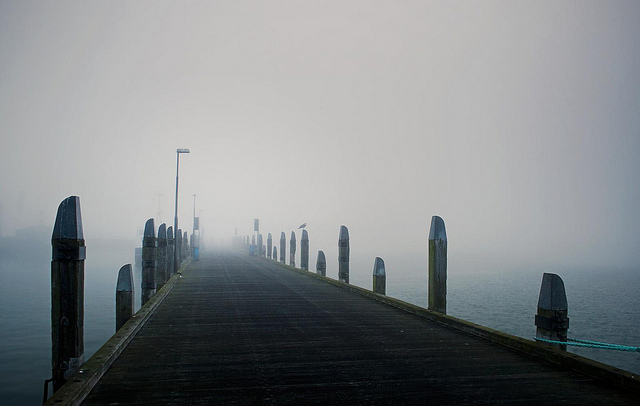
If for you, the dock is too short, out of desire or necessity, you build it forward, step by step, plank by plank, as you go—through the spray and the mist and the fog. And when you’ve built till you’re more coming than going, you see another shore—build, step, build, step. You are there.

This is crossing cultures. This is creating a bridge. This is going from home to home.

Then, at some point, out of desire or necessity, you step back onto the bridge. You must have been gone a long time, because what was once a complete span is now incomplete. You need to build to close the gaps. And at times you’re simply on a dock again, building to a shore you cannot yet see. Strange. It was a bridge before.

This time while you’re crossing, you find that in the mist there are others with you, and when they talk, you understand them, because they are speaking your language.

“Where are you from?” you hear someone ask, and the answer, “That’s an interesting question.” “You, too?” one says. “Me, too,” another replies. You understand them, not because you use the same words, but because when you speak those words you agree on the impreciseness of their meanings: near, far, hot, cold, friends, enemies, rich, poor, family, strangershere, there, hello, goodbye. Their meanings are slippery, like the damp boards beneath your feet. And the slipperiness is comfortable.

In time, you cross the bridge again and again, sharing familiar greetings with those in the misty middle. But never do you set out without having to repair what was built before. You continue . . . build, step, build, step.

What is a bridge, but a paradox, leading from home to home, from not-home to not-home? Your heart’s compass spins. The shores, they push and pull, they give hugs at arms length, they don’t plan on changing, but they do. The same can be said of you.

And then, out of desire or necessity, you settle down farther inland. You put down roots in loose soil. There’s a dock over the next, next hill. You go to visit from time to time and walk its length. You listen to the slap of the waves. You breathe in the smell of the ocean. You taste the salt in the air . . . and you remember the sounds and the smells and the bitter-sweet flavors of where you used to be.

What do you see when you see a dock?

You put down roots in loose soil, but you still speak the language of the bridge.


These thoughts are inspired by Mission Training International‘s “Pair of Ducks.” MTI uses two rubber ducks—a “yay duck” and a “yuck duck”—to show cross-cultural workers and their kids that all the places where they’ve lived have their good and bad parts.

[photo: “Harbour Bridge,” by D.Reichardt, used under a Creative Commons license]
Empty Videos: Where Have All the People Gone?

Imagine the busiest, most crowded place you know . . . in the middle of the day . . . but without a single person.

It’s hard to form that mental image, because some places are what they are because of all the people.

429575638_4d0c1b16da_zWhile we were living among the 6 million people of Taipei, all we had to do was stand at the corner of a major intersection to get a feel for how dense the city is with people—on foot, in cars, in buses, on bicycles, and on scooters . . . so, so many scooters. That’s what made it so shocking when once a year, a seemingly random (at least to a foreigner) military drill chased everyone off the streets. In fact, during the half-hour Wan-an drill (萬安演習), all vehicles need to pull over, and it’s illegal for pedestrians to be outside, except for the officers stationed at nearly every corner telling everyone to vacate the streets.

In 2004, Hong Kong pop star Jacky Cheung saw this in person when he was in Taipei to film an MTV show. When the streets cleared, Cheung and his record-company crew thought they’d found the perfect backdrop for a photo shoot, so they snapped a photo of Cheung standing out in the street all alone. When the photo hit the Internet, the National Police Agency was not amused, and they promised a fine (though I’m not sure if they followed through).

There’s something about seeing places that are normally teeming with people when they somehow become un-teeming. It’s oddly alluring. Or maybe its just odd. Or eerie. Think ghost town, the Apocalypse, The Day After, or The Day after Tomorrow.

But thanks to some video wizardry, we don’t have to survive Armageddon to see what the world would look like without people. Take, for instance, Ross Ching’s vision of Los Angeles in Running on Empty (Revisited). At Vimeo, he even offers this step-by-step process for how to remove all the cars from the highways of LA:

1. Record for 20-30 mins.
2. Go frame by frame and grab pieces of the road that aren’t obstructed by a car. Eventually, you will have every piece of the road.
3. Put the static image of the road in with the moving background.

And then there’s the Empty America series from Thrash Labs, including New York, usually a pretty busy place in its own right, and Washington, D.C., Seattle, and San Francisco.

The music in these videos takes away some of the eerie feeling that can come with the visuals. That’s not the case with para l l el, a short film from the globetrotting French couple Claire & Max. Their music choice is “Dark Places.”

“What if parallel worlds existed?” they ask at Vimeo. “What if in one of these worlds mankind disappeared? What if the Eiffel Tower and the Statue of Liberty had never existed?” (Their vision of London is pretty creepy, too.)

In case Ching’s step-by-step instructions for creating an empty world seem a bit simplistic, Claire & Max provide their own how-to video tutorial. It’s step-by-step-by-step-by step. In their list of needed items, the last one is patience. Indeed.

Or you can pretend that You Are Legend, and you’ll have all the time in the world.

(Jimmy Chuang, “Pop Star’s Photo Op During Air-Raid Drill Could Net Big Fine,” Taipei Times, September 26, 2004)

[photo: “On Your Mark,” by h4rrydog, used under a Creative Commons license]
#9 Map: “The Age of Man”

7564199138_f613b0fc16_z
Frederick De Wit’s Double Hemisphere Polar Map, c 1668

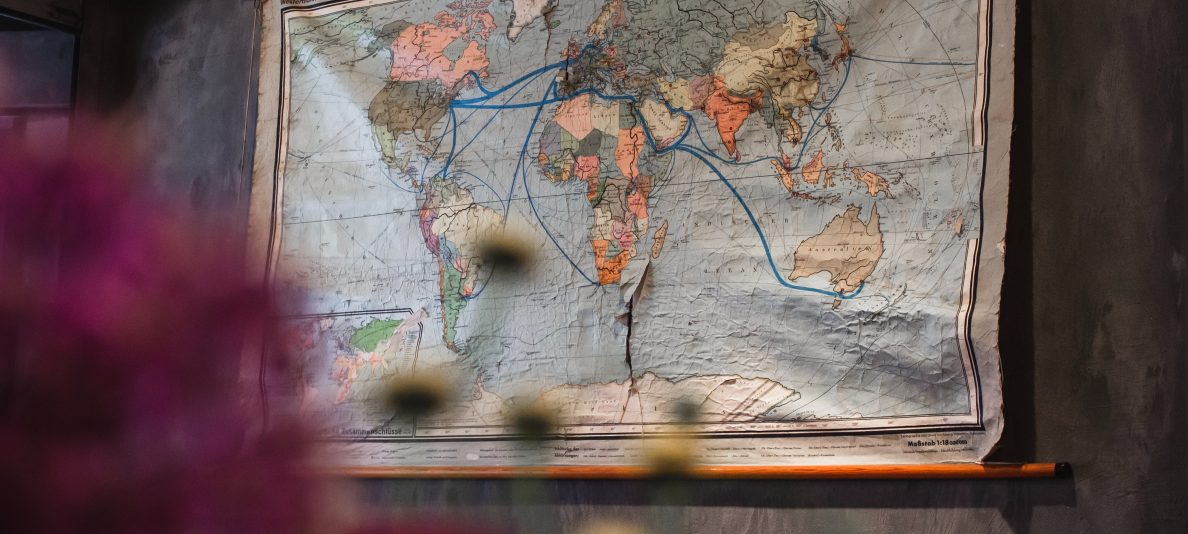
According to one of my favorite sources, the Online Etymology Dictionary, the word world comes from the Proto-Germanic wer, meaning “man” (as in werewolf), and ald, meaning “age.” Thus, world can be translated into “The Age of Man.”

And that’s exactly what German cartographers Stephan Hormes and Silke Pest call the world in their “Atlas of True Names.”

By “true names,” the pair are referring to the original, literal meanings of place names in English. The atlas, published by the pair’s company, Kalimedia, consists of five maps—Europe, British Isles, Canada, USA, and the World—and includes such places as Boar’s Head Lake (Lake Huron), Children of the Sun (Spokane), Navel of the Moon (Mexico), and Land of the Strong Ones and Land of the Really Strong Ones (Turkey and Turkmenistan).

Others have written about the maps, and most mention the mapmakers’ reference of Middle Earth in Kalimedia’s description:

Once the names have been taken back to their roots and translated into English, it is immediately apparent that our world has an extraordinary affinity with Middle Earth, the mythical continent where the events of Tolkien’s ‘The Lord of the Rings’ are played out.

Middle Earth’s evocative “Midgewater”, “Dead Marshes” and “Mount Doom” are strikingly similar in nature to Europe’s “Swirlwater”, “Darkford” or “Smoky Bay”, as revealed by the Atlas of True Names.

I don’t think that begins to do justice to the wonderfully foreboding literal names of the British Isles. I can easily imagine a group of Hobbits setting out from their shire near Raven Breach in search of Mount Malicious in the Land of Darkness.

The maps can be purchased at Omnimap.com, starting at $9. There’s also a 39″ x 27″ wall poster of the world map available (for $24 at Mapsonline4u).

The map’s authors admit that their translations are not definitive, and they often lean toward more interesting or fanciful options. But each map includes a list of all names with their etymology—so argue away.

All of this makes “The Atlas of True Names” a great conversation starter. And that’s why this set is my newest addition to “8 Maps and Globs That Will Change Your Perspective of the World.”


[photo: “Old Map,” by Enrique Flouret, used under a Creative Commons license]

Sites of New York

New York. The City that Never Sleeps. The Big Apple. The Melting Pot. The Capitol of the World. The Center of the Universe.

I’ve never been there, but it’s on my bucket list. I want to see first-hand the diversity, the culture, and the people.

Until then, I’ve got the Internet.

Most of you have heard of Humans of New York, the wildly popular photoblog and book created by Brandon Stanton. It’s a captivating collection of portraits and stories. In the video below, Stanton talks about the appeal of his work:

I think, you know, we walk down the street and we see all these people and we kind of wonder about their stories, the celebrations and the victories, and that’s what people are engaging with.

Humans of New York got me thinking. What other of-New-Yorks are there out there?

Here’s what I came up with:

Voices of New York (CUNY)
“The best journalistic work being produced by scores of community and ethnic publications,” curated by the CUNY Graduate School of Journalism. It currently is featuring such stories as “Diversity in Korean Language Schools,” “Remembering the Earthquake in Haiti,” and “Guyanese Artist Tells an Immigrant’s Story.”

Voices of New York (NYU)
This site, from New York University, is an archive of findings from the Fall 2001 students of the class The Language of America’s Ethnic Minorities. It’s a look at how distinct language groups in New York are being maintained or being lost. From “The Irish,” here are Nicole Feder and Chiene Joy Jones:

Coming off the train in Woodside, we had all kinds of fixed notions of what a typical Irish person would look like and how they would act. While sitting in the subway car Chiene turned to Nicole and said, “I bet he’s Irish, lets ask him if he is going to Woodside.” We played into those stereotypes of pale skin, reddish hair, light eyes, and drinking all the time. Feeling ridiculous for making such speculations, we decided not to ask and eventually reached our destination. While in Woodside we met several people fitting into various categories of the stereotypes. It wasn’t until we walked into an Indian owned Deli that I realized how easy it would be to categorize people. When we asked the owner why he had so many Irish products in his store, he replied, “You should know better than I, you’re Irish. . . .”

The Many Languages of New York City
In 2012, Arun Venugopal of WNYC reported that only 51% of New Yorkers are English-only speakers at home. A graph in the article shows the languages that are spoken. Another set of graphics, from Andy Keirsz at Business Insider last year, shows a map of the most-spoken languages in New York (“Here’s the Most Commonly Spoken Language in Every New York Neighborhood that Isn’t English or Spanish“).

Endangered Languages of New York
The New York based Endangered Language Alliance is “the only organization in the world focused on the immense linguistic diversity of urban areas,” including the 800 spoken in New York, many of which are at risk of extinction.

Bookstores of New York
Last Year cartoonist Bob Eckstein of The New Yorker shared his drawings of his favorite bookstores in the city, along with anecdotes from store keepers. Of Three Lives & Company he writes, “Any time a book is bought, the entire shelf must be reordered, since no books of the same colored spine may be adjacent, lest they appear erroneously as a set.” And just as New York has its endangered languages, so it has its threatened bookstores. “The Endangered Bookstores of New York,” is the title of Eckstein’s followup collection.

Museums of New York
From ny.com, here’s a long, though probably not exhaustive, list of the city’s museums. But if you want THE Museum of New York, you’ll need to go the Museum of the City of New York, where you can see exhibits such as Péter Forgács’ Letters to Afar, an art installation made from home movies filmed by Jewish immigrants who traveled back to Poland in the years preceding the Holocaust.

Loneliness of New York
In a city of 8,336,615 people, you can be “lonely, but never alone.”

Doors of New York
Graphic designer Allan Markan has collected images of doorways in the city and published them in the book Door Jams: Amazing Doors of New York City. You can see samples of his images at his website. They are pretty amazing.

Windows of New York
Another graphic designer, Jose Guizar, has put together his illustrations of windows in the city that have caught his attention. Colorful and creative.

Parades of New York
Here’s a list of NYC parades arranged by month, from MustSeeNewYork. Coming up next on the calendar, The Lunar New Year Parade.

And last, but not least . . .

Streets of New York
I thought this was just a movie, like Gangs of New York, but it’s a pizza, pasta, and sub restaurant. Mmmmmmm. I can already taste those authentic flavors of NYC, located a convenient 2,400 or so miles from Times Square . . . in Arizona and Nevada. (It took me a while to figure out the location. The fact that they serve “the official pizza of the Arizona Diamondbacks and Phoenix Suns” was my first clue.)