Empathy has taken somewhat of a beating lately, as Paul Bloom’s Against Empathy: The Case for Rational Compassion has made the rounds. I’ve not read the book, so what I know of it comes from third-party reactions, not enough for me to make any intelligent critique or defense. After all is said and done, though, I would guess that most of us would champion empathy, even if we agree that it can have a negative impact when misguided.
Christopher O’Shaughnessy is author of the book Arrivals, Departures and the Adventures In-Between. He’s also, per his website, an “international speaker and globetrotting adventurer” and, per the video below—an excerpt from his keynote address at last year’s Families in Global Transition (FIGT) conference—an empathy advocate. In fact, the video begins with him saying,
I want to tell you a story that emphasizes for me when I first sort of imprinted how important empathy was.
His story takes place after he entered a new school as an eighth grader and met an Eastern European girl who had just made her first international move. O’Shaugnessy, who was born in England to US military parents and spent chunks of his growing-up years on alternating sides of “the pond,” understood what she was going through and befriended her while others made her the object of their bullying.
His first story ends with a second story that takes place years later, in a bank, with a suspicious character, a note passed to a teller, annoying hope, and leaping tears.
It’s worth a listen.
This video is posted at Youtube in the Culturs.guru channel, which says that “CULTURS is a global multicultural philanthropic brand that brings lifestyle content to liminal identities.” I wasn’t familiar with the word liminal, but quick Google search told me that it means “occupying a position at, or on both sides of, a boundary or threshold.” I like that. There’s plenty of room for empathy in that place.
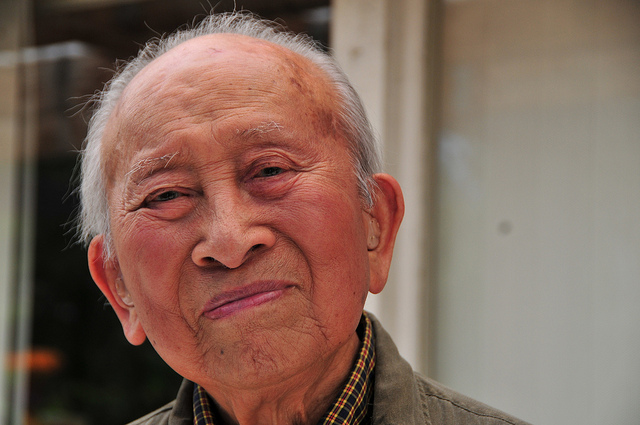
At the age of nine, in 1920, Tyrus Wong left Guangdong Province in China, boarding a ship bound for San Francisco with his father. To get around restrictive American immigration policies, the pair used fake identities to gain entrance to the US. Wong later attended art school and as an adult joined Disney as an inbetweener, drawing fill-in artwork between main animation frames. Then, when the studio was creating Bambi, Wong’s landscape paintings, influenced by the style of the Song Dynasty, became the driving force for the film’s breakthrough look. Though not given much credit at the time for his contributions, in 2001 he was officially named a Disney Legend. Wong died last Saturday, at the age of 106.
Below are four short videos, piecing together aspects of Wong’s life. The first is a trailer for the 2015 documentary Tyrus. The second tells about Wong’s ordeal at the Angel Island Immigration Station in San Francisco Bay. The third details his work on Bambi. And the last shares the story behind his art.
I recently wrote about Steve Saint’s travels with Mincaye, when Steve—the son of martyred missionary Nate Saint—was logging thousands of miles on his way to speak to thousands. But that was before an accident in 2012, while testing an experimental wing at I-TEC, that left him as an incomplete quadriplegic.
Since then, Steve has openly shared about his struggles and pain. In a post he wrote last month at the I-TEC blog, Steve talks about his feelings of insignificance. “It is hard to feel very important when Ginny has to help dress me and when I need a bib at dinner time,” he writes. “But then when I’m lamenting that I no longer count I’ll get a letters from someone thanking me now for trusting God in suffering. Go figure.”
I’d like to add my vote saying that Steve still counts. I am so grateful for his honesty, for his willingness to be vulnerable. He is truly serving through his scars.
Here is how he begins his post:
About half of the time I can only function at about 4 on a scale of 1 to 10. Then, with no warning I crash to about 1 or 2 in 10. I lose the tiny bit of feeling in my hands, the bands around my body begin to clamp down so tightly that I go into spasms just trying to stand up. But worse than the physical torment I struggle with, the increased pain is accompanied by an involuntary hardening in my “heart”. I sing along in church and hear preaching that used to move me, and I feel nothing.
But, the physical pain and spiritual feelings take second place to an almost constant sense that my life has no significance anymore. But I’m not the only one struggling to have my life count. . . .
I hope you’ll take the time to read the rest of “No Count People?”
And on the topic of letting others see us as we are—if you haven’t watched it yet (or if you’d like to watch it again), here’s Brené Brown’s TED Talk entitled “The Power of Vulnerability,” in which she says,
I know that vulnerability is the core of shame and fearand our struggle for worthiness,but it appears that it’s also the birthplace of joy, of creativity,of belonging, of love.
(I’m sure this makes me a prude, but before you gather the kids around the computer to listen to a video that Uncle Craig recommended, please note that it has a touch of PG language.)
I have a soft spot in my heart for nativity sets. I think it’s because the cast is familiar and recognizable, so much so that it can be altered to fit any culture and we still know what it is. It’s kind of like hearing “Silent Night” sung in many languages. We may not understand it, but we understand it. Variations on a theme.
But, of course, not all cultures know the significance of the nativity figures. While we were living in Asia, a few blocks away from our house there was a knick-knack store that during Christmastime was filled with Western decorations. Here’s what I wrote about that in a newsletter, 13 years ago:
Amongst the jumble of holiday odds and ends are the scattered pieces of a few nativity sets. On one shelf is a shepherd standing next to a Christmas tree. On another is a stable with only a wise man and Joseph. Without the infant Jesus, there’s no nativity, and the figures become just people staring at the ground, elbowing for space in between the rows upon rows of Santa Clauses.
It’s that holiday time of the year, which means lots of traveling and probably some quick meals along the way. If you’re wanting to up your grabbing-a-bite-to-eat game, take a look at Business Insider‘s list of the top 25 US limited-service restaurant chains, published earlier this year. Below are the ten restaurants with the highest customer-satisfaction scores. (By the way, if you’re wondering, “limited service” means pay before you eat and includes fast food and fast casual.)
Firehouse Subs
Chick-fil-A
Papa Murphy’s Pizza
Ben & Jerry’s
In-N-Out Burger
Raising Cane’s Chicken Fingers
Krespy Kreme
Fuddruckers
Jersey Mike’s Subs
The Habit Burger Grill
I guess you could say this is a pretty congenial group of eateries—offering good food at a good price with good service—but if you want to know just how friendly the American food-distribution scene is, you need to look at it from an outsider’s point of view. In his book End of the Spear, Steve Saint tells about his friend Mincaye’s first trip to the States. Mincaye is from Ecuador, a member of the isolated Waodani (Waorani, Huaorani) tribe.
After he and Steve return to Ecuador, Mincaye describes grocery stores to members of his village. To him, “food houses” are wondrous places with endless amounts of food (people take it out but no one brings it in), and taking it out is oh so easy:
The only thing you have to do is when you are leaving, you have to go by the place where the young foreigner girls stand. They look at you very seriously. But if you just stand there and smile, when they smile back, you can take all your food and go eat it happily.
At this point, Steve corrects Mincaye’s story by explaining that the food needs to be paid for and shows the group a credit card.
“Don’t worry,” Mincaye explains. ” They just give that thing right back to you, and then you can go and eat all your food!”
But someone wants to know how food can be gotten when you’re out driving and not close to a food house. Mincaye knows the answer. That’s not a problem for Babae, as he calls Steve:
Babae has friends everywhere. Whenever we are away from the big, big food house and my stomach hurts, telling Babae, he just stops at one of his friend’s houses. They open the little windows in their walls and hand us food. Those people really like Babae, just like we do.
I really feel special now. I guess those people really like me, too!
(I’ve written about Steve and Mincaye before, but if you’d like to know their full stories, read Elisabeth Elliot’s Through Gates of Splendor and Saint’s End of the Spear, or watch the movie of the same name.)
First expatisms, then airportisms, and now . . . pre-tripisms. Because we simply don’t have enough ways to talk about things.
metapacking
Carrying a suitcase in a suitcase so that you can bring back more stuff than you take. This can be as simple as a duffle bag inside another piece of luggage, but in its purest form, it is a checked bag precisely fitting inside another checked bag. The term metapacking can be extended also to encompass using a cheap or broken suitcase to transport items one way and then disposing of that suitcase after you arrive. Seasoned travelers always keep a broken suitcase lying around.
eurekathing
Something you find inside your luggage when you start packing—something you haven’t seen since your last trip. Discovering it brings out such responses as “Oh, that’s where that is,” or “I do have one of those.” A wad of ten-dollar bills is eurekaching, a piece of jewelry, eurekabling.
flotsam and jetsam and thensam
The abundance of things that people give you and your children right before you leave for the airport or get on the plane. This includes gifts, souvenirs, snacks, word-find and sudoku books, coloring books with a four-pack of crayons, and those faces with metal shavings that you form into a beard with a magnet.
tetrisness
The feeling of accomplishment one feels after packing every necessary item just right in a suitcase. A landmark study out of the University of Gatwick-Hempstead shows that tetrisness activates the same portion of the brain as when one successfully folds a fitted sheet.
bait and glitch
You find a cheap plane ticket online and go through all the steps to buy it, double and triple checking all the details, and then when you select “confirm,” you get that encouraging message that says, “The fare you’ve selected is no longer available.” Maybe it’s because the search site wasn’t up to date or because someone else recklessly grabbed the last seat while you were prudently making up your mind. If it’s the latter, it just proves the old standard, “Time flies when you’re choosing flight times” (or something like that).
vontrappish
How you feel when you’re ready for bed the night before a morning flight, with all your luggage placed neatly (more or less) next to the door—lined up like the von Trapp family ready to sing “So Long, Farewell.” You may have mixed feelings, and you may or may not sleep. In extreme cases, you hear yourself humming the tune.
So long, farewell, auf Wiedersehen, good night
I hate to go and leave this pretty sight
I’m glad to go,
I cannot tell a lie
I flit, I float
I fleetly flee, I fly
So long, farewell, auf Wiedersehen, goodbye
I leave and heave a sigh and say goodbye—Goodbye!
fortnightlies
Countless requests for coffee, a get-together, or a meal made by friends who have just realized that your departure for a long or permanent stay is only. two. weeks. away.
direct flight to the dog house
This is what you receive after you proudly show the money-saving itinerary—that you just booked—to your spouse, and said spouse points out that it includes a 14-hour layover (also known as a “wayover”) and that you and your four children will need to collect all checked baggage between each of the five connecting flights. Travel to the doghouse does accumulate frequent-flyer miles, but they can only be redeemed for undesirable trips, such as to overnight stays on the living-room couch.
disafearance
Leaving your tightly locked up (?) house thinking you might have left the iron on (even though you don’t remember having done any ironing) is one thing, but watching your hand zip your passport into the front pocket of your backpack and then just two minutes later checking to see if it’s actually there because you’re afraid that you didn’t in fact zip your passport into the front pocket of your backpack but instead, due to a muscle spasm, may have opened the car window and tossed your passport onto the shoulder of the highway—or what if it just spontaneously combusted, leaving no smoke or ashes?—that’s disaffearance.
TSAT
The TSAT (pronounced Tee Ess Ay Tee or Tee-Sat) is an oral exam in which family members yell questions and answers from room to room concerning Transportation Security Administration regulations:
Is it the 3-1-1 rule or 1-1-3 . . . or 3-2-1 or 9-1-1? Does deodorant count as a liquid? What about wet wipes? Or snow globes? Or chocolate-covered cherries? Can I take nail clippers in my carry-on? What about tweezers? Duct tape? Scotch tape? Chopsticks? Toothpicks? Javelins?
By way of Mockingbird, I saw a c-ville interview with Lulu Miller, co-host of NPR’s Invisibilia, in which she speaks on the value of listening to authentic stories. Sounds as if she’s taken some lessons from Dick Gordon.
She’s often amazed at the things people reveal about themselves in an interview. It’s a reminder that when you’re vulnerable, “when you do show your worst side, that can be an act of humanity, because it shows everyone that everybody else is so deeply imperfect,” Miller says. “That can be such a gift, because sometimes people put up such a front.”
(I would think that a lot of the gifts she receives don’t have bows.)
Miller continues about not just listening, but really listening:
“Really listen,” Miller says. “Really show you’re with them. Sometimes people are almost shocked when they’re very closely listened to.” Once the person is a bit more relaxed, she says she starts poking and prodding gently.
“The range of people and their take on the world, that’s what never ceases to amaze me,” Miller says.
Invisibilia‘s most recent episode is titled “Outside In” and asks whether external change can produce inner change. In it, they talk to members of an all-female debate team in Rwanda. Following the genocide in 1994, the formerly male-dominated country was left with a population reported to be at least 70% female—because so many men had been killed, had been arrested for the killing, or had fled. To fill needed jobs, Rwanda legislated gender equality, without first going through a gradual change in culture. Has it worked? Invisibilia follows an all-female debate team as they push against long-held expectations. In one debate, by the luck of the draw, they had to argue the negative position on the topic “Developing countries should adopt Western feminism.” You can listen to the podcast to see how that turned out.
Another Invisibilia installment, “The Personality Myth,” is about the idea that personalities are more malleable than we commonly assume. It focuses in part on a woman who finds out about a TEDx event in the Marion Correctional Institution and meets a prisoner whose personality has seemed to change dramatically. One of the links at the podcast website is to an NPR article on personality tests, written by Annie Murphy Paul, author or The Cult of Personality Testing. If you can’t tell by the title of her book, Murphy Paul is not a fan of such things as the Myers-Briggs Type Indicator. Simply put, she says that “human beings are far too complex, too mysterious and too interesting to be defined by the banal categories of personality tests.”
Even if you agree, that doesn’t mean that you can’t use your four-letter MBTI code for a little fun and games.
Speaking of fun and games, each episode of Invisibilia includes a downloadable coloring page of the episode art.
And finally, back to Miller’s listening skills: John Casey, professor in the University of Virginia creative writing MFA program where Miller studied, describes her in The University of Virginia Magazine as “extremely sympathetic and attentive, and people open up to her because she is open to them.”
Those sound like the qualities demonstrated by Shawn Braley and Chris Ashwell, who direct Cincy Stories in Cincinnati. Their project, inviting locals to tell their unedited stories, began when Braley, a church pastor, was looking for a way to connect with his neighbors. Braley was inspired by StoryCorps and The Moth, two more personal-story telling podcasts from NPR.
But, Braley tells Christianity Today, his main inspiration is “obviously” Jesus. “The marginalized people and the people on the outskirts: He loves them and just listens to them, and that’s why they’re drawn to him. We want to replicate that.”
We can see Jesus’ come-as-you-are attitude catching many people off guard in the pages of the New Testament, and Braley enjoys doing the same.
“What I see often,” he says, “is, ‘Wait . . . there is a pastor overseeing this, and you still let me tell my story?’”
For a taste of Cincy Stories, here’s Caitlin Behle, who says,
I’m still Asian as far as I can tell and I’m still adopted and I feel really good about it so that’s something that I haven’t really had to question . . . until this one time. So in November 2010 I went to Korea for the first time, like since I’d been born there. . . .
Authenticity. It’s a big buzzword today, popular among millennials, pastors to millennials, mom bloggers, and . . . missionaries. Sharing shortcomings and struggles has many benefits, not the least of which is showing other imperfect people that they’re not alone.
But where that sharing grows and grows, there is bound to be pushback. One person’s honesty is another person’s whining. One person’s transparency is another’s self-centeredness. One person’s telling it like it is is another’s pity party. One person’s authenticity is another’s complaining.
So, are we complaining too much?
I think about that quite a bit. I believe it’s important to share our struggles, openly and honestly, but when I get ready to do just that, Philippians 2:14 often comes to mind. Actually, it’s not the verse itself but the children’s song based on it: “Do everything without complaining / Do everything without arguing / So that you may become blameless and pure children of God.”
Maybe it’s not enough to ask, Are we complaining too much? Can we, in fact, complain at all?




 Clearing Customs