Standing Up Crooked Together [—at A Life Overseas]

640px-Nowe_czarnowo-krzywy_las
The Crooked Forest outside Gryfino, Poland

Here’s an intro to my post this week at A Life Overseas.

Standing Up Crooked

There’s a tree near Colorado Springs that I admire. It’s a pine tree sitting on the property of The Hideaway Inn and Conference Center, where I and my family attended MTI’s Debriefing and Renewal several years ago.

This tree is surrounded by other pines, but this one’s different. While its trunk starts out on a vertical path, after a several feet, it breaks to the side at a ninety-degree angle. Then, over a few more feet, it makes a slow curve, working again on an upward climb.

Near the end of the retreat, we were told to find a place to be by ourselves, and I knew where I wanted to be, sitting in front of that tree. I must not be the only one who appreciates it, since there’s a bench facing it close by.

I don’t know what trauma caused the tree’s shape. Maybe it was a storm, maybe a disease, maybe the blade of an axe. Or maybe it was more of a heart thing—a promise unkept, a hope deferred, a joy shattered.

Regardless of the cause, the reason I admire this tree is that though having faced trouble, it still reaches upward. It’s “persecuted, but not abandoned; struck down, but not destroyed;” wrecked, but not ruined. No, not ruined at all.

Can you identify with this tree?

Have you ever had your feet knocked out from under you because of some tragedy?
Have you ever tried to take hold of something beyond your reach and fallen in the trying?
Have you ever been bent to the point of brokenness?
Have you ever been laid low by the realization that you are the cause of someone else’s pain?
Have you ever wrestled with God, refusing to let go until you get a blessing, and walked away limping?

[photo: “Krzywy Las w Nowym Czarnowie,” by Artur Strzelczyk, used under a Creative Commons license]

Finish reading at A Life Overseas.

Yo-Yo Ma: Putting Together Sounds from the Silk Road

5599935812_6b053c683b_z

“Since the very beginning,” Grammy-winning cellist Yo-Yo Ma tells his Facebook audience, “the Silk Road Ensemble has been about departure and explorations, new encounters and homecomings.”

Ma was born in Paris to Chinese parents, moving to New York at the age of seven. The Silk Road Ensemble, a collective of musicians and composers from over 20 countries, was born in 2000, under Ma’s direction.

A documentary on Ma and the group, The Music of Strangers: Yo-Yo Ma and the Silk Road Ensemble, had its US premier at the True/False Film Festival two weeks ago in Columbia, Missouri. Since most of us will never see the film, I’ve put together several videos to give a glimpse of what we’re missing.

The first is a trailer for The Music of Strangers. “Everybody is afraid, but you make a connection with another human being, you can turn fear to joy”— Yo-Yo Ma. (Edit: I added this video to the post after the trailer came out on March 24.)

This one is an intro from the Berlinale (Berlin International Film Festival), including a clip of the young Ma and his eleven-year-old sister performing on television for President Kennedy. Leonard Bernstein introduced him by saying, “Now here’s a cultural image for you to ponder as you listen: a seven-year-old Chinese cellist playing old French music for his new American compatriots.”

In the next video, Ma describes the ensemble, saying that its members see the alignment between classical and world music: “I think it’s a way of thinking about, again, who we are, who we would like to be, how we want to fit in a larger world.”

Here is another trailer for The Music of Strangers, featuring Cristina Pato from Spain, a pop star in her home country and holder of a PhD in music. She is an accomplished player of the gaita, a traditional bagpipe from Spain’s Galician region.

This one is the trailer for an earlier documentary The Silk Road Ensemble with Yo-Yo Ma “Tanglewood Revisited.” In it, you can hear Pato’s gaita, and she says, “We are very lucky because we do some kind of art that it doesn’t need words.”

In this video, the Silk Road Ensemble is at the Kennedy Center, playing the traditional Persian folk tune, “Ascending Bird.”

Here is a performance of “Rustem,” a Roma song from Romania.

And finally, this is North Carolinian Rhiannon Giddens joining the Ensemble to sing “St. James Infirmary Blues,” from their album Sing Me Home.  Ma says,

Each piece on Sing Me Home invites listeners to explore the “music of home” through the individual experiences of Ensemble members, many of whom are immigrants. The result is a compelling collection of innovative and deeply moving tributes to the rich cultural heritage of the Balkans, China, Galicia, India, Iran, Ireland, Japan, Mali, people of the Roma, Syria, and the United States.
(“New Album: Sing Me Home” February 22, 2016)

[photo: “Silk Road Ensemble,” by rotor, used under a Creative Commons license]

Decisions, Decisions: How Better to Make Them

5583561290_8714669389_z

Decisions. Life is full of them.

Leaving our ministry overseas and coming back to the States has been one of the hardest decisions we’ve had to make, but it was even more difficult because it didn’t stand alone. So many issues were intertwined with it: our home, our community, our children’s education, our careers, our ministry, our identities, our income, our friends.

Sorting by Numbers

While we were weighing our options, our field coordinator introduced me to a very helpful tool: the Prioritizing Grid, presented by job-hunting expert Richard Bolles in What Color Is Your Parachute? The grid offers a systematic way to rank multiple options or to determine which factors in your life are the most important to you.

The Prioritizing Grid works by numbering each item in your list and comparing them all in pairs. When you’re done, you tally the total votes for each one and you’re able to put your list in order. Over the years, I’ve tried to recreate the grid on paper, but I’ve found it hard to remember how to set it up. I was glad to find that career coach Beverly Ryle has provided an online version of Bolles’ grid at her website. It’s customizable from 5 to 40 items. Forty items?! Yes, sometimes our lives can be pretty complicated, and sometimes the list of alternatives can become overwhelming. Ryle writes that using the grid “helps people in transition to focus their energy and keep from spinning in circles.” Sounds like good goals to me.

Creating Your Own Reasons

While the Prioritizing Grid presents a quantifiable approach to decision making, Ruth Chang, professor at Rutgers University, looks at the same topic from a more philosophical slant. For Chang, even her ideas surrounding decisions, especially hard decisions, stem from her own choices. In a TED Talk, embedded below, she says,

I couldn’t decide between two careers, philosophy and law. I really loved philosophy. There are amazing things you can learn as a philosopher, and all from the comfort of an armchair. But I came from a modest immigrant family where my idea of luxury was having a pork tongue and jelly sandwich in my school lunchbox, so the thought of spending my whole life sitting around in armchairs just thinking, well, that struck me as the height of extravagance and frivolity.

So she made the “safe” choice to become a lawyer. But when she realized that wasn’t a great fit for her, she turned back to “extravagance and frivolity” and began a life of philosophizing. Now she’s a well-known expert on making tough decisions.

She explains that choosing is more than a mathematical comparison, and it’s more than simply finding the best of multiple options. Rather than discovering reasons for what is best, she says, difficult choices give us the opportunity to create reasons, and in so doing, recreate ourselves:

When we choose between options that are on a par, we can do something really rather remarkable. We can put our very selves behind an option. Here’s where I stand. Here’s who I am. I am for banking. I am for chocolate donuts. This response in hard choices is a rational response, but it’s not dictated by reasons given to us. Rather, it’s supported by reasons created by us. When we create reasons for ourselves to become this kind of person rather than that, we wholeheartedly become the people that we are. You might say that we become the authors of our own lives.

Deciding to Decide

And finally, there’s this from the fictional Reverend John Ames, as written by Marilyne Robinson in Gilead:

I stay home Mondays when I can—my day of rest—so I had the morning to think and pray and also to do a little resolving, and while I was doing that, it came to my mind that I should consider what I would say to myself if I came to myself for counsel. In fact, I do that all the time, as any rational person does, but there is a tendency, in my thinking, for the opposed sides of a question to cancel each other more or less algebraically—this is true, but on the other hand, so is that, so I discover a kind of equivalency of considerations that is interesting in itself but resolves nothing. If I put my thinking down on paper perhaps I can think more rigorously. Where a resolution is necessary it must also be possible. Not deciding is really one of the two choices that are available to me, so decision must be allowed its moment, too. That is, as behavior, not deciding to act would be identical with deciding not to act. If I were to put deciding not to act at one end of a continuum of possibility and deciding to act at the other end, the whole intervening space would be given over to not deciding, which would mean not acting. I believe this makes sense.

Marilynne Robinson, Gilead, Picador, 2004

[photo: “Choices,” by Derek Bruff, used under a Creative Commons license]

Remember when We Wore Our Sunday Best to the Airport and Had Manners to Match? Yeah, Me Neither

8164044950_2090d07690_z

We’ve all seen people with poor etiquette at airports. Of course, you and I would never be guilty of such boorish behavior. I do have a friend whose cousin knows someone who does that kind of stuff. I hope he gets to see these JetBlue videos below.

You might like to watch them, too, just for fun. You’ll enjoy them more if you’re comfortably seated—but don’t get too comfortable.


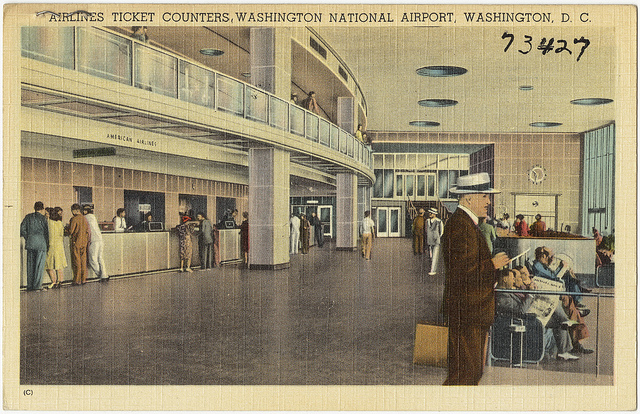
[photo: “Airline ticket counters, Washington National Airport, Washington, D. C.,” by Boston Public Library, used under a Creative Commons license]

Airportisms: New Words for Your Travel Lexicon

20068868814_3ee691764e_z 

Following up on my Modest List of Invented Expatisms, here are nine new terms to help you describe your traveling experiences. So the next time you’re in an airport, remember

Do not leave your bags unattended.
Do not stand on the toilet seats.
And do not let your words fail you.

Here for your vocabulary building . . . airportisms.

duffling
Upon hearing that your checked bag is three pounds overweight, you feign frantic action by grabbing zippers, patting your pockets, turning in circles, and saying things such as “I could . . . ,” “Well, I . . . ,” and “What can . . . ,” hoping that the ticket agent will take pity on you and say it’s OK. Be careful that your duffling isn’t too aggressive or the agent will actually let you follow through on solving the problem.

terminal fowliage
Birds that have somehow gotten into an airport and fly around amongst the rafters and indoor trees. Birds stuck inside a place where people come to fly. Sense the irony?

flaggle
A flaggle of tourists is a group of middling to senior travelers, led by a tour guide with a flag and bullhorn. The flag is akin to the kind I and my friends used to bolt onto our banana-seat bikes when we were kids. Oh, if only we’d had megaphones, too. You can tell that the flaggle is on the return leg of their trip when you see them bringing home food and souvenirs packed in large, branded gift bags or boxes with tied-on handles.

making a this-line’s-not-for-you-turn
After standing patiently in a line for fifteen minutes and realizing that it doesn’t lead where you need to go, you nonchalantly walk away—as if standing in lines is simply your hobby and you’re now looking for another place to queue up for more pleasant amusement. (Aren’t you glad you came early?)

shuftle
The standing-room-only shuttle bus at some airports that shuffles passengers on the tarmac from plane to airport terminal (or vice versa). This word can also be used as a verb.

Sadow-Plath effect
Happens in the moment when you accidentally kick a pulled carry-on with your heel and it flips onto one wheel and mo.men.tar.i.ly balances before flipping completely over or wobbling back to both wheels. This brief pause at the top of the carry-on’s arc is actually a tiny breach in the space-time continuum, caused by the rapid upturn of the luggage in combination with the forward motion. The effect is named after Bernard D. Sadow, inventor of the wheeled suitcase, and Bob Plath, creator of the rollaboard.

glizing
Glizing is the act of experiencing the wonderfully smooth exponential forward motion as you stride confidently on a moving walkway. This only happens when you’re not in a hurry, in part because, as studies show, the walkways do little to speed you up, and often slow you down.

BlackNSquare
When you try to describe your piece of luggage at the lost-luggage counter, all you can remember is that it’s part of the BlackNSquare line made by the Yuno company. Question: “What Kind of luggage do you have?” Answer: “Yuno, BlackNSquare.” Yuno also makes the upscale models BlackNSquare with handle and BlackNSquare with wheels.

preseating
To sit down, with plenty of time before boarding, able to relax because your bags are checked, you’re definitely at the right gate, and a quick look shows that your passport is right where it’s supposed to be. You take a deep breath and contemplate the hopeful possibilities of your trip. You can charge your phone, read, or people watch. You’re free to walk about and might grab a cup of coffee, browse the bestsellers in the bookstore, or window shop expensive luggage and watches . . . and on the way, you can go glizing.

[photo: “Opportunities | Airport Moment,” by John Ragai, used under a Creative Commons license]

It’s What’s Inside That Counts, Right? Here’s a Resource to Help Us Live That Way [—at A Life Overseas]

Inside-JobCome join me at A Life Overseas for my full post on a helpful book written by a friend and former missionary.

Stephen W. Smith wrote Inside Job for leaders, leaders who find themselves trying to “climb the slippery, treacherous slope of success” and too often falling with a crash, landing in a heap below.

Stephen was once among them. When he began life after graduate school, he says, “I developed an addiction to work that was applauded by every organization I worked for in my career. I was hooked—as every addiction hooks a person.” For Stephen, that work included his service on the mission field.

The solution, he writes, is to redefine success and to prioritize the care of one’s soul, what he calls “the work within the work.” Using the “Great Eight Virtues” listed in 2 Peter 1 as his foundation, in Inside Job Stephen presents the need for emotional and spiritual transformation and fleshes out what must be done to bring it about—”a process of learning, adjusting, repenting and starting anew with courageous convictions.”

The work within the work includes finding rhythm (not balance) in life, saying “no” in light of our limitations, recognizing the need for Sabbath rest, and understanding and managing transitions.

For many of us, this will require a nearly 180-degree turnaround. . . .

Finish reading at ALifeOverseas.com.

Football, 2, 3, 4

“How the World Sees American Football: Foreign Students Throw the Pigskin”

The glee of Maximilian Bushe of Berlin could have been used for a billboard to advertise the clinic. He had run a pass pattern as if he were a wide receiver in the American game. He snatched the ball thrown to him and scored a make-believe touchdown. He was overjoyed, almost breathless as he stood with the ball he held out in front of him with two hands. The Georgia Tech football players—the real ones helping conduct the clinic—made a boisterous scene of cheering around him for his catch.

Then Bushe did what any good American football player would do. He did an end zone celebration, a little dance.

“I am just surprised I caught the football,” he said, smiling wide. “A little bit is OK, right?” he asked about celebrating. No, not really. In the NCAA, what he did would earn a yellow flag and 15-yard penalty for excessive celebration.

. . . . . .

“Back home, they think it’s boring, and that’s totally wrong,” Bushe said. “We don’t know anything about it in Germany. We just see it in the movies—somebody has the ball, and 20 people jump on him and pile up in a big, big tower. Once you get the whole game, it gets really interesting. You watch the game and cheer for your team, and it’s awesome.”

Ray Glier, Aljazeera America, April 25, 2015

The Listening Pastor

After 36 years, Leadership Magazine is calling it quits as a print magazine. The Winter 2016 issue is its last, as its parent company, Christianity Today International, is replacing it with a new section inside the pages of Christianity Today, and a future website, CTPastors.com.

Leadership is currently celebrating its history by counting down a series of “Top 40” articles, presented in chronological order, at the magazine’s site. Number 38, reprinted last week, is Eugene Peterson’s “The Unbusy Pastor,” originally published in the magazine’s second year.

It’s amazing to realize that Peterson has been writing about, and living out, his opposition to busyness for that long.

Two years ago I borrowed from Peterson’s article, using a quotation in a post I wrote about  listening. I’m reposting it below, because Peterson on listening is worth reading again . . . and again.

Listening and the Spirit of Unhurried Leisure

9563583010_8d7fb48cc5_z

“Get busy.”

That’s the mantra of many a boss.

“Look busy.”

That’s what coworkers say when the boss is coming.

Busyness isn’t always a synonym for work. In fact, busyness can get in the way of productivity.

Eugene Peterson, best known for his translation of the Bible, The Message, also served as a pastor of Christ Our King Presbyterian Church in Bel Air, Maryland, for 30 years. One of the consistent themes in his teaching and writing is that pastors should not fall into the seductive trap of busyness. Instead, as he writes in “The Unbusy Pastor,” his goal in his role as a church leader was to do three things, things that are too easily pushed aside by a busy life: to pray, to preach, and to listen.

Listening, he says, needs “unhurried leisure.” This leisure is the opposite of busyness. And just as busyness does not equal work, neither is leisure the same thing as laziness. Instead, leisure is having time at one’s disposal, and when one chooses to use that time for listening to what someone else has to say, it is a very valuable gift.

The passage below was written by Peterson in 1981. It is about and for pastors, but it can help any of us listen better, unless, of course, listening is something else we’ve ceded over to the professionals.

I want to be a pastor who listens. A lot of people approach me through the week to tell me what is going on in their lives. I want to have the energy and time to really listen to them so when they are through, they know at least one other person has some inkling of what they’re feeling and thinking.

Listening is in short supply in the world today; people aren’t used to being listened to. I know how easy it is to avoid the tough, intense work of listening by being busy (letting the hospital patient know there are ten more persons I have to see). Have to? But I’m not indispensable to any of them, and I am here with this one. Too much of pastoral visitation is punching the clock, assuring people we’re on the job, being busy, earning our pay.

Pastoral listening requires unhurried leisure, even if it’s for only five minutes. Leisure is a quality of spirit, not a quantity of time. Only in that ambience of leisure do persons know they are listened to with absolute seriousness, treated with dignity and importance. Speaking to people does not have the same personal intensity as listening to people. The question I put to myself is not “How many people have you spoken to about Christ this week?” but “How many people have you listened to in Christ this week?” The number of persons listened to must necessarily be less than the number spoken to. Listening to a story always takes more time than delivering a message, so I must discard my compulsion to count, to compile the statistics that will justify my existence.

(Eugene Peterson, “The Unbusy Pastor,” Leadership, Summer, 1981, also in The Contemplative Pastor: Returning to the Art of Spiritual Direction, reprint edition, Eerdmans, 1993)

[photo: “Railway Chit Chat,” by Brett Davies, used under a Creative Commons license]