The Psychological Health of Missionaries—Adding to the Research

6903821997_e0a95ce498_nHere’s a quick question:

What percentage of returned missionaries and aid workers report psychological disorders during their time overseas or shortly after their return? What do you think? About a quarter, a third, half, two thirds, three quarters?

According to a 1997 study conducted by Debbie Lovell-Hawker of Oxford University, the answer is “about half.” More precisely, Lovell-Hawker’s findings show that among the returned missionaries and aid workers she studied,

46% reported that they had experienced a clinically diagnosed psychological disorder either while working overseas or shortly after returning to the United Kingdom.

Before I went overseas, I would have guessed much lower than half, but after I first heard this statistic referenced in a debriefing I attended, in my mind, the number began to grow much higher than 46%. Statistics have a way of doing that.

Lovell-Hawker’s research included 145 aid and development workers and missionaries from 62 organizations. Though not definitive, the findings are significant as a wake-up call to cross-cultural workers, sending agencies, NGOs, churches, and member-care givers. And they also can assure those repats who are struggling that they are not alone.

Other  findings include

• 18% reported that their problems developed while they were overseas—82% said they began after returning to their home country
• Depression was the most frequently reported problem, occuring in 87% of the cases
• Those who reported having psychological problems had spent significantly longer time overseas than those who reported having none

(Debbie Lovell-Hawker, “Specialist Care: Psychological Input,” Global Connections Member Care Conference, February 18, 2002)

Moving forward from this study, there are some things I’d still like to know: Has anything changed in the 26 years since the findings were published? What would the numbers be for all missionaries and aid workers, not just those who’ve returned? What would the breakdown be among those working in relief and development vs other settings, such as teaching or church planting in developed areas? Are the numbers consistent for workers returning to countries other than the UK? And what about TCKs?

The good news is that there are researchers who are working on these and similar questions.

The Research Continues

One of those researchers is Lynette H. Bikos. Lynette served as a guest editor (along with M. Elizabeth Lewis Hall) of a special issue of Mental Health, Religion & Culture in 2009, titled “Missionaries.” Lynette is director of research and professor of clinical psychology in the School of Psychology, Family, and Community at Seattle Pacific University—and she also happens to be a friend who lived next to me, on an adjoining farm, as we grew up in northeast Missouri. We’ve kept in touch over the years, and she corresponded with my family and me as she worked on her research.

The special issue includes 10 articles dealing with several aspects of cross-cultural adjustment among those whom the editors call “religiously motivated sojourners.” I’d like to highlight four of those articles:

“Social Support, Organisational Support, and Religious Support in Relation to Burnout in Expatriate Humanitarian Aid Workers”
(Cynthia B. Eriksson et al., Mental Health, Religion, & Culture, November 2009)

This assessment found that 40% of expat middle managers in an international faith-based agency were at “high risk” of burnout in one of three areas—lack of personal accomplishment, emotional exhaustion, and disconnection or distance from those being cared for—but less than 4% reported high levels of burnout in all three.

According to the authors of the study, “This suggests that despite intense work and chaotic environments a majority of workers find ways to identify accomplishments, stay connected to others in their work, and rejuvenate. Team relationships, friendships, and positive organisational support may contribute to the resilience for these workers.”

The findings also indicate that younger workers are at a greater risk of burnout, as they register greater negatives in all three burnout areas. But while age was a factor, the number of years serving with the agency was not.

“Resilience in Re-Entering Missionaries: Why Do Some Do Well?”
(Susan P. Selby et al., Mental Health, Religion, & Culture, November 2009)

The authors posed the question ‘‘Why do some re-entering missionaries do well while others do not?’’ and interviewed 15 Australian cross-cultural missionary workers to help find the answer.

All the participants were over 25 years old and had spent at least 2 out of the previous 3 years in a non-Western country. Based on their responses, the researchers divided the missionaries into two categories: “resilient” and “fragile.”

In the interviews, the eight resilient missionaries described having

• flexibility
• higher expectancy and self-determination
• denial in the form of minimization to deal with their distress
• good mental health
• more social support
• a positive reintegration
• a personal spiritual connection to God

In contrast, the seven who were considered fragile described

• less flexibility
• lower expectancy and self-determination
• less use of denial with minimization
• poorer mental health
• less social support
• difficulty reintegrating
• a decreased or fluctuating personal spiritual connection to God

It is interesting that while the results of a questionnaire measuring depression, anxiety, and stress (DASS 21) showed higher levels for the fragile group, the scale showed that only one out of the entire group (including resilient and fragile) had an actual perception of being “personally stressed.”

“Psychological Well-Being and Sociocultural Adaptation in College-Aged, Repatriated, Missionary Kids”
(Michael J. Klemens and Lynette H. Bikos, Mental Health, Religion, & Culture, November 2009)

When the researchers compared a group of MKs to non-MKs at a Christian university, they found that while both groups scored in the healthy range of psychological well-being (PWB),  the missionary kids’ scores were significantly lower.

The missionary kids’ MK status accounted for only 4% of the variance in psychological well-being but was responsible for nearly a quarter (23%) of the difference in sociocultural adaptation (SCA). In this latter area, the MKs reported the most difficulty in “taking a US’ perspective on the culture; seeing things from an American’s point of view; understanding the US’ worldview; understanding the US’ value system; and making yourself understood.”

“Curiously,” report Klemens and Bikos, “neither the age of the participant, nor the number of years abroad, nor the number of years since repatriation was related to PWB or SCA for the MKs.”

“Reduction in Burnout May Be a Benefit for Short-Term Medical Mission Volunteers”
(Clark Campbell et al., Mental Health, Religion, & Culture, November 2009)

This assessment looked at how international short-term mission trips affect burnout among volunteers.

The participants in the study, most of whom were physicians and nurses, travelled to South America for two weeks to provide medical care in a non-disaster-relief setting. Prior to their departure, the group members’ responses to questionnaires showed that they were experiencing moderate burnout. Their burnout levels were again assessed one month and six months after the trip.

“The major finding of this study,” report the researches, “is counter-intuitive: that medical personnel who are emotionally exhausted, have an impersonal response towards their patients, and lack a sense of [personal accomplishments] (moderately burned out) benefit by working hard with numerous patients in an international context.”

They found that levels of emotional exhaustion and perceived personal accomplishments showed significant improvements following the short-term trip and continued in a positive direction in the 6-month followup.

___________________________________________________

All good research builds about what has been learned before and leads to questions for new studies in the future. I join with Lynette and her co-editor in hoping that the information in their special issue of Mental Health, Religion & Culture encourages others to join in the “exploration” of the psychological health of missionaries. There is so much more to be discovered.

(Lynette H. Bikos and M. Elizabeth Lewis Hall, “Psychological Functioning of International Missionaries: Introduction to the Special Issue,” Mental Health, Religion, & Culture, November 2009)

This special journal issue also includes several articles specific to the experiences of female missionaries. I hope to discuss these in a future post.

[photo: “Confused,” by Mary T Moore, used under a Creative Commons license]

Contacting the “Uncontacted”: The Isolated Tribes of the Amazon

3793142469_341b68ee98
Members of an isolated tribe in the Brazilian state of Acre react to a plane flying over them.

After I wrote about Nilson Tuwe Huni Kui‘s trip to New York, a friend asked why Tuwe would want to bring attention to his tribe if they wanted to remain isolated. At first, I had the same question, but then I read that his tribe is not one of those seeking seclusion. Instead, Tuwe’s village is being threatened by isolated groups who are pushed from their territories by illegal loggers, narco-traffickers, and oil prospectors.

Encroachment on their land also seems to be the reason why, in June, more than 100 members of the  Mashco-Piro tribe came out of isolation in Peru’s Amazon. The group asked people in the village of Monte Salvado for bananas, rope, and machetes, but rangers with the Native Federation of the Rio Madre de Dios (FENAMAD) kept them from crossing to the village’s side of the river.

There are an estimated 15 tribes in Peru, made up of about 12,000 to 15,000 individuals,  that are considered “uncontacted.” Peruvian law prohibits physical contact with these groups, largely to protect them from germs and viruses that their immune systems are not equipped to fight off.

Contact with the tribes can be dangerous for outsiders as well.

Searching for the Tribes

In 2002, Scott Wallace, a writer for National Geographic, accompanied a team of 34—including Sydney Possuelo, explorer and founder of Brazil’s National Indian Foundation (FUNAI)—looking for the “Arrow People” of Brazil. Also known as the flecheiros, the tribe is known for its aggressive use of poison-tipped arrows to defend its territory.

Wallace chronicled the risky expedition in his book, The Unconquered: In Search of the Amazon‘s Last Uncontacted Tribes (2011). The group was walking a figurative tightrope: trying to get close enough to make visual contact with the tribe while not getting too close and becoming the victims of an attack. But they braved the risks in order to prove that the tribes exist and to show their location. Isolated tribes need to be identified if they are to be protected.

Wallace writes that after some in their party caught sight of a few Arrow People, the group left some metal pots tied to low branches as a peace offering. Then, knowing that they were close to the tribe’s villages, they decided to ensure their safety before making camp for the night. (The following excerpt of Unconquered was reprinted in MIZZOU, the Alumni Association magazine of the University of Missouri, where Wallace earned a master’s degree from the School of Journalism.)

“Spread out down the beach,” commanded Possuelo. “Let them see that we are many.” We staggered along the shoreline, feet slipping in the loose sand. We turned to face the towering wall of trees on the opposite bank, no more than a hundred feet away. “Stand up straight, look strong! Hold your guns up high!” Possuelo ordered. “Let them see how well armed we are.” Rifles came up off hips and shoulders, tilting toward the manila tufts of evening clouds that drifted overhead. Of course, Possuelo had no intention to turn our rifles on them. He’d sooner have died than fire upon the Arrow People. But he needed them to think that we might. It was an odd combination: gifts on the one hand, guns on the other.

We stared across the river into the trees beyond the far bank. We saw nothing but the high wall of jungle, but we could feel their eyes upon us. All we could hear was the incessant flow of the water and the rush of blood pounding in our ears.

(Frank Bajak, “Isolated Mashco-Piro Indians Appear in Peru,” The Associated Press, August 19, 2013; Scott Wallace, “Lost and Found,” MIZZOU, August 9, 2012)

[photo: “Índios isolados do Acre,” by Agência de Notícias do Acre, used under a Creative Commons license]

In Someone Else’s Shoes: Two Adoptees Search for Who They Were and Who They Could Have Been

Deann Borshay Liem shows the shoes that she wore that were meant for someone else.
Deann Borshay Liem shows the shoes—from her adoptive parents—that were meant for another girl in her orphanage.

These are the stories of two Asian girls, adopted by families in North America.

One of the girls is now a teenager. One is in her 50s. Both are the subjects of documentaries.

Both look back and wonder “What if?”

The Invisible Red Thread

Li Bao was born in 1995 and abandoned on the steps of a hospital, a victim of China’s one-child policy. Six months later, she was adopted by a Canadian couple, who renamed her Vivian.

As a fifteen-year-old, Vivian traveled back to China. She wanted to see what her life would have been like if she had been adopted by a Chinese family, instead of one in Canada.

Chronicled in the one-hour documentary, The Invisible Red Thread (2012), her visit includes a trip to the orphanage where she once lived and her time spent with Shumin Zhu, a fourteen-year-old who was also adopted as an infant, but by a family in rural China. The two learn about each other’s lives and see in each other a life that she could have lived.

The Invisible Red Threadis available on DVD from Picture This Productions.

The Matter of Cha Jung Hee

Cha Jung Hee was 8 years old when she came to the US, adopted by Arnold and Alveen Borshay in California. But 40 years later, she found out that she wasn’t really Cha Jung Hee. Instead, the actual Cha Jung Hee was a girl whom the Borshays had supported through a charity and then decided to adopt. But when her father appeared at the orphanage and took her away, the social worker there gave her identity to another girl—who came to America and became Deann Borshay. In time, she forgot that the name on her birth certificate and passport wasn’t hers, and then, in time, she remembered.

Now a filmmaker, Deann Borshay Liem has completed two documentaries on her life. The first is First Person Plural (2000), in which Borshay Liem and her adoptive parents travel to Korea to meet her family there—a family that the Borshays had been told didn’t exist.

The second is The Matter of Cha Jung Hee, (2010, available at New Day Films) which focuses on another trip back to Korea in search of the real Cha Jung Hee, the woman who, as a girl, had written letters to the Borshays and whom the Borshays had planned to adopt.

In an interview with PBS’s POV, Borshay Liem talks about the too-large shoes that she wore when she arrived in the US. They were bought by her new family to fit the traced footprints of Cha Jung Hee:

[The shoes] represent how any of us might have had a different life. What are the possibilities of living someone else’s life or walking in someone else’s shoes?

Borshay Liem is now working on a new documentary, Geographies of Kinship, telling the stories of Korean adoptees around the world—in Sweden, France and the US, including a woman whose father was an African-American fighting in the Korean War.

(“Interview: In the Matter of Cha Jung Hee,” POV, PBS)

[photo courtesy of MU Films]

Rainbows, True Colors, the iPhone 5c, and The British Paraorchestra

I saw one of the new iPhone 5C commercials a couple days ago. It’s a great collage of people around the world saying hello on their phones. I guess Apple wants their cheaper, more colorful smart phone to catch on all over the globe. (Who am I kidding? Of course Apple wants all their phones to catch on all over the globe.)

There are two versions of the ad, “Greetings” and “Greetings Too,” but the one-minute extended version combines both. Are the languages you speak buried inside?

We certainly live in a rainbow-colored world.

After I watched this, I got nostalgic for the song “True Colors,” so I clicked around YouTube and found Cindy Lauper’s and Phil Collin’s versions. Then I came to last year’s cover by The British Paraorchestra (“the world’s first ensemble of professional disabled musicians”), The Kaos Signing Choir for Deaf and Hearing Children, and ParalympicsGB athletes. Very moving.

You with the sad eyes
Don’t be discouraged
Oh, I realize
It’s hard to take courage
In a world full of people
You can lose sight of it all
And the darkness inside you
Can make you feel so small

But I see your true colors
Shining through
I see your true colors
And that’s why I love you
So don’t be afraid to let them show
Your true colors
True colors
Are beautiful like a rainbow

Pico Iyer on Home, Travel, and Stillness (plus, Have You Seen the TED Commandments?)

161335960_3c30374d20_nPico Iyer, best-selling author on the topic of crossing cultures, finds the concept of “home” difficult to describe. It’s no wonder. His parents are Indian. He was born in England. At the age of eight he moved with his family to California. And currently, between his many travels, he lives with his Japanese wife in Japan.

In a TED Talk from 3 months ago, Iyer “meditates on the meaning of home, the joy of traveling and the serenity of standing still.”

Some great writers are not great speakers, but Iyer expresses his thoughts with eloquence in both forms. Here are a few of those thoughts:

On multi-cultural children:
“[T[heir whole life will be spent taking pieces of many different places and putting them together into a stained-glass whole.”

On traveling:
“The real voyage of discovery, as Marcel Proust famously said, consists not in seeing new sights, but in looking with new eyes. And of course, once you have new eyes, even the old sights, even your home become something different.”

On the concept of home:
“[H]ome, we know, is not just the place where you happen to be born. It’s the place where you become yourself.”

On collecting 1 million miles on a frequent-flyer program:
“You all know that crazy system, six days in hell, you get the seventh day free.”

And on spending three days in silence at a monastery:
“I began to think that something in me had really been crying out for stillness, but of course I couldn’t hear it because I was running around so much.”

Following the TED Commandments

I’ve watched several TED Talks, and I’m always impressed with how the speakers seem to present their thoughts articulately and effortlessly. I’ve always wondered if they use teleprompters. I found my answer at Jimmy Guterman’s blog. Guterman, a TED Talk presenter, wrote that the TED Talk stage includes “confidence monitors.” These floor-mounted monitors show the slides used in the presentation, to which presenter notes can be added. He added these notes, but regretted it later, as he was distracted by the monitors and felt that he looked down at them too often.

Guterman goes on to list the “TED Commandments” that TED sends to every speaker. It’s a great list of advice, and most of it applies to even casual conversations:

I. Thou shalt not steal time.
II. Thou shalt not sell from the stage.
III. Thou shalt not flaunt thine ego.
IV. Thou shalt not commit obfuscation.
V. Thou shalt not murder PowerPoint.
VI. Thou shalt shine a light.
VII. Thou shalt tell a story.
VIII. Thou shalt honor emotion.
IX. Thou shalt bravely bare thy soul.
X. Thou shalt prepare for impact.

To this, Guterman adds a number eleven: Trust thyself. (In other words, Don’t use monitors.)

If you’re thinking about brushing up your public-speaking skills and want to imitate that TED Talk style, you might want to take a look at this “Onion Talk,” produced by the folks at The Onion. It’s called “Ducks Go Quack, Chickens Say Cluck” . . . sort of a lesson on cross-cultural communication.

(Jimmy Guterman, “How to Give a TED Talk (and How Not To),” Jimmy Guterman’s blog, March 12, 2002)

[photo: “Loneliness,” by David Jakes, used under a Creative Commons license]

8 Maps and Globes That Will Change Your Perspective of the World

8280671002_19c064bddf_nLast week, out of the blue, my 7-year-old son said, “Guess what?”

(He doesn’t really want me to guess. When I try, I’m always wrong.)

“Guess what? The earth doesn’t have an upside down.”

Of course, he’s right. But you wouldn’t know it if you look at our maps and globes. Isn’t north up and south down? How else would you explain Upstate New York, Manhatten’s Upper East Side,  Sub-Saharan Africa, and Australia’s location “down under”?

And, of course, north is better than south, since up is better than down, right? According to a 2011 study, that seems to be the perception in the US. The results, published in Social Psychological and Personality Science, show that 72.5% of participants in the study would rather live in the northern half of a hypothetical city, because, they assumed, that’s where the more affluent people live. And when the map was flipped, with south at the top, participants no longer saw the northern half as better, since it was now on the bottom.

Also, side to side, we all know where the center is. It’s Europe. So Saudi Arabia is in the Middle East and Japan is in the Far East. Just look at any map, and you’ll see it’s so.

Well, not any map, just most of them . . . at least in the West. But the West doesn’t make up the whole world, or even most of the world.

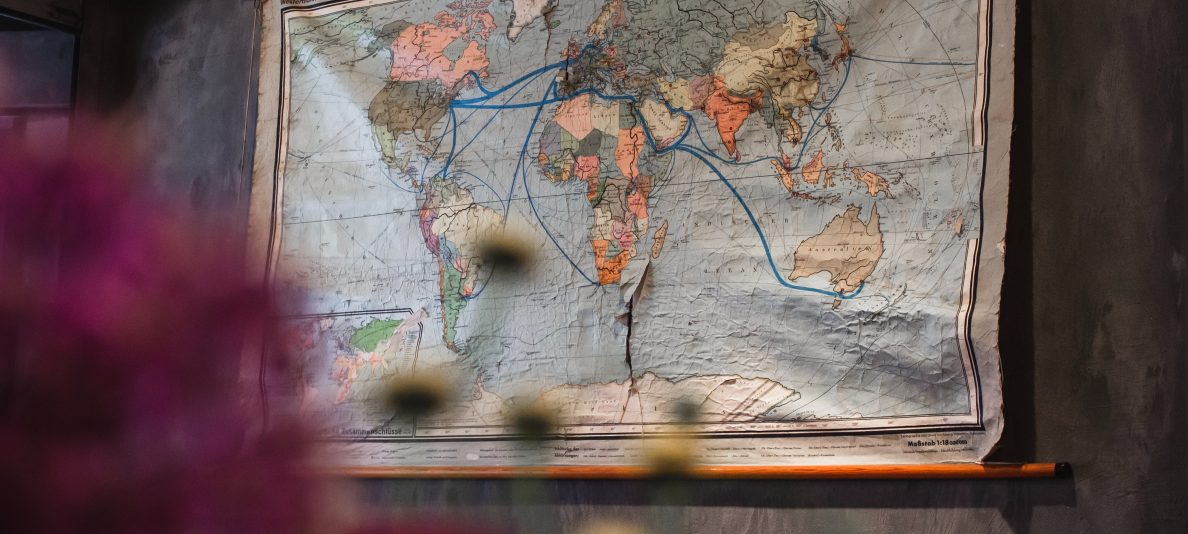
When I was in Taiwan I saw a wall map centered on Asia. It makes sense, since the Mandarin word for China is Zhongguo, meaning “Middle Kingdom.” That map opened my eyes to seeing the world in a different way.

So here are five maps to help us all see our global neighborhood differently. Each is available for purchase online, though some are quite pricey. Display these and listen to the conversations begin.

  1. Upside-Down Maps

    These are more than just regular maps flipped bottom to top. What makes them special is that all the names and notes are printed right-side up on north-down images of the countries. Get them from Maps.comODT Maps, and Metsker Maps.

  2. Center-Shifted Maps

    These two Pacific-centered maps (physical and political) from Maps.com put the Western Hemisphere on the right. And their Asia/Europe-centered map even has the gall to split North America in two.

  3. Azimuthal Maps

    An azimuthal map puts you at the center, showing the world spreading out from that center in all directions. This means that distances can be measured from you—the center point—to anywhere on the globe using a straight line (unlike with traditional rectangular maps). It also means that the farther away from the center, the more distortion there is. (This map is truly egocentric). ODT Maps offers a USA-centered and an Africa-centered map, as well as custom-made maps centered on any city in the world.

  4. Imaginary-Underground Maps

    Contemporary artist Chris Gray has produced a creative collection of maps showing an imaginary global system of subway lines. Versions include Asiocentric, Eurocentric, and Antipocentric (Asia-centered and upside-down).

  5. Earth at Night Maps

    These cool maps are actually compilations of nighttime photos taken from space and show clusters of light from cities around the globe. Two renditions, with different results, are at National Geographic and PosterRevolution.

  6. City Lights Globe

    This globe puts the “earth at night” map on a sphere. It’s an automatically rotating daytime globe that, when the lights dim, illuminates the cities of the world. Available at Innovatoys. Waypoint Geographic’s Earth by Day and Night, at World Wide Globes, is a similar globe that lights up when turned on.

  7. Replica Globes

    Authentic Models has a line of reproductions that mimic famous and beautiful globes from years gone by. The physical world hasn’t changed, but the borders and place names certainly have. Each of these globes, available at OnlyGlobes.com, is a lesson in history. Replica globes show us the world the way it used to be seen.

  8. Upside-Down Globe
    AS17-148-22727

    I was sure that someone would have made one of these, but alas, I couldn’t find one. Too bad. The closest thing I could come up with is the inflatable Astronaut View Globe from Jet Creations—available at Ultimate Globes. It is, as the name suggests, what the world looks like from space. Since there’s no printing on this globe, you could easily turn it south side up, which is actually the way NASA’s famous “Blue Marble” photo was originally taken (as shown here).

Maybe I’ll have to get somebody to make an upside-down custom-made globe for me. Maybe Mr. Bellerby, of Bellerby & Co. Globemakers, can give me a hand. (Update: see An Upside Down Globe: The Wait Is Over, Now the Waiting Begins)

(My favorite quotation from this video is “The whole way of making anything using a sphere as its base, as its centerpiece, is fraught with different problems and issues because you’re multiplying every error by pi.”)

All this has got me thinking: What else do we in the North and West take for granted? For instance, in my post Les Images de France 5, the creators of the TV idents describe their images this way: “Everything travels from left to right,” and “this is of course about moving forward.” Why is rightward movement usually associated with progress? Is this because we read from left to right? If so, then is it the same in cultures that read right to left, such as in Arabic-speaking countries? Or is progress, for them, a right-to-left thing?

It’s got me thinking.

Bonus Map #9: The Atlas of True Names
This set of maps, from German cartographers Stephan Hormes and Silke Pest, renames places with their original literal meaning. See my later post for a full description.

(Sanette Tanaka, “Study Points to Bias toward a City’s North Side,” The Wall Street Journal, July 4, 2013)

[photos: “World Grunge Map,” by Nicolas Raymond, used under a Creative Commons license; “The Blue Marble from Apollo 17, courtesy of NASA]

Miniscule: An Animated Series with a Lot of Buzz

457539675_d5c2d43dc9_mIt’s been over two years since we moved back to the US, and we’ve finally relieved our friends/forwarding agents of the things that we’ve had stored in their basement. Inside the boxes and Rubbermaid containers were several items that I’d forgotten about. But there were others that I knew we had—I just couldn’t figure out where they were.

One of those that I’d been looking for was a DVD set that I’d bought in Taiwan and left in Missouri during one of our times in the States. It’s the first season of the French series, Miniscule: The Private Life of Insects.

So why would an English-speaking American in Taiwan buy DVDs of a program from France?

First of all, while Miniscule is produced by the French company Futurikon, it’s not in the French language. Actually, it’s not in any language at all . . . unless you count bug sounds. And second, with—according to Encyclopedia Smithsonian—around 10 quintillion (10,000,000,000,000,000,000) insects on the planet at any given time, the program’s storylines have near universal appeal.

Combining computer animation and live footage, the award-winning series has been aired around the globe, counting young—like my son—and old—like me—among its fans. According to the Futurikon Website, the production company has sold Miniscule for broadcast in over 80 countries, including a deal with the Disney Channel in the US.

To watch Miniscule at your leisure, you can buy a 6-disc set of DVDs at HIDVDS.com.

Or . . . you can fly to Spain this week for the San Sebastián Film Festival, where Futurikon’s first feature-length, 3-D film, Miniscule: Valley of the Lost Ants, will have its world premiere (September 20 and 21).

Or . . . you can just take a look at these clips below:

“zzzeplin”

“libellules” (“dragonflies”)

Teaser for Miniscule: Valley of the Lost Ants

(“Number of Insects [Species and Individuals],” Encyclopedia Smithsonian)

[photo: “Ladybird, About to Leave a Dandelion,” by nutmeg66, used under a Creative Commons license]

Cake from a Roaster, Bread from a Rice Cooker—Where Will the Madness End?

3430989175_bbbcb39cc0
Yes, a loaf of bread can be baked in a rice cooker

So you need to make a cake or bake some bread, but you don’t have a full-size oven. How about using a roaster or a rice cooker instead?

It can be done. And while they may not be your top choices, in some countries, these small appliances may be your best options.

2067859950_2302a07639_m
We used a roaster similar to this one while we were in Taipei.

The Roaster Oven
In Taiwan, most meals are built around things cooked on top of a burner, rather than in the belly of an oven: There aren’t too many nationals cooking a pot roast or broiling steaks. The Taiwanese aren’t big on sweets, like us Americans, so there’s not a lot of cookie and pie baking either. With great bakeries scattered throughout most cities, there’s little need to whip up a cake on your own. And besides all that, the typical Taiwanese kitchen is pretty small, without room for any “extra” appliances.

Before we moved to Taiwan, we considered our options: Bringing over a Western-style range-oven combo and finding a place for it on a balcony of an apartment that we hadn’t found yet would have been troublesome. Besides that, the oven we had at the time wasn’t worth shipping over. Buying a used oven from another expat family who was leaving would have been unpredictable. And buying a new oven there would have been expensive. In the end, we decided on the roaster-oven option.

Turns out, it worked pretty well. In fact, my wife used ours nearly every day for four years—until it wore out and quit heating up. She used it for cakes, cheesecakes, cookies, pies, dinner rolls, casseroles, and, of course, several types of meat. Probably the trickiest project was an angel food cake, but she met even that challenge. (As I recall, the hardest part wasn’t the baking. It was finding something to invert the pan on, since we didn’t have any glass soda bottles.)

Mostly through trial and error, here are some things that she learned:

  • You’ll probably have to leave your food in the roaster longer than the recipe calls for. And lifting the lid to check on your progress releases a lot of heat and adds more time.
  • A small metal rack, or something else that lifts up the baking/cooking pan, will keep foods from burning on the bottom. If you don’t have a rack, you can use an upside-down cake pan.
  • If you can find a rack with legs, you can cook on two levels, with a pan above and one below.
  • It can be difficult to get large pans into and out of the roaster. There’s not a lot of wiggle room, so be extra careful not to burn your hands.

After our roaster gave out, some generous friends bought us a countertop convection oven. We brought it back from the States with our checked baggage, and it worked great for the rest of our time in Taipei. It wasn’t long before we saw a similar oven for sale in a shop near our neighborhood, so if we were to go back to Asia again, we’d probably plan on locating one there.

The Rice Cooker
But what if a roaster oven is out of the question? What if your kitchen countertop space is all full? Or what if you don’t even have a kitchen? Don’t despair. A rice cooker can save the day. And if you’re in Asia, you certainly won’t have any trouble finding one to buy.

If you’d like to find recipes and how-to’s for baking with a rice cooker, just do a search on the Internet. You’ll see that it’s not a problem, as the even the simplest model can bake cakes, cheesecakes, and breads.

I’ve never baked with one myself, but here’s some bits of advice I’ve gathered from the sites I looked at:

  • Most recipes will work in a rice cooker without being modified, but you may need to cut back on the size. Cakes won’t cook evenly if they are too deep, and breads will work best if they’re no more than a few inches thick.
  • Bread will need to be flipped over several times during the baking process so that it won’t burn underneath.
  • If it takes more than one cooking cycle to complete a recipe, then let the cooker cool down and start it again. Another option is to wedge something under the switch to prevent it from flipping to “warm.” Be careful with this second method. You’re bypassing the cooker’s automatic shutoff, so it can get too hot if left unattended, and it might shorten the life of your cooker.
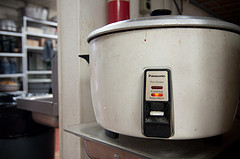
A simple, tried-and-true rice cooker
When it comes to choosing a rice cooker, Roger Ebert suggests, “Nothing Fancy.”

Of course, one way to make things easier is to buy a modern rice cooker with a “bake” or “cake” setting. (I didn’t know those existed until I started writing this.) But if you’re old school in your rice-cooker preferences, you’ll go with a more traditional style.

Roger Ebert, the Pulitzer Prize-winning movie critic, was one such devotee of the simple elegance of the basic “Pot.” In fact he was such a fan that he wrote a book dedicated to its multiple uses: The Pot and How to Use It: The Mystery and Romance of the Rice Cooker. In it he advises,

Have nothing to do with anything “Micom Programmable.” Nothing to do with words like “Neuro Fuzzy.” No dials or “settings.” Nothing fancy. You will only cost yourself money and mess things up. If a rice cooker comes with more than two pages of instructions, you’ve overspent. I am saving us money. What you want is your basic Pot with two speeds: Cook and Warm. Maybe it will say it in Japanese. You’ll figure it out.

Though Ebert doesn’t stray into the realm of baking, he does enthusiastically praise the rice cooker for its abilities in preparing such things as vegetables, stews, soups, sauces, and oatmeal.

And the Crockpot, Too

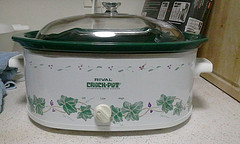
This crockpot is a real "Crock Pot" from Rival.
There are crockpots, and then there’s the Rival Crock-Pot®, “The Original Slow Cooker.”

I was about to finish up this post when I had a thought: I wonder if you can bake with a crockpot (slow cooker). Sure enough, you can do that, too.

I don’t have any experience with this—cooking or eating—but I can point you to a couple sites that give some details. The first one is from Better Homes and Gardens, entitled “Easy Slow Cooker Dessert Recipes.” There you’ll find directions on making cheesecake, pudding cake, brownies, and cobbler, along with the kind of almost-too-good-to-be-true photos you see in magazines like . . . well . . . Better Homes and Gardens.

The second is from Carroll Pellegrinelli at About.com—”Crockpot Baking: Making Breads and Desserts in the Slowcooker.” If you don’t have a slow cooker with a baking insert (again, who knew there was such a thing?), you can use a coffee can, paper towels, and aluminum foil. It’s not fast—it is a slow cooker—but, according to Pellegrinelli, it’s easy.

So . . . what else can you use a roaster oven, rice cooker, and crockpot for? Or what else can you use to bake a cake? Well, that’s up to you.

Experiment.

Try. Fail. Try again.

And remember these two important phrases: “Necessity is the mother of invention,” and “You don’t know how far you can go until you’ve gone too far.”

PS: It Ain’t Over Yet
A friend, former coworker, and long-time missionary to Taiwan, Bev Skiles, commented below that she’s used a rice cooker for cakes and a crockpot for bread. Not only that, but she’s baked cakes in an electric skillet and in cookware on top of the stove. Want more info? Check out these two sites from eHow: “How Do I Bake Bread in an Electric Skillet?” and “How to Bake in an Electric Frying Pan.”

Thanks to Bev for her input. She’s been a great help to expats in Taiwan for many years, showing them how to adjust their Western recipes to Eastern kitchens and cupboards.  She even helped helped put together a cookbook in 1981, “Tips ‘n’ Treats” on Taiwan. If I’d looked in my wife’s copy before I wrote this post, I would have seen several recipes for baking with a rice cooker. I should have consulted her as an expert.

(Roger Ebert, The Pot and How to Use It: The Mystery and Romance of the Rice Cooker, Kansas City, MO: Andrews McMeel, 2010)

[photos: “Currant Bread Made in a Ricecooker,” by Dennis Kruyt, used under a Creative Commons license; “Westinghouse Roaster,” by Julie Weatherbee, used under a Creative Commons license; “Rice Cooker, Peking House, Dudley Square, Roxbury,” by Planet Takeout, used under a Creative Commons license;  “Rival Crock-Pot,” by George Kelly, used under a Creative Commons license]