
I Like “I Like Giving”

6510934443_8bd2942b79_qGeorge was born in Romania to an impoverished family who couldn’t care for him. When he was fourteen months old, he weighed only 9 pounds. Fredericksburg.com reports that his medical report  already included a space for the time and date of his death.

When Mike and Sharon Dennehy, of Ashland, Virginia, saw his picture, they decided to adopt him, and in 1995, he joined their three biological children as part of their family. That was 18 years ago, and since then, the Dennehy’s have adopted eight more children. Including those from Romania and the US, their family now has representatives of six countries.

The Dennehy’s story, I Like Adoption, is one of many collected by Brad Formsma on the website I Like Giving, because “generosity inspires generosity.” It all started when Formsma heard about a Sudanese family whose bicycles had been stolen. He and his wife and children went out, bought some bikes, found the family, and gave the bikes to them. The father from Sudan kept saying, “I like bike. I like bike.”

A couple other “I like” stories with cross-cultural aspects (and videos) are I Like Soccer Balls, telling about a ten-year-old boy who travels to Mozambique and decides to make return trips to Africa, giving soccer balls to kids wherever he goes, and I Like Bug Shells, about two little girls who collect money and soda cans door to door to help children in Africa without clean water.

I Like Giving invites you to share your story to inspire others. Your generosity doesn’t have to be huge. You don’t have to have a video. And, of course, your efforts don’t have to cross cultures. Crossing the street is just fine.

“I like ____________.®” You fill in the blank.

(Last year, George Dennehy became something of an internet celebrity. As part of the Dennehy family, George learned how to play the piano, drums, guitar, and cello—with his feet. After playing a Goo Goo Dolls’ song on his guitar at a fair, a friend posted a video of his performance on YouTube. When Mike Malinin, the band’s drummer saw the video, he invited George to play with them at a concert. “It was amazing to see this boy who once was almost dead up there onstage with the Goo Goo Dolls,” Mike told Fredericksburg.com. “The whole place exploded with excitement.”)

(Amy Flowers Umble, “Couple Found Time to Adopt Nine Children,” Fredericksburg.com, November 7, 2012)

[photo: “Gift,” by asenat29, used under a Creative Commons license]

Two Great Resources for All Things Member Care and Missions

2164279407_666969752a_tMissionary Member Care
I recently found out about an ebook by Ronald L. Koteskey, Missionary Member Care: An Introduction. Koteskey and his wife, Bonnie, have served in member care for over 16 years and share this and other “resources for missions and mental health” at the website Missionary Care.

There is a wealth of useful information in Missionary Member Care‘s 169 pages, but the parts that interested me the most were

  • An overview of the trials faced by the “father of modern missions,” William Carey, and his family. (I’d read about some of what they went through, but hadn’t known the full extent of it.)
  • The writings of other early missionaries, revealing their struggles and their need for member care.
  • Numerous books and websites dealing with member care.
  • Information on a number of member-care organizations.
  • A list of conferences for member-care givers.

2231790512_109fa60425_tBrigada
And the second great resource? That’s where I heard about Missionary Member Care. In case you’ve never seen it, it’s Brigada, a weekly “web journal offering resources, strategy tips, tools and ‘hacks’ to Great Commission Christians.”

There are a couple ways to read Brigada, edited by Doug Lucas, founder and director of Team Expansion. One is to go to the website, where the newest issues are displayed, as well as a link to the archives, with issues dating back to 1994. The other way is to join thousands of other subscribers by signing up for weekly updates.

Brigada‘s information comes from a myriad of sources, and if you’d like to submit your own items for publication, you can do that, as well.

[photos: “Number One,” by John Ayo, used under a Creative Commons license, and “Copper Number 2,” by Leo Reynolds, used under a Creative Commons license]


Rising from Ashes: A Documentary on Biking and Hope in Rwanda

londonHere’s another entry for my list of movies “coming later to a library near you”—the documentary Rising from Ashes (2012), directed by T.C. Johnstone and narrated by Forest Whitaker.

It tells the story of the formation of a bicycling team in Rwanda and its quest to send a rider to the 2012 London Olympics. Coached by American Jock Boyer, the team includes many who as children had lost multiple family members in the 1994 Rwandan genocide. Therefore, Team Rwanda has to deal not only with issues of equipment, conditioning, and time trials, but they also tackle such things as loss, emotional pain, and poverty.

One of the focal points of the film is Adrien Niyonshuti, a member of the team who lost 60 members of his family, including 6 brothers, in the genocide. Since the documentary was completed, Niyonshuti became the first cyclist to represent Rwanda in the Olympics and the first black African to qualify in mountain biking.

Rising from Ashes also features Boyer, someone who knows about firsts—being the first American to race in the Tour de France. He also knows about defeat and brokenness and striving to rebuild lives. In 2002 Boyer pled guilty to having sexual contact with a girl beginning when she was 12 years old and was sentenced to 20 years in prison. That sentence was stayed, and he was put on 5 years probation and spent 8 months in jail. A 2009 article about Boyer in the magazine Bicycling begins with the simple sentence, “The child molester prays before every meal.” It then goes on to give a detailed account of Boyer’s life, his crime, and his work in Rwanda, where he now lives.

Boyer was invited to Africa by the bicycle builder and racer Tom Ritchey, who himself had come to Rwanda searching for meaning in his own life. “To me, Rwanda represents new beginnings,” he told Bicycling, “Goodness, mercy, hope. Rwanda is me. . . . It’s anyone having to work through serious disappointments in life.”

That is the story of Rwanda, not wanting to be defined by the past mass killings but to be celebrated for redemption, recovery,  . . . and champions racing on bikes.

(Kathryn Bertine, “Documentary Tells Team Rwanda’s Moving Story,” espnW, May 8, 2013; Steve Friedman, “The Impossible Redemption of Jonathan Boyer,” Bicycling, January 2009)

[photo from First Run Features]

Passion Fruit and Birds of Paradise, What’s in a Name?

535800103_b7553b4fa4The passion fruit, with its leathery skin, slimy seeds, and great flavor, has always been something exotic (strange?) to me. I used to think that it got its name because people thought that eating it would produce passionate feelings. Wrong kind of passion. I now know that the name comes from the “passion,” or the suffering, of Christ.

When Spanish Jesuit missionaries found the plant in South America, they called it the “passion flower” because they saw in its bloom symbols of Jesus’ crucifixion. Specifically:

  • The 10 petals and sepals of the bloom represent the 10 disciples present at Christ’s crucifixion (the 12 minus Peter and Judas),
  • The fringe inside the flower represents the crown of thorns on Jesus’ head.
  • The five stamens represent  Christ’s wounds (one in each hand and foot and one in his side).
  • The flower’s three styles represent the nails used for the crucifixion.
  • The plant’s tendrils represent the whips used to scourge Jesus.
  • The leaves represent the hands of those who killed Jesus.
  • And the flower’s colors, white and blue, represent purity and the heavens, respectively.

But that’s not all I’ve learned. I lately found out the origin of the name for birds of paradise. Again, I figured they were called that because of their exotic beauty—that would be found in a tropical paradise. Wrong again.

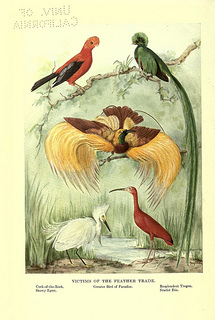
6956272927_479613cc0a_nAn article in a 1906 issue of Birds and Nature (the “only magazine in the world illustrated by color photography”) states that European traders first discovered birds of paradise when they visited islands in southeast Asia—some 300 years earlier—looking for spices. Some natives gave the explorers the dried skins of  birds with beautiful plumage. The locals called the birds “God’s Birds,” and when they killed them, they cut off the legs and feet, burying them under the tree where the birds came from as an offering to heaven.

The dried bodies of the birds were exported as time went on, and as the people of Europe had never seen one alive, but always the skin without legs and feet, they came to consider them as heavenly birds, indeed, formed to float in the air as they dwelt in the Garden of Eden, resting occasionally by suspending themselves from the branches of trees by the feathers of their tails, and feeding on air, or the soft dews of heaven. Hence they called [them] the Birds of Paradise.

Those Europeans with their creativity and imaginations.

So what’s in a name? Obviously, a lot more than I thought.

(Robert E. Paull and Odilio Duarte, Tropical Fruits, Volume 2, Cambridge, MA: CABI, 2012, p 168; “The Kingbird of Paradise,” Birds and Nature, October 1906, p 92)

[photos: “Passion Flower,” by kuribo, used under a Creative Commons license; and “n7_w1150,” by Biodiversity Heritage Library, used under a Creative Commons license]

At Eight Years Old, New Family, New Country, New . . . Everything

I missed Wo Ai Ni Mommy when it aired on PBS in 2010. Neither did I see it while it was still being streamed on the internet. But there are plenty of pieces online that give insight into this documentary of an adoption story.

Wo ai ni is Mandarin for “I love you,” and the film is about the adoption of an eight-year-old Chinese girl by Jeff and Donna Sadowsky, from Long Island. While comments about the film show that many have been inspired by the story, others are troubled by seeing the process of how Fang Sui Yong quickly became “Faith” and lost her Chinese heritage. If for nothing else, Wo Ai Ni Mommy is a thought-provoking look at adopting an older child internationally and shows the difficult transition, warts and all.

The DVD for the full film is available here, as well as a downloadable discussion guide and a lesson plan for grades 9-12, “Assimilation or Acculturation?” In introducing the lesson plan, PBS calls the documentary

an honest and intimate portrait of loss and gain. As an outreach tool it raises important questions about cultural preservation, transracial and international adoption, parenting, family and what it means to be an American, what it means to be Chinese and what it means to be white.

The lesson plan includes links to several short clips from the film:

Other clips available at PBS are

There are also two interviews with Amanda Baden, the counselor from the last clip, “Being Foreign Forever” and “Choosing between International and Domestic Adoption“; a Q & A session at the New York City Asia Society with Donna, Faith, and Stephanie Wang-Breal, the film’s director; and an update with the Sadowsky’s following the making of the documentary.

And finally, here are two more interviews, one with Donna Sadowsky and one with Stephanie Wang-Breal:

An American Wedding, Up Close and Personal

One of my favorite cross-cultural stories comes from a former colleague in campus ministry at a university. He had taken a group of international students to tour the state capitol building, and when they arrived, they were surprised to see that a wedding was taking place on the capitol lawn. What an opportunity to see up close an American tradition in a beautiful setting.

How “up close”? Well, two students from Korea wanted to get some good pictures, and before my friend could stop them, they walked straight up to the wedding party and sat down in the audience. And of course, the row that had the most available seats was the one in the front, next to the bride’s mother and father. So they sat there through the ceremony, nearly front and center. Best of all was that when it was over, as the usher’s dismissed the crowd row by row, the students followed protocol and walked down the aisle behind the parents.

No word on whether they took a place in the receiving line.

9016622729_00c89fe541
[photo: “QH3C3119,” by Jordan Smith, used under a Creative Commons license]
Nancy Berns: “Closure Doesn’t Exist,” Let Grief and Joy Be Intertwined

4677361453_f392fc8e47_n“What have you grieved in the past?” asks Nancy Berns, a sociologist at Drake University. “What might you grieve in the future? And some of you are grieving today. It’s not just the death of loved ones that we grieve. Our life is full of losses.”

These include the losses associated with transitioning between homes and cultures, away from family, friends, and the familiar.

When faced with that grief, we usually look for ways to move on, to find closure. But according to Berns, “Closure doesn’t even exist. It’s a made up concept that we use to talk about loss and grief.” And trying to gain closure “can do more harm than good.”

in her TEDxDesMoines talk below, Berns, author of Closure: The Rush to End Grief and What It Costs Us, says that we shouldn’t box up our pain, close the lid, and walk away to look for a separate place of joy. In a previous post I asked, “Can Grief and Joy Coexist?” Berns is convinced that not only do they exist together, but they are intricately intertwined.

Listen to her explain this relationship and open a box to share stories of people expressing their grief . . . and joy. Hers is a message for those who are grieving and for those know others who are dealing with sorrow. And that pretty much includes us all, doesn’t it?

Knowing that joy and grief can be carried together is so important,” says Berns, “because it’s a long journey without the possibility of joy.”

So the next time that you see someone who’s entering that space of grief—might be a family member, might be a friend, a coworker, just someone you recently met—don’t hand them a box. Don’t tell them to find closure. Meet them where they’re at. And they might be broken and down and beaten up.

Then, kneeling on the stage, she continues:

Meet them where they’re at. And while you’re there, take a moment and look around, ‘cause you might be surprised at the view you have when you’re on your knees. And if you’re the one broken, you might be surprised at how comforting it can be to have someone just meet you where you’re at, not to try and get you to stand before you’re ready, not to try and take away your pain or explain it away. Just to be with you. And when you’re ready, to give you a hand up, to take those steps. . . . You see it’s not about closure. Healing? Yes. But that’s different.

[photo: “Box 5,” by Brenda Clarke, used under a Creative Commons license]
Nando’s: Tastes like Chicken, Looks like an Art Gallery

2791367612_e1be822cbf_nThe Obama family are currently in South Africa, as part of a three-country visit to the African continent. The president will not meet with Nelson Mandela, who is in the hospital, but he has spoken with Mandela’s family by phone. While there, they will also tour Robben Island, where Mandela was a prisoner for 18 years.

I’ve never been to South Africa, but would love to visit. I have, though, found a place (somewhat) closer to home that might some day give me a taste of the country.

In Chris Stark’s interview with Mila Kunis, Stark invites Kunis to a Nando’s for some chicken (to which she responds, “You’re teaching me so much.”)

So what is Nando’s? Why, it’s “Home of the legendary, Portuguese flame-grilled Peri-Peri chicken,” of course.

And what does that have to do with South Africa? Go to the “Story of Nando’s” and you’ll see an animated history of how the restaurant came to be. In a nutshell. . . . Years ago, exploring Portuguese sailors ended up in Mozambique where they discovered the African Bird’s Eye chili pepper. Some 400 years later, some of these Portuguese left Mozambique for Johannesburg, taking with them their peri-peri chicken recipes. (Peri-peri is how they pronounced the Swahili name for the chili.) In 1987, Fernando Duarte and Robert Brozin bought a chicken restaurant—featuring peri-peri sauce—in the Rosettenville suburb of Jo’burg. They changed the name from Chickenland to Nando’s, and the chain was born. Nando’s restaurants are now found around the globe, and while they’re present in the US, they’re (so far) confined to Maryland, Virginia, and Washington, DC.

While each Nando’s is unique, one constant is that they all display artwork from South Africa. Their “art project” started in 2002, and since then, Nando’s has become the self-proclaimed “largest buyer of South African contemporary art in the world.”

What we like most about our art project is that it’s given undiscovered, emerging and established artists from diverse social and economic backgrounds the opportunity to have their work on display in our restaurants around the world. It feels really good to know that we’ve helped give many artists the freedom to focus on their art full time, and that we’ve given our customers something beautiful to look at, without having to set foot in a gallery. (from “Our Restaurants)

Nando’s even has an online display of over 170 pieces of their South African art, produced by “everyone from bushmen on community farms to renowned Johannesburg painters.”

Here’s a recent commercial for Nando’s in South Africa. Eyes down. Now up. Now look closely and you’ll see some of the South African art on the wall.

[photo: “Nando’s Peri Peri Sign,” by Mr T in DC, used under a Creative Commons license]