If You’re Stuck in Customs, Browse Trey Ratcliff’s Photos

Farewell India
Farewell India, by Trey Ratcliff

When I  saw the tag on Stuck in Customs, “Welcome to the #1 Travel Photography Blog,” one of my first thoughts was a paraphrase of Buddy the Elf: “You did it! Congratulations! The #1 travel blog! Great job, everybody! It’s great to be here.”

Then I read more about Trey Ratcliff, the blog’s author, on his “About Trey” page and learned that his photos register over a million views each week. I guess that probably does make him number one.

And somewhere along the way, I added to his view total by looking at a bunch of his photographs. His work is pretty amazing. Not only does it span the globe, but he is an expert in—and proponent of—high dynamic range (HDR) imaging. By Ratcliff’s definition, HDR “is a post-processing method of taking either one image or a series of images, combining them, and adjusting the contrast ratios to do things that are virtually impossible with a single aperture and shutter speed.” The result is a picture that better imitates what is actually seen by the eye, and remembered by the brain, with a fuller range of light and color. If you’re interested in creating your own HDR masterpieces, take a look at Ratcliff’s free tutorial (in nine languages).

A gallery of Ratcliff’s photos are at his online portfolio or at his Flickr account, or you can follow his blog and see a photo a day.

Oh, yeah. The other part of Ratcliff’s blog that caught my attention is its name. For a site focused on global/cross-cultural content, Stuck in Customs is quite possibly the #2 title out there.

Customs: If you can’t clear ’em, enjoy some photos while you’re stuck in ’em.

Miracle in Iceland
Miracle in Iceland
River Runs through the Andes
A Moody Evening at the Great Wall

[photos:  “Farewell India,” “Miracle in Iceland,” “River Runs through the Andes,” and “A Moody Evening at the Great Wall,” by Trey Ratcliff at Stuck in Customs, used under a Creative Commons license]

Even Paul Needed Member Care

5389776890_84c6406d67_nEven Paul—the apostle, the quintessential missionary, and, to many, the quintessential Christian—needed member care.

At times, Paul stressed his independence. In his letter to the Galatian churches, he affirmed that his role as an apostle came directly from Jesus, not from his association with the other apostles:

But when the one who set me apart from birth and called me by his grace was pleased to reveal his Son in me so that I could preach him among the Gentiles, I did not go to ask advice from any human being, nor did I go up to Jerusalem to see those who were apostles before me, but right away I departed to Arabia, and then returned to Damascus.

But Paul wasn’t a loner. He took partners with him on his missionary trips, and he looked to others for encouragement and comfort . . . for member care.

When Paul finally met with the apostles in Jerusalem, Barnabas helped him by being his advocate, vouching for his dedication to Jesus. Later, Barnabas sought out Paul for his help in working with the church in Antioch, and the two were sent out by the church on Paul’s first missionary journey. It was during his trips (three are recorded in the book of Acts) and while he was a prisoner that Paul wrote his New Testament letters, often mentioning those who served to encourage him.

Near the end of his first letter to the church in Corinth, he wrote about “the household of Stephanus” (or Stephanas), who “devoted themselves to ministry for the saints,” and added,

I was glad about the arrival of Stephanus, Fortunatus, and Achaicus because they have supplied the fellowship with you that I lacked. For they refreshed my spirit and yours. So then, recognize people like this.

In his second letter to the Corinthians, Paul told about how he turned away from a God-given ministry opportunity because he needed to hear from Titus:

Now when I arrived in Troas to proclaim the gospel of Christ, even though the Lord had opened a door of opportunity for me, I had no relief in my spirit, because I did not find my brother Titus there. So I said good-bye to them and set out for Macedonia.

Then, in Macedonia,

our body had no rest at all, but we were troubled in every way—struggles from the outside, fears from within. But God, who encourages the downhearted, encouraged us by the arrival of Titus. We were encouraged not only by his arrival, but also by the encouragement you gave him, as he reported to us your longing, your mourning, your deep concern for me, so that I rejoiced more than ever.

While under house arrest in Rome, Paul wrote to Philemon, “I have had great joy and encouragement because of your love, for the hearts of the saints have been refreshed through you, brother.” But Paul  had an issue he wanted to address, as well. Onesimus, Philemon’s slave, had run away, had come to Paul, and had become a Christian. Paul was sending him back to Philemon, not as a slave but as a brother in Christ, even though Paul wrote, “I wanted to keep him so that he could serve me in your place during my imprisonment for the sake of the gospel.” Paul also looked forward to spending time with Philemon in the future, telling him to “prepare a place for me to stay, for I hope that through your prayers I will be given back to you.”

Still a prisoner, Paul wrote to the Colossians and the Philippians. He told those in Colossae that Aristarchus, Mark, and Jesus (called Justus) were the only Jewish Christians still working with him, saying “they have been a comfort to me.” And to the Christians in Philippi, he told of his plans to send to them Epaphroditus, whom he described as

my brother, coworker and fellow soldier, and your messenger and minister to me in my need. Indeed, he greatly missed all of you and was distressed because you heard that he had been ill. In fact he became so ill that he nearly died. But God showed mercy to him—and not to him only, but also to me—so that I would not have grief on top of grief. Therefore I am all the more eager to send him, so that when you see him again you can rejoice and I can be free from anxiety. So welcome him in the Lord with great joy, and honor people like him, since it was because of the work of Christ that he almost died. He risked his life so that he could make up for your inability to serve me.

Later, imprisoned in a Roman dungeon, Paul wrote his second letter to Timothy, saying, “As I remember your tears, I long to see you, so that I may be filled with joy,” and then,

May the Lord grant mercy to the family of Onesiphorus, because he often refreshed me and was not ashamed of my imprisonment. But when he arrived in Rome, he eagerly searched for me and found me. May the Lord grant him to find mercy from the Lord on that day! And you know very well all the ways he served me in Ephesus.

Alone, except for Luke, Paul told Timothy, “Make every effort to come to me soon,” requesting that he also bring Mark, because “he is a great help to me in ministry.” Paul even mentions some items that he needs (a care package?), asking Timothy to bring along a cloak that Paul had left in Troas, as well as his scrolls.

Even Paul needed member care. Or maybe we should say, given the hardships that he faced, especially Paul needed member care. He needed it, and he appreciated it.

 And if Paul needed it, so do today’s missionaries, every one.

(Scripture quoted by permission. All scripture quotations are taken from the NET Bible® copyright ©1996-2006 by Biblical Studies Press, L.L.C. www.bible.org. All rights reserved. This material is available in its entirety as a free download or online web use at http://netbible.org/.)

[photo: “St. Paul (Burne Jones),” by Lawrence OP, used under a Creative Commons license]

In Sports and Member Care—Be Safe

8034078799_e3ca406150_n

This post is about the need for safe confidants in the lives of cross-cultural workers. But before I address that directly, I’d like to share three relevant stories from the world of sports:

From Major League Baseball
In 1978, All-Star catcher Carlton Fisk played a key role in the Boston Red Sox’s tight pennant race. But he was playing hurt—with injuries that had the potential for long-term harm. In a Sports Illustrated article published the next year, pitcher Bill Lee described Fisk as one of those players who “like to gut it out.” “He’s just going out there because of his puritanical upbringing,” he said, “you know, staunch, quiet, archconservative, play-with-an-arrow-in-your-heart type of thing.”

Even though Lee thought Fisk should take some time off, no one on staff with the Red Sox told him to sit down—not the manager, not the owner, not even the team doctor, Arthur Pappas.

The role of team doctors and “especially the question of where their loyalties lie” was the focus of the SI article. What was Pappas’s top priority, Fisk’s welfare, or the team’s? Should a player expect a team doctor to look out for him the same way a personal physician would? Is there a conflict of interest built into the system?

While Fisk praised the qualifications of Boston’s physician, he also knew that Pappas not only worked for the team’s owners but was a part owner himself. Fisk admitted that the decision to play was ultimately his own, but he wondered if he’d gotten the best advice. “He’d be wanting to get you better,” he said about Pappas, “but not with the players’ interest at heart. He’d want to get you better for the team.”

(William Nack, “Playing Hurt—the Doctors’ Dilemma,” Sports Illustrated, June 11, 1979)

From the NFL
Twenty-nine years later, Sports Illustrated looked at this difficult issue again. (The titles of both articles include the word Dilemma.) This time, reporter Selena Roberts talked to an NFL player who told her about being injured on the field the previous season. When he’d seen his team’s medical staff rushing toward him, he’d wondered, “Whose side are they on?”

Roberts also talked with Andrew Tucker, team physician for the Baltimore Ravens, on the topic of confidentiality concerning “personal matters.” “This is where that unique situation of dual responsibility comes in,” he said. “If a player’s medical issue—like depression—gets to the point where performance is affected, then I have the responsibility to certain people in the club. . . . Now, sometimes players will choose to share that information with other people.”

One answer to the problem, wrote Roberts, is an NFL-wide health-care system that puts doctors under a “league-union cooperative” rather than on the payroll of individual teams. This would increase trust in the patient-doctor relationship and encourage more openness and honesty.

Robert Huizenga, former team doctor for the Oakland Raiders, said that after he left the organization, he was surprised at how many players only then sought him out for help. “How much was hidden from me?” he asked.

(Selena Roberts, “Rx for a Medical Dilemma,” Sports Illustrated, November 3, 2008)

From the NBA
In 2007, Greg Oden was selected by the Portland Trail Blazers as the #1 pick in the NBA draft, but since then things have mostly gone downhill from there. He soon had microfracture surgery on his right knee and missed his entire first season. He played most of the following season, but by his own admission, during that time he “pretty much became an alcoholic.” Before his third year with Portland, he got his drinking under control and got himself into shape, but his season was cut short when he fractured his left kneecap. Then a couple weeks later nude photos he had taken of himself were leaked to the Internet.

Oden was in need of counseling, and he contacted sports psychologist Joseph Carr. Paying for sessions out of his own pocket, Oden met with Carr regularly, but that ended when the Blazers also hired Carr. When Oden saw Carr talking with people from the Blazers’ front office, he was suspicious that Carr was disclosing information from their sessions, and he stopped their meetings. According to Oden, it “seemed like a conflict of interest.”

(Mark Titus, “Oden on Oden,” Grantland, May 9, 2012)

Member Care—Safety First
When athletes don’t feel “safe” with team doctors or counselors, they don’t get the care they need, and they suffer. When cross-cultural workers don’t have safe confidants, they suffer, as well.

We all need safe people to talk to. Safe people care about us as individuals. They accept us for who we are, not for what we can do. They don’t listen to us with competing agendas or loyalties. (For more on what makes a person safe, see Drs. Henry Cloud and John Townsend’s Safe People: How to Find Relationships That Are Good for You and Avoid Those That Aren’t [Grand Rapids: Zondervan, 1995].)

While this safety is important to everyone, it is especially crucial for cross-cultural workers, because they have been removed from their natural support network. That makes safe, trustworthy confidants more difficult to find and often more needed. With fewer and fewer casual and informal relationships, cross-cultural workers must often turn to those in their own organization, who have a vested interest in the organization’s success or who sit in the workers’ line of authority.

In the Christian community, the giving of emotional and spiritual help to missionaries, and other cross-cultural workers, is often called “member care.” Ronald L. Koteskey, in “What Missionaries Ought to Know about Member Care,” writes that it includes many facets:

friendship, encouragement, affirmation, help, and fellowship as well as sharing, communicating, visiting, guiding, comforting, counseling and debriefing.

For some, the person who fulfills these roles is called a “coach” or “mentor.” I am using the term “member-care giver” because it is what I’m more familiar with and because I don’t think that what it represents needs to be limited to the church. Neither does it necessarily carry the meaning of someone with specialized education or training, though those things can sometimes be beneficial.

Using the definition above, I can say that member care is necessary for all cross-cultural workers. But when it comes to safety, not all member care is equal. So what can we do to promote true safety?

Safety is vital to deep, healthy, trusting relationships, the kind of relationships that cross-cultural workers desperately need. Here are some observations to help in making those relationships a reality.

  1. Safety can’t be claimed, it must be earned. We can argue all we want about how someone should be seen as safe, but if the worker doesn’t feel that way, then should doesn’t matter. The doctors and counselors in the sports examples above would say that they are trustworthy, but that doesn’t take away the athletes’ concerns. A member-care giver can take steps to make himself more safe, but he can’t force someone else to see him that way.
  2. Where there is a lack of safety, it is only natural that there will be a lack of openness. And when there is a lack of openness, those giving member care will hear only incomplete stories.
  3. Safety is damaged when the worker is accountable in his job to the member-care giver—or when the member-care giver reports to someone else who has that role of authority. And this authority isn’t always clearly defined. Take, for instance, missionaries, whose emotional and spiritual supporters back home now support them financially. How open will missionaries be with people who are investing in their work? What about the leadership of the sending church, or the member-care professionals on staff with the sending agency? Do missionaries wonder, “Whose side are they on?” Can missionaries even ask this question without feeling disloyal to their church, to God?
  4. Who can honestly say to a cross-cultural worker, “In this relationship, you are my priority. I am more concerned about your physical, emotional, and spiritual wellbeing than I am about the success of your work. If you quit this vocation, I will still support you because I am invested in you”?
  5. We can learn from counselors who begin their sessions by saying, “What you say to me is confidential. I won’t share it with anyone (your boss, your organization, your parents, your coworkers, etc.) without your permission, unless you pose a danger to yourself or someone else.”
  6. If a member-care giver talks to a worker about others’ personal problems, that worker can assume that her problems are being shared with others, as well.
  7. In discussing the situation in the NFL, Selena Roberts suggests the formation of a “league-union cooperative.” To date, the football powers that be haven’t implemented such a system. And while there’s no “league” or “union” for cross-cultural workers, concerned people have come together to form “cooperatives” of sorts to provide safe member care (or coaching or mentoring). There are many of these groups, and a wide range of them can be found in a quick search of the Internet. Among them you’ll find trained member-care givers, professional counselors, people who “get” what cross-cultural workers are going through, those with their own overseas experience, and opportunities for extended care and training, on the field and at dedicated facilities. For those looking for help or training coming from a Christian worldview, or for those just wanting to get a taste of what is out there, here are three groups which I’d recommend:
    – Mission Training International (MTI)
    – Barnabas International
    – Link Care

If you are a cross-cultural worker, don’t go it alone. And don’t simply go through the motions of member care with someone you don’t trust. It is vital—and well worth the effort—to find someone who is truly safe . . . a confidant, an advocate, a friend.

(Ronald L. Koteskey, “What Missionaries Ought to Know about Member Care,” Missionary Care: Resources for Missions and Mental Health)

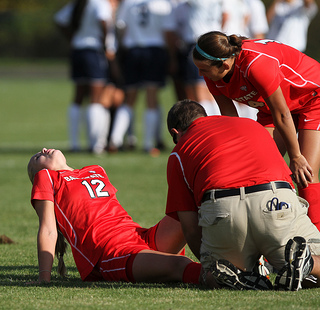
[photo: “Flashes vs Cardinal Soccer,” by lindsayjf91, used under a Creative Commons license]
A Scholar, a Footballer, and a Tourist Walk into a Foreign Country . . .

Did you hear the one about the Fulbright Scholar in China studying stand-up comedy? The student, Jesse Appell, put together a spoof of Psy’s “Gangnam Style,” called “Laowai Style.” Lao wai is a Mandarin term for foreigner—literally meaning “old” and “outside.” Here’s the video, with subtitles:

And then there’s the former amateur soccer player from Norway, Havard Rugland, who watched the Super Bowl in 2011 and started working on his American-football-kicking skills. The result was a video of amazing trick kicks, called “Kickalicious.” It went viral and caught the attention of some NFL franchises, with a couple giving him tryouts. Last week, the Detroit Lions announced that they had signed him to their team. No joke.

I heard about the two stories above on “PRI’s The World” while I was listening to NPR in my car last Friday afternoon. This last video isn’t related, but it shows some cross-cultural miscommunication, between an English-speaking tourist and a couple French locals—and I think it’s pretty funny. It’s “Do You Speak English?” by BBC’s Big Train comedy team:

(Nina Porzucki, “Humoring the Chinese: An American Comedian Has a Run-in with Chinese Censorship,” PRI’s The World, April 12, 2013; Steven Davy, “Norwegian Kicker Havard Rugland Signs Detroit Lions NFL Deal after YouTube Video Goes Viral,” PRI’s The World, April 12, 2013)

Asian-American Stereotypes: “A Whole Different Issue”

Jeremy Lin puts up a shot in a game against the LA Lakers last year.
Jeremy Lin shoots in a game against the LA Lakers last year.

60 Minutes devoted a segment of its April 7th show to Jeremy Lin. Lin’s is a great story—born to Taiwanese parents in California, he graduated from Harvard and now plays basketball for the NBA’s Houston Rockets. The interview covers a range of topics, including culture, race, religion, and . . . prejudice.

When Charlie Rose asked Lin about why he didn’t get any scholarship offers from Division I schools, even though he was named California’s player of the year in high school, Lin replied: “Well, I think the obvious thing, is . . . in my mind is . . . that I was Asian-American, which, you know, is a whole different issue, but that’s . . . I think that was a barrier.”

“When you say because you were an Asian-American, what is that?” said Rose. “Because there’s nothing about being an Asian-American that doesn’t give you the ability to play basketball.”

“Yeah,” said Lin. “I mean it was just, I mean it’s a . . . it’s a stereotype.”

“Average” Asian Americans?
While Lin certainly contradicts some common Asian-American stereotypes, he seems to fit with others.

A study by the Pew Research Center, “The Rise of Asian Americans,” gained attention last year for announcing that Asian-Americans had surpassed Hispanics as the largest group of immigrants entering the US. But there is a lot of other information in the detailed report, including:

  • In 2010, 49% of Asian Americans age 25 and older had a bachelor’s degree or more (compared to 28% of the overall US population).
    “More than six-in-ten (61%) adults ages 25 to 64 who have come from Asia in recent years have at least a bachelor’s degree. This is double the share among recent non-Asian arrivals, and almost surely makes the recent Asian arrivals the most highly educated cohort of immigrants in U.S. history.”
  • The median household income of Asian Americans is $66,000 (US population: $49,800)
  • 93% agree with the statement, “Americans from my country of origin group are very hard working.”
  • 50% identify as part of or lean toward the Democratic Party, while 28% identify or lean Republican.
  • The largest religious affiliation for Asian Americans is Christian, at 42%. The next largest group is “Unaffiliated,” at 26%.

A Double-Edged Sword
While much of the information in the Pew report reflects well on Asian-Americans, some feel that the statistics can have negative consequences.

Deepa Iyer, executive director of the National Council of Asian Pacific Americans, told NPR that

it’s really important to understand that the community’s not a monolith and that we can’t use this information to think that it is the norm across all Asian-Americans because, historically, our communities have either been seen as model minorities or we’ve been put into the box of being disloyal, suspicious or we’ve been put into a box of foreigners who take away jobs. And the reality is that none of these stereotypes are true. Right?

Iyer wants us to remember that within the group of Asian Americans are many subgroups, representing people from a great diversity of circumstances and from a great diversity of countries—such as China, India, Vietnam, Pakistan, Cambodia, and the Philippines. (The Pew site has a great graphic that breaks down the demographics for each country of origin, here.)

Asian immigrants themselves tend to identify more with their country of origin than simply as “Asians.” While 19% most often refer to themselves as “Asian” or “Asian American,” 62% most often describe themselves by their country of origin, as in “Chinese” or “Chinese American.” Only 14% most often call themselves “American.”

Academic Robots?
The question of what to call oneself can be especially relevant to high-achieving high-school graduates. According to an Associated Press article, published in USA Today, some are refusing to check the “Asian” box on applications for top colleges. That is because they believe they need to score hundreds of points higher on test scores to compete with applicants from other ethnic groups. Critics of the current system believe

that Asian-Americans are evaluated not as individuals, but against the thousands of other ultra-achieving Asians who are stereotyped as boring academic robots.

Some applicants refuse to mark any box in the race section, but some who are mixed race, have a choice of which box to check.

Tao Tao Holmes is a student at Yale. Her mother is Chinese-born, and her father is a white American. She told AP:

My math scores aren’t high enough for the Asian box. I say it jokingly, but there is the underlying sentiment of, if I had emphasized myself as Asian, I would have (been expected to) excel more in stereotypically Asian-dominated subjects.

Holmes calls herself “an American . . . an Asian person who grew up in America.”

Susanna Koetter, another student at Yale, said that her racial identity changes depending on where she’s at. The daughter of a Korean mother and a white American father, Koetter said she’s “not fully Asian-American. I’m mixed Asian-American. When I go to Korea, I’m like, blatantly white.” But back in the US, when it came time to fill out her college application, did she leave the “Asian” box unchecked? No. “That would be messed up,” she said. “I’m not white.”

(“Linsanity: Jeremy Lin’s Rise to Stardom,” 60 Minutes, CBS News, April 7, 2013; “The Rise of Asian Americans,” Pew Research Center, June 19, 2012, updated April 4, 2013; Asian-Americans on the Rise,” NPR, June 20, 2012; “Some Asians’ College Strategy: Don’t Check Asian,” USA Today, December 4, 2011)

[photo: “Jeremy Lin 林书豪,” by DvYang, used under a Creative Commons license]

Pitt Pal: Facilitating Friendships with International Students

4935587436_f4ea98c4df_n
A student worker shares about International Programs and Services at PSU’s annual Community Activities Fair.

Tucked in the southeast corner of Kansas, in the heart of the United States, is Pittsburg State University. Though it’s far from any international borders, this school with an enrollment of  less than 7,300 has become the educational destination for students from around the globe, with 469 internationals attending from 37 countries in the spring of 2012.

In light of statistics that say more than one third of international students have no close American friends, it is easy for students to arrive in the US feeling out of place and to leave feeling the same way. How does a school like Pitt State leverage Midwest hospitality to make its international population feel at home?

One answer is the Pitt Pal program, which facilitates friendships by pairing international students with American students. I asked the coordinator of Pitt Pal, Brenda Hawkins, to share about the program:

Pitt State had its International Friends program, matching up international students with local families, for many years before starting Pitt Pal. What are some of the added benefits of involving American students, rather than just relying on families?

My first day of work here we went to a regional international education conference and I heard K State talk about their buddy program. Realizing that we didn’t have anything like that I did some research on that type of a mentor program and we decided PSU needed one. At first I thought it would be a great opportunity for a domestic student to serve an international student and help them acclimate to the USA and college life here. We also wanted to encourage domestic students to have a global eye and outreach and knew that this would change their lives as well. Having been overseas myself on many trips, I knew that the hospitality of people we met always impressed me and helped us feel welcome.

The local family opportunity is encouraged to meet at least once a month. I felt like international students could also benefit from more frequent interaction with an American-born student. Since they would have in common being students this would provide an initial platform to build a friendship on. Being on campus and perhaps in the same dorm or classes would lend itself to potentially daily contact.

A recent survey found that 38% of international students have “no strong American friendships.” What do you see as the biggest obstacles to friendships between US and international students, and how does Pitt Pal help to overcome them?

In a nutshell, obstacles to friendships between US and international students are language barriers, cultural differences and misconceptions, stereotypes, and indifference to get out of your comfort zone and learn about another culture. Students don’t always see the value in learning about another culture and the effort that takes.

But I think another obstacle is a structural challenge that most universities face because international students arrive on campus up to a week before domestic students return. The first students they have a chance to meet and befriend are other international students. By the time most of the domestic students return to campus, friendships are formed and they tend to sit with other international students in class. To an American student it may appear that internationals prefer to hang together. Another structural challenge in some universities is that international students are separated from domestic students in their freshman experience classes. While this is necessary because some topics are unique to each group, it might put them on unequal footing for making friends.

Pitt Pal helps overcome these obstacles because it becomes a tool to facilitate cultural interaction and challenges each party to a level of commitment. It helps break the ice for students who may not reach out to form friendships with those who do not have as much in common with them. Finding common ground is key to the beginning of a newly forged relationship between an international and domestic student.  In getting acquainted, students relate to each other by finding similar interests like shopping, sports, food, and exchanging stories about their lives.  But having a desire and flexibility to try and learn new things takes the friendship to another level.

Pitt Pal helps students get to know the individual regardless of their culture and not hide behind generalities. They learn to appreciate the differences and similarities of their cultures and personalities.

Also, for the domestic student it appeals to their sense of helping a student in need.  This generation is strong in their desire to volunteer. I believe finding common ground and having a commitment to this responsibility helps overcome stereotypes and misconceptions. When domestic students return from their study-abroad opportunities, they understand the challenges international students face and are quick to volunteer to help them acclimate.

That’s an interesting thought on international students arriving to campus early. I would think that having students get in touch with each other before the international students get to the States helps with that. Of course, in the end, the relationships that develop are dependent on how much the students invest in them. Can you leave us with a couple examples that show the potential of Pitt Pal friendships?

I have several great examples of Pitt Pal relationships. Some American students have even been able to visit their international friends when they were on study abroad in Korea and Finland, etc. But I think I’ll let two students from China tell about their experiences in their own words, from essays they wrote about Pitt Pal:

This was my first time to meet my Pitt Pal. She was in a green shirt with golden hair and sunshine smile. We introduced ourselves to each other and she said she was American and good at volleyball while I like Ping-Pong, but this didn’t affect us talking about our favorite clothes and bags. We also determined that next week I would cook Chinese dishes for her and she would teach me how to bake.

and

I am proud that I built a good relationship with my Pitt Pal over the semester. I am so thankful for her keeping company with me during the fall break, when everyone flew to other places to have an enjoyable holiday except me. Even though the dorm on that day was very cold, I felt warm with my Pitt Pal and not lonely any more.

[photo: “DSC_0018,” by Michael Fienen, used under a Creative Commons license]

Preschooler Lessons in Taiwan

137606024_740de4ca96

Last week’s post on adoption got me rethinking some of my family’s experiences. Here’s a story we put in a newsletter three years ago. One of our sons is Taiwanese and had been in our Taipei home for a couple years, long enough to become a part of the culture within our walls.

Our youngest son has recently started preschool in the mornings. The main goal is to help him understand and speak more Chinese. After his first day, the teacher told my wife that he was hugging the other children—and they didn’t know how to respond. The teacher said that she explained to them, “It’s OK, he’s a foreigner. They hug a lot at his house.”

As he learns more about himself and the world around him, we have more opportunities to talk with him about “who he is.” While we were out one day last month, he saw a sign showing Chinese chess pieces. He asked why they had letters on them. I told him that they weren’t letters, they were Chinese characters. Seeing an opportunity, I asked him, “Are you Chinese?”

He said, “No.”

“Are you American?”

“No,” again.

“What are you?” I asked.

“I’m normal,” he said.

[photo: “Parachute Fun,” by Chris Pawluk, used under a Creative Commons license]

Exporting Fast Food: The Biggest American Chains

Ronald McDonald in Thailand

You already know that McDonald’s is the global king of fast-food success, but do you know which US chains are next in line outside of America’s borders?

Well, the answer depends on how you define success. If overall non-US sales is important to you, then number two is KFC, followed by Burger King (according to figures from 2011).

But if you’re more of a How-many-international-restaurants-do-they-have? kind of person, then Subway comes after the Golden Arches and KFC.

Or maybe you care about who’s expanding the most. In that measurement, McDonald’s isn’t in the top five. The three American companies that opened the most non-US units—from 2009 to 2010—are Subway, Dunkin’ Donuts, and KFC.

All this information comes from QSR‘s “Global 30,” a sortable list ranking the top American “quick-service” restaurants outside the US.

Below are the ten American chains with the most restaurants outside the US. That’s the list I’m most interested in, since that gauges your chance of running into one of them overseas. Most are in Taiwan, so I’m adding embellishments from my experiences during my time in Taipei. We had more than our fair share of American fast-food outlets in the capital city, but there were still some gaps. I mean, how can a city of 6 million be Taco Bell-less?

  1. McDonald’s – 18,710 units
    When we first arrived, we didn’t have the vocabulary to order individual items, so we just ordered meals by number. This meant a soda for even our smallest child, and we had four children. One day I walked up three flights of stairs (most McDonald’s in Taiwan are vertical) balancing 6 Cokes on a tray. I was pretty proud that I’d made it and pretended to stumble when I got to our table . . . and spilled the whole tray. . . . On another day we went to our local McD’s to find out that they’d run out of hamburger. I didn’t know that was possible.
  2. KFC – 11,798
    The extra crispy chicken at Taiwan’s KFCs is spicy hot, which we grew to like more than its American counterpart. And because the Taiwanese like dark meat better than white meat, when we ordered a bucket of chicken, we could substitute white for dark at no extra cost. One negative is that their KFCs don’t have slaw. I love KFC’s slaw.
  3. Subway – 10,109
    You could almost replace your vegetable-vocabulary unit in language learning with several trips to Subway. If you want the right toppings on your sandwich, you simply have to learn the words. Pointing at “that green thing” won’t do. Building a sandwich at Subway is like a chapter test. . . . By the way, a Subway near us in Taipei also ran out of meat. For a few days it was a salad shop.
  4. Pizza Hut – 5,890
    We had a Pizza Hut around the corner from our last apartment in Taiwan. Loved their pepperoni pizza. Not so crazy about toppings with peas or corn . . . or squid . . . or tuna.
  5. Starbucks – 5,727
    Most of what I have to say about Starbucks I’ve already said here. The chain has made a big enough impact on the tea-drinking island of Taiwan that several coffee shops have sprung up with circular green logos and/or copycat names (ecoffee, for example). My favorite was the shop that had a sign that said, in a small font, something like, “We’re Not,” over the very large, “STARBUCKS.”
  6. Burger King – 4,998
    For a while, my absolute favorite sandwich was a bacon cheeseburger from the Burger King in Keelung next to the train station, eaten on the train as I and a teammate rode back to Taipei after our evening Bible studies with students at the National Taiwan Oceanic University. My second favorite sandwich near the station was a da chang bao xiao chang, or “big sausage wrapped around a small sausage” (the outer “sausage” was made from sticky rice).
  7. Domino’s – 4,422
    After serving for two years as a Mormon missionary in Taiwan, Scott Oelkers returned to Minnesota and double majored in Chinese and economics. Following his graduation, he got a job as a buyer for Domino’s Pizza International and worked his way up to vice president. He sold franchise rights in Taiwan to a private equity firm, and the firm asked him to run the business for them. He did, and in the process became a minor celebrity in Taiwan with his humorous TV commercials. Now Oelkers is president and CEO of Domino’s in Japan. He’s still making commercials, like the one below that just came out last month. Betsy Isaacson of the Huffington Post calls it “the most awkward ad in the universe.” I guess one man’s awkward is another man’s profitable.
  8. Dunkin’ Donuts – 3,005
    When the first Mister Donut opened in Taipei in 2004, the lines were so long that there was a sign a ways back on the sidewalk that read, “240 minutes from this point.” Dunkin’ Donuts came not long after, and we were glad to see one open in our neighborhood. We held our team meetings there for a while because we usually had the upstairs mostly to ourselves. Not a good sign. It closed.
  9. Dairy Queen – 802
    There’s no DQ in Taiwan that I know of (and we usually heard about those kind of things). I do see from an article in Taiwan Today that one was slated for opening in 1986 “located near Church’s Texas Fried Chicken and Lotteria in Taipei.” Someone else with a longer history in Taiwan would have to say whether it ever opened its doors.
  10. Papa John’s – 755
    We’re getting farther down on the list, and neither is there a Papa John’s in Taiwan. But that doesn’t mean there’s not room for another pizza franchise, or room for some other kind of fast-food chain. The question is, which one should it be? . . .

For those of you living outside the US, are there any restaurants that you long for? For you American expats, what tastes do you miss, and what do you think would go over well among the locals?

Wendy’s? It comes in at number 11. Taipei used to have at least one. I’ve heard stories from my former coworkers, and a Taipei Wendy’s is even the setting for a short scene in Ang Lee’s 1994 movie, Eat Drink Man Woman.

Or how about Long John Silver’s? It didn’t make the Global 30. One came to Taipei for a short time. We ate there a couple times just to try it out. As I recall, it didn’t last more than a year.

Oh, yeah. There’s Taco Bell (#19). Why can’t you find more Taco Bell’s overseas? I can’t count how many times I heard American expats say that when they get back home the first thing they want to do is eat at a Taco Bell.

I asked a good Taiwanese friend—who had studied at a US university—if he thought Taco Bell would do well in Taiwan. He wasn’t sure that it would, as Mexican flavors don’t always fit the Asian palate. Then I asked him about Arby’s (#21). It seems to me that roast-beef sandwiches could fit in in a lot of cultures, and I like them a lot, too. He said, no, that he didn’t think that there would be enough room for parking. That seemed strange since most fast-food restaurants in Taiwan don’t have any dedicated parking at all. When I questioned that, he said that Arby’s are just too big for Taiwanese. I was confused. Were we talking about the same thing? They’re too big, he said again. Who in Taipei would have room to park an RV?

Hmmmm. Maybe our miscommunication has birthed an idea. How about setting up a fleet of mobile Arby’s in RVs around the globe. I wonder. . . .

(“The Global 30,” QSR Magazine, April 30, 2013; “Scott Oelkers: Bringing Something Extra to the Table,” College of Liberal Arts, University of Minnesota; “Personality, Pizzaz Mixes with Pizza,” Taipei Times, September 9, 2002; Ashley Chang, Tiffany Huang, and Alan Wu, “Mister Donut—Worth the Wait?” Centered on Taipei, December 2004/January 2005; Betsy Isaacson, “Domino’s Ad Featuring Japanese Computer-Generated ‘Vocaloid’ Hatsune Miku Is Incredibly Awkward,” March 8, 2013; “Dairy Queen Joins American Parade of Food Chains to ROC,” Taiwan Today, December 29, 1986)

[photo: “Sawatdee Khrab!” by iamagloworm, used under a Creative Commons license]