In Praise of Petite Feet

I remember seeing a large advertisement in the Taipei subway station showing a Western model in a swimsuit sporting a dark tan. In the US, a photo of a lady with that kind of complexion might be promoting a tanning product, but in Taiwan, it was an example of what you don’t want to look like. Instead, the ad was for a skin whitener. Beauty really is in the eye of the beholder. But recent research has finally shown us a female trait that everyone around the globe agrees is attractive: little feet.

According to a team led by Daniel M.T. Fessler, six studies confirm that “small foot size is preferred when judging women.” In one study, when asked to pick the most attractive women, males and females from eight countries chose the ladies with the smallest feet. That’s because everywhere in the world, small feet represent “youth and femininity, and thus desirability.” . . . Um, well, not everywhere. Seems there is one group of people who disagree. They are the Karo Batak of rural Indonesia, hard workers who often don’t wear shoes. They prefer women with large feet, which are associated with strength and a better ability to work in the fields.

The research was presented in the journal Evolution & Human Behavior, under the title “Testing a Postulated Case of Intersexual Selection in Humans: The Role of Foot Size in Judgments of Physical Attractiveness and Age” (abstract here). (I’m thinking a lot of cultural anthropologists and their ilk have a preference for long titles.)

(Tom Jacobs, “Great Dessert? Depends on the Plate,” Miller-McCune, March 2, 2012)

Evolution and human behavior. Now those are a couple topics that can cause some disagreement around the world. An article published in Science in 2006 reported on studies showing that adults in the US, when compared to people in 32 Europe countries and Japan, are much less likely to accept “the evolution of humans from earlier forms of life.” Back then, only 14% of adults in the US believed evolution to be “true,” while about one third said it was “false.” The only country in the study with a lower opinion of evolution was Turkey. On the opposite extreme of the spectrum was Iceland, where over 80% of adults believed in evolution.

(John Hartman, Eugenie C. Scott, and Shinji Okamoto, “Public Acceptance of Evolution,” originally in Science, August 11, 2006, online at The Richard Dawkins Foundation for Reason and Science)

[upper photo: “Chinese Bound Feet (7)” by DrJohnBullas, used under a Creative Commons license; lower photo: “DanicaPatrick_05” by daisygold2002, under a  Creative Commons license]
Joplin, Missouri, USA, World

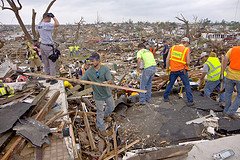
It’s been ten months since an EF5 tornado hit Joplin, MO, where we live. (We moved back here in June.) The city is still recovering, but even though there’s still a long way to go, a lot of progress has been made, in large part because of the thousands of volunteers who have given time to help. It’s spring break now, and workers are coming in from all over the country. Since May 22, help has come from outside the US, as well: For instance, after the Joplin school district announced its plans to provide Joplin high schoolers with MacBooks, the United Arab Emirates decided to donate $500,000 to help pay for them—with an additional pledge of another half-million dollars in the form of matching funds for the laptop program.

(Kelsey Ryan, “United Arab Emirates Donates $500,000 for High School Laptops,” The Joplin Globe, August 9, 2011)

And then there’s Toshiya Muto, who came to Joplin from Japan, to help in the cleanup. Muto wanted to pay back the US for what Americans did for his country after the tsunami. While in Joplin, Muto rode his bike 10 miles round trip everyday from his hotel to the disaster zone. “Of course it has an impact on my life,” said Muto, “but though my strength may be soft, slightly weak, if it has some impact, if someone needs me to exert myself, I’d like to do my best to help.”

 (Ethan Forhetz, “Joplin Tornado Victims Get Help from Japan,” WCTV, June 28, 2011)

[photo by BabyBare11, used under a Creative Commons license]
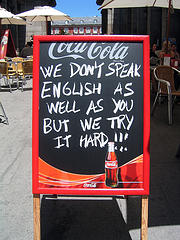
Attention Monoglots

What do you call someone who speaks three languages? Trilingual. What about someone who speaks two languages? Bilingual. And someone who speaks one language? American. (It’s an old joke, but when I was teaching ESL, my students thought it was funny.) There’s even a name for a person who can speak more than 10 languages. It’s hyperpolyglot. But hyperpolyglotism is not in everyone’s future. Michael Erard, author of Babel No More: The Search for the Worlds’ Most Extraordinary Language Learners, writes, “Hyperpolyglots are not born, and they are not made, but they are born to be made.” Do you have what it takes? Hyperpolyglots tend to be male and left handed and tend to have high IQs . . . and immune disorders. Not sure why.

(“How Do You Learn to Speak More Than 12 Languages,” The Hot Word, January 9, 2012)

Even though she doesn’t fit the mold (being a girl), ten-year-old Sonia Yang last year won a regional competition in England with her ability to speak 10 languages, including Chinese, Taiwanese, English, and Lugandan (spoken in Uganda). “It gets easier with each language you try out,” said Yang, who prepared for the qualifying rounds of the competition by picking up Kazakh and Portuguese.

(Paul Byrne, “10-Year-Old Schoolgirl Can Speak 10 Languages—and Crowned One of Country’s Top Linguists,” Mirror Online, October 19, 2011)

Update: Just saw an essay by Michael Erard in The New York Times  in which he says that Americans may not be as far behind the rest of the world as we often think. He figures that more US citizens are bilingual than is commonly reported and then cites an estimate that “80 percent of people on the planet speak 1.69 languages—not high enough to conclude that the average person is bilingual.”

(Michael Erard, “Are We Really Monlolingual?,” The New York Times, January 14, 2012)

[photo: “English sign” by andreasmarx, used under a Creative Commons license]

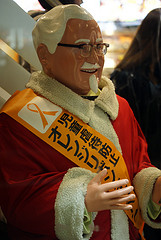
Merry Christmas, Colonel Sanders-san

In the early 1970s, a Christian missionary school in Tokyo was looking for turkey for Christmas dinner. Finding none, a representative contacted the local Kentucky Fried Chicken and ordered chicken instead. A KFC employee suggested the company turn the request into an ad campaign, and Japan has never been the same since. Today, KFC’s Christmas Party Barrels are so popular that sales for December 23, 24, and 25 usually equal half of what is sold during a normal month, and Christmastime customers wait in long lines to pick up their orders, placed as early as October. Very few in Japan celebrate Christmas for its religious meaning, as less than 2% of Japanese even call themselves Christian. Instead, consumerism is emphasized, and the focus is on gifts, decorations . . . and chicken from the Colonel.

(Lindsay Whipp, “All Japan Wants for Christmas Is Kentucky Fried Chicken,” Financial Times, Dec. 19, 2010)

[photo: “KFC Colonel Santa” by Kleemo, used under a Creative Commons license]

Texas Rangers, 2011 World Champs

Somebody somewhere may already be wearing a T-shirt or cap proclaiming the Rangers winners of last year’s World Series. That’s because before every  major sporting championship, vendors order boxfuls of apparel proclaiming both teams the winner, so they’ll be ready to sell the right ones immediately after the outcome is final. But what happens to the “wrong” ones? Vendors can return them in unopened boxes to the leagues that licensed their printing, and then they’re donated to humanitarian groups, which deliver them around the world. These groups include the Christian relief and development organization World Vision, which handed out over $2 million worth of clothing from the Chicago Bears’ loss in Superbowl XLI. Speaking about their ongoing distribution of this kind of sports gear, Dean Owen, a World Vision executive, said, “The clothing has been distributed in about 20 countries, all over Africa, to Asian nations, to Latin America and Europe. It goes to places of the greatest need, definitely not to Sweden, but definitely to Zimbabwe.”

(Steve Henson, “Both World Series Teams Have Championship Gear. What Happens to the Losers’ Stuff?ThePostGame, Oct. 28, 2011)

Even if you don’t have any sports gear to donate, find out how you can meet needs around the world through World Vision here.

[photo: “Texas Rangers” by Mandolux, used under a Creative Commons license]

The Global Church Is on the Move

According to Peter Crossing of the Center for the Study of Global Christianity, one hundred years ago, the statistical center of Christianity was in Spain, with over 80% of Christians living in Europe and Northern America. But today, broad changes in the Christian population have moved the statistical center to Western Africa. “This 100-year shift is the most dramatic in Christian history,” said Crossing, who spoke in October of last year at the Global Christian Forum in Manado, Indonesia. Other statistics noted at the forum were

• In 1910, less than 2% of Christians were in Africa. Today, 20% live there.

• While 60% of Christians now live outside of Europe and Northern America, their share of Christian income is only 17%.

• The top five languages used in churches are Spanish, Portuguese, English, French, and Chinese.

• 32.39% of the world’s population consider themselves Christian. The next largest group, Muslims, make up 22.9%.

• In 1960, evangelical Christians were 2.9% of the world’s population. Today they have reached 7.9%.

(Mazda Rosalya, “For 100 Years, Christians Make up One-Third of World’s Population” and “Christianity Underwent Greatest Cultural Shift in 2,000 Years, Says Scholar,” Oct. 10, 2011, The Christian Post.)

[photo: “Praying Together” by Boyznberry, used under a Creative Commons license]

Made in Americus

One-third of the people in the world use them, then throw them away. Japan uses about 23 billion pairs each year. And China produces 63 billion pairs annually. They are disposable chopsticks . . . and recently, more and more of them are being made in the USA. Back in mid July, Georgia Chopsticks, of Americus, Georgia, was churning out about 2 million pairs of chopsticks per day, with plans to produce 10 million a day by the end of 2011. Why Georgia? “The Pacific Rim, especially areas of China and Japan, they’ve run out of wood,” says David Garriga, head of the local economic development council, “but we have an abundance of it.” This includes sweet gum and poplar, which are great for making chopsticks because their wood doesn’t have to be chemically lightened, like Asian wood, to achieve the desired color. Susan White, who works at the company says, “Everywhere in America you see ‘Made in China,’ and you wonder if, in China, they ever see ‘Made in America.’” With every chopstick made in Americus going oversees, she really doesn’t have to wonder any more.

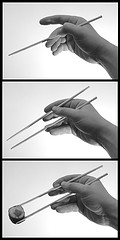
If the subtle art of chopsticks usage eludes you, and you’d like some instructions to go with the pictures above, go to eHow’s “How to Use Chopsticks.”

(Philip Graitcer, “Chopsticks Carry ‘Made in America’ Label,” Voice of America, July 18, 2011)

[photo by lintmachine, used under a Creative Commons license]

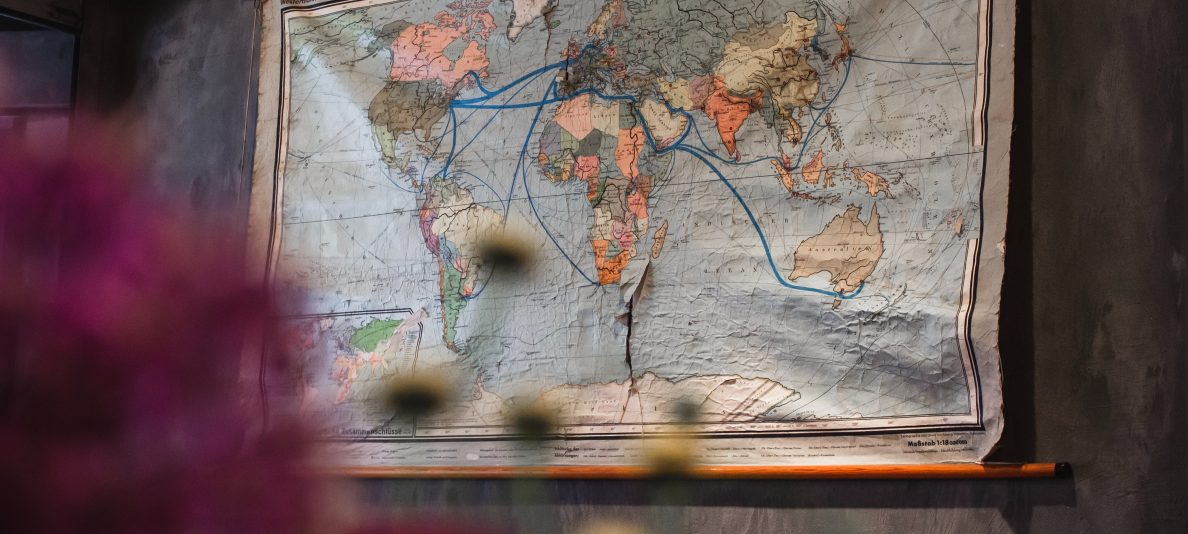
Welcome to Clearing Customs

During our 10 years as missionaries in Taipei, Taiwan, we wrote about 120 newsletters. In each one, we included a small section on some news coming out of Taiwan, a fact about the country, or an insight on Chinese culture. When we came back to the States in 2011, we switched the topic from Taiwan to globalization. Globalization means different things to different people, but the aspect we focused on is how the world is shrinking and cultures are more and more interacting with and affecting each other.

Soon, we’ll write our last newsletter, but I wanted to continue gathering and sharing information on the aspects of globalization that interest me. The first few posts come from our newsletter, so some go back a little while, but I’ll be catching up soon. Thanks for joining me.

Craig

[the photo is of a sculpture at Taiwan’s Taoyuan International Airport. Ahhhh, memories: by T.CSH, used under a Creative Commons license]