Missionaries, Don’t Let Your Expectations Weigh You Down

2186726069_711fd402f4_z

Remember the good old days when you could pack 70 pounds into each of your two checked bags on international flights? That meant that when our family of six moved overseas as missionaries, we could take 840 pounds of clothes, books, sheets, cake mixes, and the like. And we used just about every ounce of it.

It could be argued that we didn’t need to take that much with us, but we’re Americans, after all, and we Americans don’t often pack light. I’ve traveled with people from other countries, and even on short trips, I invariably seem to end up lugging the largest pieces of luggage. What if there’s a pool nearby? Better bring swimming trunks, and a towel. What if it snows? What if I spill something on my Friday jeans? What if I need work shoes? What if somebody throws a formal party?

There’s also another set of luggage that missionaries tend to overpack. It’s the bags that hold our assumptions, our plans . . . our expectations.

A few years ago, Sue Eenigenburg and Robynn Bliss surveyed 323 female missionaries on how their expectations corresponded to reality on the mission field. The results form the backbone of their excellent book Expectations and Burnout: Women Surviving the Great Commission. What they found is that our pre-field predictions often don’t measure up to our on-field experiences. (I say “our” because though the book is written for and about women, most of its insights and lessons easily apply to both sexes.)

The authors gave the women a list of 34 expectations, and asked them to rate each one on the degree to which it applied to them. Then the respondents went back and evaluated the list against what actually came to be in their lives as missionaries.

In 14 of the areas, the women reported that their expectations exceeded what they found in real life. The 10 with the highest percentage of expectations greater than reality include some very deep, personal issues:

75.4% Am fruitful
70.4% Am a prayer warrior
67.6% Am growing spiritually continually
62.7% Am spiritually dynamic
65.8% Continually trust God for everything
57.5% Have a daily quiet time
56.5% Have a successful quiet time
56% Am well balanced in areas of ministry in and out of home
55.1% Have miraculous stories to tell of how God is using me
50.9% Embrace my new host culture

The disconnect between expectations and reality often leads to disappointment and guilt. And as the authors point out, this can lead to burnout. It is difficult to move steadily forward when we are dragged down by the weight of our overpacked luggage.

So how can we pack less? How can we lighten our load? Here are some suggestions.

  •  Read fewer biographies, read more people.
    Stories about missionaries can be very inspirational, but when inspiration is the main goal, they can often leave out the flaws and shortcomings. When we assume that real missionaries are superhuman, then we are discouraged when we don’t measure up. That’s why we need to have honest conversations to find out the good and the bad, the easy and the hard. But not everyone will give you the unvarnished truth. It usually takes time to earn someone’s trust. And you’ll need to ask questions that get people rethinking their responses, to speak beyond the safe and familiar answers. Try asking a missionary, “What do you wish you’d known before you moved overseas?” “What have you learned?” “What would you tell yourself as a younger missionary candidate if you could?” “What are some of your unmet expectations?” (For other examples, see the questions asked of missionaries in Eenigenburg and Bliss’s survey, printed in the appendix of their book.)
  • And when you read, read between and outside the lines.
    As Eenigenburg and Bliss discuss, too many books on the lives of past missionaries paint a picture of spiritual perfection. One of the best-known missionary legacies is that of William Carey, who is often called “the father of modern missions.” In 1792, a sermon he delivered gave us the words, “Expect great things; attempt great things.” But I doubt that all of his expectations were met in his later life as a missionary in India, during which a five-year-old son died, his wife, Dorothy, went insane and died, and another son, after becoming a missionary himself, suffered tragedy and walked away from God. In Expectations and Burnout, the authors report that James R. Beck, in his book Dorothy Carey: The Tragic and Untold Story of Mrs. William Carey, writes that Carey has often been portrayed as “never discouraged and never complaining.” But Carey wrote in his journal, “I don’t love to be always complaining—yet I always complain.” The context for “Expect great things; attempt great things” is the life and work of Carey, not a Pinterest board or a poster of a snow-capped mountain range. But just as some books—and missionaries—are only completely positive, some are entirely negative. Be cautious in drawing conclusions based on either side. When you hear what sounds like cynicism and despair, be slow to judge. Context is important here, too. Find out the whole story. And don’t say, “That will never happen to me . . . not with my faith, my preparation, and my plans.”
  • Remember that short stories can be good literature, too.
    Before packing your bags, talk to those missionaries who have failed and come home early. I say “failed” only to grab your attention. I don’t really count those missionaries as failures. Instead, I understand that most are people who have struggled with some great disappointments and have made the extremely difficult decision to return. What can they teach you about packing? Know that “ex missionaries” who left under less-than-ideal situations often fade into the woodwork and aren’t often sought out for their expertise. But they just may be the ones with the most to offer.
  • Don’t book a ride on the magic plane.
    A ride on the magic plane is the one in which you fall asleep half way across the ocean and wake up “A Missionary,” with all the super powers that that entails. You may arrive at your destination with increased confidence, but you’ll still be the same person who stepped onto the plane. You’ll still need to deal with the same issues and weaknesses that vexed you back home. In fact, you’ll probably see your struggles increase in the crucible of cross-cultural service. Simply taking on the title missionary doesn’t change who you are on the inside, in the same way it didn’t change those missionaries you’ve idolized in the past, or those teammates you’re traveling to join.
  • Pack your own bags.
    Here’s another throwback to days gone by. Before 9/11 and TSA protocols, ticket agents would ask, “Did you pack your bags yourself?” That question isn’t asked much anymore, but it’s an important one for missionaries. Yes, getting input from those who have gone before is important, but the luggage holding your expectations needs to be filled by you, not by your sending agency, supporting churches, supervisors, teammates, or even other members of your missionary family. Get clarity on other’s expectations and work out disagreements before disillusionment is allowed to set in. And don’t set yourself up for failure in their eyes by over predicting the positives in order to gain support—or to convince yourself. Sometimes you’ll find that others’ assumptions are unreasonable and need to be corrected. Sometimes you’ll find that you’re trying to please voices that exist nowhere except in your own head.

Before you set out for the mission field, prepare thoroughly and pack carefully. When it comes to packing your expectations, it isn’t just about seeing how much you can get into a suitcase and still get the zipper closed. It’s also about being discerning and knowing what to leave behind.

But you don’t want to go empty-handed, either. Hopes, dreams, and plans are important. Don’t forget your underwear and socks. And if you’ve got room, you might want to take that swimsuit, too. Just in case.

(Sue Eenigenburg and Robynn Bliss, Expectations and Burnout: Women Surviving the Great Commission, William Carey, 2010; “Expect Great Things; Attempt Great Things,” Center for Study of the Life and Work of William Carey, D. D. [1761-1834], updated November 22, 2013)

[photo: “Suitcases,” by Tom Godber, used under a Creative Commons license]

Why Do Missionaries Leave the Field? It’s Hard to Say

7793620080_30d1cace90_z

Read very many reports of people who out of the blue quit their prestigious, well-paying jobs (for example, company CEO, NBA coach, speaker of the house), and you’ll quickly see that one of the main reasons they claim is “to spend more time with family.” Of course, we understand that in most cases, that’s a boilerplate answer used to sidestep what’s really going on. The truth is much more difficult to discern.

When it comes to missionary attrition, the situation is not much different.

After finishing our first term on the mission field in Taiwan, I and my family made our first trip back to the States. During that visit I heard a representative from our sending agency talk about the many reasons why missionaries leave the field. What she said went something like this:

There’s the reason you tell your supporters.
There’s the reason you tell your church.
There’s the reason you tell your agency.
There’s the reason you tell your teammates.
There’s the reason you tell your family.
There’s the reason you tell yourself.
And there’s the reason you tell God.

Detlef Bloecher, in Worth Keeping: Global Perspectives on Good Practices in Missionary Retention, has a similar list, citing

stated reasons (written in the missionary’s prayer letter)
personal reasons (told to close friends or family)
secret reasons (not shared but believed deep in the missionary’s heart)
leader’s reasons (identified by the team or field leader)
recorded reasons (added to the missionary’s file)
believed reasons (accepted by the director of the sending base)
socially accepted reasons (published in the mission journal)
further reasons identified by the missionary’s professional counsellor, and
true reasons (a combination of the above or something completely different)

Bloecher’s listing is part of his discussion of the challenges faced by the Mission Commission of the World Evangelical Fellowship (WEF) when, in 1994, they set out to examine why missionaries leave their work. Their study, surveying 551 mission organizations and sending churches from 14 countries, was called ReMAP (Reducing Missionary Attrition Project), and their findings were reported and discussed in Too Valuable to Lose: Exploring the Causes and Cures of Missionary Attrition.

Why do missionaries leave the field? It seems that it’s hard to say.

Attrition Happens

In Chapter 6 of Too Valuable to Lose, Peter Brierley writes that one of the key findings of ReMAP is that each year the on-field mission force loses 5.1% of its workers. Of these, 71% leave for what are called “preventable reasons.” These reasons are in contrast to non-preventable reasons, “such as normal retirement, a political crisis, death of a spouse, marriage outside the mission, or a change of job.”

To clarify, this number of “leaving” missionaries includes those who resign from one agency and then join another, thus returning to the field, but it does not include those who leave the field to take a home-based position with their agency.

When grouped in categories, the reasons that ReMAP found for missionary attrition are as follows, ranked by weight/importance:

  1. Unpreventable
  2. Personal
  3. Marriage/Family
  4. Society
  5. Work-Related
  6. Team
  7. Cultural
  8. Other

Broken down further, the complete list includes 26 reasons, arranged by perceived significance, from greatest to least:

  1. Normal retirement
  2. Child(ren)
  3. Change of job
  4. Health problems
  5. Lack of home support
  6. Problems with peers
  7. Personal concerns
  8. Disagreement with agency
  9. Inadequate commitment
  10. Lack of call
  11. Outside marriage
  12. Immature spiritual life
  13. Marriage/family conflict
  14. Poor cultural adaptation
  15. Problems with local leaders
  16. Elderly parents
  17. Inappropriate training
  18. Lack of job satisfaction
  19. Political crisis
  20. Inadequate supervision
  21. Death in service
  22. Dismissal by agency
  23. Immoral lifestyle
  24. Language problems
  25. Theological reasons
  26. Other

Where Should the Data Come From?

It is important to note, and fully acknowledged by ReMAP researchers, that the reasons above are not necessarily those given by the missionaries themselves. Rather, they are the ones perceived to be true by their sending agency or church. This is because, writes Jonathan Lewis in Too Valuable to Lose, interviewing all 4,400 missionaries who left the field during the study period, from 1992-1994, would have been nearly impossible. And by choosing to get data from organization “decision makers,” the researchers were involving the people who would have the power to later make the changes necessary to reduce attrition.

This method of gathering data on attrition is not uncommon in the missionary community. Mark Wingfield, writing in the Baptist Standard, reports that the Southern Baptist Convention’s International Mission Board (IMB) carries out a study each year on personnel attrition, with regional supervisors filling out the survey forms.

In 2000, several IMB trustees had questions about the reported numbers. They wondered if IMB’s recent movement of missionaries to new fields had caused an increase in missionary attrition.

David Garrison, then the associate vice president for strategy coordination and mobilization, assured them that that was not the case.

IMB’s figures showed that in 1999, only 9.56% of those who left their work left with “disagreement with IMB philosophy, policies, staff or structure as a contributing reason.” The largest proportion, 25%, left because of a “change in understanding of God’s call.”

Winfield writes that Garrison “admitted some who resigned could have failed to cite their true feelings about IMB philosophy changes but expressed confidence that was not likely to have been true in many cases.”

Drilling Deeper

When Worth Keeping was published in 2007, it was ten years after Too Valuable to Lose. The second book uses the results of the ReMAP II (Retaining Missionaries: Agency Practices) study to followup on ReMAP, this time focusing on what organizations can do to keep their missionaries. ReMAP II called on agency leaders to evaluate their practices, and then their responses were used to find correlations between methods and retention.

Two  months ago, the mission research organization Global Mapping International (GMI) published a post on their blog commenting on ReMAP II, calling it “one of the more famous mission research studies since the turn of the millennium.” But GMI reports that when Jim Van Meter, the leader of the US analysis, looked at the correlations, he found that the practices and retention rates didn’t match up as expected. So he asked GMI for its input. Were the questions flawed?

No, said GMI. “The problem isn’t the questions. It’s the person answering them!” They explain further:

Administrators can reliably answer factual questions about their agency’s practices, but they cannot reliably answer evaluative questions related to their support of field staff.

GMI cites the following example: In ReMAP II, administrators were asked to rate their agencies’ practices in relation to the statement “Missionaries are included in major decisions related to the field.” While the responses showed that this is something that agencies do well, the findings did not correlate with retention rates.

When GMI did their own survey of over 1,700 workers in the field, the phrase “My organization involves employees in decisions that affect them” was rated in the bottom 10 of 68 items. And unlike in ReMAP II, this finding did correlate with retention.

The solution, says GMI, is a third-party collector of data, and in what they call a “shameless plug,” they offer Engage, “a customized Field Missionary-Friendly employee survey,” implemented by GMI and Best Christian Workplaces. By using Engage, they say, “Everyone wins. Leadership teams get to celebrate successes and identify priorities. Boards receive meaningful measures and see how leaders are taking initiative.  Field staff gets a chance to be heard and offer ideas.”

Getting the Full Picture

To better know why missionaries leave the field, it makes sense to me to start with what the missionaries themselves have to say, reported by them, unfiltered through others. We all have our natural, inherent biases, along with fears that come with speaking and hearing the unvarnished truth, and the less we add these to the equation, the closer we will get to that truth.

This won’t be easy, and we should consider utilizing GMI and Best Christian Workplaces, and other groups like them, for their objectivity and for their experience in conducting and analyzing surveys. At best, surveys should be repeated consistently (as is done by the IMB), and they should be shared with, and owned by, everyone in the organization, not just those in leadership.

While I highly value the responses of missionaries, I also realize that their views alone aren’t guaranteed to represent the whole picture on the causes of attrition. Missionaries don’t always completely understand their own situations, and even when they do, they’re too often inclined to voice safe or respectable explanations. Getting to the truth will take patient listening and will need to seek anecdotal input that goes beyond numerical responses to a standardized list of questions.

Groups and individuals who offer member care and debriefing can help in this area. They often hear what others do not, because of their willingness to listen and because of the safe outlets they provide. But care needs to be taken to ensure that any reporting they do does not compromise the very trust they have fostered that encourages missionaries to share openly.

Writing in Too Valuable to Lose, Brierley suggests that future research on attrition goes beyond the statistics of quantitative research and move to the explanations of qualitative research. One example he gives of how this would be helpful would be to look more deeply at the differences between responses collected from different sources. How and why do the reasons given by missionaries and those written in the missionary’s personnel file and those believed to be true by mission leaders differ?

The Truth Is Out There

We need to recognize that though the truth on why missionaries leave the field may be elusive, it can be found. The differences in viewpoints can cause confusion, but they can also bring clarity. Recognizing how we see things differently can help us get closer to the truth and can also point out areas where more communication is necessary.

I think of how we prepare for the classic interview question, “What is your greatest weakness?” Knowing that the question is coming, we try to prepare an answer that at least seems honest but also doesn’t reveal an actual grievous problem. In one interview, I was asked to tell what my coworkers would say my greatest weakness was. Though I can’t remember what I said, I know it was more revealing. Just looking at myself through others’ eyes helps me see myself more clearly.

I hope that we will be able to trust each other more and become more open to listening to different perspectives. This goes both ways in the relationships between mission leaders and field workers—and should also include researchers, trainers, and member-care workers. We’re all on the same team, and while we sometimes don’t see eye to eye, we all are working toward the same goals.

So back to the question: Why do missionaries leave the field?

It is hard to say. But if we commit ourselves to opening our hearts and our ears, it’s far from impossible.

[Update: Global Mapping International closed in June of 2017, and the Engage survey is no longer available. For more on this and for a deeper look at the ReMAP results, see my post at A Life Overseas.]

(Detlef Bloecher, “ReMAP 1: What It Said, What It Did, and What It Achieved,” Worth Keeping: Global Perspectives on Good Practices in Missionary Retention, edited by Rob Hay, William Carey Library, 2006; Peter W. Brierley, “Missionary Attrition: The ReMAP Research Report,” Too Valuable to Lose: Exploring the Causes and Cures of Missionary Attrition, edited by William D. Taylor, William Carey Library, 1997; Jonathan Lewis, “Designing the ReMAP Research Project,” Too Valuable to Lose; Mark Winfield, “Disagreements Discounted as Source of Missionary Attrition,” Baptist Standard, April 24, 2000; “Listening Well . . . and Why It Matters,” Global Mapping International, September 22, 2014 [cached at Google])

[photo: “Walk Away,” by Nikos, used under a Creative Commons license]

Two Ladies Step into the Slums of India . . . and Find Stories to Tell

5204718392_38cc34d558_z

Here’s my entry for the “first-world problems” meme: I accidentally left my copy of Katherine Boo’s Behind the Beautiful Forevers outside overnight. The next morning the pages were swollen from getting wet and I had to throw the dust jacket away.

Woe is me.

If you’ve read Behind the Beautiful Forevers, you’d recognize the irony.

Katherine Boo

Boo’s National Book Award-winning work, published in 2012, is the true story of the people of Annawadi, a slum in Mumbai, India, where ruined dust jackets are the least of their worries. Most of the characters barely scratch out their livings, many by sorting through trash and selling what they can. All are struggling against the surroundings they’ve inherited. There’s Abdul, a teenage garbage picker who supports his family. There’s Asha, who aspires to be a slumlord, and her daughter, Manju, who hopes to become Annawadi’s first female to graduate from college. There’s Abdul’s neighbor, Fatima, a one-legged woman who sets herself on fire, blaming Abdul and his family for her pain. Abdul, his father, and sister are arrested.

Sometimes trying to scratch out a living isn’t enough. Fatima dies from her injuries. Kalu, a young scrap-metal thief is murdered. And Meena, the first girl born in the slum, commits suicide by drinking rat poison.

Boo, winner of the Pulitzer Prize for her work in the Washington Post, was introduced to India by her Indian husband. As she writes in her “Author’s Note,” “I fell in love with an Indian man and gained a country. He urged me not to take it at face value.”

That she did not do. Instead, she moved to India and chose to dive into the gritty life of Anawadi, asking questions of what and why and how and what now . . . and listening to the many answers.

Before her move, she wondered if she could handle life in India, particularly spending time in the slums. During one night alone in Washington, D.C., she made up her mind:

Tripping over an unabridged dictionary, I found myself on the floor with a punctured lung and three broken ribs in a spreading pool of Diet Dr Pepper, unable to slither to a phone. In the hours that passed, I arrived at a certain clarity. Having proved myself ill-suited to safe cohabitation with an unabridged dictionary, I had little to lose by pursuing my interests in another quarter—a place beyond my so-called expertise, where the risk of failure would be great but the interactions somewhat more meaningful.

Listen to how she begins the story of what she found in Annawadi:

Lana Šlezić

Lana Šlezić is an award-winning freelance photographer who was born in Canada to Croatian parents. For two years she lived in Afghanistan, documenting with her camera the abuse of women there. The result is the book, Forsaken: Afghan Women.

But, she writes at lanaslezic.com, living in Afghanistan “was peanuts compared to raising kids.”

She says the birth of her first child brought an “emotional upheaval” that was “extraordinary.” When her son was just six weeks old, mom, dad, and baby boy moved to New Delhi. Then, less than two years later, their daughter arrived.

[E]very time I left our home in Delhi to drive across the city—my own children singing or crying or screaming in the back seat—without fail, I would see street kids while waiting at a traffic light. They were everywhere on every street corner and in every neighbourhood. At car windows they knocked relentlessly and if not asking directly for money then offering something in exchange—a dance, balloons, matches, plastic flowers, inflated airplanes, anything for a few rupees. It nagged at me but I had not the emotional nor physical energy to do anything but sigh and lean back into my seat. An inexplicable feeling of impossibility sat like vinegar in my stomach and started to turn me inside out so that my heart actually became visible. Friends told me I was grumpy.

So in December 2011 when I was wandering around Old Delhi—eyes wide open, conflicted heart in hand, mother of two with all the love that brings and a little less exhausted—I walked through a gate and onto a dirt field. It was a park, though not like any park I had known as a child. . . .

Šlezić was captured by what she experienced . . . children playing in the dirt, children showing her their homes amid the squalor, children talking about life and death. She returned again and again, listening to their stories, playing with them, and taking photos, lots of photos. Out of this she produced “A Walk in the Park,” a collection of striking documentary-style photographs as well as portraits of the children. You can see a gallery of her photos online, and you can view a set of nine portraits as well, each accompanied by a short story told in the child’s own words.

You can also watch the two videos below, which serve as sort of “trailers” for her project. As you can see, because of privacy settings, you’ll have to click the image and then click again to start them on Vimeo. What a bummer. That’s two clicks when one really should be enough.

Woe is me.

(Katherine Boo, Behind the Beautiful Forevers, Random House, 2012; Lana Slezic, “A Walk in the Park: Artist’s Statement,” lanaslezic.com)
[photo: “Pipe Play 2,” by Meena Kadri, used under a Creative Commons license]

A New Blog: “Putting Words in Our Mouths”

2250062732_5d9670fba0_zThe Bible has been called the most quoted, most translated, most published, most sold, and most shoplifted book of all time. It is difficult to overestimate the impact of its ideas on Western culture. And, particularly in the translation completed under the direction of King James I of England in 1611, it has had a leading role in shaping the English language and English literature. Alister McGrath, in his book In the Beginning: The Story of the King James Bible and How It Changed a Nation, a Language, and a Culture, writes,

No other book has so permeated and penetrated the hearts and speech of the English race as has the Bible. . . . The King James Bible, along with the words of William Shakespeare, is regularly singled out as one of the most foundational influences on the development of the modern English language.

I wrote Putting Words in Our Mouths: A Look at Biblical Expressions in American English with English learners in mind, to teach them the meanings of commonly used phrases and to familiarize them with the stories and concepts of the Bible. Familiarity with the Bible leads to a better understanding of the art, history, music, politics, and customs of English-speaking peoples. The authors of The Bible Literacy Report II state, “Almost without exception, English professors we surveyed at major American colleges and universities see knowledge of the Bible as a deeply important part of a good education.” The report quotes a professor from Northwestern University who calls the Bible the “most influential text in all of Western culture.”

But this doesn’t mean that all English speakers are aware of or understand the Bible’s influence. In fact, serious English-language students who gain a basic knowledge of the Bible may find themselves ahead of many native speakers.

Today, biblical words and phrases—including idioms—appear in informal conversation, news articles, blogs, television shows, movies, popular songs, and literature. Even the word bible itself has a place in modern English as any “authoritative book on a particular subject.” Bible comes from a Greek word meaning “books.” This is because the Bible is a collection of 66 books, written by at least 40 men over about 1500 years. And on the pages of these books are written many well-known stories, some of which take place on a grand scale or involve huge groups of people—such as Noah and the flood, the 10 plagues of Egypt, and the journey of the Israelites to the Promised Land. Therefore, something that is “enourmous or extremely extensive” can be said to be of biblical proportions or on a biblical scale.

I invite you to join me on a journey through the Bible, using common English expressions as our stepping stones.  We’ll start at the best place possible . . . in the beginning.


The format of Putting Words in Our Mouths is simple. Each word or phrase is introduced with its definition and a sample sentence showing how it can be used in conversation. Then an explanation of the word/phrase’s origin follows, along with the biblical passage from which it comes. Where it differs from the more modern translation, I’ve included in brackets the expression in its King James version.

I will be adding expressions as time permits, moving from Genesis to Revelation. You can view all the posts in order by clicking on Browse All Entries in the right-hand column. You can also look for specific topics by using the search field.

(Wachlin, Mary, and Byron R. Johnson, The Bible Literacy Report II: What University Professors Say Incoming Students Need to Know, Bible Literacy Project, 2006)

[photo: “Used Bible,” by Doug 1021, used under a Creative Commons license]

Storytelling: The Bosphorus Bridge between Cultures

8594010074_38522b8612_z

At one end of Istanbul’s Bosphorus Bridge, says Elif Shafak, is a sign that says “Welcome to Europe.” At the other end, another sign reads, “Welcome to Asia.” Shafak, the most widely read female author in Turkey, knows well this city that spans the Bosphorus Strait and connects two continents. She also knows well the push and pull of Eastern and Western cultures in Istanbul. She writes in Time Asia:

East and West are not water and oil. They do mix. And in a city like Istanbul they mix intensely, incessantly, surprisingly. That can leave the city confused about its identity. We Turks like to brag about straddling past and present, East and West, but we are not quite sure what we mean by that. We think of these two civilizations as boroughs we can go in and out of randomly. . . . But things are not so simple.”

Expanded Circles: Elif Shafak

Shafak has lived out her own cross-cultural experience. Born in France to Turkish parents, she was later raised by her mother in Turkey. Then, after her mother became a diplomat, they moved to Spain, Jordan, Germany, and back to Turkey.

Everywhere I went,” she says in a TED Talk, “The Politics of Fiction,” “I felt like my imagination was the only suitcase I could take with me. Stories gave me a sense of center, continuity, and coherence, the three big Cs that I otherwise lacked.”

While living in Madrid, Shafak attended an international school where she was the only Turk. While she describes the school as “a miniature United Nations,” it was not “a cosmopolitan, egalitarian classroom democracy.” Rather, she first encountered cultural stereotypes there. In her later moves with her mother, she saw more and more the general human penchant for retreating into “cultural ghettos”:

Now we all live in some kind of a social and cultural circle. We all do. We’re born into a certain family, nation, class. But if we have no connection whatsoever with the worlds beyond the one we take for granted, then we too run the risk of drying up inside. Our imagination might shrink; our hearts might dwindle, and our humanness might wither if we stay for too long inside our cultural cocoons. Our friends, neighbors, colleagues, family—if all the people in our inner circle resemble us, it means we are surrounded with our mirror image.

Shafak’s tool for helping break us all out of our cocoons is her fiction. She is the author of a number of novels, including The Forty Rules of Love: A Novel of Rumi, which bridges 13th-century Persia and present-day Boston, and Honor, which tells the stories of Kurdish twins, one who grows up to live in London, the other staying in a small village in Turkey.

I’m not saying that fiction has the magnitude of an earthquake,” says Shafak, “but when we are reading a good novel, we leave our small, cozy apartments behind, go out into the night alone and start getting to know people we had never met before and perhaps had even been biased against.”

Intersecting Journeys: O. Z. Livaneli

I have not read any of Shafak’s novels, but I did recently finish Bliss: A Novel, written by O. Z. Livaneli in 2006. (It was made into a film in 2007.) Livaneli, like Shafak, is one of Turkey’s most prominent and most-read authors. And, like Shafak, his works often investigate the meeting of cultures.

In Bliss, the cultures are embodied by three characters: Meryem is a fifteen-year-old from a small Turkish village. After being raped by her outwardly pious uncle, she is shunned by her community. Then she is taken to Istanbul by her cousin to be killed. Cemal, a soldier, newly returned from fighting rebels in the mountains, is the cousin chosen to carry out the “honor killing.” And Irfan is a Western-educated professor who abruptly leaves his wife—and his wealthy lifestyle—to sail the Aegean Sea. It is on his journey that he meets Meryem and Cemal.

At first the novel tells three seemingly unrelated stories, each from a distinct viewpoint. Then, as the characters come together, their stories, and their perspectives, intertwine. The settings are varied as well: the shack where Meryem is imprisoned, given only meager food and a rope for hanging herself; the dangerous mountains where Cemal kills ruthlessly so that he won’t be killed; and the university offices populated by the colleagues whom Irfan despises. And then there are the locations that bring them together and expose them to people of still other backgrounds: the train compartment on the way to Istanbul, the chaotic city center and its decrepit surroundings, the home of an eccentric retired ambassador, and the close quarters of Irfan’s rented sailboat.

Through it all, the three have their worlds expanded, in dramatic and often very painful ways.

The Gift of Bridges

Thankfully there are storytellers around the globe such as Shafak and Livaneli, authors whose works juxtapose cultural differences and uncover similarities. These writers allow us to pick up their books and step outside the mirrored walls of our houses and onto bridges that traverse oceans and connect cultures.

By walking these bridges, we reach distant shores, and when our feet touch foreign ground, we find signs that read, “Welcome,” even when it’s not so simple.

(Elif Shafak, “Pulled by Two Tides,” Hurriyet Daily News, August 13, 2006, first published in Time Asia, August 7-14, 2006)
[photo: “Bosphorus Bridge,” by Simon Q, used under a Creative Commons license]

For Global Nomads, a Better Question than “Where Are You From?”

3117467895_011eeea741_zLast week I had the extreme pleasure of meeting with a small group who came together as Global Nomads.

The vocabulary in the conversations was peppered with insider words and phrases. Of course there was global nomad itself, as well as TCK and Adult Third Culture Kid and army brat and MK. But there was also talk of using “English English” and recognizing something as “weirdly comforting.”

No one was in charge. No one gave a prepared presentation. Instead, we just talked. It was kind of like a panel discussion where the audience was the panel itself.

Everyone there was a professional in higher education, but the backgrounds and countries represented were diverse. I was the first one to arrive, and as others came into the room, I asked them, out of habit, “Where are you from?” I only meant “Where do you live?” or “Where did you arrive here from?” I really wasn’t looking for a philosophical response, but in this group, it may have felt as if I were. One person responded with something like, “Oh, that is the question, isn’t it?”

We went around the room and introduced ourselves, and as people continued to join us, we introduced ourselves again. One person had started a group for global nomads on her college campus. One had done her doctoral dissertation on TCKs and university life. One had married an Adult TCK. One was preparing to move overseas.

One mentioned a book he’d read about authors who’d grown up abroad. When I later searched for it on the internet, I found out it is Antje M. Rauwerda’s The Writer and the Overseas Childhood: The Third Culture Literature of Kingsolver, McEwan and Others. While I was looking, I also ran across Writing out of Limbo: International Childhoods, Global Nomads and Third Culture Kids, a compilation of essays by and about TCKs, edited by Gene H. Bell-Villada, Nina SichelFaith Eidse, and Elaine Neil Orr. I’ve added both books to my Amazon.com Wish List, but I’m afraid the prices will continue to go up rather than down. Even the used copies are over $30.

My search also led me to a blog post written by Sichel, who, along with Eidse, also edited Unrooted Childhoods: Memoirs of Growing Up Globala book that I’d put on my list long ago. In her post, “The Trouble with Third Culture Kids,” Sichel talks, in the context of children’s mental health, about “chameleons,” “adjustment problems,” “TCK grief,” and “existential loss.”

She writes about a young TCK who is struggling: “She doesn’t want to talk about it.  She doesn’t know where to begin.” When you meet such a girl, she says, “don’t ask her where she’s from, or what’s troubling her.” Instead, she offers a better response, one that would work with adult “kids” as well:

Ask her where she’s lived.  Ask her what she’s left behind.  Open doors.  And just listen.  Give her the time and space and permission she needs to remember and to mourn.  She has a story—many stories.  And she needs and deserves to be heard, and to be healed, and to be whole.

“Where have you lived?” I’m going to try that next time I meet a global nomad. And if she seems to be weighed down in her soul, I’ll ask, “What have you left behind?” Then I’ll try to be quiet and just listen.

(Nina Sichel, “The Trouble with Third Culture Kids,” Children’s Mental Health Network, February 11, 2013)

[photo: “Which Way to Go,” by theilr, used under a Creative Commons license]
Reading the Bible without Cultural Near-Sightedness

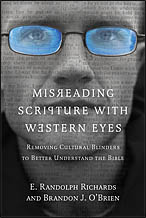
3782“Can you imagine a Jesus without all his teeth?” That’s one of the many questions that E. Randolph Richards and Brandon J. O’Brien ask in Misreading Scripture with Western Eyes: Removing Cultural Blinders to Better Understand the Bible.

In modern America, the authors point out, we tend to associate missing teeth with lack of intelligence. But what would your smile look like without the luxury of modern and available dentistry? Would you have a full mouth of straight pearly whites? Did Jesus have all his teeth intact? The authors write, “It seems like heresy to suggest otherwise.” But for much of the world, a lack of teeth would be irrelevant—if not expected—in a carpenter who lived 2,000 years ago.

Richards (a former missionary to Indonesia) and O’Brien’s goal in Misreading Scripture is to get us to rethink our assumptions about what we read in the Bible. They’re not saying that non-Westerners can understand the Bible better, just that we all come to the text with our own cultural baggage that we need to lay down. (They offer that someone else could easily write Misreading Scripture with Eastern Eyes.)

The authors admit that they’ve had to oversimplify the topic, as there is way too much to cover in one book. But, they write, their purpose is to “unsettle you just enough that you remember biblical interpretation is a crosscultural experience and to help you be more aware of what you take for granted when you read.”

For instance, they open the book with the example of the hot, cold, and lukewarm waters of the church in Laodicea:

I know your deeds, that you are neither cold nor hot. I wish you were either one or the other! So, because you are lukewarm—neither hot nor cold—I am about to spit you out of my mouth. (Revelation 3:15,16 NIV)

Our assumptions lead us to think that hot means “on fire” with faith, while cold means that faith is absent. This reading says that God would rather us be non believing than to have a weak faith. But when O’Brien traveled to the site of Laodicea, he learned that nearby were the hot springs of Hierapolis and the cold springs of Colossae. Laodicea didn’t have any springs, so aqueducts brought water in. Both kinds of water, hot and cold, would have been welcome and refreshing to the people of Laodicea, but by the time the water arrived, it was only lukewarm. New insights bring new perspectives.

The story of David and Bathsheba gives another opportunity for us to see an “Eastern” viewpoint. The authors’ thought-provoking analysis suggests that David’s actions were motivated more by honor and shame than by feelings of guilt. In fact, they show how not only the king’s decisions, but also those of Bathsheba and Uriah, exemplify a culture where individual convictions of right and wrong are trumped by the weight of societal expectations.

Other topics covered in Misreading Scripture are the cultural differences of Individualism and Collectivism, Time, Rules and Relationships, Virtue and Vice, and Finding the Center of God’s Will. In the chapter covering this last subject, Richards and O’Brien discuss the common Western practice of a reader applying scriptures to himself, while non-Western readers—as with the Jews of the Old Testament—are more likely to apply it to the entire group. This is compounded, as the authors point out earlier in their book, by the lack of a plural you in the English language.

While I taught the Bible in Asia, it was a constant challenge to set aside my American presuppositions and allow my non-American friends to understand the Bible on their own terms. Instead, I was tempted to share my personal and cultural footnotes before they could be convicted of a “misguided” interpretation. This was especially dangerous when I found myself, as the authors call it, “arguing [them] to a lower standard.”

As I read through Misreading Scriptures, I wasn’t always convinced of the authors’ conclusions, but I was consistently “unsettled” enough to rethink my assumptions. And when I question those things that I take for granted, it makes me a better teacher and student. When I acknowledge my cultural biases, I am then better able to understand what the Bible says and less hindered by what I’m sure it should be saying.

(E. Randolph Richards and Brandon J. O’Brien, Misreading Scripture with Western Eyes: Removing Cultural Blinders to Better Understand the Bible, IVP, 2012)

“An Extraordinary Theory of Objects”: A TCK in Paris and the Things That Keep Her Sane, Sort of

31703109_4ad6f7ce2c_nI just finished reading a cool little book entitled An Extraordinary Theory of Objects: A Memoir of an Outsider in Paris. It was a Christmas gift from my son, the one who got a Moleskine Journal from me.

An Extraordinary Theory of Objects is a series of vignettes by Stephanie LaCava about her move to France as a twelve-year-old in 1993, her years there growing up, and then her visits back again after attending college in the States.

On the cover of my copy of the book are romantically filtered and tinted photos of the Eiffel Tower, and on the pages inside, her writing style evokes the same kind of mood. If stories could be sepia-toned, this is how they might sound.

Actually, the filter through which LaCava encounters the world is her attachment to things. First, there are the small, curious relics—a skeleton key, a mushroom, an opal necklace found in the mud—that she gathers and places on her windowsill. Initially they replace her old collection, “everything that represented [her] past life and its predictable ways,” which is on a container ship making its way across the ocean from New York.

And then there are the objects she encounters from day to day, common things that she illuminates in copious footnotes often taking up more than half a page. Cataloging these objects gives her security and makes sense of her life in a new city . . . as she faces depression and what she calls her own “kind of crazy.”

Some might find her footnotes distracting, but they cover just the kind of obscure topics that intrigue me, such as a Japanese smuggler of black-market butterflies, a photo book dedicated to Salvador Dali’s mustache, and the origins of the tea bag. And they are replete with references to a variety of figures, from Pliny the Elder to Kurt Cobain, from Anne Boylen to Kate Moss.

Much of LaCava’s narrative is about time spent with her father, often searching flea markets for items to fulfill their eccentric tastes. At other times, she talks about her classmates at the international school. She says she was “mostly alone” her first year there. Even among these other outsiders, she doesn’t fit in.

I rode the bus to school and listened to my Discman while the girl in the back row threw gum wrappers at my head. The girls at school didn’t like me very much. They had never given me a chance, decided immediately that I didn’t belong, which was funny, as they didn’t either—at least not in France. They made me feel as if I had done something wrong, and they spoke badly about me to each other. Through my own odd rationalization, I decided excommunicating me meant they belonged to something, simply because I did not. . . .

Come the new academic year, the old class would be replaced with another set of students who had just moved overseas. Only a few remained year after year—and still the same insensitivity.

One day, a classmate tells her that she looks like Angela from the TV series My So-Called Life.

“I haven’t seen it,” she replies.

“Everyone’s seen that show,” he says. “Don’t you have friends in the States? They can send it to you.”

In a footnote, LaCava delves into the significance of the series, quoting Matt Zoller Seitz of The New York Times, who writes, “What the series’ narration does best: it shows how teen-agers try to control their chaotic inner lives by naming things, defining them, generalizing about them.”

That’s what LaClava does, as well—controlling the inner chaos of her life in a Paris suburb by naming the objects she encounters. Then, years later, she examines them even more closely and writes about them so that she can share with us her own kind of strange . . . and her own kind of normal.

(Stephanie LaCava, An Extraordinary Theory of Objects: A Memoir of an Outsider in Paris, New York: Harper Perennial, 2013)
[photo: “Eiffel Tower,” by charley1965, used under a Creative Commons license]